Debut albums come in all flavors. Some barely hint at the artistry to come; others are solid first salvos only to be eclipsed by stronger and/or further refined efforts. Below, I’ve chosen perhaps that rarest breed: the fully-formed release that kicked off careers both fleeting and venerable and were also arguably never topped by anything else the artist would make. To be eligible, they must have recorded at least more than one follow-up. Here are ten favorites in chronological order:
Probably this list’s most contentious choice given I’m Your Man (1988), the first Cohen I ever heard (and loved) is its equal and fully holds up despite radically different and deliberately dinky period production. Alas, this debut plays more like a greatest hits compilation than the one he’d release seven years later: credit the three songs later brilliantly used in McCabe & Ms. Miller, but there’s also “Suzanne”, “Master Song”, “So Long Marianne”, “Hey, That’s No Way To Say Goodbye”—even Lenny’s off-key bleating at the end of “One of Us Cannot Be Wrong” still charms me.
Violent Femmes, Violent Femmes (1983)
Maybe the most obvious choice here but this is a textbook example of a debut so definitive, so iconic that Gordon Gano and co. arguably haven’t tried to top it. I don’t know how many officially released singles there were from this, but at least five of its ten tracks are undeniable standards (“Blister In the Sun”, “Kiss Off”, “Add It Up”, “Prove My Love”, “Gone Daddy Gone”) and most nonfans would likely struggle to name more than two or three songs from the rest of their catalog.
Deee-Lite, World Clique (1990)
“Groove Is In The Heart” remains one of a handful of songs I wholly fell in love with on first listen and it’s aged beautifully compared to most hits of its era. To a lesser extent, one could say the same of its parent album. Whether skewed towards Italo-house (“Good Beat”, “Power of Love”) retro-funk (“Who Was That?”, “Try Me On, I’m Very You”) or electro-pop (“What Is Love”, “E.S.P.”), World Clique is exuberant party music with substance that also doesn’t take itself too seriously (unlike their next two albums.)
An eighteen-track manifesto seemingly untouched by the outside world, it’s a pure distillation of Phair’s raw talent. Few first albums have expressed such palpable perspective, much less a feminine one so unapologetically, frankly sexual and forthcoming. It either came out at exactly the right time or it ended up shaping the times even if it didn’t trouble the monoculture much. When Phair did exactly that on Whip-Smart (1994) and the much-maligned Liz Phair (2003), the effect wasn’t as novel or powerful.
A truly strange band that could’ve only ended up on a major label at the height of alt-rock, Soul Coughing’s mélange of beat poetry-derived vocals, jazz rhythm section and sample-heavy soundscapes was both instantly recognizable and really like nothing else. So inspired was their debut that it gave off the impression they could be the 90s answer to Talking Heads. Instead, they ran out of gas after three increasingly conventional albums, suggesting such a notion was too good to be true even if for a brief shining moment it might have been.
Whereas most 90s singer-songwriters took inspiration from John Lennon or Neil Young, breathy-voiced Matthews learned his stuff from Burt Bacharach and The Zombies’ Colin Blunstone, crafting intricate, opaque chamber-pop miniatures with guitars as prominent as the trumpet solos, cathedral organ, string quartets, etc. Call it an anachronism, but perhaps Matthews was (however unwittingly) playing the long game as, nearly thirty years on, this debut sounds as out-of-time as it ever did and also as fresh, brimming with little details and nuances ripe for discovery.
The breaking point where “trip-hop” was not yet a genre to emulate but more of a happy accident, a sound stumbled upon when a DJ, a blues guitarist and a one-of-a-kind vocalist with a sweet but alluringly hazy tone all came together and their seemingly disparate contributions somehow gelled like smoothed-out alchemy. From the catchy, loping “Trigger Hippie” to the somber, hypnotic title track, it’s overall more of a sustained groove than a collection of discernible songs—a potency that they only intermittently recaptured when they later mostly eschewed grooves for songs.
Speaking of DJs and sampling, it took nearly sixteen years for this Australian collective to record a second album and a relatively scant four more years to release a third; whenever I listen to the first one, I can fathom why—a triumph of plunderphonics and fin de siècle attitude of “here’s where we’ve been, and here’s what’s next”, Since I Left You remains a singular point continually reverberating and a miracle of reappropriation so far-reaching it feels impossible to improve on—I don’t listen to it as much, but it’s still my favorite album of the 00’s.
This “delightful nutcase” (as a friend once correctly described her) released a debut so audacious, precocious, declarative and altogether stunning that I suspected it would be her Bottle Rocket or Reservoir Dogs (a great first effort in a career full of ‘em); unfortunately it ended up more of a Donnie Darko—one great glimpse of promise, followed by weird left turns and outright disappointments to the point where she’s settled for interpreting other people’s work, which she’s often gifted at doing. But I remember how much potential she once had.
Talk about the voice of a generation—Florence Welch, then in her early twenties made that very rare accomplishment of coming off as a *star* from the get-go with excellent tunes (“Dog Days Are Over”, “Rabbit Heart (Raise It Up)”) and an arresting, bold sound entirely worthy of and complimentary to that voice. Welch remains the most promising heir apparent to succeeding Kate Bush at the High Alter of Eccentric Female Divas, even if none of her subsequent work startles or transcends like Lungs (although 2015’s How Big, How Blue, How Beautiful comes close.)
Once streaming video overtook physical media as the primary way to watch movies at home (or (god forbid) on your smartphone), it was no longer unreasonable to think that everything could be available at the touch of a button whether via paid subscription services like Netflix and The Criterion Channel, free-with-ads platforms such as Tubi or FreeVee or not-entirely-legal uploads to YouTube, Vimeo and a horde of other websites. While finally sounding the death knell for movie rental and retail stores, streaming didn’t entirely solve that availability problem. Sure, one no longer had to rely on whether your local Blockbuster had a DVD (or if you’re of a certain age, a VHS tape) of a particular title in stock but easy access is not the same as having access to everything. Twenty-odd years ago, I kept a mental running list of movies to see that either weren’t ever released on home video, out of print, unavailable in the US (i.e. on a format other than NTSC such as PAL) or extremely difficult to find, hoping they would become available to rent and/or buy one day. Off the top of my head, it included John Cassavetes’ final feature Love Streams, Abbas Kiarostami’s Where Is My Friend’s House (and the rest of the Koker Trilogy) and most of Theo Angelopoulos’ work prior to 1989’s Landscapes In The Mist; I still recall the glee and satisfaction with which I purchased my newly-released Criterion Blu-ray of Love Streams in 2014.
A little accessibility breeds expectations for its continuation and advancement. We’ve progressed from an age where you couldn’t own any movies to one where you could rent and/or buy some of them to another teeming with available content. This ability to watch an increasing number of titles whenever you wanted threw into relief the relatively minor amount that you couldn’t. If I could see movie A for free, why not movie B? If I had to pay to see movie B, why wasn’t movie C available at all, even for a price? No matter how far we’ve come in the rough half-century since the invention of the VCR, we are nowhere near this idea of utopian unlimited access even if what we do have presents enough content and choices that most viewers could never possibly run out of stuff to watch.
The casual viewer, on the other hand, may take for granted the current streaming unavailability of titles from Academy Award Best Picture winners (Rebecca) to cult films (Gummo, the original Dawn of the Dead)and even beloved box office hits (Cocoon, for christ’s sake!) In this project, I’ve already tackled titles that I had to access via my own DVD copy (All That Jazz) or on YouTube (To Live). As for What Time Is It There? (2001) by Taiwanese director Tsai Ming-liang, I’m thankful I held on to the DVD I purchased at a video store’s going-out-of-business sale fifteen years ago since, in addition to currently being unstreamable, the DVD is also long out of print (a better-than-acceptable used copy sells for at least $50 on Amazon), never released on Blu-ray and not uploaded to YouTube (unlike Head or the original version of The Heartbreak Kid, both of which I’ve recently watched on the platform.)
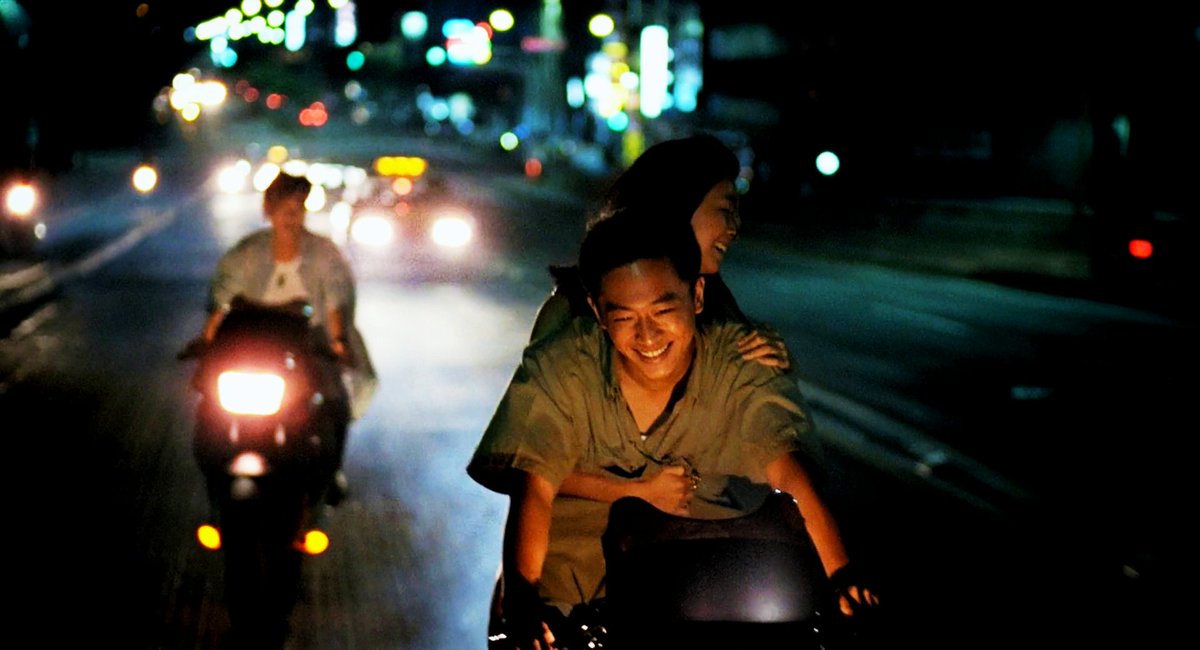
Tsai’s feature debut Rebels Of The Neon God arrived in 1992 but I’d not heard of him (not even in film school) until a decade later. In anticipation of What Time Is It There?, Boston’s Museum of Fine Arts, then under the expertise of programmer Bo Smith, ran a retrospective of his work. Not knowing too much about Tsai apart from rave reviews of the new film, I chose to start at the beginning. Rebels Of The Neon God concerns a young Taipei man (Lee Kang-sheng, who serves as the protagonist/muse in nearly all the director’s work) who falls in with two juvenile delinquents—a setup straight out of early Godard or a contemporary like Gregg Araki. Unlike those two auteurs, Tsai is far less interested in narrative than texture and atmosphere. Actually, this first feature has relatively more plot than most of his subsequent efforts, although specific themes and motifs one would see throughout his oeuvre are already in place: urban life, loneliness, food, sex and, perhaps more so than any other auteur, water in all of its forms (and sounds.)
Rebels Of The Neon God
I detected similarity but also a great advance between Rebels Of The Neon God and What Time Is It There? and viewed his other three features to date within the next few months: Vive L’Amour (1994), an advance over its predecessor while further eschewing such elements as “plot” or having a score, even; The River (1997) of which What Time Is It There? might be loosely interpreted as a sequel; and The Hole (1998), something of an outlier in that it interrupts Tsai’s usual urban ennui with the occasional colorful and deliberately campy (and overtly lip-synched) musical number. I’ve revisited most of these in the past few years (save The River, also unstreamable/out of print) and can detect a developmental through line of Tsai becoming progressively more minimal and sparser (save the occasional musical, like 2005’s The Wayward Cloud) with each film.
As a caveat, Tsai’s movies are not for everyone. I once likened his unique and deliberate approach to that of silent-era slapstick only slooooowed all the way down as much as possible before turning into complete stasis or a freeze-frame. While one of the chief devotees of what could be called “slow” cinema (along with Andrei Tarkovsky and Bela Tarr), things do happen in his films, often recognizable activities that we partake of offscreen: eating, sleeping, fucking, selling wares, watching movies, sitting in a public space, etc. And yet, most other filmmakers do not give these ordinary actions such raptly held attention or focus. Stray Dogs (2013), for instance contains an infamous shot of one of its characters in close-up meticulously eating a chicken dinner for what seems like infinity—an extreme example in Tsai’s filmography for sure, but not an atypical one (especially in his later work.)
Revisiting What Time Is It There? for the first time in nearly two decades, even I took some time to fully adjust to its unusual rhythms. It begins with a seemingly endless single shot of Lee’s aged father (Miao Tien) in his apartment. He slowly sits down at a kitchen table, lights a cigarette, stands up, calls out “Kang!”, sits back down, gets up again and walks down a hallway to a laundry room at the far rear of the frame. As usual with Tsai, the camera remains entirely static. It feels almost as unassuming as a Warhol screen test or a piece of stock footage nearly resembling Ed Wood’s silent B-reel of Bela Lugosi leaving his house that was inserted into Plan 9 From Outer Space to make good on the notion that the now-deceased actor “starred” in the film.
In the next scene, Lee rides in the backseat of a car with a veiled object sitting upright in his lap. He says, “Dad, we’re going through the tunnel; you have to follow us, okay?”, although we see no other passengers. Those familiar with Buddhist customs will recognize the object as his father’s urn and the other things he’s holding onto as traditional implements of bereavement. For those who are not (like me), the following scene at a mausoleum clarifies his dad’s death. From that moment, What Time Is It There? establishes itself as a film partially about grief and the different ways its characters process it. Lee’s mother expresses it forthright: per her faith, she fervently believes her husband will return in another form such as one of her pet fish housed in aquarium that Tsai often places towards the front of the frame. She’s increasingly superstitious about his return, laying out food at the dinner table for him to consume and later obsessively covering up all the windows and cutting the electricity because “he prefers the dark” (even though, as her son argues with her, the fish will die in their tank without power.)
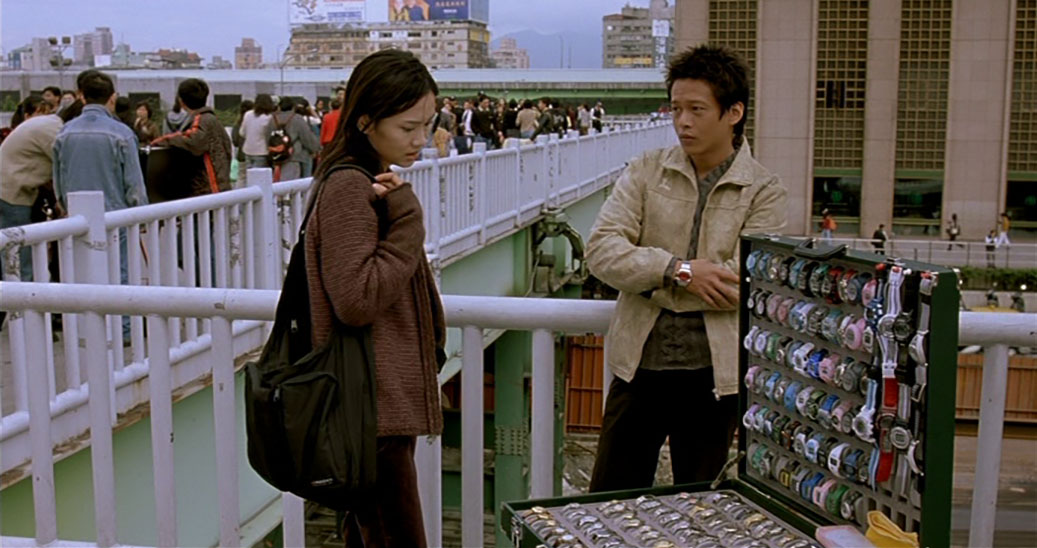
Lee’s approach to mourning is more difficult to parse. The persona Tsai crafts for him throughout the director’s oeuvre is that of a stone-faced onlooker, like a more passive Buster Keaton (perhaps without the acrobatic comic timing.) Initially, his grief doesn’t seem outwardly apparent at all except through quirky acts of behavior such as repeatedly urinating into a plastic bag or a water bottle in his bedroom rather than using the bathroom (no concrete reason is given for this as far as I can determine.) He makes his living selling wristwatches, often standing on the street with a giant open suitcase of his merchandise, repeatedly and almost robotically banging a single watch against the metal railing behind him to draw attention. After much haggling with a young woman (Chen Shiang-chyi) over his personal wristwatch (which belonged to his father), he agrees to sell her it after she discloses she’s about to take a trip to Paris.
From there, the film alternates scenes of Lee in Taipei with those of Chen in Paris with the watch serving as a psychic connection between the two. Lee seems to believe his father’s spirit partially remains within the watch and obsesses over it and the country Chen has taken it to. He calls Information to ask the film’s titular question (re: Paris) and buys and repeatedly views a bootleg copy of The 400 Blows, Francois Truffaut’s landmark 1959 French New Wave film. Meanwhile, Chen wanders around Paris alone, an outsider in a land where she doesn’t speak the language. At one point, Tsai frames her on a busy moving walkway as the only figure standing still. Later, at a cemetery, she sits down a bench next to a middle-aged man who happens to be Jean Pierre-Leaud (the child star of The 400 Blows), though this fact is lost on her.
Jean-Pierre Leaud and Chen Shiang-chyi
Time itself becomes a motif. In addition to Lee’s profession as a street watch salesperson and the brick-and-mortar clock store that employs him, various timepieces appear throughout the film. In one sequence, he steals a clock right off the wall of a cinema’s hallway, placing it on the seat next to him inside a theater (what the stocky, bespectacled young man silently pursuing Lee does with that clock after he steals it from him leads to one of the film’s funniest sight gags.) In another scene, he sits in what appears to be a mall at a fountain which contains a giant water wheel forever unhurriedly revolving like a clock. Later, he ends up in some sort of room (maybe a security booth?) with a menagerie of clocks both analog and digital and later still, on the balcony of a tall building manually trying to adjust (with long tongs) the hands of the clock below him on its façade.
Tsai often sidesteps Taipei’s more traditional, tourism-friendly urban landscapes for liminal spaces such as that security booth packed with clocks or the backseat of a parked, possibly abandoned car. Chen’s Parisian vacation is full of these as well: endless subway corridors and platforms, a phonebooth where with futility she attempts a conversation as a man in the adjacent booth keeps yelling obscenities into his receiver, a miniscule, red-tiled bathroom where she vomits up her dinner. Tsai renders worlds as they are (unglamorous, run-down, often grime-encased) but does so within artful, meticulously composed frames. His lengthy, static shots begin to feel like living paintings—for those receptive to such stillness, it can be like sitting on a bench or standing next to a wall, simply observing life play out before one’s own eyes no matter how little (or how much) action occurs.
Combined with a heightened sound design which doesn’t have a musical score but emphasizes such ambience as traffic noise and trickling water, What Time Is It There? invites one to extensively take in an environment rather than lose oneself in a story—which is not to say it’s all just visual and aural wallpaper. The film slowly reaches its climax as all three of its principal characters engage in some sort of sexual activity. Chen attempts a one-night stand with a female traveler from Hong Kong who walked in on her vomiting in the red-tiled bathroom; Lee fucks a female prostitute who stumbles by him as he’s camped out in the abandoned car drinking wine and eating some sort of meat on a stick; Lee’s mother, meanwhile, puts on a fancy dress at home and, for lack of a better term, “gets intimate” with the urn full of her husband’s ashes.
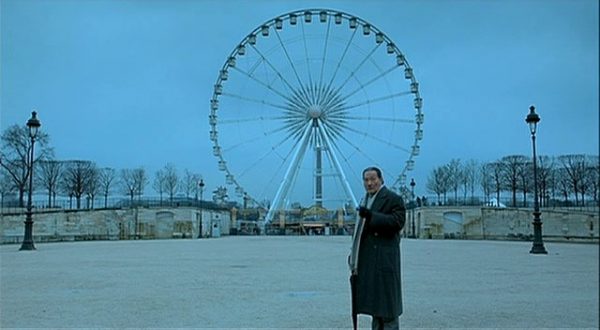
None of these encounters have a particularly happy ending (so to speak.) Chen fails to find much of a connection with the Hong Kong woman and leaves the hotel disappointed. The prostitute absconds with Lee’s suitcase of wristwatches, sneaking away before he awakens. When he arrives home, Lee finds his mother in bed holding the urn, unresponsive. She’s obscured by camera to a degree where it’s indeterminable whether she’s dead or just sleeping—Lee just silently climbs into the bed, embraces her and that’s the last we see of either of them. However, the film concludes in Paris. As Chen falls asleep on a lounge chair in a park next to a lagoon, a familiar suitcase last seen escaping an abandoned vehicle floats by her only to be retrieved from the water with an umbrella handle held by a man whom the camera gradually pans up to reveal as Lee’s father. He walks away from the lagoon with the suitcase in hand; standing and facing the camera, Tsai reveals a giant Ferris wheel behind him: it’s another clock-like figure, perhaps the grandest one so far. Lee’s dad turns around and walks beatifically in its direction. The screen turns to black with the director’s dedication, “To my father and Lee Kang-sheng’s father.”
This is a film not just concerned with time as a concept but also as an experience and how it is fleeting and, for us as individuals, finite. Tidy as its recurring, symmetrical imagery is, its rigor, combined with its minimalist, understated, almost meditative demeanor renders What Time Is It There? one of Tsai’s most accomplished, satisfying and original works. So, twenty years on, why is it difficult to see? One can currently stream his follow-up (and arguably far more challenging) feature Goodbye Dragon Inn (2003), along with later efforts such as Stray Dogs and Days (2020). Quality and critical acclaim, however, are rarely decisive factors in regard to availability. Both the theatrical and home video distributors for What Time Is It There? are long defunct and have been acquired by other corporations. It’s unclear who currently holds the rights to the film which is most likely the reason why one can’t stream, rent or even buy it for a reasonable price. Perhaps in another year or five, a reputable distributor such as Criterion will acquire them (as they did with Love Streams) and audiences will rediscover the film. It happened to What Happened Was… (1994), a long-lost indie hit of its time that received a theatrical re-release a few years ago and eventually made its way to streaming platforms despite never having been released on DVD. For now, What Time Is It There? remains but one of many currently “lost” titles that we can only hope will find a new audience when it can be easily seen again.
Celebrating her latest album Business and Pleasure (which comes out this week), here’s a CD-length playlist of some of my favorite songs from Canadian singer-songwriter Emm Gryner. Despite the easy rhyme afforded by her last name, it is very much a primer—proceeding chronologically, it kicks off with two tracks from Public (1998), her third album and major label debut on Mercury Records. Had they appeared two or three years earlier, perhaps “Summerlong” or “Hello Aquarius” might’ve become modern rock radio staples; however, by then, female artists were struggling to get airplay in that format. With that in mind and Universal Music’s acquisition of Mercury, Gryner was dropped from the label shortly after Public came out.
In the 20-odd years since, she has put out 20-odd albums and EPs via her own label, Dead Daisy Records (not to mention a stint in David Bowie’s touring band.) One-third of my selections overlap with her best-of compilation from 2012, including “Summerlong” and the regal, soaring “Almighty Love”, a track a figure no less titanic than Bono cited in a magazine article as a song he wished he had written. I’m surprised there wasn’t more crossover between the two track listings since one of Gryner’s greatest strengths is a knack for glorious, anthemic pop. “Symphonic”, “Young As The Night”, “Black-Eyed Blue Sky”, “Ciao Monday” (the last one’s from 2011’s Northern Gospel)—all of them are alternate world number one singles lifted by ringing guitars, effervescent melodies and Gryner’s endearingly bright and deeply emotive voice.
She’s such a talented, underheard songwriter that I was only going to include her own compositions, but it wouldn’t be fully representative to not highlight her interpretative skills. I first heard of her via Girl Versions (2001) a set of stripped-down covers of songs originally popularized by men including her radical reworking of Def Leppard’s “Pour Some Sugar On Me” (which at the time received ample airplay on WERS, a college radio station in Boston.) Later, she recorded Songs of Love and Death (2005), another covers collection, this time of Irish artists in tribute to her paternal heritage (her mother’s family is Filipino)—likely what tipped Bono off to her. It’s represented here by a gorgeous version of “Forget Georgia” originally by late 80s/early 90s Dublin outfit Something Happens. There’s also She’s Gone, a 2012 EP of Hall and Oates covers, of which the title track (a lovingly chill rendition that gets bonus points for not changing the lyrics to “He’s Gone”) is a highlight.
In recent years, she’s moved from spare balladry (“The Race”) to heavenly psych-pop (“Imagination”) to even fist-pumping EDM (how does “All The Love All The Time” only have 2K streams on Spotify?) Appearing after an extended hiatus, “Valencia”, the lead single from Business and Pleasure makes good on Gryner’s aim to craft a yacht-rock record complete with a Doobie Brothers bounce and horns sympathetic to those on Steely Dan’s “Deacon Blues”. Fortunately, it’s not a simulation or a pastiche, just a sincere, finely honed tune brimming with personality and hooks for days like any other track on this playlist.
Getting there required crossing the Blue Line MBTA tracks via this suitably blue-lined overpass.
Walking up the overpass, I felt as if I was on a footbridge rollercoaster.
According to this, the overpass was opened and named for Anthony and Dee Dee Marmo in September 2001 (no conspiracy theories, please!)
One but can’t help but notice its electric blue curves.
And on the other side of Marmo Overpass, it’s the beach!
It was pretty deserted on an unseasonably chilly Friday in early May.
Although I would’ve liked to have seen more activity, I have to admit I appreciated the solitude.
At the beach’s south end sits a residential neighborhood that juts out east towards the coastal suburb of Winthrop.
I must have arrived at or near low tide.
According to a municipal sign (not pictured), the beach is officially open from Memorial Day to Labor Day, so I was only weeks away from enjoying a hot dog from Selma’s Kitchen or a cup of Richie’s Italian Ice.
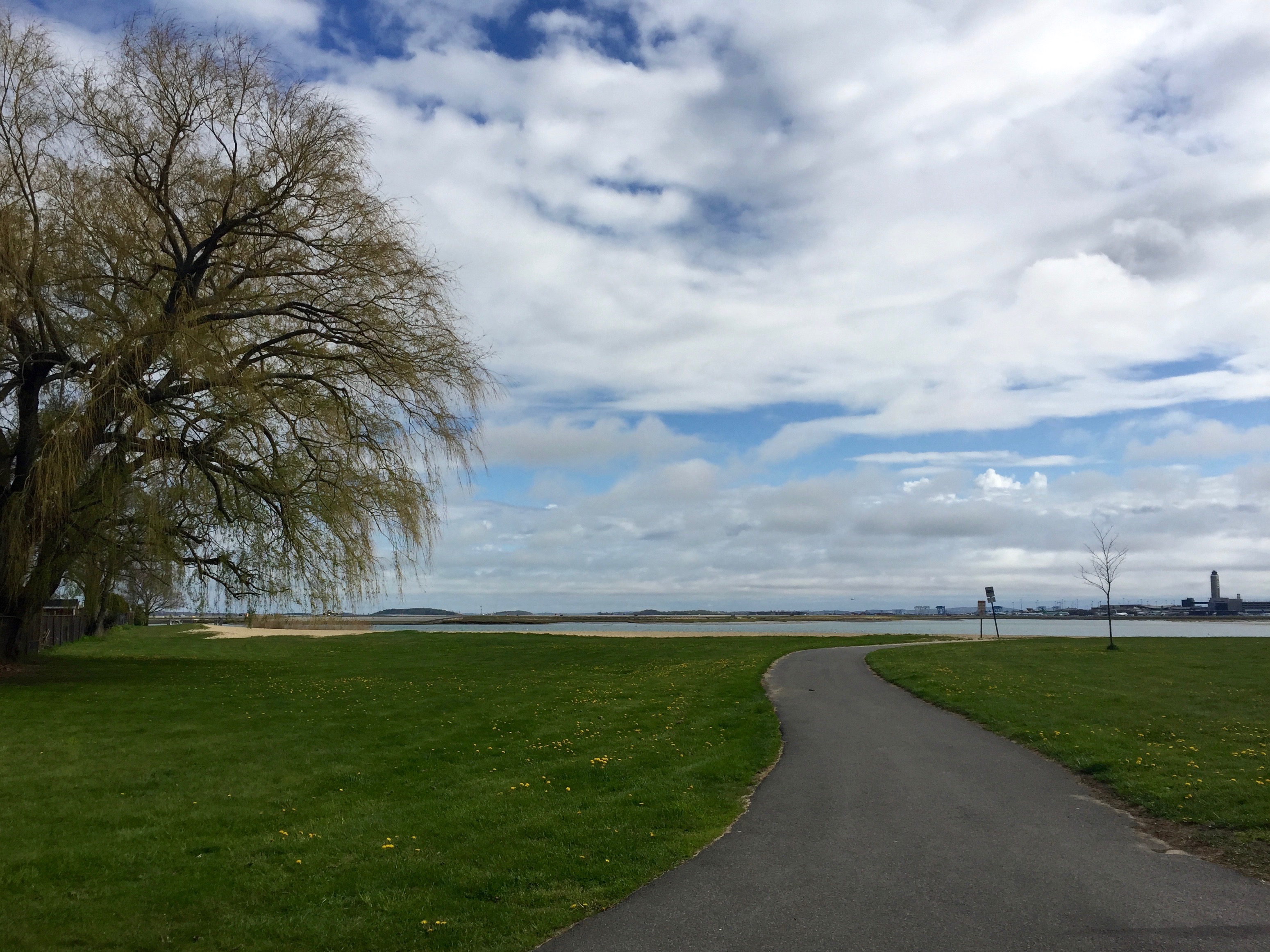
Looking south towards Porrazzo Skating Rink and beyond that, the familiar sight of Logan Airport Tower. In my last post, I mentioned I haven’t had a reason to return to Orient Heights (I live on practically the opposite end of Boston), but if I ever find myself out that way again, I’ll revisit Constitution Beach (that is, if it’s not too cold and windy.)
On a Friday afternoon in May 2016, I took a Blue Line MBTA train out to Orient Heights (according to Wikipedia, Boston’s northernmost and northeasternmost neighborhood) simply because I could. Having previously taken the line all the way to its terminus at Wonderland station in Revere Beach, I had never stopped anywhere along the way between it and Logan Airport.
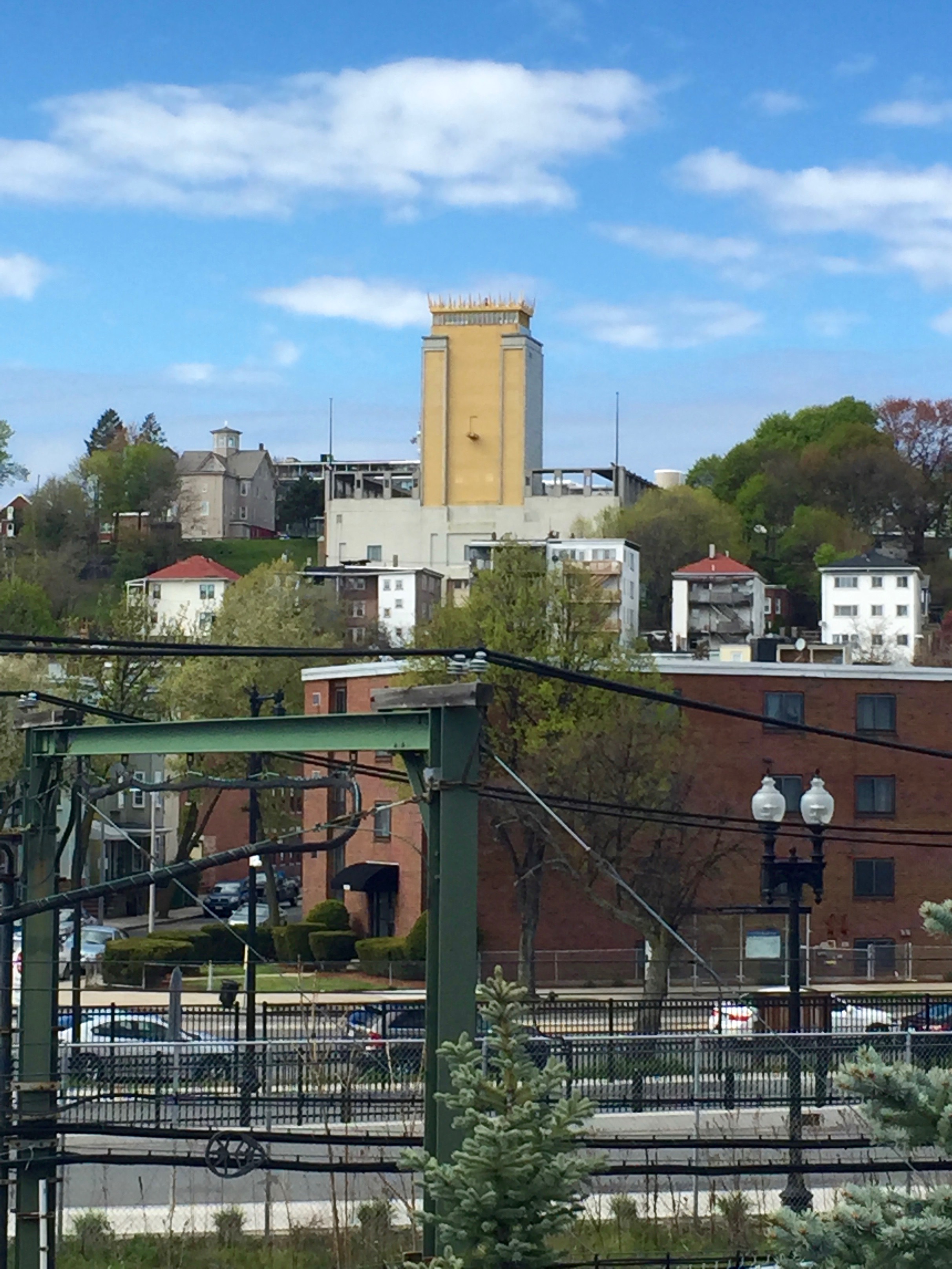
If Orient Heights has a landmark, it’s the Madonna Queen of the Universe Shrine, the front of which is visible (albeit from a distance) from Route 1A; its back (the tall, narrow structure above) faces most of the actual neighborhood.
Otherwise, this is another average residential neighborhood accessible by T but not much of a magnet for tourists or visitors. (As of 2021, the tire shop with the vintage signage above is now a cell phone store.)
It’s an enclave mostly stuck in various past eras.
This antiquated siding is something you rarely see in Boston’s hipper neighborhoods (as well as business names with curiously placed periods.)
Of course there’s a Chinese-American restaurant with stereotypical signage and lots of red.
No name, just billiards, presumably.
As of 2023, the Beverly Richard Dance Center is still in business (I wonder if there’s much crossover with the billiards place?), as is Oxigen.J and Great Chef.
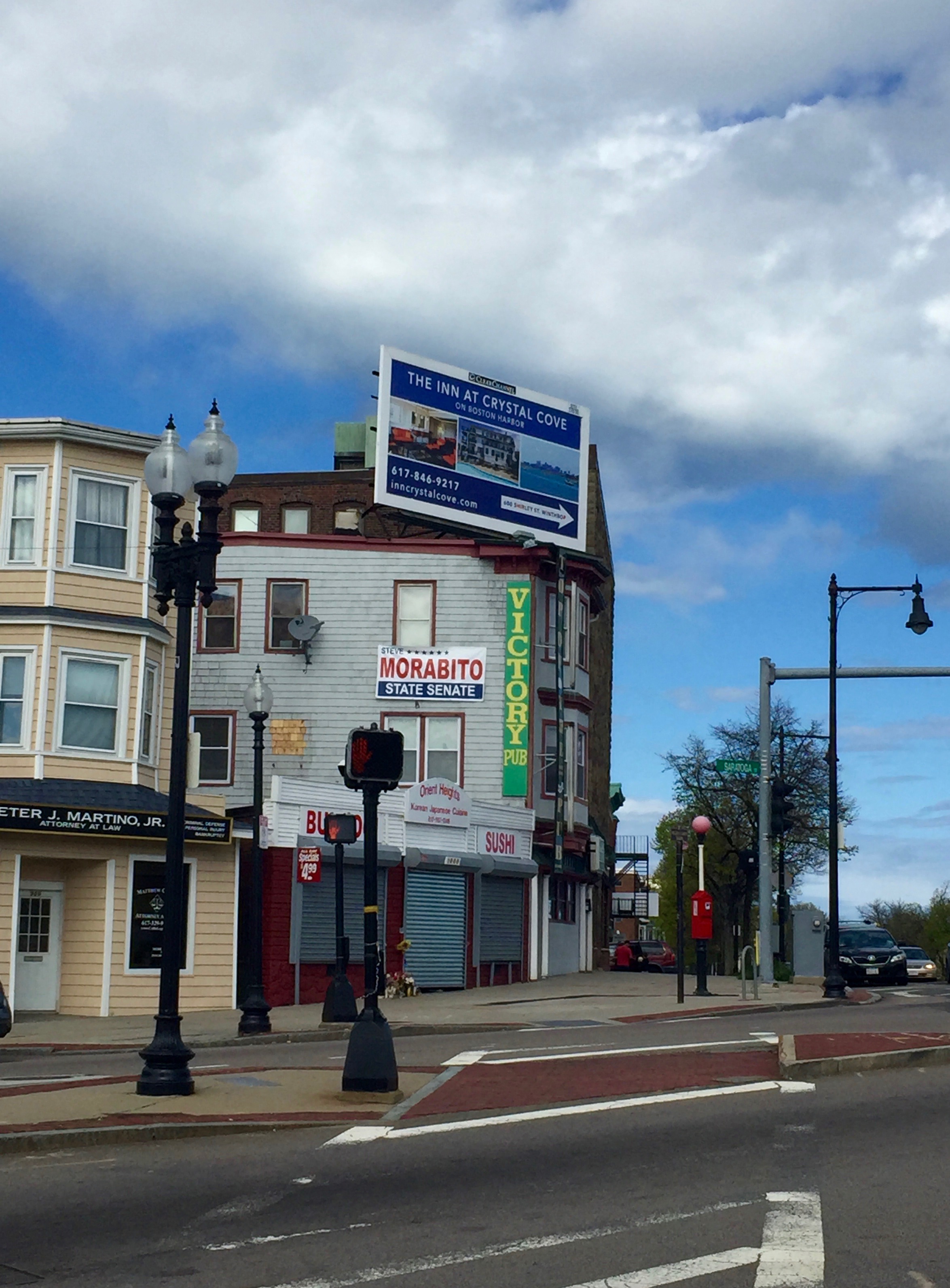
A look at Google Maps confirms Peter J. Martino, Jr. is still practicing (along with fellow Martino’s Nicholas and Justin) but the storefront to the right has been refurbished into the much brighter (if still Japanese) Sunny’s Cafe. Victory Pub is now called Renegade’s Pub and doesn’t appear to have changed much (at least on the outside.)
The intersection of Bennington and Saratoga Streets where Route 145 curves right from the former onto the latter with Orient Heights MBTA station in the distance. I haven’t had a reason to return to Orient Heights, although on that one visit I also came across an interesting piece of municipal architecture that I’ll post about next week.
Cheerfully billed as “A Saturday Night Television Special” starring Sissy St. Claire (Sophie von Haselberg), writer/director Amanda Kramer’s film may feel as if it’s beaming in from another planet to those unfamiliar with 1970s/80s variety shows. Devotees of camp classics such as Donny and Marie, The Lynda Carter Special or the finale of Bob Fosse’s All That Jazz will recognize all the genre tropes being lovingly replicated and satirized but even they might feel bewildered (or perhaps transported) by the dark interior spaces an increasingly taxed and frayed Sissy inhabits.
Kramer understands that if you’re going to make a feature-length pastiche, pinpoint accuracy is required. Not only does she shoot on smeary video in the classic 1:33 analog format, stylistically, she replicates everything of the era from the sequined clothing, elaborate wigs, neon colors and piercing lasers to the requisite hanging mirrorball, vintage-looking graphics and Donna Summer-worthy disco anthems including the title track and “Making It” (not a David Naughton cover.) If she left it at that, it would be nothing more than an elaborate tribute to an ultra-specific type of entertainment from a bygone era. However, as with last year’s Please Baby Please, a 1950s-set mashup of West Side Story-style bohemia and genderqueer studies starring Andrea Riseborough (!), this pushes the viewer much further than that.
Not even a few minutes in, Sissy literally faces her demon(s) while the screen glitches and distorts and continues to do so intermittently. Effervescent and hungry for attention, she seems to shrug it off at first, for the show must go on and she’s made it clear she’s giving it her all. As the special moves from one titled set piece to another (“The America Number” answers the question, “What if Laurie Anderson had been given one of these specials circa ‘O Superman’”?), we see the implications and consequences of this. Touches of surrealism such as a literally faceless psychic and an interpretive death-dance with a nurse that climaxes with Sissy declaring, “You will never, never, ever, ever have your own television special, so don’t even DARE to DREAM!” add to the disorientation, burrowing deeper into madness. But you can’t stop ever-resilient Sissy who is dead set on triumphing, even if it means nearly losing what’s left of her sanity while delivering an epic, climactic monologue about a defining, near-traumatic childhood memory and how it made her who she is today.
Whereas Please Baby Please, while fabulous, occasionally muddles its intentions with its many intellectual diversions, this firmly retains its focus (being just 79 minutes helps.) Von Haselberg’s casting is especially inspired—I didn’t even know who her famous mother (someone who might’ve starred in a special like this back in the day) was until afterwards; it’s the type of role that could make her career if it wasn’t such a genuinely strange little film. Regardless, as we get to know Sissy (who appears in nearly every frame) rather intimately, Give Me Pity! gradually transcends its premise, revealing layer after layer of everything that goes into a performance and the toll it can take on the performer’s psyche.
No overarching theme here, just some songs I’ve been listening to lately that are split nearly evenly between old and new. Most mixes I’ve made for other people tend to follow this non-format with selections I think they’d like to hear; this one, however, is for me.
Much of the new-ish stuff has a retro-disco tint that is always welcome; we’re so many decades past the “disco sucks” era (it arguably vanished once Deee-Lite’s “Groove Is In The Heart” hit in 1990) that such a notion now looks not only misinformed but positively quaint. Not that it’s suddenly fashionable, give or take a Dua Lipa or Lady Gaga, but just the idea of wistful, joyous, throw-all-caution-to-the-wind dance music endures whether it’s an unlikely duet between Carly Rae Jepsen and Rufus Wainwright, a kaleidoscopic anthem from former Savage Garden vocalist Darren Hayes, or an unlikely but euphoric ode to formalwear from U.S. Girls’ just-released album Bless This Mess. A choice cut from Pet Shop Boys’ best LP of the 21st century, 2013’s Electric, fits right in with these glitterball newbies.
And yet, I reiterate this isn’t a thematic mix since most of the other new songs aren’t danceable at all. Former Go-Betweens member Robert Forster takes stock of a thirty-year relationship and the profound meaning it has given his life, Yves Tumor crafts an itchy, rhythmic, onomatopoetic earworm, the onomatopoetically named beabadoobee pays inspired tribute to a similarly-titled classic by The Cure and The National ascends towards dad-rock heaven on their latest (and maybe best?) single. Listen as they all complement older tunes such as Blossom Dearie elegantly essaying another standard, Richard and Linda Thompson exhibiting fine defiance and drollness and Sky Ferreira constructing 21st century 1980s music out of such time-honored tools as melody and urgency.
The new song that kicks the mix off and gives it a title is a musical reunion for a duo who has recorded separately since the year 2000. I always wondered if Tracey Thorn and Ben Watt would ever work together again since they’ve remained a couple all this time; the first released track from the forthcoming album Fuse seems to almost pick up where they left off on 1999’s Temperamental with its electronic fervor, chill breakbeats and Thorn’s diva-like croon. But she sounds intriguingly deeper and wearier than she did just five years ago on her own great Record. “Kiss me while the world decays / Kiss me while the music plays” she repeats near the end and for sure, Everything But The Girl are firmly standing in 2023.
Pauline Kael rarely saw a movie more than once. Even near the end of her life, long after her tenure as film critic at The New Yorker, she remarked, “I still don’t look at movies twice. It’s funny, I just feel I got it the first time.” While Kael’s quirk is a notorious one, it’s to some extent explicable given that she spent most of her career pre-home video. Apart from theatrical releases or even private screenings, she had limited access to rewatching a title, at least compared to today’s wealth of viewing options. Yet even with them, of the thousands of films I’ve seen over the past three decades, there’s at least half, maybe even two-thirds that I’ll likely never rewatch or want to revisit. After all, if I limited myself to first-time watches, I’d never run out of new things to see.
Still, a world where I never again returned to Mulholland Drive, Beau Travail or Young Frankenstein holds little appeal. I acknowledge that films (and, for that matter, books and episodic television series) require a heftier time commitment than a favorite piece of music. I can prepare for an essay on an album by listening to it four or five times over the course of a day; for one on a film like 2001: A Space Odyssey, however, I’d need to put at least 10-15 hours for an equivalent experience. As a visual medium, movies require closer concentration. Unless you literally know one by heart, you arguably can’t put it on in the background and absorb it while attending to other tasks as you could with any piece of music from Abbey Road to ABBA Gold.
I’ll often rewatch a movie for one of three reasons: it’s playing theatrically, available for streaming or just simply one of my favorite films. Accessibility plays a key role here but so do other factors. Is it something I’d love to see on a cinema’s big screen given the opportunity? Do I revisit it because I haven’t watched it in decades and want to see how well it holds up (or not)? Has the film been in my thoughts for whatever reason (for instance, having read a web article or a social media post about it), or is it something I love to rewatch because it gives me joy, no matter how many times I view it?
Particularly in the pre-streaming age, this last reason was my most common for wanting to see a film again (and in some cases, again and again.) When my family acquired our first VCR in 1985, we soon accumulated a cabinet overflowing with recorded VHS tapes of favorite movies and TV shows I’d watch repeatedly, from childhood favorites like Race For Your Life, Charlie Brown to movies such as Monty Python and The Holy Grail and dozens of episodes of Mystery Science Theater 3000. I replayed some more than others but the novelty and attraction of having a permanent record of something I loved to watch whenever I wanted (often for the price of a blank tape) was considerable. Even later on, when VHS tapes largely became priced-to-own (instead of priced-to-rent), for comparatively little money one could proudly curate a collection of favorite titles akin to having shelves of CDs or stacks of vinyl.
1999, Left to Right: Cassettes, books, videotapes (and a few records…)
Beyond accessibility or convenience, that “it” factor which draws us repeatedly to a particular work of art is harder to pinpoint. I may as well have watched Trainspotting over a dozen times because I owned it on VHS (and later, DVD) but I didn’t just watch it because it was there. Something in it beckoned me to want to see it again and again because I got something out of it (and in most cases, something different) each time. I’ve revisited films that don’t hold up to subsequent viewings—La La Land is a good recent example. While I appreciated its invention and audacity the first time through, after rewatching it ten days later with my family, my first thought leaving the cinema was, “Well, I never need to see that again.” In this case, the novelty had worn off, enabling me to see the film’s flaws more clearly. Luckily, most rewatches are worth the time and effort, even if they all can’t be as continuously rewarding as Trainspotting which took me a few run-throughs to fully comprehend the deeper, often ironic implications beneath all the flash and fury of its editing, music and performances.
There’s also comfort in returning to favorite works of art. While as a well-rounded film critic I strive to seek out titles I haven’t seen before (both new and old), I return to specific ones because their familiarity provides solace, often for various reasons. I’ll rewatch some films as a tradition in celebrating a particular season like Christmas or Halloween (for years, the latter wasn’t complete without a viewing of Dario Argento’s Suspiria or the Bela Lugosi Dracula.) Others I’ll put on when I’m in a particular mood: Bringing Up Baby for screwball comedy, Back To TheFuture for 1980s escapism, Beyond The Valley Of The Dolls for psychedelic, counterculture exploitation. What pleasure I find in these films is, like any work of art, entirely subjective; for instance, Katherine Hepburn and Cary Grant together never fail to make me laugh (which is why I also adore Holiday), the Robert Zemeckis film came out when I was 10 and had a formative impact on me at the time and the Russ Meyers-directed, Roger Ebert-scripted film is so gloriously bonkers that watching it is never less than a blast.
Rarer than isolated titles lending themselves to multiple viewings are those entire oeuvres of a particular filmmaker that do so. Naturally, I’ve revisited many works by some of my favorite directors from Robert Altman to Claire Denis. Over time, Wes Anderson has proven something of an ideal in this regard. Most of his films hold up to additional viewings because, so densely are they packed with insane attention-to-detail production design and such complex, shifting tones that I get more out of them each time. I’ve grown accustomed to giving Wes the benefit of the doubt if I’m initially underwhelmed by one of his pictures—The Grand Budapest Hotel, for example, struck me as nothing more than a solid addition to his canon when it came out in 2014 and became his highest-grossing film to date. Revisiting it seven years later, I found it exceptionally moving to a degree I hadn’t previously, marveling at its tenderness for a lost, presumed world rather than just admiring the intricate fantasy world it had presented.
Like most people my age or older, Anderson’s second feature Rushmore was the first one I saw during its early 1999 theatrical run (his first, 1996’s Bottle Rocket got such a limited release that I hadn’t even heard of it.) The first film of his I revisited, however, was his third. Stoked by my love of Rushmore, I prioritized seeing The Royal Tenenbaums like no other new release in December 2001. After that first screening at the AMC Fenway in Boston, I thought it was… fine. I placed it at #7 on my annual top ten list; in my journal, I praised its set design, soundtrack and some of its cast but also thought that “it made little advance” on the “visionary”(!) Rushmore. So, not a failure or outright disappointment but apparently not as impactful as Waking Life (my #1 film of that year at the time), Memento (#2) or In The Mood For Love(#3).
The Young Tenenbaums
Flash forward seven months to a particularly taxing summer. Just about shellshocked by the rough (if necessary) end of a long-term relationship, I sought comfort wherever I could find it. During a week-long “staycation” from work, on a whim, I rented the newly-released Criterion Collection DVD of The Royal Tenenbaums. After this rewatch, I wrote, “I found it more affecting the second time: once you know to expect the sensory overload and stylistic quirks that threaten to turn too brittle or clever, you’re left with a literary jewel of a film that makes the most of Rushmore’s best qualities.” It wasn’t long before I purchased my own copy—while the Criterion Collection was mostly beyond my price-range at that point, Anderson had made a deal with the distributor to issue the film at a lower price point for consumers.
As autumn beckoned, I kept returning to my The Royal Tenenbaums DVD. My 19”, late 1980s-model TV probably didn’t provide as robust a viewing experience as a big cinema screen would have, but in this case, Anderson’s carefully packed mise-en-scène felt reassuring rather than overwhelming. For instance, take the bravura opening sequence. Accompanied by a swelling, then soaring instrumental version of The Beatles’ “Hey Jude” and wistful voiceover narration (from a rarely better Alec Baldwin), it provided succinct but revealing mini-portraits of each member of the Tenenbaum family as it toured 111 Archer Avenue, their enormous, meticulously designed New York brownstone (as much of a character as its inhabitants), informing us of their rise, decline and subsequent fracture, all in the space of a few minutes.
From there, the story picks up twenty-two years later. Banished and broke patriarch Royal Tenenbaum (Gene Hackman) longs to “make up for lost time” with the family he neglected, only to discover how much everyone has changed. His estranged wife, archaeologist Etheline (Anjelica Huston) is now engaged to Henry Sherman (Danny Glover), a respectable accountant—he’s “everything Royal is not,” (as Royal himself notes late in the film.) Uptight, eldest son Chas (Ben Stiller) is an entrepreneur traumatized over the recent death of his wife. Overprotective of his two pint-sized-versions-of-himself sons, Ari and Uzi, he moves them back into the Tenenbaum home. Adopted, eternally disaffected middle child Margot (Gwyneth Paltrow), a failed playwright, and shattered youngest son Richie (Luke Wilson), a former tennis pro, also return. Margot is stuck in a loveless marriage to psychologist Raleigh St. Clair (a somewhat dour Bill Murray) and is cheating on him with Richie’s childhood friend, novelist Eli Cash (Owen Wilson), while Richie is secretly in love with her. With the aid of butler/sidekick Pagoda (Kumar Pallana), Royal schemes to return to 111 Archer Avenue and win back everyone he’s alienated.
The film weaves together a tapestry exploring familial relations made relatable by Anderson’s quirky but ultimately compassionate sensibility. Structured like a novel (the opening shot imagines the film as a well-worn book being checked out of the library) and divided into chapters, it’s also bursting at the seams with literary references and allusions. For instance, most of the characters have either written books (from Margot’s plays to Henry’s Accounting For Everything) or, in Richie’s case, have appeared on a magazine cover. The film’s design also suggests a comic strip come to life (it’s no coincidence that the Peanuts standard “Christmas Time Is Here” plays in a scene having nothing to do with that holiday.) Virtually every character is cloaked a requisite costume of sorts that rarely changes throughout: Richie’s tennis shirt and headband, Henry’s blue blazer and bow tie, Chas’ red Adidas track suit and the identical, miniature versions his sons wear. The immaculately storyboarded interior sets with their deep pink walls and insane attention to detail (the childhood drawings on Richie’s bedroom walls (created by Anderson’s brother Eric), the walk-in closet overflowing with board games) are also obviously exaggerated. Many shots even feature someone tightly framed through a window, peering at the outside world.
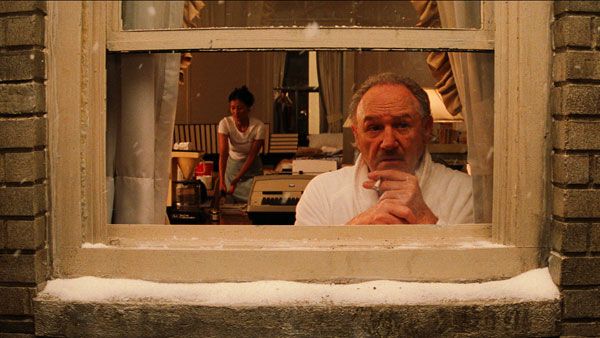
Royal ponders his future.
Although it had a relatively large budget (twice that of Rushmore), a high-profile ensemble cast (supposedly, Hackman’s and Huston’s parts were written with them in mind) and a far wider, more ambitious scope, it was, at that time, still instantly recognizable as a Wes Anderson film. Like the previous two, it featured credits entirely done in Futura Bold typeface, a whimsical musical score from former Devo member Mark Mothersbaugh, Anderson stock players such as Pallana, Seymour Cassel (as Dusty, the elevator operator-cum-doctor) and Andrew Wilson (Luke and Owen’s older brother), a cameo from the director himself (as the tennis announcer) and a final, reflective shot that’s filmed in slow-motion. Viewers could also look out for various motifs and in-jokes: the number of Tenenbaums wearing a piece of pale pink clothing at any given moment, the particular instrument on the soundtrack most prominent during Margot’s scenes, the cameo appearance (as a paramedic) by one Brian Tenenbaum, a real-life college friend of Anderson’s.
For all its self-aware cleverness, off-the-wall sight gags, and excessive stylization, The Royal Tenenbaums is really a sweet, rather poignant film that resonates more profoundly with each viewing. Once you’ve absorbed such showy (but dazzling) moments as a detective’s clipped rundown to Raleigh and Richie of Margot’s past loves (furiously edited to The Ramones’ “Judy is a Punk”), you’re left with essentially a kindhearted (if occasionally side-splitting) tale of redemption. Marvel at the brilliant long take where Royal tells Etheline he’s dying and note how Huston’s reaction continually shifts from disgust and surprise to concern, grief and rage without missing a beat. Observe how Anderson often tempers melancholy with hilarity without obscuring either tone (e.g., the Gypsy Cab that appears just in time as Margot walks out on Raleigh.) Pay attention to subtle details like how Royal finally refers to Margot not as “my adopted daughter”, but simply, “my daughter” in the ice cream parlor. Take in the “Sparkplug Minuet” scene late in the film, where the camera tracks from one group of characters to another along the street outside 111 Archer Avenue and notice the obvious affection and care Anderson has for each of them. At one point, poor, yearning, forever-the-outsider Eli gently says, “I always wanted to be a Tenenbaum.” Royal replies (mostly to himself), “Me, too,” and you just want to join him in unison.
I pause to think what life would be like had I emulated Kael and never bothered to give The RoyalTenenbaums (or anything else) a second viewing. I might remember it fondly the way I do, say, In The Bedroom or The Man Who Wasn’t There (to name two other films from that time I’ve never rewatched.) If I hadn’t seen it again, perhaps I wouldn’t have given subsequent Anderson films like the aforementioned The Grand Budapest Hotel or Tenenbaums’ even more ambitious and widely misunderstood follow-up The Life Aquatic With Steve Zissou (2004) a second chance. With the exception of his most recent work (2020’s The French Dispatch), I’ve seen all of Anderson’s movies more than once and each rewatch has yielded similar results. Tenenbaums remains my favorite, perhaps due to when I saw it and that process of being able to see deeper into it on additional viewings, but he has other works that come close, like Grand Budapest, 2012’s Moonrise Kingdom and of course Rushmore, forever his breakthrough film.
We revisit works for the pleasure they provide. Occasionally, we also have a sixth sense, an inclination that there’s more to glean from them than we can discern from a single viewing. The best films (and books, and albums etc.) are ones that gradually insert themselves into our lives and by extension, our subconsciousness. Their dialogue, visual design, narratives and richly-drawn characters become part of us whether, in this case, we identify more strongly with well-meaning asshole Royal or guilt-ridden, tortured Richie. Revisit them enough and they become touchstones raising the bar for what we expect and hope from every new (and in some cases, old) movie we watch.
My second year participating in #MWE (Music Writers Exercise) where for the month of February, I listen to an album for the first time every day and tweet about it. A productive way to go through all the albums I’ve added to my Spotify library but haven’t yet made the time to listen to, but if I do it next year, it won’t be on Twitter, which has devolved into a ghost town/shit show since its unfortunate Musk-ification. These days, tweeting almost anything feels like flinging thoughts into a void and I didn’t experience nearly as much engagement as I did last year. Perhaps in 2024 I’ll try Facebook or Instagram or just save everything for here.
Here’s what I posted for February 2023:
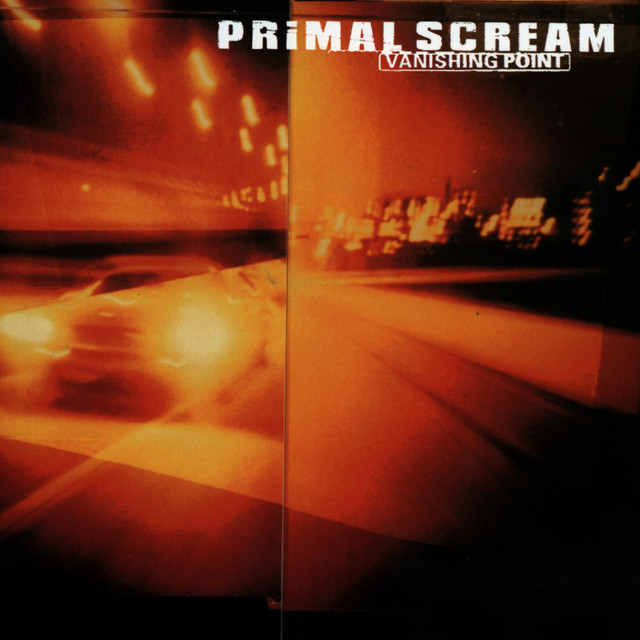
1. Primal Scream, Vanishing Point(1997): Not as highly regarded as Screamadelica but maybe it should be for its sample-heavy, everything-but-the-kitchen-sink approach actually coheres. A close companion to Morcheeba’s debut from the year before, if not exactly trip-hop.
2. Peggy Lee, Sea Shells (1958): In stark contrast to the era’s maximalism, this is simply Lee trilling folk songs over harp and occasional harpsichord. Her readings of “Chinese Love Poems” anticipate the verses of “Is That All There Is?” minus the droll detachment.
3. Broken Social Scene, You Forgot It In People(2002): Harder to get a handle on than that other Canadian supergroup The New Pornographers, call it scrappy “Indie-rock” (for lack of a better term) with unflashy hooks even if “Pacific Theme” could almost be 1970s Chicago.
4. The Wild Tchoupitoulas, S/T (1976): A glorious one-off: Mardi Gras Indians performing Allen Toussaint-produced funk-rock. With songs primary about how much fun it is to be them, it emanates so much pure bliss, deserving a place on the shelf next to Dr. John’s Gris-Gris.
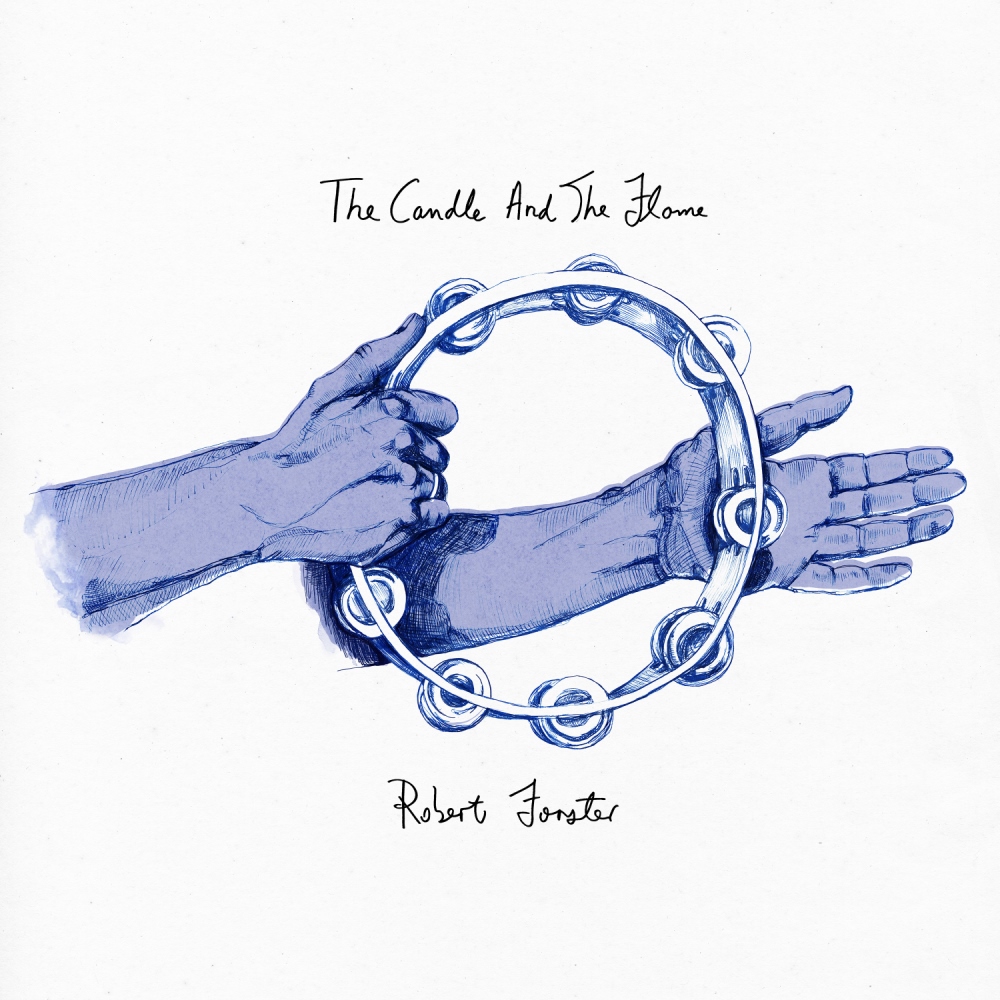
5. Robert Forster, The Candle and The Flame (2023): A beacon of solace in a world we have can’t control. Intimate and direct but rarely ever obvious. Might take weeks or months for some of these hooks to resonate but they’re there and just one facet of the grand design.
6. Charles Mingus, East Coasting (1957): Less formally radical than what he’d record in the following years but that doesn’t mean less effective or interesting. As always with Mingus, he constructs a nimble but solid foundation that encourages all the players on top to shine.
7. Gem Club, In Roses (2014): Could’ve been recorded in a bedroom or a cathedral. Near-ambient pop that probably needs more than one listen to sink in for all I can recall are the legato, echoing piano chords, occasional strings and Christopher Barnes’ ethereal sigh.
8. Meshell Ndegeocello, The World Has Made Me The Man Of My Dreams (2007): A groove record that, after caffeinated near-drum-and-bass salvo “The Sloganeer” drifts unpredictably but languorously like an ultra-chill George Clinton. Most revealing song title: “Elliptical”.
9. Neu!, S/T (1972): Today, I learned that Negativland named themselves after a track off this; also learned that (last track aside) this is far more accessible than what I expected of krautrock, so either it seems less radical than it did fifty years ago or I’m just a weirdo.
10. The Loud Family, The Tape Of Only Linda (1994): Okay, now I get why Aimee Mann liked Scott Miller enough to make an (unreleased) LP with him. This proves he did have a tight ten-track pop record in him; not that it would ever cross over like even Mann occasionally could.
11. Leonard Cohen, Recent Songs (1979): His only pre-2000 LP I hadn’t heard; coming off his Phil Spector disaster, it’s a model of restraint and consequently a tad boring until the Mariachi horns appear and one can safely resume questioning whether he’s being serious or not.
12. Yo La Tengo, This Stupid World (2023): Could be titled Death, Taxes and Yo La Tengo for all the consistency/dependability it emits. Not much stands out but everything coheres and gently sparkles like a vast starry night. Easy to take them for granted, so listen closely.
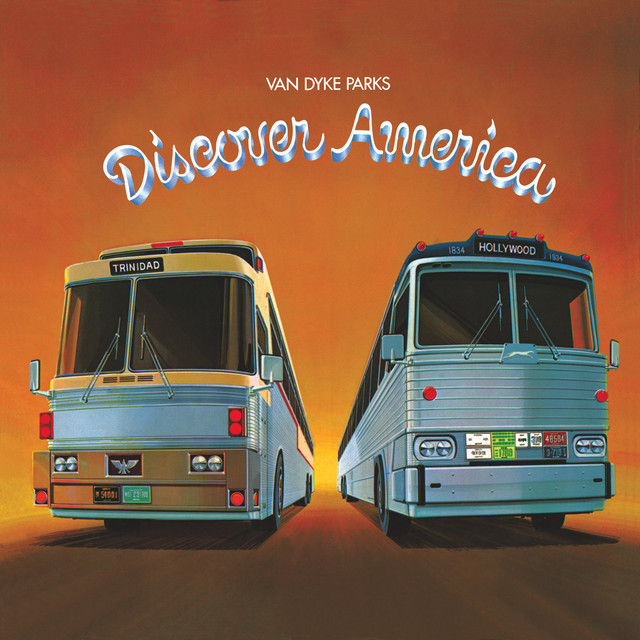
13. Van Dyke Parks, Discover America(1972): One of my more delightful first listens in months. Public domain tunes with a little whimsy, a lot of personality and as usual with Parks, ingenuous arrangements, anticipating those he’d compose with Nilsson for Altman’s Popeye.
14. Various Artists, One Kiss Can Lead To Another(2005): I thought this 52-minute digital distillation of an out-of-print, vintage girl group box set would be sufficient but now I wish I had access to the whole thing. An underrated genre from a not-so-innocent era, really.
15. FKA Twigs, MAGDALENE (2019): Obvious comparisons aside, I can’t get a handle on who she is which I suppose is the point. Acting unknowable can run the risk of obscurity but the production’s so striking it serves partially as a way in rather than just fancy window dressing.
16. Caroline Polachek, Desire, I Want To Turn Into You (2023): Likening her to Dido didn’t occur to me until she popped up on “Fly To You”; actually, this is near-worthy of early, edgier Sarah McLachlan, buffed and shined to a cool gleam other guest Grimes should aspire to.
17. Tennis, Pollen (2023): This couple/duo has raised “staying in one’s lane” to an art form but such interchangeability works when there’s consistency and ample hooks. Might sound better over retail loudspeakers than headphones but that comes down to one’s own preference.
18. Curtis Mayfield, Super Fly (1972): The joy in doing this exercise is to find a classic record you can’t believe you’ve never heard before. I don’t need to tell the world how sublime and definitive this soundtrack is, only to give it another chance if you’re unconvinced.
19. The Teardrop Explodes, Kilimanjaro (1980): On the basis of some of Cope’s solo work, not as wild and surely poppier than contemporaries such as Echo and The Bunnymen or The Soft Boys. Sirius XM’s “First Wave” could stand to play them (and so many other artists) more often.
20. The Upsetters, Blackboard Jungle Dub (1973): Knowing very little about dub reggae, this was exactly what I expected until it quoted both “Pop Goes The Weasel” and “Tijuana Taxi” in the same track. Such mischief broke up the repetition but was it more than just a goof?
21. Tame Impala, “Lonerism” (2012): The real test of a supposed stoner-friendly album is how well it holds up when listened to while sober. Even when favoring texture over melody, this makes the grade, though as a one-man band he might be better off revering Eno than Rundgren.
22. Life Without Buildings, Any Other City (2001): I spent years looking for this in used CD stores based on hype and hearsay; while it lives up to its postpunk-with-quirky-spoken-vocals description, not even that prepared me for Sue Tompkins’ cadences and fizzy demeanor.
23. Scott Walker, The Drift (2006): Sure, I prefer Walker’s more accessible earlier work, but there’s enough of it and this is purposely something else, pushing beyond accepted parameters of song structure toward a sound that’s compelling and confounding in equal measure.
24. Al Stewart, Past, Present and Future(1973): Of course he’s so much more than his two big hits even if those wistful, mealy vocals all but define him. Unlike fellow 70s art-poppers Supertramp, his wispy Anglo-quirk endures because he leans closer to folk-rock than prog.
25. Phish, The Story of The Ghost(1998): Got off the bus just prior to this one and I might’ve liked it more back then. Same issues as usual with them: heartfelt but patchy (and dorky), dexterous but diminished by studio confinement, insular despite all the genre-blending.
26. U.S. Girls, Bless This Mess (2023): “Fonky” as opposed to funky. Emulates Steely Dan, quotes from Jimi Hendrix and sounds like Daft Punk. Best songs are about monkey suits and the color spectrum. Increasingly slick and exceedingly weird (and enough to hold my attention.)
27. Destroyer, Trouble In Dreams(2008): Barely hints at the big pivot Bejar would make three years later on Kaputt but I’ll give him this: over time, I’ve pivoted from him as that guy w/the annoying voice in The New Pornographers to someone incapable of making a bad record.
28. Robert Wyatt, Shleep (1997): Tuneful and dissonant (often simultaneously), he seems as versed in and enticed by classic rock tropes as with free-floating, sing-song poetic improvisation. Challenging but rarely boring, not one second of it feels wasted or redundant.
Years ago, possibly even before I began my 100 Albums project, I participated in a then-popular meme where one would pick their favorite albums of each year since birth. Now that I’ve recently completed another trip around the sun, here is an update along with links to all the albums I wrote about in that project and elsewhere. Not too many changes, although Grace Jones’ Nightclubbing is one of my best discoveries in the past decade (checked it out after reading her memoir, I’ll Never Write My Memoirs which quotes the album track “Art Groupie”); other records such as Bad Girls, Purple Rain and Cosmic Thing continue to grow in my estimation and endure, even if I didn’t originally include them among my 100 favorite albums: