I’ve always been a proponent of being a tourist in one’s own town; having taken many pictures documenting the city’s iconic spaces over the years, here are a baker’s dozen that you likely won’t find on a tourism map or website.
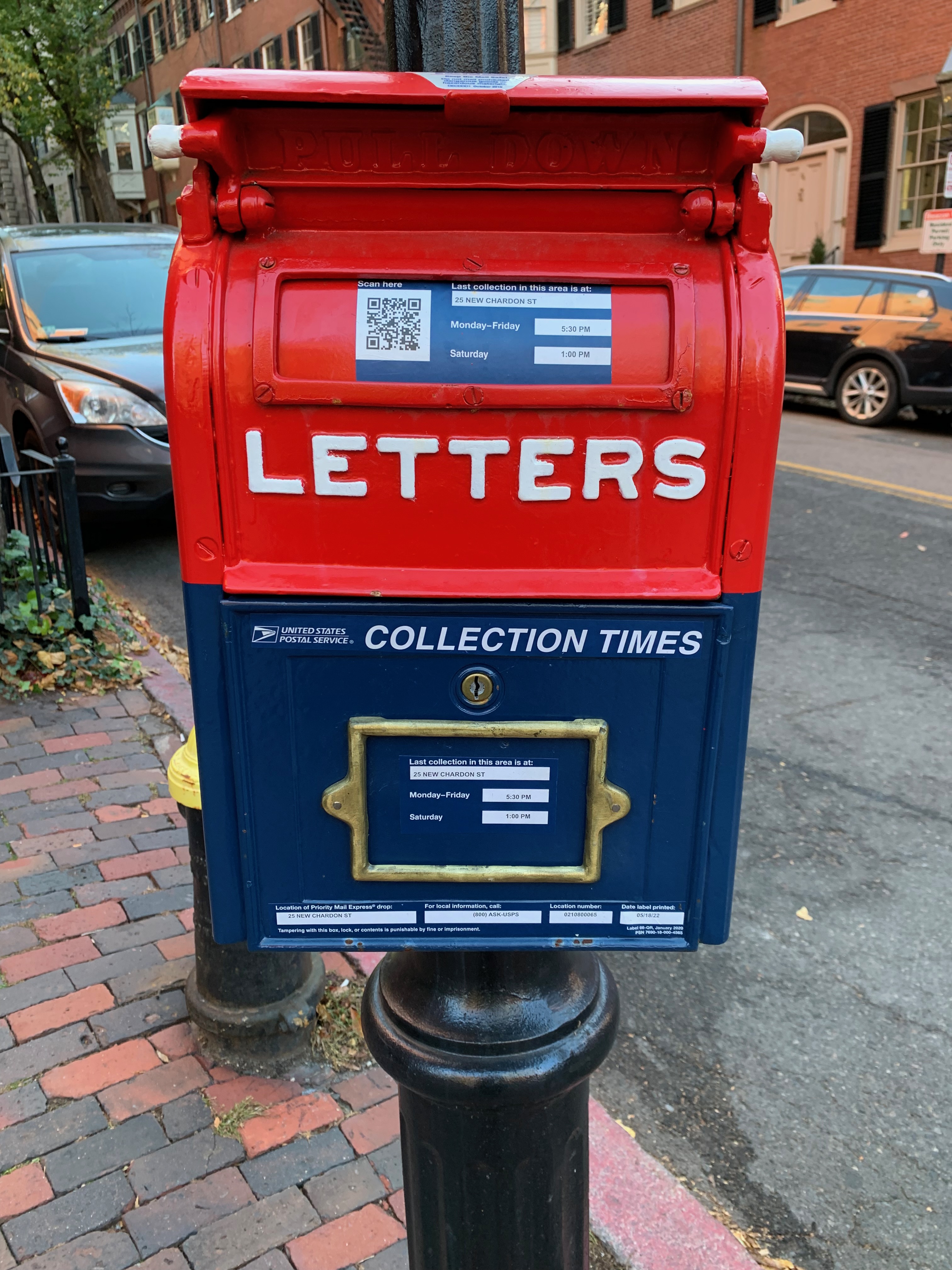
We begin in Louisburg Square, arguably the toniest enclave of Beacon Hill, the city’s toniest neighborhood. I don’t remember this old-fashioned mailbox always being there although it’s possible someone may have recently painted or gussied it up. Sitting along old row homes and cobblestone sidewalks, its antiquity fits right in.
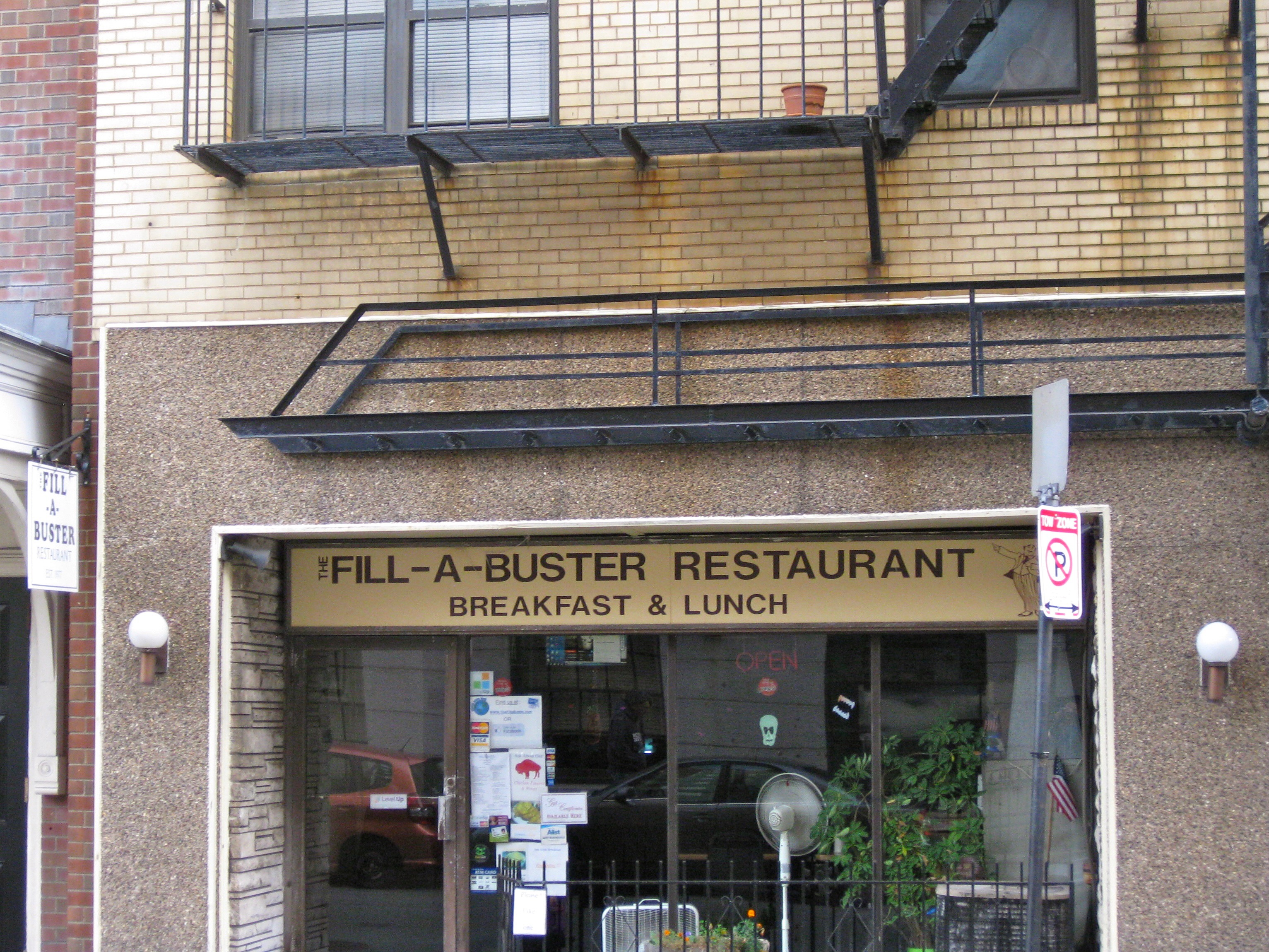
A couple blocks away on Beacon Street near the State House sits this somewhat dingy luncheonette which, at least from the outside hasn’t changed much since it opened in 1977. I haven’t tried it (as with most downtown eating places, it’s only open during working week hours) but I’d be sad if it ever closed for good as it’s part of a vanishing breed gradually being taken over by your Cavas, Sweetgreens and Chipotles.
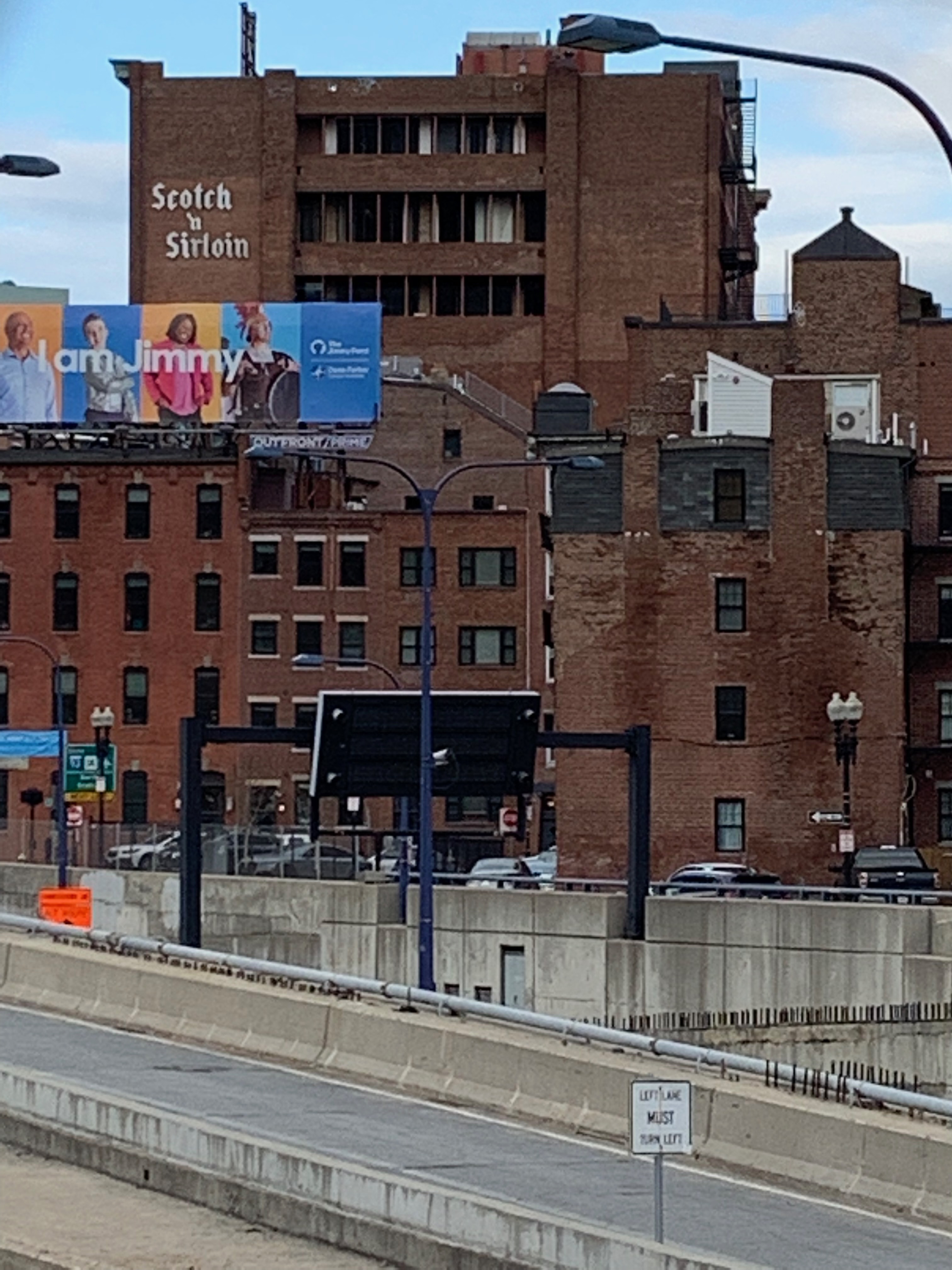
A Google search reveals that Scotch n’ Sirloin, a restaurant overlooking a stretch of I-93 that wasn’t entirely consumed by the Big Dig twenty-odd years ago closed in 1991 and yet the sign remains (the above photo is from December 2020) and likely will until the building gets rehabbed or torn down.
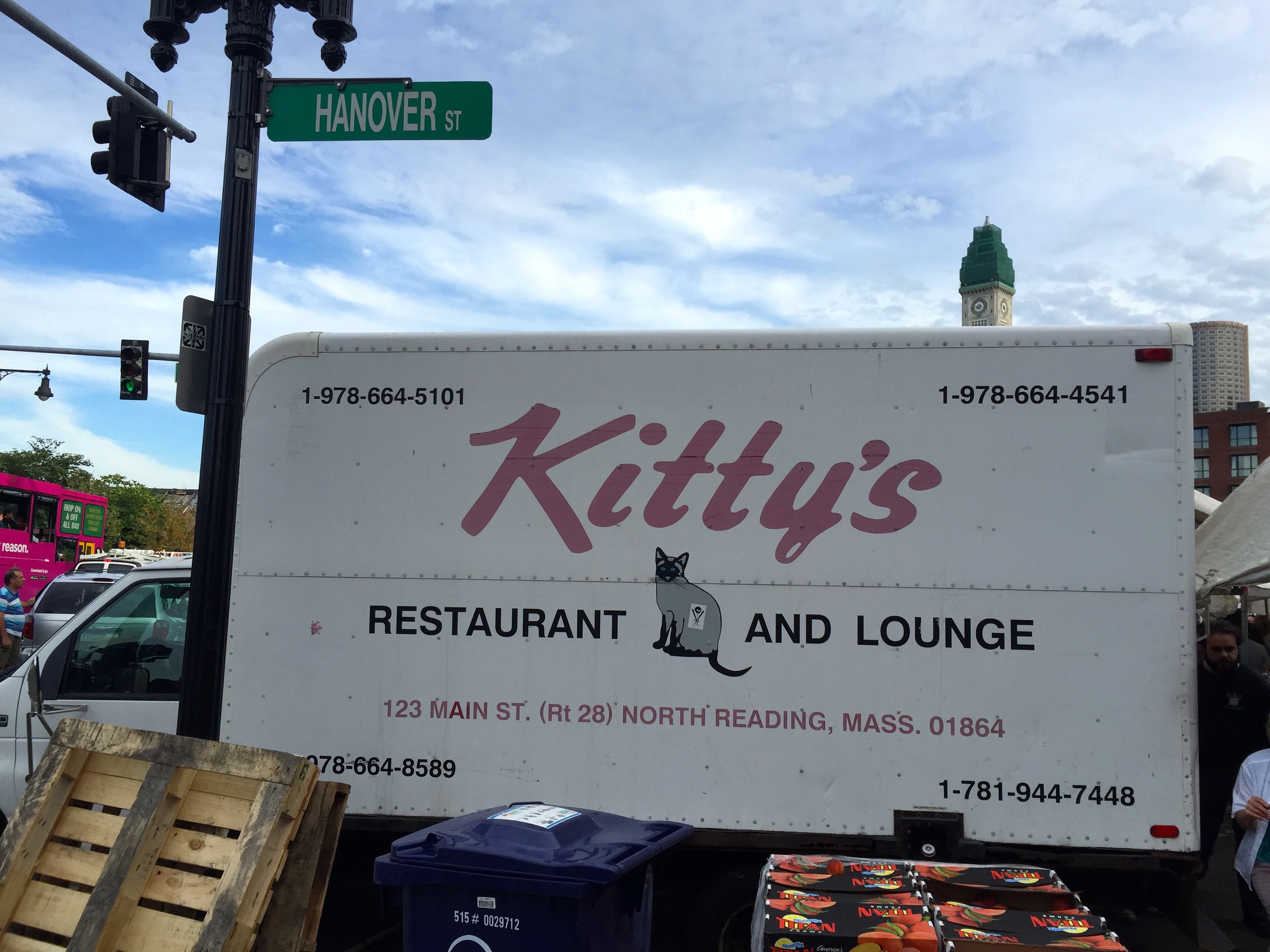
For years, this truck for Kitty’s Restaurant and Lounge in the far North suburbs has been a fixture at Haymarket. I don’t know why, exactly, but it’s always parked there and I rarely fail to notice its distinctive logo.
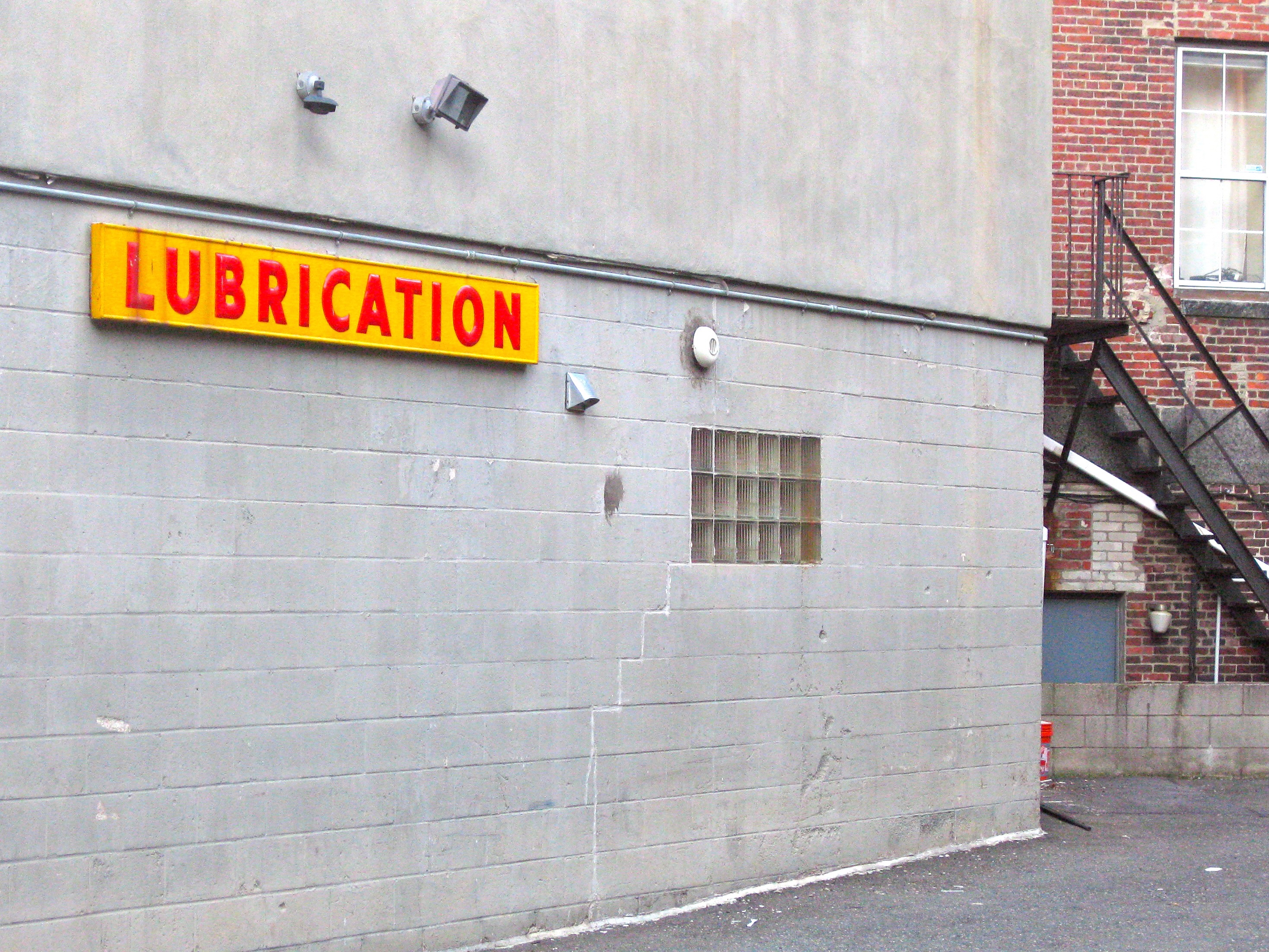
The North End is a tourism Mecca but out-of-towners tend to flock there for the restaurants, the Italian pastries, the Freedom Trail, etc. People actually live there too and occasionally need to service their vehicles (though let’s face it, the word “LUBRICATION” caught my eye more than anything else.)
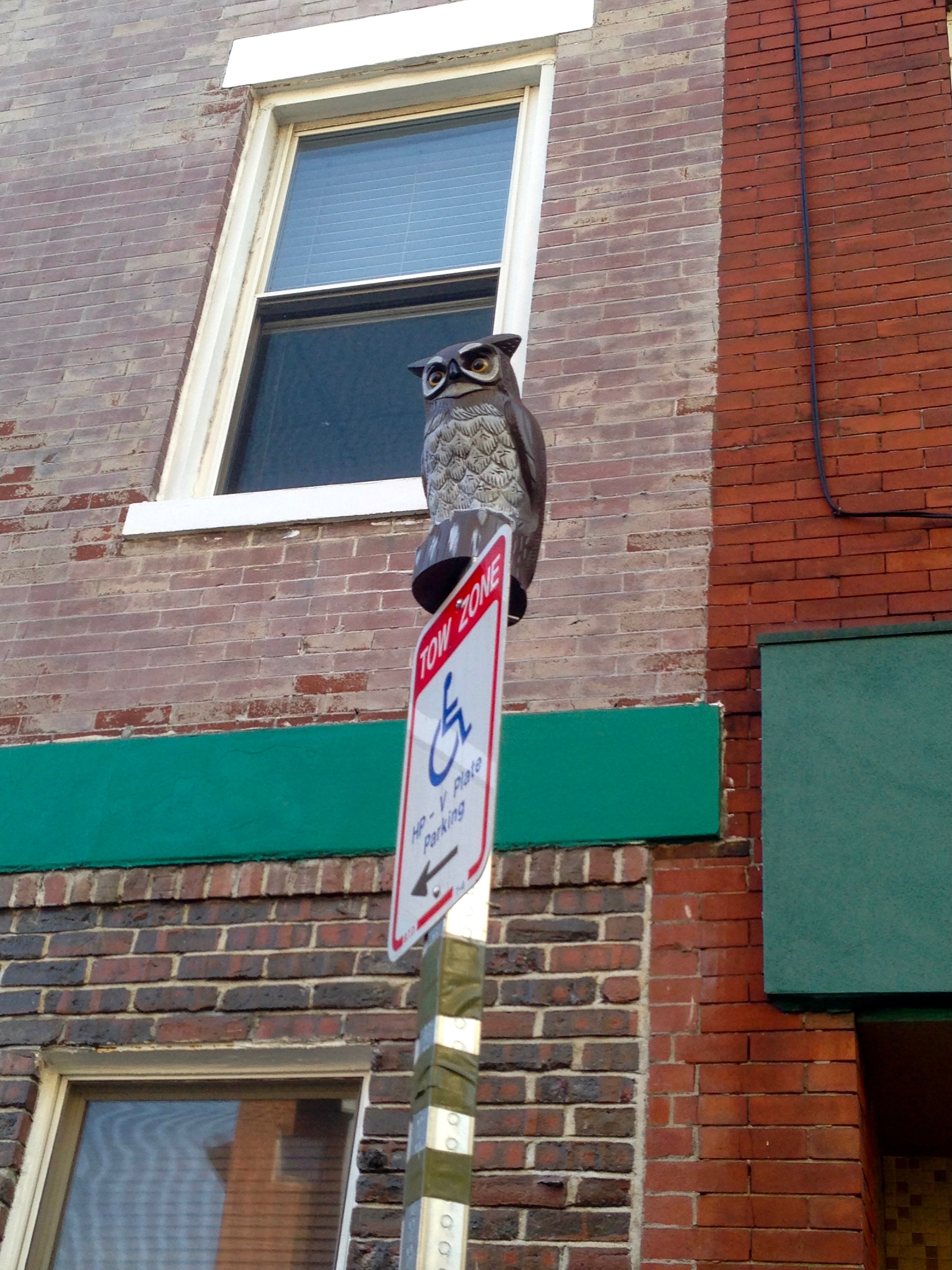
Also spotted in the North End: a fake owl on top of a tow-zone sign. I don’t get it, either.
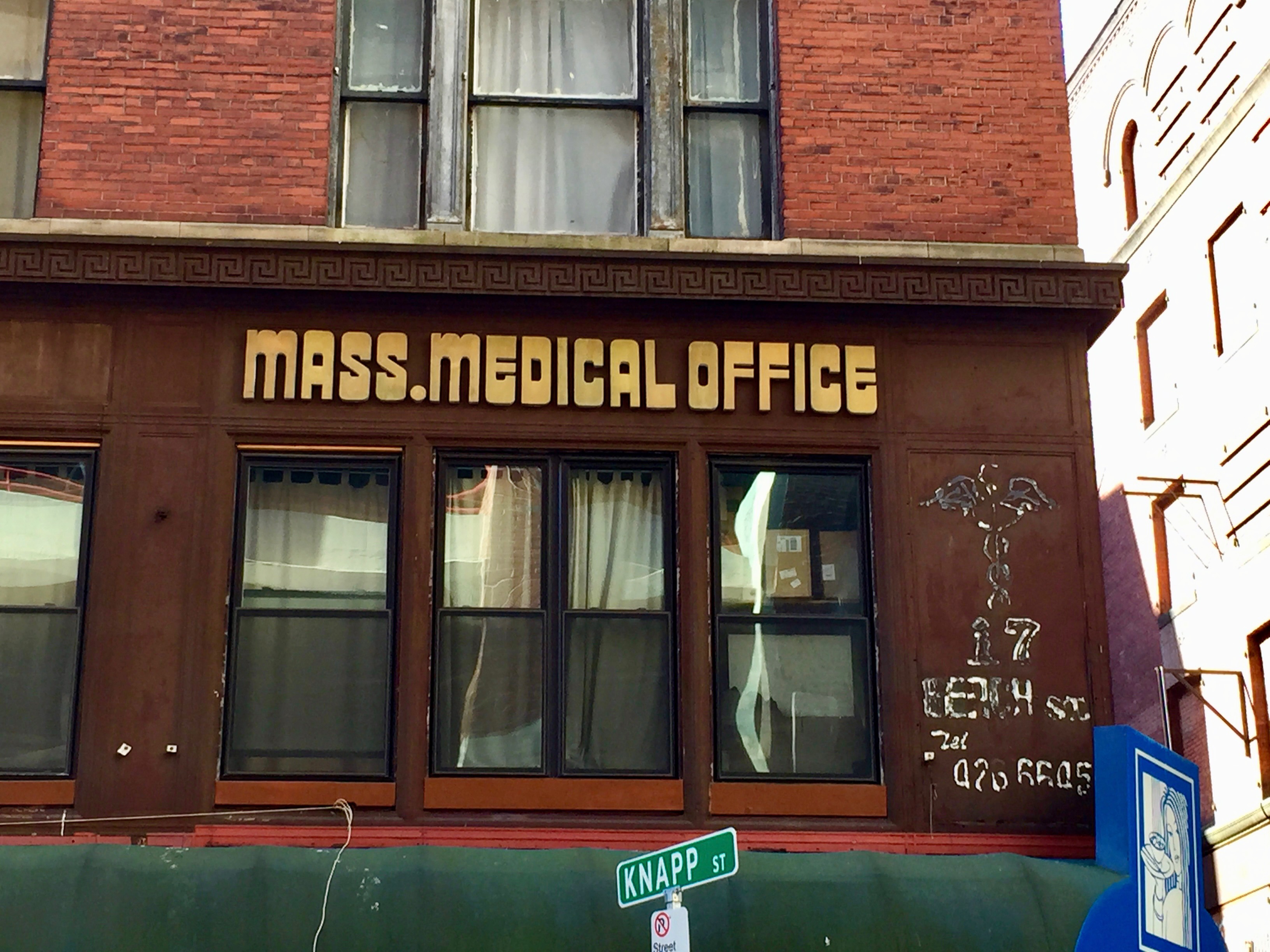
On the opposite end of downtown is Boston’s Chinatown, an ideal spot for Dim Sum but perhaps not so much for those seeking medical attention. My first thought upon seeing this unflashy dated signage in 2015 was, “Oh, really?”; according to Google Maps, work was being done on it as of 2020.
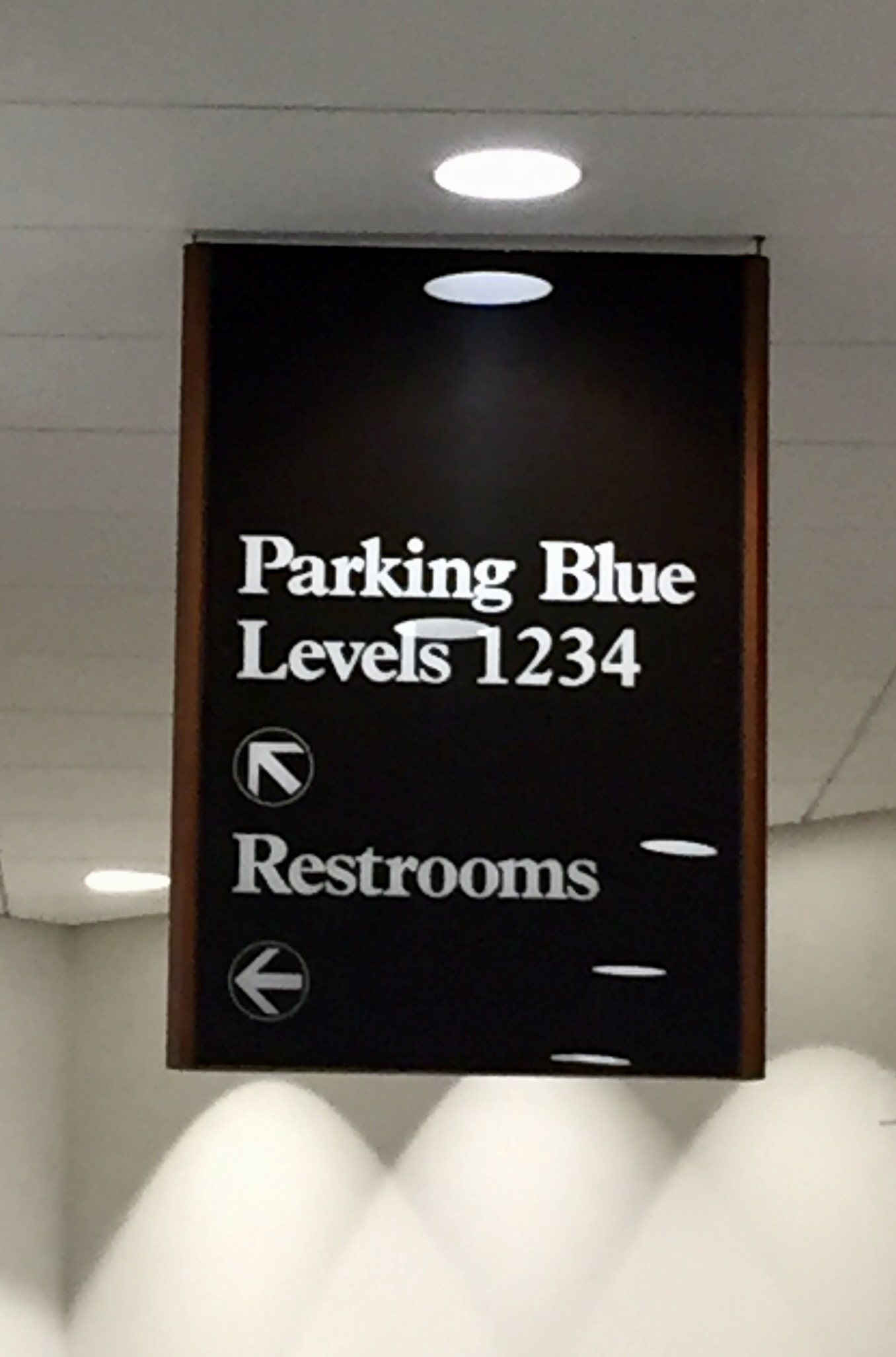
Speaking of dated signage, when Copley Place mall in the Back Bay began finally updating their 1980s-designed interior a few years ago, I knew I had to get a shot of this, located in hallway next to what was then Barney’s (and, long ago, a multiplex cinema with postage-stamp sized theaters) and is now Saks Fifth Avenue Mens’ Store.
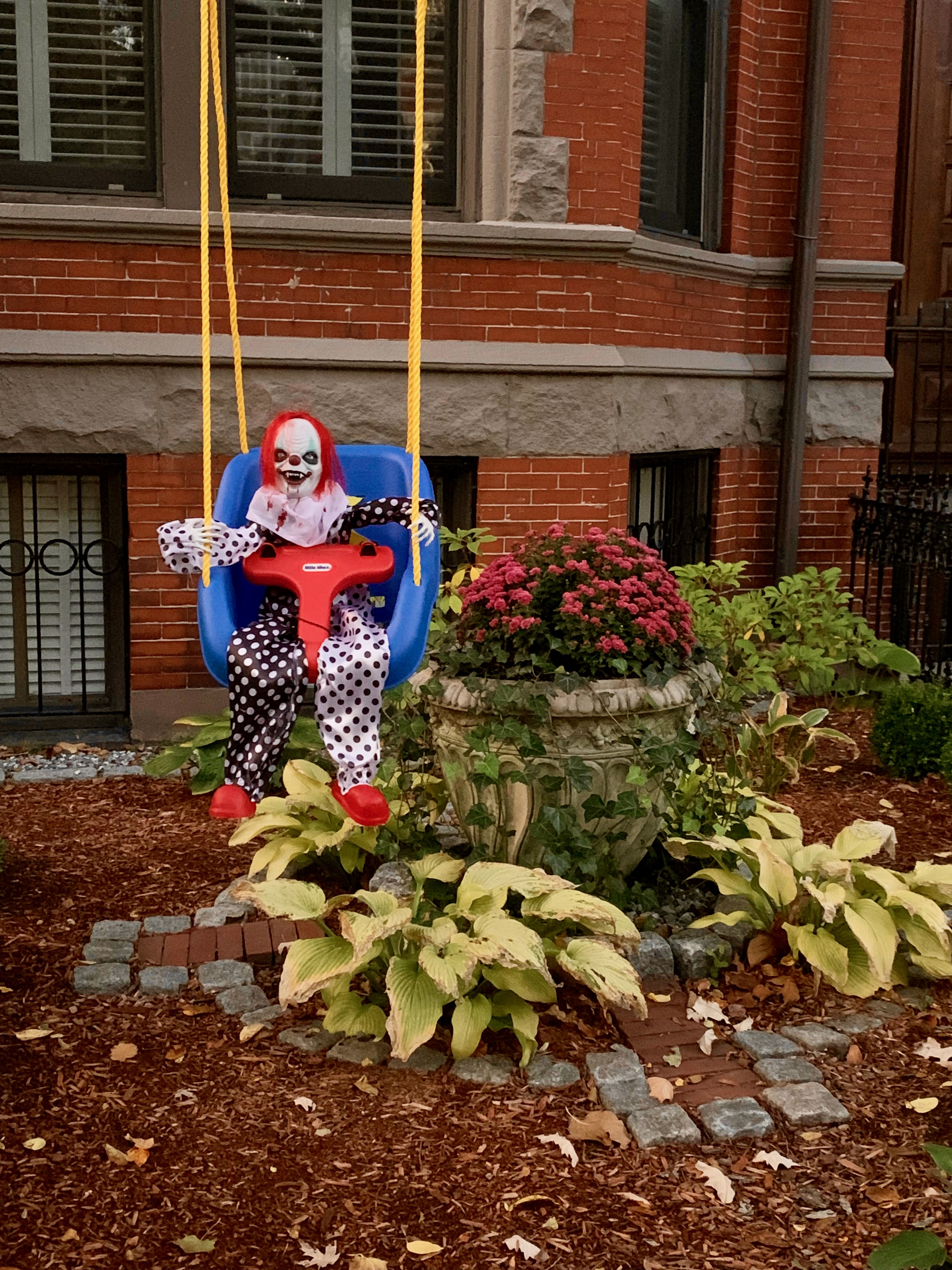
A few blocks from the mall, probably on Marlborough St. or Commonwealth Ave. The neighborhood rivals (probably exceeds) Beacon Hill in terms of wealth, yet I tend to see the most elaborate (not to mention unsettling) Halloween decorations there every year.
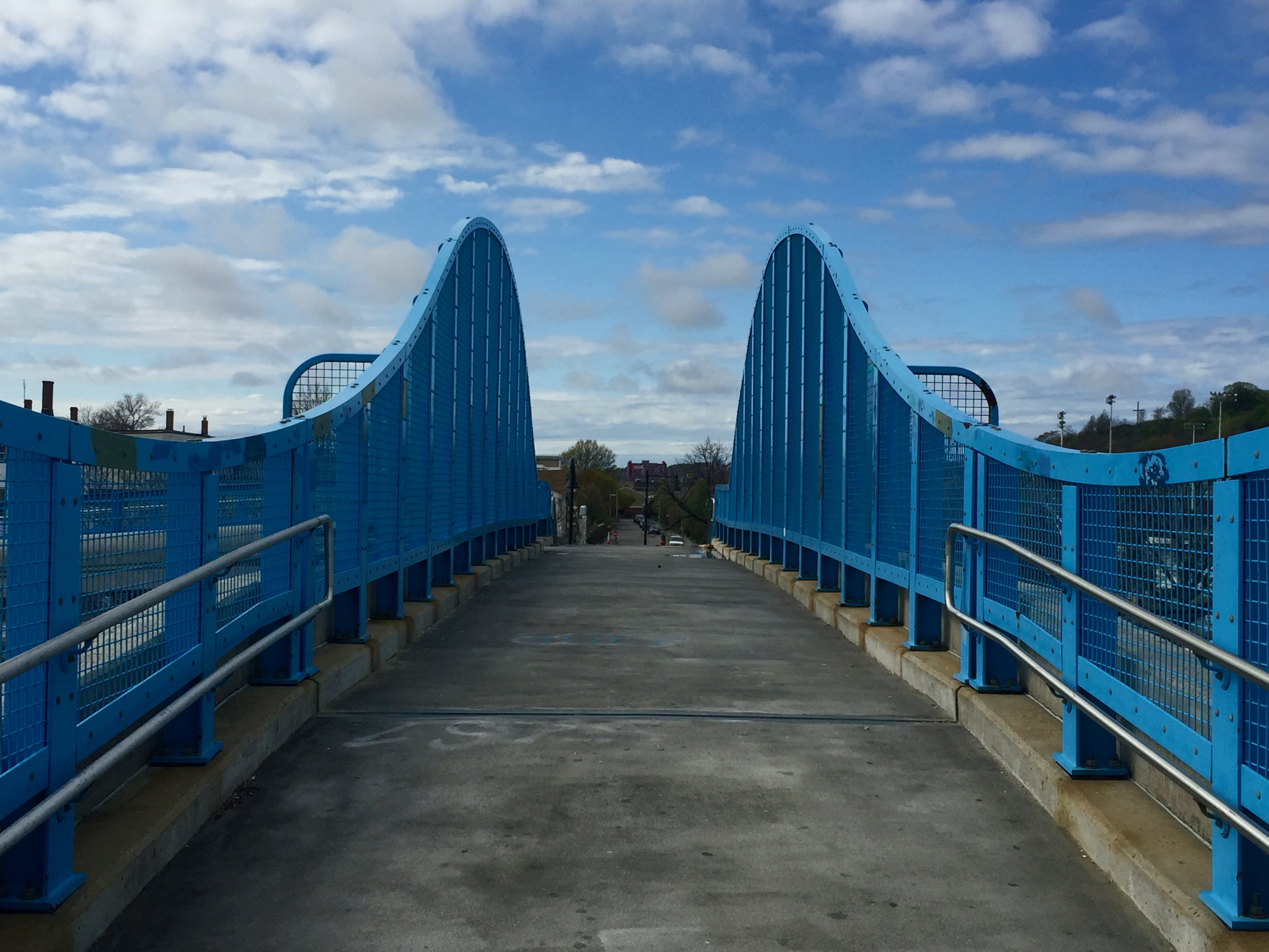
Stepping away from Central Boston, it’s the Marmo Pedestrian Overpass in Orient Heights, a section of East Boston that I visited in May 2016 simply because I could (the Blue Line T goes out there.) It’s a pleasant, unremarkable neighborhood, most notable for Constitution Beach and this colorful footbridge. I posted a bunch of pix from there on my now-defunct Tumblr and maybe I’ll repost some of them here one day.
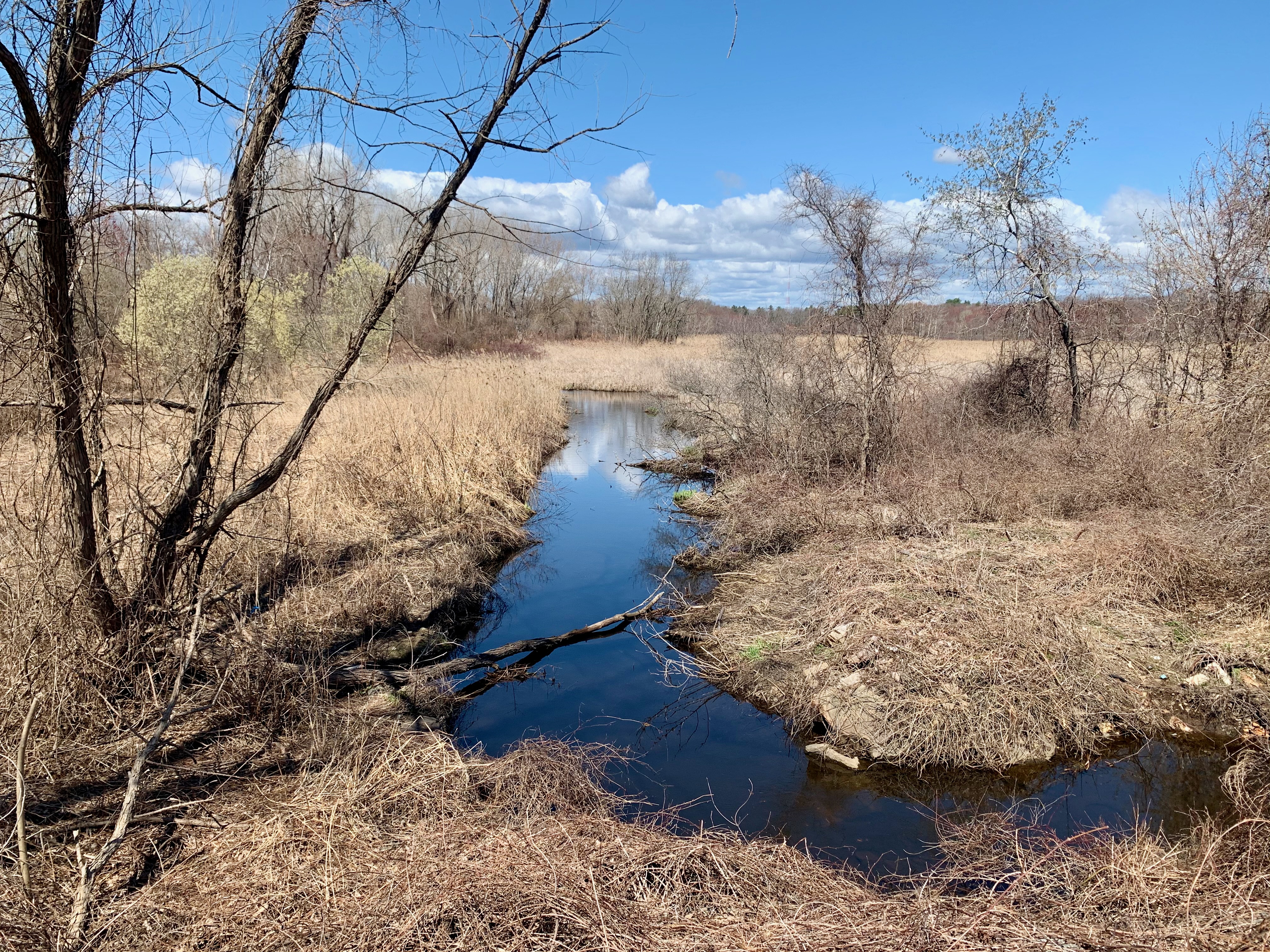
From East Boston to the city’s Westernmost boundary, which happens to be a ten minute walk from where I currently live. I’ll post an entire essay on West Roxbury some other time, but for now, here’s Sawmill Brook at Millennium Park, a vista I’ve taken dozens of shots of over the years; it’s almost as far West as one can go while staying within the city limits.
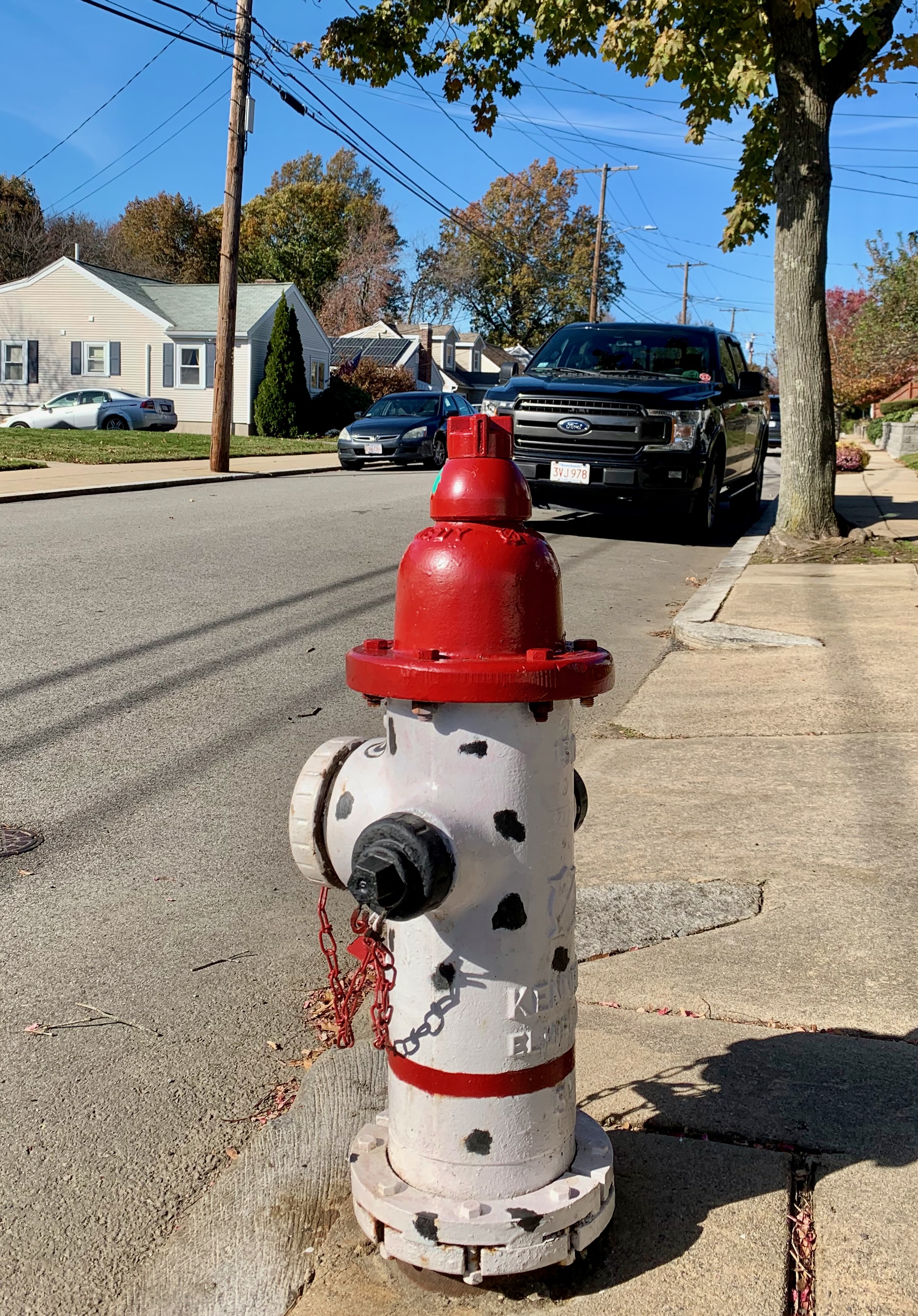
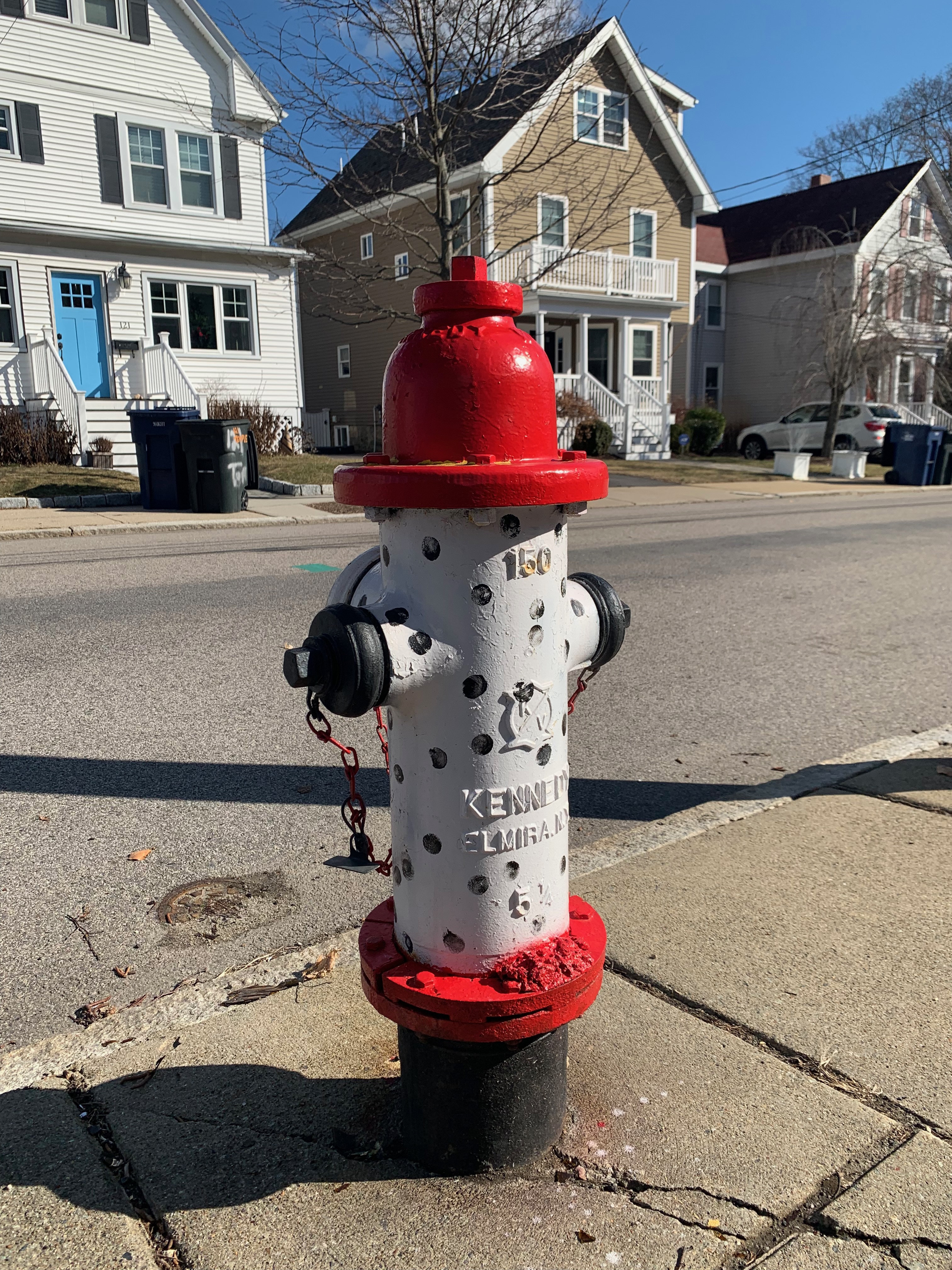
I was going to conclude with this whimsical hydrant on a residential West Roxbury street that I got to know well via many pandemic-era neighborhood walks.
However, I spotted this twin hydrant one street over the other day. Now I’m curious as to whether others exist throughout this neighborhood and beyond. Stay tuned.
In an effort to live up to this blog’s name, I plan on posting a new mix/playlist at least once a month going forward. Some will have a theme of sorts, others will be centered around one artist (or perhaps a related group of them) and a few will have no connecting thread at all and consist of new and old songs that I’m into at the present moment.
I’m kicking off this series with a thematic mix mostly culled from an ongoing playlist I keep of songs I want to listen to when it’s cold outside—scratch that, when the temperature dips below freezing, the sun occasionally peeks out through the terminal gray skies and all feels blustery and raw, an invitation to sit by the fireplace with a mug of hot tea (or perhaps a glass of cognac.) When linked together, the words “cold” and “comfort” bring to mind a stark contrast between the outside world and refuge taken from it indoors.
To find solace in this bleak midwinter, I often turn to (mostly) acoustic folk-pop. The first three tracks here come from late ‘60s/early ‘70s UK-based artists in reverse order of renown—I’d likely be unfamiliar Scot Bert Jansch if not for his inclusion on The Squid and The Whale soundtrack nearly two decades ago. I could’ve made an entire playlist of such likeminded folk (in both senses), but although they did this sort of stuff very well (Fairport Convention’s Sandy Denny had an exquisite, peerless voice), that doesn’t mean Americans weren’t up to the task decades later. Sufjan Stevens, for instance, has sustained a career by defying expectations from album to album but he’s arguably never matched the stripped-down intimacy of Seven Swans (2004) and its guitar-and-vocal instant standard “To Be Alone With You”.
Most of these songs are defined by their sparse instrumentation, calm sense of wonder and general quietude. After a while, amidst an excess of acoustic guitar, other elements emerge and gain power they wouldn’t necessarily retain in isolation: the dwindling piano riff on Kings of Convenience’s “Riot On An Empty Street”, the disarming fiddle laced throughout Grant McLennan’s “Hot Water”, the harmonica adding texture to Saint Etienne’s “Former Lover”. Even when things briefly turn electric, as on Nicole Atkins’ “If I Could”, its restraint and tone is enough to sit alongside purer, acoustic-guitar-and-voice selections such as Jenny Lewis and The Watson Twins’ fable-like “Rabbit Fur Coat”, Rufus Wainwright’s campfire sing-along cover of his father Loudon Wainwright III’s “One Man Guy” and Concrete Blonde’s plaintive but effective “Make Me Cry”.
I also can’t help but place a classic hit everyone knows like Simon and Garfunkel’s “Scarborough Fair/Canticle” or even the Beatles’ “I’ll Be Back” (note that vaguely sinister guitar hook) next to a relatively more obscure and recent number like Belle and Sebastian’s “Piazza, New York Catcher”; together, they show how, through the decades, music (and folk music, in particular) may evolve but also evoke an ongoing tradition that, no matter what adjustments or mutations occur is as recognizable and heartening as a sliver of sun during a cold snap.
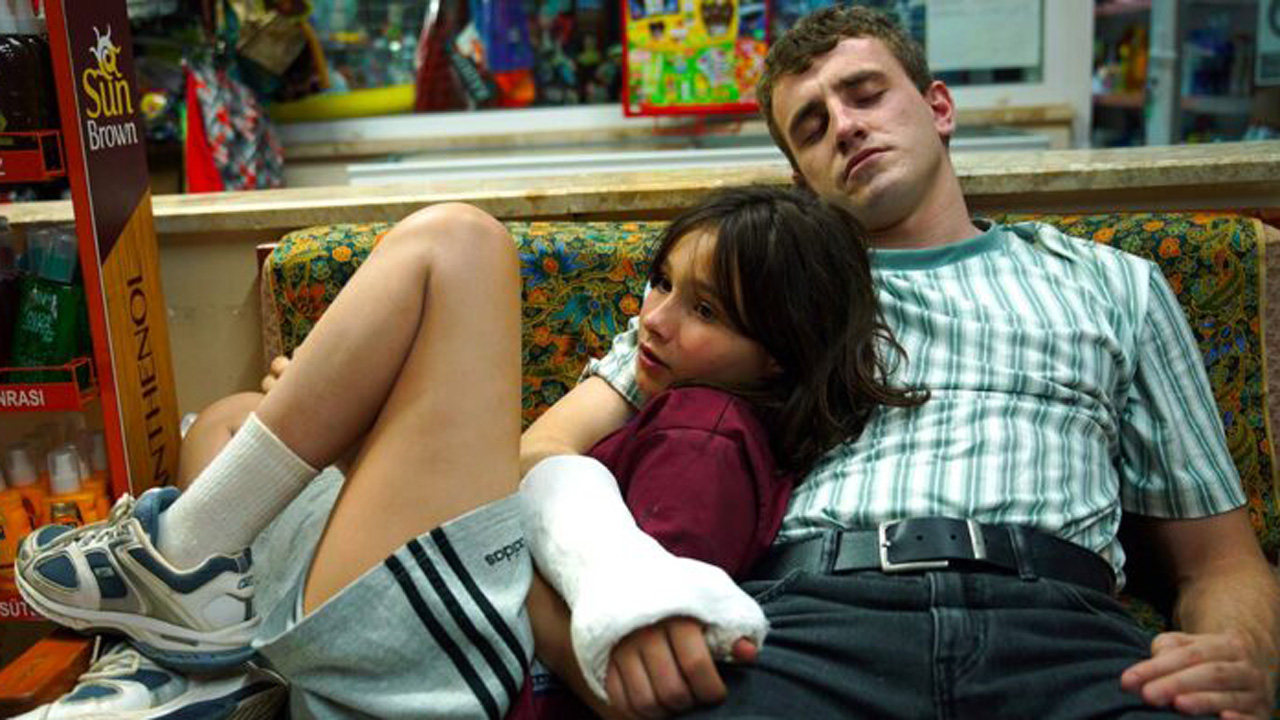
A few nights after viewing this, I was still piecing it together—less in terms of logistics than taking in all the shifting perspectives, recurring images, ambiguous tones and sustained feeling of drifting in and out of consciousness. Then again, I like movies that are somewhat unknowable. I retain and reflect on the experience of watching this more than anything else I’ve seen in some time. Charlotte Wells’ debut feature is less a key for a lock than an open door into another way of seeing. Also, Paul Mescal proves that his breakthrough performance in NORMAL PEOPLE was just an inkling of things to come.
2. TÁR
A great film, and writer/director Todd Field and star Cate Blanchett seem to know it; such air would normally be off-putting, but the fluidity and grace with which the whole thing moves (acrobatic sound design and all) reminds me of something like Kenneth Lonergan’s MARGARET but minus that film’s pretensions towards greatness, or perhaps everything comes together so convincingly that it doesn’t matter. A pitch-black comedy in prestige drama clothing, TÁR is sui generis, nearly as entertaining as Paul Thomas Anderson and as enigmatic as Kubrick. 158 minutes have rarely passed by so swiftly.
3. AFTER YANG
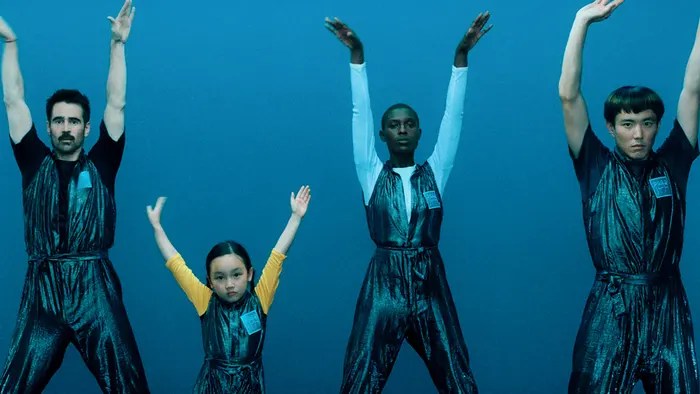
I recently wrote something about falling in love with a film over its opening credits, and I think this one is a contender. A tad more accessible and also genre-defying than director Kogonada’s last film COLUMBUS without lessening the qualities that made it unique, it’s science fiction without walls, exploring artifice and memory and what it could look like if the two would ever intersect. Also, I want to feel as passionate about and satiated by something as Colin Farrell’s character (his best work since THE LOBSTER, though see also #11 below) is with regards to tea.
4. MEMORIA
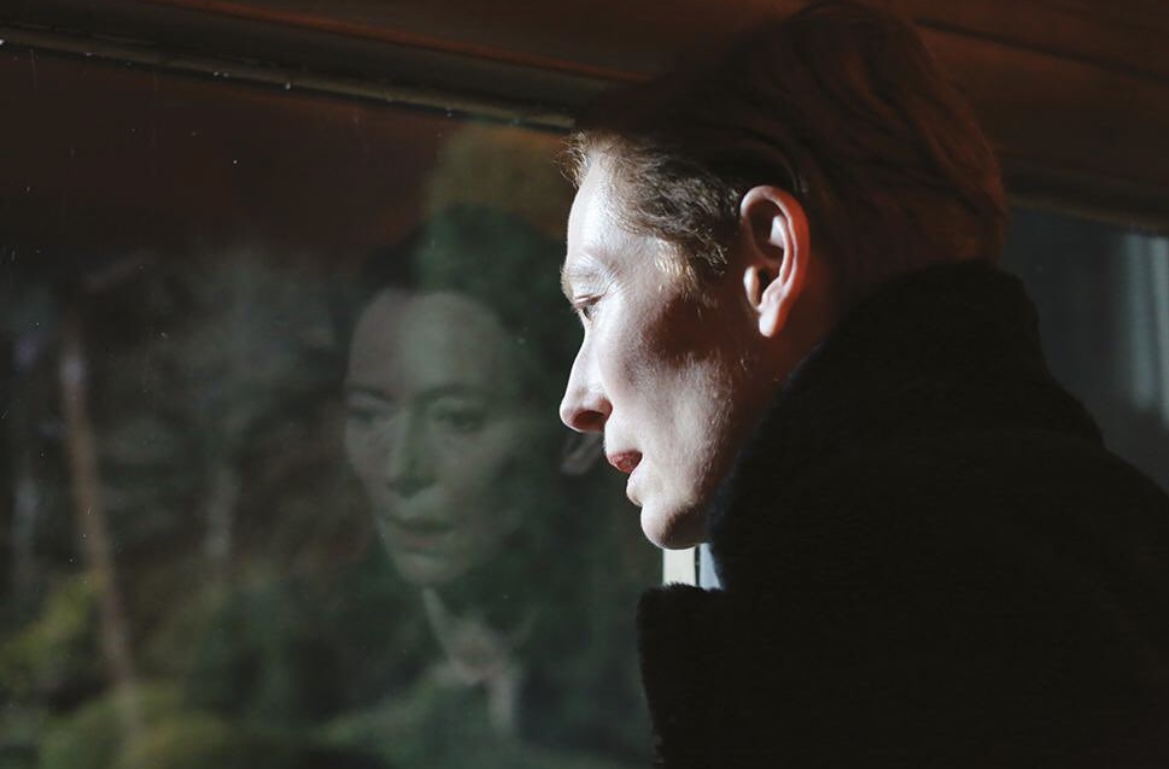
Apichatpong Weerasethakul’s first film outside of Asia (and follow-up to my favorite film of the last decade) is no less experimental than his previous work, thank god. Tilda Swinton’s been an expertly intuitive reactor since her Derek Jarman days, and this might be her most fascinating performance in some time for how she simultaneously commands the screen and also fades into it. I found this fascinating (if equally confounding) after my first viewing; it made somewhat more sense after a second viewing but remained, like everything else the director has done, slow, perplexing, surprising and one-of-a-kind.
5. A LOVE SONG
Her weathered face, Tennessee accent and general moxie has relegated Dale Dickey to smaller, supporting parts (most notably WINTER’S BONE); here, she’s as earthy and tenacious as you’d expect, but this tailor-made leading role allows her to exhibit much more vulnerability and warmth than usual. Furthermore, writer/director Max Walker-Silverman’s gem of a first feature gradually reveals itself as a film about time and loss, the need for connection and the benefit of perseverance and finding strength within. Although Dickey’s character doesn’t stray far from where she’s anchored her trailer, she goes on a considerable journey of the soul.
6. DRIVE MY CAR
Despite all the awards it received last year, I’m counting this as a 2022 film since it didn’t screen or stream here until then. The allure of this bold if leisurely paced Murakami adaptation is that you don’t necessarily know where it’s going, but when it gets there, the impact is staggering without seeming showy or unearned. I first saw it last March and am still looking forward to carving out another three hours to watch it again.
7. THE ETERNAL DAUGHTER
Call it the year of Tilda Swinton, I guess, or call this Joanna Hogg’s THE PARENT TRAP, only Swinton plays mother and daughter instead of twins, the genre’s gothic/psychological horror (set at an equally creepy/charming old British estate/hotel) rather than Disney rom-com, and the dog (Swinton’s own pet!) gets fourth billing. Also the third of a trilogy (which includes THE SOUVENIR, PART II (see below)) and possibly the best of the three.
8. WOMEN TALKING
Mostly meeting my ridiculously high expectations for it, Sarah Polley’s return to filmmaking is both of the moment and seemingly timeless. Though the story occasionally oversteps and the final section drags a bit, those are minor complaints: here, Polley depicts a world contained to the point of being restrictive; with great catharsis and reasoning, the film shows with artful clarity why this is damaging and what future generations can do to avoid succumbing to such a closed-off, incomplete life.
9. BENEDICTION
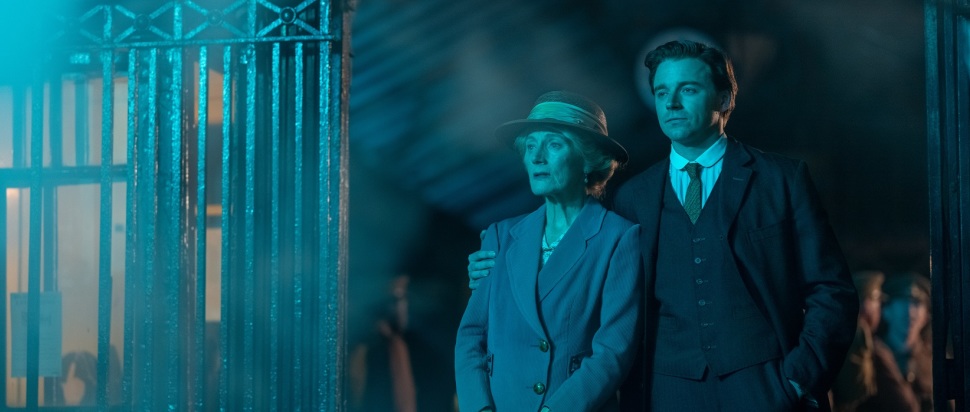
Terence Davies’ portrait of World War I soldier/poet Siegfried Sassoon is as unique as you’d expect from the director; what I wasn’t expecting was something more akin to his early masterworks like THE LONG DAY CLOSES than anything he’s done since. Along with his other recent poet biopic about Emily Dickinson, Davies is clearly on a late-career high with this, his most deliciously bitchy film to date (and it doesn’t even have Laura Linney in it.)
10. PETIT MAMAN
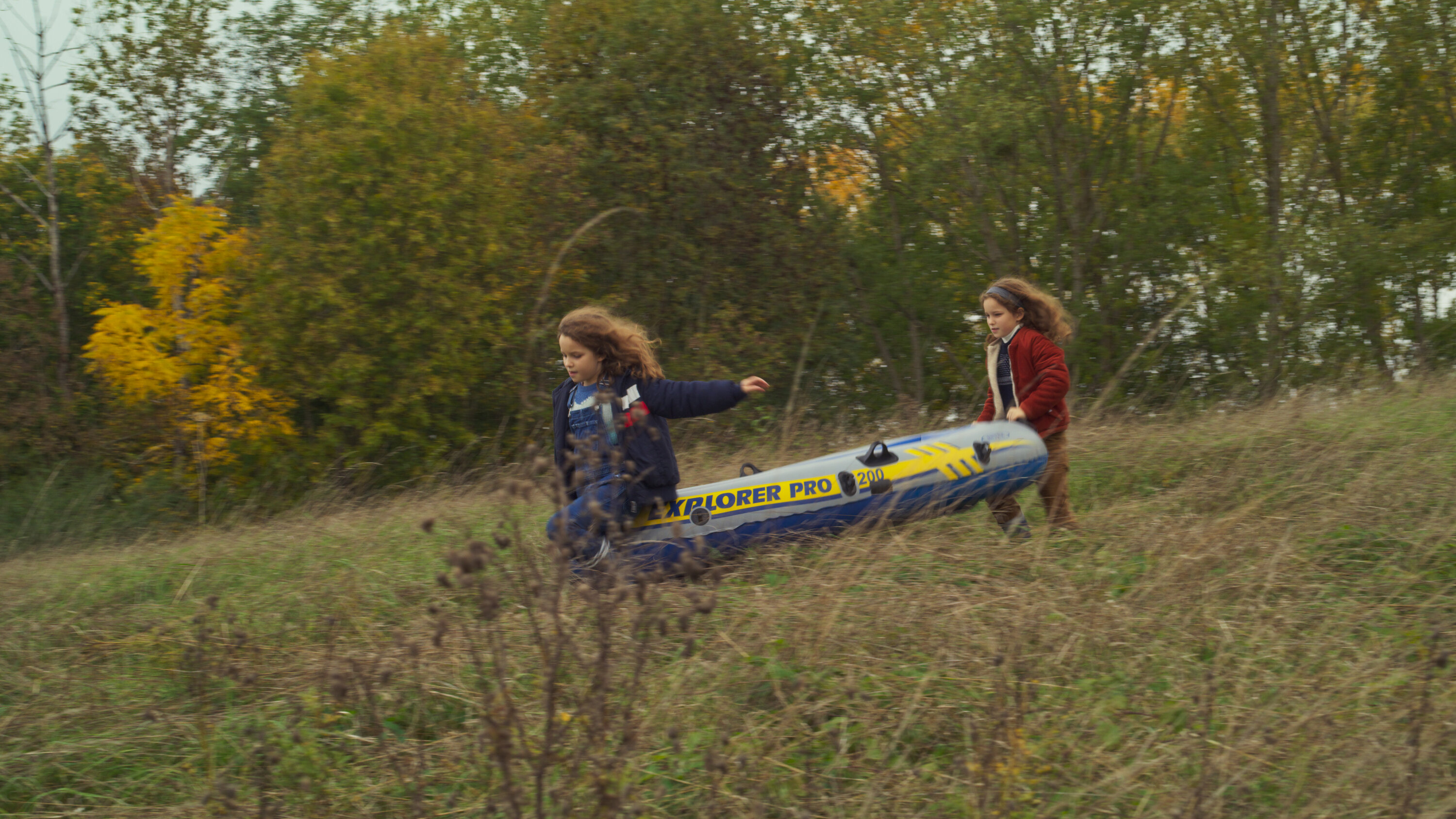
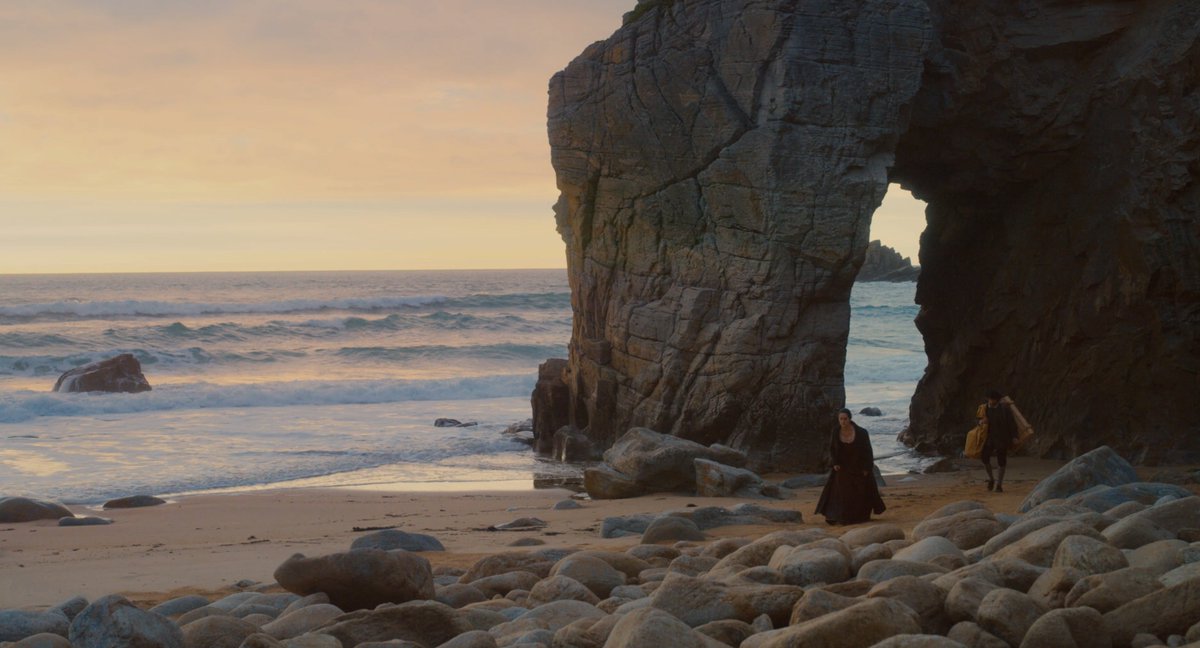
Celine Sciamma follows her most acclaimed work (PORTRAIT OF A LADY ON FIRE, already placing high in this decade’s Sight and Sound poll) with a deceptively simple fantasy about memory and motherhood that ends up one of her more conceptually ambitious films. As usual, she builds a fully realized world built out of a few essential components, only this time with a playfulness-bordering-on-whimsy that’s difficult to pull off (but rest assured, she does.)
11. THE BANSHEES OF INISHERIN
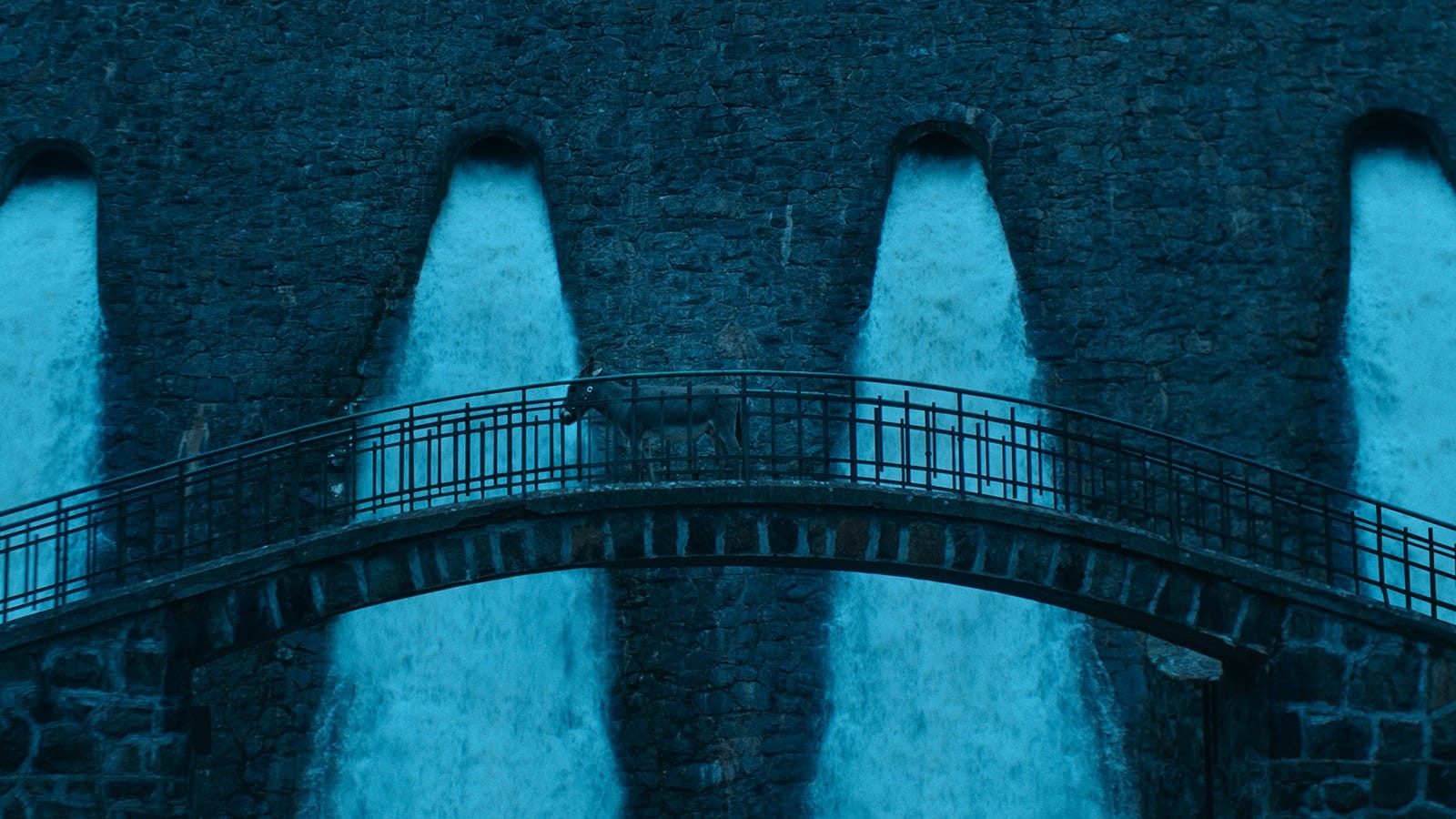
Makes a lasting impact for the striking, evocative landscapes, the performances and the confirmation that an isolated place, no matter how striking or evocative can be heaven for a few days and deadening for an eternity.
12. GIRL PICTURE
An immensely likable Finnish indie dramedy which portrays female teen relationships with a genuineness that’s instantly winning—up there with the likes of OUR SONG and GHOST WORLD (though far sweeter and less acerbic.)
13. THE DOG WHO WOULDN’T BE QUIET
“You’ll be fine, it will pass, you’ll get used it,” our protagonist is dutifully told in this purposely disorienting but intriguing, unclassifiable reverie from Argentinian director Ana Katz.
14. STRAWBERRY MANSION
Set in a near-future where dreams are taxed by the government, I knew I adored this film about ten minutes in when the title card appeared (let’s just say it involves an ice cream cone.)
15. ALI & AVA
From the director of THE ARBOR, it has a good beat and you can dance to it (to quote American Bandstand.) Also gratifying to see Adeel Akhtar and Claire Rushbrook cast as unconventional romantic leads.
16. THE CATHEDRAL
A sort of autobiography relayed in carefully chosen fragments, it plays like BOYHOOD condensed to ninety minutes but with four different actors instead of one (because it wasn’t shot over a dozen years.)
17. GLASS ONION: A KNIVES OUT MYSTERY
Rian Johnson can make as many of these as he likes as long as he keeps assembling dynamite casts and giving Daniel Craig-as-Benoit Blanc phrases to drawl like “Jared Leto’s Hard Kombucha.”
18. THE WORST PERSON IN THE WORLD
Divided into a very Godard-ian twelve chapters with a prologue and epilogue, Joachim Trier’s latest plays with form and genre; it also verges on precious at times only to always snap back into sharp focus.
19. PETER VON KANT
This is how you remake Fassbinder: cast a boisterous lead (Denis Menochet) who could play him in a biopic and include a glorious running sight gag like poor, dear, silent slave-twink Karl (Stefan Crepon).
20. EVERYTHING EVERYWHERE ALL AT ONCE
Unlike SWISS ARMY MAN, this is silliness I can fully abide, thanks to Michelle Yeoh and the rest of its glorious weirdo ensemble. Nearly a BEING JOHN MALKOVICH for the internet age of info-overload.
My movie watching decreased by 30% in 2022—completely expected since between the pandemic and unemployment, 2021 was an anomaly of a year. If I learned anything from such circumstances, they helped me acclimate to watching more movies at home, as Letterboxd (now five years after I began using it) ended up a motivator to watch more movies, period. Here are the best older (pre-2021) films I saw for the first time this year.
1. KES
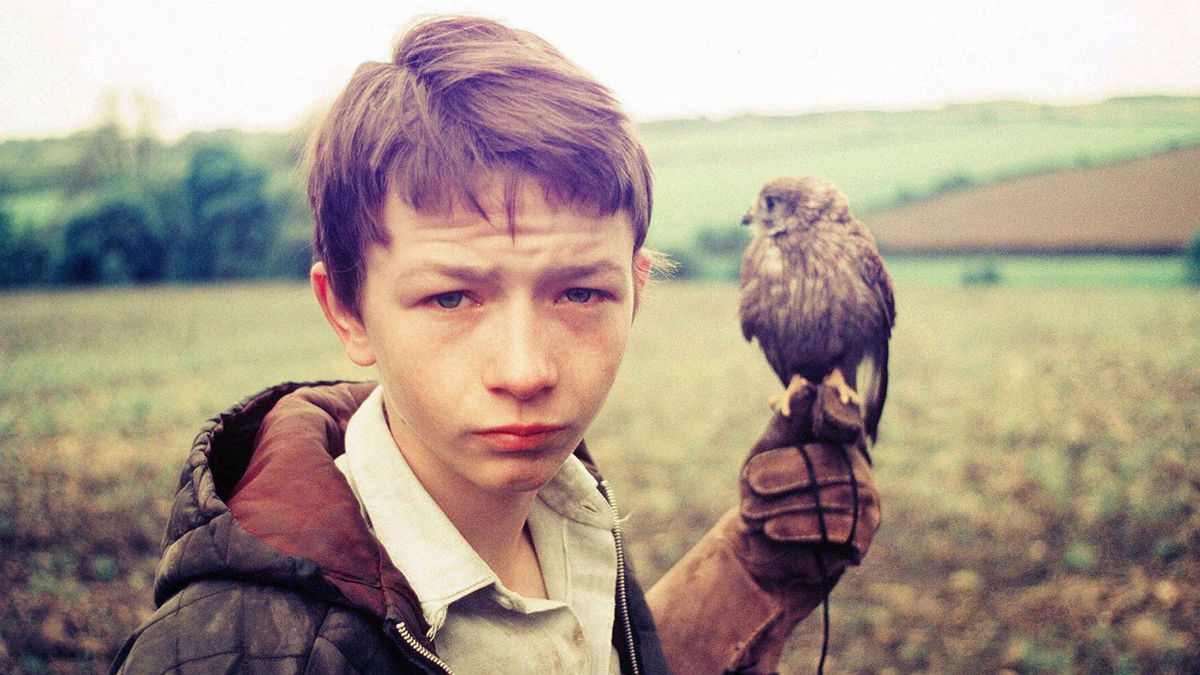
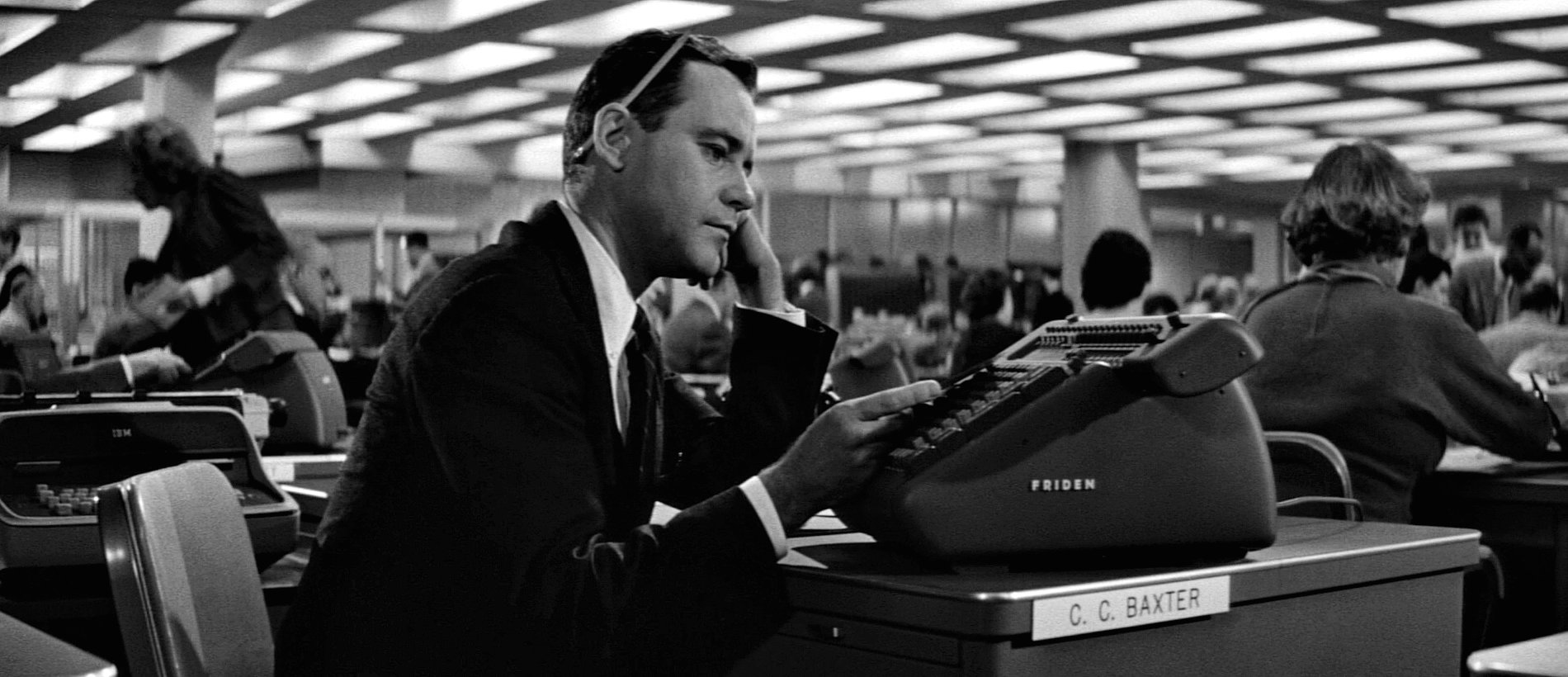
I’d seen a handful of Ken Loach pictures from this century but nothing earlier (unless you count the Poor Cow footage inserted into Soderbergh’s The Limey); I want to see more in 2023 as his second feature (from 1969) is simply masterful. An initially straightforward but increasingly resonant story about a boy and his bird, it captures something about the British working class arguably not even Loach contemporary Mike Leigh has ever replicated. Looking beyond archetypes, it subtly indicts an entire social structure while also locating a speck of transcendent beauty within it.
2. RUNNING ON EMPTY
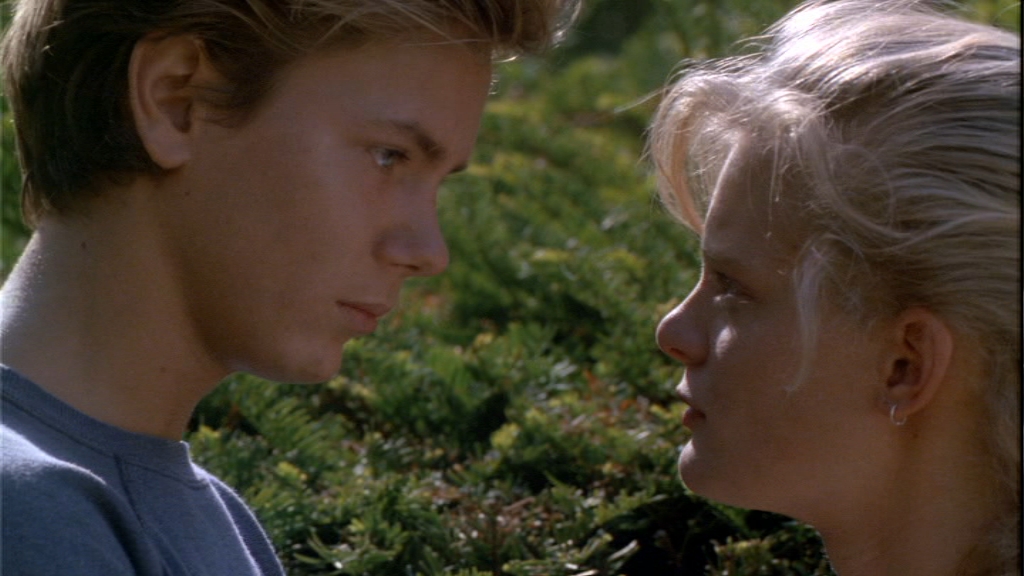
A teenager (River Phoenix) born into family forever on the run (due to a crime committed by his former hippie-activist parents) struggles to forge his own identity. While Phoenix’s death five years later makes it too easy to overrate his work, here (along with My Own Private Idaho) it’s sublime, as is Sidney Lumet’s direction—for that matter, so is the family sing-along to (of all things) a James Taylor song (too earnest to probably get away with in a movie today.)
3. GRAND HOTEL
In 2022, I kicked off an attempt to watch all the Best Picture Oscar winners I haven’t seen (about 40 or so) over the next few years; this is the best of the five I’ve made it through so far. Viewing this pre-code film was like trying on a vintage coat that fits beautifully: you’ve experienced such level of comfort before (via all the ensembles that followed from Robert Altman to Wes Anderson) but its age, finery and grace render it all the more satisfying.
4. SHERLOCK, JR.
I admired Slate film critic Dana Stevens’ new book about Buster Keaton—not enough to make my top ten this year, but at least it encouraged me to seek out the major works of his I’ve missed. This one in particular also landed dead-center on my radar after it cracked the latest Sight and Sound poll’s top 100. It’s 45 minutes long, just at that breaking point to distinguish a feature from a short, and it would be peak Keaton even if it didn’t have the best chase scene of all time.
5. DEAD RINGERS
David Cronenberg came back with the good-enough Crimes of The Future this year; if you liked it, chances are you’ll love this. Building on the body horror/tech-nerdery of Videodrome, it’s a feat of camera trickery but also a deep dive into all of the unsavory obsessions that makes his characters (and for all we know, the director himself) tick. Also, watching Jeremy Irons perform mouth-to-mouth on himself (or at least his body double) is a very Special Moment.
6. ONE SINGS, THE OTHER DOESN’T
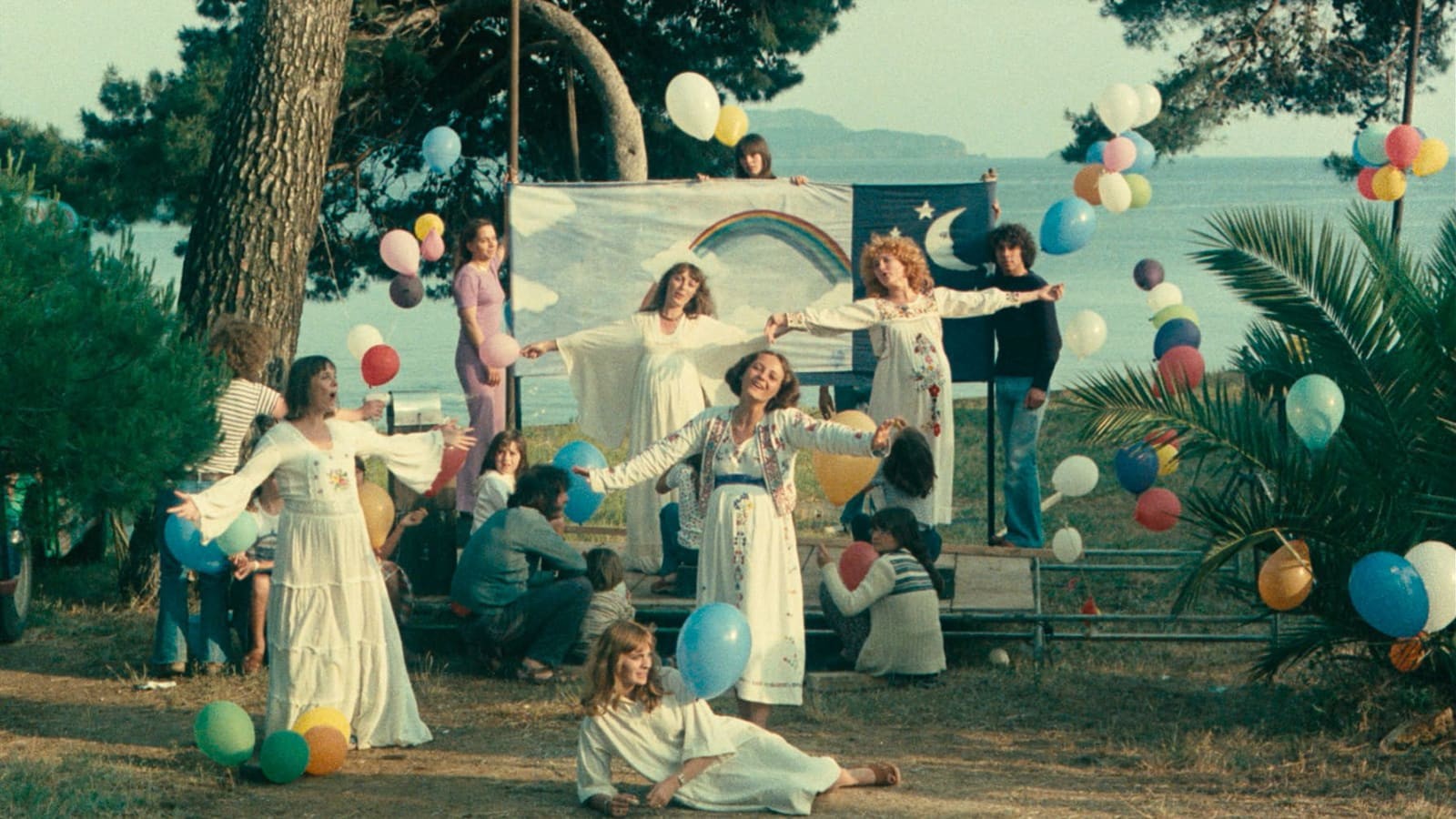
Alternate title: Women’s Lib Rules. Agnes Varda was a treasure for many reasons, not least of which was that she made narrative films (Cleo From 5 To 7) as genuine and engaging as her documentaries (The Gleaners And I). This hails from a somewhat undervalued period between those two peaks; however, its dissection and celebration of feminism and abortion rights is obviously as relevant as ever and that she fashions it with whimsy and humor doesn’t make it any less powerful than a more outwardly darker work like Never Rarely Sometimes Always.
7. THE CROWD
This came as a recommendation from former Boston Globe critic Ty Burr when it aired on TCM (it’s not streaming anywhere); I want to rewatch it in a cinema when I next have a chance. Although King Vidor’s film about society, peer-pressure and collectivism looks and feels the near-century old that it is, it doesn’t matter: great art endures when it retains a strong resemblance to the present moment in premise and concept if not in its physical aesthetic.
8. CORPUS CHRISTI
The idea of a criminal posing as a member of the clergy isn’t new; to frame it as an identity crisis and a genuine attempt at redemption rather than just for laughs, however, sets up a tightrope walk for this Polish film’s protagonist, who lives out his selfish fantasies while also becoming a more active presence for good in the world. And yet, there are no easy resolutions and the film zags when you expect it to zig without losing focus or purpose.
9. MIDNIGHT RUN
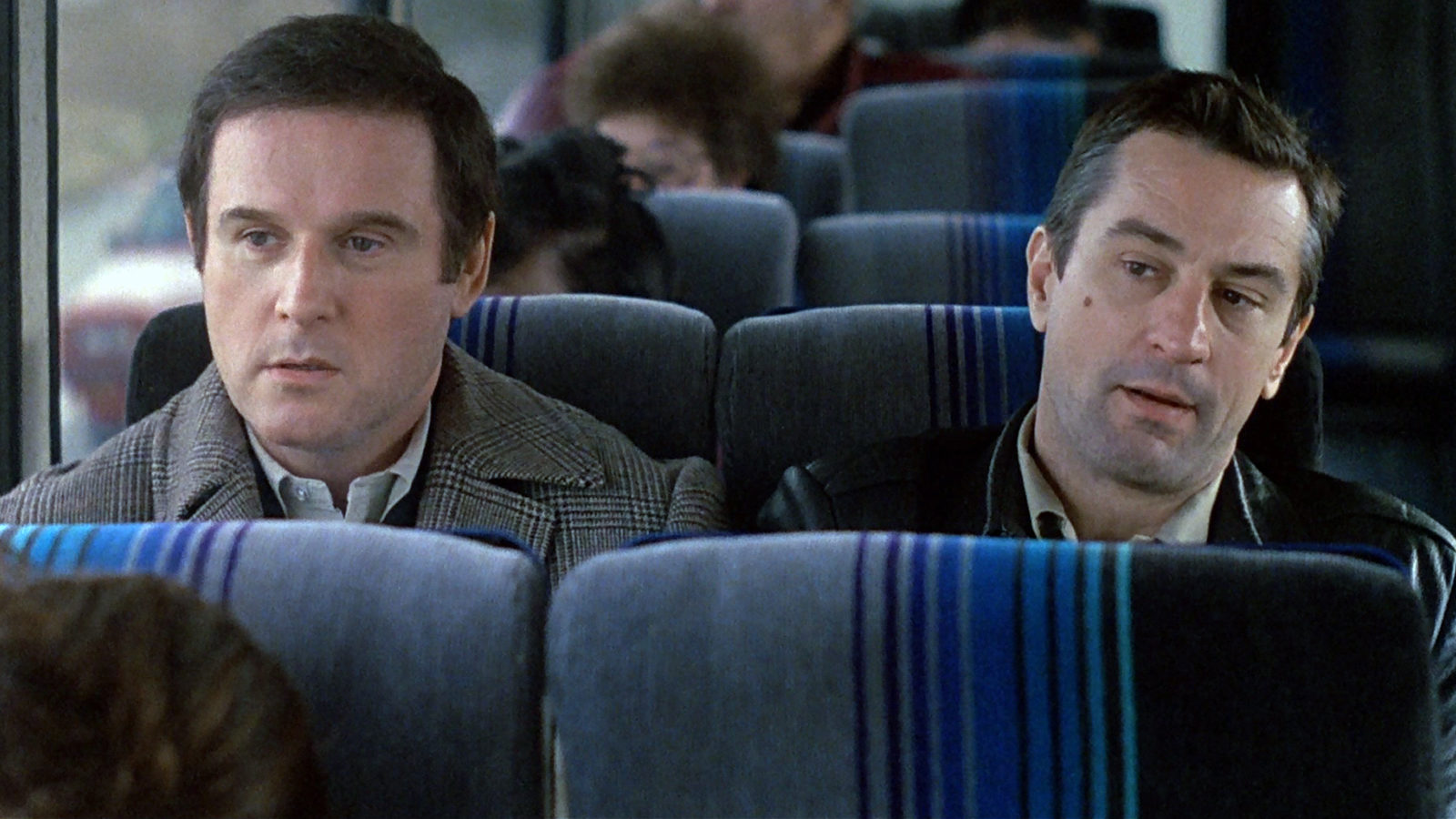
I often think of the late 1980s as a particularly fallow period for cinema, but this is the third 1988 film in this top ten and it’s a glorious action-comedy, like Lethal Weapon but with brains and far more nuanced dialogue and character development. Also, it greatly helps that Robert De Niro (so good at comedy when given a good screenplay!) and Charles Grodin are as inspired and sublime a pairing as Lemmon and Matthau, Pryor and Wilder, Tracy and Hepburn.
10. SIGN O’ THE TIMES
Long available for whatever reasons I suspect are firmly kept locked up in the Paisley Park vault, this concert film to complement Prince’s landmark 1987 double album of the same name has, like so much since his untimely death, reemerged. As a “director”, the Purple One was obviously no Jonathan Demme, but this, made at his absolute fucking peak (at least artistically), should be as well-known as Stop Making Sense. The choreography is almost as amazing as the outfits, which are almost as wonderful as the music.
HONORABLE MENTIONS:
Birth, Blue Collar, Chocolat (1988), Darling, Fort Tilden, The Godfather Part II (!), The Heartbreak Kid (1972), Jaws(!!), Once Upon A Time In America, ‘Round Midnight, The Secret of Roan Inish, The Sisters Brothers, Splendor In The Grass, Time Piece*, Titicut Follies, A White, White Day
(*A short presently streaming on Mubi and a must-watch for any Jim Henson fan.)
Vive L’Amour
BEST RE-WATCHES (not including anything for 24 Frames):
Appropriate Behavior, The Boy Friend, Delicatessen, Dick, Ed Wood, Hairspray (1988), Knives Out, The Last Days of Disco, Nosferatu The Vampyre (1979), Out Of The Past, Phantom Thread, The Shop Around The Corner, Something Wild, The Sweet Smell Of Success, Vive L’Amour, Written On The Wind
I dutifully post top ten lists of favorite albums, books and movies every year; you’d think I’d do the same for TV, but I’ve only tried it once, back in 2013, roughly when the term “Peak TV” entered the parlance (although streaming was relatively new with Orange Is The New Black in its first season.) My tendency to not formally keep track of shows I watched is likely what prevented it from becoming a tradition; an endless number of platforms, limited series, and erratic scheduling (I haven’t been excited about “The New Fall Season” in well over a decade) didn’t help, either.
This year, I started a spreadsheet listing every new series and every new season of returning series that I watched, along with a second tab of new shows/seasons I hoped to watch (I made decent progress on the latter, even if I never got around to a dozen new-ish shows ranging from For All Mankind to Fleishman Is In Trouble.) Rather than roll out a top ten accompanied by capsules for each title, here’s a simple list (with the platform each show aired on), followed by a longer essay.
Severance
Top Ten TV Series of 2022:
Severance (Apple TV)
Reservation Dogs (FX)
Better Call Saul (AMC)
Somebody Somewhere (HBO Max)
Barry (HBO Max)
The Rehearsal (HBO Max)
The White Lotus (HBO Max)
The Sandman (Netflix)
Minx (HBO Max)
Heartstopper (Netflix)
This year, I bit the bullet and subscribed to HBO Max indefinitely (as opposed to my usual month or two at a time)—a wise investment, since its shows make up half the list (even if they foolishly got rid of Minx in Dec.) Neither The White Lotus’ highlyanticipated second season nor Barry’s even longer-awaited third season disappointed—in the latter’s case, it was the show’s best yet, further blurring what genre it was (Sitcom? Harrowing Crime Drama? Absurdist Tone Poem?) while giving Sarah Goldberg a slow-burn of a trajectory the elevated her performance to the same level of excellence as Bill Hader, Anthony Carrigan and a never-better Henry Winkler. I’m still on the fence whether The White Lotus’ Sicilian jaunt was better than the original Maui season, but one can’t accuse creator Mike White of cashing in or resting on his laurels (or Aubrey Plaza or Jennifer Coolidge, for that matter.) Hacks’ second season retained everything great about the first (plus Laurie Metcalf and Susie Essman) and just narrowly missed the top ten.
Getting back to Minx—what a well-cast and conceived period piece about feminism, journalism and sex (props to Starz for saving the show, which had nearly finished production on a second season when HBO Max’s parent Warner Discovery pulled the plug.) The Rehearsal was also a triumph, both exactly what one would expect from a follow-up to Nathan For You and so much more, almost like Synecdoche, New York transformed into an ongoing quest that never fully lays down all its cards. My favorite new show on the streamer, however, was Somebody Somewhere, a somewhat unlikely vehicle for the usually bawdy comic performer Bridget Everett—it valued community and the importance of cultivating dreams like no other show since my beloved, gone-too-soon Lodge 49.
Although Netflix still often stresses quantity over quality, it premiered two new series (both adapted from graphic novels) that made my list. Heartstopper I instantly fell for with its well-cast leads, gentle demeanor and its comprehension (along with the streamer’s) that the world was more than ready for a nuanced gay teen romance. Neil Gaiman’s The Sandman, on the other hand, took a few episodes to connect with—understandable, given that nearly each one could be the seedling for a different branch of a show. Headier and riskier than say, Stranger Things, it’s a compelling vortex if you happily give yourself over to getting lost in it.
Breaking Bad’s final season topped my 2013 list; this year, its spinoff/prequel’s final season comes close. Overall, Better Call Saul is the better show in that I’d much rather watch it again in its entirely than its predecessor (also, Kim Wexler is more fascinating a parallel protagonist than Jesse Pinkman.) While the final run of episodes might’ve been tighter (Carol Burnett or not), that it ends up a show about redemption puts the entire series in a class with The Americans and Mad Men.
Reservation Dogs has potential to end up a show of such distinction. I began watching the first season (which aired in 2021) in late summer and after a typically embryonic pilot, the show’s rhythms clicked into place but continued to evolve. By the first season’s end, it revealed itself as a show about grief as experienced by four Native American teenagers and their extended community, which gradually expanded in the second season, building worlds upon worlds for a people whose story the medium had previously at best, ignored (and at worst, misrepresented); that it does so by forgoing sanctimony for a more complex mix of emotions and tones makes it nearly the best series currently airing.
Severance, however, is something else. Nearly Netflix’s opposite, Apple TV seems to value quality over quantity: Dickinson, Mythic Quest, Loot, Bad Sisters, even Ted Lasso (we’ll just ignore The Morning Show) are all personal projects that reward the time put into them but Severance defies categorization. Tempted to compared it to Twin Peaks, I knew better, remembering when I likened the unclassifiable Lodge 49 to Northern Exposure—it hints at an overarching sensibility but is still entirely its own thing. The Office meets The Twilight Zone doesn’t do it justice, either. Talk about building one’s own universe—the production design is as distinct (and as radically different from) a Wes Anderson film, yet it doesn’t overshadow the emotional beats of its slippery narrative or fiercely dedicated performances from Adam Scott, Patricia Arquette, John Turturro, et al. Each episode both a gift and a puzzle, it is the one show from 2022 I want to re-watch right now because perception of it shifts continually, like if The Good Place was sci-fi/thriller instead of a sitcom. Hoping the second season, to air later this year sustains and further enhances what the first one assembled without faltering and/or withering.
Our Flag Means Death
Honorable Mentions:
Abbott Elementary*, Documentary Now!, Ghosts, Hacks, A League of Their Own, The Marvelous Ms. Maisel, Only Murders In The Building, The Orville: New Horizons, Our Flag Means Death, The Righteous Gemstones, Russian Doll, Search Party, Wednesday, What We Do In The Shadows
(*watched the first season (early 2022) but not the second yet)
Haven’t Finished the Current Season, But Am Invested:
Bad Sisters, Derry Girls, Loot, Physical, Welcome to Chippendales
Most years, my film group conducts a poll amongst its members. In the past, we’ve determined our all-time favorite films of a particular genre (horror, documentary, animation) or other categorical distinction (remakes and sequels, foreign language, black-and-white.) For the first time, this year’s list is centered on people rather than films. One would think it a breeze to curate a list of just 25 or 50 directors; my original long list ended up past the 150-mark. We were allowed to include up to 100, which is what my ballot below has. The first 30 or so are the most important; the placement of almost anyone beneath is a little more arbitrary.
In curating my list, I thought about whom I’d most like to see on the group’s list which is chiefly why Agnes Varda ended up at #3 – French, female, equally adept at documentary and fiction, she’s the sort of revered talent (that might not necessarily be a household name) that the group was created to promote and highlight. I also wanted to talk up my favorite LGBT directors which accounts for half of my top ten. My first draft placed the ever-dependable, ever-unique Tsai Ming-liang at top but in the end, I couldn’t deny giving it to the artist I wrote my Master’s thesis in Film Studies on.
The thing with all-time-best-of lists is that they could credibly go on for days. What favorite filmmakers of yours missing from the 100 below would you have included?
I read exactly the same number of books as last year, though that doesn’t necessarily mean I read as much. Look through the list below and you’ll find nothing nearly as long as My Struggle (Book 6) or Don Quixote (though the compulsively readable The Goldfinch sprawls way past the 500-page mark.) Of the eight re-reads, Tom Spanbauer’s semi-autobiographical coming-of-age-in-1960s-Idaho novel was the most enjoyable, but Jennifer Egan’s A Visit From The Good Squad proved the most illuminating, particularly in those moments where she anticipated (if not quite fully predicted) the current era.
My ten favorite new-ish books I read in 2022 (unranked; in alphabetical order by author’s last name):
Jennifer Egan, The Candy House
As sequels to Pulitzer Prize-winning novels go, this gets a nod over Andrew Sean Greer’s pretty great Less Is Lost for its sheer ambition. Matching and occasionally exceeding the first book, Egan shifts her focus from music to technology which allows her to cast an even wider net without obscuring the ethical and psychological implications of humans having access to, well, everything.
Jonathan Franzen, Crossroads
Franzen’s long-form fiction is so consistent he might be my favorite current American novelist. This typical-for-him doorstop, the first in a purported trilogy is simply what he does best. A rich but contained familial drama set mostly in 1971, it’s like The Corrections after two decades of lived experience informing an attitude that neither belittles nor deifies its well-drawn characters.
Hannah Gadsby, Ten Steps To Nanette
You’d wouldn’t expect a by-the-numbers memoir from Gadsby or even her one-woman show Nanette simply retold in book form. Although this serves as both memoir and Nanette companion, it’s also a fascinating deconstruction of Gadsby’s history, persona and, in meticulous detail, how she conceived and constructed the monologue that made her infamous.
Jessi Klein, I’ll Show Myself Out
I enjoyed this as much as You’ll Grow Out Of It, television writer/producer/voice actor Klein’s first essay collection from 2016. Following the birth of her son, this sequel consists of amusing, caustic and often riotously funny observations of raising a young child in your 40s. More Sedaris than Bombeck, Klein deserves an audience as bountiful as either of them.
Mary Jo Pehl, Dumb Dumb Dumb: My Mother’s Book Reviews
Best known as a writer/performer on Mystery Science Theater 3000, Pehl’s slim but satisfying memoir has a novel slant. Following her mother’s death, Pehl discovers a box full of notecards containing handwritten, haiku-like thoughts on the books she had read. From these pithy remnants, she assembles (with disarming Midwestern humor) a multifaceted portrait of her mom while also surveying her own grief.
Sarah Polley, Run Towards The Danger
A child actor-turned-director/screenwriter, Polley’s been mostly MIA for the past decade; this essay collection explains why. Due to a freak accident, she suffered brain damage that left her unable to work. She’s now recovered (her new film, Women Talking, is in theaters as I write this) and uses this experience as a catalyst for six essays about taking risks, working through trauma and confronting the unknown. Happily, her essaying retains all of the steel-eyed complexity and personable wit of her other creative pursuits.
David Sedaris, Happy-Go-Lucky
The newfound depth and maturity on display in 2018’s Calypso continues in this latest collection. Sedaris muses on life during COVID, naturally, but also centers on his 98-year-old father’s decline and death and his own mortality. Rest assured, even as he delves further into personal and often uncomfortable places (from American gun culture to revelations about his father), he has little difficulty locating the humor in such taboos without coming off as cynical or flippant.
Gary Shteyngart, Our Country Friends
Having written a novel set during the 2016 election, Shteyngart’s follow-up concerns a family and their friends sequestering themselves at a crumbling, upstate New York estate in the early days of the pandemic. It reads like a Robert Altman-directed French farce as filtered through the author’s unique, endearing perspective of an immigrant writer/humorist forever navigating/questioning/discovering their own place in America.
Bob Stanley, Let’s Do It
A companion to 2013’s Yeah Yeah Yeah, a history of modern pop (i.e. the Rock and Roll era), this tracks everything that came before, from the dawn of popular music at the turn of the 20th Century to early 1950s crooners and their adherents in the following two decades. It doesn’t cohere as well as its predecessor but Stanley writes so eloquently about everyone from Duke Ellington to Rod McKuen that it winds up another essential tome for nearly all music fans.
Martha Wainwright, Stories I Might Regret Telling You
Often in the shadow of her parents and older brother, Wainwright’s own talent as a singer/songwriter is nothing to scoff at. Her memoir might be the best I’ve encountered by a musician since Liz Phair’s Horror Stories in that Martha exhibits a candor fully in tune with the book’s title without seeming sensationalist or self-indulgent. She’s set a high bar if Rufus ever decides to attempt a memoir of his own.
***
Here’s my complete 2022 Booklist, with titles in chronological order of when I finished reading them (starred entries are books I’ve re-read):
Tom Gatti (ed.), Long Players
Jonathan Franzen, Crossroads
Tamara Shopsin, LaserWriter II
Gary Shteyngart, Our Country Friends
Kelefa Sanneh, Major Labels: A History of Popular Music in Seven Genres
Dana Stevens, Camera Man
Jennifer Egan, A Visit From The Goon Squad*
Robin Sloan, Mr. Penumbra’s 24-Hour Book Store
David Mitchell, Ghostwritten
Chuck Klosterman, The Nineties
Marilynne Robinson, Jack
Peter Terzian (ed.), Heavy Rotation
Mel Brooks, All About Me!
Dale Peck, What We Lost*
Barbara Kingsolver, The Lacuna
Ann Patchett, The Dutch House
Kurt Vonnegut, Deadeye Dick*
John Dos Passos, 1919
Stephen King, On Writing
Augusten Burroughs, Running With Scissors*
Alex Jeffrey, Donna Summer’s Once Upon A Time (33 1/3 series)
Bob Odenkirk, Comedy Comedy Comedy Drama
Julie Klausner, I Don’t Care About Your Band*
David Sedaris, Happy-Go-Lucky
Karen Fowler Joy, We Are All Completely Beside Ourselves
Jessi Klein, I’ll Show Myself Out
Sarah Polley, Run Towards The Danger
Mary Karr, The Liars Club
John Waters, Liarmouth
Jennifer Egan, The Candy House
Carson McCullers, Collected Stories*
Donna Tartt, The Goldfinch
Sloane Crosley, Cult Classic
Tom Perrotta, Tracy Flick Can’t Win
Lesley Chow, You’re History: The Twelve Strangest Women In Music
Charlie Berens, The Midwest Survival Guide
Amos Vogel, Film As A Subversive Art
Hannah Gadsby, Ten Steps To Nanette
Molly Shannon, Hello, Molly!
Geoff Dyer, The Last Days Of Roger Federer
Kliph Nesteroff, We Had A Little Real Estate Problem
Scotty Bowers with Lionel Friedberg, Full Service
Paul Rudnick, Playing The Palace
Martha Wainwright, Stories I Might Regret Telling You
Patricia Bosworth, Montgomery Clift: A Biography
Bob Stanley, Let’s Do It
Mary Jo Pehl, Dumb Dumb Dumb: My Mother’s Book Reviews
As kids, we learned to define a holiday by its traditions: a neighborhood parade and fireworks for Independence Day, costumes and trick-or-treating for Halloween, turkey dinner on Thanksgiving. Christmas might have had more traditions than all the other holidays put together. I’ve previously written about such hallowed activities as purchasing and trimming a fresh tree, putting up lights and displays and, as an adult, braving blizzards and state lines to visit my folks.
Such rituals, however, barely graze the bottomless cornucopia of what makes Christmas complete. Not only did we schlep home a fresh tree every year, Mom would also handcraft a distinct set of ornaments (albeit usually from a kit): wooden painted Disney figures, painstakingly cross-stitched trinkets, little “people” constructed from clothespins and felt (I was always partial to the lady cellist because her eyes ended up a bit googly.) She’d also lay out my grandmother’s nativity on the dining room’s built-in buffet shelf while Dad and I put up the vintage Lionel train set I inherited from my Great Uncle Eugene around the tree. We’d watch nearly all the television specials that, in those pre-cable, pre-VCR days you had but one chance to view in real time when they aired, from the unimpeachable A Charlie Brown Christmas to whatever was trendy that year (even Pac-Man was deemed worthy of one.) Mugs of hot chocolate, glasses of eggnog, the brass angel display that spun when the heat from a lit candle was applied underneath, the red (or green) bulb Dad would place in the front porch light fixture—it simply wasn’t Christmas without each and every one of these traditions.
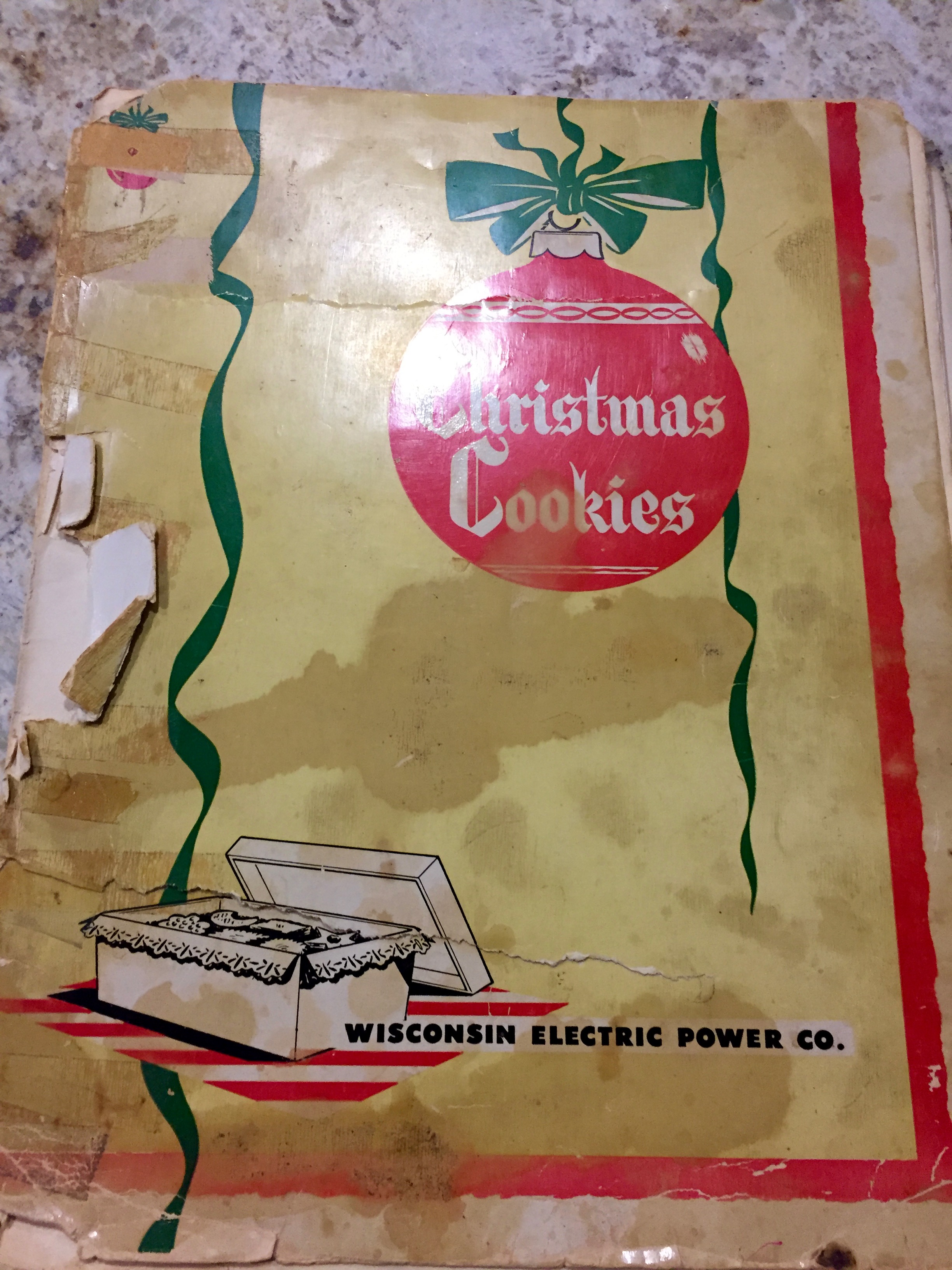
The most anticipated and certainly tastiest of them all were the many batches of cookies Mom made (and still makes to this day.) The rest of the year, we’d have your standard Nestle Tollhouse Chocolate Chip and Peanut Butter varieties, perhaps Oatmeal Raisin if mom was so moved. December was strictly for the season, even if it was as elemental as changing the chips from milk to mint chocolate or sprinkling colored sugar on the peanut butter ones. Actually, even those somewhat paled next to the extra special varieties, the ones that took more effort. Many came from ten-to-thirty-year-old cookbooks my mom wouldn’t consult for anything else—some of them were even exclusively devoted to Christmas cookies, published by and made available for free from the Wisconsin Gas Company every season. I was astonished a few years back to discover my mom had hung onto a book from 1953 that appeared to have been run through the dishwasher multiple times.
From such tomes came recipes for delicacies like Pecan Fingers, Rum Balls and that famous holiday staple, the Gingerbread Man. I believe this is also where the beloved, dreaded Pinwheels came from—adored for their complex taste and texture of chocolate and vanilla dough swirled together as its name dictates, abhorred because it was a particularly difficult, time-intensive cookie to make (even my grandmother, a masterful baker often groused about the process.) Much simpler (but no less delicious) were Almond Shortbreads topped with apricot or raspberry jam and Cream Cheese “Spritz” cookies, their dough (often enhanced with red or green food coloring) stuffed into a tube in a machine that would emit perfect spheres onto the baking sheet while unnervingly making a noise resembling a protracted, if finite scream.
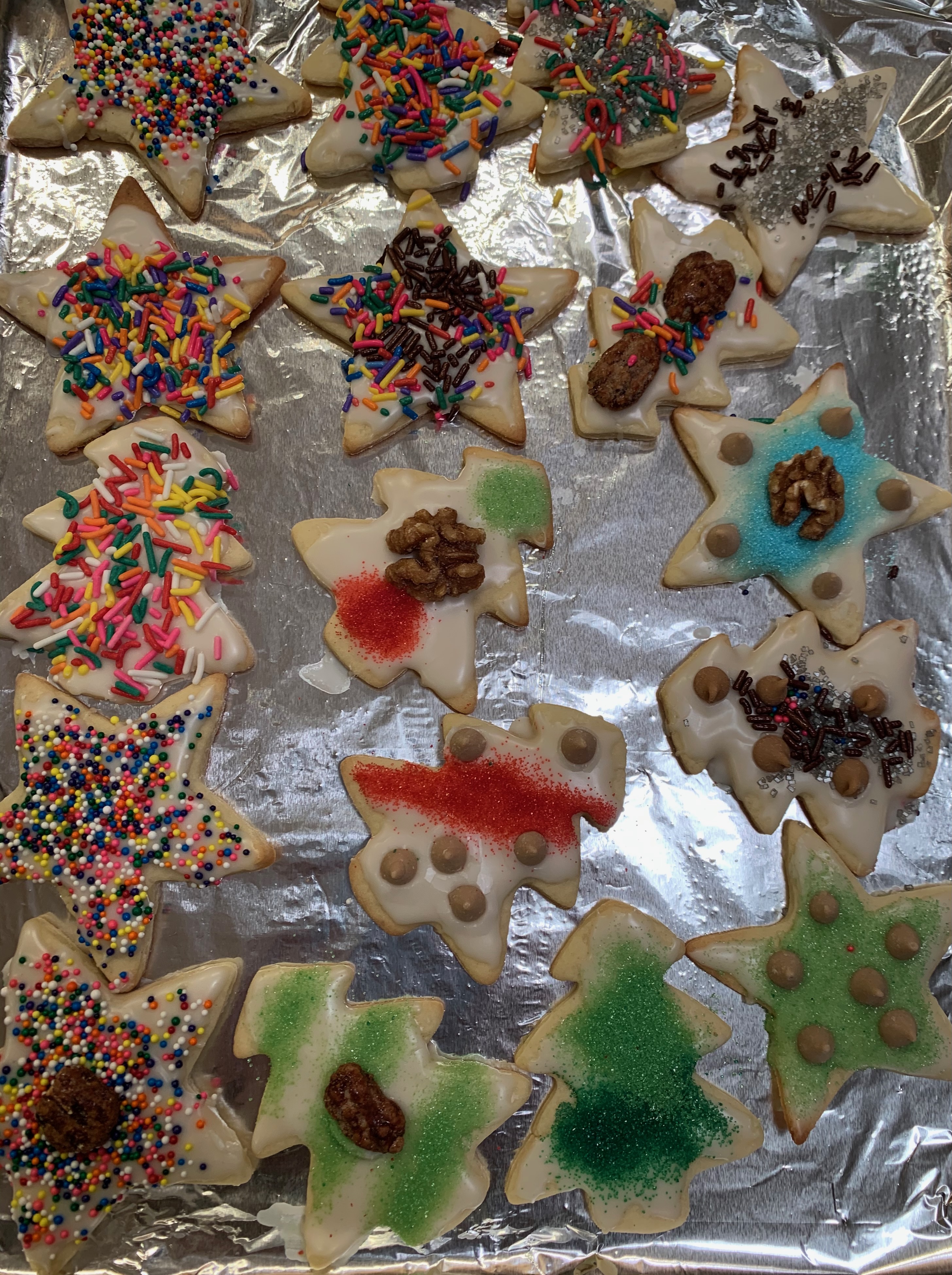
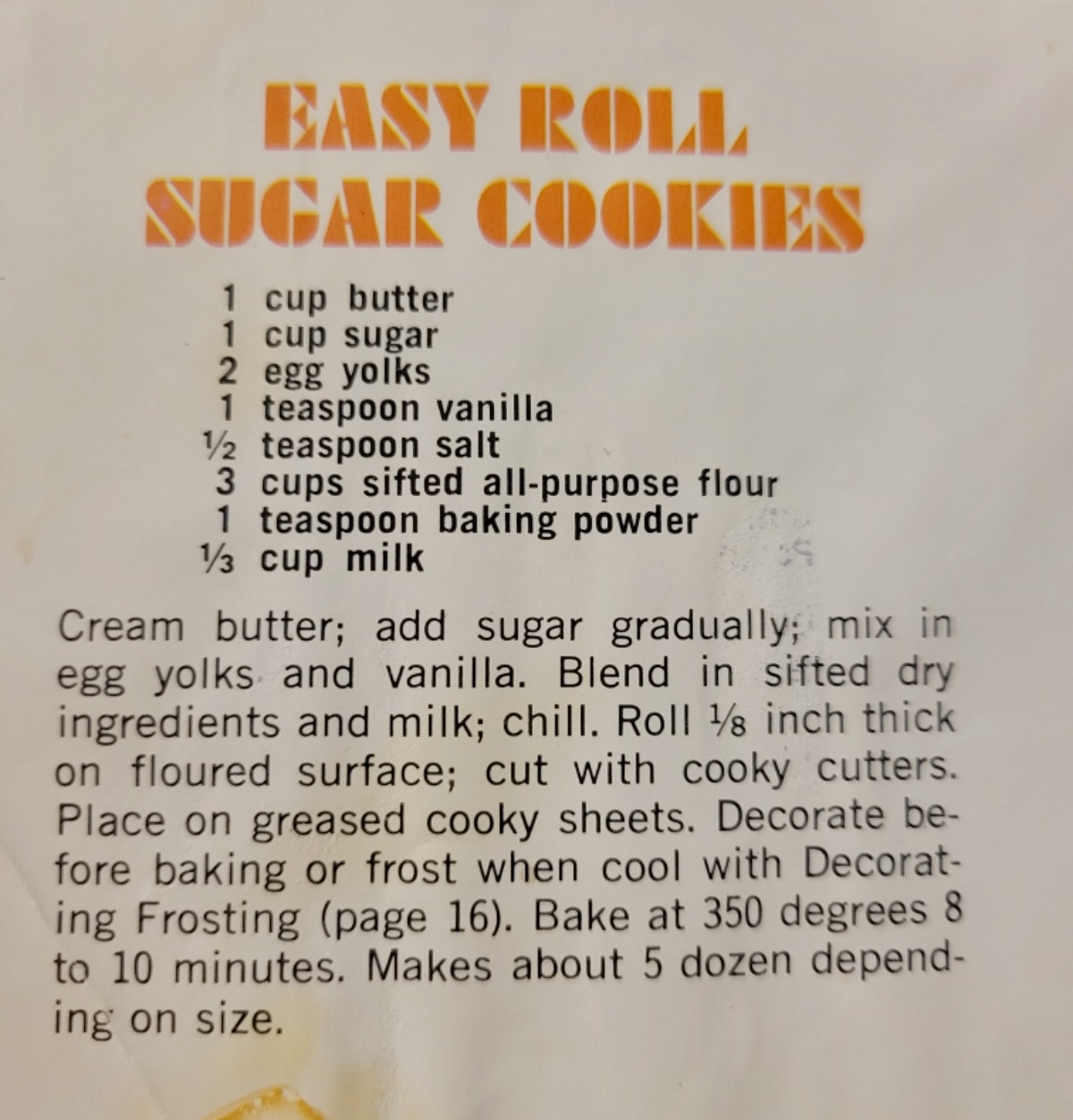
Even without any of these varieties, it’d still be Christmas as long as we had a few batches of iced and decorated sugar cookies, so essential that as a child I simply referred to them as “Christmas Cookies” (as if everything else was ancillary.) A week or two before the 25th, Mom would mix together two batches of the dough and refrigerate them overnight to allow for hardening. The next afternoon, she’d remove them from the cold to briefly thaw, then bring out her massive plastic rolling pin usually filled with water to give it some weight. She’d clear off and clean the kitchen table, sprinkle it with a fistful of flour, then roll out the dough to the perfect width—not too thick or thin. Then, out came the cookie cutters, seasonal shapes such as bells, trees, candy canes (which could also double for the letter J), angels, wreaths, stars and of course, Santa Claus himself. She’d cut the shapes, lay them out on baking sheets and place in the oven for eight to ten minutes.
The fun began once the baked shapes cooled. We’d set up a mini-assembly line of sorts: mom would spread white icing on each cookie, then hand it to me for decorating. I’d sit at the table with a large spread of aluminum foil or plastic wrap before me and an array of shakers and plastic containers with spoons. What a smorgasbord I had to choose from: chocolate and multi-colored sprinkles (or “jimmies” as we called them), a rainbow of sugars (definitely green and red, but also yellow, blue and occasionally pink), tiny cinnamon candies, even tinier crunchy, crystalized multicolored dots of sugar, walnut pieces and, if we had any leftover, some chocolate chips. It was my job to make sure we had a suitable variety of different colors and textures on various shapes. As the excess sugar and sprinkles accumulated on the foil or plastic, I’d occasionally place a cookie on top of the mess, generating a baked good equivalent of the zombie concoction one could devise at a restaurant’s do-it-yourself soda stand, mixing together all available flavors simply because you could. Mom wasn’t a fan of my zombie décor but she preferred it to those times when I’d place two chocolate chips on an angel shape, anticipating that infamous cone bra Madonna would adorn years later.
I was allowed to enjoy a cookie here and there in the days leading up to Christmas Eve when Mom would bring out her loaded, multi-tiered dessert display stand and all bets were off. The next 48 hours and beyond were for eating cookies day and night, along with boxes of chocolate covered cherries and, when I was a bit older, fancy petit fours my parents would procure from a mail order catalog. We’d also make sure to put some out for Santa (along with an obligatory bowl of sugar for his reindeer); I recall earnestly asking my parents one year if he’d like any Rum Balls, a bit uncertain whether it was appropriate to bequeath him something with a presumed alcohol content. We always had enough cookies to last us through New Year’s Eve. By then, the three of us, close to crashing from our extended sugar high, my folks struggling to make it to Midnight (but enjoying a few Brandy Alexanders regardless), would finish off whatever was left and resign ourselves to a bright New Year of diets and other resolutions, quietly anticipating Valentine’s Day where cards and chocolates and perhaps some store-bought cookies would have to suffice.
Instead of my usual multi-post countdown, here are my top ten albums of the year, starting at number one. Number two is not too far behind and was my frontrunner for most of the year. All ten are pretty good-to-great and those in the Also Recommended list are all worth a listen.
1. Beth Orton, Weather Alive
After Trailer Park and Central Reservation, two striking, genre-expanding albums she made in the late 1990s, Orton continued putting out new music every couple of years. Apart from a track here or there, she often felt like an artist simply past her prime even if she rarely repeated herself, often distilling her approach into pure folk (2012’s Sugaring Season) or something predominantly electronic (2016’s Kidsticks.) Her latest studio album (and her first self-produced one) is less a reset or return-to-form than a bold leap forward. It defies categorization as much as those first two albums although it feels part of a British neo-folk tradition reaching back to Fairport Convention, John Martyn, even Everything But The Girl’s Amplified Heart. Its eight songs unfold at an unhurried pace, with Orton’s piano accompanied by murmuring saxophone, gentle polyrhythms and a haziness providing contrast to the sturdy melodic foundations. Most remarkable, though, are Orton’s vocals—now in her fifties, she exude more warmth and also mystery than before, emitting sounds both mellifluous and occasionally harsh. Since its September release, Weather Alive has proven ideal Autumn-into-Winter listening; I suspect it’ll adapt nicely to Spring and Summer as well.
2. Big Thief, Dragon New Warm Mountain I Believe In You
A double-length album in the age of maximum streaming seems like a potential folly, although with streaming comes flexibility from restrictive formats which proves a boon for this American folk-rock quartet. Their appeal has escaped me in the past (perhaps due to Adrianne Lenker’s plaintive vocals or lack of a novel angle) but here, track by track, they produce a lasting impact. Tusk of all things is the rough template, as this also kicks off with a ballad (“Change”) before branching out in 19 different directions (from the downhome stomp of “Spud Infinity” to the loping, lyrical pop of “Simulation Swarm”.) Then again, perhaps 69 Love Songs is a closer analogue (and not just because “Wake Me Up To Drive” actually resembles The Magnetic Fields)—throughout, Lenker and co. convey the intimacy of people simply playing together in a room while remaining open to seemingly limitless permutations.
3. Destroyer, Labyrinthitis
Dan Bejar stumbled upon a kind of genius with Kaputt, his 2011 yacht-rock-in-heaven opus. While he has hasn’t released a subpar album since, his latest is nearly its equal for building on the bizarro-world New Order-isms of ken and Have We Met? while burrowing further down the rabbit hole without getting lost (even with titles such as “Eat The Wine, Drink The Bread”.) Gradually building opener “It’s In Your Heart Now” only hints at the odd but appealing detours he takes, from the irresistible extended “rap”/funk breakdown of the second half of “June” to the trancelike “The States” and guitar-and-voice closer “The Last Song”. Labyrinthitis is Bejar’s 13th album as Destroyer and it still shows more potential than most acts with only three albums in their discography.
4. Stars, From Capelton Hill
This veteran Canadian indie-pop band’s first album in five years doesn’t necessarily do anything new; fortunately, it plays so well to all their strengths that it doesn’t much matter. The primary mood is pastoral and reflective—similar to 2010’s The Five Ghosts, only more consistent and confident. Still crafting music swoon-worthy enough for a John Hughes film (“I Need The Light”, “Back To The End”) or propulsive enough for a home dance party (“Build A Fire”, “Hoping”) their unforced exuberance, boy/girl vocals and chiming arrangements never grow old. Now, they further benefit from hindsight and accumulated wisdom.
5. Alvvays, Blue Rev
This Canadian indie-rock band’s first album in five years positively deepens the twee wall-of-sound approach of their evergreen 2014 single “Archie, Marry Me”. Dressing up their perfect pop instincts in reverb-heavy guitars, nimble key changes and melodies stuffed with hooks for days, their tunes’ less-than-three-minutes average duration thrills like early Ramones. Vocalist Molly Rankin’s careening tone, however, remains their most distinct feature and she sounds better than ever, whether she’s aiming for humor (rave-up “Pomeranian Spinster”, the hilarious, searing “Very Online Guy”) or heart (“Belinda Says”, a sparking tribute to the lead singer of The Go-Go’s.)
6. Wet Leg, Wet Leg
Last year’s “Chaise Longue” is one of those out-of-nowhere debut singles so sublime it could forever prove a tough act to follow; while this cheeky British female duo doesn’t exactly match it on their first full-length (which includes it), they’re far from a one-trick pony, even if their sharpest tunes (“Wet Dream”, “Angelica”, “Ur Mum”) exhibit a similarly bratty reserve. Some will balk at them singing about getting too high at the “Supermarket” and dropping Buffalo 66 references into their lyrics but name another band this buzzed-about as fully formed and disarmingly themselves.
7. Cate Le Bon, Pompeii
A Welsh weirdo who makes recordings that sound like Kate Bush 45 slooooowed down to 33 rpm, I got on her wavelength with her fifth album, 2019’s Reward; this follow-up is not so much a continuation as a refinement. Strip away the occasional goofy synth or honking sax and you’d be left with music not dissimilar to what you’d hear on Sirius XM’s Coffeehouse channel, except that Le Bon often sounds like she’s happily floating into the great beyond. Thankfully, the playfulness and humor in sweet, if slightly off tunes like “Remembering Me” and “Running Away” or even the near-anthemic “Moderation” comes through.
8. Arctic Monkeys, The Car
I didn’t care about them when they were post-Britpop breakouts in the mid-aughts or arena rawk stars about ten years ago; their transformation into spacey lounge music on 2018’s Tranquility Base Hotel & Casino also passed me by. This seventh album, however, is enough for me to question if I’ve missed anything. Apparently extending the vibes of its irony-laden predecessor, it sounds completely out of time: wah-wah guitars, dramatic strings and Alex Turner’s Bowie-esque falsetto all suggest vintage American soul but it translates as something quiet, melancholy, almost unknowable and on standout “Body Paint”, soaring and majestic.
9. Jenny Hval, Classic Objects
Probably this Norwegian’s most accessible work (I haven’t heard all of her previous seven albums, though keep in mind her breakthrough was called Blood Bitch) but by no means lesser or boring due to that—not when it has a seven-minute tone poem named after an Apichatpong Weerasethakulfilm (“Cemetery of Splendour”) or the prog-pop epic “Jupiter”, a clear highlight which builds to a chewy, lovely mind-melting coda. Going for ethereal and bright instead of sinister and subterranean opens up worlds for her as does the world-music percussion and dreamlike chord changes that nearly seem like second nature to her.
10. beabadoobee, Beatopia
This 22-year-old Filipino-British wunderkind got my attention when, prior to her second album’s release, she remarked, “I’ve been really getting into a band called Stars.” Given her vocal similarity to that group’s Amy Millan, it’s not too much a stretch. On Beatopia, it’s merely a jumping off point. Sure, much of it sounds like it could’ve come from 2006 (or even 1996), but the guitar crunch (“Talk”) and wistful melodies (“Lovesong”, not a Cure cover) are everything one would want from such a formulation. Occasionally, she even transcends it (the lithe bossa nova of “The Perfect Pair”.)
ALSO RECOMMENDED:
Alex G, God Save The Animals
Andrew Bird, Inside Problems
Angel Olsen, Big Time
Christine and the Queens, Redcar les Adorables Étoiles
First Aid Kit, Palomino
Hatchie, Giving The World Away
Hot Chip, Freakout/Release
Sharon Van Etten, We’ve Been Going About This All Wrong
A rumor spread like wildfire across social media last week that this decade’s Sight and Sound critics poll of The Greatest Films of All Time would crown a new winner. Citizen Kane had won every ten-year iteration of the poll from 1962 until 2012 when Vertigo finally knocked it off the top—an upset for sure but supposedly not as shocking as 2022’s victor. Some speculated it would be 2001: A Space Odyssey, which placed sixth in 2012—a reasonable guess but not a particularly game-changing one; although somewhat divisive among viewers, Kubrick’s sci-fi head trip feels firmly ensconced in the canon as much as the Welles or Hitchcock films. I wouldn’t mind it topping the poll nor would I have felt too strongly about it.
One can imagine the collective gasp on Film Twitter when the actual winner was announced: Chantal Akerman’s Jeanne Dielman, 23 Quai du Commerce, 1080 Bruxelles, all the way up from #36 in 2012. For the unfamiliar (i.e. mostly everyone who is not a film critic or a considerable cineaste), it is a 1975 drama about three days in the life of the titular housewife (Delphine Seyrig) and her mundane routines. She peels potatoes, cleans the dishes, brushes her hair, etc. Nothing else happens, except for one crucial thing each day—revealing it here would be a major spoiler. The film is over three hours long and so exceedingly methodical that it can feel like thirty. This deliberateness is crucial for, as the film continues, the slightest deviations in Dielman’s routines (like when she drops a just-washed spoon) seem all the more noticeable though even they do not prepare one for the alarming finale.
I first watched this in a graduate-level film studies class; at the time, few of us knew what to make of it. Completely unprepared for the sluggish pace and rigorous formalism, many of us sat in our seats talking back to the screen, giving it the Mystery Science Theater 3000 treatment (our professor was not present for the screening, though he heard about our reaction to it and later scolded us at length.) Whenever one describes a movie as unlike anything one has seen before it often comes off as hyperbole, but Jeanne Dielman (few casually refer to it by the full laborious title) wholly lives up to this aphorism. It is an experimental, structurally radical film and also one of the key works of feminist cinema (made by a 25-year-old Belgian lesbian director, no less.)
How could something so extreme top even a critics poll of the best films of all time? For one thing, nearly doubling the number of participants (1639, up from 846 in 2012) allows for more inclusivity and diversity. It could reflect the current era, serving as a course-corrective to decades of white male critics dominating this and other likeminded polls. It might also be a way to honor Akerman’s legacy (sadly, she committed suicide in 2015.) The film is also more accessible than ever before: one can easily stream it on Criterion Channel (or, a few years ago, purchase it on Blu-ray or DVD; it’s currently out of print. At the time of my first viewing, I don’t think one could even find it on VHS.) I remember watching it again a year or two later, perhaps at the Harvard Film Archive; I haven’t revisited it since though I’ve seen a good chunk of Akerman’s filmography, which contains everything from audio-visual diaries (News From Home) to a glossy musical (!) (Golden Eighties, also starring Seyrig.) Undeniably a great work, it is a film to endure, maybe even admire rather than enjoy in the conventional sense. That it topped Sight and Sound in 2022 will delight some and infuriate many. Still, it’s altogether preferable to seeing Citizen Kane (a worthy film whose continued dominance of such polls pushed it to seem overrated) at number one again.
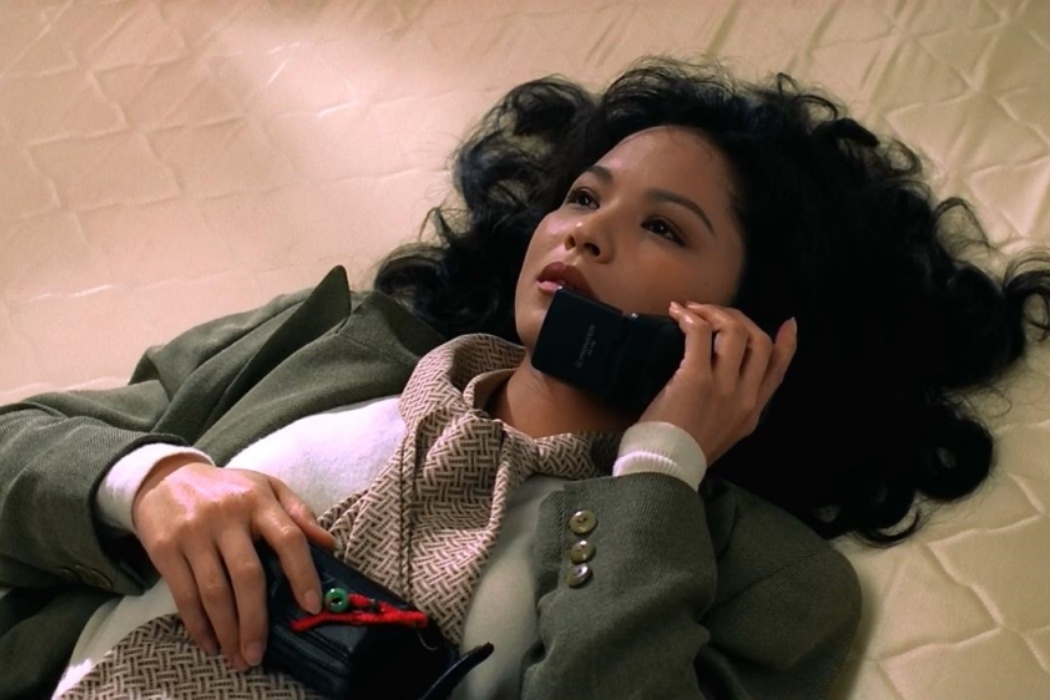
As for where films on my (fake) 2022 ballot placed, the highest was In The Mood For Love (#5, up from #24), followed by The Passion of Joan of Arc (#21, down from #9), The Apartment (#54, did not crack the top 100 in 2012), A Matter of Life and Death (#78, up from #90) and Parasite (#90)—the latter the newest entry to make the top 100 along with Portrait of A Lady on Fire (#30). I didn’t expect most of my other five entries to chart except for maybe The Shop Around The Corner. 35 Shots of Rum isn’t as nearly as beloved as Claire Denis consensus choice Beau Travail (#7, up from #78!) and I suppose the others are too obscure, though at least Love Streams and The Long Day Closes are part of The Criterion Collection—not so Bring Me The Head of Alfredo Garcia, which I just bought a Kino Lorber Blu-ray of since it remains unstreamable.
Regarding my entirely different 2012 ballot (which included Beau Travail), four other titles placed in 2022: Vertigo (still a very respectable #2), Mulholland Drive (#8, up from #28), Sunrise: A Song of Two Humans (#11, down from #5) and Playtime (#23, up from #43 (tied)). As for titles I’ve covered so far in my 24 Frames project, in addition to the Denis and Lynch films, there’s Close-Up (#17, up from #43 (tied)), Meshes of the Afternoon (#16) and The Piano (#50) (the last two did not crack the top 100 in 2012.)
Akerman’s triumph was not the only surprise among the results. I certainly didn’t predict Barbara Loden’s Wanda (#48), Daughters of the Dust (#60), The Gleaners and I (#67), My Neighbor Totoro (#72 – over Spirited Away at #75!) or Tropical Malady (#95) to place. That The Godfather Part II dropped out of the top 100 entirely after placing at #31 in 2012 was also unexpected. 2001: A Space Odyssey did top the adjacent directors poll where Jeanne Dielman reached #4 (tied with Tokyo Story.) I’ve seen all but ten of the critics poll’s top 100; of those, I’m most eager to watch Sherlock Jr. (I know!), The Spirit of the Beehive, Madame De…, Once Upon a Time in the West and Black Girl.
Is it too soon to speculate what will top the 2032 poll? Given that I wouldn’t have bet my life on this year’s number one back in 2012, who knows? I’m more curious about where the most recent titles (Portrait of A Lady On Fire, Parasite, Get Out) will place, for it’s always intriguing to see how a newish movie endures (or not) in real time.