Up North!

Every summer, my family vacationed in Minocqua, Wisconsin. A five-hour drive from our home in Milwaukee, we didn’t even have to leave the state! Throughout the ’80s into the early ’90s, my parents and I would pack up our aging navy blue Mercury Monarch on a designated Saturday morning either right before or not long after the Fourth of July and head straight for Route 41 North. Following a carefully planned trajectory of state and county highways, we’d bypass smaller metropolises like Fond Du Lac, Oshkosh and Wausau until leafy trees gave way to endless rows of towering pines. The expressway would abruptly end, turning into a two-lane blacktop and by mid-afternoon, we were finally “Up North!” (as I first learned to call it at age seven.)

For years, we also didn’t have to pay for lodging. Actually, we initially made the trip only because of an invitation from longtime friends of my parents. Another couple with two sons near my age, they had relatives who owned a small cabin that they’d let family and friends use throughout the year. A modern, compact, one-story, two-bedroom rectangle of a house, it had a deck that overlooked some woods leading down to a small lake. To reach the cabin, one had to turn onto a little road off the highway whose intersection was flanked by a small, decades-old shop with a green sign plainly labeled BAIT. It was our tradition to stop there and pick up a week’s worth of worms wriggling around in a Styrofoam container of soil and other various fishing supplies before taking the narrow, winding road two miles up through the woods up to our long-awaited destination.

The seven of us would spend a week huddled in this cozy space, the three boys taking one bedroom and the two sets of parents alternating between the other bedroom and a camper van parked outside. From Saturday to Saturday, we fished, suntanned, swam, hiked and passed the time playing endless rounds of Uno and other card and board games. We also made runs into town to play rounds of miniature golf, pick up supplies at the Save More Supermarket and walk along Minocqua’s charming main street, which was strewn with taverns and tchotchke shoppes, but also places that sold books, toys, ice cream and fudge.

By the time us three boys reached our teens, the little cabin began feeling a tad cramped. My parents decided time had come for the three of us to rent our own place for the week. My fifteen-year-old self pictured we’d find another, near-identical version of the place we had stayed at all these years, or better yet, a rustic but charming, spacious house like the one in the movie The Great Outdoors. I imagined all the amenities and luxuries of a Best Western or a Holiday Inn, transported to a beautiful spot on a quiet, picturesque, crystal-clear lake.

We ended up renting a cottage at the Lazy L Campground and Resort. Upon hearing its name for the first time, I wasn’t too keen on the campground part—I had slept outdoors in a tent many times as a Boy Scout and knew very well neither my mom nor dad would be up for doing so for an entire week—but the word resort held some promise. Presumably, in addition to an eat-in-kitchen and two bedrooms, we’d have a patio and our own yard, plus proximity to and views of Squirrel Lake (which was more than five times the size of the lake we usually stayed at.)

The road to Lazy L from the highway was much longer and narrower than the one by the BAIT shop. It seemed to go on indefinitely, each curve burrowing deeper into an endless woods and further away from civilization. After what felt like fifteen, possibly thirty minutes, we finally saw an old wooden sign with two giant L’s painted on it, not far off from the ones Laverne DeFazio embroidered on all her outfits.

We turned onto a dirt driveway, passing through yet more woods until reaching a partial clearing. A small, clapboard building served as an office, and there were four other cottages plus a larger house situated further back in the woods. To the left were signs pointing towards the campground. Ahead of us, partially hidden through some tall trees sat Squirrel Lake, so immense one had to squint to make out the other side.

Marcel, the establishment’s owner, exited the office and greeted us with a warm “Howdy!” Balding, flannel clad and pushing sixty, he ambled over to us and shook my father’s hand. He then led us over to what would be our home for the next seven nights. Our two-bedroom cabin, called the Edgewater, wasn’t much smaller than what we were used to, but it was far more rustic, probably built when my parents were little kids, possibly earlier than that. Although it was clean and didn’t smell like mildew, my spirit sank as I gazed upon the kitchen/living room. Most of the furniture, while in reasonably good shape, was a few decades old, from a tan couch with an exposed wooden frame to a white electric stove so narrow one couldn’t even fit a Thanksgiving turkey in it. I wasn’t yet at an age where I could appreciate now-trendy vintage items such as the pristine, 1950s red-and-white Formica kitchen table; at 15, I just found it dated and depressing.

Sensing my disappointment, my mom said to me, “You know, Chris, it’s not like we’re staying at a fancy, modern hotel; this place is perfectly fine. And it’s just for one week!” I let out an exaggerated sigh like any good snotty teen and slouched off to my new bedroom. I sprawled across the full-sized bed where I noticeably sensed a layer of squishy plastic under the pale green linen sheets. I turned up my Sony Walkman, seeking out whatever local top 40 station I could find.

Over the course of that week, I grew to tolerate our cottage at the Lazy L to the point where I actually kind of enjoyed it. We had planned our trip for the same week as our friends/former roomies, and we spent most evenings at each other’s places, partaking in all the fun stuff we did in years past. By week’s end, my dad told Marcel we’d probably return next summer. While part of me secretly hoped we’d look for a new place to stay, I decided I’d be open to more time on Squirrel Lake.

Sure enough, exactly fifty-one Saturdays later, we were back at the Lazy L, checking into the Edgewater for another week. This time, my father wanted to rent a motorboat—why, we’d be able to do our own fishing and exploring without always having to go across town to our friends (once again at their usual place.)

Marcel was happy to oblige. “Now Bob, I have this boat here that I’m gonna let you rent,” he said. “The motor is a little too powerful and complicated for the older couple staying at the cottage next to yours, but I bet you can handle it.”

I’m not sure what inspired Marcel’s confidence in my father apart from his relative youth. I’d seen him work a boat motor before; it didn’t appear too difficult a thing to do—just pull the rip cord and steer in the direction you wanted to go. How hard could that be?

Now that we had our own vessel for the week, my parents took it out fishing nearly every morning, while I joined them in the afternoons and evenings for rides around the lake. In general, it was another pleasant, tranquil Minocqua vacation—a brief but necessary respite from urban life and the daily grind. I’d begun my own first part-time job that summer, scooping ice cream at a Baskin-Robbins, so this rest and relaxation seemed sweeter than it had back when I was an unemployed youth. The Lazy L definitely lived up to its name.

The last night of the week, our friends came over for a Friday Fish Fry, a tradition most sacred in predominantly Catholic regions, but particularly in Wisconsin. We delved into our coolers full of fresh fish from the week that we had caught and filleted, breading and frying up somewhere between a dozen or two on that little but resilient white stove, saving the rest to bring back home. Once there, they’d take up room in the freezer indefinitely, allowing us to replicate the experience the best we could on a few cherished occasions during the rest of the year.

After dinner, our friends headed back to their place—no more fishing that evening for any of us, as we were all driving back to Milwaukee early the next morning. As their white SUV pulled away from the Lazy L, we still had about two hours of sunlight left.

“Hey, let’s take one last ride around the lake,” my dad buoyantly suggests.

This idea of “one last ride around the lake” is romantic and idyllic: What better way to cap off the best time of the year in the upper Midwest—a week blessed by ample sun, piercing blue skies and perfectly comfortable temperatures?

My parents and I approach our pier which is splattered with dried-up shit from all of the ducks that had taken up residency there at intervals throughout the week. Incidentally, we’d grow fond of this waterfowl, repeatedly spotting them via our kitchen window—going so far as to name one “Crazy Louie” for his tendency to stubbornly isolate himself from the rest of the flock. I see a pale orange sun reflecting on the crystalline lake ahead of us. The gleaming white metal of our small, rented motorboat also catches my eye. We wave hello to the elderly couple fishing off the next pier—they’re the ones Marcel perceived as too weak to handle our boat’s supposedly robust motor.

We enter the small craft one by one. First, my mom, who sits in the middle. I warn her, somewhat snarkily, not to fall off her seat as she had done on our last ride. Then, it’s my turn to get in. I sit in front (or the bow) as my dad takes the stern in back to work the motor.

Once everyone’s settled, sitting on overstuffed blue life-preserver cushions, I untie the rope connecting us to the pier. We row away for a bit, the stern pointing away from the shore. As my dad tries starting the motor, nothing happens. After a few more attempts, still nothing. My upbeat mood takes a turn: Is the motor broken? Are we out of gas?

Fortunately, after another attempt, a loud, raucous WHIR-R-R-L-LLL appears and we’re moving. Hooray! I’m ready to enjoy the scenery and maybe even see a few perch or some turtles pop their heads up above the deep, voluminous fresh water surrounding us.

The objects one views in a boat backing away from the shore are supposed to get smaller, not larger. It takes a few seconds for this to sink in. When I become fully aware of our situation, I shout out, “Dad, we’re going the wrong way!”

Over the motor’s immense roar, I can barely make out him saying, “I can’t find the gear, I can’t get it into gear!”

My mom sits still as if in a state of suspended animation, quiet but perplexed, unable to do much of anything. She cautiously questions, “Bob…?”

Speed. We are picking up on it as we head perilously closer to shore. I don’t look back at my dad or question why he can’t change direction. I just look ahead at the other boats we could potentially hit.

The words, “I can’t get it into gear!” echo in my head. We’re getting perilously closer to the neighboring pier. All at once, I feel as if I’m in a fever dream, or watching myself on TV—this can’t really be happening! How could we be going the wrong way?

I shout, “WHAT are you DOING?”

The next few seconds are a blur. I close my eyes. Someone (maybe it was me?) barks out, “We’re headed right straight for the…”

THOINK!

A loud crashing sound both heard and felt. I might’ve let out a “WHOAH!” right before we made impact, but I’ve blocked most of those few seconds out. I recall opening my eyes, noticing that our boat had stopped and was somehow halfway up the neighbor’s pier and halfway in the lake. Although I’m on the tippy-top, I’ve somehow managed to hold on to my seat. My mother has fallen off hers (despite my warning!); my dad’s at the bottom, his shoes drenched in water that has infiltrated the stern.

The elderly couple stands before us, speechless, staring open-mouthed. Once my shock subsides, I start to laugh, queasily. My mom later recalls that as we were on a collision course with the pier, she kept thinking of an old Woody Woodpecker cartoon that had a boat literally tearing through a wooden pier as if it were a buzz saw.

Miraculously, the vehicle’s still in one piece. I hop onto the pier and pull my mom, then my dad out of the boat. We slide it back into the water—apart from a few noticeable scratches around and under the bow, the boat’s perfectly fine. Marcel, thank god, is nowhere to be seen.

After all this, most people would just walk away and call it a night, but not my father. He was determined to get that last ride in, dammit. We all got back into the boat, he started up the motor and this time, we made it out onto the lake successfully. Still, my mom and I held on extra tight to our seat cushions, barely speaking a word to each other. As much as we wanted to enjoy this “one last ride around the lake”, the recent memory of having unceremoniously gone up a pier couldn’t help but dampen our moods.

We left for home early the next morning, never to return to the Lazy L, embarrassed to face Marcel again after scratching up his boat. I’d return to Minocqua the next summer on my own, staying with our friends for a few days, but my parents and I never set foot there together again. I began feeling too old, too much of an adult to spend a weeklong vacation with them. I’ve thought about going back to Minocqua again as an adult out of nostalgia for a place I once knew, but fear I’d only set myself up for disappointment. I prefer to simply remember and cherish all the fun I had there in my youth—my parents and I literally going up a pier in a motorboat remains a one-of-a-kind experience I could never, ever hope to replicate or surpass.

My Father, The Navigator.

Ice Cream Man

The summer I turned sixteen, my parents informed me I was to get a part-time job. No longer could I spend all my days watching three-hour blocks of I Love Lucy reruns or setting off on rambling, endless bike rides all over town. Time had come for me to make a living, or at least earn some spending money beyond a weekly chore allowance (and the very occasional babysitting gig.)

Luckily, I had plenty of entry-level employment options within walking distance from home. I could stock shelves at Sav-U supermarket or Payless Shoes Source, bus tables at B&B Lounge, expose myself to a variety of chemicals at Wolf’s Dry Cleaners—there was even a fish market I could work at, although it emitted an odor one could smell from up to a block away.

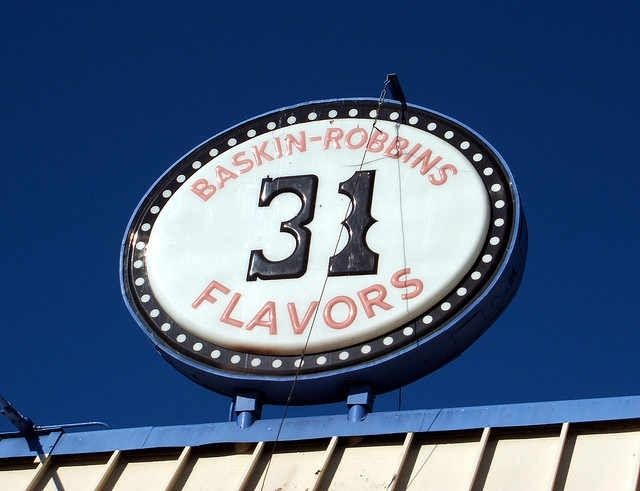
Such potential first jobs barely crossed my mind, however, for I was fortunate enough to live close to both a frozen custard stand (for the unfamiliar, frozen custard is richer, fattier ice cream freakishly more popular in Milwaukee than most other cities) and a Baskin-Robbins 31 Flavors. The former, named General Custard’s (“Food Good Enough to Make a Stand For!”) was a block closer, but also a burger joint. Not wanting to return home reeking of grilled onions and meat every night, I gravitated towards the Baskin-Robbins, which had been in its long, narrow storefront location since before I was born. In addition to loving the stuff (oh how I would anticipate what each Flavor of the Month would be when I was a tyke!), scooping ice cream was also something I knew I could probably do, even with my total lack of experience.

The last week of May, I walked the two-and-a-half blocks over there to ask if they were hiring. Stan, the ancient, white-haired man behind the counter whom I’d later find out had owned and operated the franchise for over 25 years, handed me an application. I could have filled it out at one of the three tables (all of them encrusted with traces of sugar, butter and cone) to the right of the gleaming display freezers stacked with nearly forty different three-gallon ice cream tubs; instead, I took it home, completed it very carefully and brought it back the next day. Stan was still there, tallying up the afternoon’s sales, printing an almost comically long receipt from the cash register. He browsed over the application, and asked when I’d like to work my first shift. I told him I’d be out of school next week. “Come in Wednesday at 3:00 PM,” he responded in a guttural smoker’s rasp I’d soon know very well.

I had done it! I was going to scoop ice cream and furthermore, make money doing so! How cool was that? Apart from my folks, I told no one else of my summer plans; I didn’t want to jinx my good fortune. Of course, being a newbie to the workforce, I had no clue what to expect, but I didn’t care—I found a job right near my house, and I suspected I’d be able to eat a lot of free ice cream there too.

That following Wednesday, I made sure I arrived at the shop minutes before 3:00. As I opened the door, Stan looked up from behind the counter and regarded me as if I was merely another customer, asking, “Whadda you want?”

Caught off guard, I hesitated, “Uhh, it’s me. Chris… your new employee?”

“Ach! Come on back,” he grumbled. I followed him behind the counter and into a rear room partially concealed from the public via two swinging half-doors not dissimilar from those separating the kitchen and dining room in my Aunt Judy’s suburban ranch home, only these were painted the color of Pepto Bismo. Beyond them sat shelves haphazardly stacked with all the crap Stan never threw away: piles of old promotional banners, faded flavor labels, assorted paper and plastic goods like napkins and straws and a somewhat tarnished array of ice cream cake decorations, from frostings and sprinkles to a rainbow of sugars. Along one wall sat a couple of upright and top-opening white freezers populated with brand-new ice cream tubs waiting to take the place of those sitting in the display cases out front after their depletion.

Stan handed me a polo shirt the same color as the swinging doors and an outsized thick plastic binder that was the Baskin-Robbins employee handbook. He ordered me to put the shirt on, sit down at the desk next to the cake decorations and read the book. He then returned to the front of the store to wait on customers, tally up sales and whatever else it was he did all day. I dutifully sat there, scanning the handbook cover-to-cover, learning everything one could possibly know about scooping ice cream and exhibiting good customer service.

At least thirty minutes passed before Stan came back through the swinging doors and bellowed, “What, are you sleeping?” He gestured me to follow him out front, where he showed me how to use the ice cream scooper, craft such delicacies as a fudge brownie sundae or a banana split, run the cash register and use a waffle iron and a spherical wooden tool that formed the freshly made waffles into cones.

Within an hour, one of my co-workers arrived, also named Chris and also Stan’s grandson. Two years older than me, this other Chris had worked there for some time; as Stan left to go home for dinner (he also lived in the neighborhood), his grandson would continue my training. The other Chris was fun because he was a smartass and a co-conspirator. That first evening, when it came time to get ready for closing, he showed me the bathroom in the back where I’d prepare the mop to clean the store’s tiled floors. Next to a rusting sink and a mirror desperately in need of a streak of Windex was a slightly cracked sign from the Milwaukee Health Department: in funky, early ‘70s-style lettering, it said “Wash Your Hands,” the words actually rendered within the shape of a hand. Directly underneath it, a plastic shelf held a yellowed, dusty bar of soap.

“You know, the soap’s older than that sign,” the other Chris remarked. I nearly believed him.

In those hours when it was just us two Chris’s at work, we had a blast—especially in the colder months as up to an hour would often pass by without a single customer. We’d hang out in the back room, rummaging through piles of old stuff such as a poster for “Monte Carlo Stripe” (a flavor inspired by the long-forgotten 1977 flick Herbie Goes To Monte Carlo), making note of such peculiar stock as a cardboard box of Maple Nut topping stamped with a then-six-year-old expiration date. Whenever the front door opened, the other Chris would suddenly snap to attention and proclaim, “INCOMING!” (a M*A*S*H reference), our cue to emerge from the back room and actually do some work.

I certainly enjoyed working with him far more than my other co-workers, two guys both my age. Frank, who wasn’t much for conversation, had started working there only weeks earlier but never failed to lord this sort of dubiously-won authority over me. When not telling me what to do, he sat next to the rear counter, doodling in a well-worn spiral notebook. Joe, on the other hand, might’ve been less friendly than the other Chris, but I appreciated his droll demeanor. A regular customer who lived three doors down would come in at least once a week and always order the same thing: two scoops of chocolate chip topped with hot fudge. During one of his visits, Joe said to me, quietly and pointedly, “I’ll take care of Monty Clift over there.” At the time, I had no idea who that was; in retrospect, Joe’s assessment of this handsome, if somewhat creepy guy was spot-on.

Joe could be a co-conspirator as well. Once, we were in the store alone together when an obscenely large, hairy, yellow-brownish rat emerged from under the rear counter. I quickly ran into the back and grabbed a broom, but before I could return to the front, we suddenly had customers (INCOMING!) whom thankfully did not see the rat behind the display cases. Joe quickly put his hands up in a “NO! NO!” sort-of-way at me to prevent the customers from witnessing me running out with a broom in hand (was I planning on sweeping the rat away?) Luckily, the vermin soon disappeared back under the counter and we never saw it again.

I can only imagine what one of our customers would’ve done upon seeing a rodent in the store, for many of them were nuttier than the massive plastic container of macadamias we had for a special Hawaiian-themed sundae. Baskin-Robbins was where I learned the actual cardinal rule of working in retail or food service: contrary to popular belief, the customer is hardly ever right, but it’s polite and often expected to let them think they are. The mother and daughter who sample a dozen different flavors and then leave without buying anything? The middle-aged man who asks for a scoop of “Blue Chocolate Chip” (meaning our most popular flavor Mint Chocolate Chip, of course) two minutes before closing on a Saturday night, the floors all mopped and chairs upside down on the table tops? The wispy young couple whom, upon inquiring how long we’ll have Bubblegum ice cream and, after being told just for the next two months, whining, “For the whole year???” All of ‘em wrong to various degrees, but not yelled at, turned away or (openly) made fun of by me and my fellow scoopers.

A few customers made this exceedingly difficult. I’m thinking of the clueless woman who asked me, “Is this your first day?” as I stood there, the only employee at the store, my right hand bleeding profusely from a mishap with our nefarious cake-cutter as I could not help but betray my impatience with her ninety-nine questions about the display freezer full of prepackaged ice cream quarts and pints. Even better was the lady to whom I accidentally served a scoop of Fudge Brownie when she had asked for Chocolate Almond (they looked almost identical.) Whereas you or I would likely just say, ‘Hey idiot, this is the wrong flavor,” she took a seat at a table, ate her ice cream cone and spat out all of the brownie pieces into a napkin. She then left this napkin full of masticated food bits on top of the counter right under my nose and said, “I don’t remember these being in Chocolate Almond,” and left. I believe I was literally speechless for the first time in my young life.

I suspect Stan had seen it all. I didn’t know much about his past, although the other Chris once disclosed he had worked as an ambulance driver (!) before he bought the franchise. Stan was a constant presence, opening and closing the store every day and night, usually handing off the reins to his young male scoopers for hours in between. His equally ancient wife Adeline would occasionally come in to help decorate ice cream cakes. She was quiet but nice enough, her most distinguishing feature being her two-toned hair (as my mother described it), probably due to a messy dye job. Although he was a crotchety old fart, Stan knew what he was doing as a manager—he would have had to, given that he’d been running this franchise and presumably turning a profit for nearly three decades.

Still, Stan had his own share of quirks. Every night, he’d prepare a sink full of soapy water to prep rags for wiping down all the counters and tables. The water was always SCALDING HOT, as I discovered the first time I stuck my hand in it. In time, I’d come to prep it exactly that way, with the other Chris once reaching in for a rag and exclaiming, “Hey, that’s STAN hot!” He also loved contemporary country music (he was of the age where you’d expect him to be more into big-band oldies or polkas) and regularly used such dated colloquialisms as “darn-tootin’” and “cotton-pickin’”.

Stan once even ended up on the 5:00 news: that first Christmas Eve I worked there, I was home in my bedroom when my mom called out, “Hey Chris, your boss is on TV!” Running over to the living room, I learned from our television that some guy had taken a massive cement truck for a joyride and ended up crashing into Stan’s garage, mere blocks away from my own house. Adeline showed up at the store days later, a few yellowed bruises on her face. “I guess you heard we had a dramatic holiday this year!” she remarked with folksy understatement of the sort one often encounters in the Upper Midwest.

As the lowest on the store’s totem pole, I must have worked those first ten or fifteen Saturday nights in a row before I finally asked Stan if I could have the next one off. He gave it to me, but he also occasionally gave me a rough time. More than once, he pulled me aside and said, “Y’know, I’ve had people ask me, ‘Why doesn’t that young man of yours ever smile?’”, insinuating I was the sullenest of his four teenaged scoopers. The accusation always maddened me because I suspected it was the dour Frank they were talking about, but I wasn’t comfortable shifting the blame over to him, which would be akin to tattling. It bugged me, but I learned to put it aside. Initially, the job’s benefits far outweighed any of these frustrations: free ice cream, for sure, but also a lot of autonomy—particularly on winter weeknights, when I’d be the only person at the store. I’d sit in the back, do my homework, and occasionally watch a 13” black-and-white TV while my mom would swing by with TV dinners and fast-food takeout, since my usual shift would go from 4:00 to 10:00 PM, not allowing me to leave for a meal break.

However, little things began gnawing away at me. The other Chris left for a stint in the Army (INCOMING!) and Stan never replaced him, resulting in more work for all, but also additional shifts spent in close quarters with no one to talk to but Frank. I remained the new guy more than eighteen months after I started; I was also getting paid less than minimum wage, which I was too green and meek to do anything about. When I once asked the other Chris how come we were paid so low, he said, “Oh, that’s because the job is agricultural,” some hot garbage I could never confirm or deny given this was the age before Wikipedia (or the Internet, even.)

As the next summer came and went and I entered my senior year of high school, I grew to loathe those six-hour weeknight shifts, the measly pay, the same three co-workers in different permutations, the waffle cone maker that never failed to burn my fingers, the endless parade of customers asking to taste this flavor and that flavor on the little pink sampling spoons we had in abundance. I had particular contempt for the plastic cutout of a giant, grinning anthropomorphic pink spoon hanging over the doorway to the back of the store—Baskin-Robbins’ half-baked idea of an unnamed cartoon mascot (Spoony? Scoopy?) I’d look up at it and think, “What are you so happy about?” and picture it accidentally falling off the wall, hitting Frank in the head.

The final straw came in January. One otherwise unremarkable evening when I was in the back searching for a new tub of Jamoca Almond Fudge, I heard a sudden THUMP. Looking out, I saw that Stan had accidentally dropped an opened, full tub of Cookies N’ Cream face down on the floor behind the counter. He proceeded to pick it up and place it back in the display case without so much as wiping any residue from the exposed surface. Once again, I was speechless. When he wasn’t looking, I examined the tub for hints of dirt or crumbs or other floor particles but couldn’t detect any (of course, Cookies N’ Cream can conceivably mask such stuff.)

That night, I decided I’d give Stan my two-week notice. I didn’t want to work there anymore and the Cookies N’ Cream fiasco was only part of it. I had four months left of high school and was just beginning to open myself up to the world. Over the past year, I’d discovered how much fun it was to hang out with friends and have a social life instead of watching TV every night. The idea of spending most of my evenings and weekends sequestered in a half-dead ice cream parlor for four bucks an hour was none too appealing; I estimated I wouldn’t be giving up much in terms of spending money. I’d worked my first real job, but it was time to move on and enjoy my newfound social life—I could always look for another job come summer.

When I told Stan of my plans, he didn’t say anything, just a near-quiet harrumph as he continued refilling the hot fudge dispenser. My last day ended up being the last day of January with just Stan and myself at the store. We had no tearful goodbyes or any goodbyes at all, period—after mopping the floor and wiping down the counters and tables, I hung up my pink polo shirt for the last time, and walked out into the chilly air, taking the five-minute route back home I had walked hundreds of times over the past two years.

Exactly two weeks later, whizzing past the store with a buddy on our way to the movies (see, I was socializing!), he remarked, “Hey, this morning in church, they said that the ice cream guy died.” Upon hearing this, I’d like to think I turned as bright white as the painted exterior of my mother’s Grand Am that I was driving.

“WHAT?!”, I responded, “You mean STAN?!!”

“Yeah, you know… the ice cream guy!,” he replied, not knowing I’d worked for the man until very recently. Somehow I managed to maintain control of the car, not pulling off to the side of the road as we headed to the Skyway Cinema to see Groundhog Day. The next morning, I phoned St. Helen’s rectory and the secretary confirmed that Stan’s funeral was scheduled for noon that day. I didn’t ask about the cause of death and never found out, too embarrassed to call up the store, much less inquire in person. I assumed it was something like a heart attack or a stroke—the man was in his late ’70s, after all. Even though I rationally knew I didn’t cause Stan’s death by quitting, I couldn’t help but feel incredibly guilty at the unfortunate timing.

I happened to have off from school that day, President’s Day. My mom and I talked about attending the funeral but I decided I’d rather not have to face Stan’s family or my ex-co-workers. She said to me, “Can you imagine if that big pink spoon hanging over the doorway had shown up at church? He’d probably wave and say, ‘Bye, Stan! I’ll miss ya!’” I could always count on her to lighten the mood.

Stan’s family kept the franchise running for a few more years; it was a pizzeria after that for some time. It currently houses a tortilleria, or tortilla factory, reflecting the steady influx of Latinx people over the past two decades into this formerly overwhelmingly white neighborhood. That summer after finishing high school, I worked the first of a series of entry-level retail jobs that paid marginally better than Stan did, but I never liked any of them as much. I now know I left Baskin-Robbins a little hastily—I could’ve easily stuck it out for another six or seven months before beginning college (I commuted downtown to Marquette University that first year, so I could’ve stayed even longer.) Still, I acquired my first taste of what it was like to have a job. As with that infamous mother-and-daughter duo who tried a dozen different flavors without buying a single thing, I just had to sample other jobs and find out what type of work I was and wasn’t suited for; in the latter category, that was my next job, a first (and to date, last) foray into real food service, bussing tables at a chain buffet joint.

Stan was far from the best boss I ever had, but with decades of work experience behind me now, I can at least appreciate what the ice cream man accomplished. Yes, his franchise was part of a massive international chain, but by the time I arrived there, Stan’s constant, long-term presence had turned it into something more like a neighborhood institution. On those rare occasions when I get a scoop at a Baskin-Robbins (there aren’t too many in New England, where I now live), I always tip my pink plastic spoon to him.

Formerly, Stan’s Baskin-Robbins. RIP.

Halfway Through 2019

Before I take a hiatus from blogging for the rest of the summer, here are my ten favorite movies and albums midway through this year, in alphabetical order.

MOVIES:

Apollo 11
Ash Is Purest White
End of The Century
Gloria Bell
Hail, Satan?
Her Smell
In Fabric
Museum Town
The Souvenir
Sword of Trust

ALBUMS:

Alex Lahey, The Best of Luck Club
Andrew Bird, My Finest Work Yet
Calexico and Iron & Wine, Years To Burn
Charly Bliss, Young Enough
The Dream Syndicate, These Times
Holy Ghost!, Work
Hot Chip, A Bath Full Of Ecstasy
The Mountain Goats, In League With Dragons
Robert Forster, Inferno
Weyes Blood, Titanic Rising

100 Albums: Epilogue

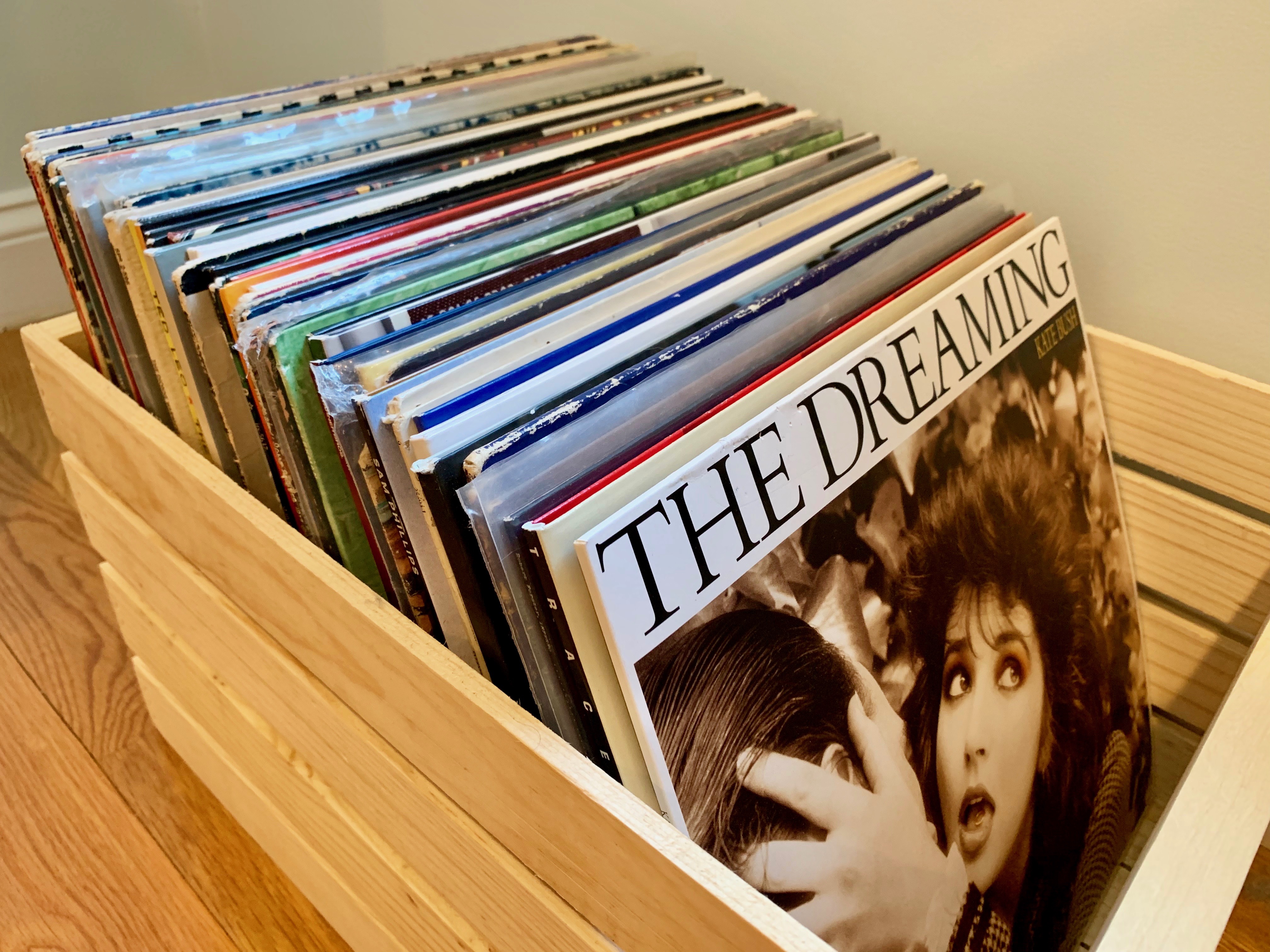
A few of my 100 favorite albums are currently in this crate.


Why did I write one hundred essays on my favorite albums, in chronological order from Revolver to Record? When I began this project five years and one month ago, I saw it as a constructive way to write more extensively about music, and also as an opportunity to get used to working on longer pieces in general. I figured I could complete a thousand-word essay a week and get to the finish line within a little over two years.

And I more or less kept up the pace until I got to album number 6, Abbey Road—a record I had far more than a thousand words to write about. Once I reached the ‘90s in my timeline, I encountered many albums that, due to when I first heard them or what presence they’ve continually maintained in my life, required far more time and attention to assess than I initially expected, to the point that at the two-year mark, I was only halfway through the entire project.

Now that I’ve finally completed it, I feel a sense of having accomplished something, but what, beyond finishing what I set out to do? I’ve left a record of my taste in music as it stands over this half-decade (go back to my 2004 list to see how it has shifted); I’ve also continually drawn connections between albums from nearly every notch on this half-century-plus timeline up to the final entry (thank you, Tracey Thorn, for injecting into your own Record a song title from Songs of Leonard Cohen!)

Throughout, I kept revising the initial list I came up with in 2014. My original end point was Random Access Memories, an ideal choice given its fixation on channeling past sounds into contemporary and possible future ones. However, it ended up at #94, which allowed me to include six more titles released after it. What happened to the six older albums I left off? Apart from the Mekons’ OOOH! (Out Of Our Heads) (I still wonder why I nixed that one; was it too similar to Sleater-Kinney’s contemporaneous One Beat?), I honestly can’t recall what they were (my original list is sadly lost to time.) I occasionally replaced one album with another from the same artist: Dig Me Out and All Hands On The Bad One were candidates instead of One Beat at various points, and I kept going back and forth between Scarlet’s Walk and Boys For Pele for Tori Amos before deciding I had more to say about the latter (mostly because it’s nuts.)

Still, as I made my way through 100 Albums, it gradually dawned on me that this project had a certain flaw: By writing only about records that I loved, I was in danger of lapsing into hagiography. Truthfully, I’ve always felt more comfortable dissecting art I was drawn to than stuff I found repulsive or that simply left me cold—I’m a fan/geek more than a critic where music’s concerned (film criticism, on the other hand, I have a graduate degree in.) While it was often fun reviewing records on a weekly basis for a website back in 2003-04, a majority of them were so awful, when I left that gig, I was elated to go back to focusing on albums I genuinely liked.

The other difficult aspect of writing essays about your 100 favorite albums is that before long, you are inevitably prone to repeating yourself: How many different ways can you say something is good and make a sound critical argument as to why others should listen to it? I’ve tried my best to confront this challenge and write criticism that comes from an honest point-of-view. I haven’t gone back and re-read every last entry in this project, but I can single out ten that I think are, at the very least (to quote Tim Curry as Dr. Frank-n-Furter in Rocky Horror Picture Show), pretty groovaay:

The Beatles, “Abbey Road”
Joni Mitchell, “Hejira”
Concrete Blonde, “Bloodletting”
R.E.M., “Automatic For The People”
Saint Etienne, “So Tough”
Ivy, “Apartment Life”
The Avalanches, “Since I Left You”
Sam Phillips, “Fan Dance”
Tompaulin, “Everything Was Beautiful and Nothing Hurt”
Kate Bush, “Aerial”

It helps that every one of these ten would probably make a top 25 if I had to rank the entire list*, but another common thread runs through them: they are among my most personal essays here. I repeatedly found myself enjoying the writing process more when I was able to lead off or build a piece around a reminiscence or an anecdote directly related to an album, one that could help flesh out or even unlock what meaning this particular piece of art had for me.

I can firmly say there will never be a likeminded follow-up to 100 Albums: No 100 Films, 100 Books, 100 TV shows, etc. Putting aside the danger and difficulty that comes with only writing about beloved art, I’ve gradually discovered throughout this project that I have other, more important things to write about (even if I now regret not including Cosmic Thing by The B-52’s or anything by Steely Dan, among other artists.) Haunted Jukebox will continue, but its primary focus will no longer be music. Oh, there will be mixes (annual and otherwise), year-end lists and likely a decade-end album list in early 2020, but I’m ready to move on from criticism into more personal terrain. Thanks to anyone following and/or invested in this project.


* In 100 Albums: An Introduction, I said I’d do this upon the project’s completion, but since rankings of all-time lists are so prone to fluctuation, I’m leaving it up to each reader’s perception as to what my favorite, favorite albums are.

Tracey Thorn, “Record”

(My 100 favorite albums in chronological order: #100 – released March 2, 2018)

Track listing: Queen / Air / Guitar / Smoke / Sister / Go / Babies / Face / Dancefloor

After Amplified Heart gave Everything But The Girl a crossover hit with Todd Terry’s remix of “Missing”, this duo of Tracey Thorn and Ben Watt, then more than a decade into their career, soldiered on for two more albums of electronic dance music inspired by this late-breaking success before essentially disbanding in 2000—I purposely use that term, for the longtime couple stopped being a band but remained together in every other sense. Thorn, who had given birth to twins two years before, later revealed in her memoir Bedsit Disco Queen that she was simply ready to stop recording and performing to raise a family. She and Watt would have another child in 2001 and eventually, officially marry in 2008, over a quarter century after they met at Hull University.

Fortunately for her fans, Thorn didn’t stay retired from music (though she never returned to live performance.) Surfacing in 2007 with a solo effort, Out Of The Woods, she retained the sound of those later EBTG albums but on a more intimate scale. Directly addressing her time away from the spotlight on such tunes as “Nowhere Near” and “Raise The Roof”, Thorn crafted a modern, electro-update of singer-songwriter chestnuts like Tapestry and Blue. Her next album, 2010’s Love And Its Opposite, displayed a wider array of textures with a far more somber tone. She later called it her “mid-life album”—a keen assessment given songs like the uncharacteristically peppy “Hormones” (“Yours are just kicking in / Mine are just checking out,” she tells her daughters) and the stirring, chamber-pop ballad “Oh! The Divorces.”

In the past decade, she’s continued building an unconventional solo career: writing multiple books and a newspaper column, appearing on duets with such indie-centric artists as Jens Lekman and John Grant, recording a Christmas album here and a movie soundtrack there and just being a generally delightful presence on Twitter. When commencing work on Record, her first studio album of new songs in eight years, she tweeted something along the lines of, “Well, it’s time for me to make another album,” her casual frankness disarming as ever. And while I thought very highly of Love And Its Opposite when it came out and came around to thinking Out Of The Woods was even better than that some five or six years after its release, at present, I’m confident that Record is really Thorn’s most essential album since Amplified Heart.

“NINE FEMINIST BANGERS” reads the sticker on Record’s cover and one could not sum up its appeal more succinctly. Once again working with producer Ewan Pearson (having helmed the majority of her output since Out of The Woods), Thorn keeps to a limited but effective palette: synths, drum machines, some guitar and on one track (“Smoke”), a string arrangement. The blunt, one-word song titles perfectly fit their tunes’ musical and lyrical directness. Like Home Counties, Record was mostly conceived in a post-Brexit, Trump-ridden world and it subtly (and occasionally not-so-subtly) reflects such times from a distinct perspective—ever approachable and candid, Record is Thorn’s ongoing monologue of who and where she is now.

In that sense, opener “Queen” is an ideal statement of purpose. A sonic analogue to Saint Etienne’s 2012 single “Tonight”, it finds a woman considering herself in midlife over ringing, swooshing synths and a clarion, yearning chorus: “Am I queen / a magisterial has-been?,” she ponders, or perhaps “A star / Propping up the backstage bar?” They are questions specific to her life as a singer and public figure, but she shifts from the potentially autobiographical to the firmly universal by concluding, “And will I ever find love / or am I still waiting?”

From there, Record finds Thorn looking back and taking stock of her past. “Air” gently bubbles with traces of an awkward adolescence and the gender politics that drove and very nearly defined it: “Didn’t understand the rules or how to play,” she notes, before rattling off a series of self-critiques: “Too tall / All wrong / Deep voice / Headstrong.” Meanwhile, the music’s mid-tempo R&B-inflected pop (the closest Thorn has emulated the sound of Idlewild in some time) and breezy backing vocals from Shura reinforce the chorus’ simple but persuasive main hook, “I need some air,” with the word “I” delicately stretched out to five syllables.

“Guitar”, propelled by pulsating synths with the titular instrument only first appearing in the second verse offers transcendence from this dilemma. Although Thorn credits a boyfriend with “arm(ing) her with three chords,” teaching her how to play, it turns out he “was only just a catalyst.” She looks back on the affair with self-deprecation and a little bemusement, name-dropping Leonard Cohen, then slyly quoting his song “Hey, That’s No Way To Say Goodbye” a few lines on (“Oh god, you couldn’t make it up,” she adds.) Still, she emphasizes her eventual self-triumph: “I couldn’t begin until I fell apart,” she admits before declaring, “Thank God I could sing and I had my guitar.”

“Smoke” goes back ever further, detailing her ancestral origin story in the guise of a modern folk ballad complete with a narrative structure and repeated phrases. Beginning with her Great-Grandparents, Thorn tells of how they moved into London (“to the rolling smoke”) and “had a son called James, who had a son called James” (“were there no other names?” she asks.) Two World Wars follow, and her mother “survived the Blitz / though she knew a girl, who knew a girl / who was blown to bits.” Thorn was born after her parents “fled the smoke,” escaping to the post-war suburbs where she herself would escape from come adulthood. Still, on the scintillating chorus, she sings, “London, you’re in my blood but I feel you going wrong.” As the song builds and sighs and marvelously changes keys at the bridge, Thorn’s history unfolds and blossoms, stretching on and outward like time itself.

“Sister” brings us back to the present with Corinne Bailey Rae’s brief, a capella vocal: it’s a beguiling intro to a minor-key anthem in the guise of an extended, eight-minute vamp sparkling with taut rhythm guitar licks, a mid-tempo beat groovy enough to dance to and an array of various synth filigrees (brought to the foreground in the mostly instrumental second half.) But don’t let the running time fool you—this is Thorn’s razor-sharp feminist manifesto and Record’s literal and thematic centerpiece. “Don’t mess with me, don’t hug my babies / I’ll come for you, you’ve bitten off more than you can chew” it starts before the singalong chorus where she states, “I am my mother / I am my mother now / I am my sister / and I fight like a girl.” Nothing cute, pensive or repentant here and that goes double on the bridge where she pointedly, cathartically asks, ‘Oh, what year is it? Still arguing the same shit. / What year is it? Same, same, same old shit.”

“Babies” is another anthem, far less angry but just as firm, offering no apologies for waiting to become a mother: “I didn’t want my babies until I wanted babies,” goes the chorus, following an opening verse that’s one of the most clever ever written about birth control, rhyming “you push a little tablet through the foil” with “better than a condom or a coil.” But the song is also an ode to what happens when you decide to have babies and when they grow up to be teenagers. “Go to sleep, it’s 3 AM / Where are you, it’s 3 AM / in a cab at 3 AM / Don’t wait up it’s 3 AM,” she rattles off as the music percolates with a joyous, assembly line sheen.

On either side of “Babies” sits Record’s two ballads. “Go” is addressed from a parent to a child leaving home for the first time. Over slow, lingering chords reminiscent of a George Michael lament (most notably “One More Try”), the generally low-voiced Thorn starts off singing in her highest register: “I resign myself to time and what’s no longer mine,” before her own grief gives way to tenderness and support as she tells her child, “Pack your bags and smile, it will only be a little while.” “Face”, in which Thorn scrolls through an ex’s social media page seems less immediate by default, although her self-effacing humor (“If I just keep refreshing, maybe you’ll disappear”) buoys what is a perceptive take on having perhaps too much access to too many people at your fingertips.

Record roars back to life on its exhilarating closer, “Dancefloor”. Like much of the album, it’s Thorn making sense of who and where she is now as a mother, sister, wife, singer, songwriter, musician, author, etc. She asks questions both philosophical (”Where did we begin?”) and searching (“Who’s just desperate for anything at all / anything at all like love?”) before proclaiming, “Oh but where I’d like to be / is on a dancefloor with some drinks inside of me,” hanging out with friends, turning it out together to such perennial bangers as Chic’s “Good Times” and Shannon’s “Let The Music Play”. The vibrant, fizzy, electro backdrop, complete with robotic voices repeatedly announcing, “ON A DANCEFLOOR!” reinforces all of this. When Thorn suddenly reveals, “Someone’s singing and I realize it’s me,” it’s a simple but immense, resounding epiphany—the kind one forever seeks but rarely finds in a pop song. How fitting that the last album in this project is not only called Record, but also recognizes how awesome it is that music has the power to shape and sustain a life.

Up next: 100 Albums concludes with an epilogue, or, my own looking back and taking stock.

“Dancefloor”:

“Sister”:

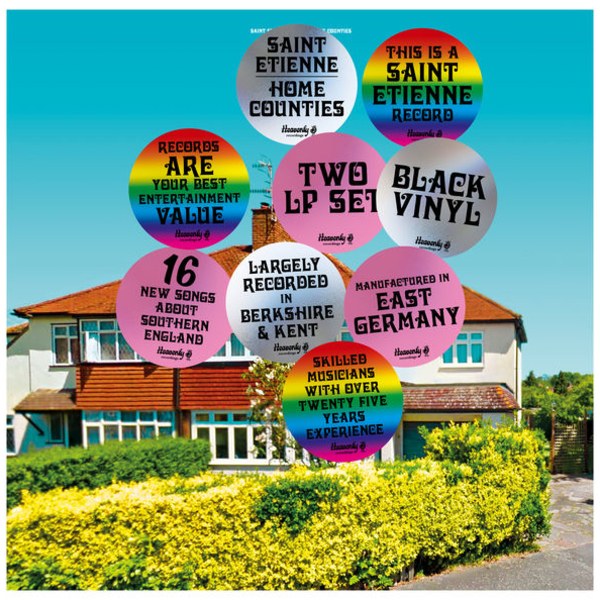
Saint Etienne, “Home Counties”

(My 100 favorite albums in chronological order: #99 – released June 2, 2017)

Track listing: The Reunion / Something New / Magpie Eyes / Whyteleafe / Dive / Church Pew Furniture Restorer / Take It All In / Popmaster / Underneath The Apple Tree / Out Of My Mind / After Hebden / Breakneck Hill / Heather / Sports Report / Train Drivers In Eyeliner /  Unopened Fan Mail / What Kind Of World / Sweet Arcadia / Angel Of Woodhatch

After the superlative song cycle Tales From Turnpike House, I couldn’t imagine what Saint Etienne would do next—apparently, neither could the band, at least not right away. Seven years passed before the release of their next album, Words and Music By Saint Etienne. Concerning the rituals and pleasures of pop music itself, the concept seemed ideal for a trio of self-avowed fans-turned-aspiring-popstars; in practice, it worked well enough, widely viewed as a comeback on both sides of the pond. It featured some of their very best singles (“Tonight”, “I’ve Got Your Music”) and, as usual with this group, exceptional album tracks that could’ve easily been singles as well (“Heading For The Fair”, “Last Days Of Disco”, “DJ” and the song this blog takes its name from.)

And yet… as a big fan myself, I found Words and Music not completely up to snuff with the four previous Saint Etienne albums I’ve covered here. For one thing, it has a substantial amount of, well, not filler, exactly, but lesser songs I rarely listen to in isolation (“Answer Song”, “Twenty Five Years”, actual throwaway “Record Doctor”); also, celebrating pop through the prism of London is more or less what this trio has always done, but by making it so explicit and upfront, they almost lessen what’s so singular and special about it. Again, for any band, Words and Music is a good album and for them a shrewd one to make after such a long absence, but it doesn’t add anything new to their catalog in the way, say, Tiger Bay or even Good Humor did.

Fast forward a few more years: there’s another band sabbatical during which Sarah Cracknell puts out a second solo album, Red Kite (solid singer-songwriter folk, and worlds away from the dance-pop of her earlier effort Lipslide) while Bob Stanley and Pete Wiggs continue curating compilations of subterranean gems from the 50’s, 60’s and 70’s. When the trio commence work on new material in mid-2016, the world in is flux. Brexit has passed and Trumpism clouds the air. Their new songs aren’t especially angry (how inconceivable to think of an incensed Saint Etienne!) but these developments (especially the hitting-closer-to-home Brexit) have no small impact on the direction their ninth album begins to take.

For most Americans and non-anglophiles, the title Home Counties requires some explanation. The two-word term refers to the seven counties surrounding London—in other words, the suburbs. All three members of Saint Etienne grew up there before moving to London as adults; it follows that one can view the record as reminiscent and hyper-specific of a time and place as Fox Base Alpha and So Tough were of early ’90s London, only observed from a great distance instead of documenting it in real time. However, the album transcends childhood nostalgia because of the band’s obvious love/hate relationship with the region, elevated in no small part by that recent specter of Brexit hanging in the air—throughout the actual Home Counties, more people voted to leave the EU than remain, whereas London voted heavily in favor of the latter option.

The result is an intriguing push-and-pull for Saint Etienne: emphatic and celebratory as always, but now guided by hindsight and filtered through a sharper, critical eye. Initially, it resembles Good Humor more than anything else in the band’s catalog thanks to its live-band feel (the winsome yet enigmatic “Unopened Fan Mail” could easily slot into it) and the fact that Cracknell’s, Stanley’s and Wiggs’ coming-of-age years coincide with the AM radio gold the earlier album successfully emulated. However, Home Counties is no Good Humor II: a mosaic of instrumentals, spoken word interludes and tone poems along with the expected three-minute pop songs, it’s the band’s longest (19 tracks in 56 minutes, but they do fly by) and most varied album since Finisterre (maybe even So Tough)—it plays like a thoughtfully, lovingly compiled mix tape that coheres into a shimmering whole after multiple spins.

As you’d expect from a band known for their meticulous, often hand-crafted attention to detail, Home Counties has ultra-specific talismans woven throughout its fabric. It makes ample room for birdsong and a pastoral children’s choir (“Church Pew Furniture Restorer”), a spot-on Northern Soul simulation (“Underneath The Apple Tree”), a little harp and plenty of harpsichord (most prominently on “Whyteleafe” and “Take It All In”), and not one or two but three recreations of vintage radio transmissions, with quiz show “Popmaster” rather tongue-in-cheek in offering such decidedly modern prizes as “a digital radio or a blue-tooth speaker.” For a band whose early albums were liberally sprinkled with sound bites from classic films, this reprises a tradition of dropping references that will go over a majority of listeners’ heads but also lend much distinction and texture to the world depicted within.

Throughout, Saint Etienne can’t help but retain a certain fondness for where they’re from. In one song, Cracknell eagerly encourages us to “Take It All In” over a baroque retro-pop arrangement with a vaguely trip-hop beat, resembling a rather unlikely cross between The Association and Portishead. “Dive” is a memory of the kind of sensual, horn-driven funk workout one could get down to at the local disco or at a backyard, tiki torch-lit house party. With its clarion chorus and propulsive beat, “Magpie Eyes” encapsulates the bittersweet feeling of being young in a small town after summer’s gone with nothing to do but seek hidden treasure among what remains. Along those lines, “Out Of My Mind” further evokes both the euphoria and turmoil of adolescent infatuation, its ebullience and urgency rendering it a proud successor to such past triumphs as “Nothing Can Stop Us” and “Lightning Strikes Twice”.

Still, they just as often firmly (if considerately) resist suburbia as the utopian ideal. “Whyteleafe” may imagine an alternate universe where David Bowie never left home for London, settling into an ordinary life as a local businessman (Cracknell singing, “His sweet mu-ni-ci-pal dream” over a surging synth is one of the album’s most indelible hooks), but it’s merely a clever “what-if” scenario (and, a year after his death, a refreshingly unconventional Bowie tribute.) Meanwhile, the protagonist of “Something New” is desperately searching for “a sound that she knows could be fun”, and the song’s electric 12-string guitar and Mellotron-aping synth lends her support, especially as it gives way to the resolve and warmth of a brass coda. “Train Drivers In Eyeliner” sweetly advocates for more flamboyantly attired, Whitesnake-listening conductors in an attempt to gently shake up the status quo: “All over this land, that’s our plan,” Cracknell coos, as if stumping for the idea at a Town Hall meeting.

As Home Counties proceeds, it further scrutinizes suburbia, putting aside any notion of rose-colored lenses. Its primary hues purposely turn darker beginning with “Breakneck Hill”, a gorgeously drowsy instrumental that sounds straight out of Twin Peaks. Its spooky female sighs and Eno-esque ambient drone set the scene for “Heather”: a Hitchcock film in miniature, it recalls a neighbor or a childhood friend. Maybe she’s a ghost now, for “She comes and she goes like the warmth in the daylight.” Near the end, Cracknell repeats, “This house is haunted” as the sputtering but insistent rhythm and minor key synths swirl around her, almost fortifying her claim. Perhaps, this tale’s ghost is the narrator herself, wrestling with her past and present selves.

A few tracks later, laden with sweeping, urgent strings, “What Kind of World” fully acknowledges this identity crisis in relation to its milieu. “This is my home but I don’t feel at home tonight,” Cracknell declares before suggesting, “Let’s find another country / a better one,” and it has a thunderbolt’s impact—for many, the suburbs are a place to escape from due to their isolationism, conservatism and provincialism; Brexit enables the suburbs to uphold these tenets, legally cordoning off the outside world. It’s an easy explanation as to main reason why the members of Saint Etienne left the Home Counties, but it doesn’t necessarily shed light on why some people stay.

“Sweet Arcadia” makes an effort to elucidate on this. Opening with another talisman, a watery electric piano of the kind heard on such ‘70s hits as “I’m Not In Love” and “Just The Way You Are”, it’s another Cracknell spoken word piece in the tradition of “Teenage Winter” and “Over The Border”: “The trains took us away from the smoke,” she begins, narrating a travelogue through obscure, self-contained locales with names like Benfleet and South-End-On-Sea. A fetching, suitably locomotive rhythm moves us along as she recounts how the modern suburbs came to be. Over aching chord changes, she recites, “We built our own cinemas, we named our own houses,” charting the ever-forward march of progress until she concludes, “We took your land, and made it our land. Sweet Arcadia.” Her narration disappears halfway through this nearly eight-minute-long epic, consumed by extended flute and soulful organ solos as the beat slows to a wavering ebb-and-flow as if hovering on water.

After Cracknell mournfully sighs the song’s title repeatedly at the close, we’re left not with a resolution but unease. Saint Etienne have offered us plenty of reasons to both love and loathe suburbia; such a mass of contradictory feelings is more true to life than art that would either merely bask in the glow of its idyllic landscapes or only reveal them to be nothing but a cultural wasteland. And as much as this trio has forged a career on songs about transcendence and escape, Home Counties is a step in another direction, observing the world not just as it could be, but also as it is.

And why can’t we consider both simultaneously? If the penultimate “Sweet Arcadia” is to Home Counties what “Hello Earth” was to Kate Bush’s Hounds of Love, closing track “Angel of Woodhatch” is this album’s equivalent to “The Morning Fog”. Its gentle woodwinds and sparkling wind chimes potentially suggest promise and renewal; here, with no lyrics to guide us toward a particular opinion, they could simply infer calm and stillness—a sweet surrender to a complex world with so many moving parts. Home Counties is Saint Etienne’s “mature” album for sure, but its richness and teeming ambiguities gives that off-derided term a good name.

Up next: #100!

“Out Of My Mind”:

“Sweet Arcadia”:

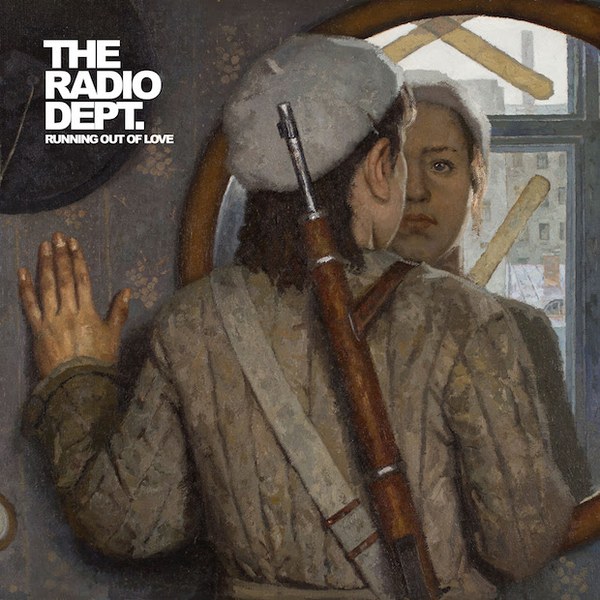
The Radio Dept., “Running Out Of Love”

(My 100 favorite albums in chronological order: #98 – released October 21, 2016)

Track listing: Sloboda Narodu / Swedish Guns / We Got Game / Thieves of State / Occupied / This Thing Was Bound To Happen / Can’t Be Guilty / Committed To The Cause / Running Out Of Love / Teach Me To Forget

I’ll never forget waking up painfully early on November 9, 2016, reaching for my phone and confirming what I and many others had dreaded—the most inconceivable, worst possible outcome of a presidential election in my lifetime (to date, I fear.) Opening Facebook, I scrolled past one confused, incensed, disgusted reaction after another from assorted friends and celebrities until coming across a link to a YouTube clip from The Radio Dept. for their song, “This Thing Was Bound To Happen.” In that moment, as much as I was in a state of shock, I mentally responded, “Well, of course.” Months of anticipation and assuredness, gradually worn down and defeated by time, determination and dumb luck—all of it led not to the outcome we expected or thought we deserved. It all simply felt inevitable now, like the punchline to a bad joke.

That’s not to say The Radio Dept. necessarily predicted this outcome, but the song and its parent album, released less than three weeks before the election, undeniably tapped into themes and feelings analogous to that of the current American political climate. In fact, said album, Running Out Of Love is essentially an extended protest/warning against the rise of fascism in the band’s home country of Sweden. It was decidedly not an overnight development: one of its most pointed and savage tracks, “Occupied”, was initially released as a single back in the summer of 2015.

Before that, the band, which primarily consists of vocalist Johan Duncanson and multi-instrumentalist Martin Larsson was dormant for a number of years due to a legal battle with its record label. I had come on board with Passive Aggressive: Singles 2002-2010; as comps go, it’s nearly up there with Pet Shop Boys’ Discography and The Go-Betweens’ Bellavista Terrace (it even has a lovely cover of the latter band’s “Bachelor Kisses”.) However, like most people, I had first heard them in 2006 on the soundtrack to Sofia Coppola’s Marie Antoinette. Prominently placed in the film, their song “Pulling Our Weight” fit right in with a king’s ransom of new wave/post-punk classics from the likes of Adam Ant, Bow Wow Wow and New Order. Upon hearing it, I guessed Coppola had unearthed a long-lost gem and was surprised to discover it was then only three years old.

On Lesser Matters (2003), Pet Grief (2006), Clinging To A Scheme (2010) and all the singles in-between, The Radio Dept. conceived of and came close to perfecting their own take on a drowsy but hook-laden, 1980s-inspired dream-pop, their distinct instrumental palette falling somewhere between The Cure’s reverb-drenched guitar attack and New Order’s bass-and-synth driven cerebral dance music. Sonically, Running Out Of Love edges towards the latter of those two poles, with the seven-minute “Occupied” a straight-up “Blue Monday” tribute in its insistent thump, thump, thump beat and klaxon-like pings that eventually build to an anxious, relentless fury.

The song’s lyrical content matches and often exceeds the sound in its vehemence. Duncanson’s an even milder-sounding vocalist than New Order’s Bernard Sumner, so when he sings, “It’s a shame how some people claim to be one thing or another / when in fact, it’s nothing but an act,” such brutal honesty is all the more unexpected and effective. This “speak softly and carry a big stick” approach is all over the album. On “We Got Game”, he complains, “So sick of hearing about that middle ground”, for it doesn’t exist with “racist loons / the kind of guys you wouldn’t like to spoon.” Later, “Teach Me To Forget” rhymes its title with the phrase, “’Because baby you’re so good at it,” as the song’s minor key melody and trance beat heighten an anger and disappointment the singer’s melodic croon can barely mask.

A steady rage courses through the bulk of Running Out Of Love. The single “Swedish Guns” proceeds as a call-and-response between the song’s titular objects and the things one can accomplish with them. “You need a helping hand? Get Swedish guns / Secure a piece of land / with Swedish guns,” Duncanson sings, and on and on over a martial/reggae beat. “This Thing Was Bound To Happen” happily buzzes along like vintage Human League, but it’s deceptive, for the resignation of the song title proves to be just a coping mechanism for utter despair (“Now I just want to get out of here / suffocate this fear.”) The Eno-esque instrumental title track consists of delicate synth and guitar licks and an brittle, singular note repeated, morse code-style for over three minutes. It certainly evokes loss—of love, time, perhaps life itself.

Fortunately, while The Radio Dept. never shy away from the horrors of totalitarianism, nor do they wallow in their misery. Their social commentary is steeped in empathy for the afflicted and a call for resistance. “Sloboda Narodu” (the title is a Yugoslav slogan that translates to “Death to fascism, freedom to the people”) is an energetic, percussion-bolstered anthem that kicks off the album on an upbeat note; “We Got Game” is nearly ebullient in its simulation of circa-1990 house music (Inner City, Technotronic) while “Can’t Be Guilty” gently floats along like a cross between ABC and The Blue Nile, its pretty melodic layers perfect for a melancholy scene in a John Hughes film, only one where a character says, “Wake me when the world has settled / then, just give it to me straight.”

This protest/pop hybrid reaches its apotheosis on “Committed To The Cause”. It begins with a melodic bassline overlapping with a second one, the twin hooks soon buoyed by a very early ’90s beat of the sort you’d find on a Happy Mondays or Primal Scream album (only darker.) Minor key verses shift into a major key chorus where Duncanson sings, “And they’re never gonna give it up,” repeatedly until getting to the title. The sublime melody and chord progression evokes potent feelings: defiance, resignation, a sense of the inevitable. Even during its extended instrumental coda, heavy with irresistible house-music piano and a synth filigree that could’ve been lifted off a Toto (!) record, the song’s momentum is sustained and deepened—you almost don’t want it to end, but it abruptly does, and the spooky title track carries these feelings further, all the way through the closing, quietly seething “Teach Me To Forget”.

I listened to Running Out Of Love incessantly before and after the election; admittedly, it didn’t seem especially more prescient or relevant after November 8 than it previously did—I’m even cautious to say it captured a specific moment, given that, at this writing, we’re decidedly still living in such a moment. Regardless, I seek pleasure in pop music as much as stimulation and provocation. Like most “political albums”, this one has plenty of the latter elements but crucially, just as much of the former. For good and for ill, the concepts The Radio Dept. confront and dissect here will always be relevant.

Up next: “We took your land, and made it our land.”

“Committed To The Cause”:

“Teach Me To Forget”:

Christine and The Queens, “Christine and The Queens”

(My 100 favorite albums in chronological order: #97 – released October 16, 2015)

Track listing: iT / Saint Claude / Tilted / No Harm Is Done / Science Fiction / Paradis Perdus / Half Ladies / Jonathan / Narcissus Is Back / Safe and Holy / Night52 / Here

Readers following this project for any amount of time will likely detect my fondness for unconventional, quirky and sometimes just plain eccentric female artists. Kate Bush, naturally, is this category’s prototype and arguably still unmatched master, and one can easily draw a straight line from her to Tori Amos to Fiona Apple to Nellie McKay. Along the way, I’ve connected others whom, while not necessarily as original or perhaps weird nonetheless created spaces for themselves in the music industry while not fully conforming to its norms: Joni Mitchell possibly did this first and best, but don’t discount Aimee Mann, Liz Phair, Sam Phillips, Róisín Murphy or Florence Welch, to name but a few who forged their own paths.

As for artists emerging in the past five years, Héloïse Letissier, who records under the pseudonym Christine and The Queens, is the most promising addition to this list. Based in Paris, Letissier released her predominantly French-language debut album Chaleur Humaine (“Human Warmth”) at age 26 in 2014 and reissued it in America under the title Christine and The Queens a year later, rerecording many (but not all) of its vocals in English, and swapping out two of the original’s songs for three new ones. Complicating things further, this English version came out in Europe the following year with Chaleur Humaine as its title and was a massive hit, charting at number two in the UK.

As an American, it’s the self-titled version I know and love. Upon my first listen in late 2016, it wasn’t Letissier’s voice (better-than-average, if occasionally reedy) or sound (laptop enhanced, 80s-tinged electro-pop) or even playfully peculiar sensibility that caught my ear, although all these things would fortify my interest over time; no, what really struck me was Letissier’s way with a melody. Like Stuart Murdoch or Andy Sturmer or Emm Gryner, she just has a knack for catchy choruses and often equally captivating verses that are approachable and indelible without sounding derivative.

Christine and The Queens’ best known song, “Tilted” (called “Christine” on Chaleur Humaine), is a perfect example. Right at the start, that clipped synth hook (like a snippet of a warped vinyl record) commands attention, along with the “heh, heh” percussive vocal sample woven into the beat. Its bright, brief verses are melodically simple but effective in how their chords carry over to the sing-along chorus: “I am actually good / can’t help it if we’re tilted.” She switches to an irresistibly rapid French rap on the bridge before slightly altering the melody on the final verse: “I’m doing my face / with magic marker / I’m in my right place / don’t be a downer,” she repeats (along with soulful “yeahs” underneath) before it neatly reveals itself as a faultless countermelody to the chorus reappearing on top. “Tilted” is modern nonsense pop of the highest order—in addition to being superbly catchy, it’s also a bold and convincing declaration of self.

Occasionally, Letissier’s melodies absolutely define and drive her songs. I couldn’t begin to tell you what “Science Fiction” is about, even in its English version (its lyrical hook goes, “We’re spinning like Mike and Freddy”), but the agility it wrings out of two chords and her kinetic, razor-sharp vocals (particularly the wordless ones, like “na, na-na, na-na-na-na”) are so infectious it doesn’t matter. Similarly, dramatic closer “Here” sidesteps any pretense of delivering wisdom or revelation for pure, visceral emotion in how urgently Letissier repeatedly sings the song’s title in its fiery choruses.

Letissier’s melodic instinct and mastery of emotional shaping is most deeply felt on “Saint Claude”. The verses are sung in French—translated, it’s yet another song of love and devotion, interesting less for what’s being said than how it’s said, with certain words swiftly repeated in triplicate. However, it’s the ascendant chorus that whole-heartedly soars: “Here’s my station,” she repeats, as if both making a defense and offering an olive branch, but her poignancy develops each time before she reveals, “But if you say just one word I’ll stay with you.” At the minute-long coda, she mournfully concludes, “We are so lonely in this part of town”; although you feel she’s deliberately left out part of the narrative, it’s also difficult not to acknowledge that it’s all you need to hear to understand or feel its effect.

Still, it would be a disservice to overlook Letissier’s lyrical content, for it illustrates her breakthrough as a new kind of pop star. Identifying as pansexual, Letissier writes about gender fluidity to the extent an artist of an earlier generation might’ve done so regarding merely being a woman in a predominantly male profession. Leading off with “iT”, she confronts matters of gender identity head-on: “I’m a man now,” she brashly, almost matter-of-factly declares, “and there’s nothing you can do to make me change my mind.” Later, on “Half Ladies”, she adds, “Cause just when you thought I’d be still a little girl, I’m one of the guys,” sounding more vulnerable but still determined, backed up by gentle Fender Rhodes and finger snaps as the song shifts into its celebratory French chorus (“Laissez passer toutes Half-Ladies!”, which essentially means, “Let them all through!”)

Not surprisingly, the three new songs here are all in English (and the two left off from Chaleur Humaine are in French); more interestingly, two of them are duets. Featuring teenaged Nigerian-American rapper Tunji Ige, “No Harm Is Done” noticeably leans heavier towards contemporary R&B than anything on the album—it’s perfectly fine, but not particularly innovative given what surrounds it. “Jonathan” is far more arresting: queer male singer Mike Hadreas, an inspired choice of a partner (who also performs under a pseudonym, Perfume Genius), takes the entire first verse of this lovely, if straightforward ballad, with Letissier not appearing until the second verse. The other new song, “Safe and Holy”, is, after “Tilted”, her most explicit move for the dancefloor, combining gospel chords with a rock-disco rhythm not dissimilar to Stevie Nicks’ “Edge of Seventeen”.

Letissier projects plenty of confidence at such a relatively unseasoned age: she interpolates Kanye West’s “Heartless” on the chorus of “Paradis Perdus”, titles one of her compositions “Narcissus Is Back” without lapsing into esoterica, and crafts music videos that are less promotional pieces than fodder for an art installation (see below.) Fortunately, her saving grace is an approachability one doesn’t always easily detect in art-pop. More than just “one of the guys”, she’s as relatable as a Tracey Thorn or a Jen Trynin. Inviting and inclusive, but also fiercely original, it’s not an easy balance to pull off, or to make appear as effortless as Letissier occasionally does here.

If anything, her second album, 2018’s released-simultaneously-in-English-and-in-French Chris, walks a trickier tightrope, with Letissier both visually and conceptually inhabiting the titular male persona throughout its entirety. Time may even prove Chris to be the superior album, with songs like “The Walker”, “Doesn’t Matter” and “What’s-Her-Name” sporting ever-sharper melodies and lyrics. At present, she carries the promise of Kate in 1982, Florence in 2009, maybe even Joni in 1970. Whether she makes good on it or not, I suspect she’ll be forever foraging her own path, and I eagerly await as to where she’ll go next.

Up Next: This Thing Was Bound To Happen.

“Tilted”:

“Saint Claude”:

Afternoon at Iguana Island

Five days into our Turks and Caicos trip, we signed up for an afternoon snorkeling excursion, part of which included an hour-long stop at Little Water Cay…

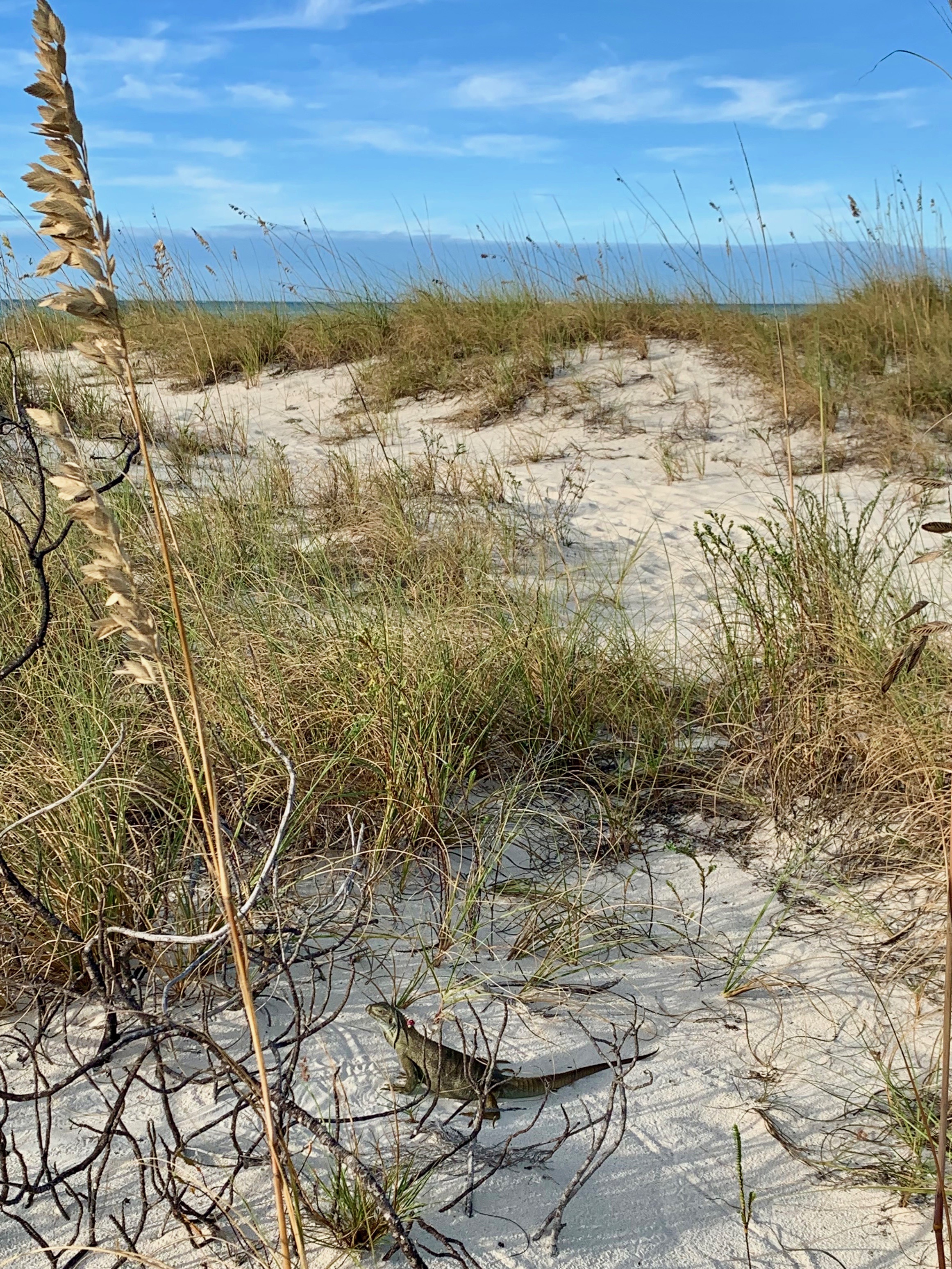
…also informally known as Iguana Island, for reasons that will soon be apparent.

A couple of bright orange-beaked birds near the shore.

Little Water Cay is long and narrow; squint and you might see the opposite shore.

Not every track came from a human.

Here come the iguanas!

They allow you to get pretty close, though I wouldn’t be in a hurry to stick out my hand.

The opposite shore, I think–we were easily turned around at one point.

Color like this is what I come to the Caribbean for.

Make that late afternoon at Iguana Island.

It wasn’t long before we had to head back to Grace Bay.

On the way, we docked near here and were invited to ride a water slide from the boat’s very top on down into the ocean.

Sunset approaching.

Grace Bay beckons.

We fondly look back at the setting sun after departing the boat. A half-day of sea, snorkeling, conch salad and plenty of rum punch comes to a close.

Róisín Murphy, “Hairless Toys”

(My 100 favorite albums in chronological order: #96 – released May 8, 2015)

Track listing: Gone Fishing / Evil Eyes / Exploitation / Uninvited Guest / Exile / House of Glass / Hairless Toys (Gotta Hurt) / Unputdownable

After Overpowered failed to connect with a wider audience, Róisín Murphy seemed to be in no hurry to put out another album, even as Lady Gaga took its look and sound to the bank a year later. Instead, Murphy went on an extended hiatus: she became a mother (twice), occasionally surfaced as a guest vocalist (most notably on “Don’t You Agree” from the David Byrne/Fatboy Slim life-of-Imelda Marcos concept album Here Lies Love) and released a few alluringly titled one-off singles of her own (“Orally Fixated”, “Simulation”.) Mi Senti, an EP of Italian-language songs, appeared in 2014; the stylistic range across its six tracks spoke to her inclination to experiment and defy expectations, but it was only a mere inkling of what was to come when her next album finally arrived a year later.

Hairless Toys decidedly does not pick up where Overpowered left off; nothing on it is as radio-friendly as “You Know Me Better” or as danceable as “Movie Star”. Its eight tracks sprawl across fifty minutes with most of them hovering around six. When first single and opener “Gone Fishing” dropped a few months before the album’s release, I did not know exactly what to make of it. Murphy’s submerged yet steady vocals fluttered in, out and all around a collage of mechanical beats and synths, all of it layered as to feel peculiar but not entirely off-putting. With lyrics inspired by Paris Is Burning, a documentary about New York City drag culture in the late ’80s (she refers to “The children of LaBeija”, meaning the “house” of performer Pepper LaBeija), Murphy fashions a paean “to building another kind of family nest” for all those stigmatized by their own blood relatives (though the song title remains either a mystery or a pretty obscure reference.) Verse after verse, it percolates on, its hooks not reaching out to hug the listener but creeping along the sidelines, only to occasionally, suddenly, ever-so-briefly emerge before retreating back into the ether.

While certainly more cerebral than anything before it in Murphy’s discography, Hairless Toys is still, at its core, comprised of pop songs—leisurely-paced, heady, at times quixotic pop songs, but ones still sporting hummable melodies and verse/chorus/verse structures. Following “Gone Fishing”, “Evil Eyes” is a slightly sharper entry point for unassuming listeners. An introductory electronic bassline/heartbeat remains a constant throughout, its irresistible strut a solid foundation for Murphy’s dreamily gliding vocals on top (“ho…cus…. / ho-cus, po…..cus….”). It plays like slow-motion disco-funk, graceful but also tense enough that it’s genuinely thrilling when it hits that key change at the bridge at 4:27 and Murphy snaps to attention: “Gonna put those demons in their place!,” she exclaims, as a call-and-response with the phrase, “Get to know them!” (See the song’s bonkers music video below, and in particular, how she chose to visualize this part.)

“Exploitation” clocks in at nearly nine-and-a-half minutes and was still chosen as the album’s second single (albeit in a four-minute edit.) Kicking off with a boisterous, galloping, thirty-second-long synth-and-percussion fanfare, it deftly settles into a subdued thump-a-thon driven by a repeated three-note hook. “Never… underestimate / creative people / and the depths that they will go,” Murphy sings, again forever wafting through a scurrying beat, pausing to ponder the question, “I just don’t know who’s / who’s exploiting who?” in the chorus. The album version’s back half is entirely instrumental, shifting from house music to straight-up trance, the melody gradually dissolving into abstraction over a series of seemingly endless piano chords and electronic noise. Weird as it may be to some (most?), it’s less a line drawn in the sand than Murphy asking her listeners, “Why separate art from pop? Why can’t they co-exist?”

It’s a question Hairless Toys returns to often without making excuses or really any concessions for either side. Combining fat, heavy synth bass with flowery do-do-do’s over what roughly amounts to supper-club funk, “Uninvited Guest” is one of the album’s most playful tracks, particularly in its baritone “whoah, whoah, whoah’s” in the chorus’ background and its cheerful whistling hook; it also transforms into one of the most gorgeous songs here when, at the three-minute-mark, the backbeat suddenly vanishes and an extended bridge unfolds with luxuriant chord changes and lush layers of guitars and multi-tracked vocals, growing more impossibly lovely until the beat resumes a minute-and-a-half later.

“Exile” is arguably even more unexpected a left turn than the back half of “Exploitation”. An honest-to-god, morning-after torch song heavy with twangy guitar, reverb, a little pedal steel and briefly, an eerie, gurgling, horror-film synth noise, it resembles a country death song for a David Lynch film with Murphy speak-singing most of the lyrics rather than sounding off like a siren. And yet, it’s also the most traditional, straightforward tune here (also the shortest at four minutes.) Like much of Hairless Toys, it greatly benefits from extra space to breathe and further ponder one’s surroundings while also both paying homage to and completely subverting an entire musical genre.

While shorter than “Exploitation” by over two minutes, “House of Glass” is almost its mirror image: disclosing its most blatant hook right away, it still sounds tentative at first, a somewhat wispy tone poem. Thankfully, it builds up rather than drifts further apart, becoming danceable midway through. Murphy’s vocals alternately peacefully float through the air (“People / who live / in / glassssss / hou-sesssss”) and cut it like a fine blade (rapidly singing, “Little pieces of a broken dream / Scattered in a million different places.”) Layers accumulate as everything proceeds, from guitar riffs and electro-xylophone runs to drunken, elongated “loo / loo / loo” vocals. The pressure builds, but deliberately, it never really climaxes.

On another album, “Hairless Toys (Gotta Hurt)” could be a delicate, heartrending ballad, its two chords gracefully buoyed by an acoustic piano or string quartet; here, its simplistic melody merely serves as a skeleton for an atmospheric wash of ebbing-and-flowing synths and various electronic textures, as Murphy’s vocals become less of a focal point and more just another element in the cavernous mix. As for that inscrutable title (what the hell is a “Hairless Toy”?), producer Eddie Stevens supposedly mistakenly heard those words instead of the song’s original title, “Careless Talk”. In a typically quirky Murphy move, it just stuck for both the song and the entire album.

Leave it to Murphy to also place her best song here at the very end. In great contrast to the preceding track, “Unputdownable” is, at the onset, pretty spare—just tambourine, Murphy’s vocal and a repeated, ascending eight-note piano hook. “You are my favorite book,” she sings, and proceeds with a series of clever reading-as-love metaphors: “You’re unputdownable / a story so confounding / the pages turn so easily,” and “I’m fully occupied / reading between the lines.” Sparse synth blips and bleeps materialize throughout, but there’s also an effective silent pause before a dramatic Spanish guitar strum transforms the entire song at its bridge and Murphy thrillingly wails, “Well, I’m left in confusion / by your epilogue.” This occurs again at the song’s climax and if anything, the out-of-nowhere guitar’s even further heightened by the introduction of a backbeat, some cowbell and a tart synth that together transform this into a glorious anthem: “If you’d allow me / to read your mind,” she sings, repeating those last four words over and over as “Unputdownable” simmers to a satisfying yet lingering close.

Rather than coasting on her past successes (and failures) as a member of Moloko and as a solo artist, Murphy chose to emerge from her hiatus with a leap into the unknown. Sure, one can detect isolated bits and pieces of Hairless Toys across her prior discography (parts of “Uninvited Guest” could easily slot into 2005’s Ruby Blue); strung together, however, they’re revelatory, collectively pushing the boundaries of what one could expect from her and, for that matter, of dance-pop in general. If 2016’s Take Her Up To Monto (culled from the same sessions as Hairless Toys) pushed them even further (occasionally to its detriment), her subsequent work with producer Maurice Fulton found a way to render her music as both fresh and familiar—particularly his radical remix of “House of Glass”, which turned it into a lucid slap-bass odyssey Alexander O’Neal could’ve sung in 1987. Releasing four 12-inch singles with Fulton in lieu of another LP in 2018, Murphy remains an iconoclast and, more than two decades into her career, still an artist to watch.

Up next: Post-modern, post-genre, post-gender, post-?

“Unputdownable”:

“Evil Eyes”: