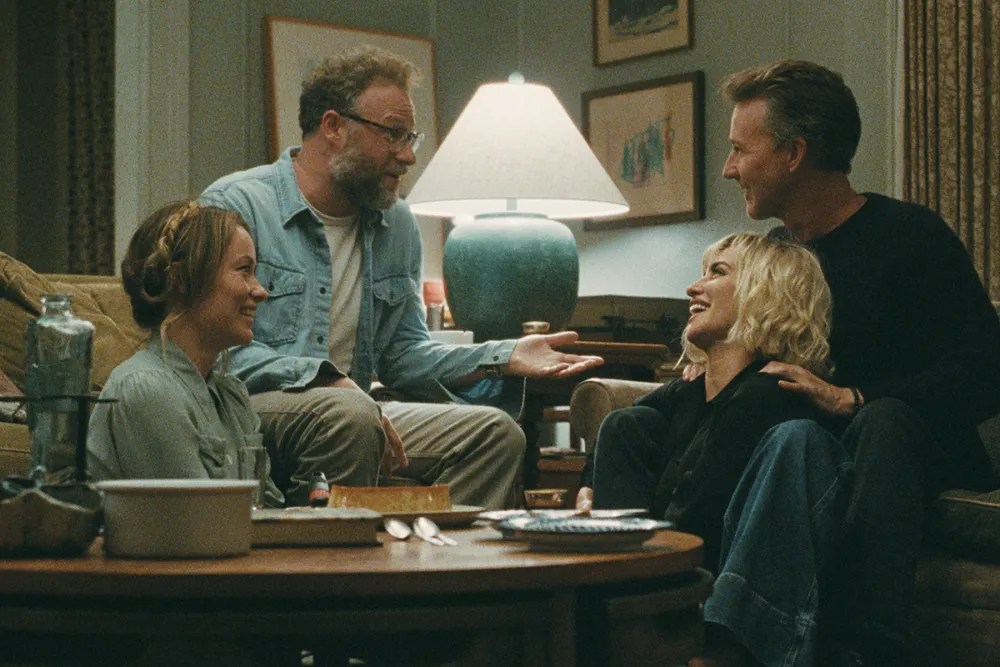
Any resemblance between The Invite and Who’s Afraid of Virginia Woolf is not coincidental. From a screenplay written by Will McCormack and Rashida Jones and directed by and starring Olivia Wilde as Martha surrogate Angela, it is almost entirely set in her and Joe’s (Seth Rogen) San Francisco apartment. One night, Joe returns from his job as a music teacher to learn that Angela has invited a neighboring couple, Pína (Penelope Cruz) and Hawk (Edward Norton) over to dinner within the next hour. Their bickering-cum-full-out-arguing hits a wild crescendo just as the doorbell rings announcing Pína and Hawk’s arrival.
While it roughly follows the trajectory of Mike Nichols’ classic film of the Edward Albee play, this is not a remake of it (actually, it’s a remake of the Spanish film The People Upstairs.) For one thing, despite the earlier film’s gallows humor, The Invite is unashamedly hilarious (the words “screwball cringe” came to mind early on) with its rat-a-tat-tat dialogue, one-liners and sight gags (Rogen struggling to bike up the city’s infamously hilly streets is a highlight of the latter.) It’s not long before sex-therapist Pína and ex-firefighter Hawk feel like near-kindred spirits to Angela and Joe, especially in their own neuroses. All four actors are a delight to watch with a reminder of still-otherworldly Cruz’s often obscured talent for comedy.
As the night lingers on, events become more outrageous before the film pulls back for pathos and some catharsis. The shifting tone is handled elegantly even as it slows the built-up momentum to a crawl. As for Wilde, this makes the misguided Don’t Worry Darling feel like an aberration in her filmmaking career. While more fun than profound, The Invite is worth sitting through to arrive at an affecting if ambiguous détente of a conclusion between two of its four characters.
“Write what you know” has become a cliché but it’s still valuable advice for anyone telling a story no matter how fantastical or accurately reflective of one’s own experience. At IFFBoston this year, I saw at least two features falling under this category: Romeria and Blue Heron. Both begin steeped in realism before unexpectedly shifting into dream sequences. The former imagines a meeting between the main character and her parents from before her birth; the latter, however, presents something more complex, using a sort of psychodrama to reinterpret a defining incident from one’s past.
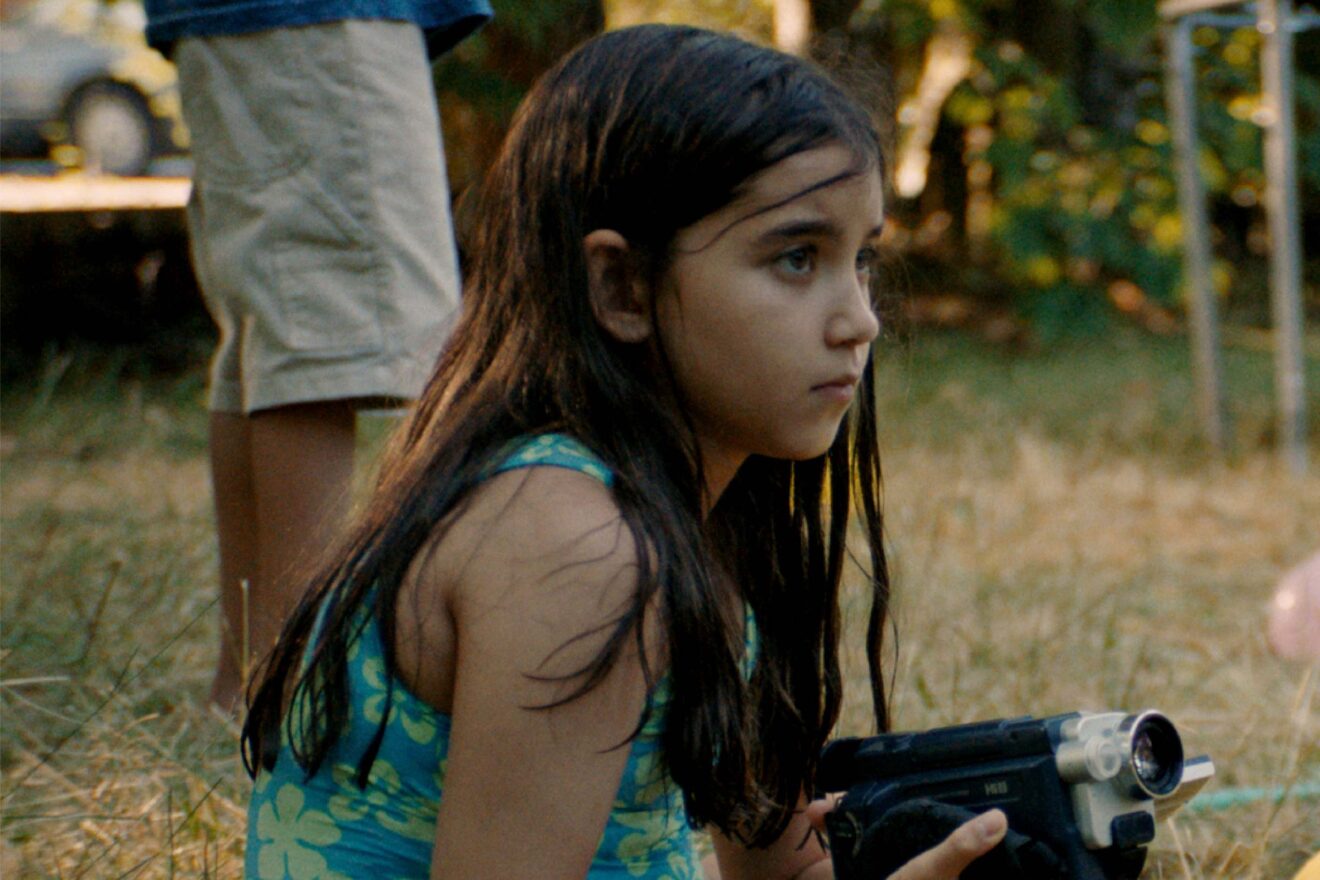
In Blue Heron, filmmaker Sophy Romvari’s 1990s childhood comes to life in the form of a Hungarian family settling into a new home on Vancouver Island. Her surrogate, Sasha (Eylul Guven) is the youngest of four children and the only one to be born in Canada. Her oldest brother, Jeremy (Erik Beddoes) blatantly doesn’t resemble any of his siblings, much less his parents (his actual father was someone whom his mother previously dated; he didn’t have any involvement in raising him.) As the rest of the family studiously works on assimilating into this new environment, Jeremy acts out. At first, his behavior is that of your average frustrated teen (moody, argumentative). Then, it escalates. He gets caught shoplifting. He climbs on his home’s roof, refusing to come down. He smashes his hand through a window. He refuses to communicate, at all. His family becomes worried for his safety, and also their own.
The shift from a near-neorealism to a far more dreamlike scenario occurs when Sasha as an adult (played by Amy Zimmer) appears and attempts piecing together the decisive actions her parents took to deal with Jeremy. I don’t want to spoil exactly what happens, for it unfolds as an act of discovery but also one of analysis, sifting through facts to arrive at some conclusion even if it’s a subjective truth. Romvari paints as an impressionist, dotting her frames with cultural signifiers both shared (pop songs, ambient sounds, suburban talismans such as freshly cut grass) and singular (the elaborate fake maps Jeremy draws which are actual ones from Romvari’s own brother.) As a filmmaker/storyteller, Romvari fully grasps the slipperiness of memory. Following a series of acclaimed shorts, Blue Heron is a remarkable first feature due to such an understanding and her ingenuity in expressing it.
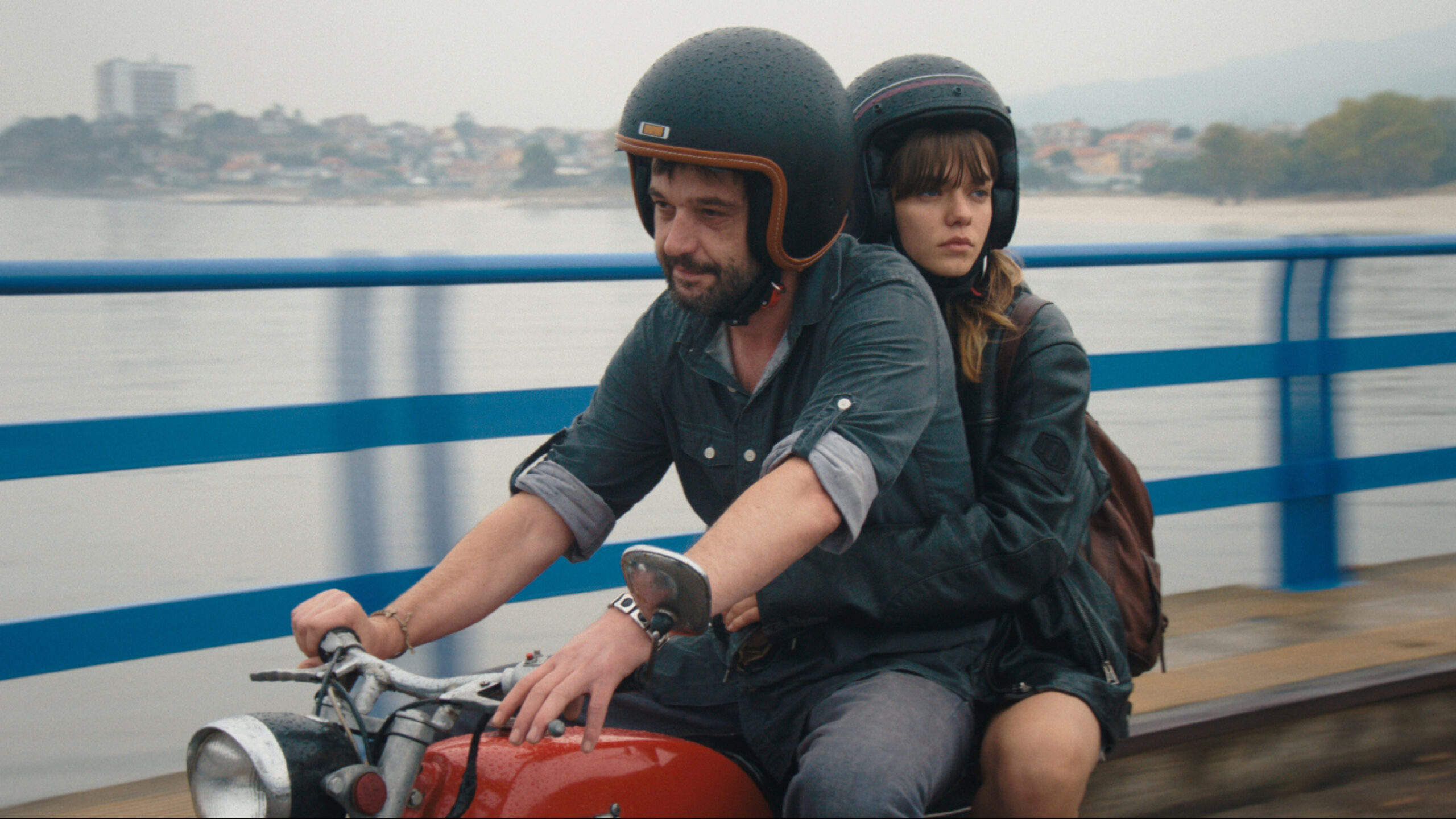
In 2004, 18-year-old orphan Marina (Llúcia Garcia) visits the port city of Vigo, Spain. She’s meeting with her paternal grandparents to obtain a notarized signature for her to be recognized on her father’s death certificate so that she can attend university. Until now, she’s never met any of her blood relatives. They seem eager and welcoming to her—perhaps overly so as her grandparents want to shower her with money out of guilt or maybe as encouragement for her to keep silent about what little she knows of her parents, along with scattered clues she picks up on from her similarly-aged cousin Nuno (the single-monikered Mitch).
She gradually pieces together a version of what happened between her parents that varies slightly from what she’s officially told. Then, the film shifts into magical realism at the initially casual appearance of a stray cat, an impetus for Marina and the audience to discover the truth, or at least a version of it (maybe Marina’s idealized one?). As with previous feature Alcarràs, director Carla Simón has a keen eye for composition and framing naturally beautiful landscapes with more depth than your average pretty picture. Despite that, Romería is pleasant but sometimes dramatically static until that shift in the third act. Apparently based on Simón’s own experiences, it didn’t entirely express the urgency of why it was being told or how it may have shaped her adulthood and career. However, the post-cat material nearly saved it; I would not have minded seeing an entire feature (or at least a short) squarely focused on that story.
Given our current tendency to document just about everything (especially ourselves) with our smartphones, will younger and future generations retain a seemingly infinite treasure trove of recorded media to reference, look back on and cultivate into living histories? Or will the ephemeralness, marginality, and sheer excess of it all render much of it forgotten detritus, lost to time, not anything worth sifting through and (re)discovering?
North Carolina born, Boston based Ross McElwee wasn’t the first filmmaker to conceive of documentary as memoir but his landmark first feature Sherman’s March (1986) suggested a manifesto of possibilities. Without the access and options we have today, he’d simply film himself and others with his 16mm or video camera and provide commentary. His mild southern accent and droll, self-deprecating humor were endearing identifiers as he tracked the titular Civil War route; in a parallel narrative, family and friends set up the still-single-in-his-mid-30s Ross with an array of (often questionable) female suitors. A surprise hit, McElwee followed it with a series of check-ins where he continued recording his life as seen through the prism of marriage and fatherhood (Time Indefinite, 1993) and as a middle-aged man parsing his family’s ancestral connection to the tobacco industry (Bright Leaves, 2003).
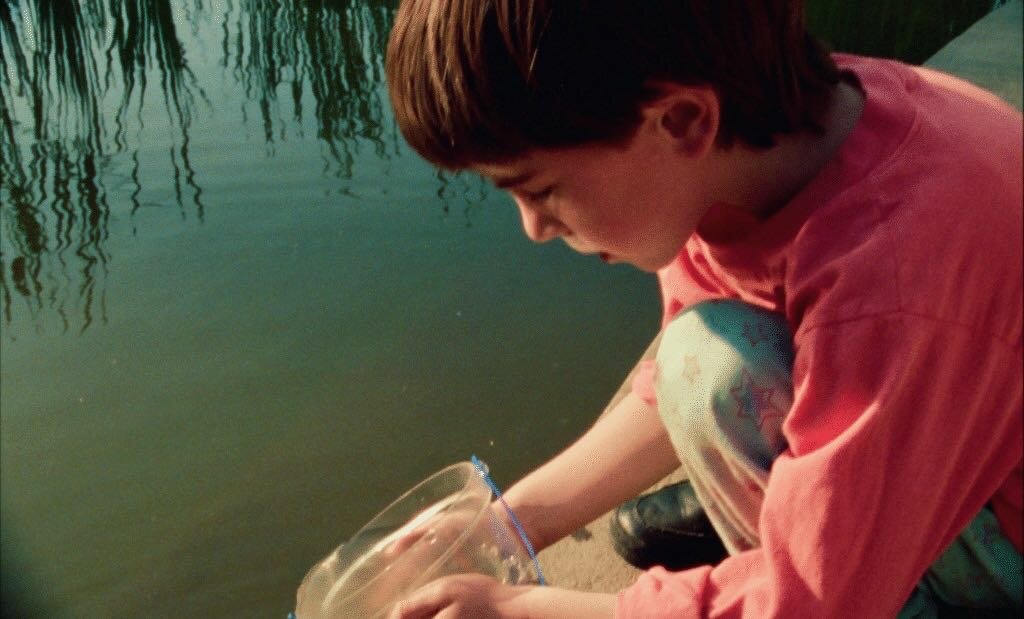
“I used to be a filmmaker” are his initial words spoken in Remake, his first feature in about 15 years. During that time, McElwee got divorced and remarried but the real focus is on his son, Adrian, whom in his mid-20s died of a drug overdose about a decade ago. Given his tendency to film himself and his family, McElwee has that treasure trove of footage; here, he includes it discriminately, often cutting from footage of himself and/or Adrian from one point in time to another to make sense of such life and loss. As a result, it almost resembles McElwee’s own version of Michael Apted’s Up series, which checks in on a dozen subjects every seven years with each subsequent film in the series incorporating previous footage to exhibit growth and change over a lifetime. Like Apted, McElwee has a knack for making connections and earning an emotional charge from viewing the same person at different life phases.
Remake has its own dual narrative. McElwee began work on it when a producer contacted him to buy the rights to turn Sherman’s March into a fictional feature, the process of which he intended to document, perhaps as a bonus feature. Naturally, this premise foregrounds McElwee’s sly humor as we see the adaptation-in-progress shuffle through many, many iterations (where it finally ends up is too good to spoil.) Putting everything aside after Adrian’s death, McElwee eventually resumed the project but with a different focus. Working through his grief and considering the events leading up to this tragedy, the adaptation material serves as a tonic of sorts while also expounding on the idea of remaking a life out of memories and archival footage.
While not as definitive as Sherman’s March, Remake could be the other primary bookend of McElwee’s career if it ends up his last feature. Incorporating Adrian’s own footage (he was also an aspiring filmmaker), drawings, animations and even some of his musical contributions to the soundtrack, McElwee’s rarely been this formally adventurous in his own aesthetic. Not all of it works (time-lapse sequences, Ross?), but what resonates is an impetus to firmly exist in and make sense of the present no matter how much the past informs or haunts it.
Named after a terminally ill 16-year-old girl (played by Lola Petticrew), she is but one of three main characters in writer-director Daina O. Pusić’s feature debut. The other two are Tuesday’s mother, Zora (Julia Louis-Dreyfus) and a feral, multi-hued parrot who can change size at will and speaks in a sinister, garbled, near-stoned voice (by Nigerian born British actor Arinzé Kene.)
It’s really all one needs to know as it’s best to go into this cold. Before the film’s screening, a collective buzz between members of my film group and I speculated that it was to be an unusual one, possibly a slow, oblique art film along the lines of Jonathan Glazer’s Under The Skin; from the first scene, however, it was more readily apparent that this was simply batshit insane and fortunately, refreshing and unique. Even once one gets the gist of what’s really going on, the weirdness doesn’t cease; nor does an ability to surprise (one moment in particular is like nothing else I’ve seen outside of a Warner Bros cartoon.) Tuesday has the feel of a future cult classic and it’s certainly not for everyone but it is assured, intriguing and unpredictable. Iconic for multiple comedic performances, Louis-Dreyfus has rarely played such a dramatic, heartbreaking role, although as in the most effective dramas, there is so much humor laced throughout that it’s almost inseparable from the serious stuff. I’m not sure if this is as great of a film as it is an original one, but I look forward to revisiting it. Grade: A-
THELMA
June Squibb found success late in life, well into her 70s and beyond when she appeared in small but acclaimed scene-stealing roles Alexander Payne’s About Schmidt and Nebraska; in both of these and many other film and TV roles, her tart irascibleness emitted the presence of an esteemed character actress. Until now, no one has built an entire film around her; enter director Josh Margolin, whose feature debut is based on his own grandmother (played here by Squibb), a victim of a phone scam bilking her out of $10,000.
The thing about good character actors is that, given the opportunity to shine in a lead role, they usually knock it out of the park. 93 when it was filmed, Squibb’s timing and verve is undiminished, but with a naturalness and gravitas that transcends the “wacky old lady” trope. She also leads an above-average ensemble populated with other great character actors (Parker Posey, Clark Gregg) and in his final role, an affecting Richard Roundtree. The film itself is as light as air (almost verging-on-silly), but Margolin’s awareness of this and the script’s gentle satire of suspenseful Mission: Impossible like theatrics turn Thelma into the summer blockbuster alternative you probably never knew you wanted. B+
PURPLE HAZE: A CONSERVATION FILM
Alternate title: Everything You Ever Wanted to Know About Purple Martins (and Should Thought To Have Asked.) The largest species of swallows in North America, the Purple Martin resides exclusively in nesting structures in order to ensure their survival. Filmmaker Zach Steinhauser noticed how these birds tended to thrive in man-made bird houses constructed from holed-out gourds around his home in central South Carolina, sparking an interest in the species, following them as they migrated to warmer climates (most notably the Amazon rainforest) and back to their domestic homes which are increasingly threatened by environmental deterioration and lack of awareness. This is the type of documentary you’ll only see at a film festival: a little rough around the edges but impassioned and heartfelt in its agenda. Steinhauser is obviously working with a limited budget, but you rarely question his interest or dedication to the subject matter, which goes a long way in rendering this a better-than-average film about birds. B
HAPPY CAMPERS
Amy Nicholson’s documentary tries to be the low-rent trailer park equivalent of Errol Morris’ Gates of Heaven, offering a deadpan look at the last summer of one said establishment off the Virginia coast before it closes for redevelopment. Forgoing context and narration for a verite-like, interview-heavy approach, it’s a pleasant, gently rambling view into working class Americana, a community of tchotchke-filled mobile homes that might seem downtrodden if not for flashes of recognition all but the most elite vacationers will pick up on or the sincerity in how its inhabitants are portrayed. Unfortunately, it stretches out a nifty idea for a short film into something that’s a bit repetitive even at 78 minutes. B-