Given our current tendency to document just about everything (especially ourselves) with our smartphones, will younger and future generations retain a seemingly infinite treasure trove of recorded media to reference, look back on and cultivate into living histories? Or will the ephemeralness, marginality, and sheer excess of it all render much of it forgotten detritus, lost to time, not anything worth sifting through and (re)discovering?
North Carolina born, Boston based Ross McElwee wasn’t the first filmmaker to conceive of documentary as memoir but his landmark first feature Sherman’s March (1986) suggested a manifesto of possibilities. Without the access and options we have today, he’d simply film himself and others with his 16mm or video camera and provide commentary. His mild southern accent and droll, self-deprecating humor were endearing identifiers as he tracked the titular Civil War route; in a parallel narrative, family and friends set up the still-single-in-his-mid-30s Ross with an array of (often questionable) female suitors. A surprise hit, McElwee followed it with a series of check-ins where he continued recording his life as seen through the prism of marriage and fatherhood (Time Indefinite, 1993) and as a middle-aged man parsing his family’s ancestral connection to the tobacco industry (Bright Leaves, 2003).
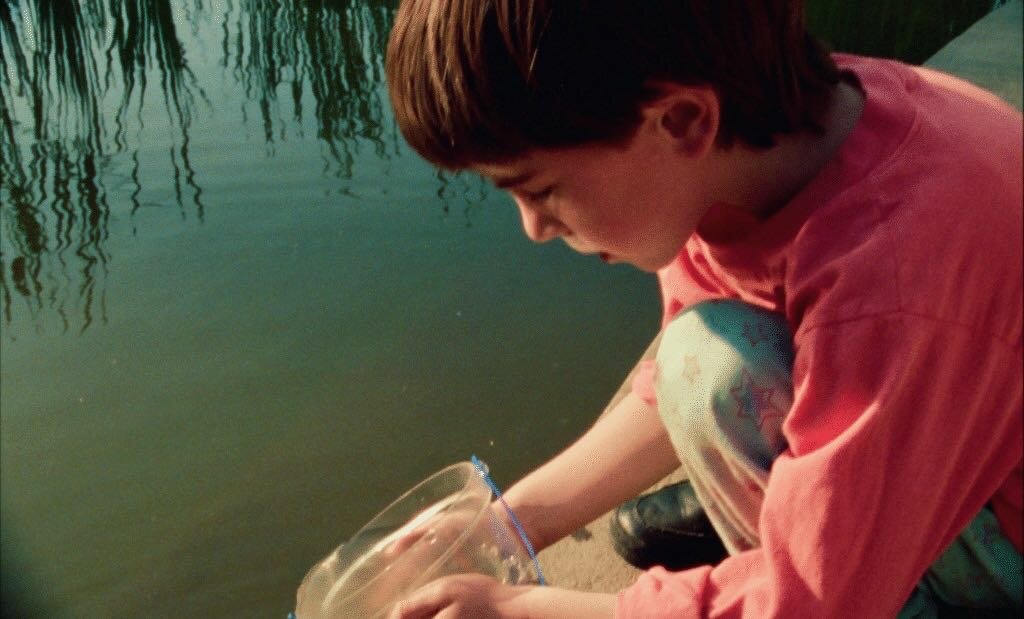
“I used to be a filmmaker” are his initial words spoken in Remake, his first feature in about 15 years. During that time, McElwee got divorced and remarried but the real focus is on his son, Adrian, whom in his mid-20s died of a drug overdose about a decade ago. Given his tendency to film himself and his family, McElwee has that treasure trove of footage; here, he includes it discriminately, often cutting from footage of himself and/or Adrian from one point in time to another to make sense of such life and loss. As a result, it almost resembles McElwee’s own version of Michael Apted’s Up series, which checks in on a dozen subjects every seven years with each subsequent film in the series incorporating previous footage to exhibit growth and change over a lifetime. Like Apted, McElwee has a knack for making connections and earning an emotional charge from viewing the same person at different life phases.
Remake has its own dual narrative. McElwee began work on it when a producer contacted him to buy the rights to turn Sherman’s March into a fictional feature, the process of which he intended to document, perhaps as a bonus feature. Naturally, this premise foregrounds McElwee’s sly humor as we see the adaptation-in-progress shuffle through many, many iterations (where it finally ends up is too good to spoil.) Putting everything aside after Adrian’s death, McElwee eventually resumed the project but with a different focus. Working through his grief and considering the events leading up to this tragedy, the adaptation material serves as a tonic of sorts while also expounding on the idea of remaking a life out of memories and archival footage.
While not as definitive as Sherman’s March, Remake could be the other primary bookend of McElwee’s career if it ends up his last feature. Incorporating Adrian’s own footage (he was also an aspiring filmmaker), drawings, animations and even some of his musical contributions to the soundtrack, McElwee’s rarely been this formally adventurous in his own aesthetic. Not all of it works (time-lapse sequences, Ross?), but what resonates is an impetus to firmly exist in and make sense of the present no matter how much the past informs or haunts it.

