By this year, music permeated my life more than it ever had before. Between regular used record store visits (including dollar vinyl bin dives), library CDs dubbed onto blank cassettes and “Ten Albums for the Price of One” record clubs (Columbia House, BMG, CD-HQ—I did ‘em all), I amassed a collection of more product than I could ever absorb. I stopped at a record store that September after a few weeks of deliberately avoiding them to save up some cash, about to burst at the seams with joy upon seeing all the new records I wanted to buy. I selected six of that year’s releases for my 100 Albums project and just as easily could’ve picked at least four more (Diary of A Mod Housewife, Viva! La Woman, Endtroducing… and Nine Objects of Desire, for starters) if I didn’t feel weird about including ten for a single year.
As with 1995, my age obviously factored into this. Everything at 21 still felt so new and limitless to me where music was concerned. While the alt-rock bubble had burst, it had not yet fully soured into the dubious mutations (nu-metal, mook rock and Smashmouth) that overtook it in the late ‘90s. Like any other year, this one had its share of pedestrian (311), overplayed (oh, I don’t know, “Macarena”?) and just plain godawful (hello, Bush!) hits. But look at Primitive Radio Gods topping the modern rock airplay chart for six weeks! Or agreeable novelty hits from Fountains of Wayne, Beck and Geggy Tah! Not to mention all the wonderful stuff not on your radio, from Sloan’s Chicago (the band)-gone-indie-pop gem to an improbable but divine duet between Nick Cave and Kylie Minogue!
The relative lack of real obscurities here (even Cibo Matto got on MTV) suggests indie’s infiltration of the mainstream was at one of its intermittent peaks though I suspect many listeners have never heard “Percolator”, “Power World” or even “I Wanna Be Your Joey Ramone”. I myself did not hear DJ Shadow’s expansive, sample-built mood collage or Belle and Sebastian’s version of indie-pop more informed by Vince Guaraldi than Tom Verlaine until later (though in the latter’s case, not too much later) but both influenced particular musical genre strands that remain in heavy rotation through this day, even if I don’t care too much about recent work by either artist.
1996: One Was Magenta, The Other Was Blue
Beck, “Devil’s Haircut”
Aimee Mann, “Choice In The Matter”
Belle and Sebastian, “Seeing Other People”
Fountains of Wayne, “Radiation Vibe”
Super Furry Animals, “Something 4 The Weekend”
Nick Cave & The Bad Seeds with Kylie Minogue, “Where The Wild Roses Grow”
Pet Shop Boys, “Se a Vida E (That’s The Way Life Is)”
Cowboy Junkies, “Something More Besides You”
Morcheeba, “Small Town”
Jason Falkner, “I Live”
Suzanne Vega, “World Before Columbus”
Sam Phillips, “Power World”
Amy Rigby, “20 Questions”
Fiona Apple, “Sleep To Dream”
Squirrel Nut Zippers, “Put A Lid On It”
Gillian Welch, “Pass You By”
Cibo Matto, “Know Your Chicken”
Patti Smith, “Summer Cannibals”
Sloan, “Everything You’ve Done Wrong”
R.E.M., “Binky the Doormat”
Luscious Jackson, “Naked Eye”
The Divine Comedy, “Becoming More Like Alfie”
DJ Shadow, “Stem/Long Stem”
Stereolab, “Percolator”
Sheryl Crow, “Home”
Ani DiFranco, “Adam and Eve”
Tori Amos, “Hey Jupiter”
Pulp, “Mile End”
Suede, “Trash”
Sleater-Kinney, “I Wanna Be Your Joey Ramone”
Geggy Tah, “Whoever You Are”
Steve Wynn, “Shelly’s Blues (Pt. 2)”
Tom Petty, “Walls (Circus)”
Primitive Radio Gods, “Standing Outside a Broken Phone Booth With Money in My Hand”
By 1995, “Alternative” was the mainstream. I spent that Memorial Day at a music festival sponsored by WLUM, Milwaukee’s corporate modern rock radio station. Violent Femmes were the hometown headliners, but their most recent album, Rock! would never get an official domestic release (and is still not streaming anywhere); in fact, none of the bands I saw are on this mix. Next to the Femmes, the highlight was seeing the Ramones on the second stage on one of their last tours. They ran through 30 songs in 40 minutes, and more than made up for having to sit through the Flaming Lips (whom I’ve never cottoned to) and Thank You-era Duran Duran (yes, they played their versions of “911 Is A Joke” and “White Lines” from this misbegotten covers album).
However, I don’t mean to reduce an entire year to a single event, even if this particular one points to how alt-rock, after having built up considerable goodwill in the decade’s first half instantly began to curdle. Fortunately, a superb left-field hit would occasionally emerge amongst all the Live, Sponge and Alanis: “Connection”, “Down By the Water”, “Better Than Nothing”, “A Girl Like You”, “Queer”, “Judy Staring At The Sun” and “1979” are all tracks I first heard via rotation on WLUM, and all of them sound good today. Other tunes, like “Downtown Venus”, “Happy Sad” and “Somebody’s Crying” might not have fit that radio format, but they were present elsewhere—on other stations, in people’s cars or perhaps (gasp) even on MTV! Plus, Britpop was at its peak (if Oasis/Blur/Pulp aren’t your thing, try Echobelly), trip-hop was close to getting there (Tricky representing) and even a band as wacky as Southern Culture on the Skids was on a major label.
That summer, I occasionally worked a graveyard shift as a desk receptionist at the Biltmore, an early 20th century hotel converted into a graduate and non-traditional student residence at Marquette. I was living at my parents’ south side home and it was a thrill to drive downtown late at night, secure street parking and sit behind the front desk in the building’s cavernous lobby until 3 AM (sometimes later), listening to music on the old boombox I donated to the post. I might have heard a few of these selections on the radio (incidentally, I still recall hearing WMSE airing Oscar the Grouch’s “I Love Trash” late one night there), although most of what I played came from dubbed cassettes (it’s where I absorbed stuff like Blue, Fumbling Towards Ecstasy and The Best of Blondie.) I mention it here because this experience felt parallel to the new music I was discovering elsewhere at the time—a sense of infinite possibility that naturally permeates the air when you’re twenty and in academic limbo between childhood and becoming a responsible adult. Stuff like folkie Eddi Reader’s ethereal, unusually electronic Batman Forever soundtrack cut, the Cardigans’ slightly loopy lounge pop, That Dog’s sophisticated take on indie-rock, Morphine’s lightness-cloaked-in-darkness—all were on the margins but undeniably in the air, exuding stimulation and promise the following years would often struggle to replicate.
1995: Feeling Good (For Now)
Elastica, “Connection”
P.M. Dawn, “Downtown Venus”
Jill Sobule, “Good Person Inside”
Jen Trynin, “Better Than Nothing”
That Dog, “He’s Kissing Christian”
PJ Harvey, “Down By The Water”
Ben Folds Five, “Best Imitation of Myself”
Teenage Fanclub, “Sparky’s Dream”
Chris Isaak, “Somebody’s Crying”
Autour de Lucie, “L’Accord Parfait”
The Smashing Pumpkins, “1979”
Saint Etienne, “He’s On The Phone”
Edwyn Collins, “A Girl Like You”
Kirsty MacColl, “Caroline”
Southern Culture on the Skids, “Camel Walk”
Garbage, “Queer”
kd lang, “Acquiesce”
Tricky, “Aftermath”
Morphine, “All Your Way”
Bjork, “I Miss You”
Eric Matthews, “Fanfare”
Pulp, “Something Changed”
Luna, “23 Minutes In Brussels”
Blur, “The Universal”
Pretty & Twisted, “Ride!”
Eddi Reader, “Nobody Lives Without Love”
The Cardigans, “Daddy’s Car”
Alison Moyet, “Solid Wood”
Towa Tei, “Luv Connection”
Echobelly, “King of the Kerb”
Erasure, “Fingers and Thumbs (Cold Summer’s Day)”
Grant McLennan, “Horsebreaker Star”
Pizzicato Five, “Happy Sad”
Suddenly, Tammy!, “Beautiful Dream”
Catherine Wheel & Tanya Donelly, “Judy Staring At The Sun”
As 1964 was for British Invasion Pop and 1977 for Punk, 1994 now emerges as the year for Alternative Rock. The early ’90s may have produced more innovative stuff, but 1995-on saw a sliding off of sorts as quantity overtook quality. It’s inevitable now that a genre clearly defined by name as to exist outside the mainstream would implode once it achieved a certain level of popularity.
I spent the year in transition from a commuting college freshman to a sophomore living in a dorm. I was at the obvious age and in the ideal environment to take to alt-rock; shortly after moving on campus (and about six months after the demise of WARP-AM), Milwaukee got its first commercial radio station in the genre (then called “New Rock 102ONE”), exposing us all to new sounds we mostly hadn’t heard before. That is, until a few months on when they became painfully familiar due to the sort of repetition you’d find on any Top 40 station, of course.
This is a long way of justifying why my 1994 mix is heavily alt-rock, although I’ve sidestepped the era’s most heavily saturated artists (like the bands mentioned in Pavement’s sardonic and lovely “Range Life”) in favor of definitive but less overplayed (and in some cases, near-forgotten) selections (Tori Amos, Morrissey, Indigo Girls, Liz Phair.) I’ve also included some longtime personal faves/non-hits by Milla (dropping the “Jovovich” for her brief music career), Sam Phillips, Luscious Jackson and Soul Coughing and a few token pop hits outside the alt-rock spectrum (Erasure’s fluke late hit, M-People’s retro-house crossover).
Of course, Britpop theoretically overlapped with alt-rock, even if little beyond Oasis’ best single crossed over here. Blur’s arguably best album track, The Auteurs’ more cerebral take on the sound and Echobelly’s distaff Smiths notwithstanding, one could stretch the definition of the term. After all, what is a terrific Alison Moyet single (why it never became a drag lip-synch standard is puzzling), an electro-folk epic from Saint Etienne or a sun-kissed but still salty almost-hit from Scots The Jesus and Mary Chain (with Mazzy Star’s Hope Sandoval) great British pop? Aussies (the proto-Belle and Sebastian twee sweetness from Frente!) and Canadians (Sloan, Nova Scotia’s finest) also showed Britpop could scan as an attitude that didn’t even necessarily need to be from the UK.
Tracey Thorn is easily the year’s MVP, both for an artistic comeback with her own duo Everything But The Girl (their big hit from the same LP would not hit big until the following year) and her indelible collaboration with Massive Attack, whose trip-hop (also repped here by Portishead and the perpetually trend-spotting Madonna) resonated more deeply with me than alt-rock ever did. I haven’t even addressed the lithe fragility of Jeff Buckley, the underrated omnipresence of Michael Stipe (both with his band and as a guest on a Kristin Hersh song) or Sinead O’Connor stripping down newly deceased Kurt Cobain to his essential core. But “Bad Reputation” still sounds remarkably fresh today–hearing it always reminds me that I should explore Freedy Johnston’s back catalogue a little further.
1994: Nobody’s Going To Tell Me Who To Love
Tori Amos, “God”
Luscious Jackson, “Deep Shag”
Jeff Buckley, “Grace”
Sloan, “Coax Me”
Milla, “Gentleman Who Fell”
Freedy Johnston, “Bad Reputation”
Everything But The Girl, “Rollercoaster”
Ani DiFranco, “Overlap”
Kristin Hersh, “Your Ghost”
Sam Phillips, “I Need Love”
Echobelly, “Insomniac”
Erasure, “Always”
Alison Moyet, “Whispering Your Name”
The Auteurs, “Chinese Bakery”
M People, “Moving On Up”
Soul Coughing, “Casiotone Nation”
Indigo Girls, “Least Complicated”
Saint Etienne, “Like A Motorway”
Massive Attack, “Protection”
Madonna, “Bedtime Story”
Sugar, “Your Favorite Thing”
Frente!, “Accidentally Kelly Street”
Steve Wynn, “Wedding Bells”
Liz Phair, “Whip-Smart”
Pavement, “Range Life”
Ween, “What Deaner Was Talking About”
Roxette, “Sleeping In Your Car”
Sinead O’Connor, “All Apologies”
Portishead, “Glory Box”
The Jesus and Mary Chain, “Sometimes Always”
Oasis, “Live Forever”
Blur, “This Is a Low”
Morrissey, “The More You Ignore Me, The Closer I Get”
Named after a terminally ill 16-year-old girl (played by Lola Petticrew), she is but one of three main characters in writer-director Daina O. Pusić’s feature debut. The other two are Tuesday’s mother, Zora (Julia Louis-Dreyfus) and a feral, multi-hued parrot who can change size at will and speaks in a sinister, garbled, near-stoned voice (by Nigerian born British actor Arinzé Kene.)
It’s really all one needs to know as it’s best to go into this cold. Before the film’s screening, a collective buzz between members of my film group and I speculated that it was to be an unusual one, possibly a slow, oblique art film along the lines of Jonathan Glazer’s Under The Skin; from the first scene, however, it was more readily apparent that this was simply batshit insane and fortunately, refreshing and unique. Even once one gets the gist of what’s really going on, the weirdness doesn’t cease; nor does an ability to surprise (one moment in particular is like nothing else I’ve seen outside of a Warner Bros cartoon.) Tuesday has the feel of a future cult classic and it’s certainly not for everyone but it is assured, intriguing and unpredictable. Iconic for multiple comedic performances, Louis-Dreyfus has rarely played such a dramatic, heartbreaking role, although as in the most effective dramas, there is so much humor laced throughout that it’s almost inseparable from the serious stuff. I’m not sure if this is as great of a film as it is an original one, but I look forward to revisiting it. Grade: A-
THELMA
June Squibb found success late in life, well into her 70s and beyond when she appeared in small but acclaimed scene-stealing roles Alexander Payne’s About Schmidt and Nebraska; in both of these and many other film and TV roles, her tart irascibleness emitted the presence of an esteemed character actress. Until now, no one has built an entire film around her; enter director Josh Margolin, whose feature debut is based on his own grandmother (played here by Squibb), a victim of a phone scam bilking her out of $10,000.
The thing about good character actors is that, given the opportunity to shine in a lead role, they usually knock it out of the park. 93 when it was filmed, Squibb’s timing and verve is undiminished, but with a naturalness and gravitas that transcends the “wacky old lady” trope. She also leads an above-average ensemble populated with other great character actors (Parker Posey, Clark Gregg) and in his final role, an affecting Richard Roundtree. The film itself is as light as air (almost verging-on-silly), but Margolin’s awareness of this and the script’s gentle satire of suspenseful Mission: Impossible like theatrics turn Thelma into the summer blockbuster alternative you probably never knew you wanted. B+
PURPLE HAZE: A CONSERVATION FILM
Alternate title: Everything You Ever Wanted to Know About Purple Martins (and Should Thought To Have Asked.) The largest species of swallows in North America, the Purple Martin resides exclusively in nesting structures in order to ensure their survival. Filmmaker Zach Steinhauser noticed how these birds tended to thrive in man-made bird houses constructed from holed-out gourds around his home in central South Carolina, sparking an interest in the species, following them as they migrated to warmer climates (most notably the Amazon rainforest) and back to their domestic homes which are increasingly threatened by environmental deterioration and lack of awareness. This is the type of documentary you’ll only see at a film festival: a little rough around the edges but impassioned and heartfelt in its agenda. Steinhauser is obviously working with a limited budget, but you rarely question his interest or dedication to the subject matter, which goes a long way in rendering this a better-than-average film about birds. B
HAPPY CAMPERS
Amy Nicholson’s documentary tries to be the low-rent trailer park equivalent of Errol Morris’ Gates of Heaven, offering a deadpan look at the last summer of one said establishment off the Virginia coast before it closes for redevelopment. Forgoing context and narration for a verite-like, interview-heavy approach, it’s a pleasant, gently rambling view into working class Americana, a community of tchotchke-filled mobile homes that might seem downtrodden if not for flashes of recognition all but the most elite vacationers will pick up on or the sincerity in how its inhabitants are portrayed. Unfortunately, it stretches out a nifty idea for a short film into something that’s a bit repetitive even at 78 minutes. B-
A transitional year. Just as I graduated from high school and began my first semester at Marquette, for me, new music felt stuck between 1992’s discoveries and, as we’ll see, 1994’s eventual, inevitable mainstreaming of modern rock. Truthfully, I spent more time in ’93 listening to classic rock and jazz, cultivating an appreciation for older music than actively seeking out new stuff; thus, many of the selections here are obscurities I stumbled upon: Mekons’ irony-drenched, Sally Timms-sung ode to sugar daddies, Teenage Fanclub’s drone-pop with its genius dumb outro repeating the same four measures sixteen times, Terence Trent D’Arby’s unclassifiable stab at Beatles-esque psych pop, Gutterball’s jaunty little comic noir. I first heard that last one via a friend who also introduced me to “Ugly On The Outside”, perhaps the most ebullient, non-sappy, queer-leaning (!) love song of its era–it should have been as big as “Linger” (which itself holds up rather nicely, by the way.)
My hometown’s first “alternative” radio station appeared this year, the automated (i.e. no-DJ) WARP-AM. It would be defunct not even midway through ’94, but it was a lifeline among the more idiosyncratic offerings left of the dial (including the freeform WMSE, still on the air today!) In addition to the Teenage Fanclub song referenced above, it’s also where I first heard songs below by The Posies, Juliana Hatfield, Deacon Blue, Concrete Blonde, Matthew Sweet and Crowded House—all stuff that might’ve aired on MTV’s 120 Minutes but not in rotation anytime else on that channel (WARP was also where I first (!) heard The Smiths’ nearly decade-old “How Soon Is Now”.) The Cranberries, The Breeders and Belly were notable crossover exceptions at the time.
Elsewhere, a mix of the usual suspects (latest singles by Kate Bush and Pet Shop Boys), 80s artists reinventing themselves (Aimee Mann’s look-back-in-wonder gem from her solo debut; Nick Heyward older/wiser/years-removed from Haircut 100) and clarion calls from what would become some of my favorite artists of the decade (Saint Etienne, Bjork, Liz Phair.) Combing over this playlist now, one never knows then what will endure decades later. Still fresh today: Mazzy Star’s pillow-soft shoegaze (and prom-friendly) balladry, James’ eccentric-but-catchy jangle pop, and an eerie, rich-in-texture track from Sarah McLachlan’s breakthrough album that shows she possessed a considerable edge pre-Lilith Fair.
1993: Something Hidden, Something Free
Belly, “Feed The Tree”
The Juliana Hatfield Three, “My Sister”
The Posies, “Dream All Day”
Nick Heyward, “Kite”
Mazzy Star, “Fade Into You”
Digable Planets, “Rebirth of Slick (Cool Like Dat)”
I saw eight movies at IFFBoston 2024; here are reviews of the first four.
JANET PLANET
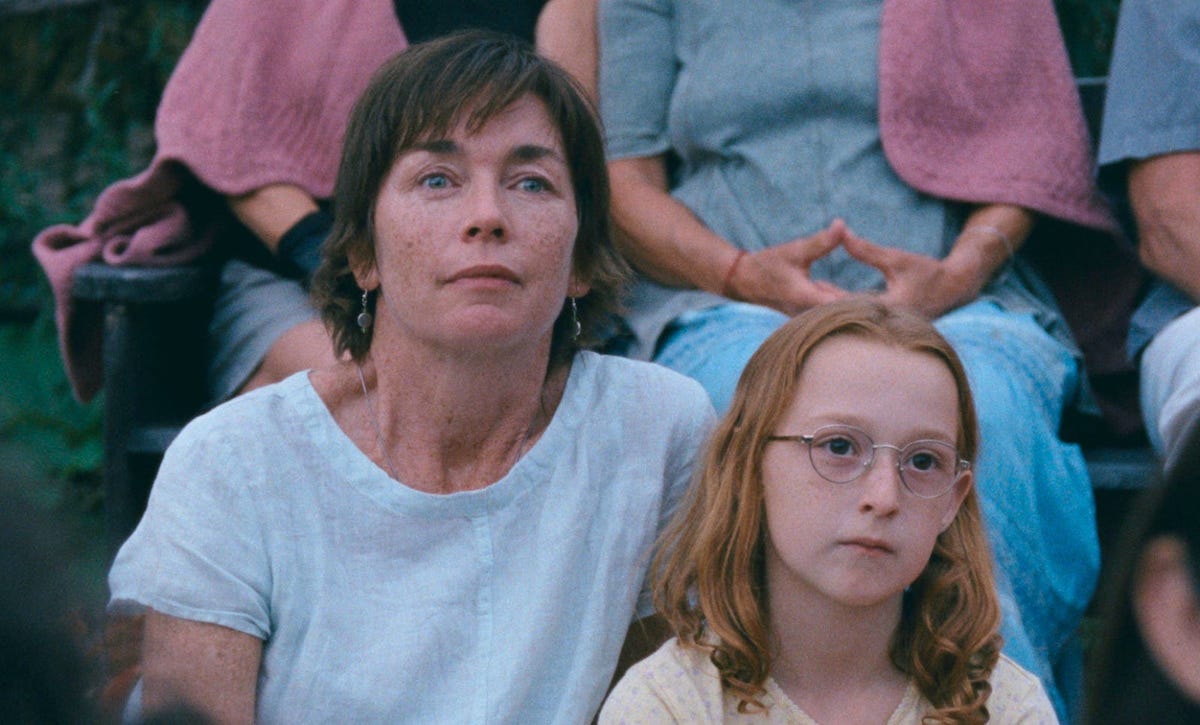
As seen in a cold open too wickedly good to spoil here, pre-teen angst has served bespectacled 11-year-old Lacy (Zoe Zeigler) well, or at least to the point where she has her single mother (Julianne Nicholson) delicately wrapped around her finger. Moody but forthright, she spends the summer in their Western Massachusetts home in the woods carefully tending after a menagerie of little figurines, camped out in the front of the TV set and mostly taking her piano lessons seriously. Meanwhile, her mother becomes involved with three people to varying degrees, including a haunted divorcee (Will Patton), an old friend (Sophie Okenedo) and a pretentious cult guru (Elias Koteas!)
Nicholson is terrific as usual but Ziegler is a real find along the lines of Elsie Fisher in Eighth Grade. Somehow both mousy and poised, Lacy is a unique but wholly believable character. Credit should also go to writer/director Annie Baker, an esteemed playwright making her film debut. Set in 1991, this inevitably feels like it could be autobiographical (Park also hails from where it’s set) but what’s striking is how it uncovers so much nuance in its internal, seeking, near-deadpan approach. Little about the film feels forced or false and yet it doesn’t feel like many other films, allowing for hints of magical realism deployed with an unusually subtle touch. While not necessarily a “lessons learned” type of coming of age story, Janet Planet nonetheless tracks a pivotal summer in its protagonist’s life, leaving her at a crossroads as to whether her angst is at all worth retaining. Grade: A-
GHOSTLIGHT
It feels like a sitcom-friendly setup at first: gruff, middle-aged construction worker Dan (Keith Kupferer) stumbles his way into participating in a community theater production of “Romeo and Juliet” and discovers a talent for acting he never knew he had. That he’s also grieving over the recent death of a family member whose demise eerily ties into the play’s narrative is what elevates Ghostlight into something richer and darker; it would also seem ridiculously coincidental if not for Kupferer’s convincing presence (he’s mostly known as a Chicago-based stage actor) or a screenplay that withholds and reveals at the most appropriate moments.
Co-directed by couple Kelly O’Sullivan and Alex Thompson (who respectively starred in and directed Saint Frances a few years back), the film also benefits from casting Kupferer’s actual wife (Tara Mallen) and daughter (Katherine Mallen Kupferer) as his onscreen family–all three are more than up to the challenge of effortlessly recreating their real-life chemistry together. Dolly de Leon (Triangle of Sadness) is also a hoot as the irascible community theater player who encourages Dan to come into the fold. Truthfully, the film takes its time to get to a place where it finally makes a desired impact, even if it ends up somewhat mirroring that lengthy process all actors and theater troupes go through in preparing for opening night. B+
GASOLINE RAINBOW
Five teenagers set out from Nowheresville, Oregon in a worn-down van to make the 500+ mile trek to the Pacific Ocean. Along the way, they chill out, toke up, run into obstacles (including a fairly major one) and meet a variety of similar transients and loners along the way. It almost sounds like a group Gen Z equivalent of the road trip Lily Gladstone took in The Unknown Country except that it feels more casual and like a documentary. Given that this is directed by the Ross Brothers, it’s probably not the latter, liberally bending the real/fake line as they did in some of their past films, most notably 2020’s last-night-of-a-dive-bar reverie Bloody Nose, Empty Pockets. Unfortunately, this doesn’t retain the momentum or the interesting “characters” of that triumph and goes on for a little too long. There are great moments scattered throughout–the hopping of a freight train, a massive bonfire on a beach–but as a coming of age portrait of friends on the cusp of adulthood, it has nothing on something fully scripted/fictionalized like Dazed and Confused. B
MY OLD ASS
18-year-old Elliot (Maisy Stella) celebrates her birthday with her two best friends by taking magic mushrooms on a camping trip in the woods; while all three experience hallucinations, only Elliot’s manifests in the form of her future 39-year-old self, played by Aubrey Plaza. A promising premise for sure, but if you’re expecting a Charlie Kaufman or Michel Gondry-esque mind warp, note that this is simply an earnest Canadian film not without a few plot holes that gets most of its mileage out of a game Plaza. In my opinion, one can never have too much Plaza but as the focus shifts back to Stella, there’s simply not enough Plaza to go around even if what’s there is golden. Still, Megan Park’s film gets points for its relaxed approach to Elliot’s fluid sexuality as she questions her attraction to Chad (Percy Hynes White), an affable doofus whom her older self warns her to stay away from. B-
I can’t help but look back on 1992 with nostalgic lenses. I was 17, and R.E.M.’sAutomatic For The Peoplecame out at exactly the right time to make a major impact on how I approached and consumed music. In addition to its gorgeous, gliding Andy Kaufman tribute, other songs here that I actually knew and loved in ’92 include Deee-Lite’s ultra catchy ode to escapism, a great Kate Pierson showcase from The B-52’s somewhat maligned Good Stuff, perhaps my current favorite single by The Cure (not as overplayed as “Friday I’m In Love” or “Just Like Heaven”) and definitely INXS’ best, most underrated single.
As with those gems, many of the other selections here happen to have been hits, but they’re good hits, from Shakespears Sister’s power-ballad with its dramatic, bonkers shift in the middle and L7’s surprisingly catchy Go-Go’s-from-Hell feminist anthem to the comforting faux-R.E.M. of Toad The Wet Sprocket and the second single from Madonna’s Erotica, a Latin-disco epic that has aged pretty well, audacious-lyrical-callback-to-“Vogue”-and-all. Lesser known are a track from Soho’s second album Thug, a big flop but far more ambitious than Goddess (which gave the world their only hit, “Hippychick”), Los Lobos’ slinky, exotica-friendly mood piece, the suitably prescient title track from Leonard Cohen’s The Future (nearly 25 years after his debut) and a gently undulating Sade album track that deservedly made it onto their greatest hits album two years later. Also, the shimmering opener on 10,000 Maniacs’ final album with Natalie Merchant is arguably the best thing she ever did with or without them.
Despite a few catchy novelties here (ravers Utah Saints gleefully sampling Kate Bush, Meryn Cadell essaying a postmodern take on a monologue inspired by 1950s educational films) and a few spirited pastiches there (Vanessa Paradis redoing classic Motown, Lindsey Buckingham cosplaying as Brian Wilson), this is a foundational year for introducing such soon-to-be-icons as Tori Amos and especially PJ Harvey—her “Sheela-Na-Gig” predicts where much of the rest of the decade will go, particularly for alternative female singer-songwriters. Thankfully, Annie Lennox, k.d. lang, and Suzanne Vega all adapt to the times (each in their own ways) as does ex-Hüsker Dü-er Bob Mould (via his short-lived trio Sugar), his pioneering melodic crunch providing inspiration for younger bands such as Ride and Catherine Wheel, whose exquisite shoegaze epic “Black Metallic” has somehow become one of my most-played tracks of the past five years.
1992: You Were The Chosen One
Annie Lennox, “Little Bird”
Utah Saints, “Something Good”
Deee-Lite, “Runaway”
The Cure, “High”
Suzanne Vega, “In Liverpool”
Toad the Wet Sprocket, “All I Want”
PJ Harvey, “Sheela-Na-Gig”
Soho, “Into the Void”
L7, “Pretend We’re Dead”
Ride, “Twisterella”
k.d. lang, “Constant Craving”
They Might Be Giants, “I Palindrome I”
Tori Amos, “Crucify”
Madonna, “Deeper and Deeper”
The B-52’s, “Revolution Earth”
R.E.M., “Man On The Moon”
Los Lobos, “Kiko and the Lavender Moon”
10,000 Maniacs, “Noah’s Dove”
Sugar, “If I Can’t Change Your Mind”
Meryn Cadell, “The Sweater”
Steve Wynn, “Tuesday”
Morrissey, “We Hate It When Our Friends Become Successful”
If it seems conspicuous that the only 1991 entry in my 100 Albums series was a singles comp (represented below via a mind-melting medley covering U2 and Frankie Valli), note that at times I seriously considered including the following: R.E.M.’s first number one album (which also had their highest-charting single), Seal’s first eponymous release (believe it or not, he was actually interesting pre-Grammys/Steve Miller cover/Heidi Klum), Sam Phillips’ second secular album (I’d write plenty about her third), even PM Dawn’s dreamy, near-unclassifiable debut. In the end, none compelled me enough to want to write about at length, but I’ve made sure to represent tracks from each of them here.
Historically, people love to sum up 1991 as The Year of Nirvana and Nevermind; I respected Cobain and co. but was never much of a fan, preferring my rock and roll to be Anglophilic and danceable. Looking over this curious selection, one might almost get an impression of ’91 as a last breath of optimism/utopianism before grunge and alt-rock’s irony/cynicism took over. Saint Etienne’s landmark early single (still easily one of the five best songs they ever did) sets the tone, and fellow Brits The Orb, The Shamen, Jesus Jones, James, Primal Scream and even Seal all sustain it, although only “Right Here Right Now” really broke through over here. Kirsty MacColl’s vivacious Latin bauble carries the same spirit although musically it has precious little in common with the others.
As with last year’s playlist, this combines top 40 (Roxette, Prince, Londonbeat) with modern rock (Billy Bragg, Electronic, Violent Femmes, Matthew Sweet) and the occasional crossover from the latter to the former (Divinyls, Siouxsie and the Banshees.) The mighty “Unfinished Sympathy” sounds absolutely undiminished, “Love… Thy Will Be Done” is a terrific, long forgotten top ten hit ripe for reappraisal and “Funeral” and “It Won’t Be Long” are obscurities everyone should know. I was giddy with joy when many songs by the KLF resurfaced on streaming in the past few years. A techno-pop hymn about the band’s own “mythology” and their ice-cream van, sung by none other than country-western legend Tammy Wynette(!), “Justified & Ancient” is the most bonkers hit of its time (and perhaps the entire decade.) Thirty-plus years on, I still can’t believe how big it was. Watch the video above and ask yourself, “Did this really happen, and could something so delightfully weird and far out of left field ever become a hit again?”
1991: All Bound For Mu Mu Land
Saint Etienne, “Nothing Can Stop Us”
The KLF feat. Tammy Wynette, “Justified & Ancient”
PM Dawn, “Paper Doll”
Siouxsie and the Banshees, “Kiss Them For Me”
Crowded House, “Fall At Your Feet”
Sam Phillips, “Cruel Inventions”
Alison Moyet, “It Won’t Be Long”
Roxette, “Fading Like a Flower”
R.E.M., “Near Wild Heaven”
Divinyls, “I Touch Myself”
Mekons, “Funeral”
The Orb, “Little Fluffy Clouds”
The Shamen, “Move Any Mountain”
Massive Attack, “Unfinished Sympathy”
Billy Bragg, “You Woke Up My Neighbourhood”
Seal, “Future Love Paradise”
Dream Warriors, “My Definition of a Boombastic Jazz Style”
Londonbeat, “I’ve Been Thinking About You”
Matthew Sweet, “I’ve Been Waiting”
Electronic, “Get the Message”
Morrissey, “My Love Life”
James, “Sit Down”
Prince & the New Power Generation, “Diamonds and Pearls”
Joni Mitchell, “Come In From the Cold”
Erasure, “Breath of Life”
Kirsty MacColl, “My Affair”
Kylie Minogue, “Shocked”
Martika, “Love… Thy Will Be Done”
Simply Red, “Something Got Me Started”
Lisa Stansfield, “It’s Got To Be Real”
Queen, “I’m Going Slightly Mad”
U2, “Until The End of The World”
Jesus Jones, “Right Here Right Now”
Pet Shop Boys, “Where The Streets Have No Name/Can’t Take My Eyes Off You”
Like songs, poems, books and the live stage, films are another medium for storytelling. Even the most simplistic (Arrival of a Train at La Ciotat, The Lumiere Brothers, 1896) or experimental (Wavelength, Michael Snow, 1967) cinema communicates something to its audience, no matter how straightforward (the former a 50-second shot of exactly what its title promises) or abstract (the latter a 45-minute zoom shot directed towards a window in a room.) Arguably the best films either relay a story like none other or do so in ways few (if any) other films have tried. One might regard this as a challenge given the sheer amount of work this relatively young medium has already produced; even accounting for the small fraction of it that’s truly great (on Letterboxd, for example, I’ve given only about 250 out of 4500 movies (6%) a five-star rating), it’s easy to be critical/skeptical of finding new films that surpass or at least measure up to one’s favorites.
Still, I’d argue the notion that “it’s all been done” actually sustains an interest in filmgoing: one rarely knows when you will find something new to enter into your own canon of great movies. To develop a critical eye is to recognize when something is a rare gem, a work presenting a world clearly distinguishing itself from others while also meaningful in how it accomplishes this. Consider the titles I’ve included in this project so far: An irreverent, satirical take on the Arthurian legend that resolves itself via anarchy? A transgressive, phantasmagorical autobiographical sketch that contains as much razzle-dazzle as it does sober self-actualization? A revisionist Western, an idiosyncratic, kinetic extrapolation of a Herman Melville novel, a near tone-poem sculpted from the textures of an urban environment, even a war-tinged romance turned fantasy pondering the afterlife—all of these have singular narratives presented in equally original ways, even if they occasionally allow one to spot allusions to other works. All That Jazz, for instance, might not have existed without the influence of Fellini’s 8 ½, though most viewers would likely find more differences than similarities between the two; casual ones might not even pick up on them at all.
Through the years, I’ve shifted stances between whether form or content carries more weight in determining a film’s greatness. In film school, after taking a class on Avant Garde cinema and another called “Ways of Seeing”, I edged towards valuing the shape of a film rather than its story (no matter how conventional or nonlinear.) I’d chalk that up to my exposure to many different ways of making a film over a short period of time. When asked by family or friends if I ever thought I’d direct any films of my own, my stock response was usually, “If I do, they’ll be experimental ones”; obviously, I perceived myself as somehow beneath becoming a more conventional filmmaker, not realizing how difficult it is to craft anything on either side of the commercial spectrum (at least in this time before anyone could make a movie with their smartphone.)
Of course, while studying film, I was exposed to just as wide a variety of narratives as I were stylistic approaches. It’s easy to focus on the plot but also let it dictate how you feel about the imagery, sound, editing, production design, etc. For instance, I was so sickened by some of the content in Darren Aronofsky’s bold, numbing Hubert Selby Jr. adaptation Requiem For A Dream that I couldn’t appreciate its style one whit. In turn, the deliberately unpleasant way it often presented said content (my god, the unflattering lighting!) altered my perception of the material and may have influenced why I had such a negative reaction to it. For better and worse, form and content are equally crucial for a film to register and connect with me—as one should expect of all great art, it constitutes a delicate balance, a confluence of all of its parts coming together to somehow form a satisfying whole.
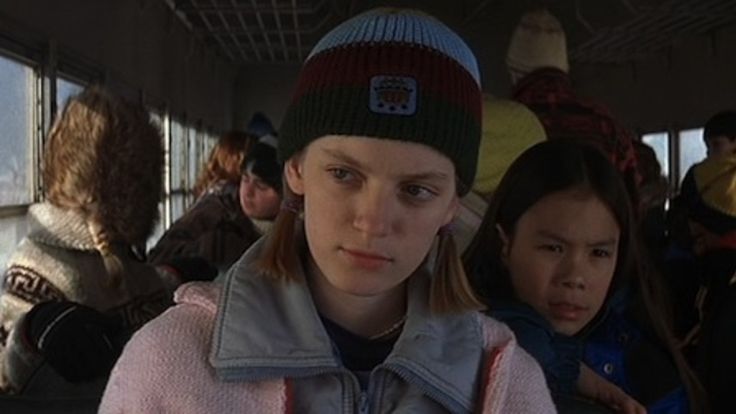
At one point in this project, I was going to include an entry on The Sweet Hereafter, Atom Egoyan’s 1997 adaptation of a Russell Banks novel about a remote community ravaged by the aftermath of a fatal school bus accident. Seen when it was first released during the holiday break between my first two semesters of film school, it had a substantial impact in how it played with time and perspective, its narrative generally nonlinear, certain information intentionally missing until strategically revealed as if sifting through puzzle pieces and attempting to piece them all together. It was the Toronto-based Egoyan’s seventh feature; I’d end up renting the previous six from various video stores over the next six months.
Sarah Polley in The Sweet Hereafter
Perhaps I’ll will write more about The Sweet Hereafter one day (it’s far from the only title I considered for this project but ultimately passed over); I mention it here because of its central performance from then 18-year-old Sarah Polley, a Canadian child actress who had appeared in such projects as The Adventures of Baron Munchausen, TV series Ramona (based on Beverly Cleary’s beloved children’s novels) and Road to Avonlea and Egoyan’s sixth feature Exotica. Nicole, her character in The Sweet Hereafter, however, was a turning point. With a naturalness and steel-eyed reserve, Polley had undeniable presence—magnetic without coming off as showy, thoughtful but not opaque. As the lone survivor of the crash, she’s thrust into a situation where she holds a rare power. As her backstory comes to light, she mesmerizes in how she wields such power while not letting us forget, heroine or anti-heroine, she’s still just a teenager, flaws and all.
The film raised Polley’s profile considerably outside her home country. Over the next few years she starred in a number of pictures from big Hollywood productions (Go, The Weight of Water, Zack Snyder’s Dawn of The Dead remake) to indieplex staples (Guinevere, David Cronenberg’s eXistenZ) and smaller, more intimate pictures like My Life Without Me and Hal Hartley’s No Such Thing. During this period, Polley began writing and directing her own short films, which led to an impressive feature debut with 2006’s Away From Her, an Alice Munro adaptation that earned its star, Julie Christie an Academy Award nomination. Along with its follow-up Take This Waltz (2011), Polley suggested that her skills as a filmmaker were up there with her acting, approaching material with a tangible point of view and a nuanced understanding of human behavior.
One can apply the same attributes to her third feature and first documentary, 2012’s Stories We Tell. It’s a personal essay film about her family and although accurate, such a simplistic description doesn’t do it justice. At least on the surface, it’s a template for Polley to interview her father, Michael, her older siblings and stepsiblings and an extended network of people who all knew her mother, Diane, who died of cancer in 1990 when Sarah was eleven. She accompanies these interviews with silent home movie footage and Michael (himself an actor) reading his account of the family’s story; in doing so, she explores in-depth the various ways of telling a story, considering multiple points of view, the abundance or absence of found documentation, and how all that information is shaped into a narrative, bearing in mind what’s emphasized and also what’s left out.
Polley commences by asking her subjects variations of the following directive: “Tell me the whole story (of our family) as if I don’t know the whole story.” To pose this instruction is a neutral way of building a story drawing from various perspectives, to see what details reoccur in each person’s version of the story and, more significantly, which ones conflict and contrast with each other. From there, the viewer can piece together a throughline narrative: Diane (also a Toronto-based actor) met Michael in 1965. They married, had kids and both mostly left their chosen professions behind to raise their family. In 1978, craving a return to acting, Diane relocated to Montreal for a few weeks to be in a stage play (called Toronto (!)); not long after her return, she found out she was pregnant with Sarah. After Diane’s early death, child actress Sarah, significantly younger than her siblings would become even closer to her father.
It seems a fairly straightforward trajectory until one hears numerous people talk about how, leading up to her time in Montreal, Diane and Michael had grown apart—she was frustrated with having given up her career to become a housewife and not fully getting the love and attention she needed from him. However, it’s not the whole story. 45 minutes in, the viewer learns that before meeting Michael, Diane was previously married to another man. Two of Sarah’s four siblings are actually step-siblings from that marriage; one of them describes their birth father as “controlling”. Deeply unhappy, Diane leaves him for Michael and as a result, loses custody of her two children.
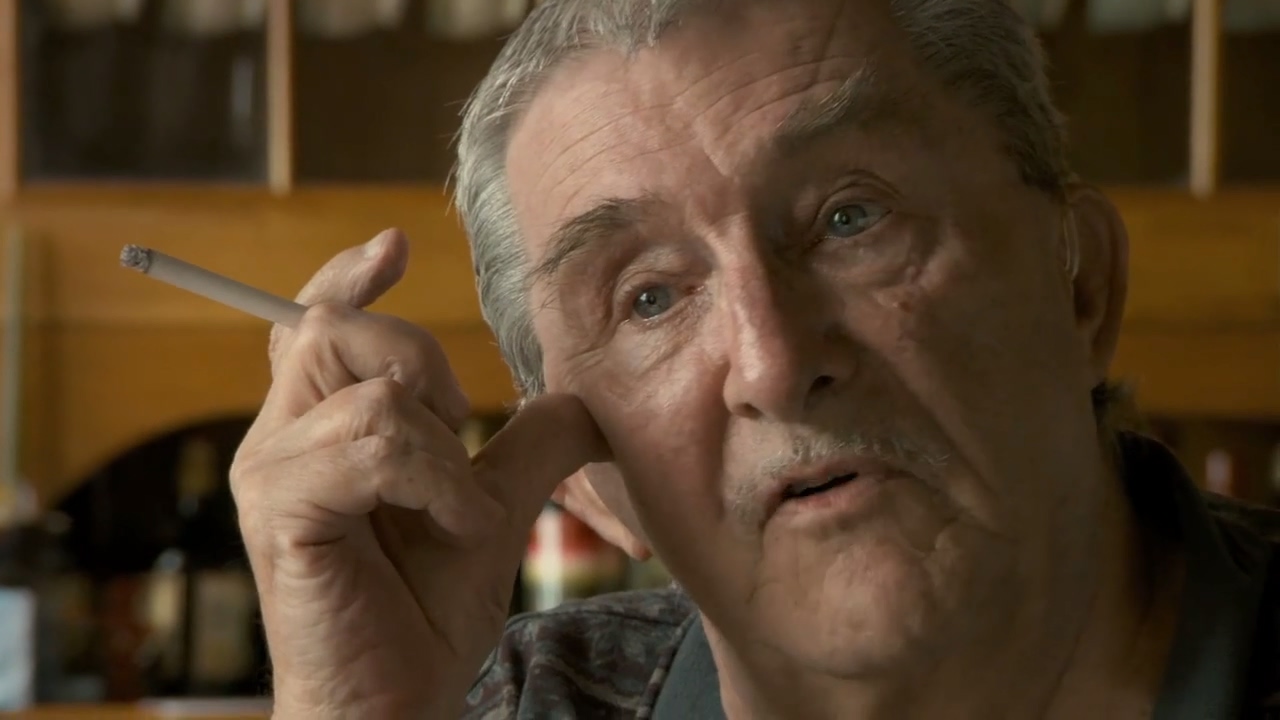
Michael Polley
In the course of their interviews, multiple siblings and friends of the family remind Sarah that they used to tease her as a child because she didn’t much resemble her father, physically, stoking speculation that Diane might have slept with another man during her time in Montreal. After some detective work as an adult, Sarah discovers her biological father is actually Harry, a filmmaker Diane met while acting in Montreal. A DNA test proves it, enabling Sarah to forge a relationship with Harry while also figuring out how to break the news to the rest of the family, and in particular, Michael. Us knowing that Diane lost custody of her two eldest children also illuminates why she didn’t leave Michael and her two kids with him after meeting, falling for and becoming pregnant by Harry.
In unspooling this ever-more complex trajectory and keeping it afloat, Stories We Tell is a marvel of editing. Often, the film stitches together phrases from numerous interviewees with a swift fluidity where one could almost believe they came about as a mass conversation, like all the subjects were sitting together in the same room. Even if this were the case, however, it would sound more disjointed, like a Robert Altman film where words overlap due to the natural messiness of most conversations. Again, deciding what to include and where to put it is a conscious decision made by Sarah and her editor, Mike Munn. That it doesn’t come off as stilted but remains engrossing is the key to effective storytelling.
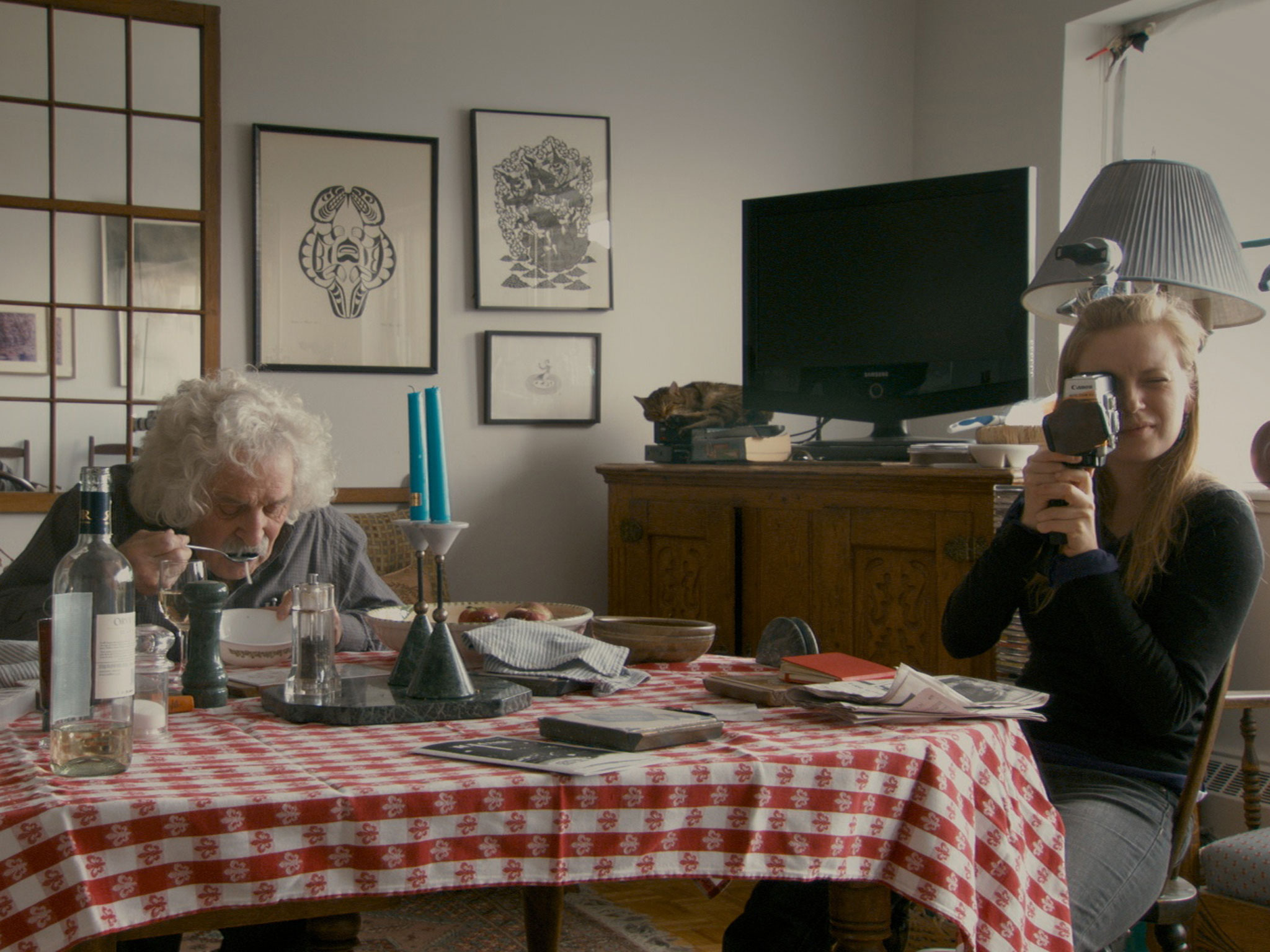
Regarding home movie footage of Diane and Michael, much of it is concentrated from their first few years together and the time immediately before and after Sarah’s birth; we also see scenes from Diane’s funeral and the years following it when young Sarah most closely bonded with Michael. They’re meant to accompany the story told by all the narrators and they often correspond neatly with what’s being said. It’s a seemingly excessive amount of footage and all reasonably convincing until, more than three-quarters of the way through, there’s some vintage footage of Diane and Michael where the camera tracks to the left to reveal a modern-day Sarah filming and directing them (as played by actors Rebecca Jenkins and Peter Evans.) At that moment, her voiceover notes, “I’m interested in the way we tell stories about our lives; the past is often ephemeral and hard to pin down.”
This late-in-the game reveal to exactly how Sarah’s been telling the story audaciously transforms the film. Suddenly, we’re encouraged to question whether any of the non-interview footage is real or a reenactment. Sarah’s initial correspondence and meetings with Harry, shot in the same fuzzy, silent, super-8 grain are surely the latter as are the Montreal rehearsal scenes of Toronto or the footage Diane’s funeral (who shoots home movies of those?), about which one sibling reminisces, “It was some kind of production; I felt like I was at a big play.” The stuff of Michael as a young child or time he spent with Sarah after Diane’s death, however, are more likely the genuine articles. Then again, we now no longer know for sure, and here’s the thing—it doesn’t entirely matter. Even beyond the “home movies”, Sarah infuses the film with deliberate artifice, whether it’s still shots and scenes of her acting (in caveperson garb!) in the film Mr. Nobody at the time of her first contact with Harry, or footage from the 1964 Sophia Loren film Marriage, Italian Style whose plot about questionable paternity provides an analogue to this film’s narrative or, most notably, all the scenes of Sarah directing her father in a studio as he records his own written narration/side of the story (multiple times we see her ask him, “Dad, could you go back over that one line?”, looking for the best “take” of his performance.) As Michael notes earlier in the film, “It’s all done with mirrors, mate,” a seemingly tossed-off comment suddenly more resonant after the reveal.
Rebecca Jenkins as “Diane” (or is it?)
Stories We Tell is the third film in this project that blurs fiction and non-fiction to a fine point. The other two, Close-Up and My Winnipeg arguably do so as narrative films exceedingly resembling documentaries to different ends: the former is a feature-length recreation of real-life events, while the latter is ostensibly a documentary suffused with fantastical elements to the point where the “My” in its title is crucial to understanding its idiosyncratic approach. Polley’s film is more explicitly a documentary in that it relays events that all purportedly happened, even if its subjects have varying accounts of such (for instance, Harry remembers attending Diane’s funeral, but Michael is nearly adamant that his wife’s lover was not there.) It’s no docu-fantasia such as My Winnipeg, but it does feature a slew of recreations that, like the events of Close-Up are presented as apparently factual (if in the end, unprovable.)
Films muddling this real/fake line fascinate me. After all, how can art connect if it doesn’t draw from some semblance of real-life experience? In my master’s thesis on Derek Jarman, I concluded that his art’s greatness depended on its inseparableness from his own life; such ambiguity has provided fodder for many films, from the deliberate, recontexualized performances in The Act of Killing and the more subtle, intentionally convincing ones of Bloody Nose, Empty Pockets to a prankster delving deep into the meta-ness of constructing what may (or may not) be one resounding prank in the guise of an entire documentary in Banksy’s Exit Through The Gift Shop. Reenactments often get a bad rap for their failure to convince or the level of artifice their mere presence suggests. Still, are they less pure than any other decisions Polley makes in telling this story? What’s left out or kept in or de-emphasized or brought to the fore can be just as calculating and indicative, documentary or not.
Midway through the film, Sarah recalls an argument with Harry where he wanted to write his own version of this story but she did not want him to publish it, hoping to give “equal weight to everyone’s version” (a lodestar for many documentarians.) Harry counters this by saying, “The crucial function of art is… to find out the truth of a situation.” Despite the facetiousness inherently unavoidable in any documentary (no matter how intentionally applied, like the “home movies”), to Sarah’s credit, Stories We Tell arrives at an unerring truth about the situation—one of its main participants, the long-deceased Diane, is unable to tell her version of this story. After Harry notes this, a montage follows of nearly all of the film’s interviewees one by one, each person silent, their faces consumed with grief, presumably thinking of Diane as a wistful, melancholic folk-pop song plays on the soundtrack. It’s deeply affecting for it reminds us not what the story is or necessarily how it was relayed, but why it was told.
Stories We Tell would end up Sarah’s last film for a decade as she struggled with a brain injury, eloquently outlined in her 2022 memoir Run Towards The Danger. She’d recuperate and make a triumphant return that year with Women Talking, an adaptation of a Miriam Toews novel that won her an Academy Award for Best Adapted Screenplay. It retains some of the thoughtfulness and innovation of her past work; hopefully, its success will enable Sarah to continuing making exactly the projects she wants to; preferably, they will look back to her third feature for a sense of inspiration and purpose.
A brand-new decade, even though many paint this as a liminal period, a bridge between 1980s flash and what we would come to know as 1990s bellwethers (grunge, alternative rock, gangsta rap, etc.) Roughly two-thirds of these songs were favorites at the time (mostly anything here that made the top 40); I became familiar with the rest over the ensuing decade, the tellingly named “Obscurity Knocks” being of the few exceptions (my husband introduced it to me not long after we first met.) You can already detect the budding Anglophile within, as more than half of these tracks are from UK-based artists; the Americans run the gamut from superstars (Madonna) to, at the time, super-obscure (Yo La Tengo long before MTV ever played ’em).
You wouldn’t expect Iggy Pop, of all people, to secure two slots on a 1990 playlist, but here he is with “Candy”, his sole top 40 hit/duet with The B-52’s Kate Pierson, and “Well Did You Evah!”, a gleefully irreverent Cole Porter cover with perfectly acidic support from Debbie Harry which appeared on the wonderful Red Hot + Blue tribute album (an early candidate for my 100 Albums list that missed the final cut). I could’ve ended and started the mix with Iggy but instead chose Deee-Lite’s immortal “Groove Is In The Heart” for an opener (it arguably sounds fresher today than anything else on this list) and The La’s deathless “There She Goes” to go out on—like Squeeze’s “Tempted” in ’81, can you believe it never made the American Top 40?
In addition to finding room for good artists who never made what I’d consider a great, timeless album (INXS, Sinead O’Connor (both of whom came close)) and quirky one-hit wonders such as Soho, who scored with a genius-dumb lament built upon a Smiths sample, this format gives me an excuse to spotlight weird one-offs that don’t fit anywhere else: Was (Not Was)’s hilariously cruel and cold character sketch (it’d be unimaginable post 9/11), Prefab Sprout’s beguiling bossa nova/samba/end-of-the-world party anthem, DNA’s infamous/genius surprise hit remix of a three-year-old a cappella Suzanne Vega album track, Urban Dance Squad’s leftfield Beck-anticipating earworm.
As with most of these mixes, I posted a putative version long ago that stopped at 25 songs; upon reappraisal, I had difficulty limiting it to 11 more. Among the most notable additions: George Michael’s career-torching but supremely catchy manifesto, Living Colour delving into Afrobeat as if making their own Graceland, Information Society’s inspired, sample-heavy nonsense, and proof that as late as 1990, Brian Eno and John Cale could join forces to produce perfect pop that should’ve topped the charts instead of all those drippy ballads that did from the likes of Michael Bolton, Taylor Dayne and Mariah Carey.

 Haunted Jukebox