Tsai Ming-liang’s a filmmaker who tends to make the same kind of picture over and over, like Yasujiro Ozu (to name one of his precursors) or Hong Sang-Soo (a contemporary.) This isn’t a deterrent, for nearly three decades after his feature debut (1992’s Rebels of the Neon God), he’s still unearthing inspiration in such long standing obsessions as loneliness, urban life, food, sex and, more so than perhaps any other auteur, water in all of its forms.
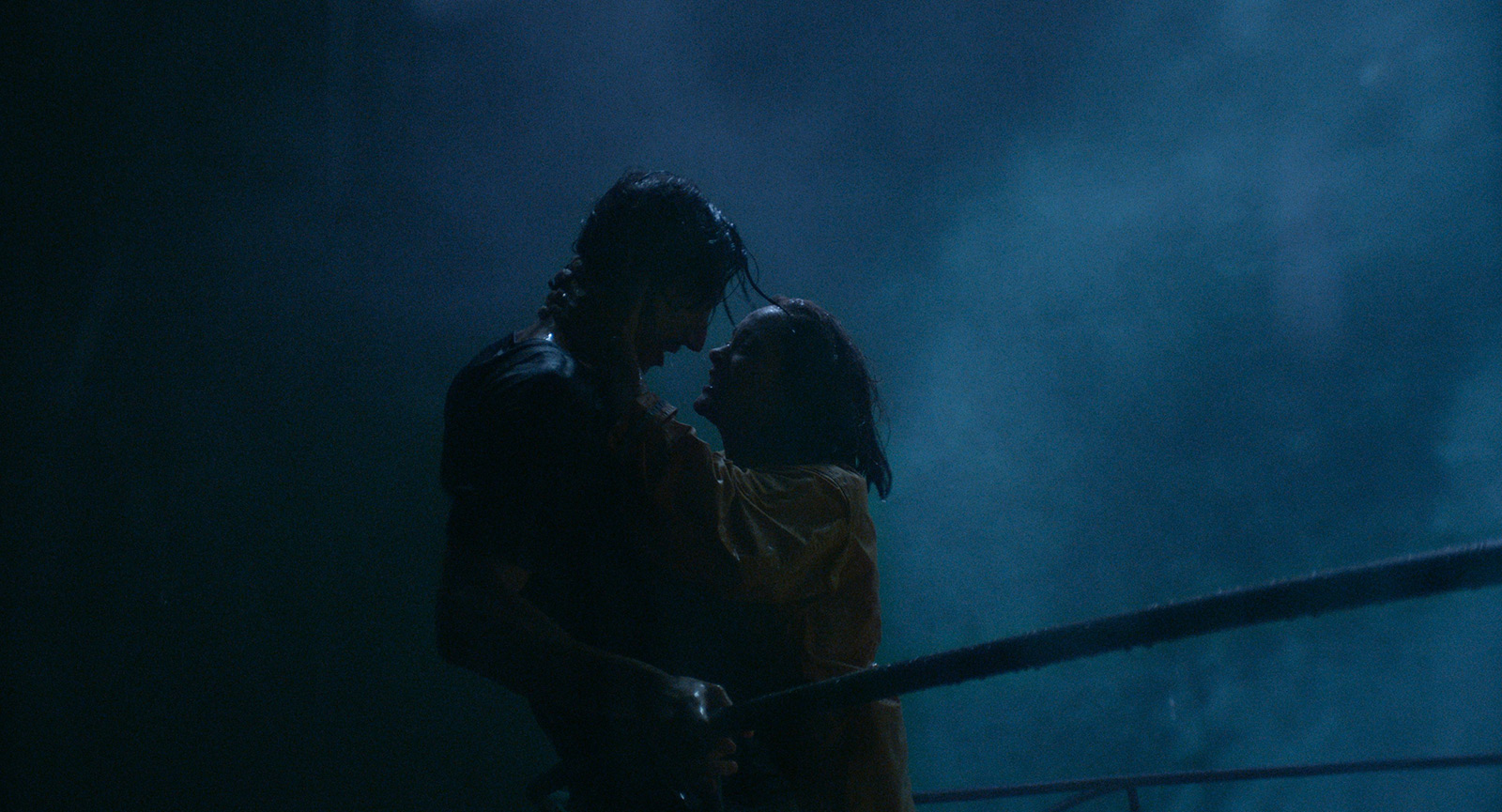
Since the anomalous erotic (!) musical The Wayward Cloud (2005), his work has seemingly turned more minimalist with each effort. His latest sports the disclaimer, “This film is intentionally un-subtitled”, which led me to expect even less action than his last narrative feature, Stray Dogs (2013), which had its share of endless long takes of people staring at a wall or eating a rotisserie chicken. Not that Days does a 180 on its predecessor, for it opens with another lengthy, static shot of Tsai’s long-running, now middle-aged protagonist Kang (Lee Kang-sheng) sitting and blankly staring into space over a steady rain.
Actually, quite a lot happens in the film; it just does so at a snail’s pace, occasionally approaching the repetitious style of classic structuralist cinema. When the film’s other character, the younger Non (Anong Houngheuangsy) spends ample time preparing his dinner, meticulously washing his lettuce and fish multiple times, it feels like a direct homage to the rituals incessantly enacted in real time throughout Chantal Akerman’s Jeanne Dielman… (1975).
Individual scenes with Kang or Non make up the film’s first half; a little more than midway through, the two men come together in a long sequence that most viewers will decidedly not find boring. Afterwards, we see them apart again until the final shot fades to white. Again, a deliberate structure, even if Tsai claims he pretty much made the film up as he went along, working without a screenplay (there’s so little dialogue that the subtitles aren’t missed.)
Viewers unfamiliar with or unreceptive to Tsai’s work may think, “Huh?” at all this; his devotees might also initially arrive at that conclusion, at least initially. While not as masterful as, say, What Time Is It There? (2001), given time to absorb and ponder Days, I grew to appreciate it far more. It’s a quiet and often gentle film, running through those same, ongoing obsessions I mentioned above; fortunately, they don’t yet feel stale or superfluous. Like any master of minimalism, Tsai’s still adept at taking the same puzzle pieces and rearranging them into (if ever so slightly) distinct configurations that at best inspire one to look at the familiar with fresh eyes.
When this blog reached its 250th post a little over a year ago, I put together a list of 250 films that I love. Likewise, for post #300, here’s a Spotify playlist of 300 songs I’ll rarely skip over whenever they appear on shuffle or the radio. Obviously, this has more than a few selections you’ll likely never hear on the radio, from the inspired lunacy of Adriano Celentano and Esquivel to relatively obscure artists like Tompaulin, Komeda and Os Mutantes. Conversely, many artists here are known and beloved by millions (Oasis, Fleetwood Mac, The Smiths, Ella Fitzgerald) while others retain devoted cult followings without ever having fully broken into the mainstream (Calexico, Jose Gonzalez, Morcheeba, Saint Etienne.)
As with 250 Films, this is by no means a definitive list of my favorite 300 songs, although tracks from nearly half of my 100 favorite albums are represented. Unlike most of my annual playlists, this one is meant to be listened to on shuffle. Pick a song you love or one that you haven’t heard but sounds intriguing to you and dive right in.
In September 2003, my roommate Frank and I decided to go spur-of-the-moment to New York City for a weekend—Greyhound bus tickets were pretty cheap, and he found a reasonably priced hotel room online. It was my first trip there.
I’d been yearning to visit the Big Apple ever since moving to Boston six years before, but never made it, not even when another former roommate relocated there in 2000 (she’d leave for San Diego shortly after 9/11.)
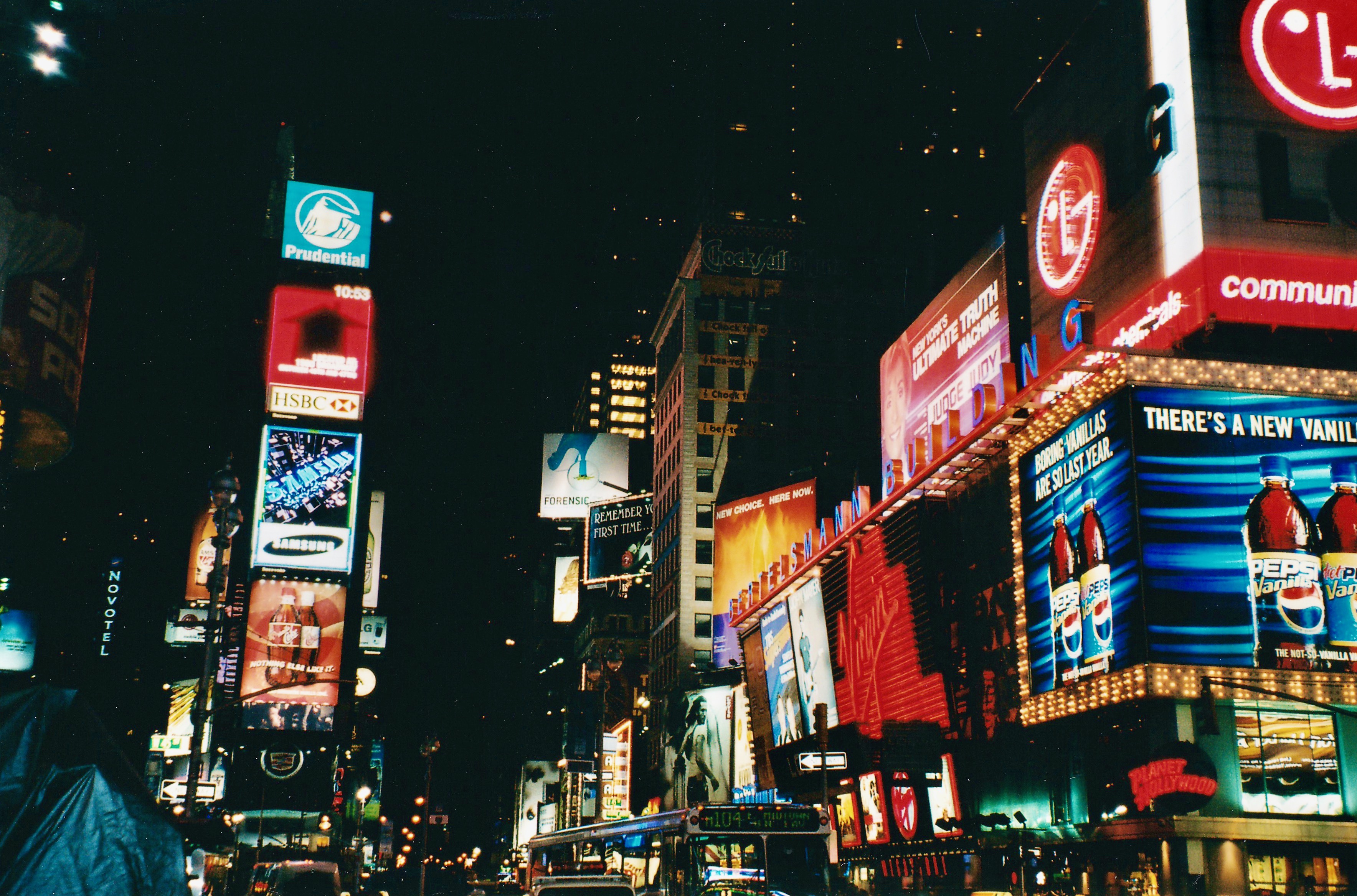
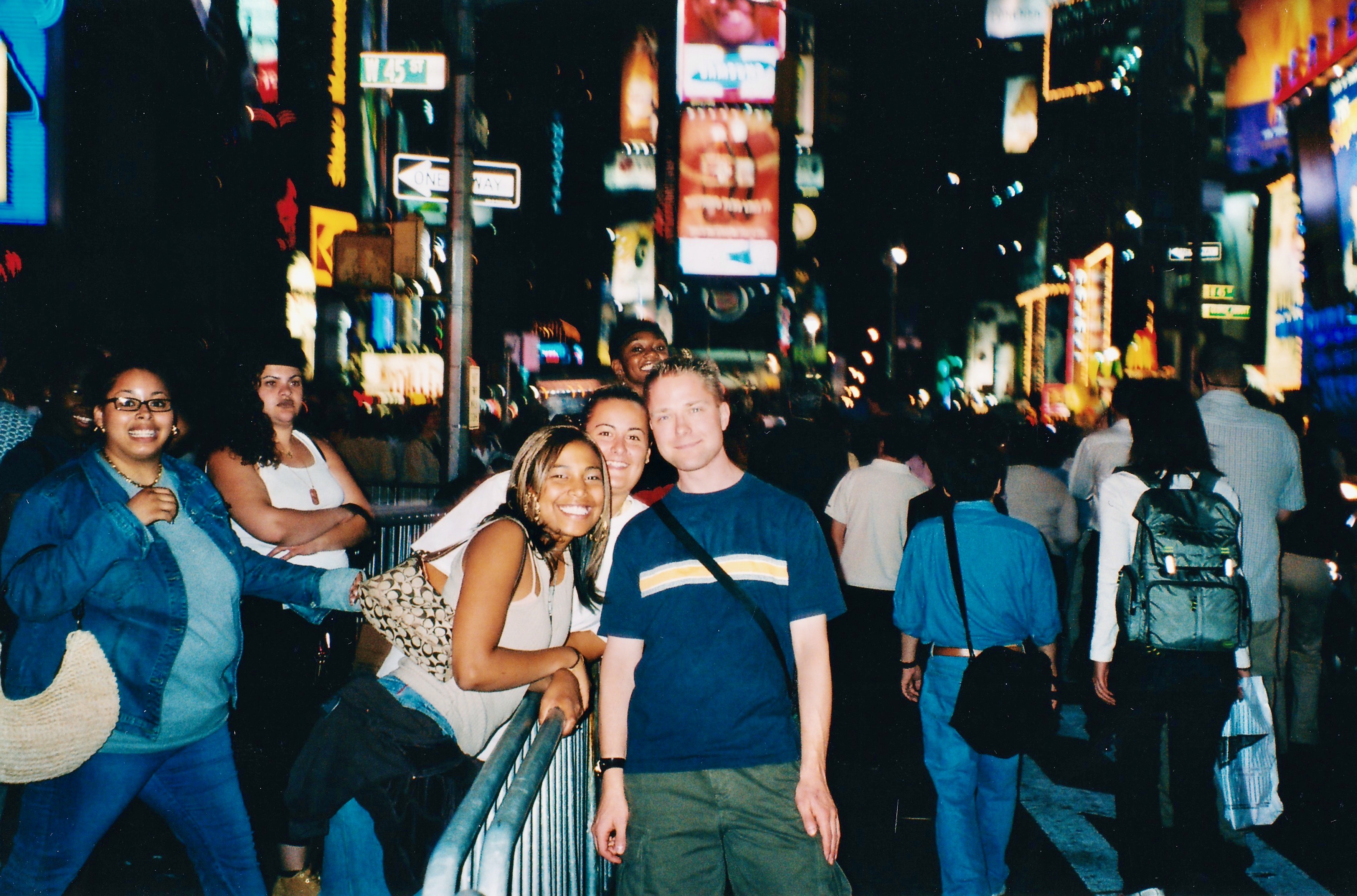
Upon arriving at Port Authority on Friday evening, we proceeded directly to Times Square, where Frank took this pic of me—I was only partially aware of the photobombing ladies on the left. Although I was too late to experience the seedy glory of pre-Giuliani era Times Square, at least the Howard Johnson’s was still in business, albeit looking most anachronistic amongst all this 21st Century neon.
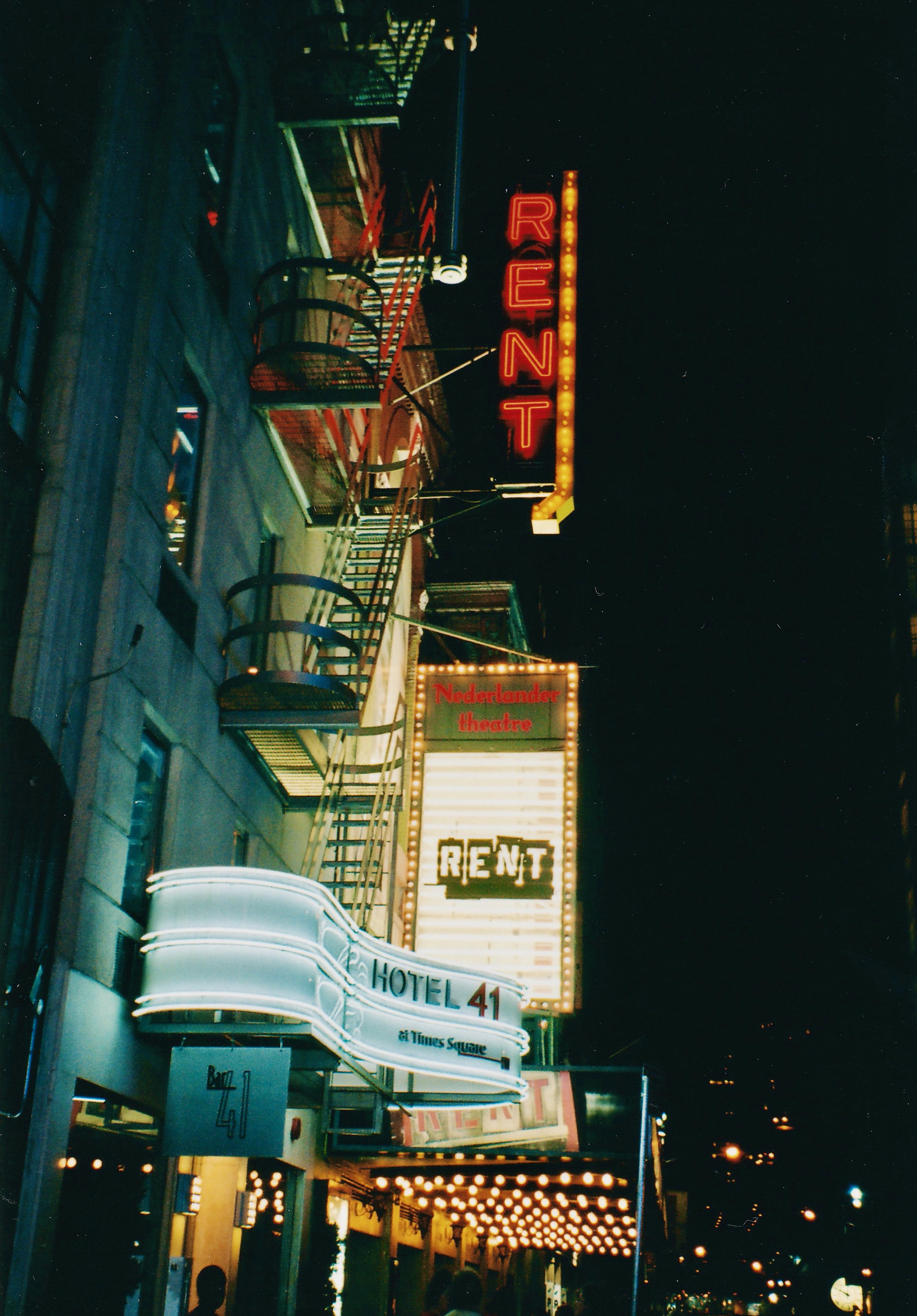
We stayed at a boutique hotel on 41st and 7th, next door to the Nederlander Theatre (then home to Rent)—yes, my very first night in NYC was right in the heart of the city’s tourism Valhalla most real New Yorkers would rather avoid. Our accommodations barely left enough room for a queen-sized bed, but they were modern and clean.
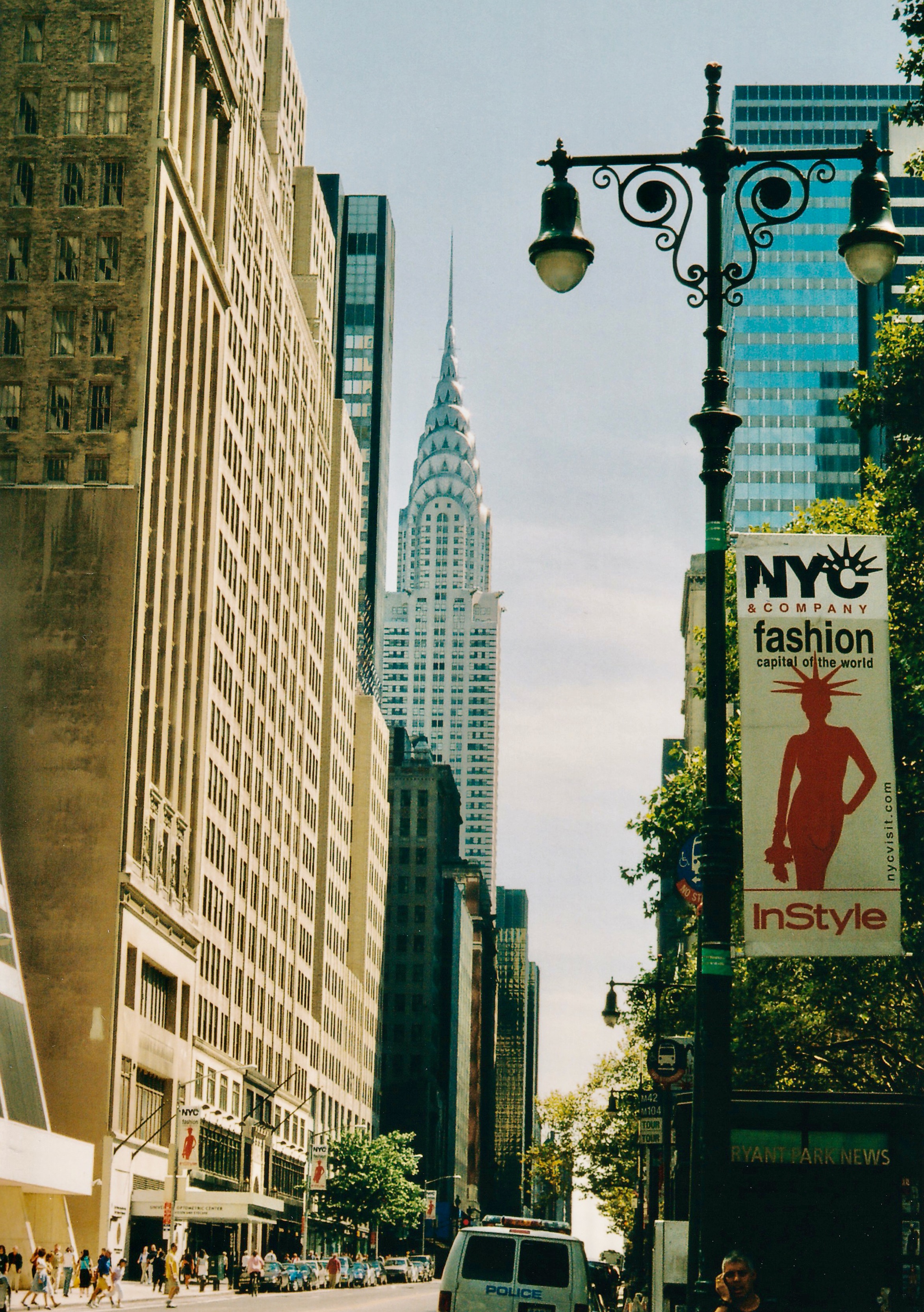
42nd Street near Bryant Park, looking East.
Anyway, we only needed the room for sleeping. That first night, we stayed out until 5:00 AM club-hopping around Chelsea and the West Village, ending up at a place called Hell in the Meatpacking District that played cool alternative ’80s and ‘90s rock (as opposed to the generic dance music most gay bars specialized in.) We slept past noon and went out exploring. Back then, one had a nifty view of the Chrysler Building from this vantage point; now, it’s blocked by the monstrosity that is One Vanderbilt.
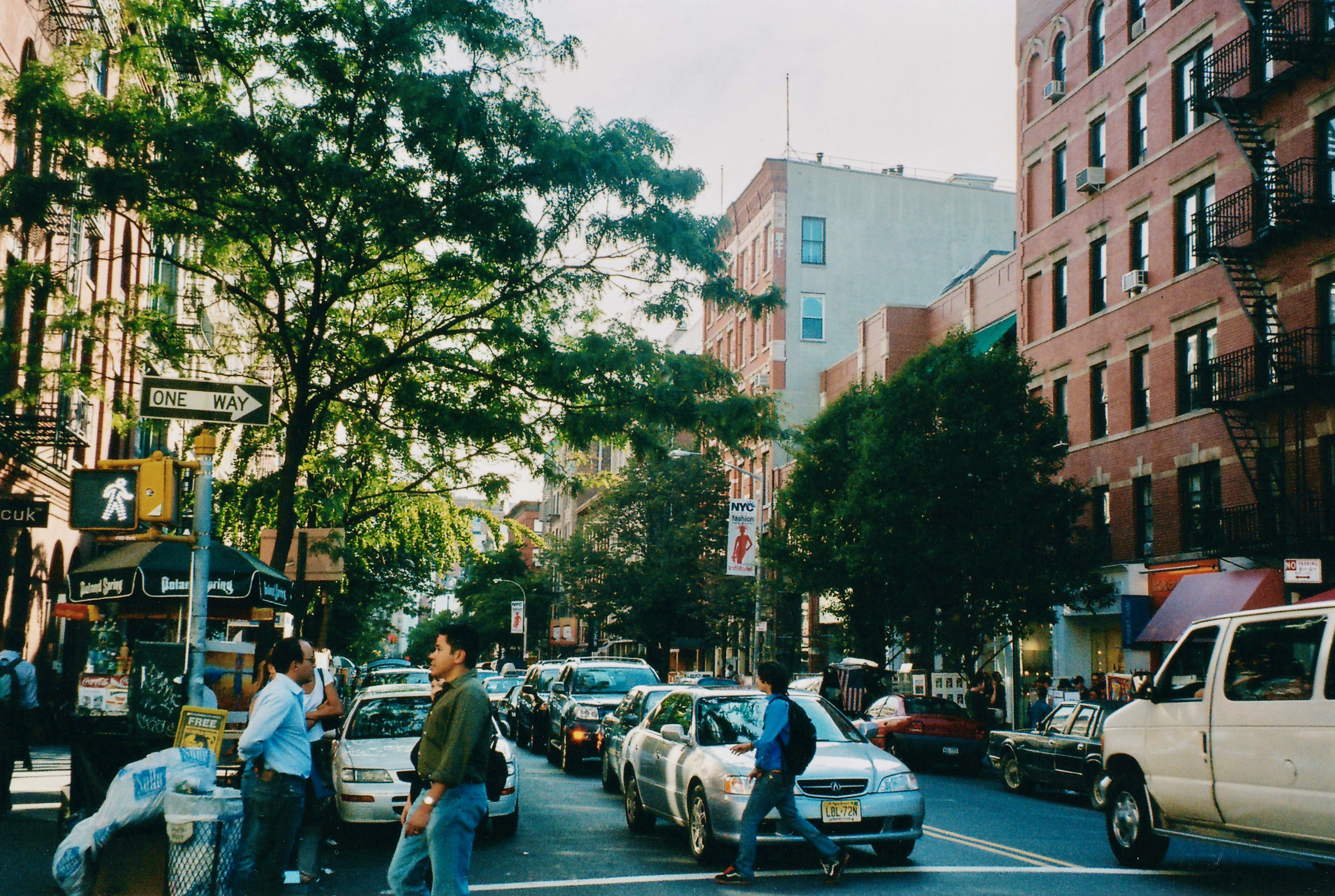
Facing South on West Broadway at Prince Street, Soho.
From there, we walked South towards the Village, and then through SoHo. I immediately felt more at home in leafier, funkier lower Manhattan than in touristy Times Square.
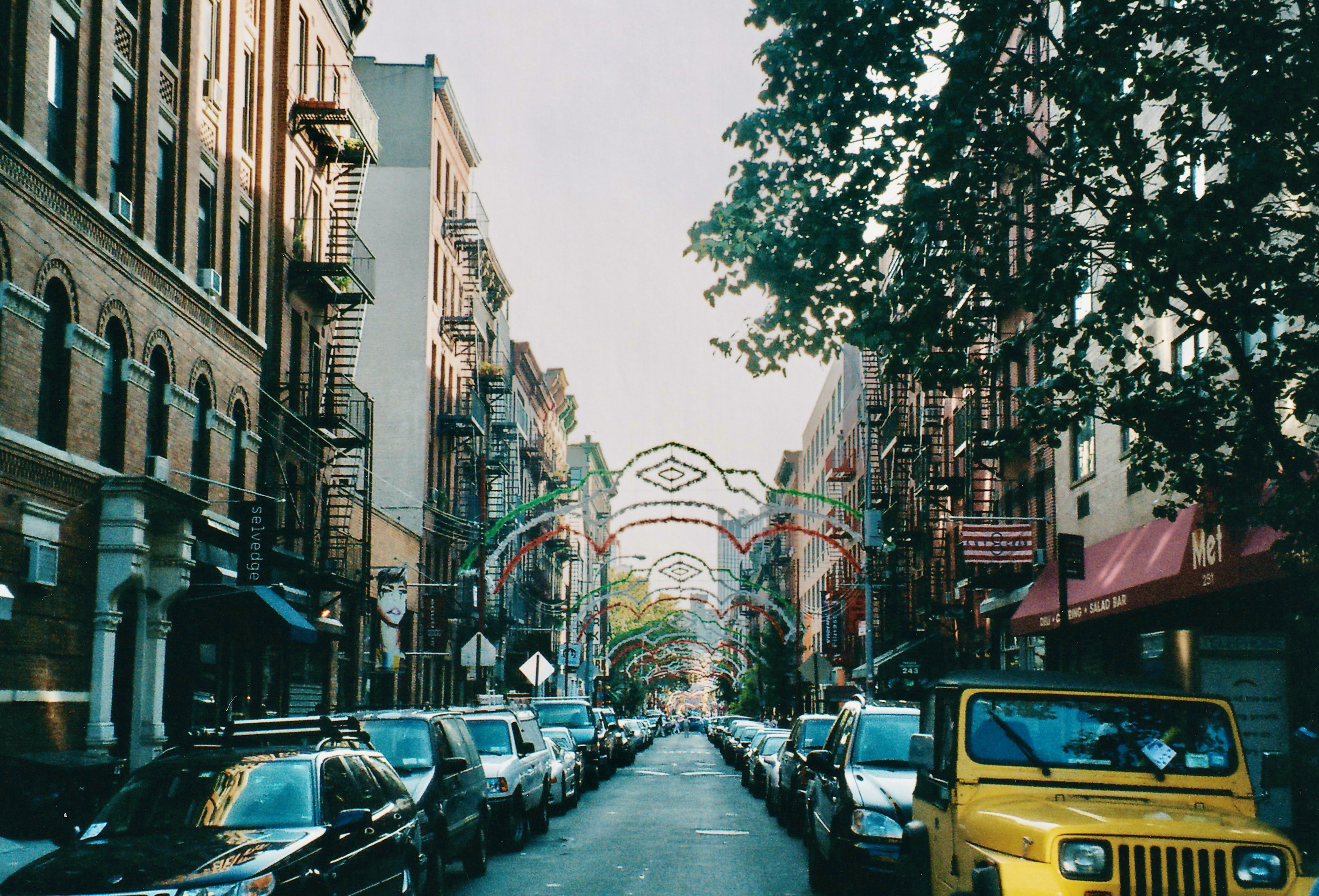
Facing South on Mulberry Street at Prince.
At this time, Little Italy still extended further North; today, the green-white-and-red banners seen here are long gone, the neighborhood technically called “Nolita” (but really just another part of SoHo.)
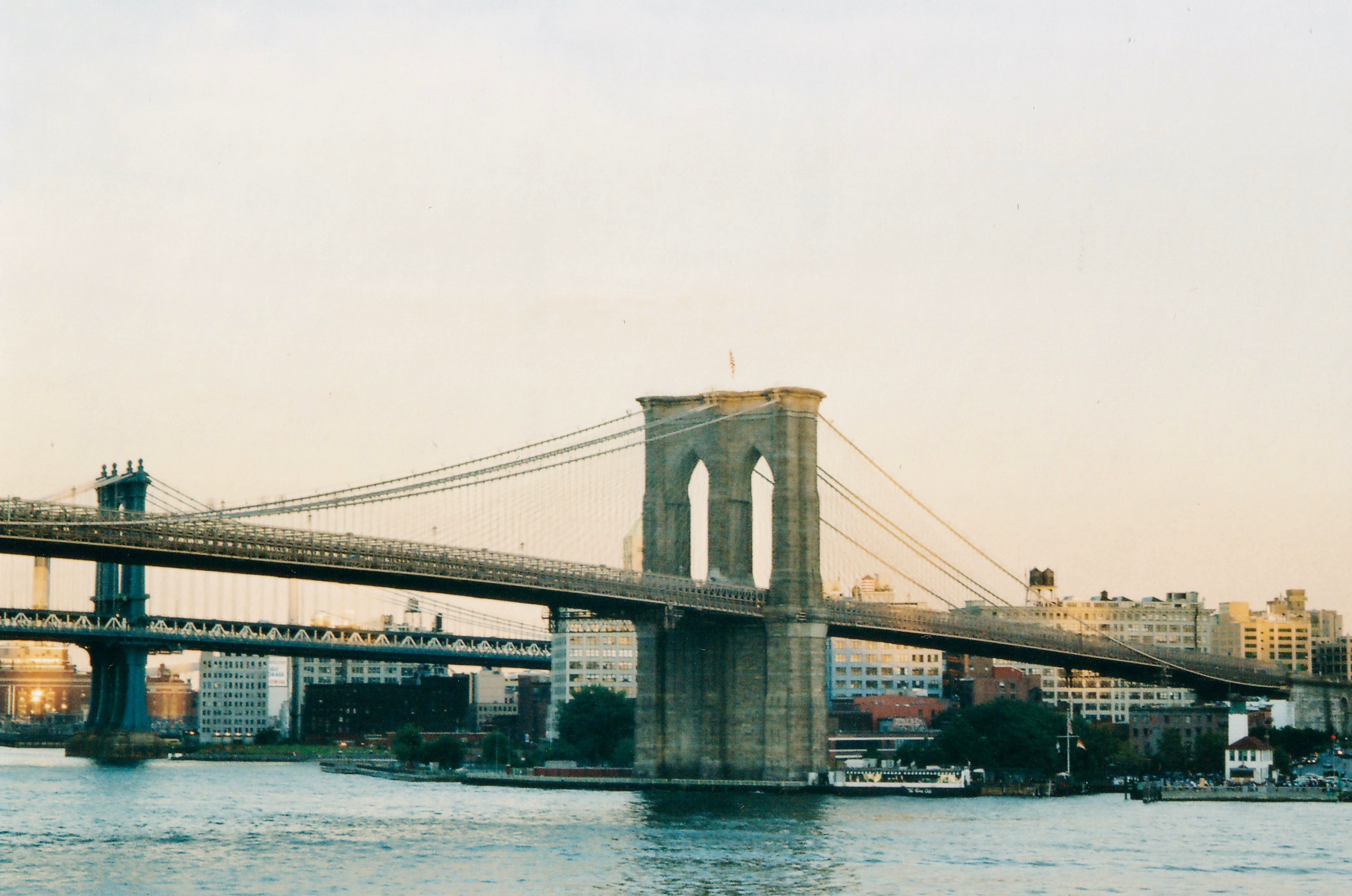
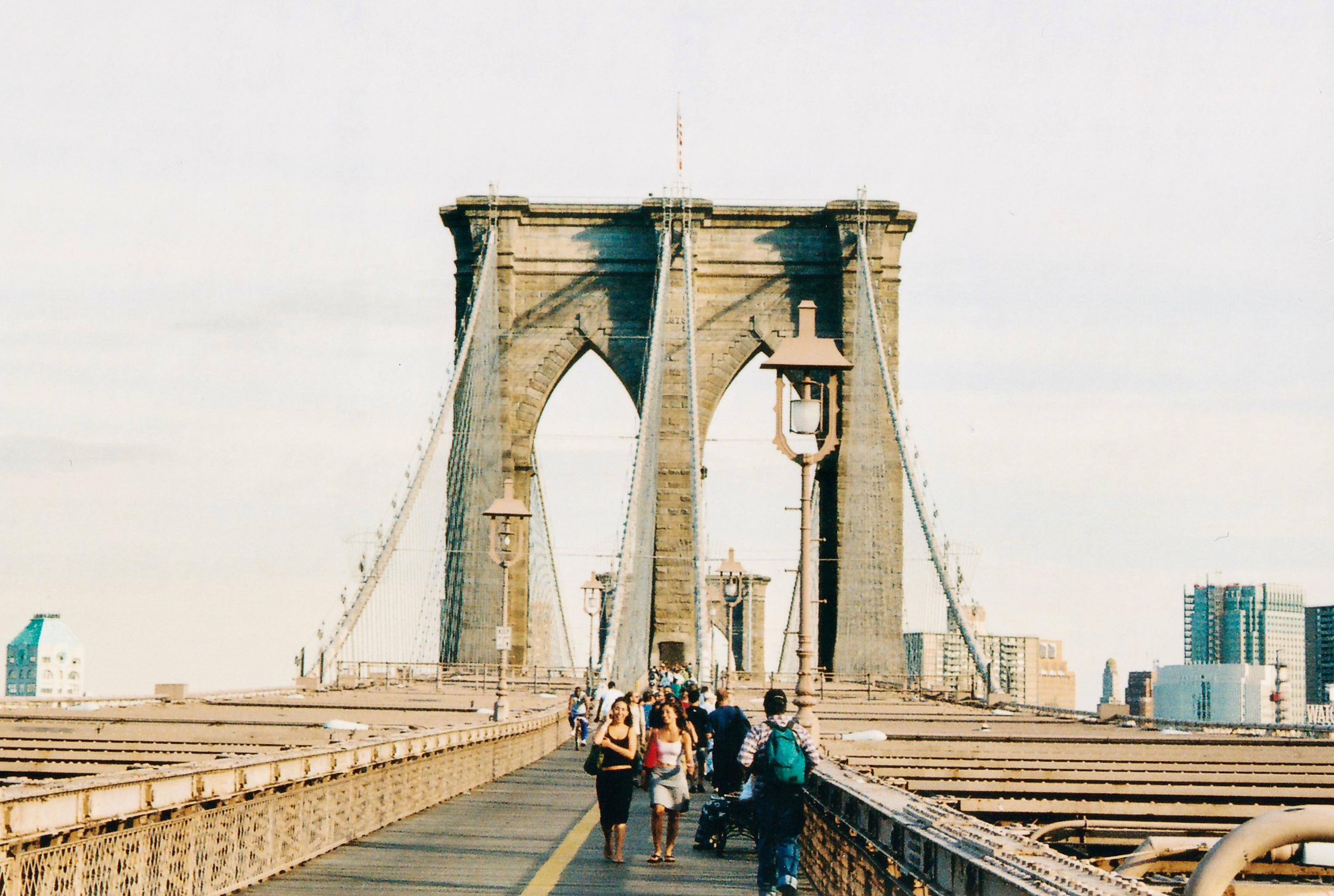
Heading further South through Chinatown (where I’m certain we stopped for dim sum at some point), we eventually reached the mighty Brooklyn Bridge.
A perfect, beautiful, late Summer Saturday to walk all the way across it.
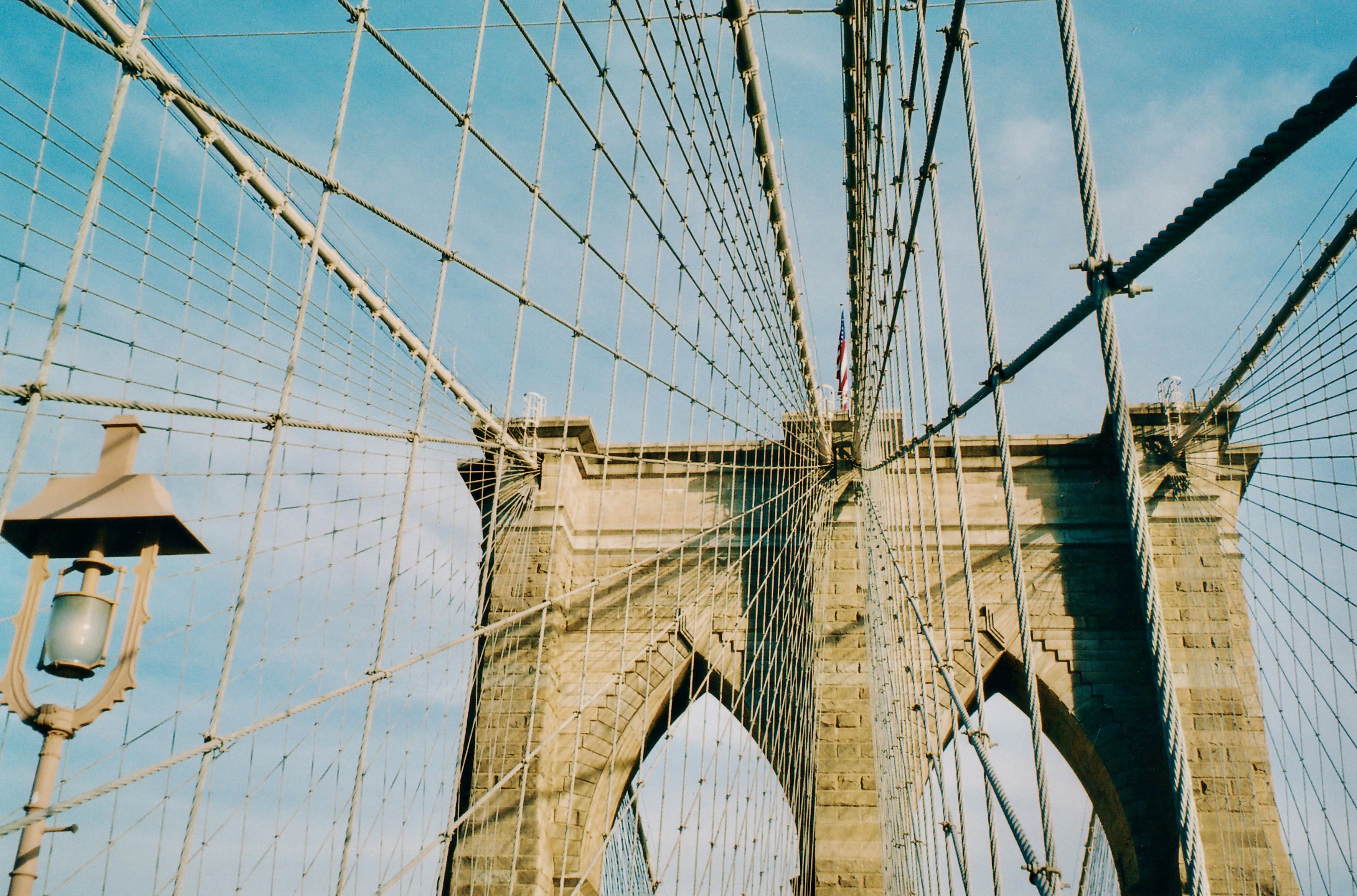
The world teems with many great urban bridges, but few match the classicism and elegance of this one.
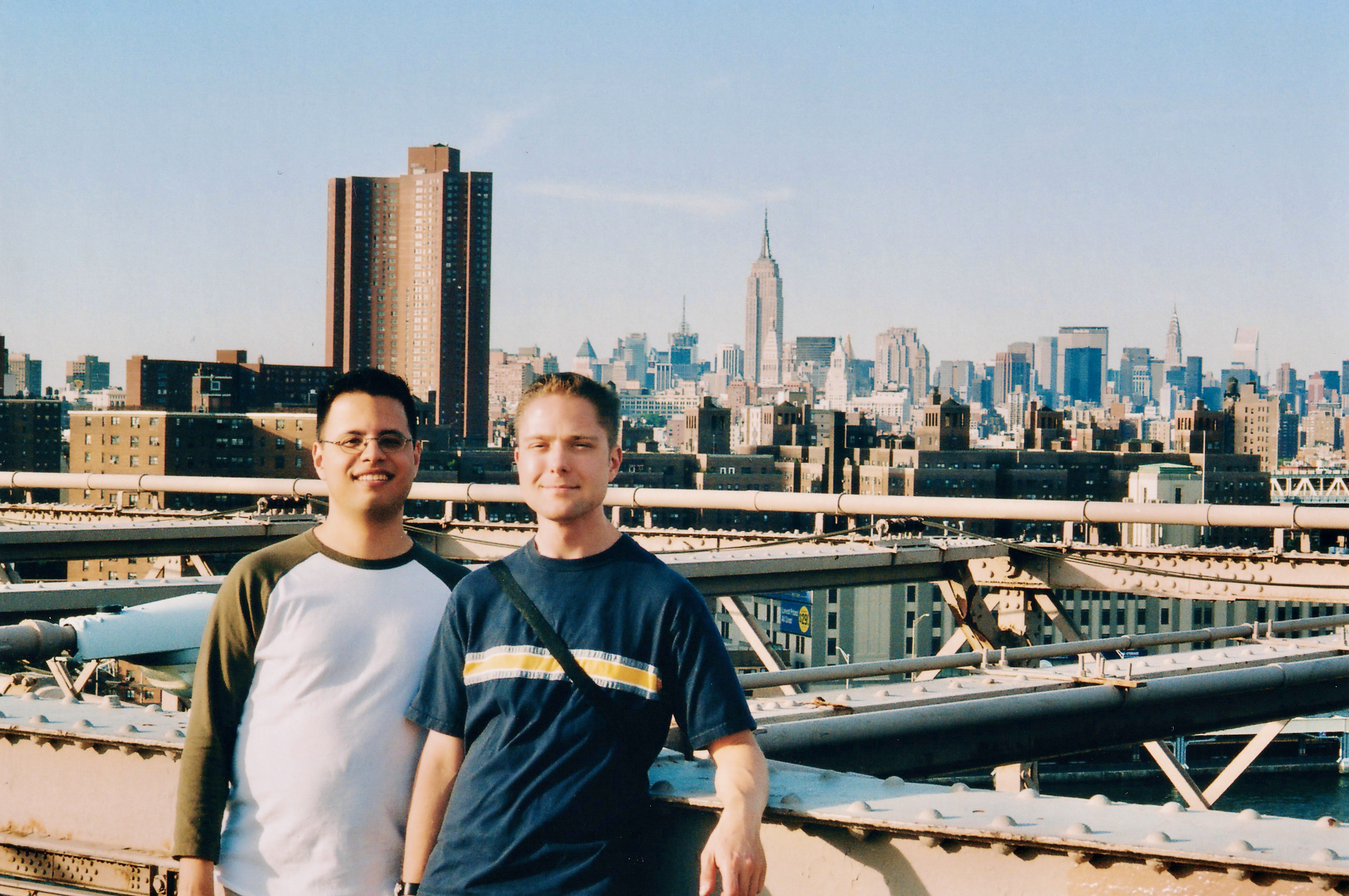
Frank and I and Manhattan, with the Empire State Building central in the background.
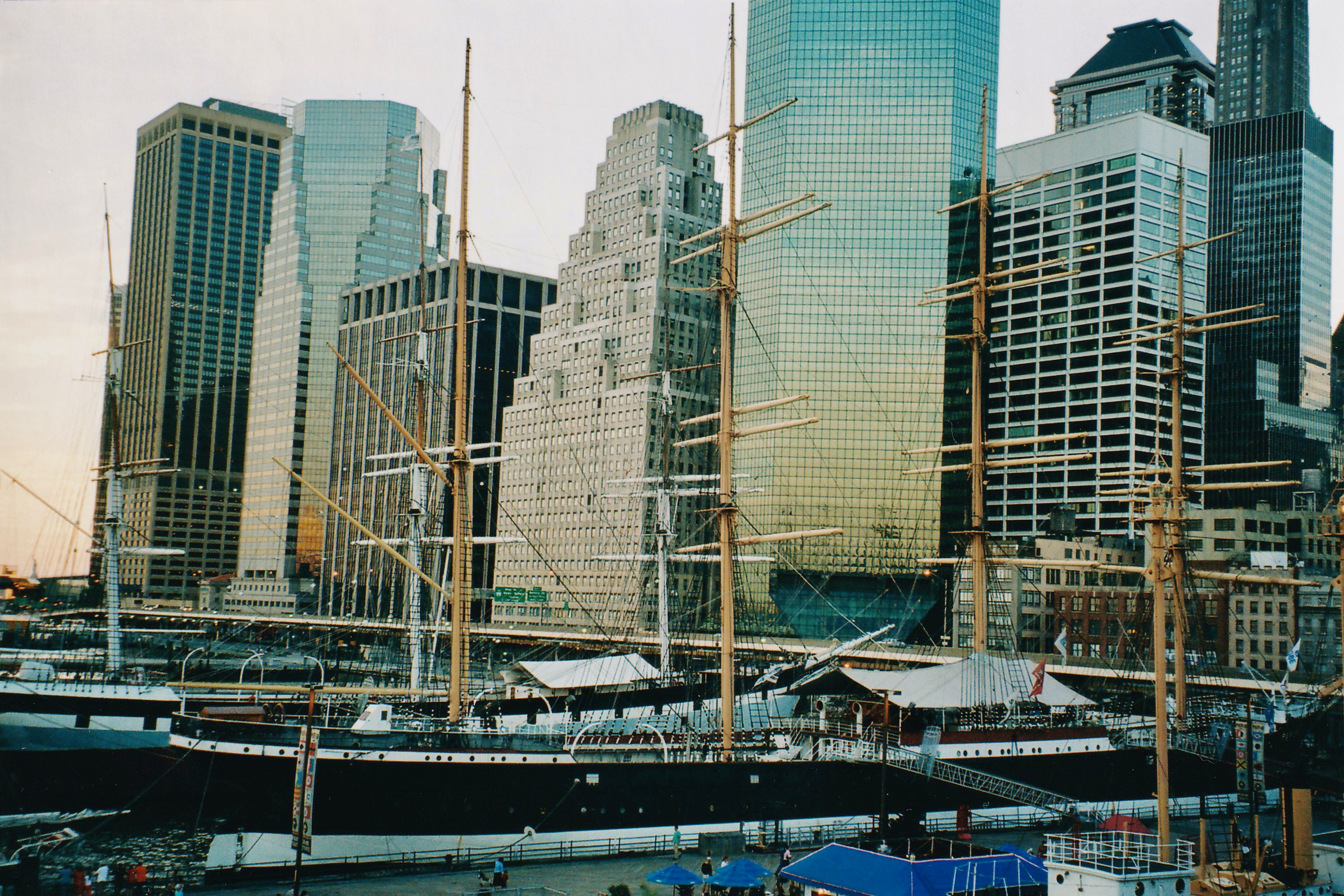
We later met up with a local friend of Frank’s and spent some time at South Street Seaport, which has undergone a massive re-haul in the past 18 years. This was our Financial District view from the deck we sat on. Although 9/11 was relatively fresh in everyone’s minds, the city felt like it was pushing forward, a celebratory air of the new New York, a Manhattan that had yet to become entirely a haven for wealthy foreign tax dodgers.
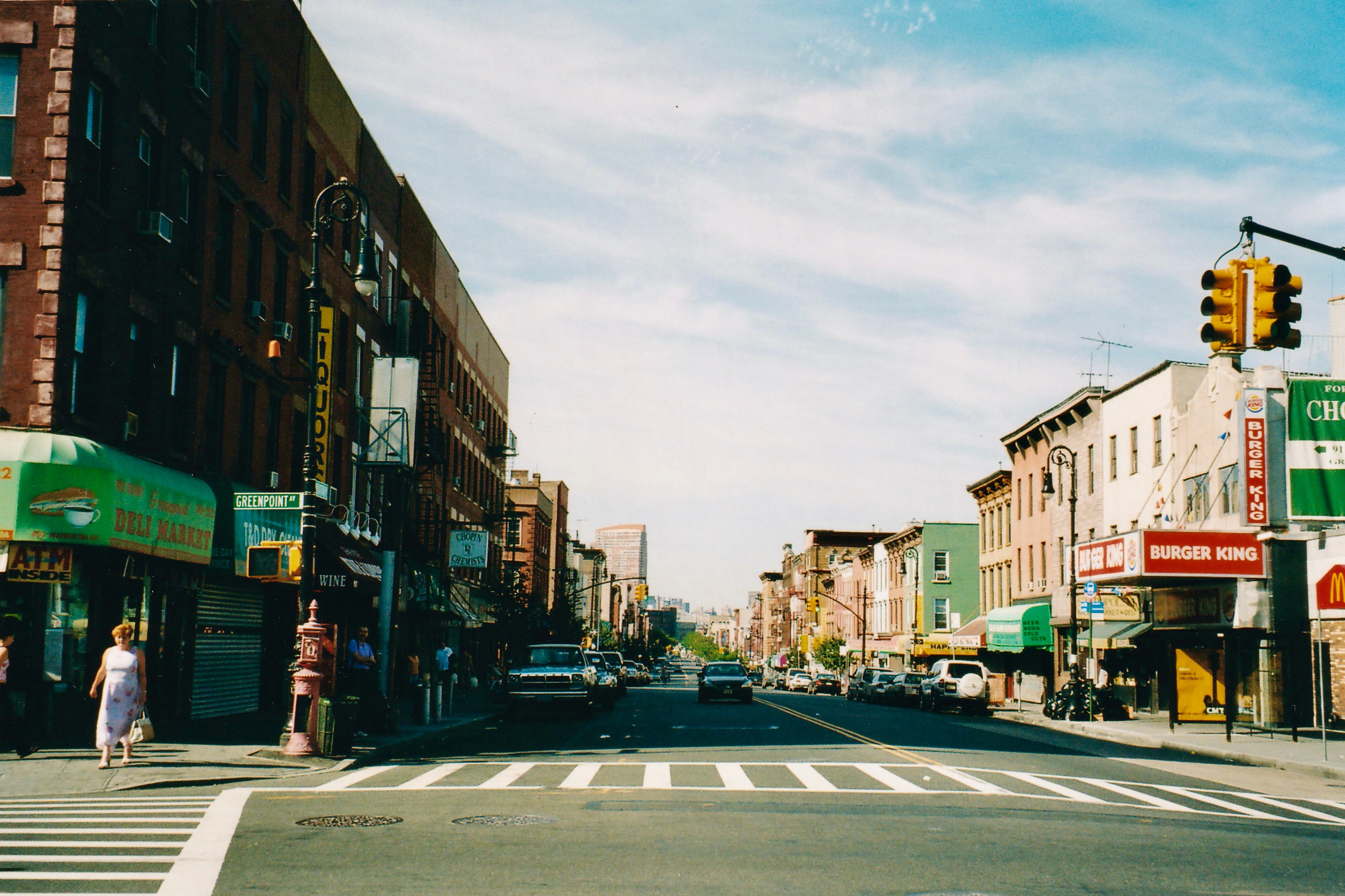
Greenpoint, Brooklyn: Facing North on Manhattan Ave. at Greenpoint Ave.
On Sunday, we ventured out to Brooklyn. Hipster Williamsburg was in its ascendancy; we walked through it over to a mostly pre-gentrified Greenpoint where we lunched at a place now known as Karczma but at the time was simply a bare-bones joint called “Polish Restaurant”. The massive combination platter, which included stuffed cabbage, pierogi, potato pancakes, kielbasa and Hunter’s Stew made me proud to be of Polish descent.
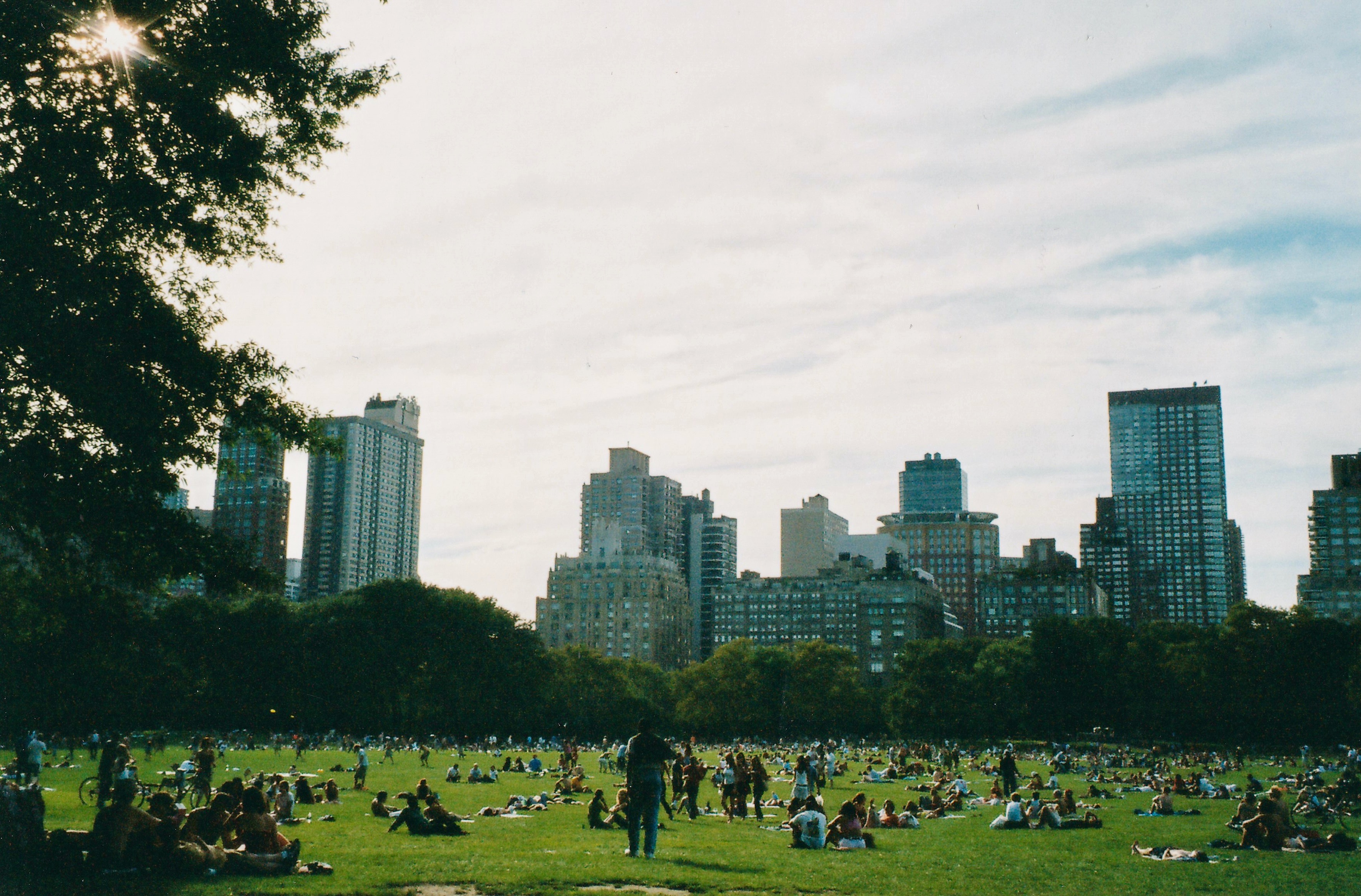
Before heading back on the Greyhound to Boston, we visited Central Park where an idyllic Sunday afternoon at the Great Lawn was in full swing. I recall walking past an affected young woman who seemed to think she was Holly Golightly in Breakfast At Tiffany’s, but I didn’t get a pic of her.
Also, I can’t leave out that before boarding the bus, Frank and I stopped at a midtown Krispy Kreme and picked up two dozen donuts (including a dozen freshly glazed and hot!) to bring back with us. As our bus made its way up through Harlem and the Bronx, we lounged in our seats, donut boxes on our laps, blissfully induced into Krispy Kreme Komas. Although I’d never seriously consider moving to NYC, I knew I’d be back to visit again—particularly after I made a good friend there who came to personify the city for me.
At 21, I knew I had to get out of Milwaukee. Mind you, I didn’t exactly hate my hometown. During Marquette University’s Freshman Orientation, I was practically a cheerleader for it, extolling the city’s many parks and local cuisines to any other student newly arrived from outside the metro area willing to listen. Three years later, however, I deeply regretted that I hadn’t gone away for school. Although I received an above-average education at the college of my choice, it gradually dawned on me that I was missing out on something. Nothing wrong or inferior about pursuing higher education as a commuter student, but I did so mostly out of fear. I had held back when I could’ve easily set my ambitions much higher. I realized I’d personally never become legitimately independent if I continued to stay put.
For me, the easiest way out was to attend graduate school in another city. Having discovered a passion for my minor (Film Studies) far more fervent than anything I had for my major (Journalism), I looked into master’s programs for the former. In those embryonic internet days, I had to consult a thick reference catalog at the campus library to determine which schools I could apply to. UW-Madison was the obvious choice—at 90 minutes away, it was a baby step of a move but far enough for me to adequately feel like I was on my own. Besides, over the past few years I’d visited friends there often enough to the point where it already felt familiar.
I was superciliously certain I could get into Madison but just to be safe, I also applied to two other schools. The first was Boston University—my roommate’s girlfriend had recently talked up the city, deeming it the ultimate college town and more “European” than other US metropolises. The other was New York University, as they had a program at the Tisch School For The Arts and I thought, “Eh, why not? I’m going to Madison anyway.”
Alas, Madison might’ve accepted me had I submitted my application on time. In the rush of taking my GRE, drafting the required essays, procuring recommendation letters and getting all the forms out in the mail, I miscalculated that school’s relatively early cutoff date. I also never seriously expected to get into NYU (nor can I imagine green 22-year-old me flailing about New York City); fortunately, I received a welcome packet from BU in mid-March. I could stick around Milwaukee for another year, maybe reapply to Madison for the spring semester; instead, I chose to see this little exercise’s outcome as a sign. I was moving to Boston.
*
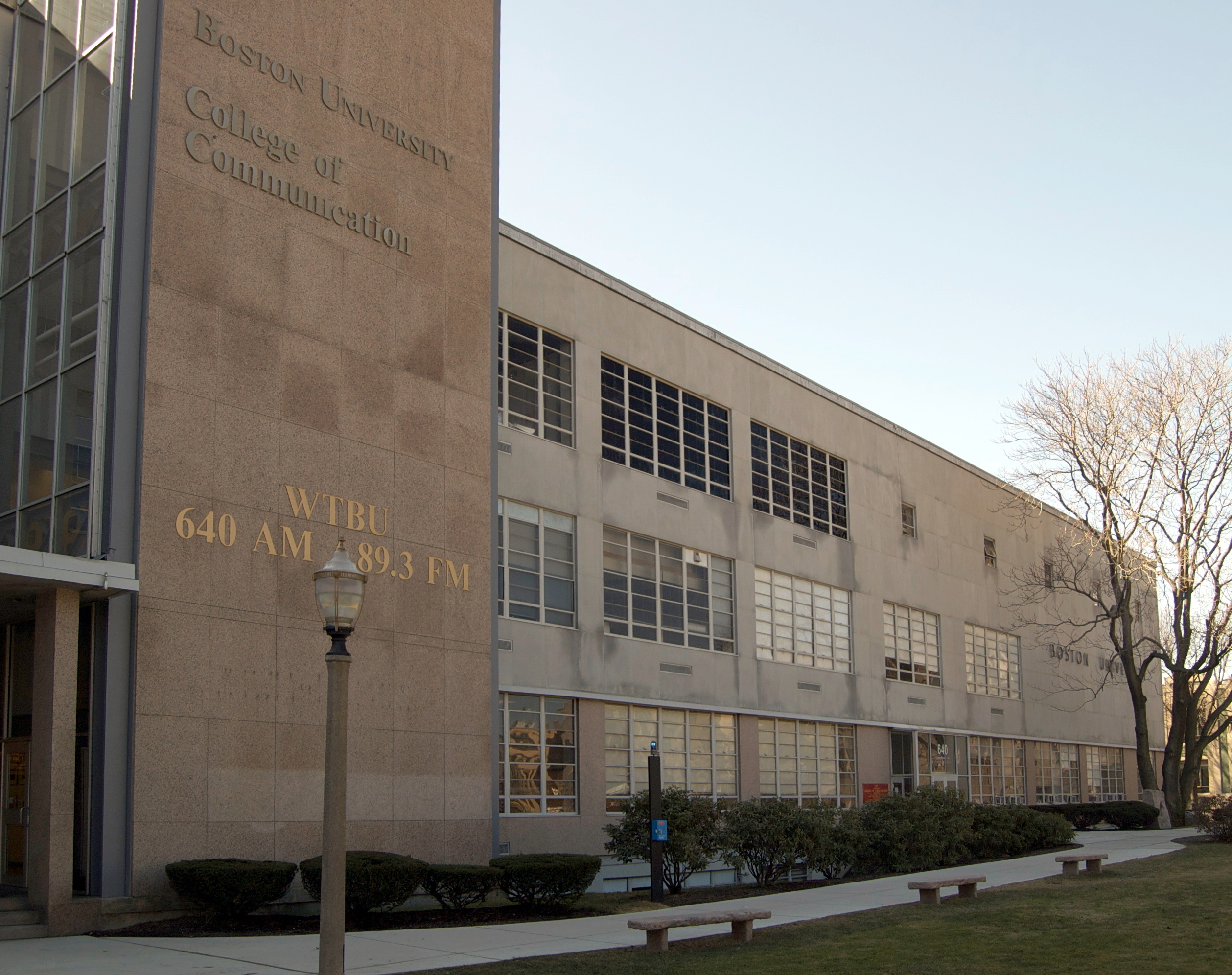
I’ve previously written about my first 48 hours in my new city. On the third day, having partially acclimated myself to my neighborhood of Allston and the BU campus, I showed up for orientation at the College of Communication building (hereafter shortened to COM), an unassuming, three story, mid-20th century structure that paled in the shadow of the gleaming, luxurious new School of Business Administration down the block. At the time, COM’s only distinguishing feature was a moderately short radio tower on its roof, which I soon learned no longer carried any broadcasting function whatsoever.
COM in all of its boxy, utilitarian glory.
I met my fellow classmates in the Film Studies program (seven of us in all) and received syllabi and reading lists for my courses. They included one on horror films, another on the work of British director Mike Leigh (who’d won the Cannes Palme d’Or for his film Secrets & Lies the year before) and a self-explanatory through-the-decades survey called “American Masterworks”. As with most of my BU courses, these were all open to both graduates and undergraduates, allowing the latter’s non-arts majors to fulfill their fine arts requirement. In subsequent semesters, I’d even serve as a teaching assistant for a few of these hybrid courses which basically meant I got to grade the undergraduates’ writing assignments and work the VCR and Laserdisc player whenever we watched movies in class.
That first semester, I also took a fourth course—one limited to graduate students included my fellow Film Studies majors along with all the new students in the Film Production and Screenwriting programs. Called “Ways of Seeing” (a simple but perceptive summation), we learned not only how to watch and assess a film but also how some films beg us to watch them differently from others. The semester kicked off with an intensive examination of Psycho. After one complete run-through the entire film, we returned to various scenes, watching and dissecting them again and again. So thoroughly did we pick it apart frame by frame that I haven’t watched it since—while our professor dutifully showed us why Hitchcock’s film was an example of major Hollywood studio cinema at its best, he also singled out in painstaking detail what he saw to be its many, many flaws, to the point where I simply couldn’t watch it again because all I could see were those imperfections.
From there, we studied films suggesting various “Ways of Seeing” that diverged from Psycho. Jean Renoir’s La Règle du Jeu presented a cinematic canvas composed less of shot-reaction shot editing than figures constantly, freely moving in and out and around the frame, engaging in moral complexities far more advanced than Psycho’s Freudian constructs. John Cassavetes’ A Woman Under The Influence further blurred such distinctions, its characters (and director) making unexpected, irrational, just plain messy choices with a raw impulsivity that felt less written than captured by a documentary film crew. Caveh Zahedi’s A Little Stiff was low-budget and contained to the point of seeming handmade, its filmmaker starring as a fictionalized version of himself and anticipating by a decade a genre critics would dub “mumblecore”. Andrei Tarkovsky’s Stalker, on the other hand, came off as immense and enigmatic, a personal sci-fi allegory that was the anti-Psycho for how it raised all sorts of questions and just left them there hanging and unanswered.
*
Late in the semester, we watched Todd Haynes’ Safe, a study of a woman suffering from environmental illness who seeks solace at a new age rehabilitation facility. I’d heard of the film when it came out two years before and recalled it briefly playing at Milwaukee’s Downer Theater. From what little I read regarding it, I imagined it to be a satire about suburban living, allergies caused by household products and the lengths people will go to find alternative solutions to combating such ailments. I pictured something not far off from, say, Alexander Payne’s screwball abortion rights fable Citizen Ruth (released the year after Safe.)
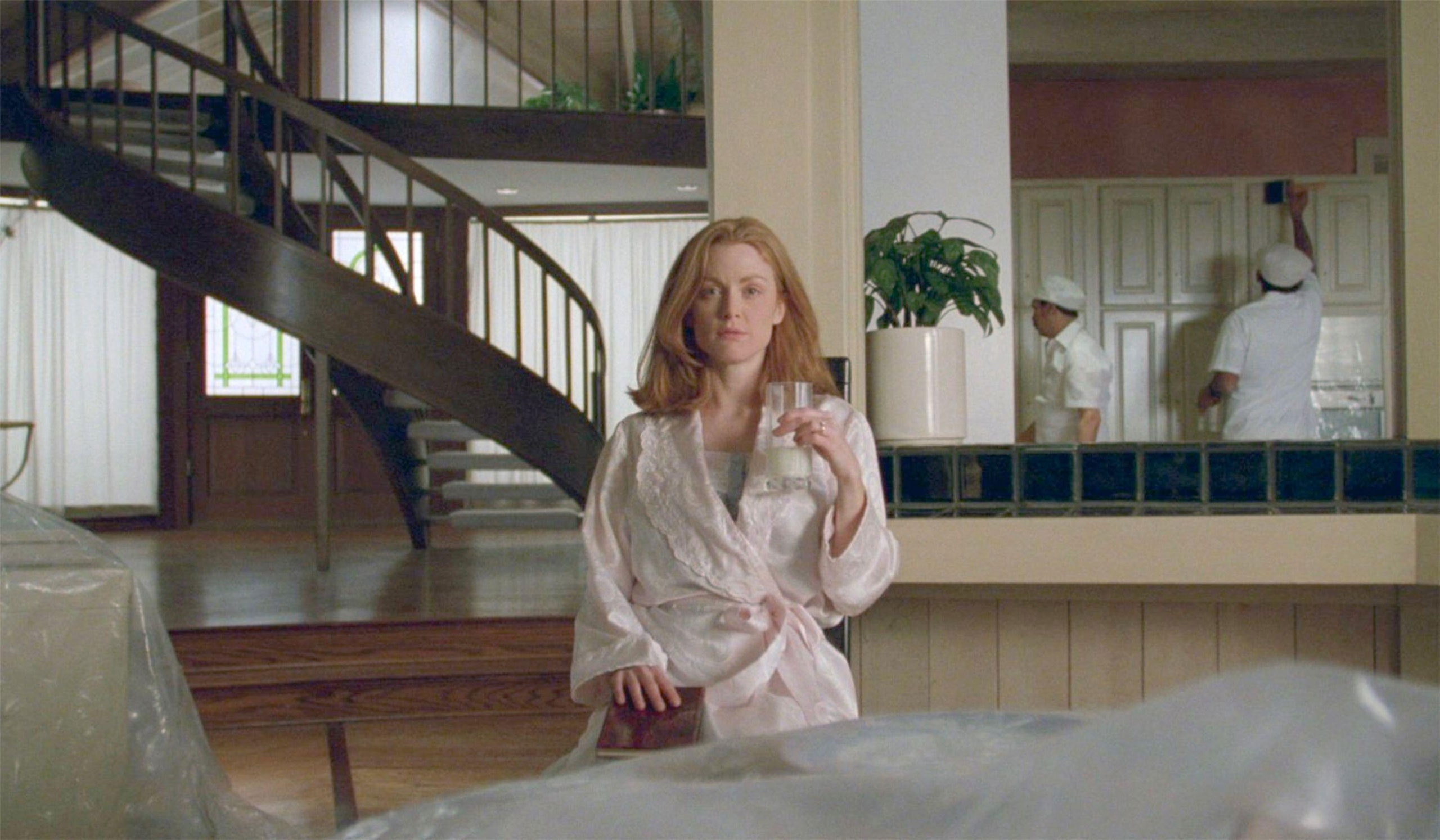
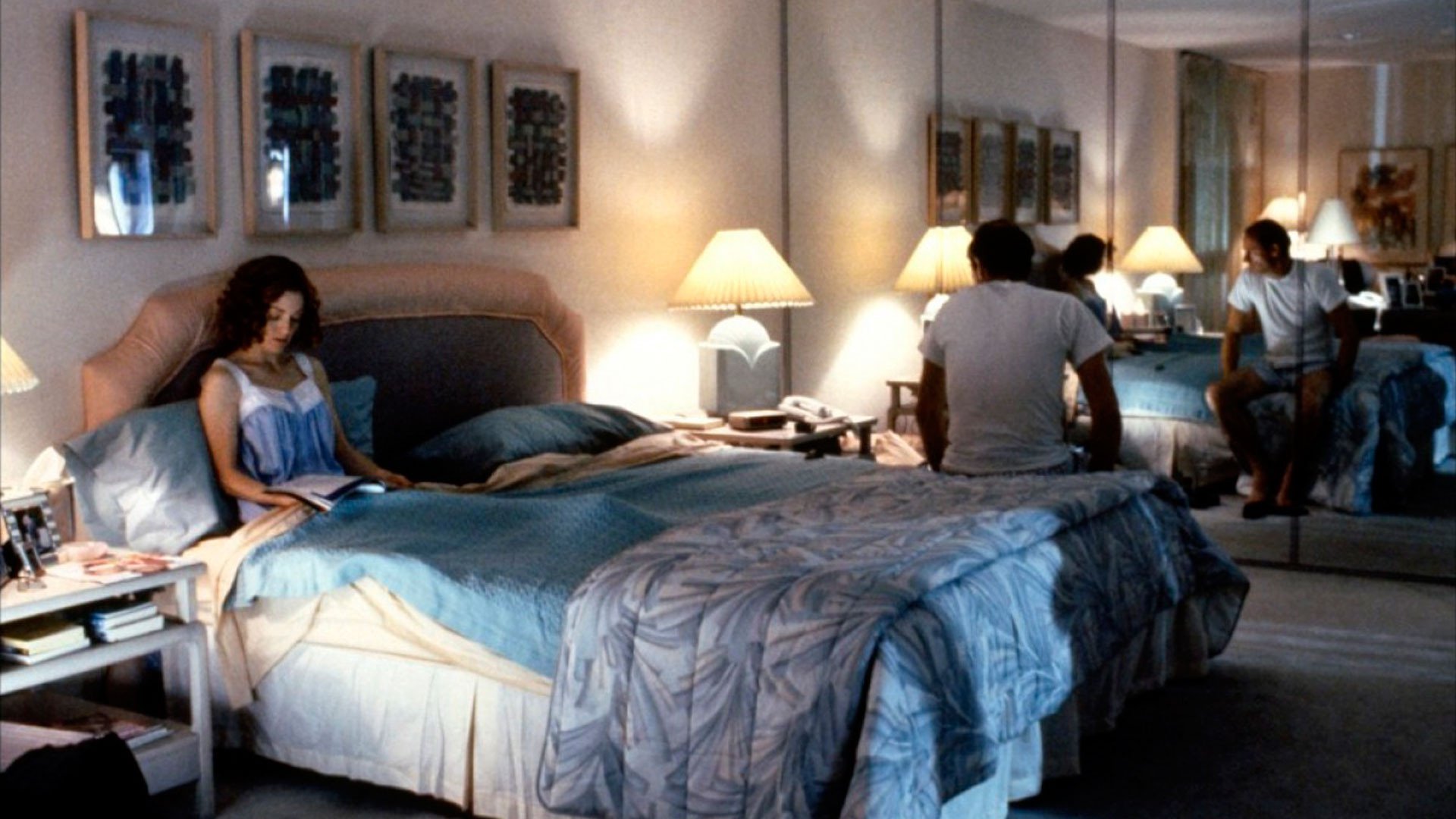
From the ominous, mournful, droning synths accompanying its opening credits, which appeared over a point-of-view shot of a car slowly driving at night through an upscale Los Angeles subdivision, I promptly understood that Safe would be absolutely nothing like Citizen Ruth. The next scene confirmed this: an uncomfortably drawn-out shot of the film’s heroine, Carol White (Julianne Moore), lying in bed, her face to the camera as she’s engaging in man-on-top sex with her husband. Her expression’s not completely indifferent but she doesn’t appear to be gleaning much pleasure from it.
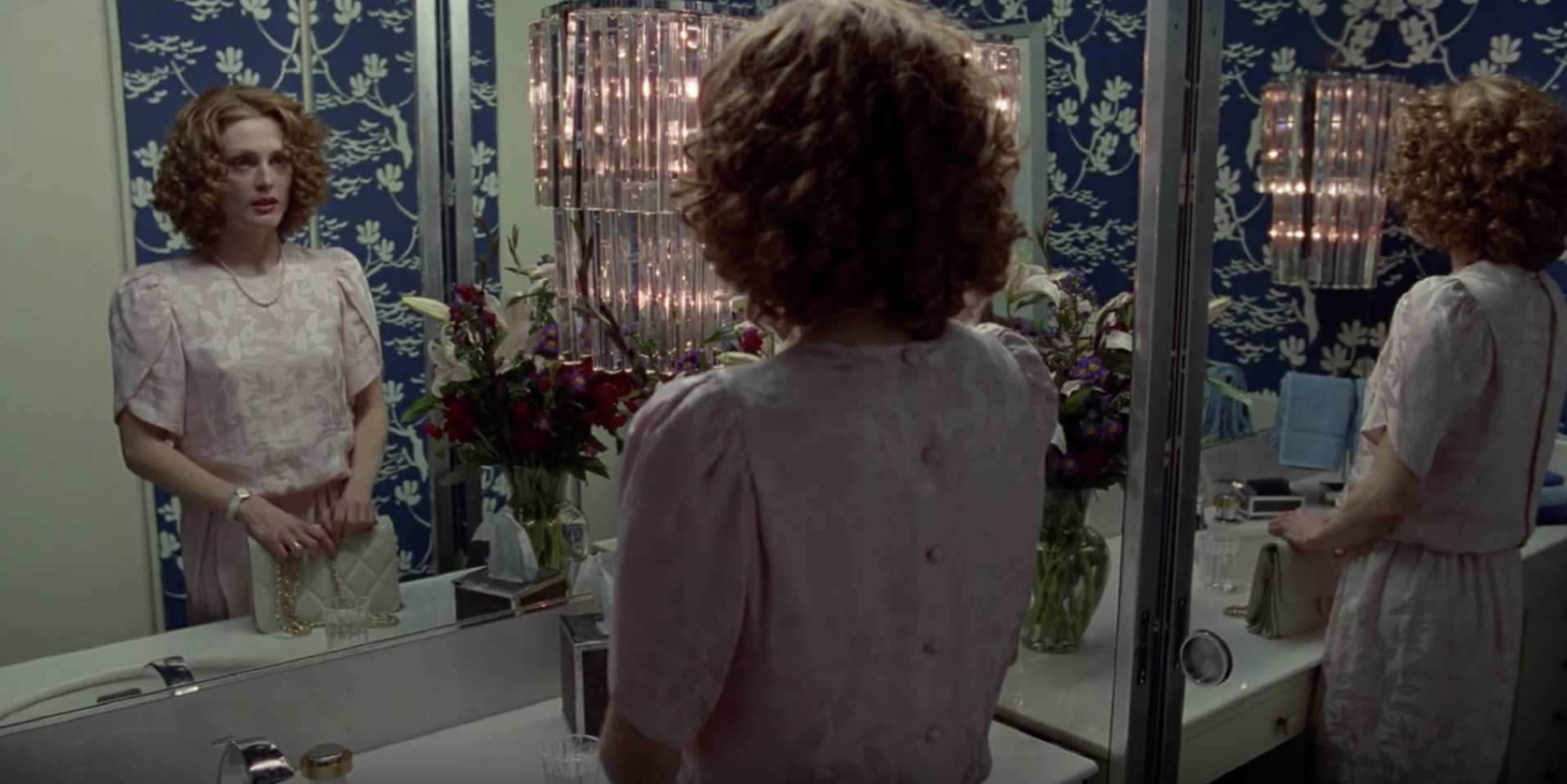
Does anything give Carol pleasure or even joy? She’s a Sherman Oaks housewife living in a gigantic McMansion in 1987 (set eight years before the film’s release.) She spends her days running errands, attending aerobics class, gardening, and going out to lunch. With a maid at her disposal and no job or profession to speak of, she seems to have a charmed life; she also seems barely there, often physically engulfed by her environment, sometimes appearing as small as a speck within the symmetrical, immaculately arranged wide shots inside her home.
About fifteen minutes into the film, she drives on a congested expressway behind a truck belching out exhaust fumes and suffers a coughing fit that’s alarmingly more severe by the second. She pulls off the road and into an underground parking garage where she stops, gets out of the car and continues to violently hack away, worryingly short of breath; as with the interior home shots, she appears tiny in the garage’s expanse, its darkness nearly encompassing her.
Similar attacks occur at a friend’s baby shower, the dry cleaners and the hair salon when she’s getting a perm. During these moments, Haynes often utilizes horror film tropes like dramatic bursts of sinister music or sudden jump cuts or close-ups—when the other ladies at the shower attempt to comfort Carol, it’s a sideways nod to the shower scene in Rosemary’s Baby (however, not Psycho.) Meanwhile, her doctor casually dismisses Carol’s claims, concluding that, despite the incessant coughing, headaches and general fatigue, there’s nothing physically wrong with her. He recommends she consult a therapist.
Perhaps the problem is psychological: after she attends a seminar on environmental illnesses (the first shot of an audience member donning a surgical mask is enough to elicit a visceral reaction in 2021), her husband, stumbling upon a pamphlet she’s brought home from it asks her, “Who told you to go to this?” His exact words and accusatory tone say more about how he and the other people perceive Carol than anything she says herself. Haynes further corroborates this by deliberately withholding what another film would regard as key information about her, like the fact she has a ten-year-old child (revealed 25 minutes in) and that it’s actually her husband’s son from a previous marriage (38 minutes in.) And Moore completes the picture of Carol as a blank by nearly disappearing into the role—a perfectly nice individual with barely a trace of discernible personality.
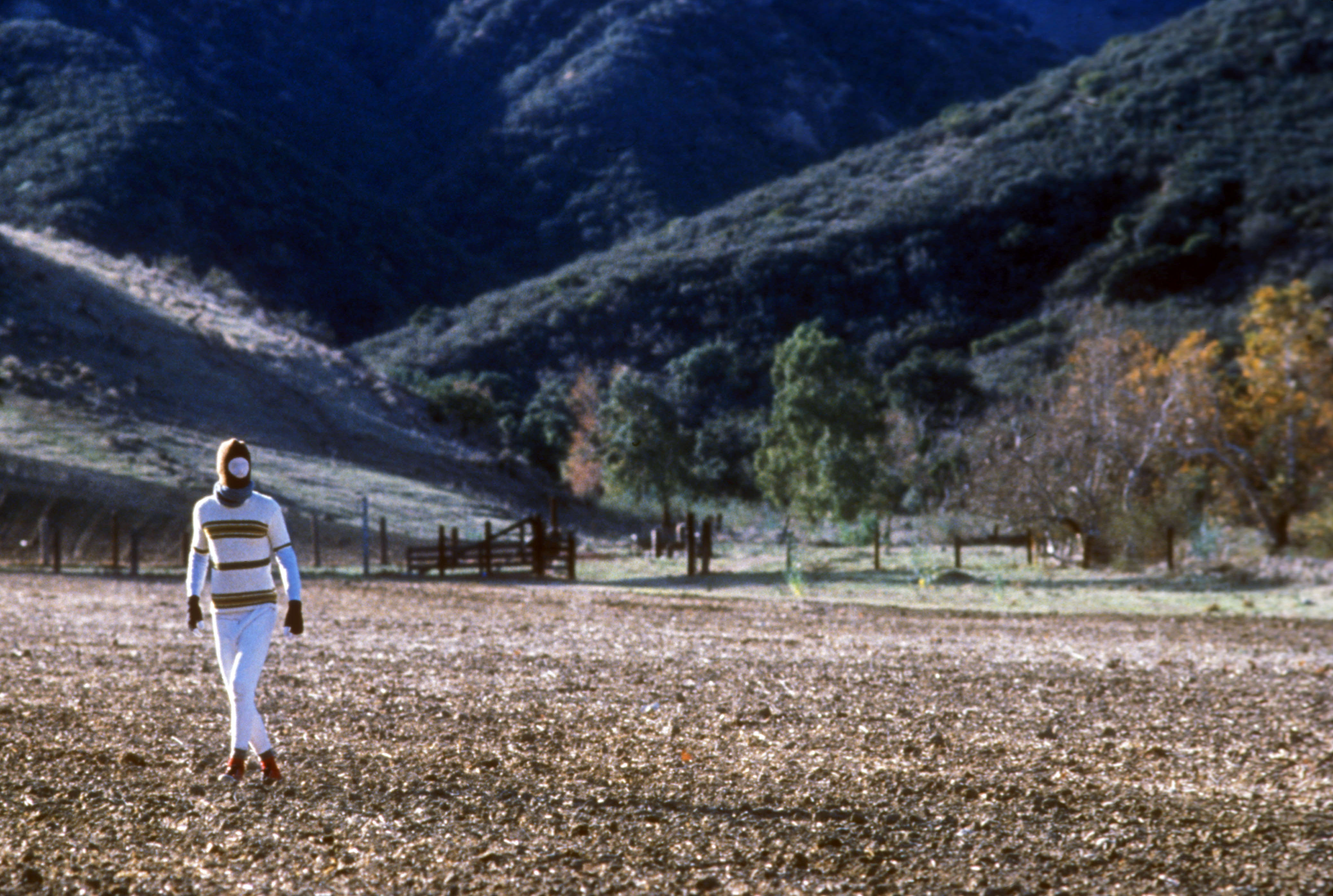
She winds up in the hospital following her attack at the dry cleaners. From her bed, she sees a TV commercial for Wrenwood, a new age-y rehab clinic in New Mexico specializing in treatment of people like her. In the very next scene, she’s in a cab, sans husband or stepson, riding through the desert on her way there. However, something seems off about the place when Carol’s cab first pulls in and she’s accosted by Nell, an older masked woman furiously screaming at her to turn back (the car fumes upset her because her husband is immune compromised), then creepily taunting her from a distance, “I see you,” after she exits the vehicle.
Wrenwood would seem a target overripe for satire given its remote location and inclination towards spoken and sung affirmations (a woman sings a Judy Collins-esque anthem to the assembled patients with such pithy lyrics as, “Give yourself to love / if love is what you’re after.”) Then, there’s Peter (Peter Friedman), the facility’s middle-aged owner who presides over the organization with an aw-shucks folksiness crossed with the understated but palpable fervor of your average cult leader. He concludes his talks by leading the group in the following inspirational credo: “We are one with the power that created us, we are safe, and all is well in the world.”
Despite all that, Wrenwood doesn’t particularly seem like a heightened or ridiculous proposition, at least not on the surface. The group therapy sessions feel straightforward and potentially constructive, especially when Peter advises Nell, “The only person who can make you sick is you, right?” Conversely, he doesn’t acknowledge Nell’s husband’s then-recent death, which for all we know might’ve been suicidal. He also never mentions to the congregation his own status a person living with AIDS (one of the other patients reveals this to Carol.) In 1987 (and, to a lesser extent, 1995), this was almost a certain death sentence; its revelation amplifies the notion that Peter is attempting to heal himself and his patients with the power of positive thinking in lieu of a (nonexistent) medical cure or treatment.
Carol doesn’t seem to be getting any better at Wrenwood; the film’s tone does not brighten once it shifts to New Mexico. She soon requests to change cabins because of “the fumes” she perceives (perhaps by way of Nell?) coming from outside the compound. Mask and oxygen tank in tow, she makes her way around the facilities in stilted movements, increasingly resembling Lester, a fellow patient only shown from a distance. When she first spots him, Peter remarks to Carol, “Poor Lester… he’s just very, very afraid.” Rather than improving in health or even disposition, Carol further withdraws into herself.
Poor Lester…
She does take tentative steps towards making a new friend in Chris (James LeGros), a fellow resident with whom she signs up to cook something for a communal potluck. The event itself seems a joyous one, with the dinner followed by its participants dancing to Kenny Loggins’ “Whenever I Call You ‘Friend’”. Then, Chris and the group surprise her with a cake (her birthday’s the next day), a genuinely sweet and selfless gesture. They ask her to give a speech, and she does, confessing to the group, “It’s just that, I really hated myself before I came here,” rambling on about such things as “education” and “AIDS” before gradually trailing off. She’s smiling but is also seriously emaciated, her face and skin disconcertingly blotchy.
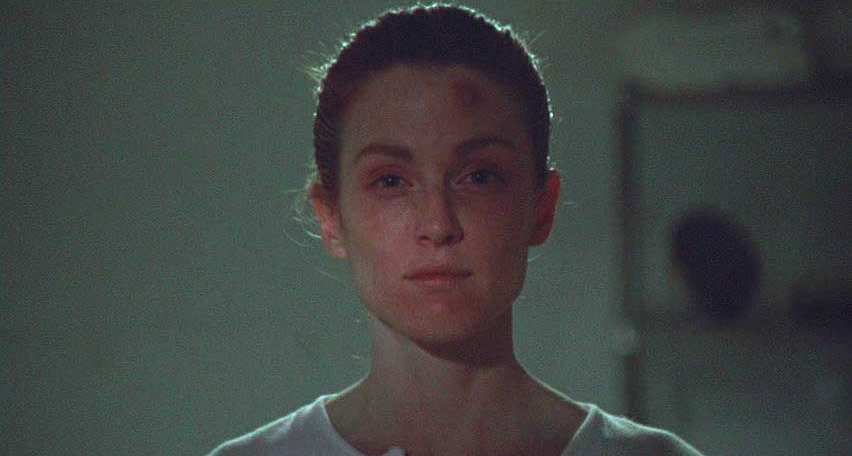
Chris walks Carol back to her cabin, which is now the “safe house”, a metal igloo-like structure once inhabited by Nell’s husband. Alone inside, Carol’s white, colorless clothing and skin blend into her stark, sterile, prison cell-like surroundings. She breathes from her oxygen tank and looks directly into a little mirror on the wall: the film’s final shot is of her staring into it, at us, her face partially in shadow. Blankly, she says to her reflection, “I love – I love you. I really love you. I love you.” Fade to black and credits roll.
*
I recall sitting in the classroom at that moment, figuratively chilled to the bone. Thoughts escaped me as how to process this deeply unnerving ending to an altogether unsettling film. Normally, a story about illness and rehabilitation would conclude triumphantly, the subject overcoming an affliction and having learned more about themselves in the process—perhaps even learning how to love themselves. Carol’s final words to us are as such, but they don’t at all reassure or convince. She struggles to get them out and indeed, they’re something a facility therapist instructed her earlier to say. As much as we’d (and, for that matter, she’d) like to believe they’re true, they come off as just words—a recitation.
It’s easy to view Safe through a cynical lens: most likely, Carol’s illness is psychosomatic, a physical manifestation of her psychological damage, self-punishment for the fact that she doesn’t love herself. A few critics at the time, most notably Jay Carr in The Boston Globe dismissed it as just that. However, I didn’t see it that way, not entirely. Safe’s austere conclusion genuinely shocked me—I was willing to believe something was physically wrong with her, that there must be an exterior reason for her symptoms, that she’d learn how to live with if not entirely combat them during her time at Wrenwood.
Then again, that’s only one of two parallel readings that Haynes thoroughly maps out in Carol’s trajectory; the other, where it is all in her head is just as present in the film’s overall design. For a character who appears in every single scene, she’s often deliberately spectral and insignificant, a non-entity. Moore’s subdued but internally complex performance only further serves this notion, that we’re looking both at and through the eyes of someone with so little self-esteem and sense of purpose that, instead of “getting better”, all she can do is further recoil into herself where she thinks she feels “safe” but in truth can’t feel anything at all.
Before Safe, I hadn’t seen a film attempt such a bait-and-switch (or at least wasn’t aware of one attempting it) and do it so seamlessly and effectively. And yet, I don’t believe what it does is a cheat or a clever way of saying, “Okay, here’s what this film’s really about.” Instead, Safe is about exterior and interior lives and how one’s physical and the psychological selves can be out of balance or even at opposition to each other. As for that title, it throws into relief its definition as an ability, an affirmation, a state of mind. Does the concept of safety ultimately imply a sense of feeling protected or does it come entirely from self-worth? Upending my life and moving to Boston at 22, I took a risk and deliberately tried to be unsafe, although one might argue that by opting for grad school instead of a job in the real world, I had deployed a safety net of sorts for myself. I’m willing to bet this conundrum lingered somewhere in my subconscious as I watched Safe, a film that asks its viewers to consider whether the desire to be “safe” is to simply crave comfort or inevitably give oneself over to fear.
I don’t know why it took me so long to get around to watching 12 Angry Men. Perhaps I’d seen it used so much as a cultural reference point that I felt like I didn’t need to see it—after all, one could easily summarize the plot in a sentence or two, tops. Sidney Lumet’s a filmmaker whose workmanlike agility I’ve always felt more admiration than passion for, but his first feature film conveys a mastery of pacing, blocking and framing to transform what is essentially a single set play into cinema, albeit one best viewed as a period piece that intrigues most when it offers occasional glimpses of self-recognition. Either way, as essential as you’ve heard it to be.
With all his shorts expiring on Criterion at the end of the month, I took a semi-deep dive into Georges Méliès, the first filmmaker to utilize optical effects and thus take serious advantage of what one could do with the new medium. Every cineaste knows A Trip To The Moon (especially the two that made this music video 25 years ago), but follow-ups like The Impossible Voyage and The Merry Frolics of Satan are even better, experimenting with textures and a fine-tuned whimsy. They are records of Méliès exploring film in real time, trying out new techniques and occasionally finding magic in them.
Not much new stuff to write home about (apart from Annette, reviewed here), with re-watches mostly confirming first impressions: Elliot Gould still iconic as a 1970’s Philip Marlowe in The Long Goodbye, Point Blank still pretentious but oddly fascinating, etc. On the other hand, Limbo feels more like a future classic the second time around and Pink Flamingos proves far more watchable with John Waters’ predictably entertaining, motor-mouthed commentary track.
On that note, I’m taking a break from these watchlist essays after 18 straight months of doing them in order to focus on other writing (including this series) and some new endeavors. However, I’ll still be posting (mostly short) reviews of everything I see on Letterboxd.
Films viewed in August in chronological order, with director, year of release and my rating (out of 10); starred titles are re-watches:
Annette is a tough film to wrap one’s head around and you wouldn’t expect anything less from an epic, operatic musical directed by Leos Carax (whose last film was the bonkers Holy Motors) and written/composed by brothers Ron and Russell Mael, better known as the long running cult duo Sparks. It’s a work that revels in its extreme artifice from the opening scene where Carax, the Maels and the cast march from the film set/recording studio through the streets of Hollywood at night, singing the self-referential anthem “So May We Start”.
The story that unfolds is similarly insane, charting the tempestuous romance between Henry (Adam Driver, possibly never better), a popular shock comedian and Ann (Marion Cotillard), an opera diva. Diametrically opposed in approach to their respective arts (Henry aims for laughter, Ann for tears as her character dies on stage every night), they have a child together, Annette; she is portrayed by a puppet.
From there, things gradually spiral, occasionally alluding to such iconic Hollywood tales as A Star Is Born and Mulholland Drive. There’s murder and manipulation, emotional and philosophical crises, and a heightened sense of fantasy and self-awareness that lends itself completely to the predominantly sung dialogue–if there is an analogue in the music here to Spark’s wildly diverse back catalog, it’s their great 2002 album Lil’ Beethoven, a quasi-classical work of melodic repetition and lyrical recitation.
The film sustains a teetering-on-the-edge-of-sanity feel that rarely lets up during its 140 minute running time and it’s not difficult to see why that makes for such a polarizing watch. Often reminiscent of similar musical/film balancing acts like Phantom of the Paradise and, to a lesser extent, Moulin Rouge!, Annette’s weird hybrid of emotion and artifice manages to feel more personal than either. After one viewing, I don’t yet know if it’s a great film or just a great effort at one, but it lingers on like a dream (maybe a nightmare?) that I’m still attempting to fully assess.
No film festivals or reoccurring themes this month, unless you count two starring Veronica Lake (the silly one’s much better than the serious one) and another two with Gena Rowlands (though her role in Mazursky’s forgotten, half-misbegotten modern Shakespeare riff is relatively tiny.) I did celebrate Independence Day weekend with two concert films: Summer of Soul is one of the best in years, adding incisive context to its rare footage with a “can you top that clip” momentum that never lets up; Monterey Pop, on the other hand is more noteworthy for its historical value than anything Pennebaker adds to it, although the lengthy Ravi Shankar number at the finale could be an excellent short in itself.
Caught up on a few new-ish acclaimed titles, including the polarizing Promising Young Woman (thoroughly entertaining, pulls few punches but I don’t think I could sit through that scene again), Minari (more than adequate but only exceptional when Youn Yuh-jung’s onscreen) and the recently re-released Between The Lines, which intrigues for its depiction of a circa-1977, pre-gentrification, pseudo-bohemian Boston, even if it feels a little sitcom-y at times. Also finally saw A Quiet Place: wasn’t expecting Krasinski to meld Raimi-esque sci-fi/horror onto what could almost be a more commercial version of Malick, although I still do not have high hopes for the sequel (which I’ll likely watch in August.)
All my re-watches this month hold up nicely, especially Altman’s gambling picture, which gives a most vivid sense of its time and place and The Conformist, which offers a dazzling simulation of its time/place that could only exist in the mind but resonates strongly anyway. This also marks the first time I’ve made it through Fallen Angels without having to look up (much of) the plot online and the first time I’ve seen American Movie since it was in theaters—as a native, I can’t say it’s the best Milwaukee movie, but it’s certainly the most.
Standing out from the remaining hodgepodge of mostly middling titles new and old (though Mandibles is almost genius in its relentless stupidity) are two highly recommended first-time watches. O Fantasma brilliantly navigates a stunning turn in its third act from agreeably kinky to deeply unsettling, making me want to watch everything else Rodrigues made between it and The Ornithologist, while during the first ten minutes of It’s A Beautiful Day I thought, “Is this all Hertzfeldt can do?”, only to conclude by the end, “No one else has ever done this.”
Films viewed in July in chronological order, with director, year of release and my rating (out of 10); starred titles are re-watches.
The Blue Dahlia (George Marshall, 1946) 5
Wildwood, NJ (Ruth Leitman, Carol Weaks Cassidy, 1994) 8
Sweet Thing (Alexandre Rockwell, 2020) 7
Land (Robin Wright, 2021) 5
Summer of Soul (Ahmir-Khalib Thompson, 2021) 9
Monterey Pop (D. A. Pennebaker, 1968) 7
A Story of Children and Film (Mark Cousins, 2013) 7
Promising Young Woman (Emerald Fennell, 2020) 8
It’s Such a Beautiful Day (Don Hertzfeldt, 2012) 9
All That Jazz (Bob Fosse, 1979)* 10
The Perfect Candidate (Haifaa al-Mansour, 2019) 6
Minari (Lee Isaac Chung, 2020) 8
Labyrinth of Passion (Pedro Almodovar, 1982) 7
California Split (Robert Altman, 1974)* 9
Between The Lines (Joan Micklin Silver, 1977) 7
The American Sector (Pacho Velez, Courtney Stephens, 2020) 6
August 1, 2002: I woke up in one corner of the United States (Boston) and set foot in the opposite one (San Diego) before sunset—to this date, it’s my first and only time in California.
I hadn’t planned on a trip to San Diego that summer. However, following a breakup and a mounting desire to get out of dodge, I decided to use up some vacation time for a four-night visit to a friend and former roommate whom, after 9/11 had relocated there from Manhattan.
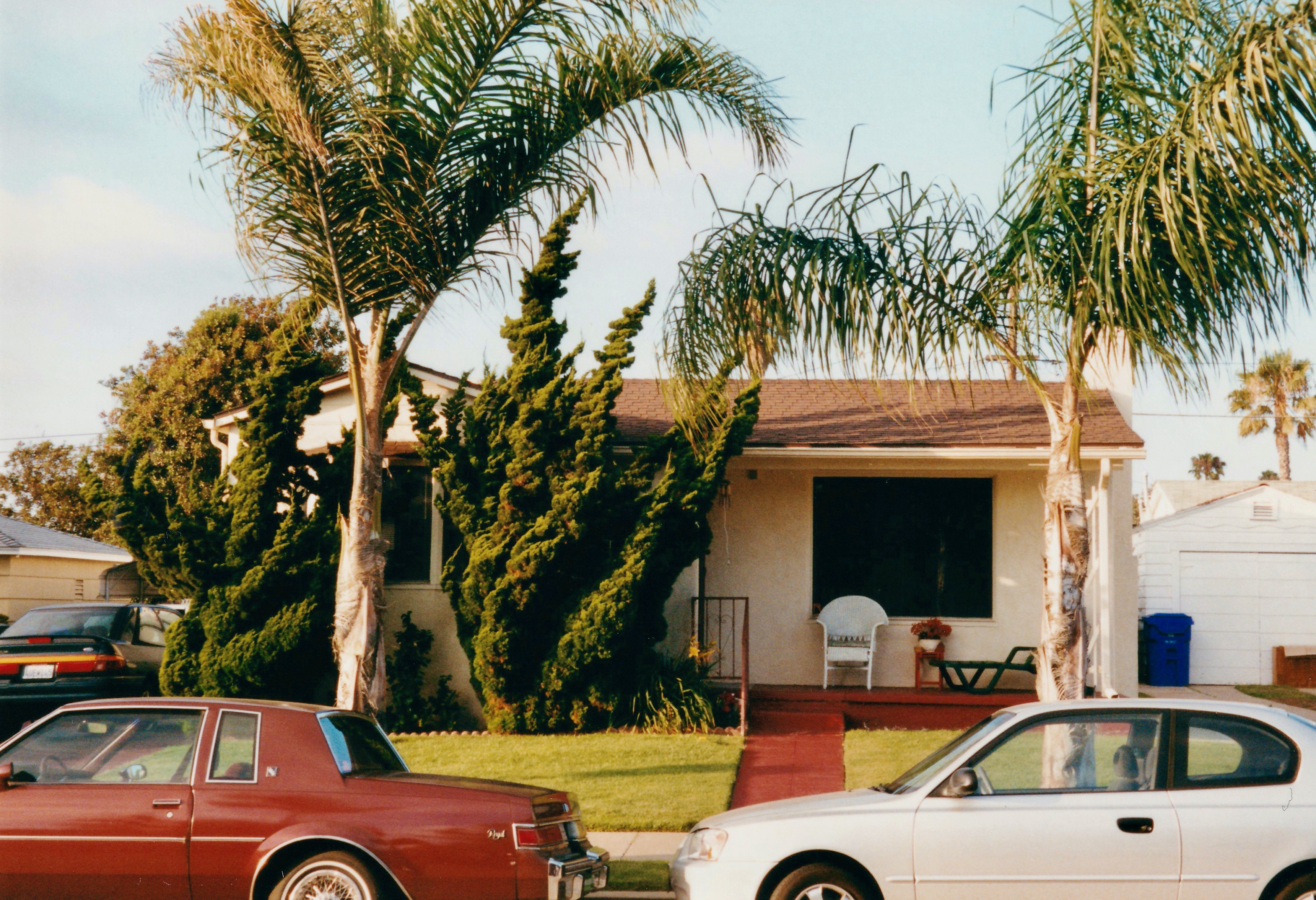
She was living in a bungalow with two roommates on Brighton Ave. in the city’s Ocean Beach neighborhood, three blocks from the Pacific.
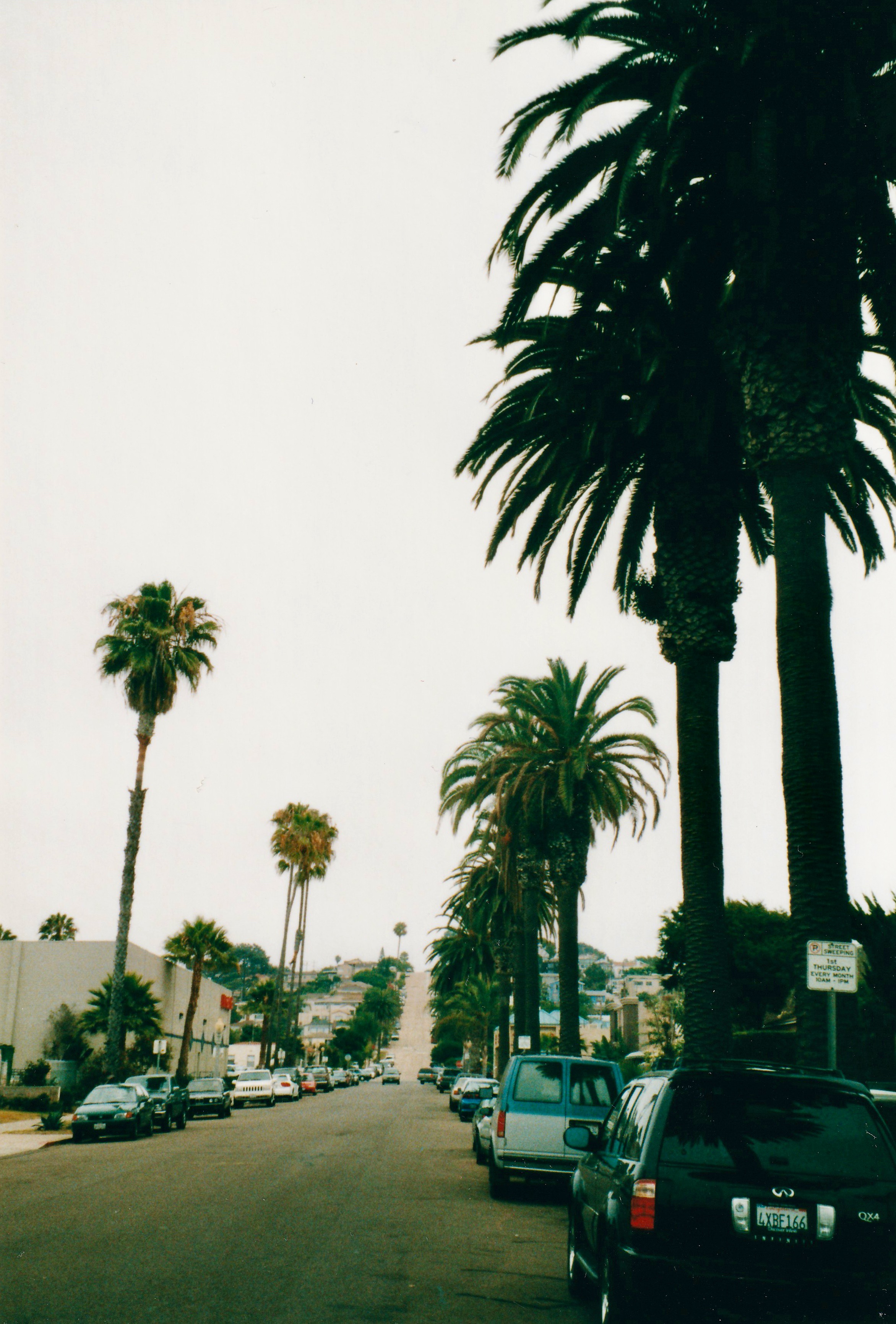
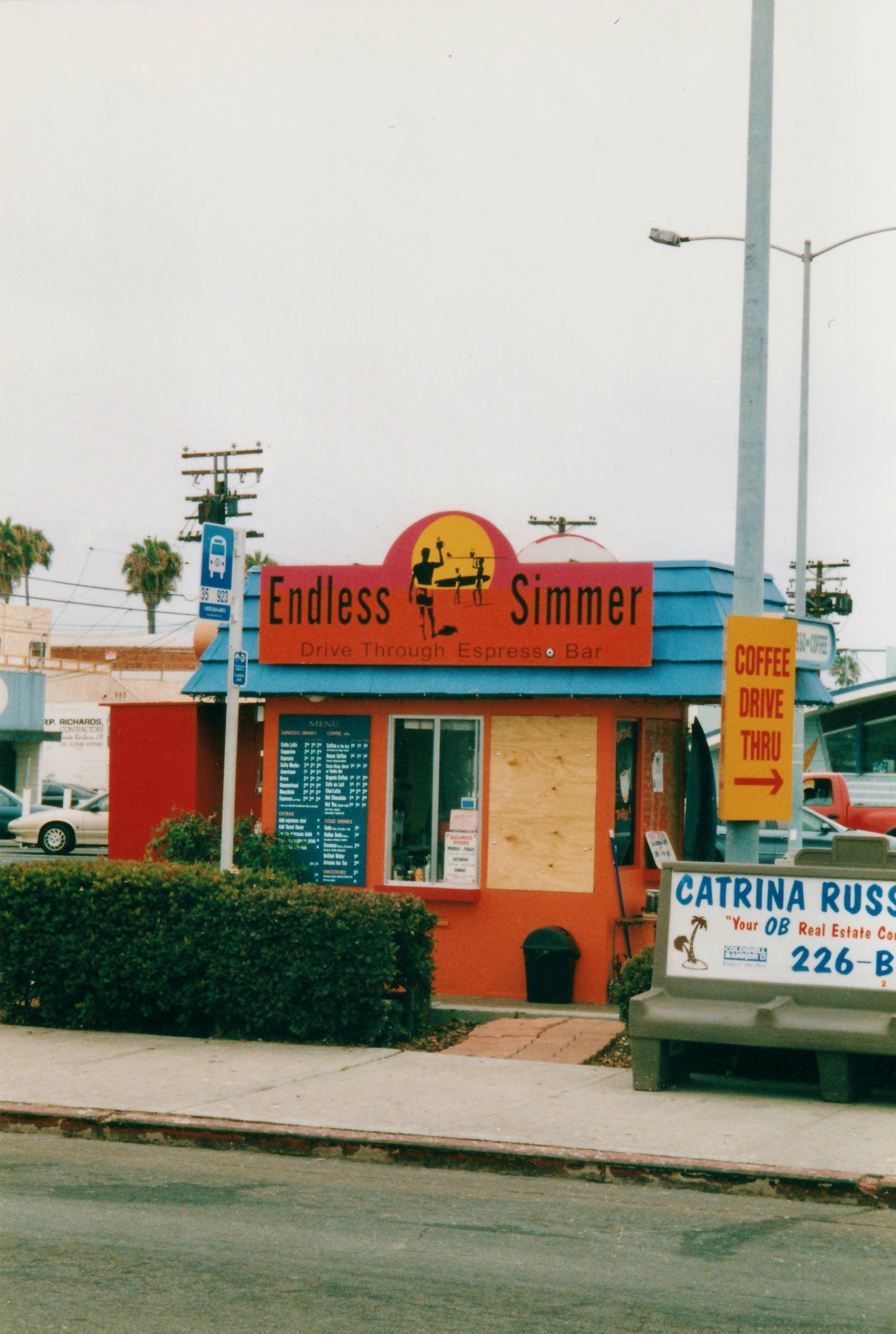
My first full day in town, while my friend was at work, I took off exploring. Rambling through Ocean Beach, it quickly dawned on me how radically different this landscape was compared to Boston. For one thing, back home we had no Drive Through Espresso Bars housed in former Fotomats.
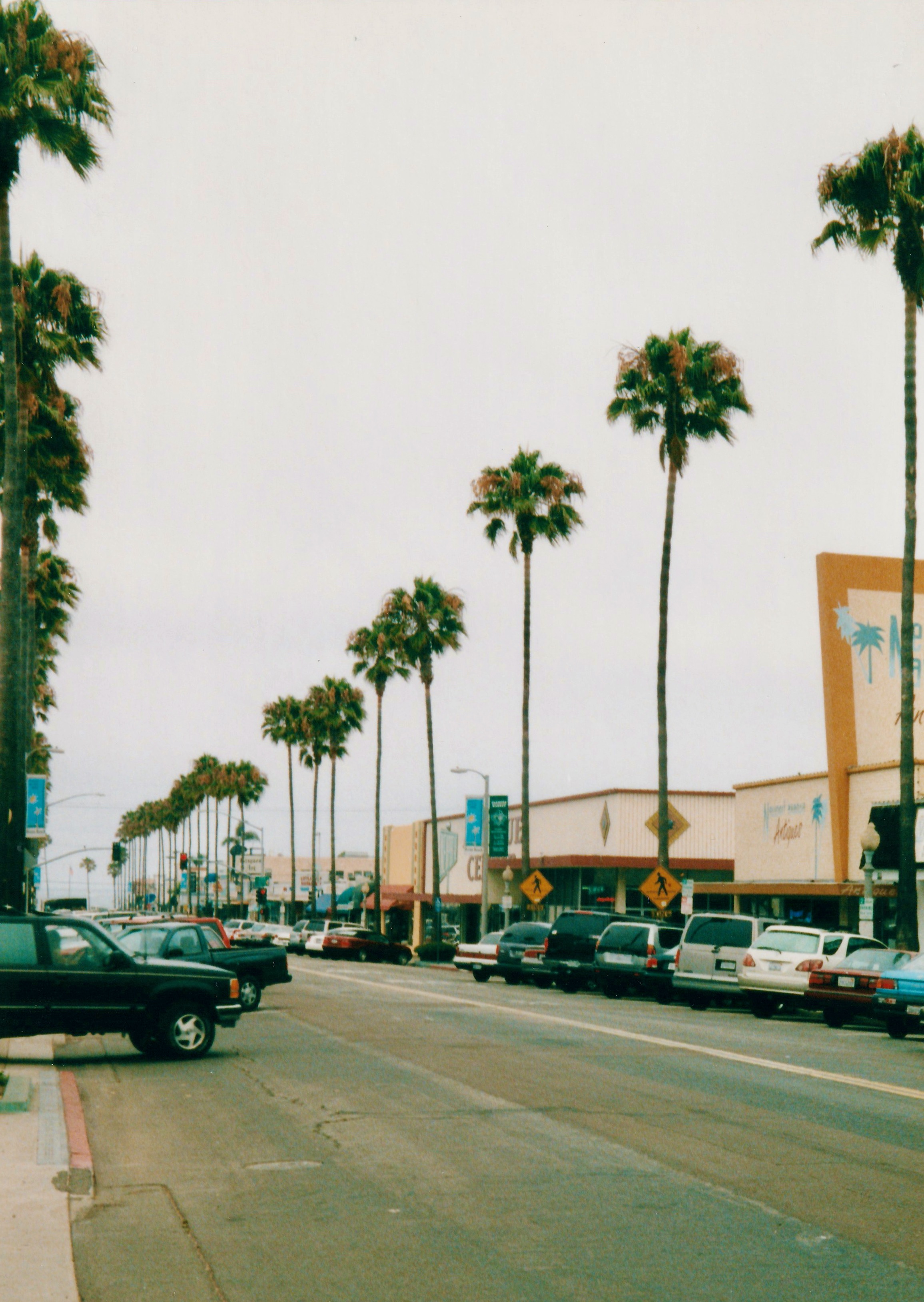
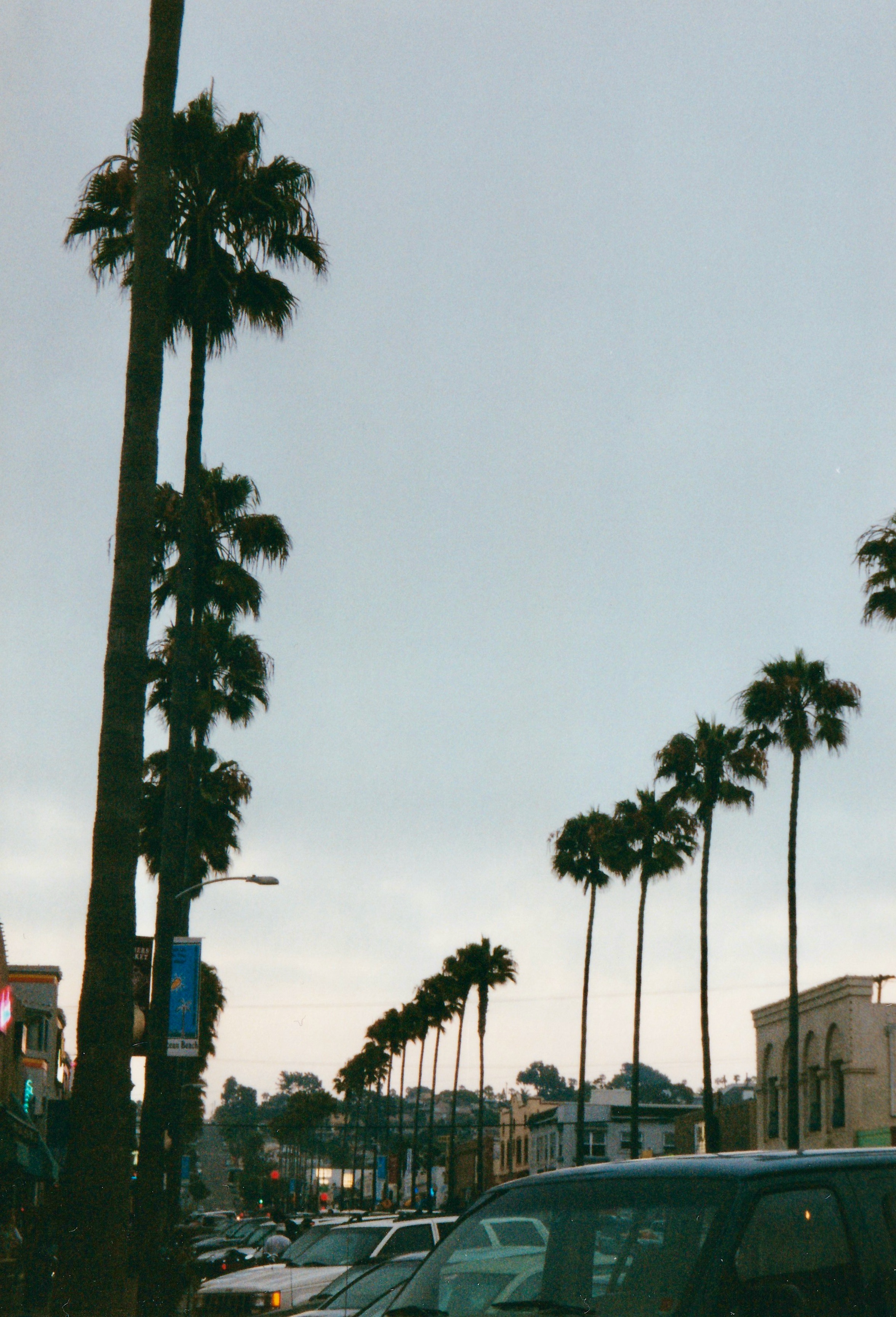
After breakfast at a run-down but clean diner on palm-lined main drag Newport Ave. (the strip seen in this essay’s first photo), I strolled over to the beach.
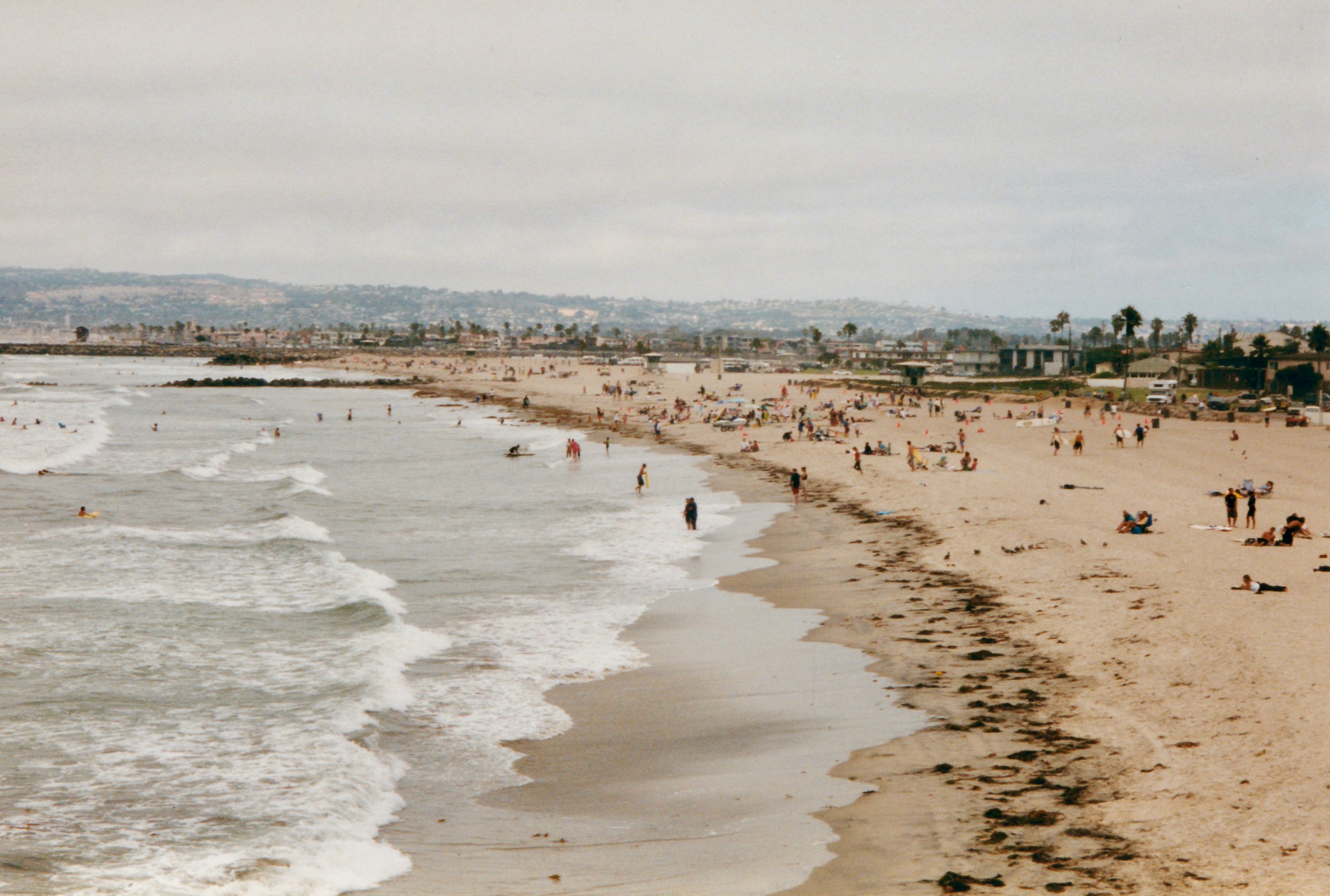
It resembled a scene out of a movie or a TV show—particularly something from the late ‘70s like Charlie’s Angels or Three’s Company.
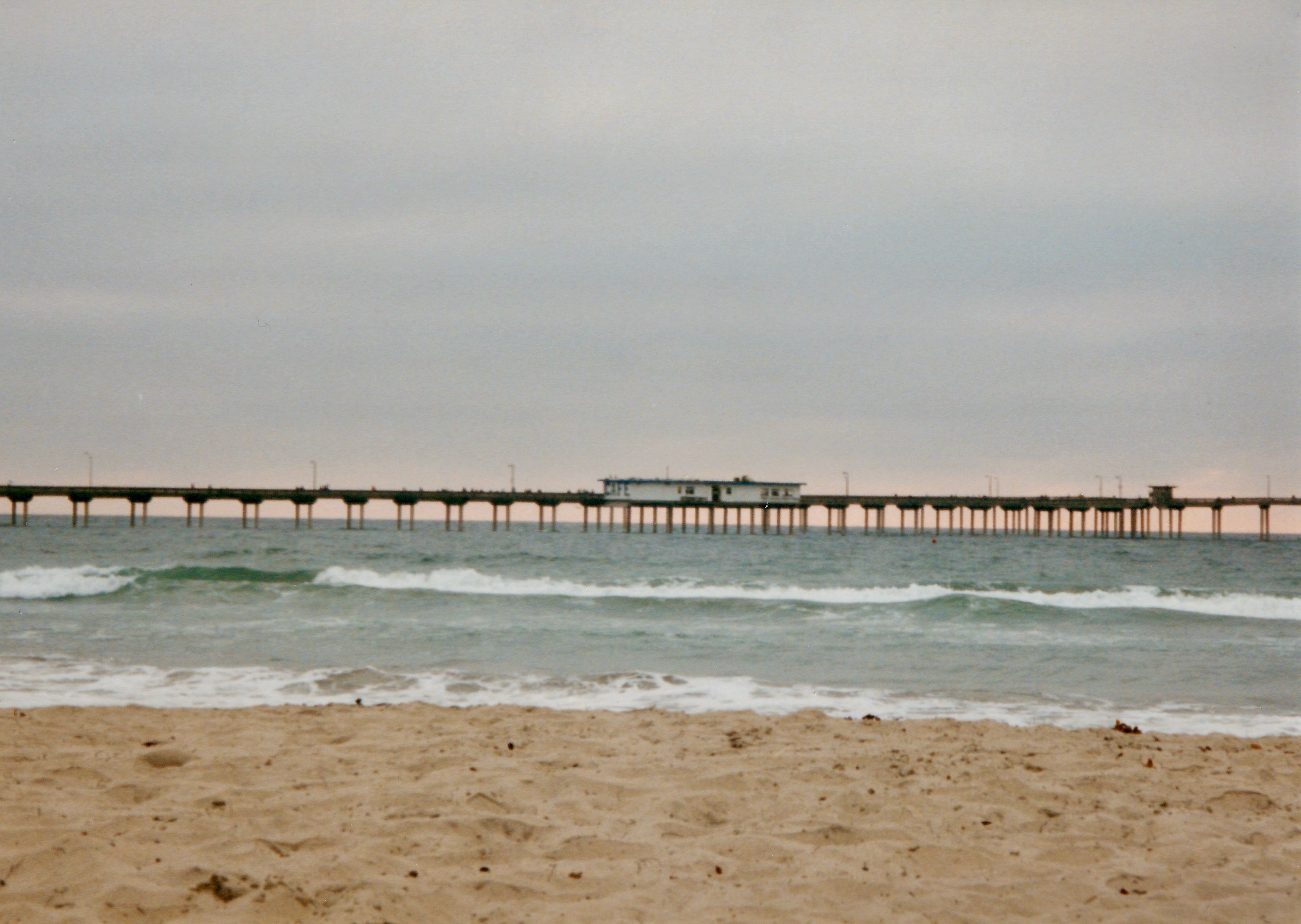
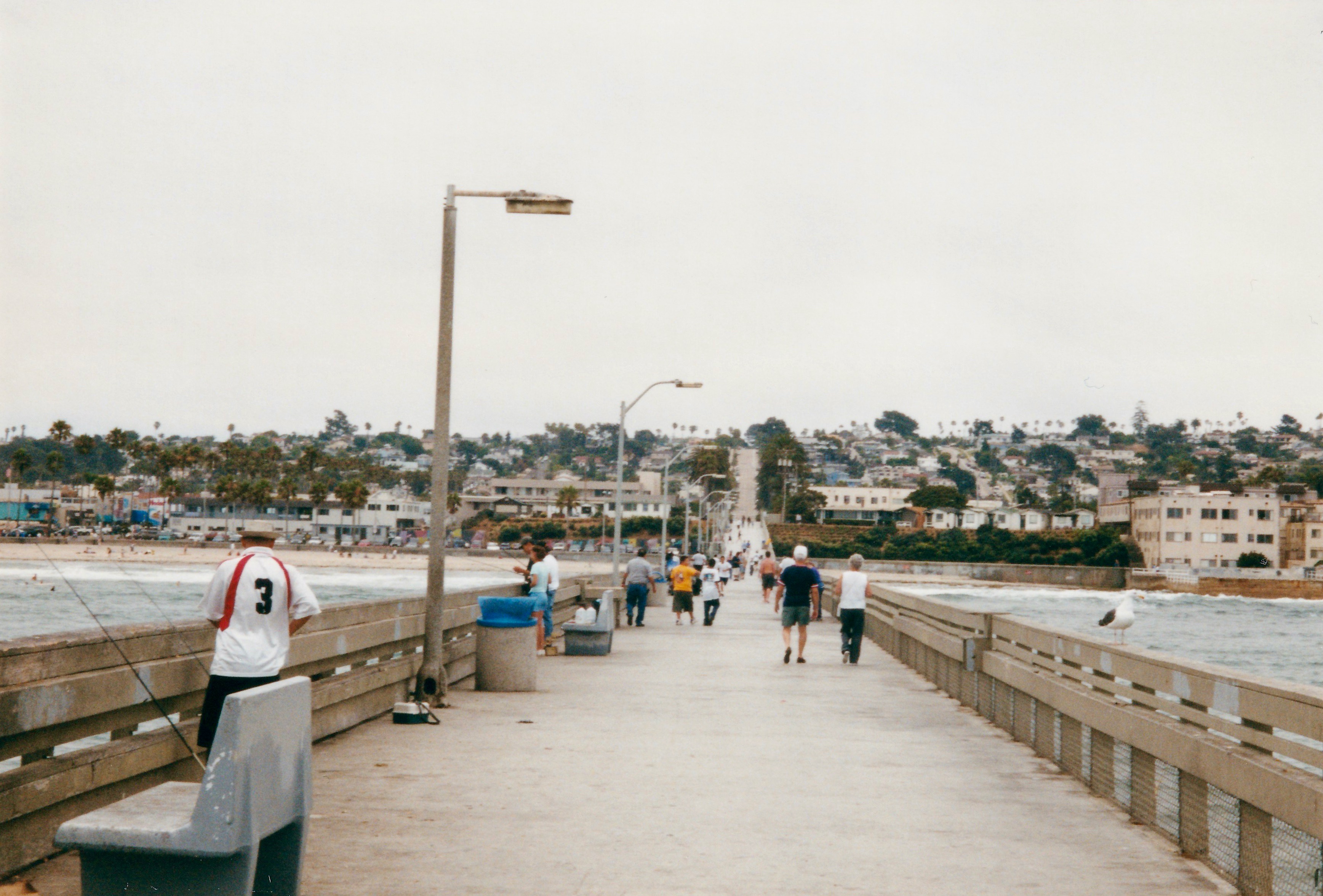
Straight off Newport Ave. sat Ocean Beach Pier. Naturally, I had to walk across it from one end to the other.
As with the working-class neighborhood, the Pier was far from glamorous, although I admired the wide-angle view of Ocean Beach from the other side in all its vaguely seedy, beach-bum glory.
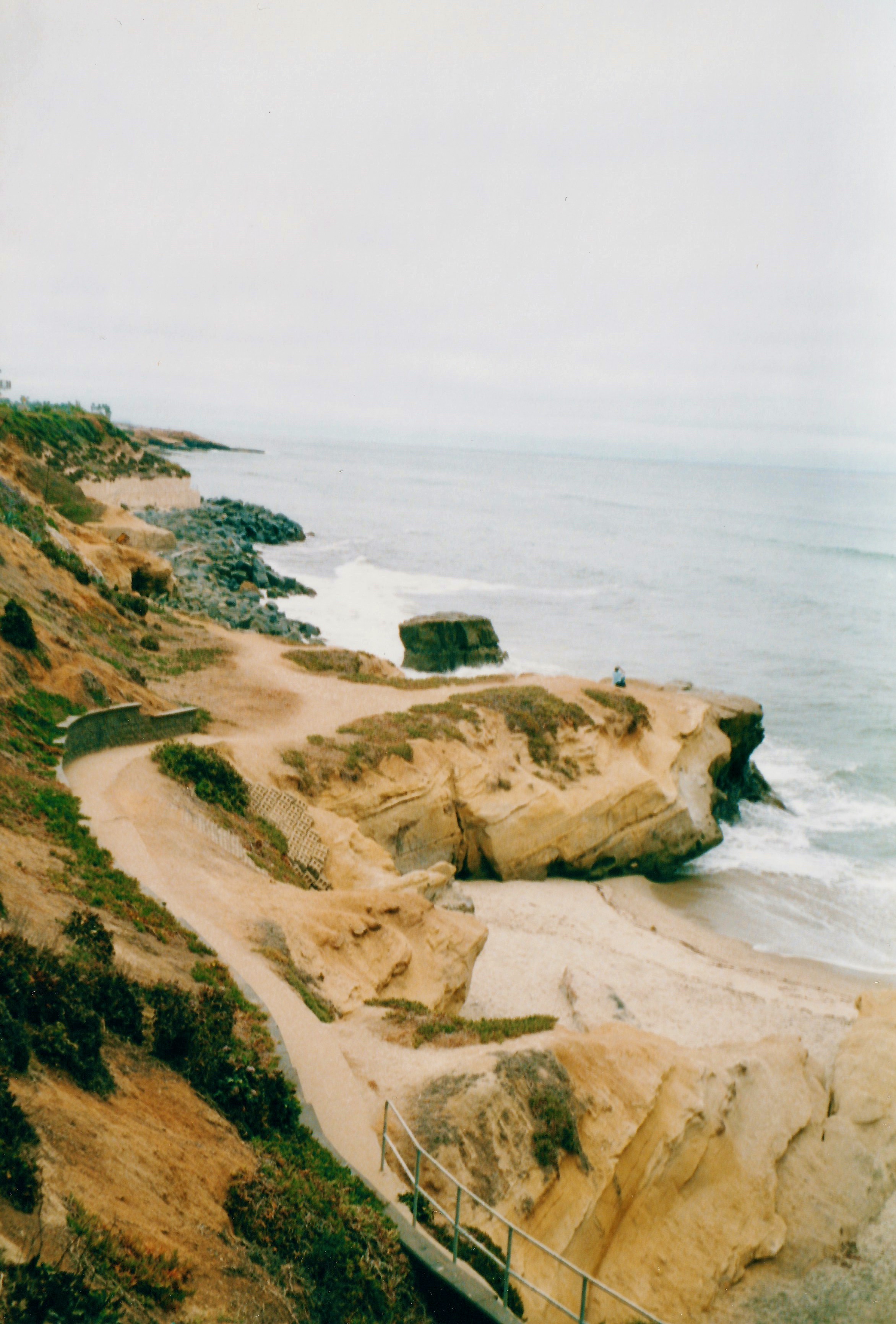
I walked away from the beach and continued about a mile south along the coast before reaching the Sunset Cliffs, which my friend had driven me by the previous evening after dinner at a local strip mall Thai joint.
Ready to rest for a bit, I found a semi-comfortable spot to sit. I spent about an hour there hanging out, waves crashing against the shore, listening to Ivy’s effervescent Apartment Life album on my discman.
After six weeks of grieving for a relationship that had hit an inevitable dead end and left me emotionally exhausted, I took in the solitude and beauty all around me. I felt, if not exactly at peace, at least in a contemplative, serene state of mind.
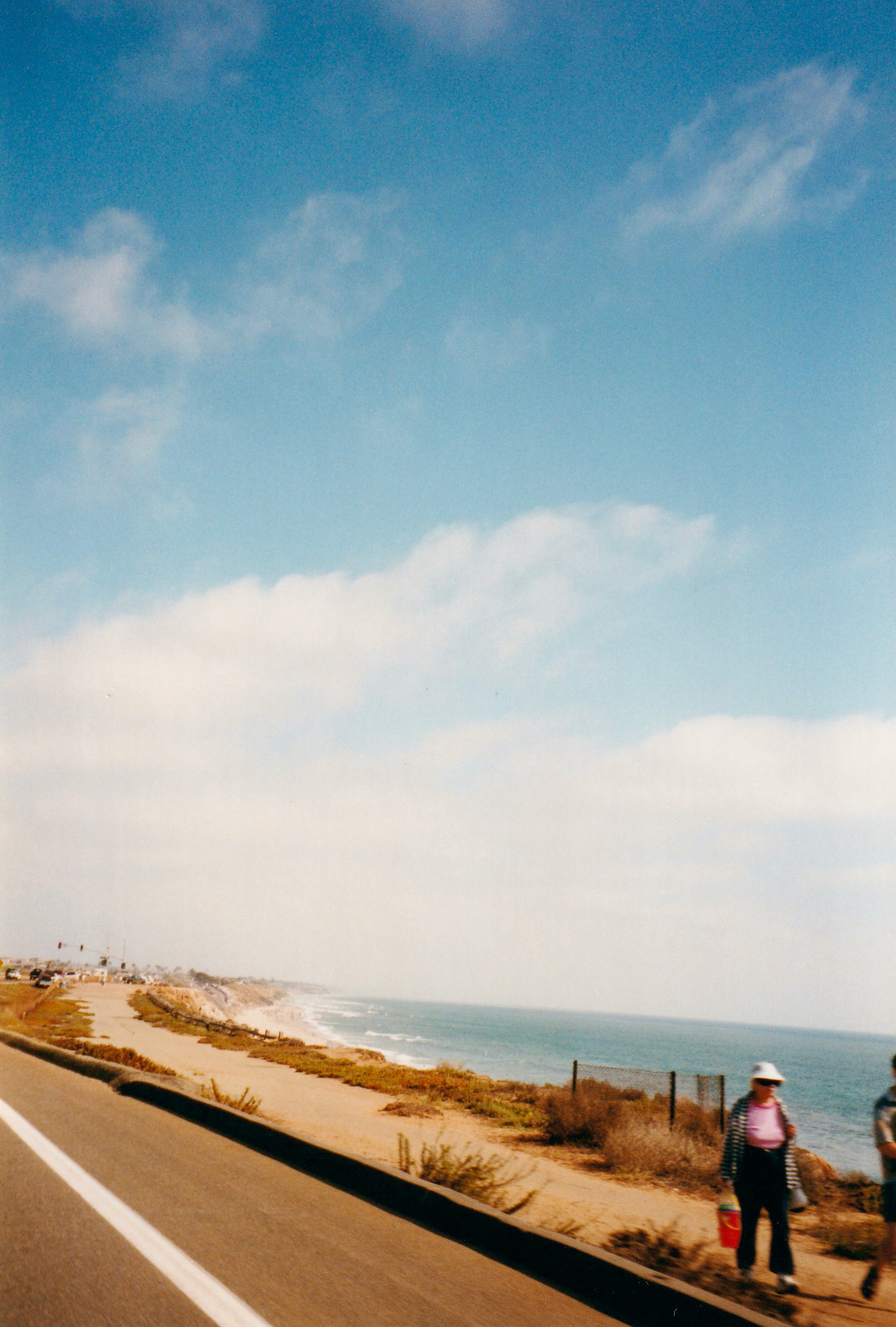
The next day, I convinced my friend to take a ride north of town, up the coast on Route 101.
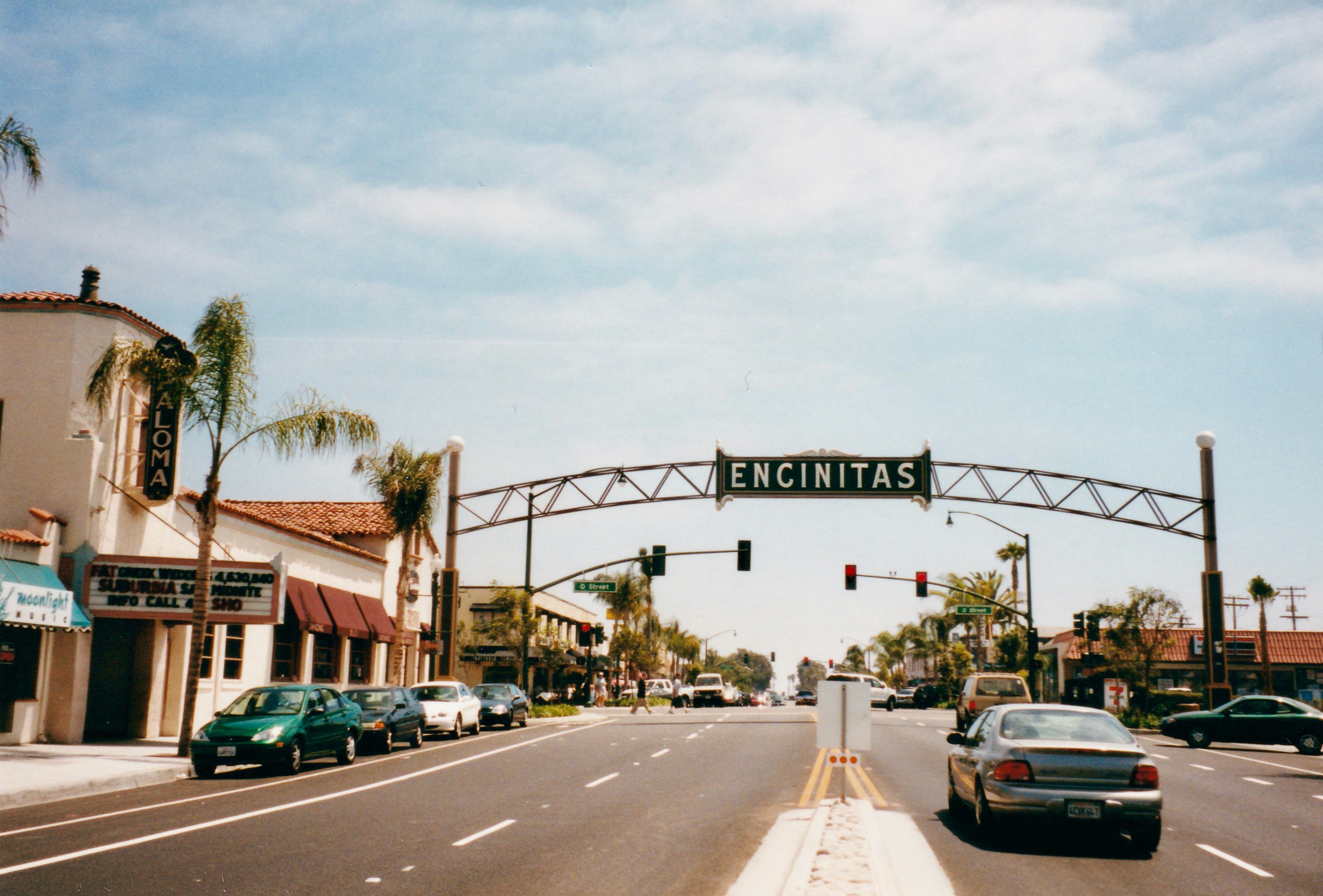
We drove through quaint beach towns like Encinitas, along with blank stretches of highway that could’ve passed for any other in Southern California (or South Carolina, as I’d witness on the way from Charleston to Savannah three years later.)
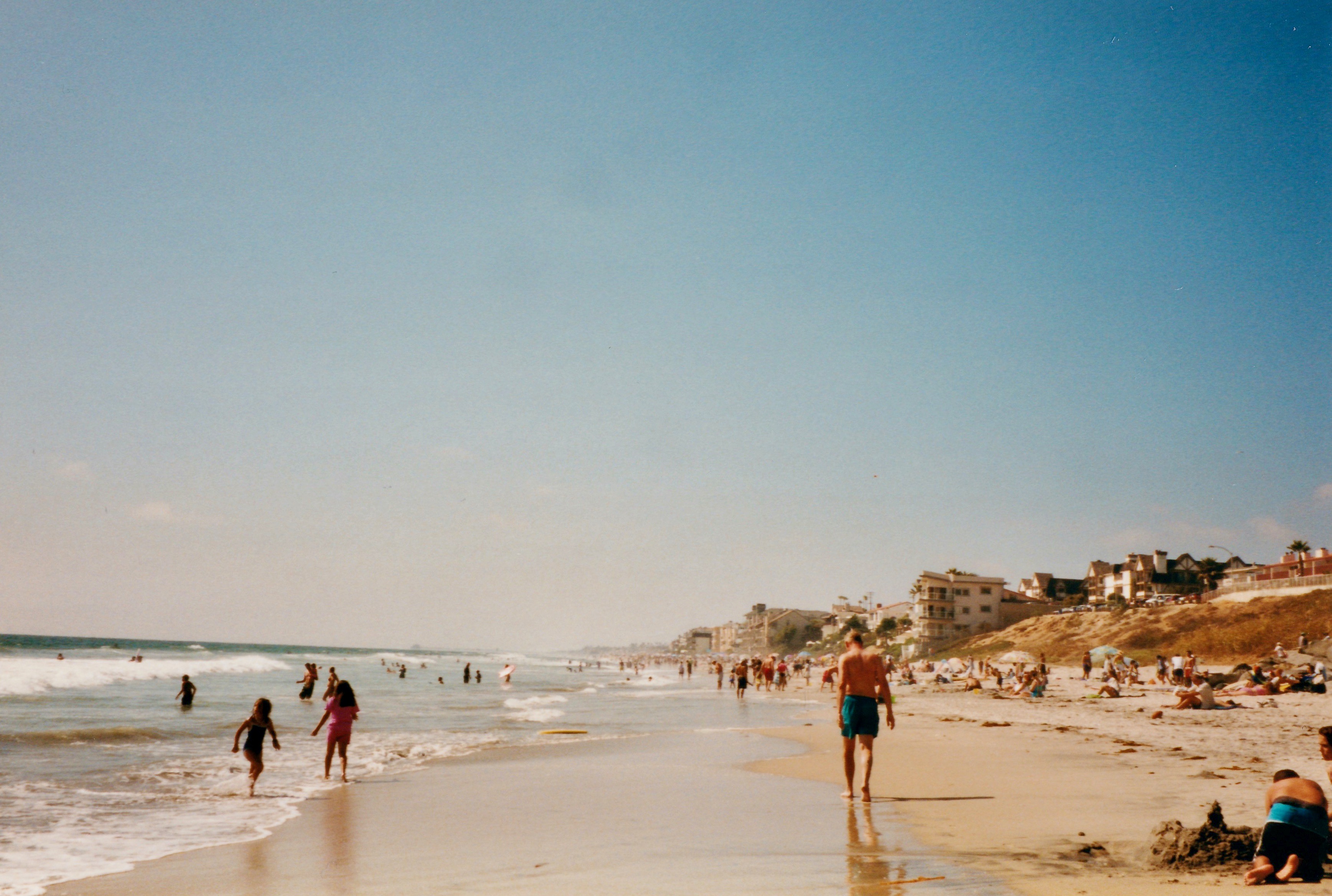
We stopped at this beach (in Carlsbad, I believe?) for a brief walk, dodging sunbathers and sandcastle makers. It was an idyllic weather day—like most days in coastal San Diego County, I’m assuming.
The rest of the trip is a story for another time—I don’t have many pictures from it. However, I do have this one shot of Newport Ave. from my last night in town where, at a dive bar whose name I can’t recall, I had the best goddammed margarita of my life. I don’t know if I’ll ever return to San Diego. My friend’s back in Massachusetts and there’s so much more for me to see in other parts of California. Still, I wasn’t expecting to make it there in 2002, so who’s to say what 2022 will bring?
In the semester after Trainspotting came out, I took two more courses at Marquette University to complete my Film minor. The first, “Gangster Films” was exactly what the title declared, covering crime movies from the original Scarface up to the likes of Point Blank and Serpico; the second, “Film As Communication”, fortunately ended up far less generic than its title insinuated. An overview of various cinematic techniques, I no longer remember much of what we watched apart from Black Orpheus (for its use of music), Throne of Blood (as an example of a literary adaptation) and for its editing, All That Jazz, Bob Fosse’s 1979 autobiographical, nontraditional, phantasmagorical musical.
When the course got to that Fosse film, I settled into my wobbly desk chair, taking in the brief opening credits (just the film’s title laid out in lightbulbs over a musical fanfare) and first iteration of its recurring “bathroom montage” (more on that later.) A strong sense of déjà vu kicked in as All That Jazz soon transitioned to a much longer montage of dancers auditioning on a massive stage for the film’s lead/Fosse alter-ego Joe Gideon (Roy Scheider), all of it set to George Benson’s up-tempo funk cover of the old Drifters song “On Broadway”. I immediately recalled watching this sequence at home with my mom about ten years earlier. I hadn’t considered it since then, but I recognized it and thought back to that distant afternoon when I was 11 or 12.
Although I spent my childhood glued in front of the TV each day after school watching stuff I’d picked out for myself (cartoons, game shows, sitcom reruns) like any other kid, once in a great while I’d take an interest in a movie my mom selected or more likely stumbled across while flipping through channels. This was how I first saw The Out-Of-Towners, where a suburban Ohio couple’s (played by Jack Lemmon and the magnificently daft Sandy Dennis) trip to Manhattan goes horribly, hilariously wrong and Sweet Charity, Fosse’s film debut and musical adaptation of Fellini’s Nights of Cabiria (which he’d previously directed on stage), starring Shirley MacLaine as a “dance hall girl” in ultra-groovy late ‘60s NYC.
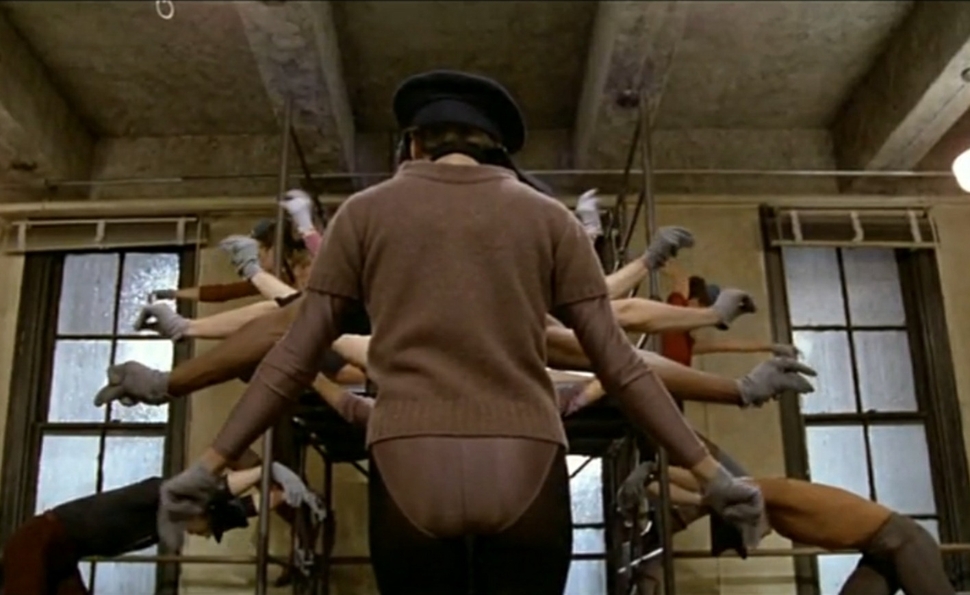
I’m sure I dutifully watched other “films for grownups” with my mom, but few were as striking or unique as those first ten minutes of All That Jazz. Cut together from what I can only assume was a mountain of footage, the “On Broadway” montage comes off like a casual, modern ballet, shifting between synchronized movements, rapid-fire edits and occasional asides to the theater seats where a group of producers sit and watch along with Gideon’s ex-wife and his young daughter. It leads the audience through the entire audition process as applicants are gradually winnowed out, but it’s often more like an impressionist painting of such. A bravura edit of seven or so twirling dancers staged to seem as if one is magically changing into the next (well over a decade before the morphing technology implemented in Michael Jackson’s “Black Or White” video) is as technically impressive and emotionally stirring as a simple, slow zoom-out wide shot of Gideon kneeling center stage before hundreds of dancers performing the same routine: the artist as director scrutinizing the massive throng of hopefuls.
Audition Montage
After that bravura opening sequence, I soon realized that I didn’t remember anything else from the film because my mom likely changed the channel before my prepubescent self had a chance to see all the bare breasts, witness teenaged Gideon’s premature ejaculation while performing onstage at a burlesque joint or hear Josh (Max Wright), Gideon’s film producer exclaim with the wailing anxiety only the future Willie Tanner could covey, “The BRASS is eating my ASS out, Joe!” All That Jazz was unambiguously R-rated and thus not something I was allowed to watch at that age.
In retrospect, I’m a little astonished that our professor, a Jesuit priest (!) felt comfortable screening such a racy film for us; just five years earlier, one of my teachers fast-forwarded through all the action sequences in the film adaptation of Man of La Mancha because, Catholic hippie that he was, he abhorred violence of any kind and didn’t want to expose us to it (a quaint notion even then.) I suppose that’s one distinction between high school and college—we were technically adults, so now it was appropriate to watch nudity and hear foul language (or perhaps my professor was just a Cool Priest.)
Either way, I’m certain I had more fun watching All That Jazz than anything else in “Film As Communication”. Fosse’s thinly veiled portrait of himself—a talented, middle-aged, self-loathing, workaholic stage and film director whose bad habits push him toward an early grave—never lets up on the “ol’ razzle-dazzle” (to quote a song from another landmark Fosse production, the 1975 stage version of Chicago.) It’s his own take on Fellini’s 8 ½, but bolder, brassier and more vulgar. An opulent feast of sight and sound, forever blurring fact and fiction, reality and dreams and striving to entertain while also being almost excruciatingly personal, it walks a fine line not unlike the quick, silent shots scattered throughout of Gideon descending, slo-mo onto a net after failing to walk steady across a tightrope of his own devising.
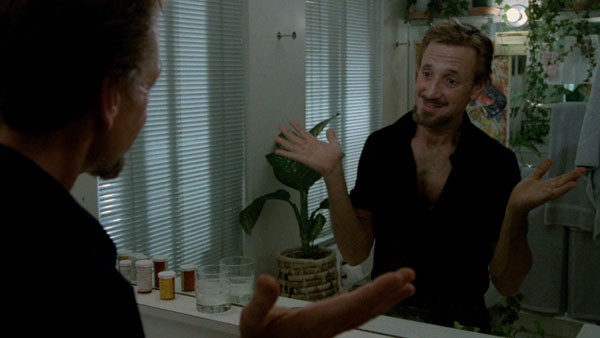
After the audition montage, the film veers from one elaborate set-piece to another. The aforementioned bathroom montage, which recurs a few times, consists of a rapid series of cuts of Gideon getting ready to face the world for yet another day, showering and popping pills, eyedrops and alka-seltzer tablets, all of it set to the stentorian strings of Vivaldi’s “Concerto in G” and ending with him gesturing in front of his mirror with feigned gusto, “It’s Showtime, Folks!” With each iteration, however, the cuts are less frequent, Gideon’s smoker’s cough more prevalent. By the last go-round, he can’t even bring himself to intelligibly exclaim his self-motivating catchphrase because he’s nearly out of breath and hacking too much. One also gets a sense he’s increasingly having trouble mustering up the gumption to believe what he’s saying.
It’s Showtime, Folks!
Centerpiece “Take Off With Us” is a musical number for the stage production Gideon’s directing. About midway through All That Jazz, his company of about a dozen dancers runs through it in a rehearsal space for the show’s producers and investors. Gleefully displaying all of Fosse’s trademarks (brimmed hats, finger snaps, sensual movements), it’s the act of creation brought to fruition: we’ve already seen most of these steps and have heard the number’s A Chorus Line-esque title song in numerous rehearsal scenes—here, Fosse shows us the thrill of it all coming together. But it’s not enough: Fosse/Gideon then pushes it further (“It’s not exactly over yet,” Gideon sheepishly says to his selected audience) as the number mutates into a dimly lit, smoke-machine enhanced, explicitly sexual ballet that might be the most elaborate, poetic and outrageous thing Fosse’s ever conceived of (on film, anyway.) Afterwards, the producers, gobsmacked, can only respond, “It’s… interesting!” while Paul (Anthony Holland), the song’s composer frets to himself, “Now Sinatra will never record it!”
Take Off With Us
Still, Fosse’s concerns extend far beyond pushing artistic boundaries while impatiently waiting for the rest of the world to catch up with them. As if directing a big budget stage production isn’t enough, Gideon spends his off-hours in an editing booth, doing post-production work on a feature film called The Stand-Up, which suspiciously resembles Fosse’s own previous feature Lenny, a biopic on comedian Lenny Bruce starring Dustin Hoffman. In All That Jazz, Gideon struggles over a sequence of the film where the title character (played by Cliff Gorman, who starred as Bruce in the original stage production of Lenny!) delivers a comedic monologue on Elizabeth Kübler-Ross’ “Five Stages of Grief”, ruminating on each one (denial, anger, bargaining, depression and acceptance) in elaborate detail.
All this death talk is a gateway into the film’s most ambitious framing device. From the opening of All That Jazz, we catch glimpses of Gideon in a darkened dressing room, casually conversing with a beautiful, veiled woman done up in white played by a young Jessica Lange. They almost scan like therapy sessions, with Gideon confessing various sins to her about the ladies he’s wronged in his life and other regrets regarding his career choices. These interactions are playful and reflective rather than morose: “Don’t bullshit a bullshitter,” he wryly warns her at one point, and it’s surely more solid and candid a core philosophy/mantra for Fosse/Gideon than “It’s Showtime, Folks!”
Such interactions between Gideon and this woman are key components of the film’s grand design. They arrive often, sometimes cutting midway into a scene, suggesting that All That Jazz is all going on in Gideon’s head as he looks over a lifetime of memories. It’s only following the “Take Off With Us” sequence that the woman in white’s identity comes into focus. Scenes of Gideon suffering a heart attack and entering the hospital are cut with her slowly removing her veil, flashing a thousand-watt smile at Gideon, inviting him to come closer for she is his manifestation of the Angel of Death (referred to only as “Angelique” in the credits.) “No, not yet,” he warns her as it dawns on him what’s happening. She temporarily disappears from the film as we get another montage, this one of Gideon behaving badly in the hospital, partying with his visitors and sexually harassing his wet nurse—a rather poorly aged sequence in the “Me Too” era that nonetheless acknowledges (with a healthy dose of self-loathing) what a scoundrel Gideon can be.
Angelique
Watching All That Jazz in “Film as Communication”, we did not make it beyond this last montage for time was up—not an uncommon occurrence for some of these MU film courses. Occasionally, some film professors would fail to keep track of the class’ three-hour running time and we wouldn’t finish the movie. In this pre-streaming age, we weren’t required to see the rest of a particular film unless we chose to write a paper about it. At the time, I was bummed to have not been able to watch All That Jazz’s remaining forty minutes; fortunately, a month later, I spotted a VHS copy of it on sale for $4.99 at Best Buy (of all places) via their weekly newspaper ad. The Saturday after Thanksgiving, on the way to a bowling night with friends, I stopped by the Blue Mound Road location in suburban Brookfield and secured my very own copy for a fiver and some change.
The next day, I popped in the tape and fast-forwarded to the moment where we left off in class. Prior to starting the film, my professor remarking that its ending was a prediction of sorts of Fosse’s own death, which would occur less than a decade later. Dropping this tidbit only heightened my curiosity about the film’s remainder. Finally finishing it a month later, I have to admit I did not even come close to correctly imagining how it would actually turn out: in All That Jazz’s third act, the surrealism gently alluded to in dribs and drabs throughout the film’s first eighty minutes comes to the forefront, escalating into a delirious finale that is at once as iconic an onscreen Fosse musical number as Sweet Charity’s “Hey, Big Spender” or Cabaret’s title song and also possibly the most 1979 thing ever.
But first, there’s so much more to cover. Like the negative TV critic’s review of The Stand-Up, which manages to drag Lenny-basher Pauline Kael and the Siskel & Ebert “thumbs up/thumbs down” approach to film reviews. Or an extended hallucination where, during surgery, Gideon’s girlfriend (played by Fosse’s own gf Ann Reinking!), ex-wife and daughter perform a quartet of musical numbers (accompanied by surgeons mockingly keeping rhythm with tambourines and a clapboard) for him, incapacitated and semi-conscious on a gurney while another Gideon directs the whole thing as if it were a film. Or a producers/investors meeting (including Wallace Shawn as a number-cruncher!) where they discuss what Gideon’s health financially means for the show (and their insurance policy), intercut with actual graphic footage meant to stand in for Gideon’s own heart surgery. Or another sequence where Gideon, bleeding from the head, escapes his bed and runs rampant through the hospital as the Kübler-Ross monologue from The Stand-Up fills the soundtrack.
All these set pieces and their overall trajectory imply that Gideon isn’t long for this world. After two orderlies find him happily singing “Pack Up Your Troubles” with an amused janitor in the hospital’s basement, they wheel him back to his bed, where, about to go under for the last time, he says of his life, “This is just a rough cut, you know.” From there, a pan up to his EKG machine dissolves into a TV screen airing another episode of a variety show (with a host played by Ben Vereen) we’ve seen Gideon watch in the hospital several times before. In each version, Vereen introduces the show as a tribute to “a great entertainer, a great humanitarian and my dear friend…” This time, the subject is only “a so-so entertainer, not much of a humanitarian and this cat was *nobody’s* friend.” Vereen also notes that this guy “Didn’t know where the games ended, and reality began… for this cat, the only reality – is Death, man.”
Of course, the honoree is Gideon, and his “final appearance on the great stage of life” (as Vereen puts it) is a full-blown rock concert duet the two perform for an audience of everyone Gideon’s ever known: a take-off of the old Everly Brothers tune “Bye Bye Love” called “Bye Bye Life”. Decked out in an ultra-sparkly shirt, backed by a rock and roll band cloaked in wacky, futuristic (for the period) garb and flanked by dancing girls in vein-covered, inside-out body suits and gleaming-eyed robotic heads dispersed throughout the crowd, Gideon goes for broke, giving (along with Scheider, it must be acknowledged) the performance of his life, at one point taking a massive victory slide across the stage. The song plays like an extended vamp, the camera often cutting in time with handclaps, the music and melody swelling and sighing as Gideon signs with wistfulness and joy, “I think I’m gonna die / Bye-bye, my life, goodbye.”
For Fosse, this all goes back to that previous notion, “Life is a cabaret, old chum” and it’s only fitting that Gideon ends his life on stage as the star of his own showstopper. A year after I first saw All That Jazz, a friend of mine watched it in another film class. He liked it, but derisively described its finale as “Pure Cheese”. He wasn’t entirely wrong—the up-to-the-minute aesthetic Fosse suffused it with would feel awfully dated even four or five years after it was first released. Its disco-friendly glitz and Star Wars-era sci-fi regalia is honestly not far off from the likes of The Apple, even. And yet, I wouldn’t change a thing about it—frozen in time as it is, what Fosse’s expressing within it is crystal clear. For Gideon, the end of his life is an about-face, the audience a reminder of what it means to love and be loved in return (in the number’s final minute, he runs down into the crowd, shaking hands and hugging those closest to him), a state of grace, a rejection of his own misanthropy, proof that he’s ready to leave the material world behind. After he’s exited the stage, we see him moving closer and closer to Angelique, ready to receive the Kiss of Death.
It’s a touching, resonant concept but remember—for Fosse, the only reality is Death, man. Thus, just as Gideon makes contact with Angelique, there’s an abrupt cut to him, motionless on a gurney, getting zipped up in a body bag. Ethel Merman’s rendition of “There’s No Business Like Show Business” plays. The end credits roll. When Fosse died eight years later, on the way to attending a show with his ex-wife/longtime muse Gwen Verdon, who knows what was going on in his mind during those last moments, if they were anything like All That Jazz. It ultimately doesn’t matter, for the vision he shared of himself, channeling so many thoughts and dreams, conveying so much brilliance and messiness into a challenging yet cogent work of art is enough. This notion of a fine line separating life and art was on my mind as I prepared the following year for a major change in my own life and the role art would play in it.
Another month, another online film festival. While I’m yearning to go back to such things in person and could’ve feasibly done so for the 23rd Annual Provincetown International Film Festival, other travel plans and some lingering trepidation (I haven’t yet set foot in a theater) left me opting for the virtual edition, itself actually pretty fulfilling: a ten-day window to watch most of the fest’s titles (save for things like Opening Night selection In The Heights) anytime, anyplace. My favorites included Sundance winner CODA (coming to theatres and Apple+ later this summer), charming dating app doc Searchers, filmed-in-lockdown two-hander Language Lessons and profiles on Aussie diver/marine life activist Valerie Taylor and the aftereffects of a fifty-year-old stunt pulled by wealthy hippie weirdo Michael Brody Jr.
However, June’s best first-time viewing was A Bread Factory, Patrick Wang’s two-part, four-hour dramedy about a struggling arts organization in small town upstate New York, with an ensemble led by Tyne Daly and mostly unknowns plus a few ringers (Glynnis O’Connor, Janeane Garofalo, James Marsters). It received a miniscule release in October 2018 (I don’t think it played Boston) but came to my attention via rave reviews from critics Matt Zoller Seitz and Jonathan Rosenbaum. Wang’s humaneness may initially seem at odds with his occasional absurdist slant, but he’s crafted a universe that, as finite as it physically appears, just continues to expand without ever obscuring the constants that embody and define it. Available to view on Kanopy and a must watch for any devotee of American indie cinema.
Solid new titles included the economical fractured marriage story of The Killing of Two Lovers, the thoroughly entertaining Some Kind of Heaven, which examines a fascinating example of artifice made “real” via a ginormous Florida retirement community and Slow Machine, a baffling but never boring pretzel-twist indie full of shifting identities and people playing versions of themselves. Paper Spiders, on the other hand, is fully skippable despite the ever-great Lily Taylor in a rare leading role.
Gypsy 83 was nearly worth a twenty-year wait (kept waiting for a theatrical release back in 2001!) and about as good as director/writer Todd Stephens’ latest, Swan Song, noteworthy for its tour de force work from the inimitable Udo Kier. House of Games was worth watching for Joe Mantegna’s barked-out reading of that old phrase, “Thank you sir, may I have another?” in its climax. Burn! was worth seeing for Marlon Brando donning an English accent and having it come out sounding like Michael Caine.
Perhaps Cruising was the worthiest screening of them all—not really a “great” film as it was neutered by its studio to get an R rating, but intriguing as a record of pre-AIDS Manhattan gay fetish bars. Also, it has undercover cop Al Pacino being asked by his boss Paul Sorvino if he’s ever been “porked”.
Films viewed in June in chronological order, with director, year of release and my rating (out of 10); starred titles are re-watches.)
A Sunday in the Country (Bertrand Tavernier, 1984) 8
Iris (Albert Maysles, 2014)* 8
Sordid Lives (Del Shores, 2000)* 6
Jerichow (Christian Petzold, 2008) 6
Cruising (William Friedkin, 1980) 6
The Killing of Two Lovers (Robert Machoian, 2020) 8
The Lost Boys (Joel Schumacher, 1987) 6
Frantz Fanon: Black Skin, White Mask Isaac Julien, 1995) 6
Four Roads (Alice Rohrwacher, 2021) 5
Gypsy 83 (Todd Stephens, 2001) 7
A Bread Factory Part One: For The Sake Of Gold (Patrick Wang, 2018) 10
A Bread Factory Part Two: Walk With Me A While (Wang, 2018) 9
The Deep Blue Sea (Terence Davies, 2011)* 8
Paper Spiders (Inon Shampanier, 2020) 4
Halston (Frederic Tcheng, 2019) 6
Some Kind of Heaven (Lance Oppenheim, 2020) 9
House Of Games (David Mamet, 1987) 7
Beyond The Valley Of The Dolls (Russ Meyer, 1970)* 9
Slow Machine (Paul Felton, Joe Denardo, 2020) 6
Shall We Dance (Mark Sandrich, 1937) 8
Mystery Science Theater 3000: The Movie (Jim Mallon, 1996)* 6