What was 2009 really like? Well, the oft-execrable Black-Eyed Peas spent 26 consecutive weeks leading the Billboard Hot 100 this year (with two songs); in happier news, Taylor Swift and the newly ascendant Lady Gaga also dominated radio, while Animal Collective topped the Village Voice Pazz and Jop album poll (no, really they did—never got their preciousness apart from a stray track here or there.) None of these appear on the below playlist, although it does feature artists who came in at #’s 2, 3 & 4 on Pazz and Jop (respectively, Phoenix, Neko Case & Yeah Yeah Yeahs.)
If any trend emerges from this mishmash of one-offs (who remembers “Sweet Disposition” and 500 Days of Summer?), indie singer/songwriter perennials (Metric, Jill Sobule, Andrew Bird) and still-hanging-on veterans (Pet Shop Boys, Chris Isaak, Super Furry Animals’ final album and what should have been Morrissey’s last hurrah), it’s an increasing propensity for lounge-pop, albeit in various guises: modern indie (The Bird and The Bee), jazzy easy listening (Pink Martini) and orchestral ’60s throwback (Camera Obscura), among others. Everything old’s also new (yet) again: Moroder-like synth-disco (Swedish duo Royksopp with Robyn’s crucial assistance), baroque retro-pop (Stuart Murdoch’s one-off imaginary-then-later-made-actual soundtrack via his God Help The Girl project) Kate Bush-influenced spooky splendor (Florence + The Machine, Bat For Lashes) and British new wave revivalism both snotty (Art Brut) and sublime (White Lies).
Throw in a handful of UK number ones (La Roux, Lily Allen, David Guetta with ex-Destiny’s Child-er Kelly Rowland) and you’ve got a shimmering time capsule of end-of-the-decade Anglophilia. Oddly enough, it took a few years for the one of the most Anglocentric, of-its-time tracks to fully register: Imogen Heap’s “First Train Home” is essentially Dido-influenced laptop music but those last, building fifteen seconds always get to me.
2009: Some Kind of Contact
The Tender Trap, “Sweet Disposition”
Florence + The Machine, “Rabbit Heart (Raise It Up)”
Camera Obscura, “French Navy”
Super Furry Animals, “Helium Hearts”
Yeah Yeah Yeahs, “Hysteric”
Morrissey, “I’m Throwing My Arms Around Paris”
Jill Sobule, “San Francisco”
Chris Isaak, “We Let Her Down”
Bat For Lashes, “Pearl’s Dream”
Pet Shop Boys, “The Way It Used To Be”
The Bird and The Bee, “Polite Dance Song”
Lily Allen, “The Fear”
Metric, “Gold Guns Girls”
Emm Gryner, “Young As The Night”
St. Vincent, “Actor Out of Work”
Vienna Teng, “In Another Life”
La Roux, “Bulletproof”
Andrew Bird, “Fitz and the Dizzyspells”
Pink Martini, “Splendor In The Grass”
Neko Case, “I’m An Animal”
Kings of Convenience, “My Ship Isn’t Pretty”
Gossip, “Heavy Cross”
Phoenix, “Fences”
Royksopp with Robyn, “The Girl and The Robot”
White Lies, “Death”
David Guetta feat. Kelly Rowland, “When Love Takes Over”
It’s only 15+ years ago as of this writing, but it feels even further away. Whatever happened to The Ting Tings, Alphabeat, Nikka Costa and Duffy, anyway? Does anyone in the UK remember top twenty hit “The Journey Continues”, known to me only because it has heavenly vocals from Saint Etienne’s Sarah Cracknell? Brazilian Girls have since put out a single album (ten years later!), Marit Bergman has long since returned to singing in her native Swedish and Portishead remains MIA to this day, suggesting Third might’ve been a fluke (although Beth Gibbon’s first-ever solo album is a prime candidate for my top ten of 2024.)
Regardless, 2008 had room for so much: an ‘80s pop star reinventing herself as an EDM diva (Cyndi Lauper), a ‘90s alt-rock star (Juliana Hatfield) collaborating with one from the ‘80s (The Psychedelic Furs’ Richard Butler), a Tony Award-winning musical from one of the decade’s best (and more obscure) rock singer/songwriters (Stew’s Passing Strange), a ‘90s Swedish teen-pop fixture coming into adulthood (Robyn), new wave icons getting the band back together for one last hurrah (The B-52’s), Sam Phillips rediscovering her jaunty, droll strut, Sia before she went mega-pop, the back-to-basics lead single from REM’s penultimate album, the first collaboration between two post-punk giants in 27 years (Byrne/Eno), plus some significant debuts: Vampire Weekend (drawing a decisive line between Gen-X and Millennial pop), Hercules & Love Affair, Lykke Li and Fleet Foxes.
If making room for weirdos such as garage rock stalwarts The Dirtbombs and the venerable, inimitable Marianne Faithfull (covering Dolly Parton!) doesn’t fully get me off the hook for going out on Coldplay (their greatest hit, how could I not include it?), so be it. The Goldfrapp song remains one of my all-time favorites, and even that’s eclipsed by Martha Wainwright’s caustic, uber-catchy gem—brother Rufus arguably never bested it.
2008: I’ve Been Calling Since 4:00 Last Night
Goldfrapp, “A&E”
Alphabeat, “Fascination”
Martha Wainwright, “You Cheated Me”
Sam Phillips, “Don’t Do Anything”
Mark Brown feat. Sarah Cracknell, “The Journey Continues”
Calexico, “Man Made Lake”
The Ting Tings, “Shut Up and Let Me Go”
The B-52’s, “Juliet of the Spirits”
Aimee Mann, “Thirty-One Today”
Marit Bergman, “Out On The Piers”
Fleet Foxes, “White Winter Hymnal”
Brazilian Girls, “Losing Myself”
Portishead, “The Rip”
Hercules & Love Affair, “Blind”
Robert Forster, “Don’t Touch Anything”
Stew, “Work The Wound”
She & Him, “Why Do You Let Me Stay Here?”
Vampire Weekend, “M79”
David Byrne & Brian Eno, “Strange Overtones”
Cut Copy, “Hearts On Fire”
The Dirtbombs, “Wreck My Flow”
Juliana Hatfield with Richard Butler, “This Lonely Love”
A weird year by any standard: of the handful of these I first heard on the radio at that time (Kate Nash, Iron & Wine, Plant/Krauss), the strangest (and most obscure) of them was Tunng, a British electro-folk collective: resembling laptop Peter Gabriel, “Bullets” somehow found regular rotation on WERS and stood out immediately. The National, Imperial Teen and Sharon Jones and The Dap-Kings were more word-of-mouth discoveries (Pink Martini I became aware of via my parents.)
Otherwise, with each year, my mixes tend to feature more artists already familiar to me. In 2007, a few had put out their best work in some time (Tori Amos, They Might Be Giants, Suzanne Vega) while others made triumphant returns after extended absences (a remix of Tracey Thorn’s first single since Temperamental; Crowded House’s unexpectedly strong reunion album Time On Earth; Alison Moyet’s voice aging like a fine wine.) The Weakerthans were on their last, eloquent gasp (as were Rilo Kiley and the incomparable Ween), while St. Vincent, then a young upstart/Polyphonic Spree refugee was only hinting at a rich, varied catalog to come (as did The National to a lesser extent.)
Stars’ anthemic, 1980s-inspired pop arguably never peaked higher than with “Take Me To The Riot” (excepting “Elevator Love Letter”, of course) while The Shins, finally following up their great 2003 album Chutes Too Narrow evoked no one so much as… prime Crowded House (even if they didn’t call the song “New Zealand” after Neil Finn’s homeland.) Apart from that, nothing encapsulates the year better than a memory of taking the Amtrak into New York City that April, LCD Soundsystem’s epic Sound of Silver opener on my headphones providing a steady, hypnotic pulse across endless row houses and railyards of Queens—more apt for what I remember as an optimistic time than, say, Rufus Wainwright’s premonition of complications still way, way down the road.
2007: Give Me Your Hand and Let’s Jump Out the Window
Stars, “Take Me To The Riot”
Tracey Thorn, “It’s All True (Escort Extended Remix)”
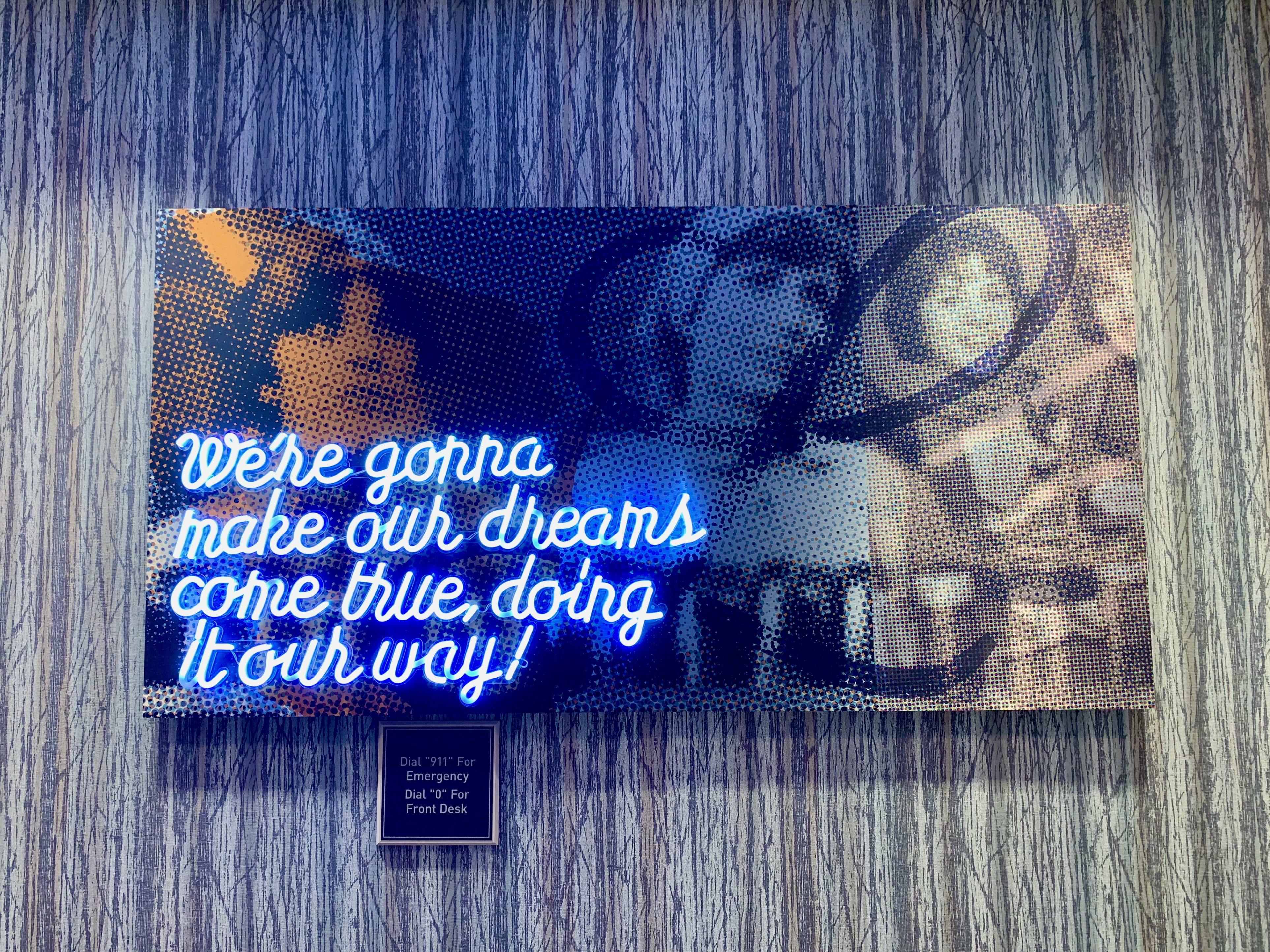
Earlier this month, I returned to Milwaukee (my hometown) for the first time in six years to meet up with my parents (who also now live in another part of the country) and a few old friends. Predictably, Laverne and Shirley (and The Bronze Fonz) remain the city’s most recognized cultural touchstones, as seen in this tableau across from the elevators in my hotel.
The weather was gorgeous for this time of year, so I skipped some of the more touristy indoor places I was considering visiting (including the soon-to-be-moved Milwaukee Public Museum). However, I couldn’t resist the Milwaukee Public Market.
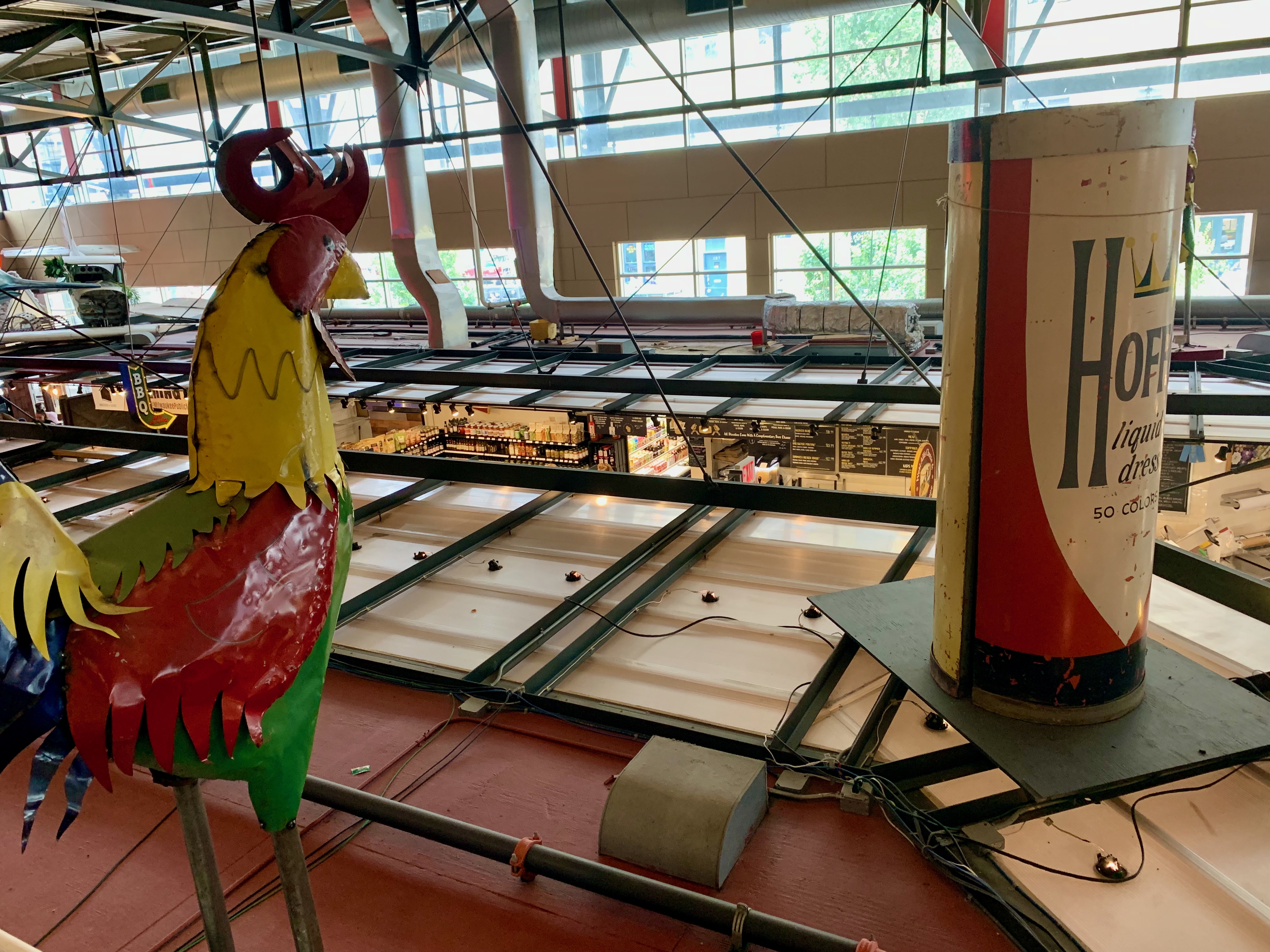
This Third Ward perennial actually didn’t open until about a decade after I left town. I’m afraid don’t know the story behind the giant rooster watching over all the stalls.
An anchor of the market, St. Paul Fish Company also has a location in suburban Mequon (which we had lunch at the following day, in search of decent seafood in the area.)
Seen on the staircase at the market. The big Allen-Bradley clock in Walker’s Point (often nicknamed “The Polish Moon”) is as much of a Milwaukee landmark as the Citgo sign is one for Boston.
After the market, we headed over to the East Side and Brady Street, picking up pasta and focaccia at Glorioso’s and Italian cookies from Sciortino’s. Decades on, Art Smart’s Dart Mart (and Juggling Emporium) endures (as does the city’s distinct, classic “harp” streetlights and those black bus shelters.)
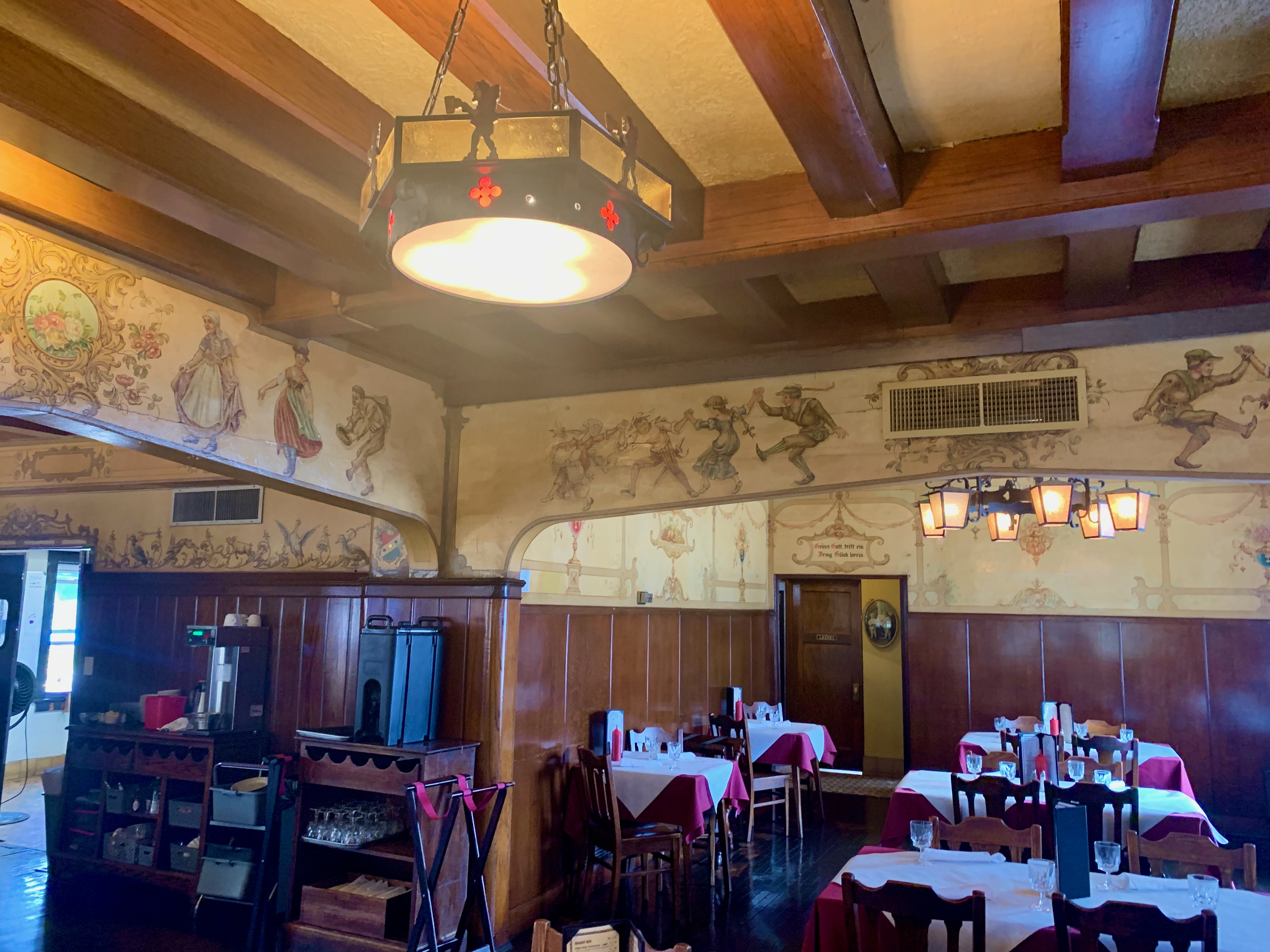
On to West Allis for a Friday Fish Fry at Kegel’s Inn, a meal no trip to Milwaukee is complete without. I can’t find great German cuisine in Boston, so it’s always a treat to get my fill of potato pancakes and Hacker-Pschorr here.
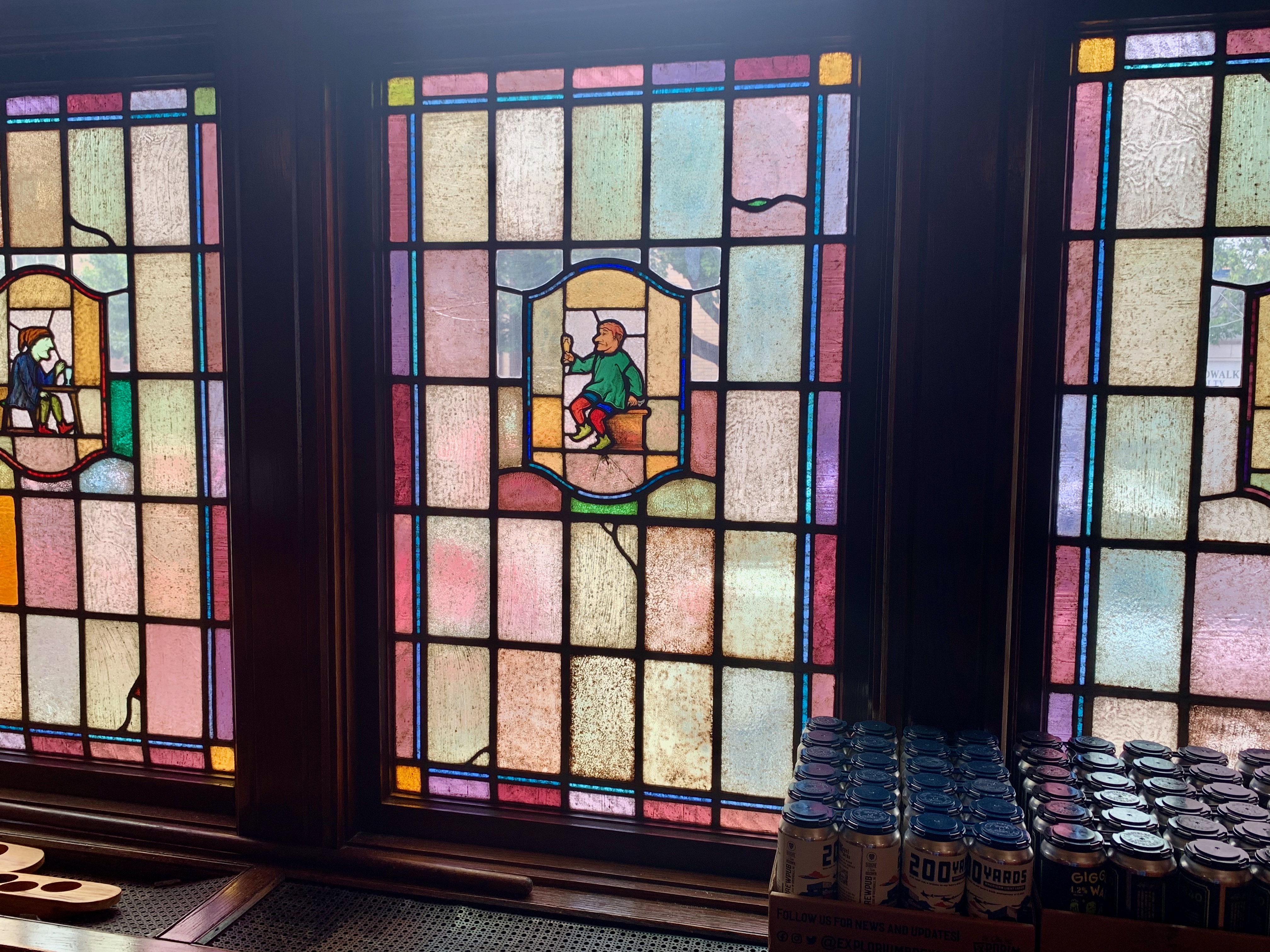
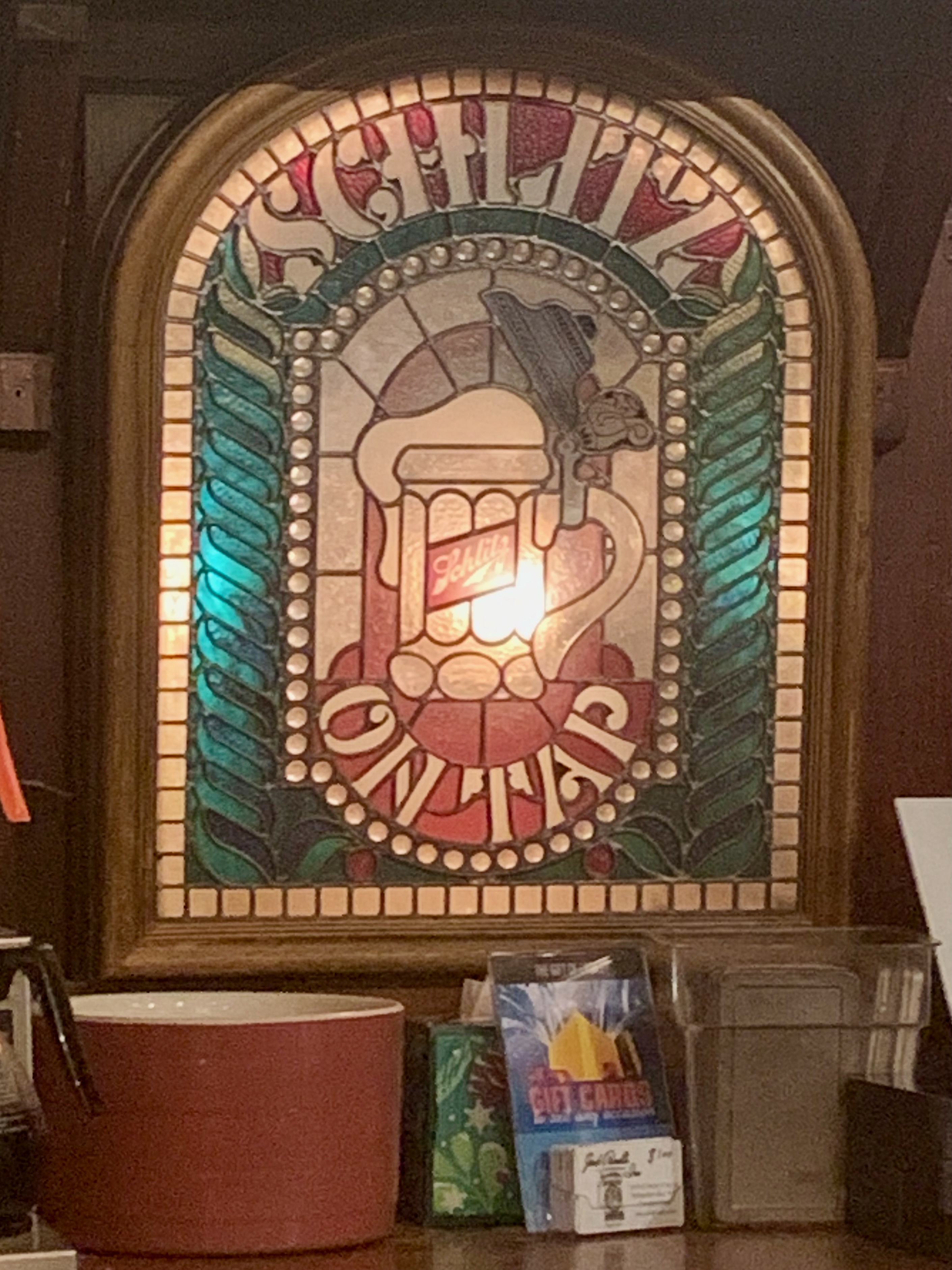
Each time I go to Kegel’s, I notice something I haven’t before, such as the detail in these stained-glass windows.
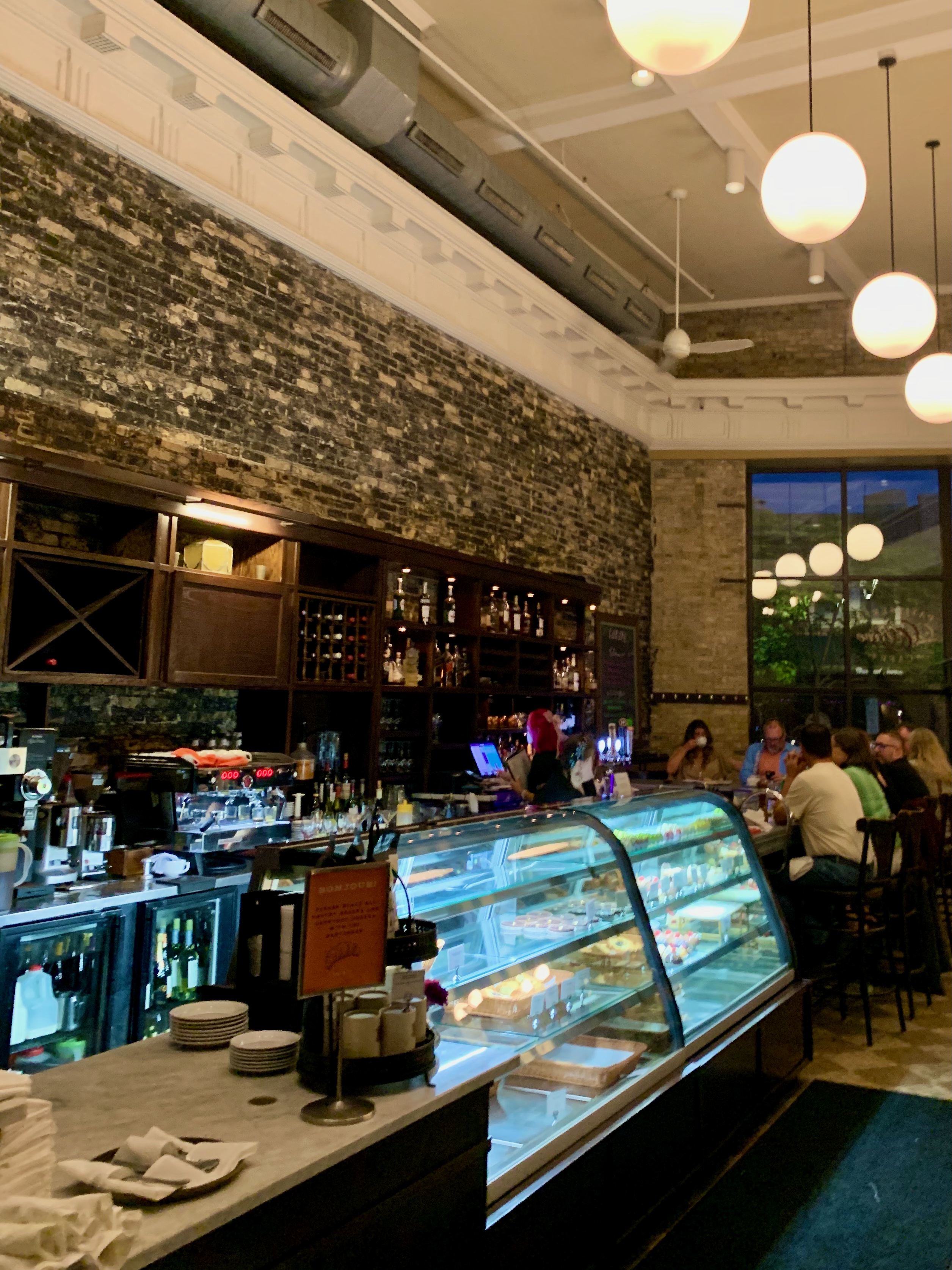
That evening, we met up with a dear friend at Le Reve in Wauwatosa Village, which had excellent cocktails, good mussels and a display case full of tasty French desserts.
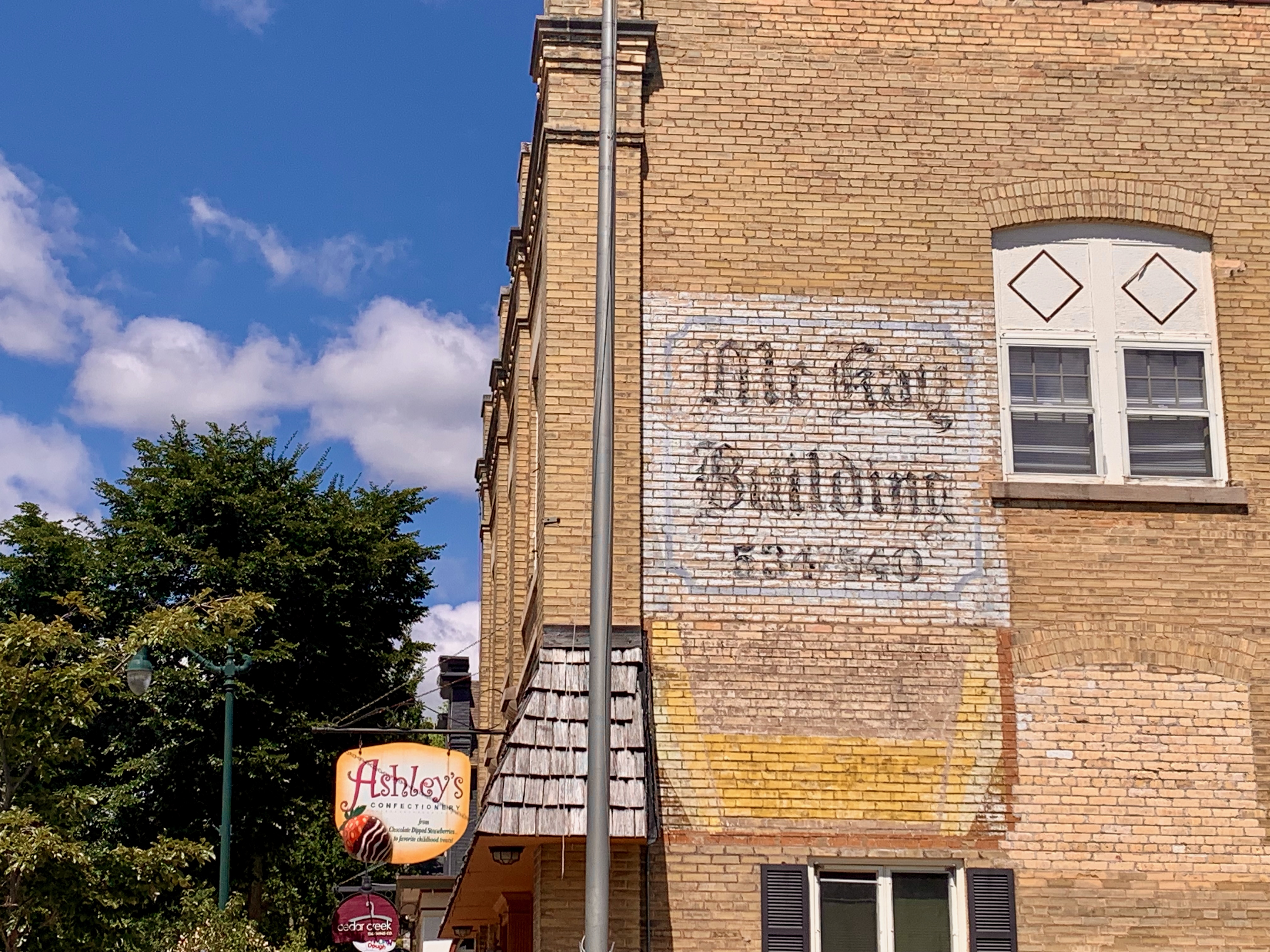
Following our lunch in Mequon the next day, we drove north to Cedarburg where I had not been in over a decade. We took a walk down the Washington Avenue Historic District and all the cream-colored brick buildings stood out to me in ways they hadn’t previously.
The vivid blue skies provided a striking contrast to these 100+ year old structures.
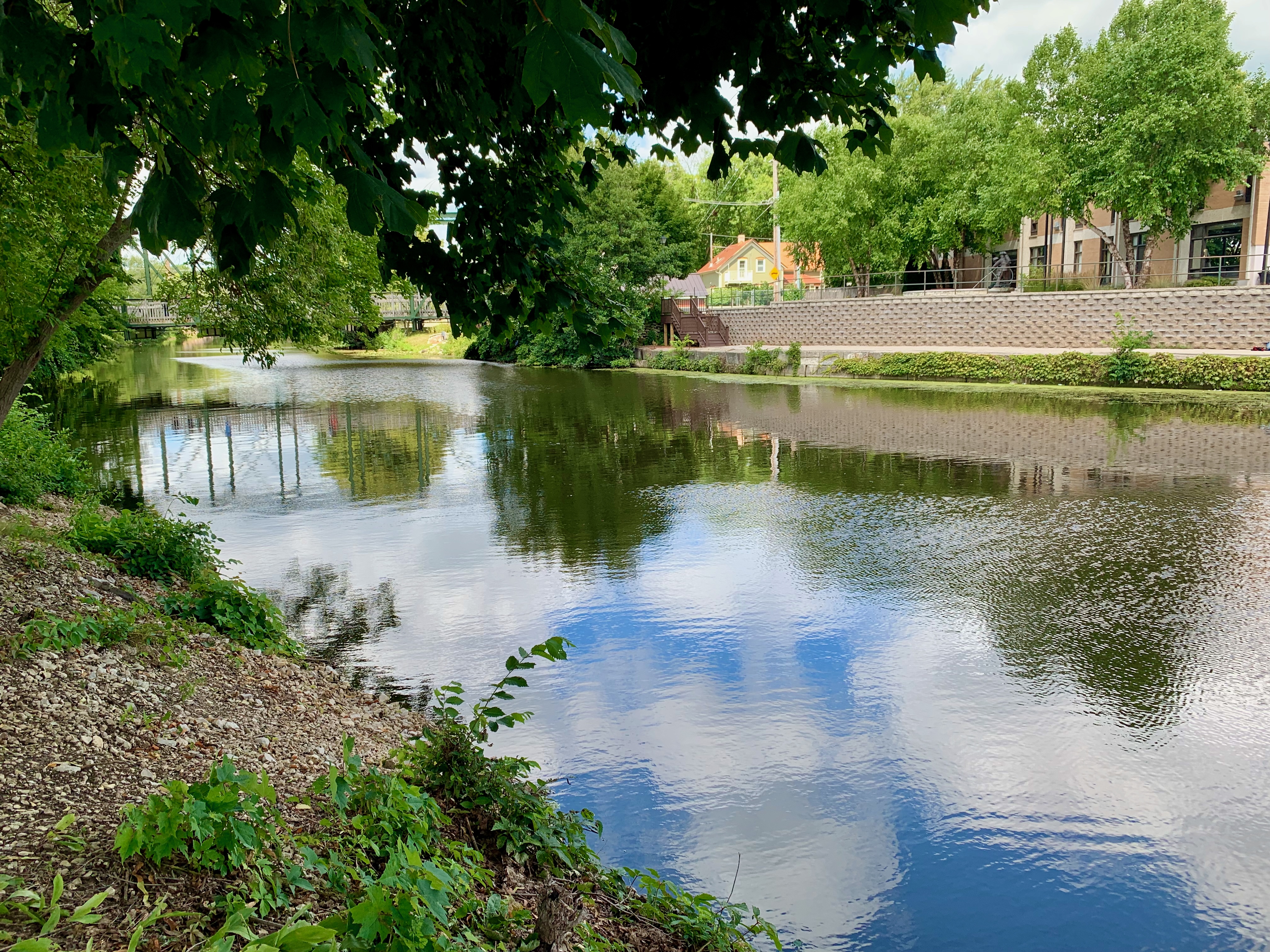
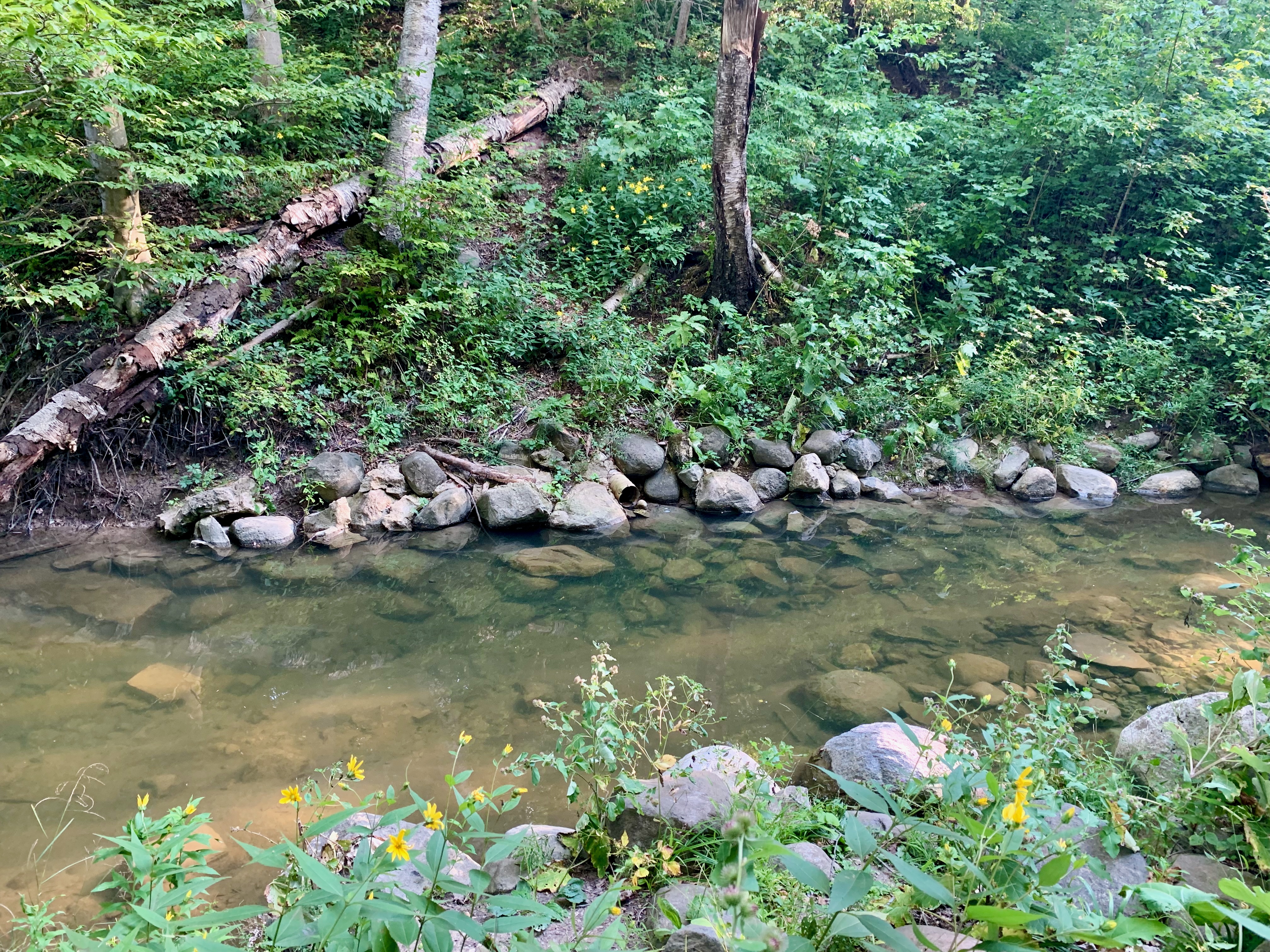
Naturally, we ended up at the Cedar Creek Settlement Shops, which I did not take any pix of this time. Here’s the Milwaukee River, which runs behind it, although this was taken a few blocks further south.
For dinner on Saturday night, we tried Jack Pandl’s Whitefish Bay Inn, a historic restaurant that my parents and I somehow had never previously visited (I do remember going to the now-defunct George Pandl’s in Bayside.)
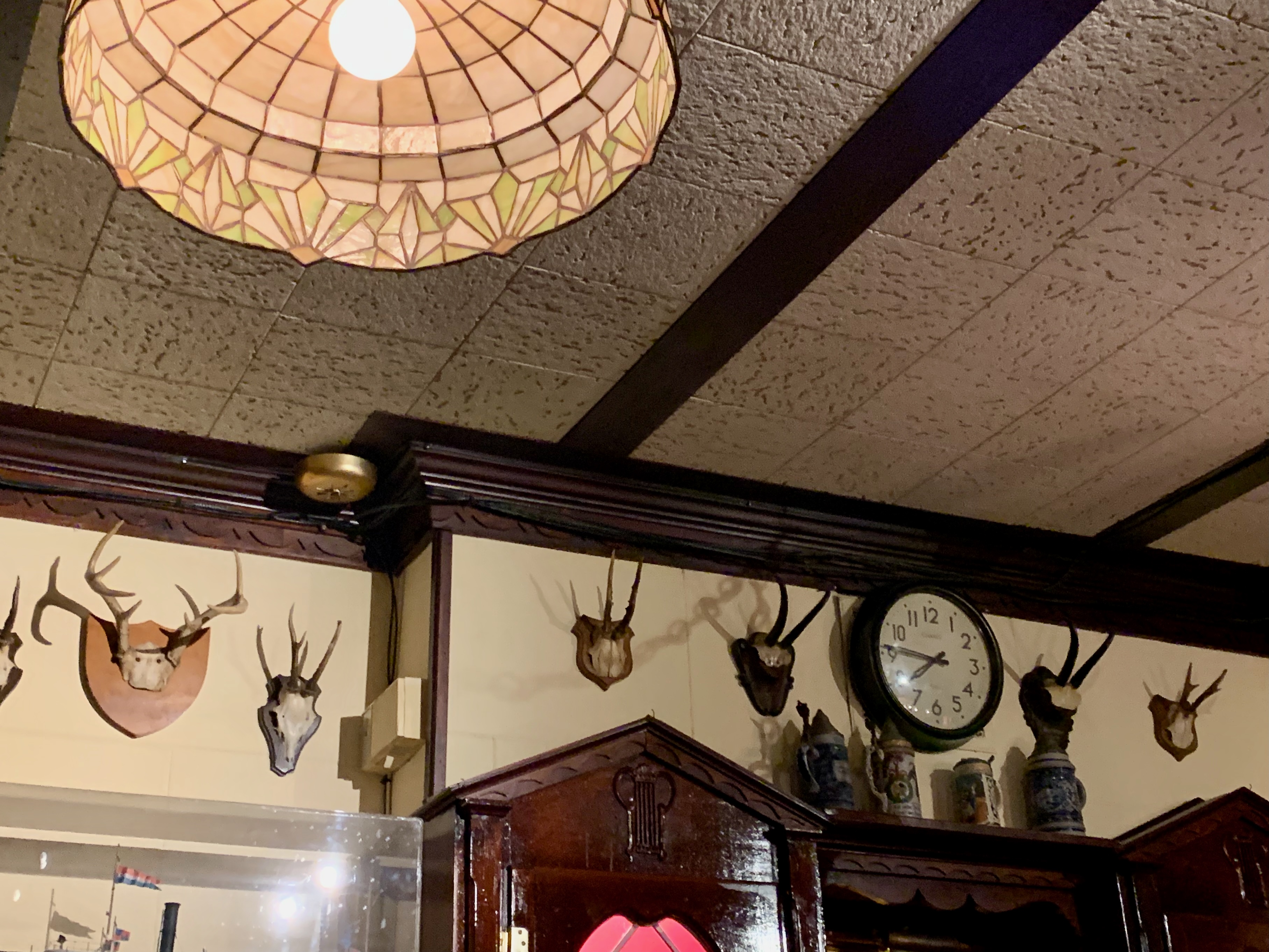
Our party of five was seated at a large round table near the bar, decked out in knickknacks one would likely only expect to find in Wisconsin.
Whitefish Bay is a rather affluent suburb, so it’s a hoot to see one of its most venerable establishments decked out in dinky taxidermy plaques.
If any classic beer brand screams Wisconsin, it’s not Miller or Pabst, it’s Schlitz!
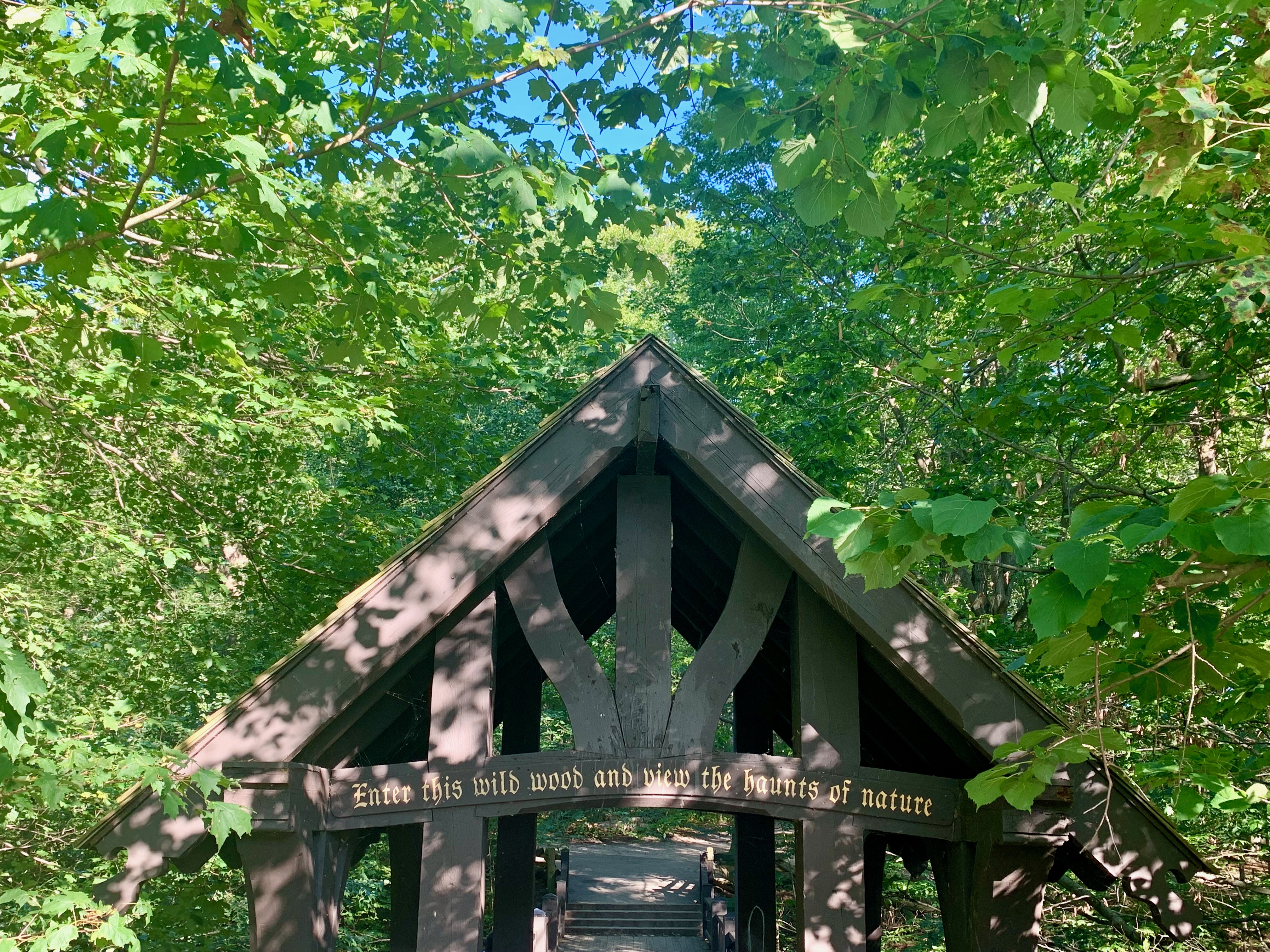
Recovering from our brandy old-fashioned soaked evening at Jack Pandl’s, we took it easy on Sunday: a stop at Kopp’s Frozen Custard, then an early evening walk at Grant Park on Lake Michigan in South Milwaukee. I hadn’t been there in nearly two decades. This gingerbread house-like bridge has always been one of my favorite places in the area (even if someone drew a dick on it, as partially shown above.)
After crossing the bridge, one is led through a series of paths, stairways and other bridges along a ravine.
The end point is a small beach on the Lake. This was my “ocean” growing up and it was a thrill to return.
On our last day, I made a run to Irving Place Records and then down to Colectivo on Lincoln Memorial Drive for a smoothie and rest and relaxation on their massive patio. Although I’ve now lived in Boston for most of my life, Milwaukee will always remain a part of me. It’s nice to know that I can always go back for a few days, even if my heart’s now fully in another city.
In 2006, now fully into my thirties, my life gradually solidified—I had a steady job, a good living situation and I even met the person I’d eventually marry. Music too remained a constant, even if none of the albums on my original year-end top ten endured to point of warranting their own entries in my 100 Albums project (the one that did, I didn’t hear until its American edition came out the following year.)
Starting this year, I began making best-of mix CDs to send out to friends, a ritual I kept up through 2010 (and briefly revived in 2015.) Most of the first seventeen tracks here appeared on that mix CD, with Marit Bergman’s winsome yet exuberant “No Party” now finally on streaming services (it wasn’t when I put together an earlier version of this playlist in 2018.) The latter half below is full of songs that have endured, from massive hits (Gnarls Barkley, Scissor Sisters) to barking-mad obscurities (please listen to the Herbert song all the way to the end) and everything in between. I would apologize for that Rodrigo y Gabriela-Sparks-Sufjan Stevens-Charlotte Gainsbourg sequence for inducing whiplash if not, even by 2006, iPod shuffling hadn’t already conditioned us into listening to music that way.
Also, if someone were to locate a copy of this playlist decades from now without knowing the title indicating the year, I’d like to think due to the timeless nature of such tracks as “Be Here Now”, “Crowd Surf Off A Cliff” and “I Feel Like Going Home”, they might not immediately deduce what exact year all these tunes came from. On the other hand, The Decemberists, TV On The Radio and The Knife are all defiantly 2006, summarizing an era when Pitchfork and Myspace ruled and practically no one knew what smartphones would portend in the immediate years to come.
2006: I’ve Got No Party To Go To
Marit Bergman, “No Party”
Neko Case, “Hold On, Hold On”
The BellRays, “Third Time’s The Charm”
Regina Spektor, “Better”
Hot Chip, “Boy From School”
TV On The Radio, “A Method”
Belle and Sebastian, “Dress Up In You”
Nellie McKay, “Long and Lazy River”
The Hidden Cameras, “Awoo”
Jenny Lewis & The Watson Twins, “Rise Up With Fists!”
James Hunter, “People Gonna Talk”
Paul Brill, “Don’t Tell Them”
Camera Obscura, “If Looks Could Kill”
Emm Gryner, “Almighty Love”
Calexico, “Cruel”
Junior Boys, “In The Morning”
Pet Shop Boys, “Integral”
The Knife, “One Hit”
Gnarls Barkley, “Crazy”
Nelly Furtado, “Say It Right”
Ben Kweller, “Sundress”
The Decemberists, “O Valencia!”
The Radio Dept., “The Worst Taste In Music”
The Divine Comedy, “Diva Lady”
Emily Haines & The Soft Skeleton, “Crowd Surf Off A Cliff”
Have you ever left a movie in a daze, almost as if your entire world has shifted? Skyway Cinemas, one of many 1970s-built multiplexes I frequented in my childhood was unremarkable apart from its spacious lobby framed by large glass windows directly across from its three (and later, six) auditoriums. My parents and I often saw matinees there: Who Framed Roger Rabbit, Arachnophobia and the Back To The Future movies, among others. Often, stumbling out of the darkened rooms meant emerging into a phalanx of blinding sunlight, as if to say, “Welcome back to the real world.” We’d pass through the lobby and out the front entrance, blinking our eyes, left to reconcile such an abrupt change in our surroundings.
I rarely experience this exact sensation anymore as neither the classic art-deco cinemas and funky non-profit arthouses nor the multistory, contemporary multiplexes offer this walking transition between subterranean dark and invasive light. However, that’s not to say I don’t ever feel utterly transformed after watching a film. We all see movies we like to varying degrees, but once in a great while, this feeling goes so far beyond a matter of simply enjoying it. Whenever recounting my decision to study film, I used to claim that this pursuit did nothing less than change the way I perceive the world; as I’ve aged, I’ve also added that watching films critically has at times also fundamentally altered the way I see myself. Naturally, there’s no substitute for real life experience, but at its best, cinema (like all arts) can serve as a way of learning, an act of discovery and a tool for both empathy and self-growth.
In one sense or another, each entry in this project zeroes in on a film that achieved at least one and often all three of those ideals, albeit to varying degrees. I’ve written about how the radical, stark ending of Safe shook me to the core and the epiphany of ongoing connections and circularity concluding What Time Is It There?, but other titles had subtler impacts: the blink-and-you’ll-miss-it reveal of what’s really going on in Stories We Tell, the matter-of-fact imagery All That Jazz dutifully, almost brutally goes out on, the haunting, frozen-in-time tableaux providing Edward II with its final grace note. All of these are resolutions I had to take time to absorb and ponder, not so much jump cuts from black to white as sifting through thousands of shades of gray, acknowledging and gradually feeling something incisive and lingering about what I had seen.
Somewhere between those two reactions is one of what I can best describe as a sort of transfiguration. Deeper and less defined than a purely emotional or intellectual response, it veers towards the spiritual, as if witnessing something has placed one in an altered, previously inconceivable state of mind. It’s awfully tricky to describe, for signifiers such as “hypnotic”, “trancelike” and “otherworldly” come off as too subjective or abstract to adequately communicate what it’s actually like to another person. A particular film may affect me so strongly while leaving another viewer cold and unmoved. The critic’s role is to make a case (or not) for how and why a film has this power; naturally, it’s a hell of a thing to fully articulate. Take Andrei Tarkovsky’s metaphysical sci-fi feature Stalker, which I first saw at age 22 in film school. It left me baffled, not comprehending what story it was trying to tell or why it even attempted it in the first place. I soon watched the Russian director’s other works (there’s only seven features in all) and responded to them all differently (some gut-quick assessments: liked Andrei Rublev, hated Nostalghia, kept dozing off during Mirror.)
Stalker
Twenty years later, I revisited Stalker, this time at the Brattle Theatre in Harvard Square on a hot summer’s afternoon. Sometime before that I had read Zona, Geoff Dyer’s unconventional book about the film (written from an average viewer’s perspective rather than a film critic’s), encouraging me to give it another shot. Perhaps because I was watching it for pleasure instead of coursework or simply two decades older and more receptive to its idiosyncrasies, Stalker confounded less and intrigued more on this viewing. Although I surely moved around in my seat often during the last half-hour of its 163-minute running time, as I arose and made my way to exit, I felt woozy but satiated as if emerging from a deep sleep. I thought this is possibly what the concept of enlightenment is supposed to be like, even if Stalker asks far more questions than it even pretends to answer. The brightness of late afternoon brought me back into the real world, but only partially—I walked around the neighborhood in a slight trance, retaining what I had just experienced in ways that only this particular film’s moods and ideas could influence and shape.
This particular reaction I had with my rewatch of Stalker is not limited to that film alone but it is uncommon (imagine if every movie one watched left one so off-kilter!) In this category, I’d place 21st century titles as disparate as Jim Jarmusch’s Paterson and Celine Sciamma’s Portrait Of A Lady On Fire, Wong Kar-wai’s In The Mood For Love and Charlie Kaufman’s Synecdoche, New York, Jonathan Glazer’s Under The Skin and many of Paul Thomas Anderson’s later works (There Will Be Blood, The Master, Phantom Thread.) The common signifier among all of them? I exited each film indisputably changed as if allowed a peek into how another person views the world and makes it their own whether through its ultra-specific rhythms and visual or narrative choices or via something recognizable that nonetheless contains other facets rendering it both somewhat familiar and fresh.
I often experience this sensation with the films of Thai New Wave director Apichatpong Weerasethakul, who often goes by the simple nickname “Joe” (which, no matter how silly or reductive it sounds, I will use going forward for brevity’s sake.) As with Tarkovsky, I admire his features to varying degrees. His 2000 debut, Mysterious Object at Noon has a fascinating premise—unscripted, it travels across Thailand, interviewing people and imploring them to add their own words to an ongoing story, “exquisite corpse” style in which each new person is only allowed to see the ending of what the previous one had written. However, it’s less effective in practice as the momentum lags rather than builds, more or less petering out midway through. Thankfully, this doesn’t occur on subsequent efforts Blissfully Yours (2003), Tropical Malady (2004) and Syndromes and a Century (2006) even as each one utilizes a nontraditional diptych structure to different ends. The best of them, Tropical Malady radically transforms at its exact midpoint from a slice-of-life, near-romantic comedy into an experimental, spiritual folk tale. I first saw it with a friend (at the same place I rewatched Stalker) and the ending left us somewhat like that of Cache, fumbling for words to describe and elaborate upon what we had just seen.
I feel similarly about most of Joe’s endings but it’s a credit to his growth as a filmmaker that with each subsequent work, it’s more of an attribute than a negative. While Syndromes and a Century, a near-essay on his parents’ profession as doctors has one of the more incongruous endings I’ve encountered, his breakthrough, 2010 Cannes Palme d’Or winner Uncle Boonmee Who Can Recall His Past Lives signs off with a deftly deployed twist that begs one to reconsider everything they’ve just seen. It’s in line with the film’s entire tone, a playful, poetic rumination on death and how life itself isn’t necessarily so linear, mixing fantasy and reality together so fluidly that one comes to view both as interchangeable while still recognizing the former’s otherworldliness. It’s not so much more accessible than it is a masterful culmination of a singular aesthetic developed and fine-honed—the perfect place to start with Joe’s filmography, perhaps.
Uncle Boonmee Who Can Recall His Past Lives
His next major work, 2015’s Cemetery of Splendour is more suited to advanced Joe scholars/admirers (as is 2012’s Mekong Hotel, a 61-minute piece that played festivals and was mostly seen as a bonus feature on the Uncle Boonmee DVD release.) First watching it in its 2016 American theatrical release at Boston’s Museum of Fine Arts, it affected me in a way similar to how Stalker would a year later, only this feeling emerged about three-quarters of the way through the film. It was on extended shot of sun piercing through fluffy white clouds in the sky—or so I thought, until what resembled a leaf (or maybe some sort of organism?) floated into the frame, revealing that this image might actually reflect the sky on a body of water. Out of context, such imagery is unremarkable but appearing as it does within the meditative, meandering rhythms established within the preceding 90 minutes, it connected with me in a profound, if inexplicable way. Again, I don’t know if this was Joe’s intention, or whether it had a similar effect on most other viewers but I felt a rush of emotions—excitement at the reveal, peace from the soothing tone, an epiphany that life may be more than it initially appears. As the film continued, I applied these feelings both to what I was witnessing unfold and also to all that had come before.
Filmed in Khon Kaen, Joe’s hometown in the northeast Thai region of Isan, Cemetery of Splendour is mostly set at a defunct elementary school turned makeshift hospital for convalescing soldiers. Middle-aged Jen (Joe regular Jenjira Pongpas) is visiting a friend who works there as a nurse. Jen now lives in Bangkok with her American husband Richard but grew up in this rural enclave and even attended this very school. Jen herself is disabled, one of her legs significantly shorter than the other (she walks with a cane.) The patients, however, are all afflicted by what is only referred to as a “sleeping sickness”. Much of the film occurs in a former classroom with a dozen of them laid out in beds, two rows of six on each side, all the windows open wide to let in the tropical air and nature sounds. The men are not exactly comatose, but not all that far off—they sleep day and night and on the rare occasion when awake, we see more than one of them overcome by narcolepsy, abruptly dozing off in mid-sentence or mid-bite in the dining hall. No explanation is given for this malady, only that it’s happening exclusively to the country’s servicemen.
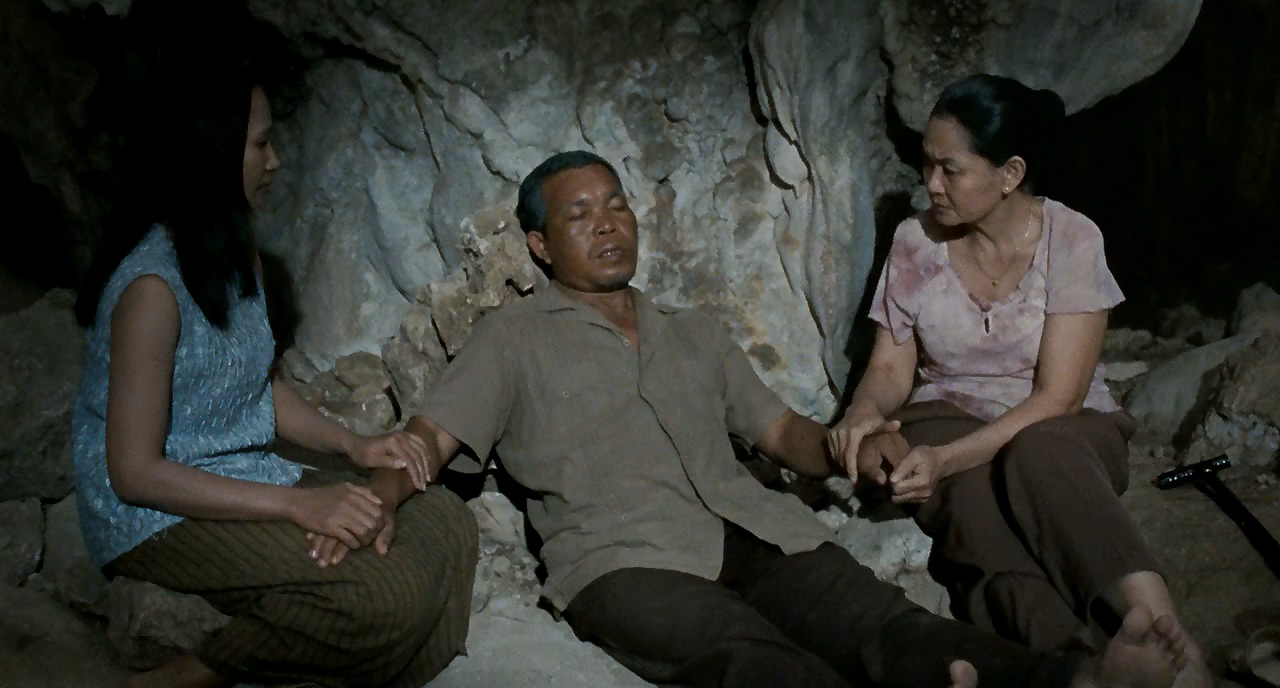
Enter Keng (Jarinpattra Rueangram), a young medium who works for the FBI. Known for her ability to contact the spirits of murder victims and missing persons, she’s at the hospital to sit with the sleeping soldiers (and occasionally, their wives) and perform psychic readings in order to understand their thoughts and dreams while in their unconscious states. Jen befriends both Keng as well as Itt (Banlop Lomnoi, another Joe regular), one of the younger, handsomer patients. Her burgeoning connection with the latter is motherly rather than sensual, but soon transcends such parameters: “It’s as if I’m synchronizing with that soldier, or he’s sleeping through me,” she says aloud at one point. As Jen spends more time bonding with both the psychic and this soldier, she herself enters altered, supernatural states of mind, rendered by Joe matter-of-factly, stressing both halves of the term “magical realism” as he tends to do in his work. One such example: not long after visiting a Buddhist shrine with Richard, Jen herself is visited in the nearby park by two women who casually reveal themselves as living embodiments of the princesses the shrine saluted in statue form. “Both of us are dead as well,” they tell Jen before leaving her with this wisdom: “Those soldiers will never recover.”
Jen watches over Itt, overcome by sleep.
Cemetery of Splendour gently tempers such fantasy elements with a naturalism informed by an immersive sense of place. The elaborate sound design favors environmental ambience over anything that’s produced although music occasionally surfaces—most notably during two sequences of people performing aerobics (an odd but insistent motif in Joe’s work along with hospital settings, for that matter.) Images such as a water wheel irrigation apparatus in the neighboring lake or the hospital room’s ceiling fans reappear throughout, adding texture rather than concrete meaning. Dialogue, however, is just as central an element in stressing the film’s realism. It often sounds unrehearsed, conversational, banal, even, but it grounds one in the moment, and the moment is key for it prevents Joe’s fascination with ghost stories and all that is unknowable from drifting out of focus—in other words, the fantastical becomes relatable.
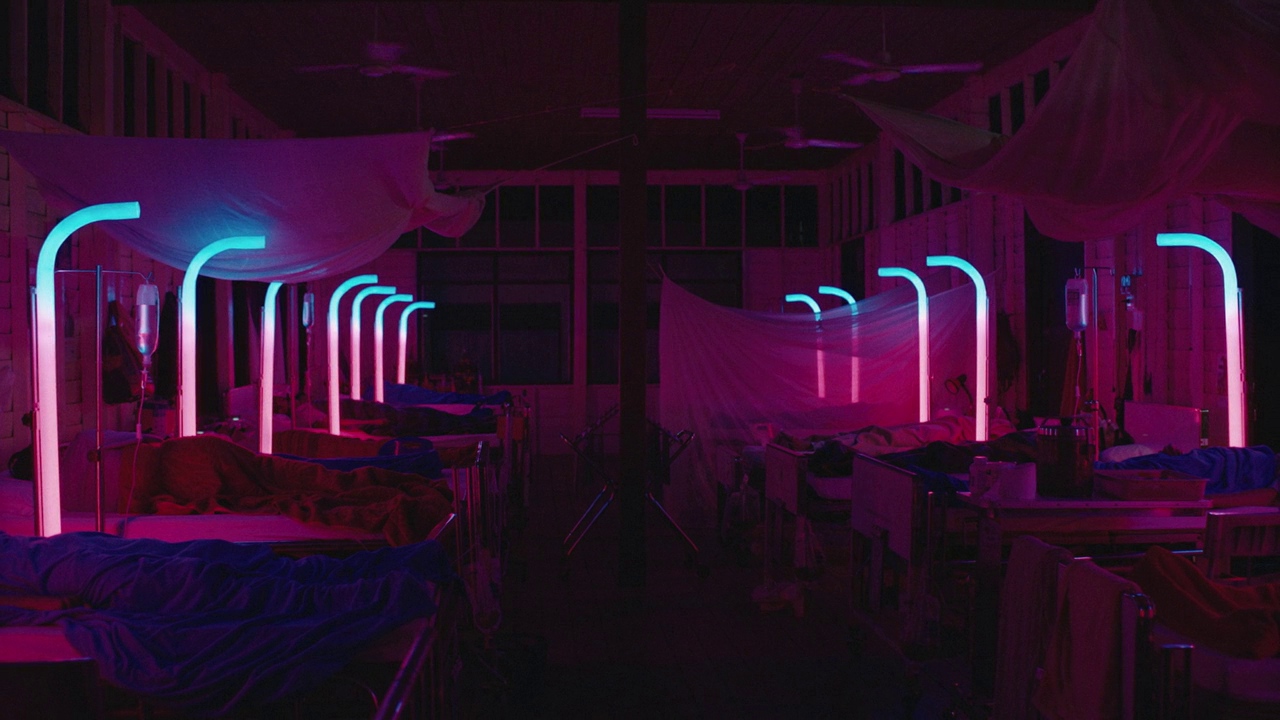
Still, an unknowable awe retains presence. Arguably the film’s most striking visual construct appears about a half-hour in with the installation a series of tall, narrow, curving neon light tubes at the head of each patient’s bed. Connected to each man by a face breathing mask, they’re meant to serve as a form of therapy, aiding with nightmares and snoring (“Americans used them in Afghanistan”, a doctor notes.) Occasionally, the light in these tubes is a pure, neutral hue; other times, it changes colors, from red to blue to green to white, the light gradually, almost lethargically surging vertically from bottom to top. No further scientific explanation is offered for these tubes, but it’s an image Joe returns to throughout the film, often after dark when the alternately cool and warm colors are exclusively illuminating the room. It’s hypnotic, presumably for the patients but also the viewer—beautifully meditative and a respite from all the conversation transpiring during the day.
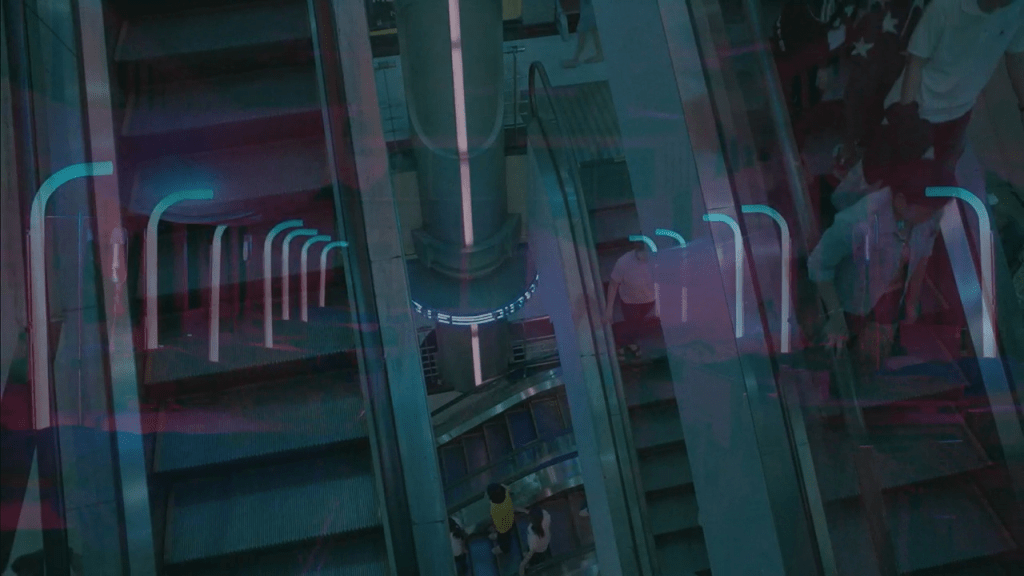
The tubes also play a role in one of the film’s key sequences. In a rare instance where Itt is fully awake, he and Jen leave the hospital for an evening trip into the city: dinner at a street market and a movie (we only see them watching a trailer for an over-the-top, CGI-heavy action/horror epic—the antithesis of Joe’s style.) After the trailer ends, as seen in silhouette, Jen, Itt and the rest of the audience stand up in the dark, silent, still staring at the screen as if in a trance (much like the viewer of one of Joe’s films, perhaps.) Everyone then leaves the theater in what appears to be a modern multiplex, walking towards a sea of escalators that will take them back to the outside world. There’s no score, only diegetic sound but as patrons get on the escalators, some familiar, slowly changing colors appear. They’re from neon lights in the building’s interior design. Soon, we also see a recognizable ceiling fan as part of an exceedingly slow crossfade. The escalator riders are still visible, but the hospital room with the glowing neon tubes also comes into focus.
The crossfade.
This crossfade endures for at least a minute; it’s like nothing else I’ve ever seen in a film. In trying to determine why Joe included it here, I have no definite answers apart from him suggesting this idea of worlds coalescing: the awake cinema patrons and the sleeping soldiers co-exist, after all, with the former arguably in just as much of a fugue state as the latter. Like many sequences in Stalker, it goes on longer than it needs to (personally, I never wanted it to end), but long enough for it resonate by inviting the viewer into this combined fugue state—the mundaneness of everyday life (leaving a movie theater) with the world of the subconscious. Jen herself latter experiences her own fugue state as a sleeping Itt communicates with her through the medium Keng. Jen tells him, “I think I’m dreaming, Itt; I just want to wake up.” This occurs right before the reflection-of-sky-on-water-reveal, itself perhaps encouraging viewers to arrive at the same conclusion.
Later, Jen is back in the makeshift hospital room besides Itt as he lies in bed. She says to him, “Suddenly, I can read your mind. I have seen your dream.” “And I can see yours,” Itt responds. Some kind of transfiguration has occurred between them. Cemetery of Splendour doesn’t offer any logical explanation for this act because none exists (something similar occurs in his next feature, 2021’s Memoria, filmed in Colombia (!) and starring Tilda Swinton (!!)). The closest cinema can do is put the viewer in a mind state attempting to express what the experience of transfiguration might be like. The final scene is of Jen sitting on a park bench outside the hospital, watching a large dump truck digging a massive hole in the ground (the image of which opened the film.) We’re never told exactly why the truck is there (it’s speculated they’re digging to install fiber optic cables) but its presence and purpose is related to talk of the makeshift hospital’s imminent closure and tearing down. In the distance, an outdoor aerobics class performs to a jaunty instrumental slightly tinged with melancholy. In the last shot, we see only Jen, eyes wide open, still watching the truck but now framed as if she was staring directly at us. She’s been through something over the course of the film, and so have we.
Irresistible to begin one of these annual playlists with a song declaring, “I am gonna make it through this year if it kills me.” Those words surely resonated for me in 2005—I had just turned thirty, my love life was in perpetual flux and I yearned for something resembling actual adulthood (and not an apartment with five roommates. )
Just as I saw more movies in cinemas this year (including my first trip to the Toronto International Film Festival) than any previously, I likely listened to more new music as well. Among the three dozen favorites below, we have unusual cameos (Cindy and Kate from The B-52s on “Take My Time”! An opera singer on the Calexico/Iron and Wine collaboration!), triumphant returns-to-form (Depeche Mode, Erasure, Aimee Mann and New Order), and defining tracks such as Sufjan Stevens’ iconic ode to the Windy City, Fiona Apple’s Disney-meets-David Lynch title track from her troubled third album and The New Pornographers’ breathless, towering mini-epic—the centerpiece of an LP I nearly gave its own 100 Albums entry.
If you asked me what some of the big hits of 2005 were, I’d answer “Hollaback Girl”, “Gold Digger”, “Boulevard of Broken Dreams” and… that’s all I can name. But this mix is packed with songs that received copious play at the time on my just-purchased first iPod: Andrew Bird’s catchy, soaring, indecipherable wordplay; Metric’s Blondie-worthy disco-rock; My Morning Jacket’s incredible fusion of Lynyrd Skynyrd and XTC; Pernice Brothers’ blissful instrumental; Amy Rigby’s disarming meet-the-new-wife fable; glorious, meticulous power-pop from The Magic Numbers and Oranger; Art Brut perilously walking a fine line between stoopid and clever; Doves’ alternately spiky and swaying Motown pastiche; and the now mostly-forgotten Shivaree’s dreamy, undulating ballad, its unresolved melancholy and regret just hanging there, affecting and unshakable.
As anticipated and thrilling as Kate Bush’s return from exile was, Saint Etienne’s latest was for me an event—the London trio’s worst selling album (not even released domestically until the following year with a stoopid rearranged track listing), it was an instant classic with the effortlessly joyous “Stars Above Us” a buoyant anthem (not even a single in the UK!) now awaiting rediscovery.
A decade after alternative rock peaked culturally (if not yet commercially), indie rock arguably did the same, but it was a whole new world—for starters, you rarely heard this music on the radio. More often, you had to find it online, usually at Pitchfork, arguably never closer to the zeitgeist since then, especially when it placed Arcade Fire’s Funeral on top of its year-end best albums list. I don’t think I was even aware of the band until this happened, and I spent most of the year writing for a competing website (albeit a far less buzzy one.)
The playlist I’ve assembled for 2004 contains so much of this stuff: in addition to my favorite Funeral track (and perhaps one of the few AF songs I can still stomach following recent allegations about the band’s leader), there’s Sufjan Stevens, Franz Ferdinand, Neko Case, Ted Leo and Tegan & Sara. Plus, a handful of relatively obscure but likeminded artists I was assigned to review, including Tamas Wells, Marit Bergman, Tompaulin and Paul Brill, whose New Pagan Love Song (represented by its title track) remains in occasional rotation two decades on.
We also have a few ‘90s holdovers putting out some pretty excellent later-career work: a single from PJ Harvey’s unjustly forgotten Uh Huh Her; Morrissey’s second-last great song to date (which rhymes “bullet” with “gullet”); The Magnetic Fields, triumphant at the impossible task of a follow-up to 69 Love Songs; Jill Sobule interpolating Chicago’s “Saturday In The Park” (and totally getting away with it!) and Sam Phillips with one of her loveliest ever ballads which, along with her “ba, ba, ba” instrumentals found immortality in Gilmore Girls (both the OG series and its Netflix sequel.)
As always, it’s the oddities I adore the most: the Delays’ marvelously androgynous vocalist Greg Gilbert (RIP), Nellie McKay’s gently jaunty, gin-soaked reverie, Madeleine Peyroux’s so-crazy-it-just-might-work cocktail jazz Leonard Cohen cover, even Mark Mothersbaugh’s electro/orchestral score for The Life Aquatic with Steve Zissou (one has to think he never worked with Wes Anderson again cause he knew he could never top this.) However, let me direct your attention to A Girl Called Eddy (aka Erin Moran (not the Happy Days star)). Her elegant, self-titled debut was a cross between Aimee Mann and Dionne Warwick (with a hint of Karen Carpenter) and like nothing else anyone put out in 2004 (not even Feist, I’d argue.) “The Long Goodbye” is such sparkling, heartbreaking pop I never skip it whenever it comes up on shuffle. She finally reemerged four years ago with a nearly-as-good second LP, Been Around, a relief as I feared she become the 00’s version of Jen Trynin.
2004: Take Your Records, Leave Me Mine
Tompaulin, “Slender”
Bebel Gilberto, “Simplesmente”
Delays, “Nearer Than Heaven”
Jens Lekman, “You Are The Light (by which I travel into this and that)”
Jill Sobule, “Cinnamon Park”
Sufjan Stevens, “To Be Alone With You”
Tamas Wells, “Even In The Crowds”
The Magnetic Fields, “I Thought You Were My Boyfriend”
Nellie McKay, “Ding Dong”
Rufus Wainwright, “Gay Messiah”
A.C. Newman, “On The Table”
A Girl Called Eddy, “The Long Goodbye”
Feist, “One Evening”
Junior Boys, “Teach Me How To Fight”
Mark Mothersbaugh, “Ping Island/Lightning Strike Rescue Op”
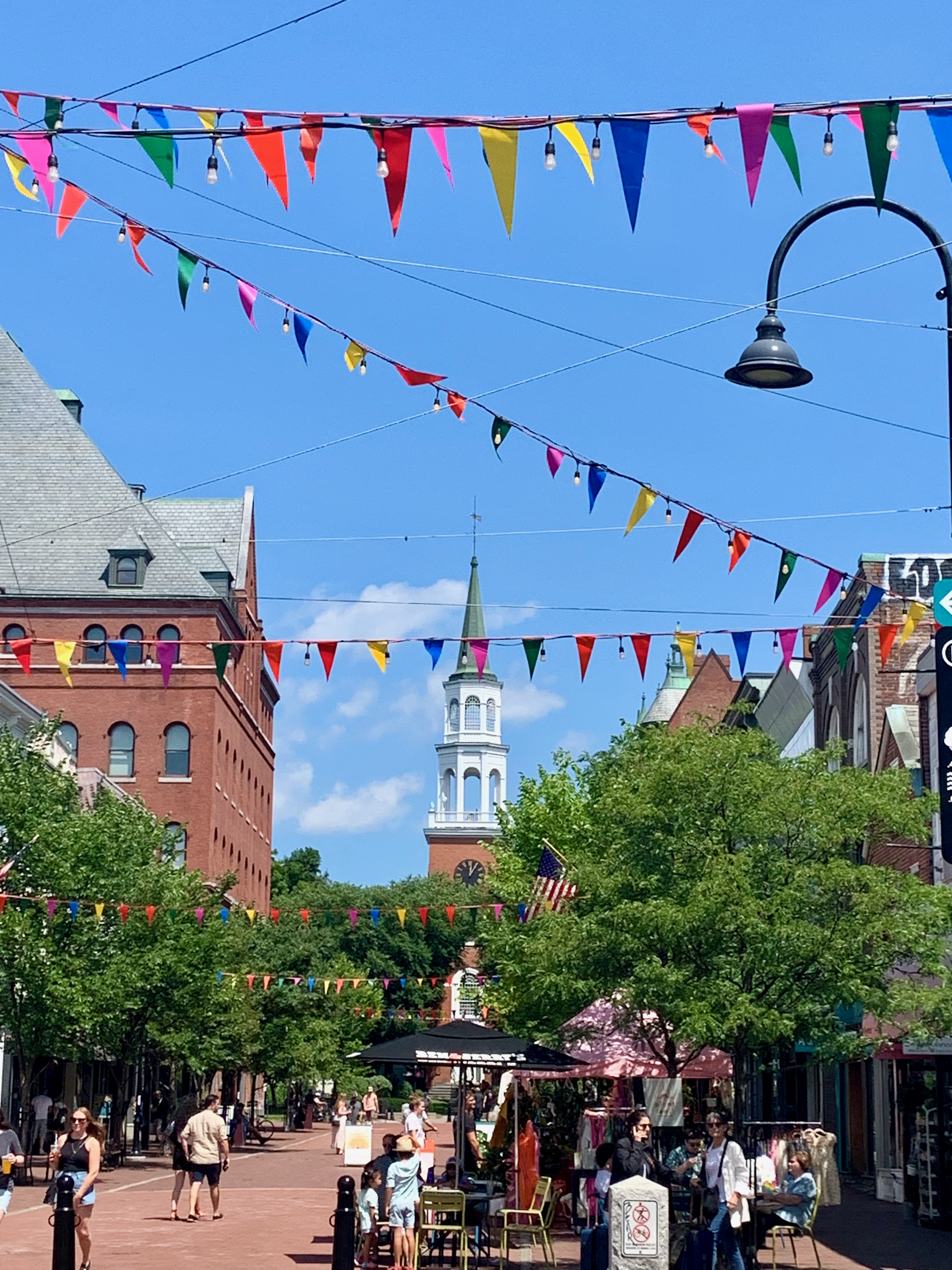
I’ve spent less time in Vermont than any other New England state, and had never traveled north of The Vermont Country Store in Weston. To rectify that, Steve and I recently visited Burlington over a long weekend. The city’s Church Street Marketplace (above) was bustling on a near-perfect Saturday afternoon.
At one end of Church Street there’s (naturally) a church: the First Unitarian Universalist Society of Burlington, built in 1816.
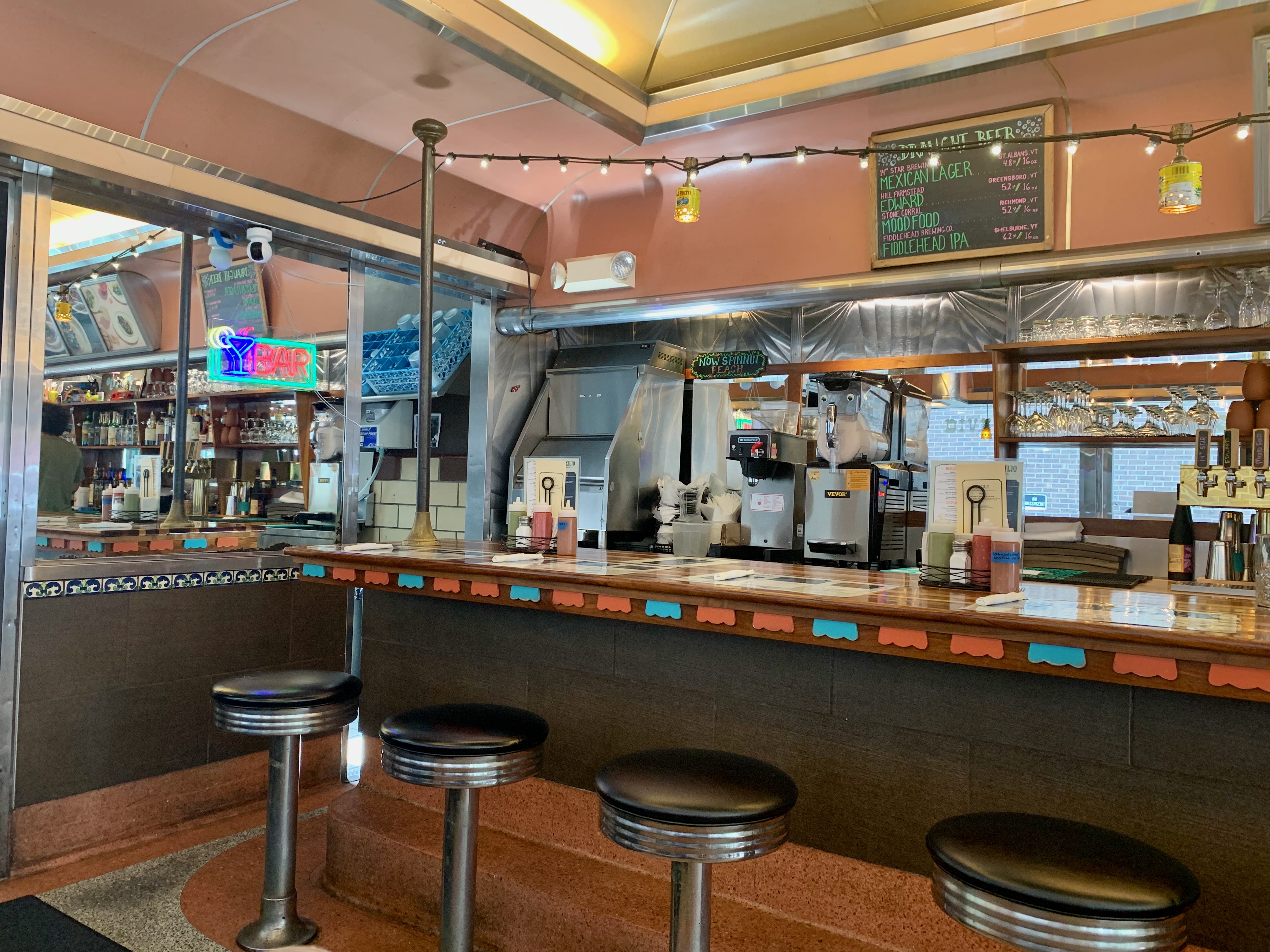
We had an excellent lunch at El Cortijo Taqueria, a Mexican joint housed in a 1950s boxcar diner just off the Marketplace on Bank St. The sort of place one would expect to find in New Mexico rather than Vermont, each table had plastic squeeze bottles of red and green chiles; the side of roasted potatoes are among the best I’ve ever tasted.
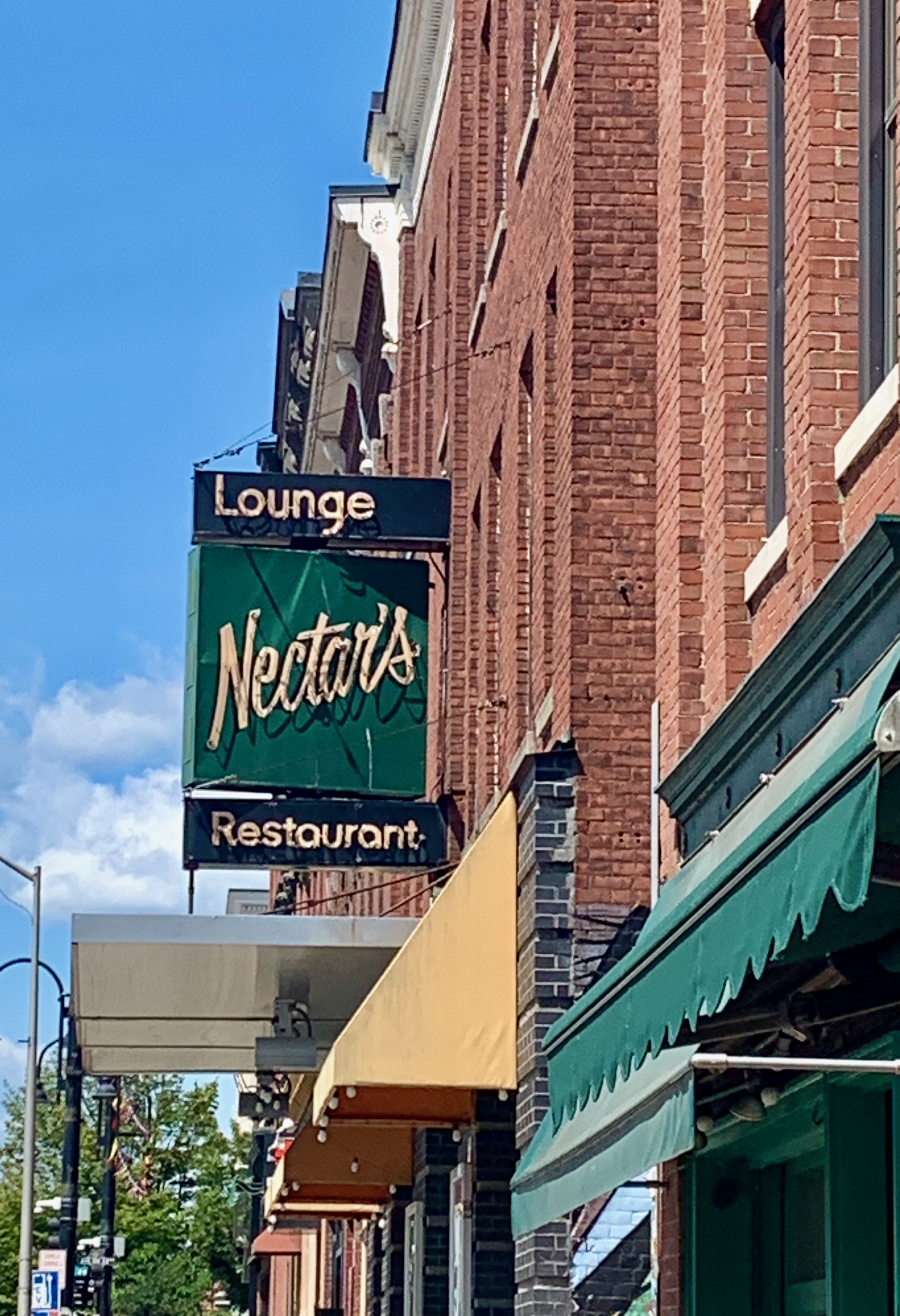
On the other end of the Marketplace (opposite the church), I immediately recognized Nectar’s as the venue Phish played in their early days and later referenced on their 1991 album A Picture of Nectar (yes, I was a fan (if not a full-on Phishhead) briefly in college.)
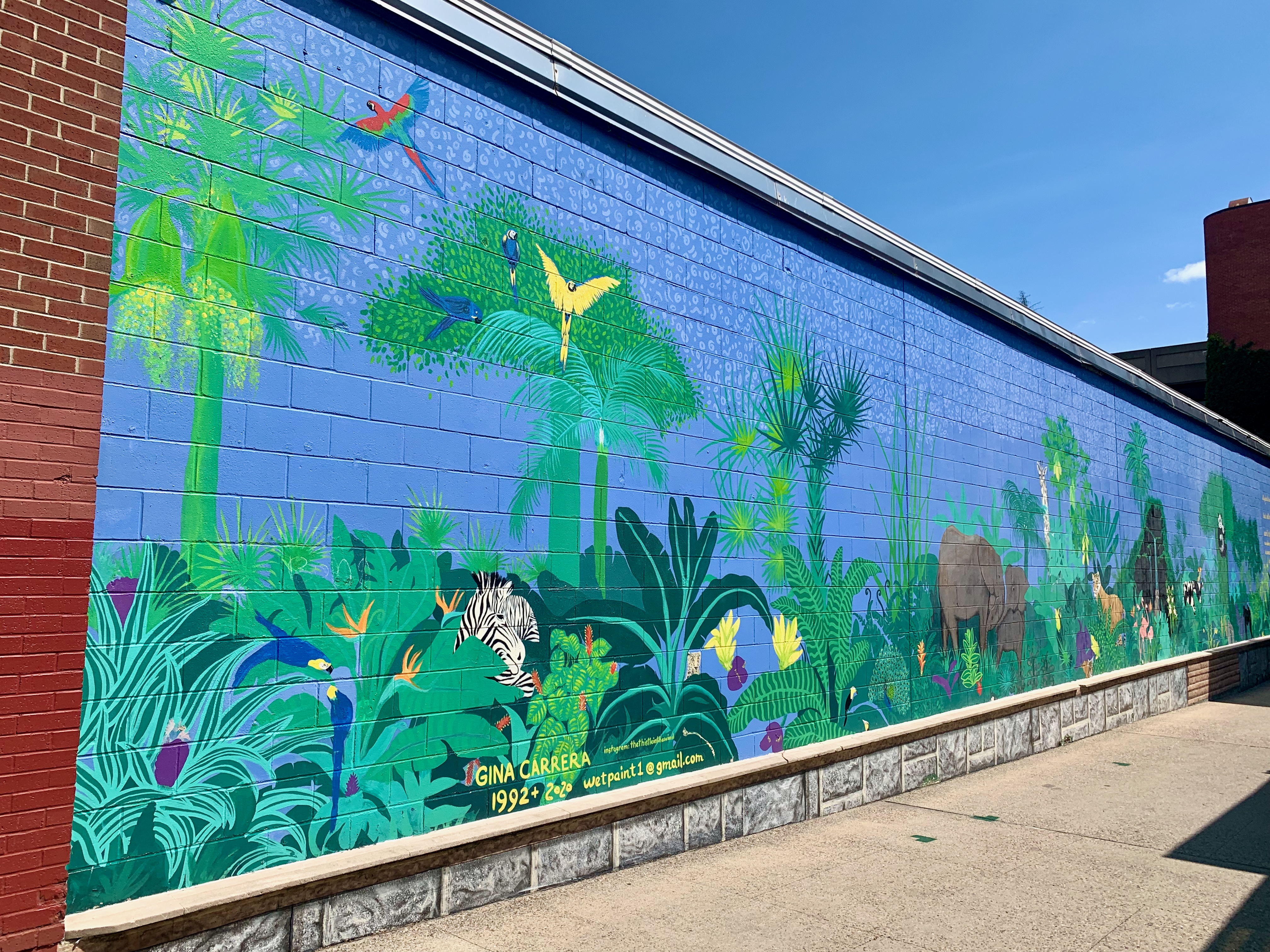
Although it has a few vacancies here and there, the mall on the whole is vibrant, made even more so by the occasional colorful mural (such as this one on Leahy Way) and public artworks.
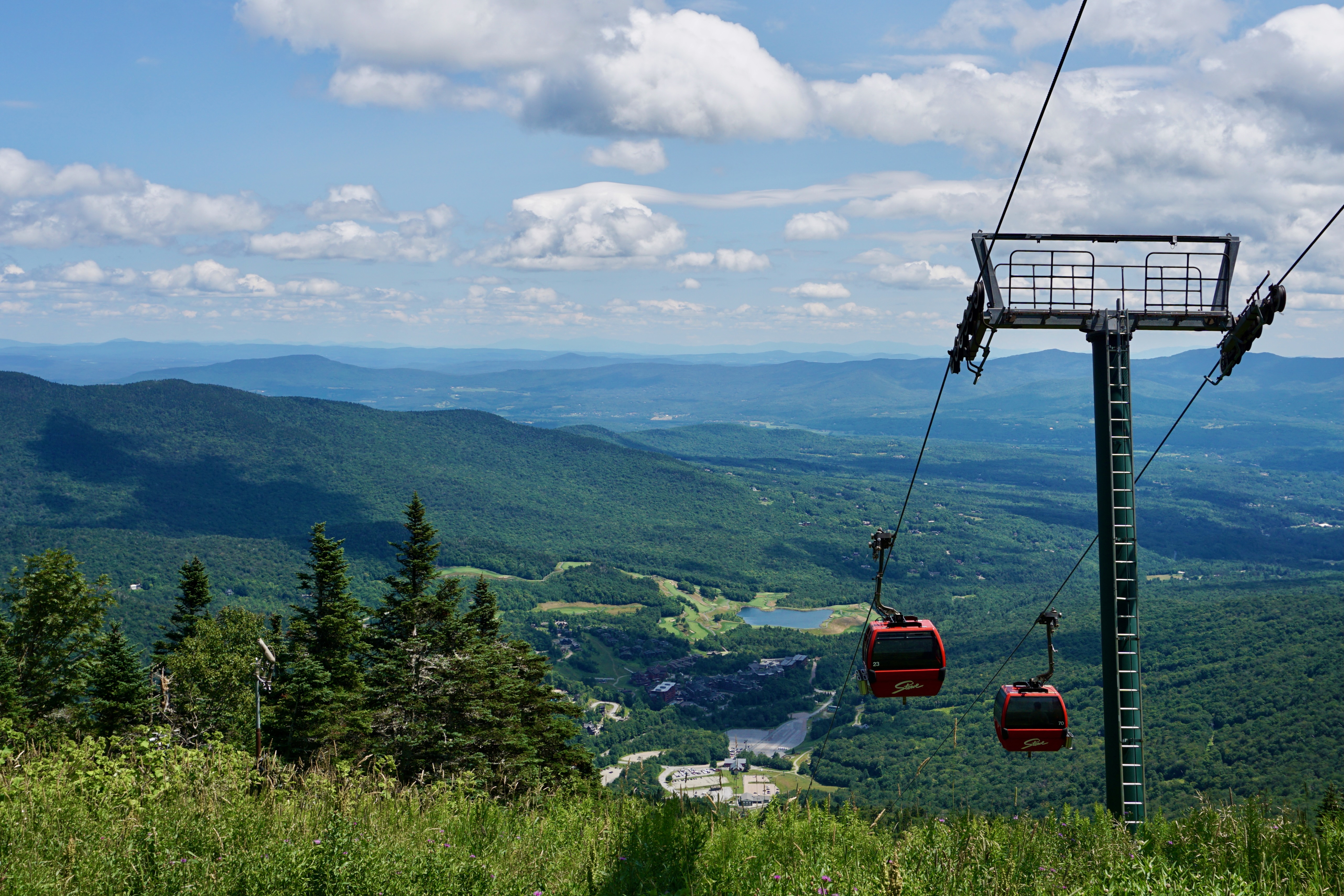
On Sunday, we drove east to Stowe Mountain Resort.
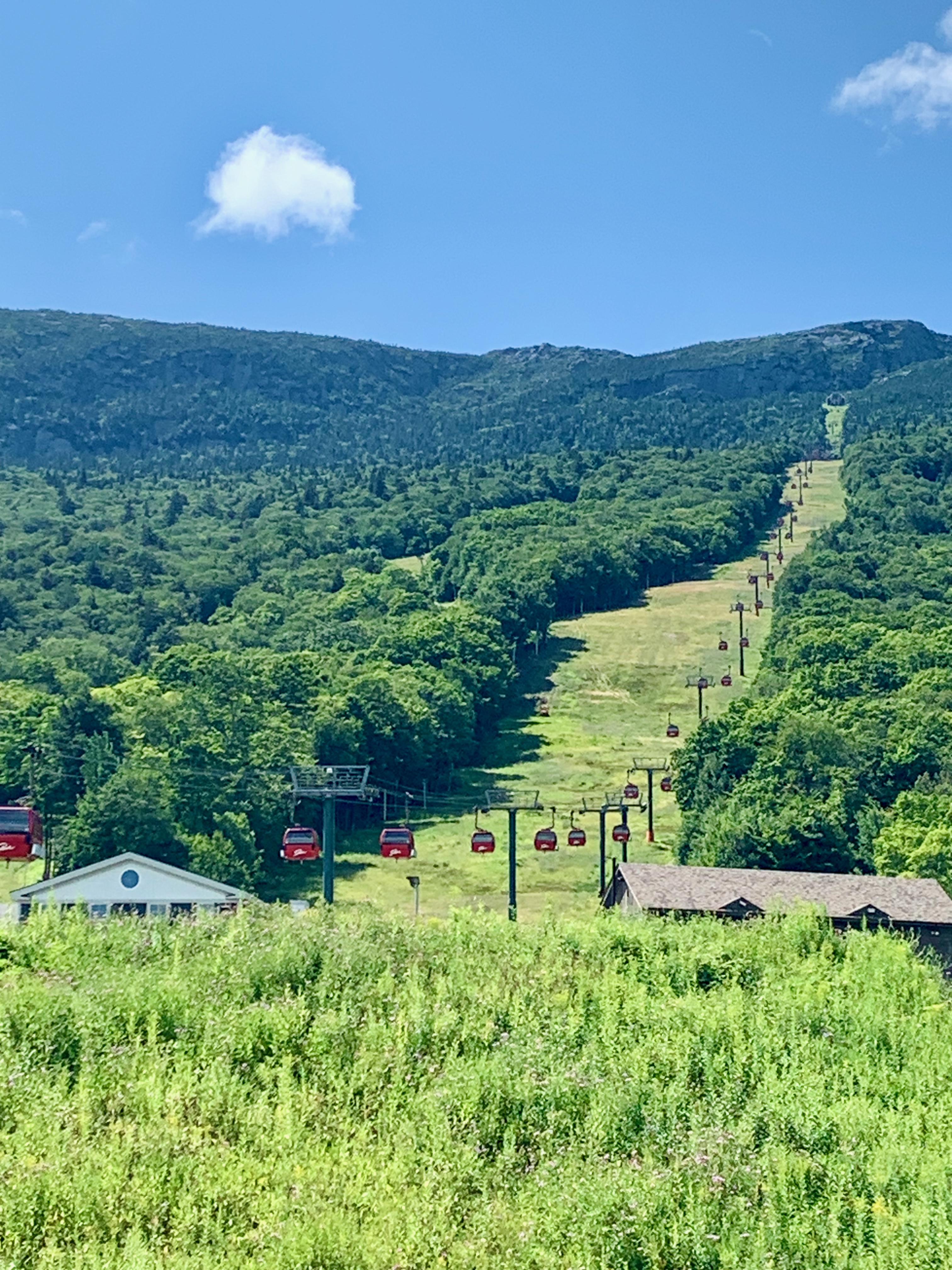
Primarily a ski haven, in the off season, one can still pay to take a gondola ride to the top of Mount Mansfield.
Years have passed since we’ve been at such a high elevation–the last time was nearly a decade ago at Rocky Mountain National Park.
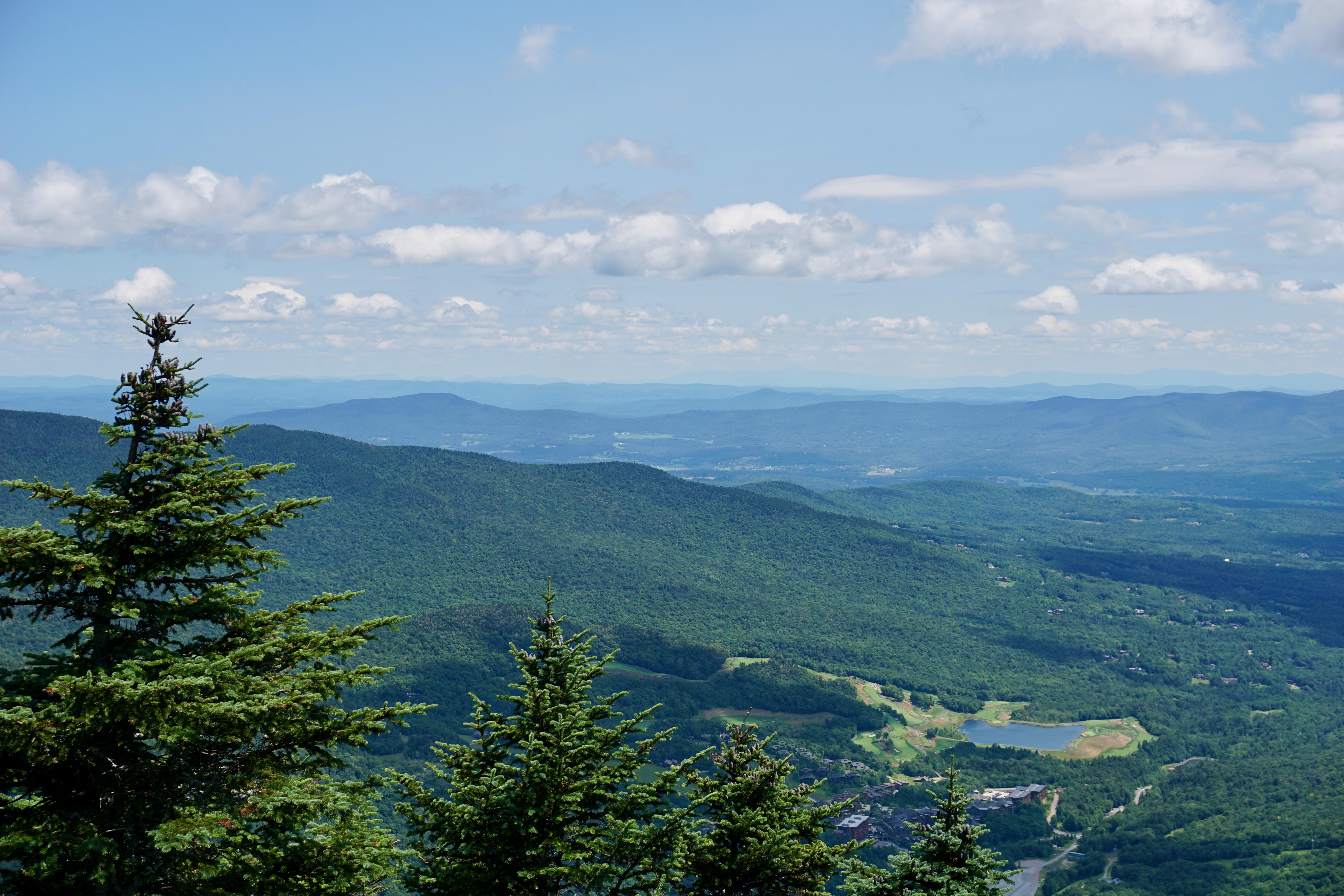
The view from the top – elevation 4,393 feet, according to the location determined by one of my Instagram posts from here.
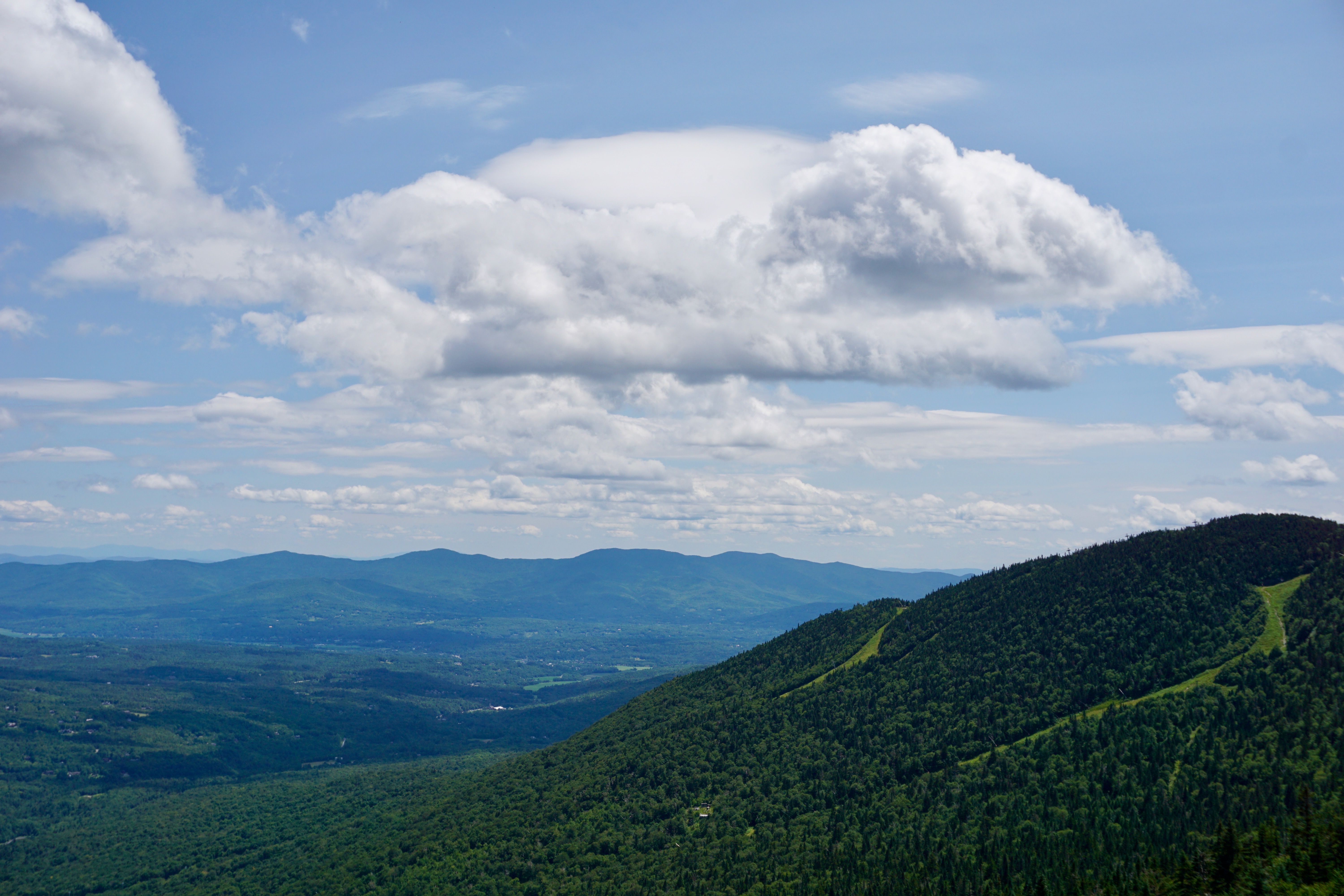
Another view. While not as mighty as the Rocky Mountains, the Green Mountains are spectacular in their own right (and undeniably green.)
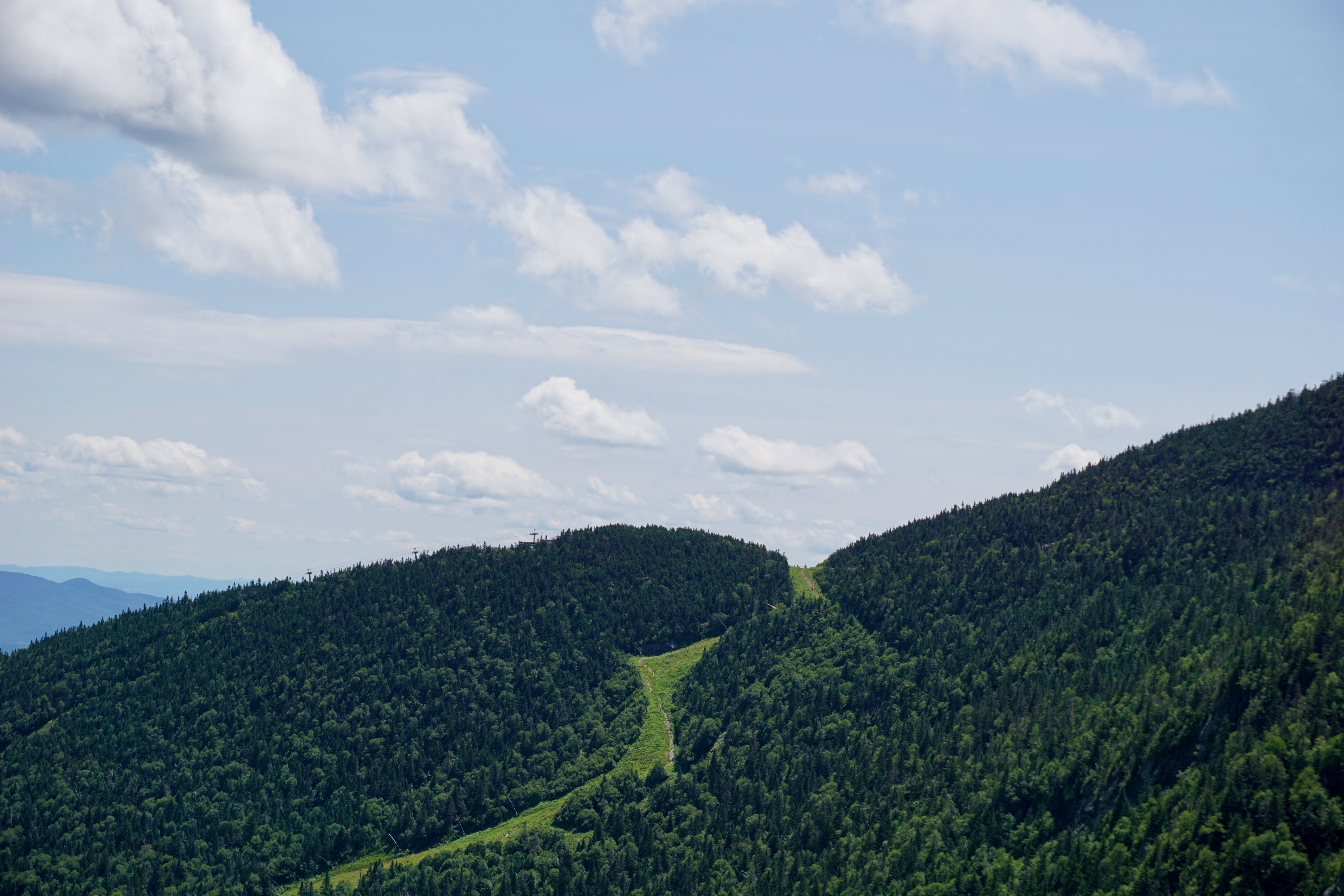
Assuming that this is a ski path–I’ve only gone cross-country skiing before, so I can just imagine the thrill (and terror) of traveling down this at rapid speed.
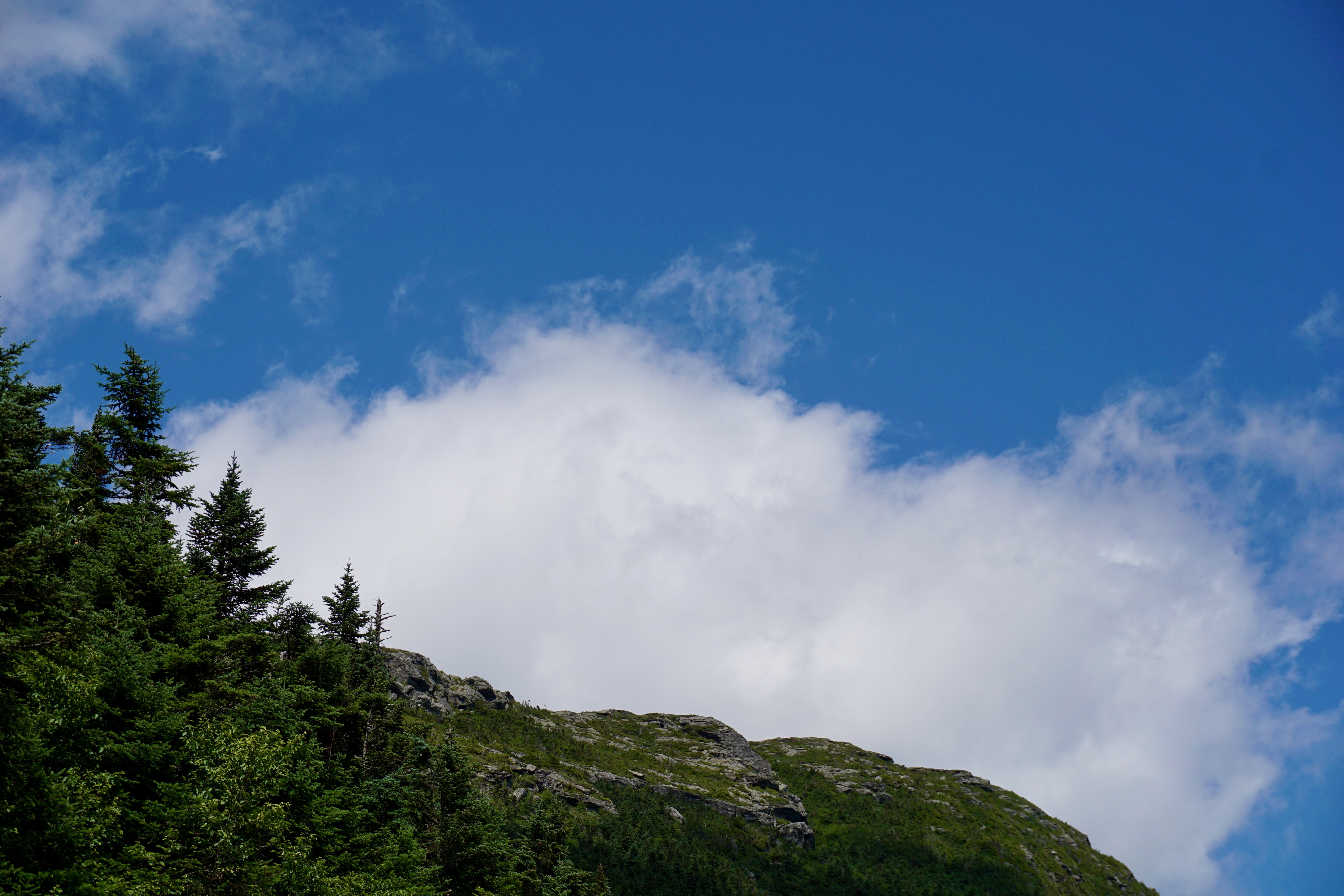
Pine trees, fluffy white clouds and expansive blue skies–what more does one need?
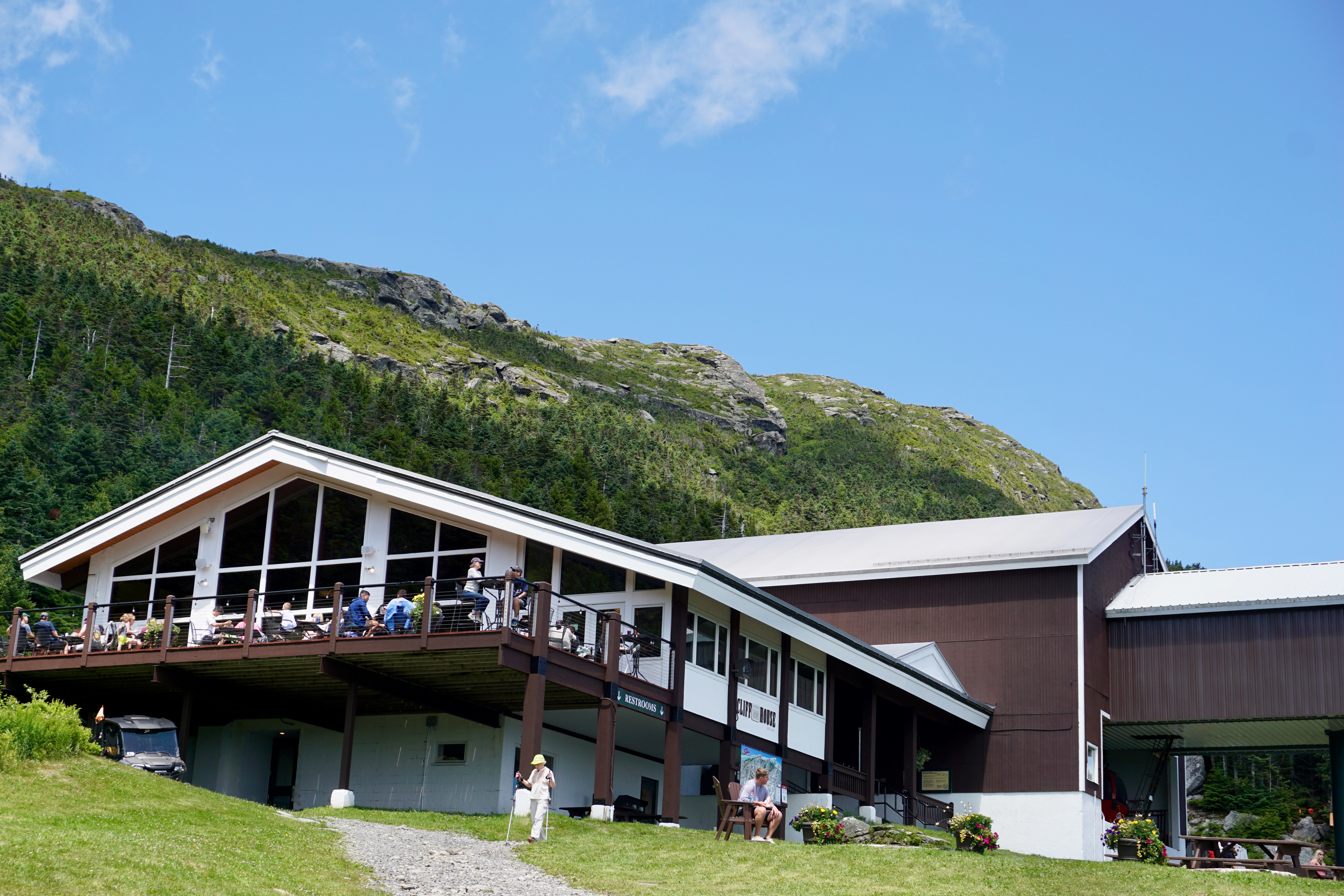
How about the Cliff House restaurant? Currently open only for lunch, we did not partake though I’ll bet it’s cozy in the winter. We could hear an assortment of 70s/80s soft rock standards wafting through the air from its direction, including “You Light Up My Life” which I haven’t encountered in the wild in at least three decades.
Waffles were also available, albeit without Cliff House-style views.
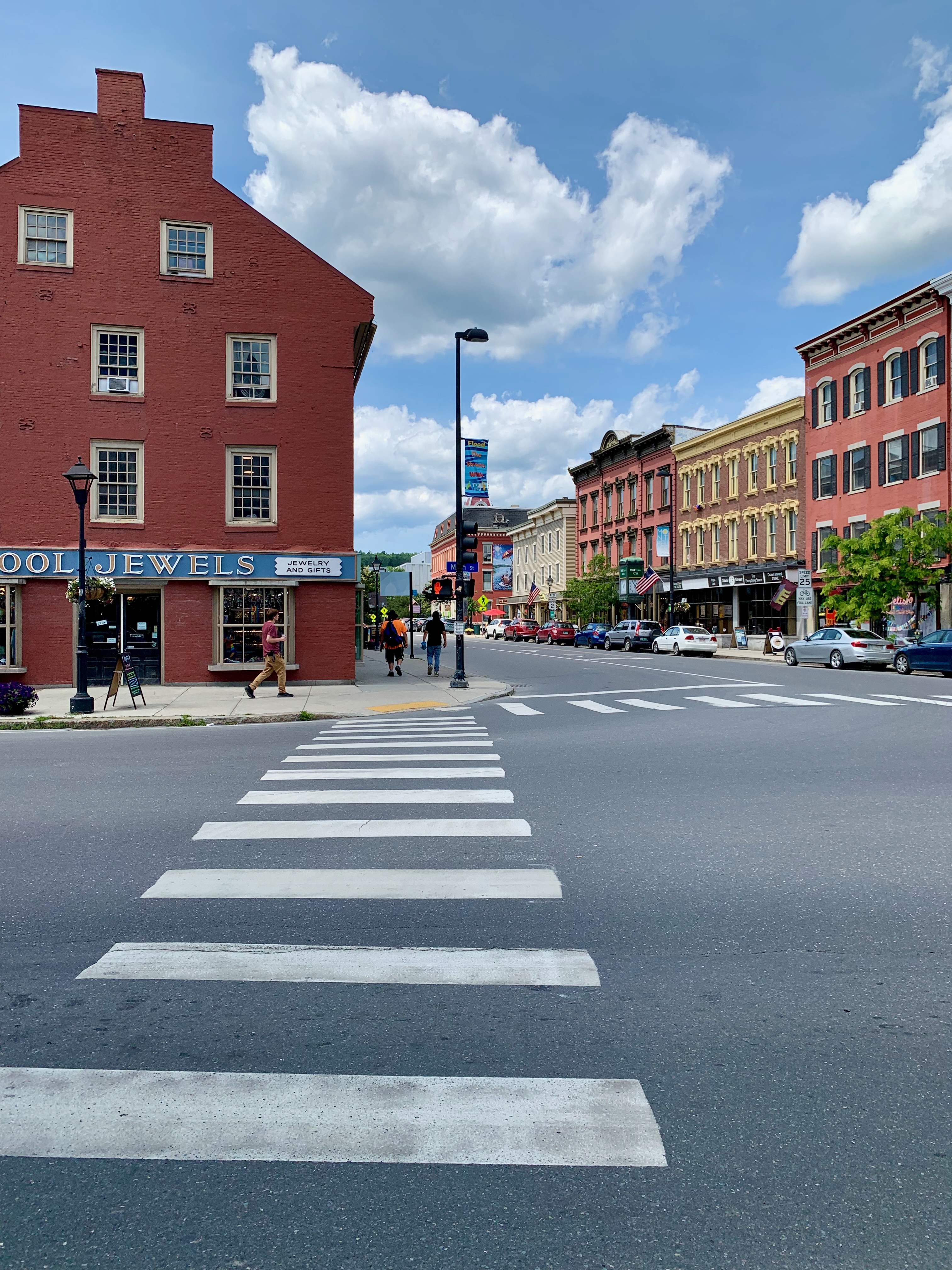
Monday, on our way home, we stopped for lunch in Montpelier, about 40 miles east of Burlington. The smallest state capital in the country, it’s an immensely charming little town.
Lunch was at Sarducci’s, a popular Italian place with a covered porch offering views of the Winooski River.
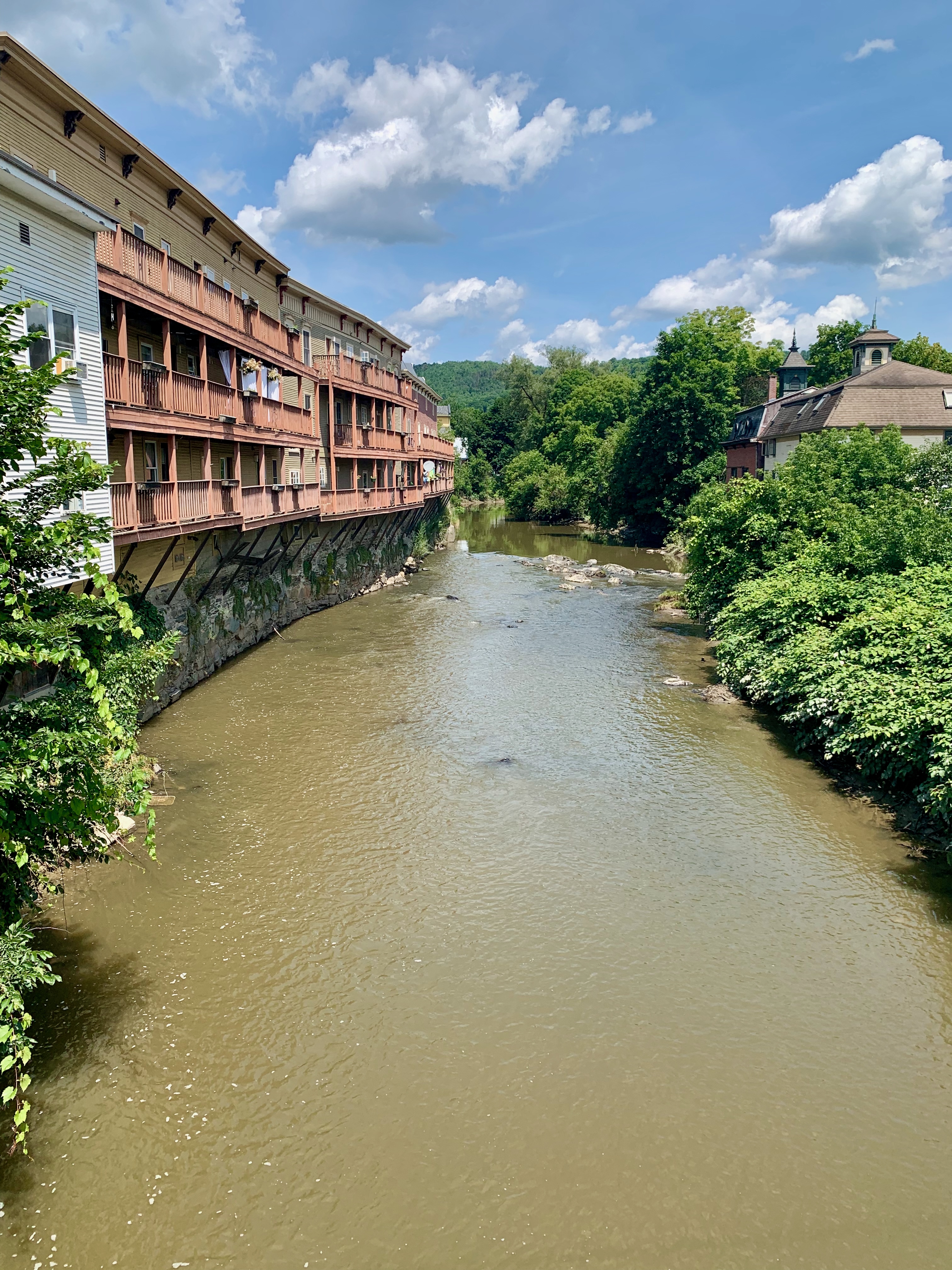
The Winooski runs through Montpelier, affording plenty of opportunities for photographers.
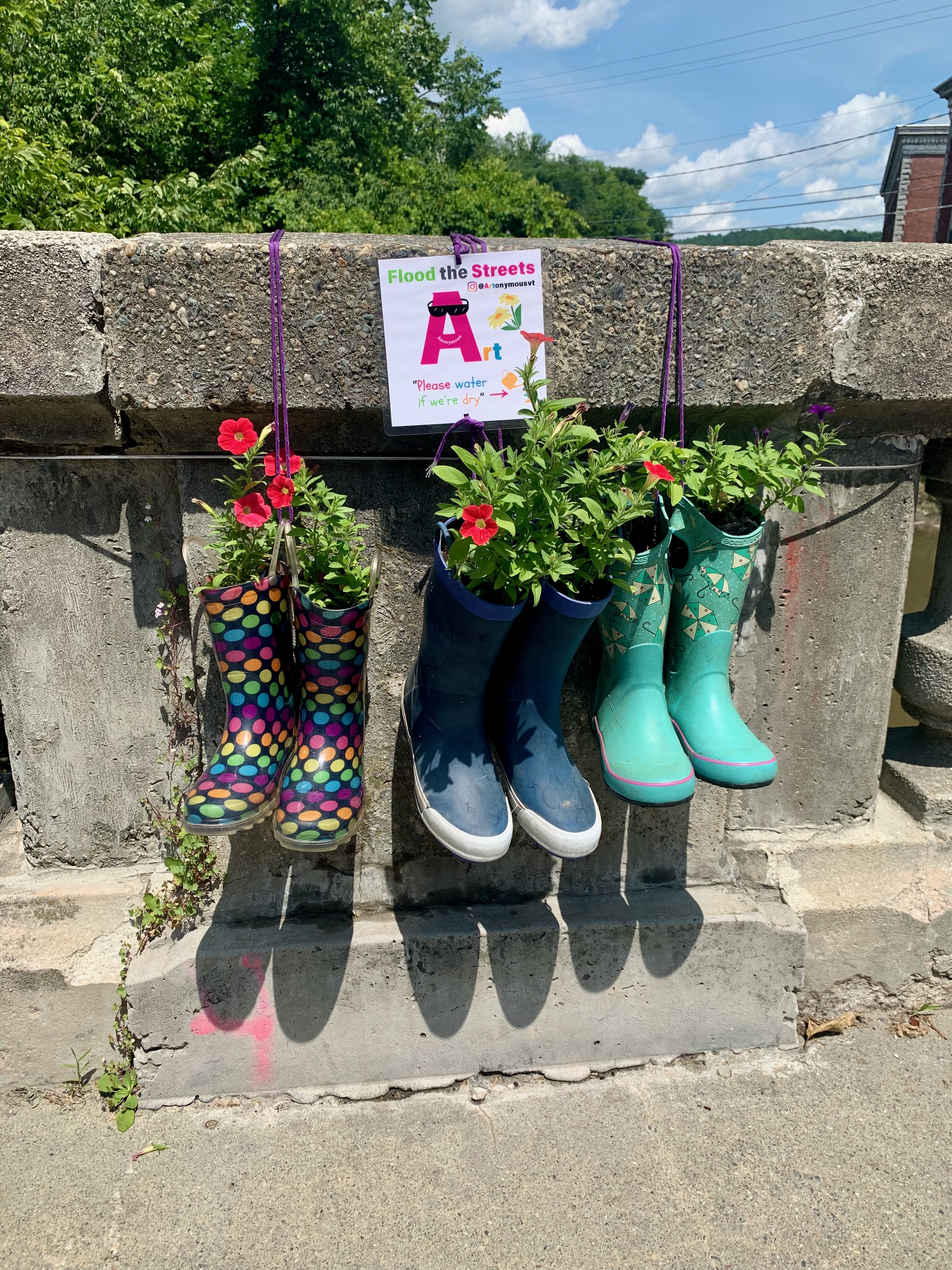
Flood The Streets With Art, an event celebrating the one-year anniversary of the Montpelier Flood, had to be rescheduled due to some additional flooding the week before. It would never occur to me to plant flowers in rubber boots, but it’s kind of an ingenuous idea.
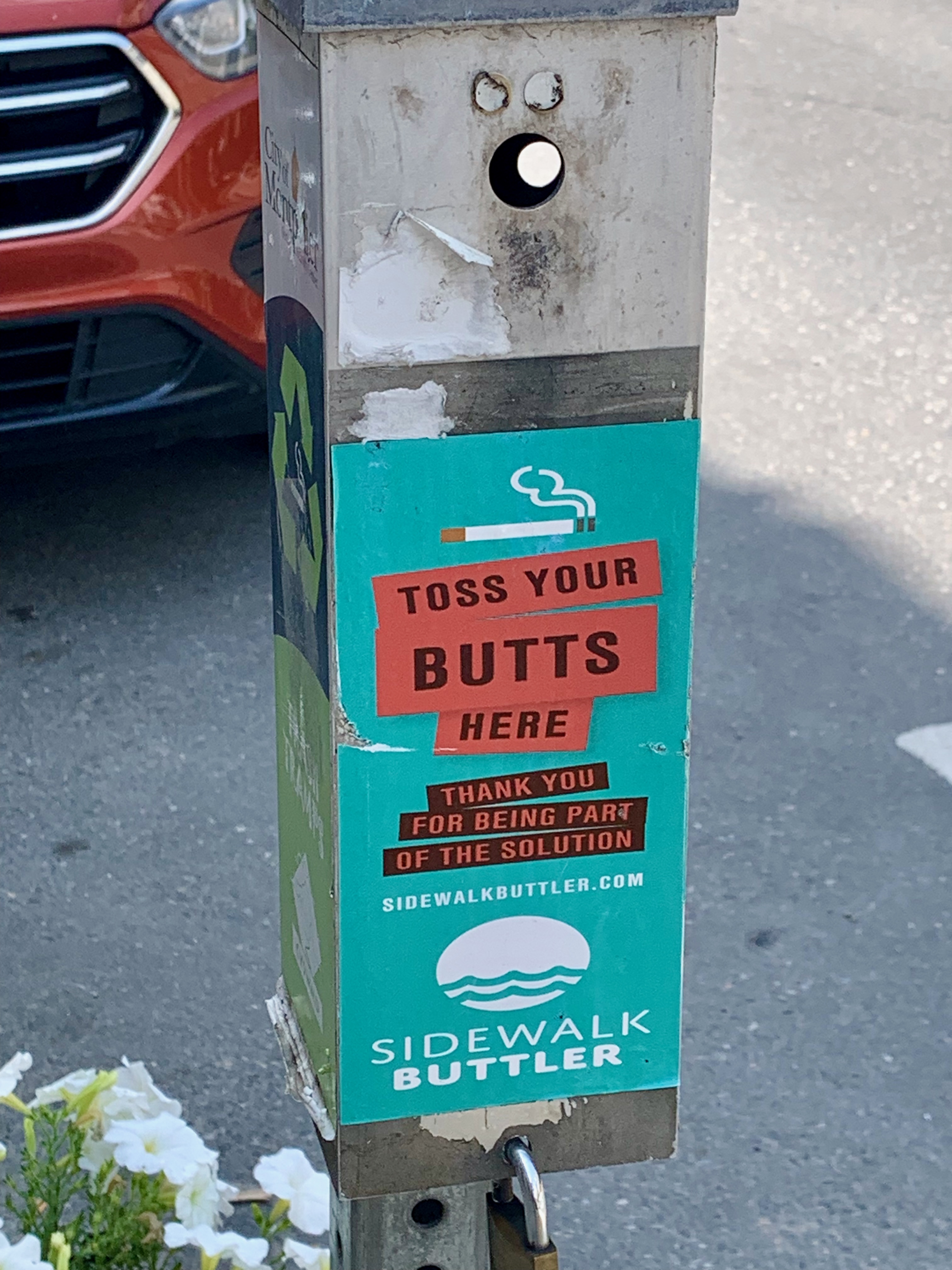
I have no notes or complains about the “Sidewalk Buttlers” present throughout downtown Montpelier.
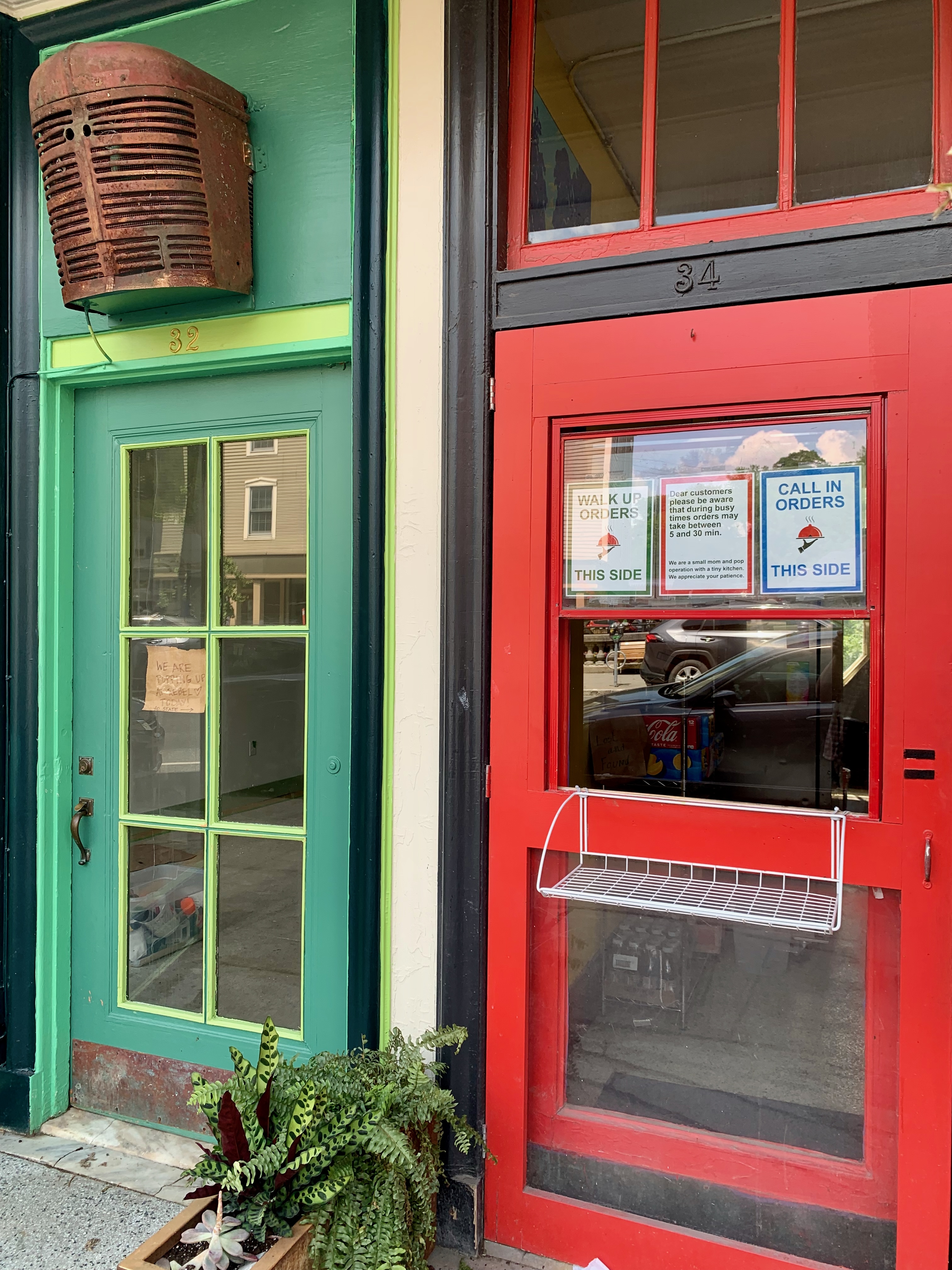
I also always encourage front doors painted in a variety of bright, bold colors.
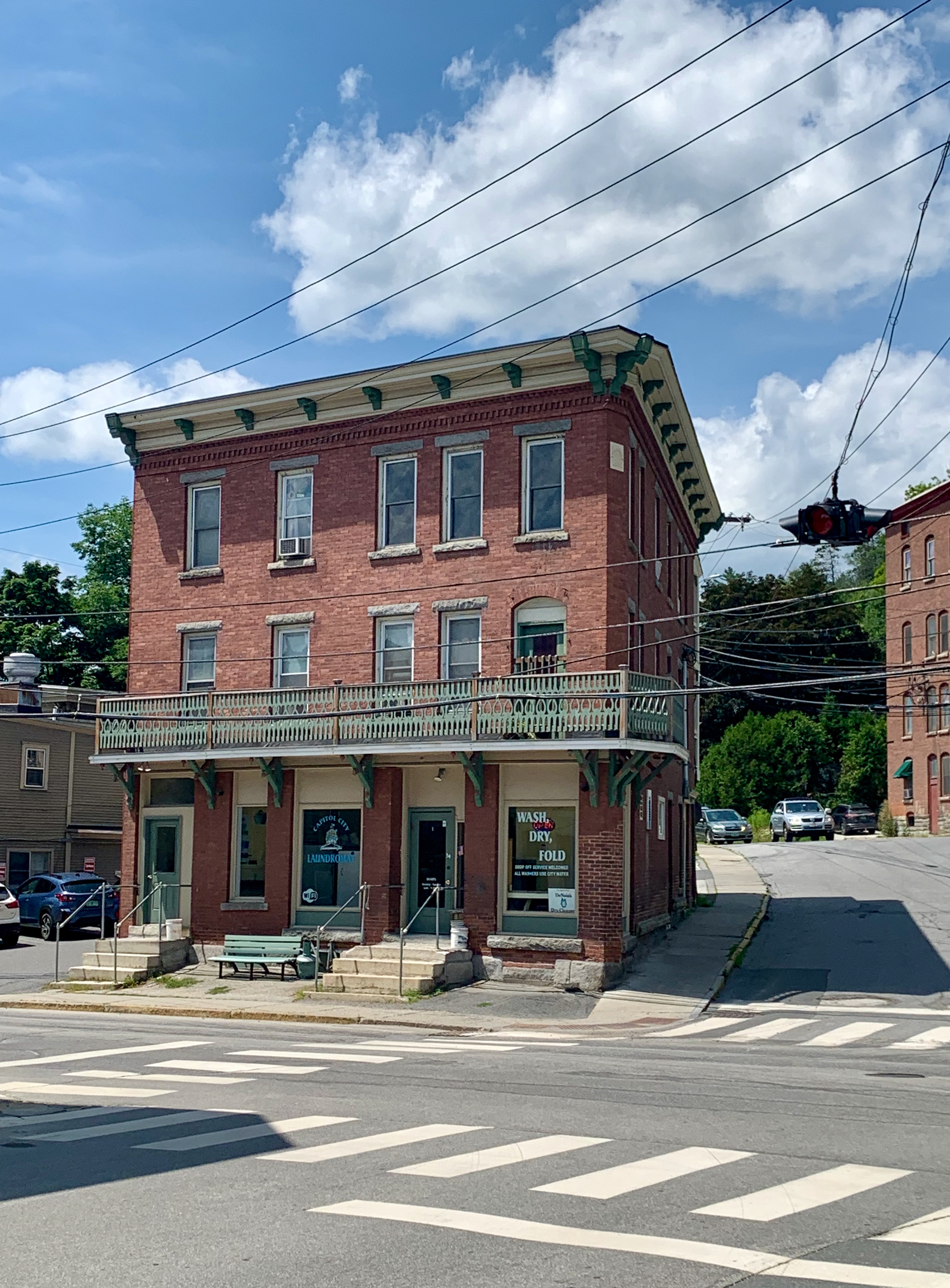
Down the block from the second picture of the Winooski River above, this ancient corner building caught my eye: quintessential small town, working class New England.
Before signing off, let’s go back to this sunset from Friday night, taken at a supermarket parking lot in suburban Williston near our hotel. While in my opinion Vermont doesn’t offer as much variety as Maine or coastal Massachusetts, I knew the longer trip up from Boston was worth it once I saw this tableaux with New York’s Adirondack Mountains in the background.
I’ve already referenced (via my essay on Want One) just how much music I was listening to in 2003—truly the era of Peak CD for me. Between a major move across town and commencing a short-lived website reviewing gig, it was a busy, heady time, with music remaining one of my few constants (the other being movies.) On that note, some of the more obscure tracks here are from records I was assigned to review: A Northern Chorus’ Smiths-worthy jangle/pastoral instrumental, Troll’s demented, inexplicable noir rock en Espanol (I think), singer/songwriter Rosie Thomas (kind of an indie Shawn Colvin), Egyptian-Belgian diva Natasha Atlas, the inimitable Arab Strap (immortalized in a Belle and Sebastian album title five years before) and the generally forgotten Oranger, whom managed to pull off the neat trick of sounding like XTC, Jellyfish and The Banana Splits all at once.
The three dozen tracks below are but the cream of a bounty of songs that received many spins on my navy blue Sony Discman at the time; I could have easily included another dozen (yes, subsequent playlists will be at least this long.) Thumbing through the below tracks, there’s only a few I didn’t hear until more than a year later, most notably The Radio Dept. when “Pulling Our Weight” resurfaced on the Marie Antoinette soundtrack in 2006. The rest predominantly represent the very best of that era’s indie pop, from relative veterans like the Nick Rhodes-produced Dandy Warhols and the magnificently cursed Wrens (they would never complete a follow-up) to next-big-things TV On The Radio (their Young Liars EP also a discovery via assigned review-writing), Sufjan Stevens and Yeah Yeah Yeahs.
In 2003, I was over the moon for both Death Cab For Cutie and The Postal Service, even if Ben Gibbard’s twee voice now feels a little too earnest for middle-aged me (although Death Cab has produced enough songs for a killer Greatest Hits album since then.) Fortunately, this year also happens to have two tunes I’d happily bring along to a desert island: The Shins’ Nilsson-esque chamber pop wonder “Saint Simon” and Canadian outfit Stars’ immortal, resplendent “Elevator Love Letter”, which saved my life more than The Shins or even The Smiths ever did.
2003: My Office Glows All Night Long
The New Pornographers, “The Laws Have Changed”
The Radio Dept., “Pulling Our Weight”
Calexico, “Quattro (World Drifts In)”
Rosie Thomas, “I Play Music”
Basement Jaxx with Lisa Kekaula, “Good Luck”
Arab Strap, “The Shy Retirer”
Steve Wynn & The Miracle 3, “The Ambassador of Soul”
The Postal Service, “Such Great Heights”
Nelly Furtado, “Explode”
Beth Gibbons and Rustin Man, “Tom The Model”
Natacha Atlas, “Eye of the Duck”
Black Box Recorder, “The New Diana”
The Hidden Cameras, “A Miracle”
Ted Leo and The Pharmacists, “Where Have All The Rude Boys Gone”















 Haunted Jukebox