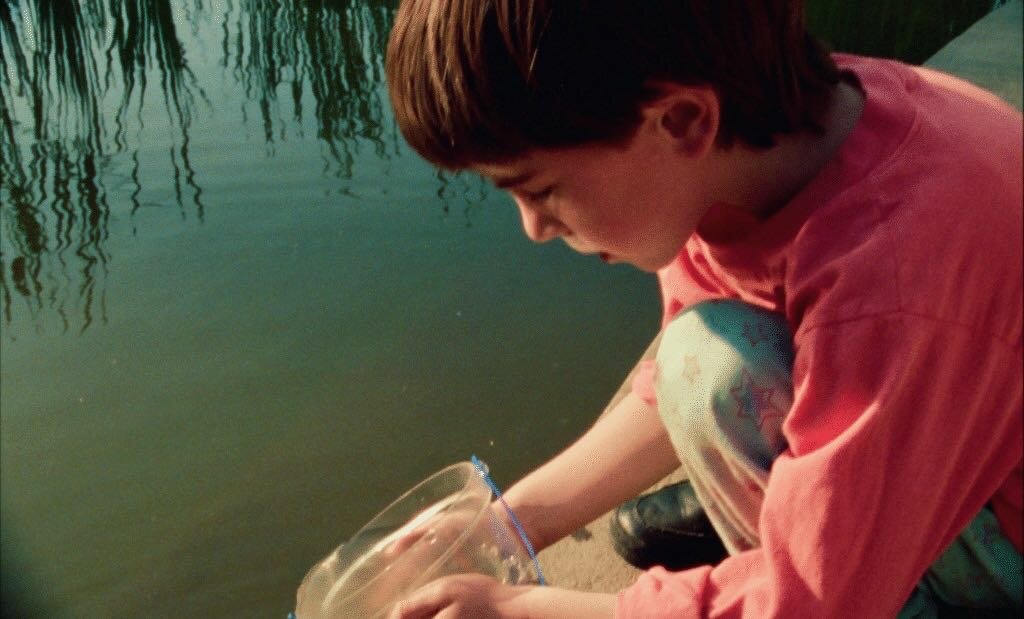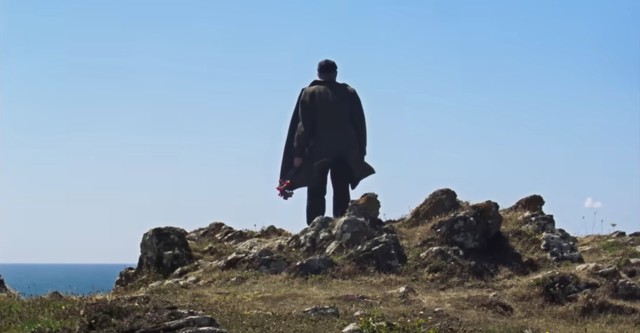
Honorable Mentions: Bad Day At Black Rock, The Desperate Hours, Marty, Ordet, Rififi
For My Watchlist: Floating Clouds, Mr. Arkadin, Picnic, The Seven Year Itch, To Catch A Thief
*
Going back to the year of Back To The Future and it feels as transitional a time as it was for music, with cinema from all corners of the globe increasingly giving Hollywood product a run for its money. I’ve previously written about recent discoveries of the former (a revelatory 35mm screening of Pather Panchalilate last year) and the latter (a viewing ofIt’s Always Fair Weather at home during peak lockdown when a scheduled screening was supposed to have occurred in normal times.)
Still, masterpiece that Satyajit Ray’s film is, the pole position goes to actor Charles Laughton’s sole directorial effort, a gothic thriller that flopped upon release but is now rightfully revered. Robert Mitchum’s “Preacher” (note quotation marks) is a delectably sinister and chilling character and performance. One could easily imagine a version of this made by Alfred Hitchcock, but Laughton imbues a tenderness that often seems beyond the former’s grasp (though his mordant comedy from the same year, The Trouble With Harry has faint traces of it); the film’s expressionistic style (particularly the high contrast black-and-white cinematography) also sets it apart from Hitch’s contemporaneous efforts (though I can’t say why To Catch A Thief is one of the few peak-period Hitchcocks I have yet to see.)
All That Heaven Allows is my second-favorite Sirk (my number one will likely top its year’s list) and perhaps his most quintessential Rock Hudson melodrama. The Phenix City Story is a startling obscurity that feels all too relevant seventy years on. It’s been too long since I revisited Rebel Without a Cause or Kiss Me Deadly but I firmly recall how iconic they are as, respectively, a teen angst character study and the hardest boiled of film noirs. LesDiaboliques could also use a revisit given my renewed appreciation of Henri-Georges Clouzot since seeing The Wages of Fear for the first time in 2023.
Given what it was competing with, I’m not mad at Marty winning the Best Picture Oscar, though it feels decidedly minor now. Not sure how high my hopes are for Picnic, though it has the enticing prospect of Kim Novak and William Holden as anchors. The Seven Year Itch is one of the few major Marilyn Monroe films I have yet to see, Mr. Arkadin one of the few minor Orson Welles ones. As for Floating Clouds, the only Naruse I’ve watched is Ugetsu which I should rewatch as well—unlike Ozu or Kurosawa, I don’t have a strong impression of him yet.
Taking assessment of my favorite films and albums so far at a year’s midpoint might seem like an irrelevant if not entirely futile exercise, although I’ve done so annually for as long as I can remember. While often interesting and occasionally amusing to look back and see what did or did not eventually make the cut at year’s end six months later, this is above all an opportunity to take stock (and an excuse for another blog post.)
I usually see a few films at local (and sometimes international) festivals that make this cut: I’ve already written on three from this spring’s IFF Boston (see links below); On Becoming A Guinea Fowl I viewed at IFF’s Fall Focus last November and I appreciated it more after a second viewing earlier this month. Thank You Very Much is an underrated Andy Kaufman documentary that could have benefited from a wider release; Grand Tour and Universal Language are both admirably unique concoctions that I won’t forget about come year-end.
As for albums, it shouldn’t come as a surprise that at 50, many of my current faves are from artists my age or older (British jangle-pop quartet The Tubs are the youngest here by a considerable margin.) I would argue that most of these “legacy” acts are churning out some of their best work, a few of which I alluded to in the mix I posted last week. I’ll add that Doves’ Constellations For The Lonely mightend up my favorite single new album since my number one of 2023. Even though following their debut Haim has made a stronger case as a singles than albums act, after two full spins, I Quit is cohering better than I anticipated it to.
Favorite Films of 2025 so far (alphabetical by title):
Honorable Mentions: The Hanging Garden, The Ice Storm, Nowhere, Princess Mononoke, Romy and Michele’s High School Reunion
For My Watchlist: The Butcher Boy, Gattaca, The Life of Jesus, Public Housing, Xiao Wu
*
During this great transitional year (got my BA from Marquette, moved across the country to attend grad school at Boston University), The Sweet Hereafter was a revelation. Already drawn in by all of its glowing reviews, I saw at the Oriental Theatre in Milwaukee when home for Christmas break with a friend whose motivation to watch it with me was solely due to its enigmatic poster. As eye-opening as anything I’d seen in my first semester of studying film, I watched all of Atom Egoyan’s previous six features within the next six months. Briefly a candidate for 24 Frames (I ended up writing a little about it in my essay on star Sarah Polley’s own film Stories We Tell), it still stands (along with 1994’s Exotica) as Egoyan’s peak, the place where all of his obsessions coalesced into one of the best book-to-film adaptations of all time.
Paul Thomas Anderson went on to direct at least five features I’d rank above his second one, Boogie Nights, but what a breakthrough, the real fulfillment of auteur-driven studio pictures that Pulp Fiction promised a few years earlier. To express the visceral charge of being in love with cinema and also being able to back that up with the level of your craft is still a rare accomplishment; perhaps due to its length, I don’t revisit it as often as I should (speaking of Tarantino, Jackie Brown, in my mind his last great film until Once Upon A Time in Hollywood, also applies here.)
While making my way through the Wong Kar-wai box set a few years ago, Happy Together, which I hadn’t seen since its original release was the nicest surprise, intriguingly looking forward to his masterpiece In The Mood For Love; Henry Fool, rewatched in late 2023 when nearly all of Hal Hartley’s work was streaming on the Criterion Channel is by far the best of that trilogy (and maybe his last great work?) Grosse Pointe Blank and Romy and Michele remain solid comfort-food watches (I suspect L.A. Confidential would as well); I should also revisit Taste of Cherry since I now understand its cryptic ending (on first watch, my reaction was, “Wait, what did I miss? It just… ends, like that?”) As for Tsai Ming-liang’s long-unavailable The River, at this writing it’s streaming (with commercials!) on something called Plex which may be my best option to see it again (not holding out for hope for a public screening on 35mm anytime soon.)
Somehow, I never got around to The Butcher Boy or Public Housing despite having numerous opportunities to do so (I might’ve taped the latter, one of Frederick Wiseman’s marathon-length documentaries off of PBS at one point.) Hoping to see Xiao Wu soon in kicking off a chronological watch of Jia Zhangke’s back catalog inspired by his latest, Caught By The Tides.
Time for a new occasional feature! Enhanced by the increase in movie watching at home I’ve undergone in the past five years, I’ll pick a year from the last century (not in chronological order), list my ten favorite films, a few honorable mentions and five titles I haven’t seen but want to watch. Kicking this off by turning back the clock to my birth year—1975’s often seen as a nadir of pop culture, but as a possible refutation, look at this list:
Monty Python and The Holy Grail
Dog Day Afternoon
Nashville
Grey Gardens
Night Moves
The Passenger
Picnic At Hanging Rock
Fox and His Friends
The Rocky Horror Picture Show
Smile
Honorable Mentions: Jaws, Jeanne Dielman, Mirror, Mother Kusters Goes To Heaven, One Flew Over The Cuckoo’s Nest
For My Watchlist: The Adventure of Sherlock Holmes’ Smarter Brother, At Long Last Love, A Boy and His Dog, Cooley High, The Story of Adele H.
*
Of course Monty Python and The Holy Grail would always end up my number one given the impact it had on my film vocabulary but Dog Day Afternoon is a close second. I revisited it about two years ago and noted that anyone looking to make a heist picture or a character study should retain all of it for future reference. Al Pacino should have also won the Oscar that year (Jack Nicholson, winner for One Flew Over The Cuckoo’s Nest arguably gave a worthier performance in The Passenger, possibly my favorite Antonioni after Red Desert) and the film’s handling of his character’s fluid sexuality is decades ahead of its time.
Nashville could’ve also been a serious contender for #2 but unlike Dog Day Afternoon, I haven’t seen it in nearly two decades. I could also stand to revisit Grey Gardens although I’m staunch (S-T-A-U-N-C-H!) in the feeling that I could remember it by heart. Night Moves, a more recent first-time watch was nearly Royal Tenenbaum, PI and I hope it’s becoming more widely seen given Gene Hackman’s recent passing. May Michael Ritchie’s perceptive beauty pageant satire Smile achieve the same status once Bruce Dern inevitably kicks the bucket.
Some may scoff at Rocky Horror’s inclusion but I’ve come to appreciate it as a genuinely good film with great music and iconic performances whose only sin is that it can’t sustain such more-ness all the way through to its somewhat ridiculous final act. It’s certainly classier than the two go-for-broke stinkers Ken Russell (whose other work from this period will likely make some of my top tens!) released this year: the overrated kitsch-fest Tommy and the justly obscure Lisztomania.
Someday I’ll give Sight and Sound grande dameJeanne Dielman another viewing; I’ve recognized its worth but have also struggled with its endurance-test construction; I’ll likely check out Francois Truffaut’s The Story of Adele H. first or even Gene Wilder’s directorial debut which I have measured expectations for despite his singularity as a performer.
I knew nothing about Gallaudet University, a liberal arts college in Washington DC for the deaf and hard of hearing; nor was I familiar with the 1988 eight-day, student-led protest against the appointment of a non-deaf president instead of two other deaf candidates. Going in cold to a story like this is obviously the most effective way to experience it but the retelling of this incident is so well-crafted that it has that rare potential to enlighten possibly even those who lived it first-hand.
Co-directed by model/activist Nyle DiMarco, who is deaf and David Guggenheim (WAITING FOR SUPERMAN), who is not, DEAF PRESIDENT NOW! similarly feels like a bridge made to represent the deaf community and educate everyone else. While the filmmakers are privy to and make good use of an excess of archival footage of the protest (which occurred at a time when camcorders made such widespread documentation possible), it’s the modern-day interviews with the four student protest leaders that add context and resonance. Some may question the addition of voiceovers accompanying the subjects’ signing to the camera when subtitles are also present for a non-signing audience but as a concession to making a more accessible film for that very audience, it’s not a distraction; neither is the elaborate put-a-hearing-person-in-a-deaf-person’s-ears sound design. More important is how the film details this community coming together, especially viewed at an age this removed from an era in which said community was viewed much differently and often detrimentally from the outside.
This is the rare feel-good documentary that’s genuinely inspiring without coming off as cloying while also being informative and entertaining. I don’t often give films 5/5 but by successfully achieving what it wants to do and also through sheer goodwill, this one earns it.
SORRY, BABY
Movies about trauma are tricky to pull off for obvious reasons: how does one express such discomfort, anger, sadness and fear to an audience without alienating them or coming off as a weight that’s too much to bear? Eva Victor, a 30-year-old actress best known for the TV series BILLIONS takes on this challenge not only as a writer/director in her feature debut but also as its star. She plays Agnes, a college professor in a small Maine town (but mostly filmed near Ipswich, Mass.) recovering from a traumatic event whose details are only gradually disclosed. To make such a scenario digestible, Victor infuses the film with a near-caustic humor, dividing in into sections with whimsical titles, gently satirizing such events as an HR meeting with deadpan punchlines and overall gifting Agnes with a persona that leans towards the comedic self-deprecation of a humorist writer like Sloane Crosley or Jessi Klein.
As an actor-turned-filmmaker, Victor is not a revelatory talent such as Greta Gerwig or even the Jesse Eisenberg of A REAL PAIN. Her use of humor doesn’t shy away from the pain Agnes experiences but the muted tone with which she often approaches it doesn’t fully register at times. SORRY, BABY works best when she has a simpatico screen partner to play off of, particularly Naomi Ackie who as best friend Lydie brings warmth but also energy whenever she’s onscreen or the great character actor John Carroll Lynch whose one sequence in the film leaves such an impact one can sense the potential of an entire ancillary feature about his character. The missing-in-action-as-of-late Lucas Hedges also has a small role seemingly crafted to display his natural charm as Agnes’ neighbor. As for Victor, this is a good first effort that mostly works but maybe doesn’t fully live up to the buzz it has received so far. 3.5/5
PEACOCK
Matthias (handsome beanpole Albrecht Schuch) has a most unusual job “renting” himself out to temporarily be whomever one needs him to: whether a friend, son, father or dinner-date companion, he’s a willing blank slate, a cipher who can fulfill any need or role. A great idea in theory but one that has serious complications for his personal life as he can’t stop being whomever anyone wants him to be even when he’s not being asked to perform.
As a zany comedy by design, PEACOCK works best whenever it’s funny; when it tries to aim for something deeper such as pathos, it’s a little wobbly, not fully pulling off the tonal shifts needed to add depth and nuance to Matthias’ plight. Happily, it just ramps up the absurdity in its final act, arriving in a place not far off from Ruben Ostlund’s THE SQUARE, only arguably more inspired (give this to Schuch, he totally commits to the bit.) This won the audience award for Best Narrative feature at IFFBoston this year, which I did not expect but can see why: for all it does to explore the consequences that come from being a likable cipher, the film’s likability (and humor) is perhaps its greatest asset. 3.5/5
HAPPYEND
A terrific sight gag and a newfangled high concept alone do not make for a wholly satisfying narrative from writer/director Neo Sora (RYUICHI SAKAMOTO: AN OPUS). Set in the near-future (though low budget enough that one may not discern this from sight alone), high school students are subject to a Big Brother-esque AI surveillance following a prank that happens to coincide with a series of minor earthquakes portending fears of an upcoming major one. The quieter, more casual moments between childhood best friends Yuta and Kuo suggest Sora has at least learned something from the films of Kore-eda, if not how to economically tell a story. Albeit an interesting mix of humanist drama and slightly absurdist satire, HAPPYEND is less notable for its accomplishments (the sight gag is pretty inspired, after all) and more for what it could have been. 3/5
Another IFFBoston, another eight movies seen. My reviews of the first four.
CAUGHT BY THE TIDES
Jia Zhangke (MOUNTAINS MAY DEPART) will never run out of ways to explore rapid change in 21st Century China or roles for his muse Zhao Tao to excel in, thank god. His latest partially distinguishes itself from previous efforts by literally going back to them, incorporating scenes and outtakes from UNKNOWN PLEASURES (2002) and STILL LIFE (2006) along with newly-shot footage to track how much China and, in particular, the Northern city of Datong has reconstructed itself between then and now in part due to the Three Gorges Dam project that the 2006 film centered on.
Using the same actors (Tao and Zhublin Li) and reediting the earlier footage (with help of some intertitles that refashion the earlier stories to relate to the current one), CAUGHT BY THE TIDES is stitched together in a way that often brings attention to its manipulation of time and space for those familiar with the earlier work, although those new to the director’s oeuvre may not even pick up on this. It’s an approach that risks confusion, but that actually might have been Zhangke’s intention. After all, time rarely travels in a straight line; the immersive, collage-like soundtrack which spans copious genres and traditions (East and West) amplifies this sense of impermanence and might be the director’s most ambitious and striking use of music to date. I now want to go back to revisit his strange, rich filmography to see how he arrived here and ponder where he might go next in detailing this world forever in flux. Rating: 4.5/5
PAVEMENTS
Where to begin with PAVEMENTS? Is it a vehicle meant to document the famed 1990s indie-rock quintet Pavement as they reunite and rehearse for a 2022 tour? A biopic of the band casting the likes of Joe Keery and Nat Wolff to play lead singer/songwriter Stephen “S.M.” Malkmus and guitarist Scott “Spiral Stairs” Kannberg, respectively? A behind-the-scenes account of the making of said biopic? A look at a stage musical about the group from its conception to its premiere? Footage of the opening of a halfway-reverent museum exhibit of copious artifacts/detritus related to the band?
Of course, the resultant ambitious collage is all of these things and many more. Supposedly, when director Alex Ross Perry (with his first feature since 2018’s HER SMELL) signed on to make a movie about the band, he was given carte blanche to do what he wanted and encouraged not to make anything resembling a traditional overview. He certainly understood the assignment as the final product is equal parts THIS IS SPINAL TAP and SYNECDOCHE, NEW YORK, but that dual-comparison only scratches the surface of everything going on here.
This isn’t an approach one could use for every musical act but it is the exact right one for Pavement, who arguably never became household names because they were just too sardonic, too drenched in irony, too much willing to be a shambles rather than a dependable, accessible outfit (all of this in the long run benefiting them artistically if not commercially.) There’s footage of Malkmus referring to the band as “the slacker Rolling Stones of the ’90s” at that time, which ends up more apt a description than I could ever come up with. Appropriately, as a genre-bend, PAVEMENTS is a bit of a shambles and ideally for those-in-the-know. Still, there’s so much that’s inventive and exciting about it (especially in how it captures the band’s time and more importantly, how it shows their impact reverberating over time) that it at least gives off the impression it’s willing to reach for the unconverted in spite of itself. 4/5
COME SEE ME IN THE GOOD LIGHT
Documentaries where the subject is terminally ill are always a tough sell; the people behind this one, chiefly director Ryan White (ASK DR. RUTH) seemingly go out of their way to dispel this impression, highlighting the film’s humor in the face of impending tragedy. Of course, with a subject like poet/activist Andrea Gibson, it would be disingenuous to oversee or even ignore how funny they are in day-to-day life, an intriguing counterpart to archival footage of them intensely performing in poetry slams and one-person shows onstage. It’s not a disconnect but more of a revelation as to how our public and private personae inevitably contrast with and also complement each other.
Gibson’s ovarian cancer diagnosis in their late 40s provides the premise for White following them and their partner, Megan Falley, mostly in and around their cozy Colorado home. Laugh-out-loud conversations about such not-profound activities as fingering and obscure word choices (“octopoidal”?) are given the same weight as the spectre of death that can’t help but color everything; to do so with such intimacy and candidness endears Andrea and Megan to us considerably. Their portrait is one of life not as a series of big moments but as something given inspiration and meaning by all the random, casual ones that naturally occur in the act of simply living. While a little slick for my taste at times (particularly the score and some editing choices), I can’t deny how genuinely effective and moving this is as a whole. 4/5
THE KINGDOM
Opening with a scene so shocking and visceral that you’re best off not expecting the filmmakers to even try topping it (and they don’t), this story of a Corsican crime family set in 1995 is business-as-usual as these things go–lotsa scenes of attacks, retaliation and hiding out from both the enemy and the police. At the center is 15-year-old Lesia (Ghjuvanna Benedetti) who has mostly been shielded from the action until she’s reunited with her crime boss father, Pierre-Paul (Santucci). This relationship is the only interesting facet here and the film’s second half is better for devoting more focus to it (particularly in some tender, nuanced exchanges between Benedetti and Santucci.) Alas, the rest is mostly unmemorable, though I did note that when Benedetti cut and bleached her hair to disguise herself, she suddenly, uncannily resembled a young Aimee Mann (but without the braid.) 3/5
Jérémie (Félix Kysyl) clearly belongs to an extended lineage of Alain Guiraudie protagonists: craggily handsome, somewhat sexually ambiguous, a laconic wanderer, an irritant to many who come into contact with him. However, unlike the others, he’s not as passive or seemingly befuddled—rather than letting everything happen to him, he takes a decisive action that carries real consequences for his surrounding community even if the person most deeply affected by it ends up being himself.
Returning from the city of Toulouse to an isolated forest village for the funeral of a baker he once worked with, Jérémie’s invited to stay on by the baker’s wife, Martine (Catherine Frot), much to the consternation of her married son, Vincent (Jean-Baptiste Durand) and something approaching indifference (but not entirely) from neighbor Walter (David Ayala). It takes time to figure out how everyone knows each other with only traces of what their past dynamics were. About a half-hour in, Jérémie takes that decisive action; from there, the film turns into essentially a dark comedy as he repeatedly makes up stories about what happened, only for other characters to do the same including an older priest (Jacques Develay) whose motives to protect Jérémie are, shall we say, less than pure. It all becomes a sort of “Looney Tunes RASHOMON”, to borrow a phrase from Errol Morris’ 2010 documentary TABLOID.
As usual with Guiraudie, the environment influences the tone (in this case, the autumnal hues of a forest that manages to seem both inviting and quietly menacing.) The film’s rhythms also develop organically with a heightened focus that looks like a course-corrective to the everything-and-kitchen-sink approach of his inferior last feature, NOBODY’S HERO (2022). While not as ingenuous as STAYING VERTICAL (2016), this is funny and surprising enough to render any claims of Hitchcockian influence irrelevant (if anything, it’s closest to an atypical film from that director like THE TROUBLE WITH HARRY.) In the end, it’s less important whether Jérémie gets away with what he’s done and more how it shifts our perceptions of those around him. Also, look up the meaning of the film’s Latin title and ponder whether or not it’s meant to be ironic. Rating: 4 (out of 5)
I could write an entire book about why 1980 stands out as a fascinatingly strange year for pop culture—below is something I first posted on Thanksgiving 2013, along with some 2025 footnotes.
1980 was a weird year for pop culture: it desperately tried leaving the 1970s behind though was still not entirely transformed into what we now recall as “Eighties”. It did produce as much great, timeless art as any year: Talking Heads’ Remain In Light, Airplane!, Nine To Five, this playlist, etc., Still, one generally senses a temporary lapse in good taste. If you disagree, well, take a look at the following five clips:
1. XANADU
I won’t argue that Xanadu is as “great” a film as, say, The Shining, but compared to the other stuff on this list, it’s fairly benign unless you HATE Olivia Newton-John and roller disco and ELO and Gene Kelly (and would you really want to spend time with someone who hates two or more of those things?) It’s rife with contradictions: a futuristic extravaganza somewhat beholden to ’70s aesthetics and a commercial flop that produced a hit soundtrack. I think what sinks it for some is that it takes itself just a little too seriously while still reveling in its own bad taste.*
2. THE JAZZ SINGER
This “very special happening” (quoted from another trailer I can no longer find) is the one thing on this list that I haven’t seen.** Apparently, film studios of that time were desperate to turn pop singers into movie stars, via Bette Midler in The Rose (if you need another example of a flop, there’s Paul Simon in One Trick Pony.) In theory, the gloriously hambone Neil Diamond should have made the transition as easily as Midler. Unfortunately, he chose what looks like a real stinker, a preposterous, anachronistic remake no one was asking for with a wooden female lead, gratuitous blackface (!) and a rube of a main character who doesn’t know what palm trees are. Oh well, as with Xanadu, at least the soundtrack was a hit.
3. PINK LADY AND JEFF
Long an easy punch line for the inquiry, “What’s the worst television show ever made?”, Pink Lady and Jeff*** has an egregiously bad premise: a variety show starring a female Japanese disco duo (each of whom speak precious little English) and an unctuous American comedian sidekick (who sadly talks too much.) Brought to you by those crazy czars of bad 70s TV, Sid and Marty Krofft, whose Brady Bunch Variety Hourfrom three years before is officially the Worst Variety Show of All Time. In comparison, this one was almost The Carol Burnett Show, but instead of an ear tug and “I’m So Glad We Had This Time Together”, each episode ended with a hot tub party–this clip features a pre-senility Hugh Hefner; I’ve seen another with Larry Hagman and Teddy Pendergrass in the tub, whom with Jeff unintentionally resemble the “stars” of our next selection…
4. CAN’T STOP THE MUSIC
Grease producer Allan Carr’s^ “musical extravaganza that launched the ’80s” (Carr biography Party Animals is a must-read, BTW) takes the rock-star-into-movie-star approach of The Jazz Singer and lets it run rampant like a bratty child on a sugar high (or an indulgent auteur with unlimited access to cocaine.) The Village People were obviously past their prime by 1980, and you can practically taste the flop sweat dripping off this trailer. The whole project’s inexplicable, really–watch Steve Guttenberg as the band’s Svengali, a pre-Kardashian, pre-trans Caitlyn Jenner decked out in a teeny tiny t-shirt and daisy dukes and special guest stars Tammy Grimes, June Havoc and The Ritchie Family, all of it directed by Rosie the Bounty Paper Towel Lady. That Can’t Stop The Music got made when disco was already “dead” is a testament to Carr’s chutzpah. Still, it’s almost Cabaret compared to…
5. THE APPLE
The Apple defies any notion of good taste and all logic, for that matter. Like Brian De Palma’s infinitely superior Phantom of the Paradise, it’s a rock-and-roll take on the legend of Faust, only this one’s set in the oh-so-futuristic-dystopia of 1994 and contains more sparkly sequins than even the opening credits of Can’t Stop The Music can manage. There are few words for how awful and bizarre this film is. You won’t know whether to laugh, cringe or hurl stuff at the screen (like audiences supposedly did at a preview screening with copies of the soundtrack album) when viewing any of the musical numbers (thankfully, most of ’em are on YouTube.) Instead of the trailer, I’ve singled out perhaps the film’s most demented (and that’s saying a lot) sequence. “Speed” (or rather, “SPEEEEEEED!”) pushes 1980’s questionable aura to an everything-but-the-kitchen-sink extreme and comes off like an unholy combination of Billy Idol video directed by Rainer Werner Fassbinder and Richard Simmons workout. It could be a lost musical number from another infamous motion picture of 1980, Cruising.^^ In the decades since my first viewing, nothing else I’ve seen has topped it in sheer WTF-ness.
*****
*And yet, my personal rating of Xanadu rises just a bit on every rewatch—a time capsule for sure, but an intriguing one.
** Still haven’t!
***For more on Pink Lady, check out this Decoder Ring episode.
^ Also infamous for the 1989 Snow White/Rob Lowe Academy Awards fiasco, Carr’s delirious if dubious legacy is further preserved by the 2017 documentary The Fabulous Allan Carr.)
^^ I’ve since seen Cruising, and it is definitely worth seeing if only for Paul Sorvino asking Al Pacino if he’s ever been “porked”.
As usual, I go by what was released theatrically in Boston and/or made available to stream in the US in 2024 even if I saw at least two of my top ten at TIFF 2023 (which also played at least four others that I couldn’t score tickets to then.)
1. DO NOT EXPECT TOO MUCH FROM THE END OF THE WORLD
I know, most viewers might not have the patience for a 163-minute, mostly black-and-white Romanian film about a production assistant (Ilinca Manolache) expending copious effort on a myriad of lowly tasks for what amounts to a public service announcement, spliced in with scenes of a 1981 film about a female Budapest taxi driver. But you should—a satire and a critique of film production, social media and Romania itself, Radu Jude’s singular achievement (and this is the man whose previous feature was called BAD LUCK BANGING, OR LOONY PORN) is to wickedly utilize humor as a balm in expressing outrage at a world gone off the rails.
2. PICTURES OF GHOSTS
Kleber Mendonça Filho (BACURAU) utilizes the essay film to both celebrate and scrutinize his coastal hometown of Recife, Brazil. Abetted by his own narration, the film is a marvel of editing as the present day often mirrors and occasionally contrasts with archival footage he and his family shot of his home, the cinemas he once worked in as a projectionist and other imagery of Recife throughout the past five decades from a cornucopia of sources—all the way to a playful finale that not only re-emphasizes the meaning of the film’s title but also comes to life with an unlikely but evocative needle drop for the ages.
3. ROBOT DREAMS
From the Spanish director of TORREMOLINOS 73 (of all people), this animated feature adapted from a graphic novel is an unexpected gem. Telling of the fractured friendship between a Dog and a Robot (no other names are given and/or needed), its whimsy and warmth is sharpened by real emotional stakes and conflict, offering up a fun-house mirror version of the world where animals and machines are able to form deep, vulnerable connections. Sweet, funny and unexpectedly one of the best ever films about friendship (and New York City), I can’t even imagine a feature-length version of BOJACK HORSEMAN turning out this well.
4. PERFECT DAYS
An unexpected late-career triumph from Wim Wenders; that it’s simply a character study about Hirayama (a superb Kōji Yakusho), an aging man who cleans Tokyo public toilets for a living only adds to its allure. This might be the closest Wenders has come to successfully making “slow cinema” with scene after scene of Hirayama methodically doing his work with pauses for bicycling, picking up paperbacks from his favorite bookstore, and listening to music on cassette tapes while driving through greater Tokyo. I’ve rarely seen such an extensive depiction of a character’s relationship to music and how it informs and fortifies his well-being and also his environment.
5. HARD TRUTHS
Welcome back, Mike Leigh. His first contemporary film since 2010’s ANOTHER YEAR is also his most brutal since ALL OR NOTHING and maybe his most aptly titled since BLEAK MOMENTS. Marianne Jean-Baptiste, rudely snubbed of an Academy Award nomination gives a towering performance as one of the rudest, most irritable, broken and heartbreaking characters since maybe Jane Fonda in THEY SHOOT HORSES, DON’T THEY? It’s hilarious, then harrowing; when it nearly gets to be all too much, it offers not so much relief as it does perspective and something approaching grace without pulling any punches.
6. THE BEAST
The first Bertrand Bonello film I’ve loved is very loosely adapted from a Henry James novella pairing Gabrielle (Lea Seydoux) with Louis (George MacKay) across three time periods: 1904 France, 2014 Los Angeles and a near-future heavily shaped by artificial intelligence. They inhabit different personas (Mackay especially effective as he transforms from a European aristocrat to a 21st Century incel) but can never fully connect with each other for reasons not fully apparent until the end of the film. A real strange trip rewarded by multiple viewings, I would’ve never previously thought to compare Bonello to David Lynch (RIP) but here we are.
7. JANET PLANET
Pre-teen angst has served bespectacled, mousy 11-year-old Lacy (Zoe Zeigler) well, or at least to the point where she has her single mother (Julianne Nicholson) delicately wrapped around her finger during a pivotal summer in her life. Set in 1991, esteemed playwright Annie Baker’s directorial debut inevitably feels like it could be autobiographical but what’s striking is how it uncovers so much nuance in its internal, seeking, near-deadpan approach. Little about the film feels forced or false and yet it doesn’t feel like many other films, allowing for hints of magical realism deployed with an unusually subtle touch.
8. FLOW
I don’t recall having two animated features in a year-end top ten before (although ROBOT DREAMS, a 2023 film received a delayed release); like #3, this Latvian production has no dialogue, conjuring a world out of movement, facial expressions and textured sound. Still, I was not expecting the full, expansive and wonderfully bizarre journey this goes on. As a flood sweeps through the landscape, a lone cat and various other animals fight to survive and encounter near-spiritual and metaphysical realms. Stirring and just a little trippy, it deserves to become this generation’s FANTASTIC PLANET.
9. BIRD
Andrea Arnold (AMERICAN HONEY) returns with what feels like an ideal of homegrown, personal cinema: searching, dreamlike, wild, a world in perpetual motion that’s chaotic and sometimes dangerous yet yearning for and occasionally capable of beauty. Brashly combining kitchen-sink realism with that of the magical kind is a new wrinkle for Arnold; some would argue she really goes for it and not all will know what to make of the Franz Rogowski’s character. Fortunately, her cast is up to that challenge—in particular, real find Nykiya Adams, as idiosyncratic and fully developed as Katie Jarvis was in Arnold’s FISH TANK.
10. EVIL DOES NOT EXIST
So, Ryusuke Hamaguchi, what are you doing now after all that acclaim for DRIVE MY CAR? A study of an environmental threat towards a remote community where a corporation wants to open a glamping (i.e., glamorous camping) site, you say? Far more Tarkovsky than Kore-eda, this is leisurely paced, visually stunning and in the end, near-impenetrable. Still, arguably no other filmmaker would so totally depict the utter futility of “information meetings” where the concerns of said community are both heard and blithely dismissed or take two characters who initially seem buffoonish and unexpectedly flesh them out until they’re nearly as sympathetic as the two protagonists.
11. THE FEELING THAT THE TIME FOR DOING SOMETHING HAS PASSED
The peculiar way writer/director/often-naked star Joanna Arnow views the world will inevitably seem off-putting to some but enchanting to others for how she finds the humor in absurdities and indignities without taking herself too seriously or losing focus of what makes them seem so real. After all, who can’t relate to the mounting pressure of being asked to bring an unwanted piece of fruit home with them?
12. THE OLD OAK
Ken Loach’s supposed final film is one of the more socio-politically relevant titles you’ll see in these challenging times, taking a fairly straightforward premise (clash between natives and Syrian immigrants on the eve of the Brexit vote) and suffusing it warmth and pain and seemingly every other emotion in-between.
13. BETWEEN THE TEMPLES
Although firmly set in the present, this feels more like a throwback to shaggy ’70s New Hollywood style but the humanity with which Nathan Silver depicts his two main characters (Jason Schwartzman and national treasure Carol Kane) is lived-in and not hackneyed (which also goes for their chemistry).
14. HERE
In Belgium, as a Romanian construction worker and a Chinese doctoral student (specializing in the study of moss) circle around each other, it’s not so much a trajectory of gaining momentum as it is becoming attuned to one’s environment, going with the flow and savoring each step at a time.
15. THE BRUTALIST
A Great American Epic like no one makes anymore, only it’s about weirdos, probably made by a weirdo himself. When you consider all the art that reflects the triumphant, the noble, the mainstream, it’s thrilling to see something so deeply felt and also transgressive in its furthest-reaching moments when it continually threatens to come undone.
16. INSIDE THE YELLOW COCOON SHELL
Chill-out Cinema: beautiful, languorous, not altogether impenetrable but mysterious, serene without seeming blank. Seven months later, I can’t entirely recall everything that happened within its 179 minutes but I would gladly watch it again.
17. HIS THREE DAUGHTERS
This evolves from pretty ordinary to something unexpected and deep but not without lightness or lyricism. A real breakthrough for filmmaker Azazel Jacobs, though he might not have pulled it off without such a strong cast, especially Natasha Lyonne in a role both seemingly written for her and in the end, unexpected.
18. ANORA
Sean Baker’s films tend to thrive on his direction and the performances rather than the screenplays, so ignoring a few structural faults is easy enough. Reserve most praise, however, for Mikey Madison who not only tackles a challenging role, her gloriously profane, full-bodied bravura turn has nearly no precedent.
19. CHALLENGERS
Welcome back, Luca Guadagnino, though I don’t think this audacious, excessively entertaining triangle film might’ve worked as well with anyone other than Zendaya.
20. CROSSING
Levan Akin showing that AND THEN WE DANCED was no fluke with Mzia Arabuli giving off some rare, prime Suzanne Pleshette energy here.
ALSO RECOMMENDED:
A Real Pain, About Dry Grasses, Beetlejuice Beetlejuice, Christmas Eve In Miller’s Point, Close Your Eyes, Flipside, Ghostlight, Good One, Hundreds of Beavers, Indigo Girls: It’s Only Life After All, La Chimera, Late Night With The Devil, Mother Couch, Rumors, Seagrass, Soundtrack to a Coup d’Etat, Sugarcane, The Bikeriders, The Remarkable Life of Ibelin, The Seed of The Sacred Fig, The Teachers’ Lounge, The Taste of Things, Thelma, This Closeness
Of the hundred-plus older films I watched last year, the two standouts were titles I hadn’t viewed in over two decades. Seconds, John Frankenheimer’s 1966 oddity about a middle-aged businessman who undergoes mysterious reconstructive surgery and wakes up in the younger, glamorous body of Rock Hudson now scans like something Charlie Kaufman might’ve written had he been a member of that generation (and an early partaker of LSD.) Rewatched on The Criterion Channel, I’d clearly forgotten how INSANE it was, as much a middle-finger to middle-class conformity as The Swimmer two years later only zanier regarding the genres it attempted to deconstruct (horror and absurdism in contrast to the later film’s melodrama.) Featuring dialogue-free sections as expressive and engrossing as the best silents, Seconds is also notable for Hudson’s out-on-a-limb turn—there’s a reason why nearly every clip reel for the man includes the incredible final scene of this.
The year’s other eye-opening rewatch was a 35mm print of the 1955 film Pather Panchali at the Harvard Film Archive (my first visit there since pre-pandemic.) I previously saw it in a film class in the late 1990s, but it made little of an impression, blurring together with all the other cinema I was consuming then. Now, I can appreciate how special and genuine it is. While rural India in the early-20th century remains as foreign a place imaginable to me, director Satyajit Ray’s humanism marks such barriers as irrelevant. Anyone tuned into what it means to be alive should relate to his depiction and understanding of family dynamics, community and how we all contain multitudes—Ray even allows the petty, antagonistic neighbor woman to later exude a hidden depth and empathy for others.
Happy Hour
Ten Favorite First Time Watches:
1. HAPPY HOUR – This 2015 feature from Ryusuke Hamaguchi (Drive My Car) about a quartet of thirtysomething female friends stood out—not just for being over five hours long (I watched it over three nights) although that length is key, for the amount of time spent with the characters is crucial as we witness their mundane lives and gradually comprehend how much they are like our own.
2. VENGEANCE IS MINE – An unearthed 1984 made-for-television production from Michael Roemer (Nothing But a Man) was particularly notable for how its messiness nearly felt like a Cassavetes film in spots, with Brooke Adams’ lead performance as complex and iconic as any she ever gave.
3. AMADEUS – In my attempt to watch every Academy Award winner for Best Picture, this is possibly the best one of the 1980s; rarely has the opulence and spectacle of it all had such a solid, nay, sobering philosophical foundation: What makes art great is that not everyone is capable of such greatness.
4. MAHLER – My recent Ken Russell kick led to his typically bonkers and visually beautiful revisionist biopic of the composer which, as an added bonus portrays the wackiest conversion to Catholicism ever.
5. WERCKMEISTER HARMONIES – I still may never watch Satantango, but I finally saw my first Bela Tarr film, which lived up to its hype of this director rewriting the language of cinema and also provided this takeaway: It’s the end of the world as we know it, and János is decidedly not fine.
6. POSSESSION – This inexplicable psychological horror still invades my thoughts three months on. That subway corridor scene is like a Cassavetes joint if Gena Rowlands (RIP) had literally gone stark raving mad and John decided to film it.
7. THE PHENIX CITY STORY – Surely a seedier and more believable view of small town 1950s Americana than anything else I’ve encountered. Also, it felt far less like a time capsule than it should have.
8. THE GO-BETWEEN – I admittedly watched this to see if I recognized the score pilfered from it for May December (and boy did I ever); however, talk about a slow burn that absolutely sears once it reaches its boiling point (Margaret Leighton’s determined frenzy here makes for one of the most visceral scenes, ever.)
9. TWO LOVERS – Flush with lyricism in constructing a realistic love story, this is the first James Gray picture I’ve unreservedly loved. Perhaps he was at his best when not-so-high-concept, or maybe just Joaquin Phoenix and Gwyneth Paltrow were unexpectedly, perfectly cast together.
10. SHOCK TREATMENT – Thrillingly anticipates this century’s escalation of consumerism and access-to-instant-stardom, not to mention Richard O’Brien’s songs which nearly rival the more iconic ones of its predecessor The Rocky Horror Picture Show.
Sunday Bloody Sunday
Honorable Mentions:
Crossing Delancey, Fear of Fear, A Master Builder, My Life As A Zucchini, The Plot Against Harry, The Selfish Giant, Starship Troopers, Sunday Bloody Sunday, The Tales of Hoffman, Twentieth Century (1934), The Verdict, Young Soul Rebels
Favorite Re-Watches*:
All of Me, The Devils, The Lady Eve, The Last Detail, The Life Aquatic With Steve Zissou, Opening Night, Pather Panchali, Ratcatcher, Seconds, Still Walking, Times Square, The Virgin Suicides