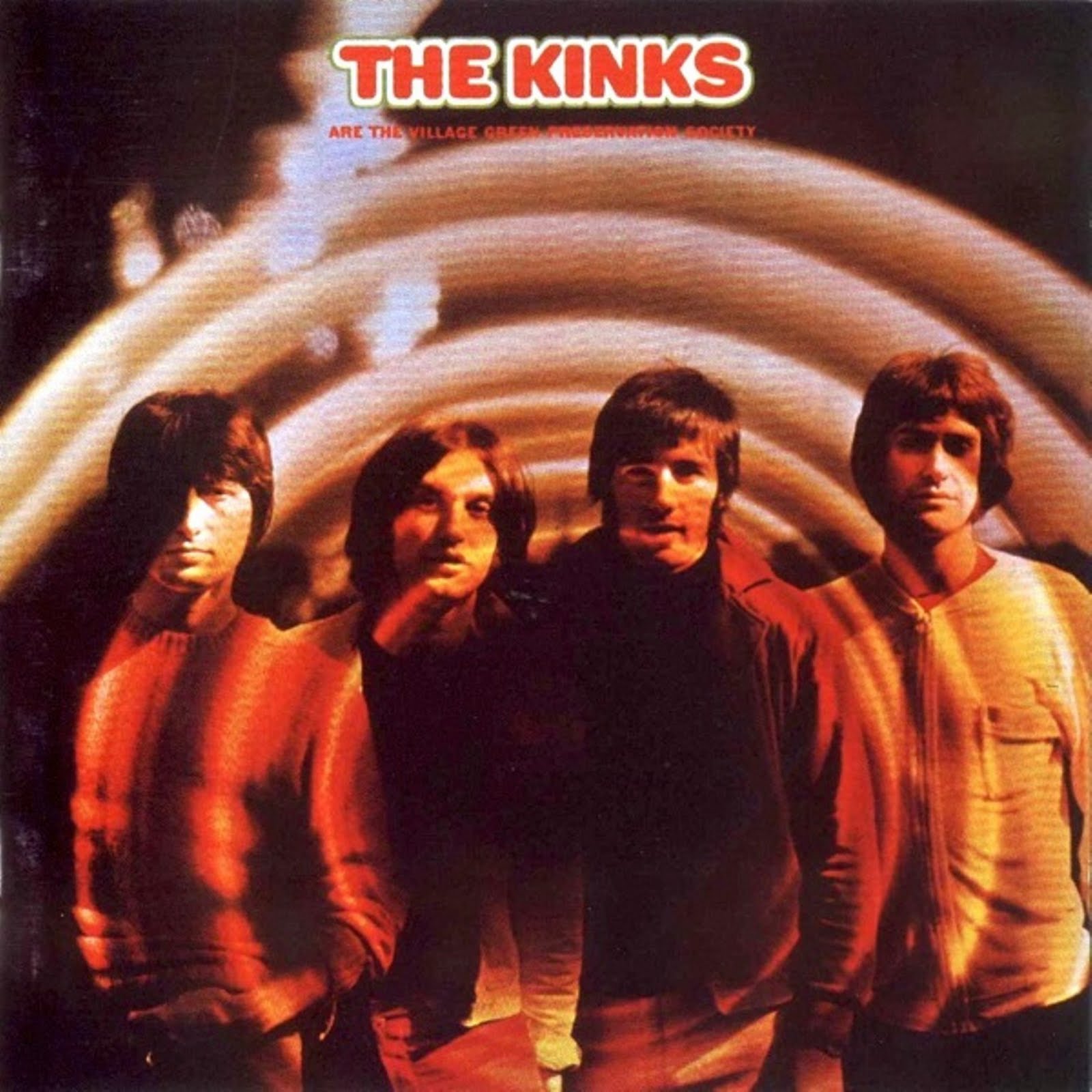
THE KINKS, “THE KINKS ARE THE VILLAGE GREEN PRESERVATION SOCIETY”

kinks village green

(My 100 favorite albums in chronological order: #3 – released November 22, 1968. Originally posted on Kriofske Mix, 6/2/2014)

Track listing: The Village Green Preservation Society / Do You Remember Walter / Picture Book / Johnny Thunder / Last of the Steam Powered Trains / Big Sky / Sitting By The Riverside  / Animal Farm / Village Green / Starstruck / Phenomenal Cat / All of My Friends Were There / Wicked Annabella / Monica / People Take Pictures of Each Other

Nostalgia inevitably permeates any facet of popular culture. Think of all the books, plays, films, TV shows and music that either deliberately recreate or pay homage to something from the past or simply admire and ruminate on a way of life that no longer exists. As a rule, critics tend to berate nostalgia—what is the value of looking back when a blank canvas carries the potential for anything? What is art, after all, but an opportunity to advance the culture, to devise new ways of seeing and hearing, nothing short of altering one’s perception of the entire world?

The catch is, for art to resonate it must also provide enjoyment and, at some primal level a sense of familiarity. Nostalgia is just another word for familiarity, and we respond to what we recognize. If the mere term gets a bad rap, that’s because most of it is lazy and pandering, at worst utilizing period-specific wardrobe or songs in order to prey on the audience’s sentimental receptors. At best, however, nostalgia simultaneously celebrates and critiques, longing for the past while trying to understand it and place it within a relevant context.

The Kinks are arguably one of the four great British Invasion bands (along with The Beatles, The Rolling Stones and The Who) and easily the most cult-ish one today. They peaked in popularity early on with a series of riff-driven rockers you can still hear on oldies/classic hits radio (“You Really Got Me”, “All Day and All of the Night”). As with their contemporaries, the band’s sound evolved as the decade wore on—only, instead of maintaining their appeal with the masses, they increasingly appeared more British, more fey, more off on their own unusual path. They still scored the occasional fluke hit (“Sunny Afternoon”), but replaced the youthful brashness of their earlier recordings with a more wistful, intricate sensibility. Robert Christgau has called their 1967 British hit “Waterloo Sunset” ‘the most beautiful song in the English language’ and he’s not exaggerating. This maturation in tone resulted in a string of classic albums, from FACE TO FACE (1966) to LOLA VERSUS POWERMAN AND THE MONEYGOROUND, PART ONE (1970), the latter itself scoring its own fluke hit with “Lola”.

THE KINKS ARE THE VILLAGE GREEN PRESERVATION SOCIETY, their sixth album overall, arrived in the middle of this run. Released on the same day as THE BEATLES (aka The White Album), it was an unmitigated commercial flop, failing to chart in the US and the UK (whereas The White Album became one of the Beatle’s all-time best-sellers). Why VILLAGE GREEN failed to find an audience in 1968 is a good question, indeed. Some blame the band’s inability to promote the album in the US due to a temporary touring ban in that country, although this wouldn’t explain its nonperformance in the UK, where they had had three hit singles the previous year. Although presently one could easily date VILLAGE GREEN, in 1968 it might’ve seemed a little out of time—not so much in sound (The Kinks are still a guitar band, albeit one now enhanced with acoustic instruments, a few baroque orchestral arrangements and the occasional Mellotron) but in temperament. Although by this time, the Beatles and the Stones had expanded their repertoire to include such stylistic diversions as “When I’m 64” or “Ruby Tuesday”, neither group had released an album dominated by them. VILLAGE GREEN is the first album by a major rock band to look inward and back rather than expand its scope (and by default, the whole genre’s). It has little in common with the trendy, flashy rocker of its time (Janis Joplin, Jimi Hendrix, The Doors)—today, it plays like an alternate-world 1968, one where an act like folk-rock collective Fairport Convention might’ve had more sway over the musical conversation.

The title track kicks off the album with nothing less than a manifesto: under the proud guise of a grassroots community organization, the band is “Preserving the old ways from being abused / Protecting the new ways for me and for you,” and asking that God save all sorts of effluvia, from strawberry jam and custard pie to Tudor houses and coffee cups. Subsequent songs reminisce over long-lost childhood mates (“Do You Remember Walter”), social rites of passage (“All Of My Friends Were There”), vanishing technology (“Last of the Steam Powered Trains”) and former residences (“Animal Farm”). Both “Picture Book” and “People Take Pictures of Each Other” are paeans to the most nostalgic act imaginable: paging through old photo albums. Throughout, lead singer/songwriter Ray Davies displays appreciation and affection for his subjects, especially in “Village Green”, which reprises the title track’s declaration of purpose on a more personal scale. The song’s narrator longs to return home, or at least to a home he once knew. He says a lot with a repeated phrase as simple and straightforward as “I miss the Village Green.”

Although VILLAGE GREEN as a whole wallows in nostalgia, it also subtly (and sometimes none-too-subtly) transcends it. Even as a straight-faced manifesto, the title track leaves one wondering if there isn’t a dollop of satire hidden within, particularly when “virginity” suddenly but quietly appears as a thing to be saved. Both “People Take Pictures of Each Other” and “All of My Friends Were There” skip along on jaunty, music hall rhythms that emanate sarcasm rather than reverence. And both “Starstruck” and “Johnny Thunder” have sections where the lyrics drop out, replaced by lusty, possibly mocking “ba, ba, ba’s”. By title alone, “Big Sky” could be praising wide open, unspoiled spaces, but examine the lyrics more closely, and you’ll see it’s really about skepticism towards spiritual belief and man’s miniscule place in the universe (“People lift up their hands and they look up to the big sky / but big sky is too big to sympathize”).

This is playful album above all. “Starstruck” and “Picture Book” now sound like peppy, great lost singles, while the moodier stuff—the gentle and utterly daft “Phenomenal Cat” with its delightfully drugged-out, sped-up vocals, or “Wicked Annabella”, a vaguely sinister vocal showcase for guitarist (and brother of Ray) Dave Davies—still retains a lightness of touch that The Beatles could no longer manage at that point without seeming strained. Placed midway through the album, “Sitting By The Riverside” neatly sums up the Kinks’ ambition at this stage in their career: it’s a breezy lament about a memory of a cherished, ideal afternoon, albeit one in danger of fading into oblivion as the song’s revolving three-note motif ebbs and flows in volume and distortion, like a unstable merry-go-round forever threatening to go off the rails completely. Fortunately, it’s a near-miss emergency, any danger obscured by a pleasant surface that concludes on a calm, reassuring note.

Despite its commercial failure, VILLAGE GREEN and The Kinks in general will heavily influence at least two bands we’ll hear from much later in this project. Up next, though, comes another massively influential group that similarly abandoned raucousness for reflection, although few would ever accuse them of being nostalgic.

Video for “Starstruck”:

Video for “Sitting By The Riverside”:

LEONARD COHEN, “SONGS OF LEONARD COHEN”

leonardcohen

(My 100 favorite albums in chronological order: #2 – released February 1968. Originally posted on Kriofske Mix, 5/26/2014)

Track listing: Suzanne / Master Song / Winter Lady / Stranger Song / Sisters of Mercy / So Long, Marianne / Hey, That’s No Way To Say Goodbye / Stories of the Street / Teachers / One of Us Cannot Be Wrong

I once read somewhere that Robert Altman heard SONGS OF LEONARD COHEN at a party and had an “eureka!” moment, thinking it the perfect soundtrack for the film he was working on, 1971’s McCABE & MS. MILLER; never mind that McCABE was set in 1902 and the album was recorded 65 years later. Both the film, an idiosyncratic, revisionist western from a New Hollywood auteur and the album, itself an idiosyncratic, revisionist collection of folk songs written and sung by a poet from Montreal convey timelessness and reflection, favoring poetry over prose while maintaining a narrative structure.

Although McCABE uses only three of Cohen’s songs (“Winter Lady”, “Stranger Song” and “Sisters of Mercy”), both film and album are forever linked together in my mind. I had heard the latter first via a dollar-bin vinyl copy purchased as a college undergrad, not long after discovering Cohen’s 1988 album I’M YOUR MAN. By then, he had altered his sound radically, favoring a deliberately chintzy aesthetic full of cheapo keyboards, cooing female background vocals and his own low, ravaged voice a more-often-spoken-than-sung growl. SONGS, Cohen’s debut album from twenty years before sounds like the work of another man: it’s primarily acoustic guitar-based, often accentuated by strings and occasional horn and organ flourishes. Most alarmingly different is Cohen’s higher vocal timbre–I was initially unable to reconcile it with the lower tone I knew and loved, playing SONGS once or twice and filing it away.

A few years on, I’d moved to Boston to study film. As I made my way through Altman’s filmography (particularly his peak early-70s period), I finally got to McCABE, having put it aside simply because it was a western, never one of my favorite genres. However, as “Stranger Song” played over the opening credits, where the lead (Warren Beatty), concealed in a hat and period gear, rides a horse into a rain-drenched, Pacific Northwest milieu, it’s no exaggeration to say it took my breath away. Rarely had I seen such an unconventional yet ideal match between song and image—Cohen’s plaintive but effective vocals, a musical backdrop consisting entirely of plucked guitars and a repetitive but engaging minor-key melody all carrying within them a quietly awestruck wonder. It felt more immediate and intimate than a more traditional, orchestral score would have; it also successfully set a precedent that this would be unlike any movie western I’d ever seen and that I’d never forget this first impression.

As “Stranger Song” becomes associated with McCabe himself, Altman utilizes the film’s two other Cohen songs as themes for specific characters. Ms. Miller (Julie Christie), the earthy, sharp whorehouse madam whom prospector McCabe goes into business with, is paired with “Winter Lady”, a gentler, more wistful but no less melancholic tune than “Stranger Song”, fleshing out the guitars with a lone flute and a soft, celeste-like chime. Meanwhile, the roughhewn, inexperienced women who become Ms. Miller’s initial employees are detailed a sequence that makes ongoing use of “Sisters of Mercy”, which has the most traditional and richest arrangement of the three Cohen songs. Some of cinematographer Vilmos Zsigmond’s most striking images accompany the song, in particular a church steeple set against a painterly, glistening sunset.

So powerful is Cohen’s music in McCABE that one wishes Altman would’ve used more of it. Hearing those three songs in the film naturally moved me to return to SONGS and in the process, discover its odd, highly distinctive allure. At least three out of its seven other tracks are now unqualified standards. Likely Cohen’s most recognized song after “Hallelujah”, opener “Suzanne” contains lyrics iconic for their specificity and vividness (“she brings you tea and oranges that come all the way from China”); Nancy Priddy’s background vocals also add texture and a welcome sweetness that Cohen’s disarming but homely croak simply isn’t capable of. “So Long, Marianne” ever-so-slightly rouses up the tempo and features one of Cohen’s catchiest choruses without sacrificing his inimitably sung cadences (“to laugh / and / cry / and / laugh / and / cry a-bout it / all a-gain”). “Hey, That’s No Way To Say Goodbye” almost subliminally reprises the melody from “Suzanne” but makes a more pointed, whimsical use of Priddy’s vocals as they pop in and out between Cohen’s lead; the arrangement’s also quirkier, the song’s title providing the main hook as it ends on a curious, nagging riff somewhere between a twanged guitar and a jew’s harp.

Two of the album’s remaining four songs are as great as the three McCABE selections. “Master Song” consists of many stanzas set to the same melody repeated for nearly six minutes, but each verse has a new musical wrinkle, gaining momentum from such additions as a muted trumpet, or a blast of strings, or a curlicue organ filigree. Throughout, it conjures a feeling of majesty, not overblown or calling attention to itself, but forever lurking within, omnipresent and exuding wisdom and gravitas. “Stories of the Street” nearly accomplishes the same feat, but with more sustained orchestration, a higher-pitched melody (in which Cohen, though not the most dexterous of singers, acquits himself well enough) and evocative lyrics such as “And if by chance I wake at night and ask you who I am / O take me to the slaughterhouse, I will wait there with the lamb.” As for the other two, less memorable tracks (“Teachers”, “One of us Cannot Be Wrong”), they’re wisely placed at the end. Neither one is a failure, although when Cohen concludes “One of Us Cannot Be Wrong” with some woefully off-key wailing (almost as if he’s piss-poor drunk or going insane), you could either find it repulsive and inexplicable and want to say, “Oh, Lenny
” or simply laugh at its audacity—a rare glimpse of Cohen not taking himself too seriously.

Cohen apparently was not pleased with producer John Simon’s orchestral additions here. He would go on to record eleven more albums and few of them sound like this one. Alternately, he’d strip down the arrangements to the barest essentials (SONGS OF LOVE AND HATE), take the complete opposite direction with Phil Spector (DEATH OF A LADIES MAN), entirely revamp his sound and voice again in the 1980s with VARIOUS POSITIONS and the aforementioned I’M YOUR MAN and continue to alter, reduce and refine with age all the way through 2012’s OLD IDEAS. His discography is as rich as the life he’s lived (Sylvie Simmons’ recent biography is essential), but I return most often to this, his first album. The McCABE association is a major reason, but by far not the only one: with SONGS, Cohen arrived fully formed, a talent with few precedents and to be honest, relatively few followers. His lyrics, vocal tones and melodies all made for a sensibility that was entirely his own. We will also find this quality in our next entry which comes from a band born out of a movement it eventually broke away from, stubbornly foraging along its own divergent, less commercial path.

“Stranger Song” / opening credits of McCABE & MS. MILLER:

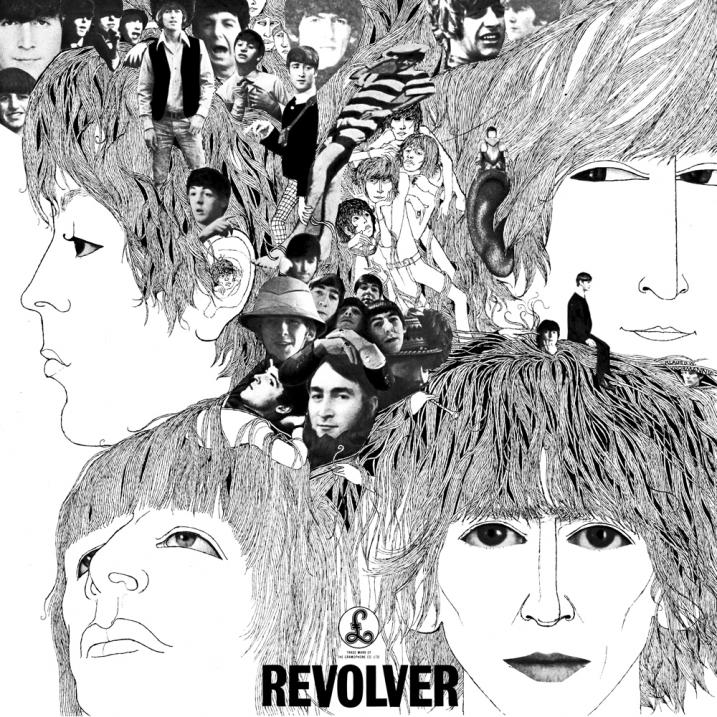
THE BEATLES, “REVOLVER”

revolver

(My 100 favorite albums in chronological order: #1 – released August 5, 1966. Originally posted on Kriofske Mix, 5/19/2014)

Track listing: Taxman / Eleanor Rigby / I’m Only Sleeping / Love You To / Here There and Everywhere / Yellow Submarine / She Said She Said / Good Day Sunshine / And Your Bird Can Sing / For No One / Doctor Robert / I Want To Tell You / Got To Get You Into My Life / Tomorrow Never Knows

At its 20th anniversary in 1987, Rolling Stone magazine listed their top 100 albums of the past 20 years, and The Beatles’ 1967 opus SGT. PEPPER’S LONELY HEARTS CLUB BAND was at number one. How could it have been anything else? “It was twenty years ago today” was the first line of the first song, after all, and it made for impeccable marketing synergy (it had also recently come out on CD for the first time); it also didn’t hurt that SGT. PEPPER’S was the band’s best selling album and inarguably their most important from a cultural standpoint. If any single effort by a rock band turned the album into an art form, this was it.

As for REVOLVER, the band’s previous album, it didn’t even make the list. However, when the magazine compiled its 500 Greatest Albums of All Time in 2003, REVOLVER came in at number three (SGT. PEPPER’S was still at the top). Just last year, Entertainment Weekly deemed it the number one album of all time. This apparently sudden surge in critical acclaim might’ve been a result of the album as we now know it not appearing in the US until its CD debut in 1987. Prior to SGT. PEPPER’S, Capitol Records released its own versions of The Beatles’ British albums with alternate track listings and, occasionally, different album titles (much to the band’s chagrin). This was presumably done to create more product for the American market. For instance, the original Capitol version of REVOLVER cut out three tracks (“I’m Only Sleeping”, “And Your Bird Can Sing”, “Doctor Robert”) because they had already appeared two months earlier on YESTERDAY AND TODAY, a particularly egregious hodgepodge also containing recent non-album singles and a smattering of tracks from the original British editions of HELP! and RUBBER SOUL.

Still, those three songs are not among the album’s most essential (though one who only knows the British track listing can’t imagine it without them). Perhaps REVOLVER (and, to a lesser extent, RUBBER SOUL) just paled in the shadow of SGT. PEPPER’S for twenty-odd years. I doubt many listeners ever dismissed its merit; I even remember first hearing it when I was 18 (possibly my fourth or fifth Beatles album) and instantly being impressed by its consistency—sure, not everything was as attention-grabbing as “Eleanor Rigby” or “Tomorrow Never Knows”, but it had no filler, either. I admit a few years passed before I warmed up to “Love You To”, George’s first full-on attempt at incorporating Indian instruments and rhythms into pop music (following the sitar in “Norwegian Wood” the previous year), while “Doctor Robert” struck me as a little nondescript until those blissed-out harmonies in the “well, well, well” section eventually got to me. Otherwise, at 18, I knew REVOLVER was a gem, but it wasn’t as outwardly flashy or seemingly ambitious or what the critical establishment deemed to be as “great” or “important” an album as SGT. PEPPER’S.

Funny, then, how some albums and their reputations age over time. SGT. PEPPER’S is still a genuinely great collection of songs—only a contrarian like Jim DeRogatis could deny the likes of “She’s Leaving Home”, “Lucy In The Sky With Diamonds” and “A Day In The Life”. Increasingly, though, it sounds very much of its time, epitomizing the Summer of Love and serving as an etching of a historical moment. REVOLVER, on the other hand, now seems more prescient and further reaching. Granted, some tracks betray their age explicitly: “Taxman” builds on the mod-ish momentum of The Who’s early singles and “Got To Get You Into My Life” is a letter-perfect mid-60’s Motown facsimile, right down to its propulsive beat and horn blasts. But most of REVOLVER is timeless due to two factors: it showcases one of the most beloved bands of all time at their musical peak and in retrospect, it has proved massively influential (hard to imagine The Jam existing without “Taxman” or power pop in general before “And Your Bird Can Sing”).

It’s also the Beatles’ most sonically diverse album (until perhaps THE BEATLES (aka The White Album)). Take the range expressed within the first four tracks: the relatively straightforward groove of “Taxman”, the dramatic, anything-but-genteel string quartet lament of “Eleanor Rigby”, the melancholy, hesitantly psychedelic (dig the backwards guitar solo) stoned shuffle of “I’m Only Sleeping”, and the uncompromising Eastern drone of “Love You To”. Similarly, look at the last three songs: Harrison’s contemporary, jaunty, piano-driven “I Want To Tell You” followed by “Got To Get You Into My Life” (a throwback in comparison) and then “Tomorrow Never Knows”, the band’s most radical, experimental composition to date. In theory, none of these songs belong on the same album, but such is the band’s proficiency, chemistry and willingness to be open to the unknown that REVOLVER as a whole is both diverse and unified. In lesser hands, its bold stylistic transitions would simply jar, like placing Paul’s impassioned, firing-on-all-cylinders vocal at the end of “Got To Get You Into My Life” next to the mĂ©lange of tape loops setting up the moment Ringo’s seminal drum pattern kicks in on “Tomorrow Never Knows”. But the band displays such a level of confidence and skill here that the shift feels almost inexplicably effortless.

The album’s mid-section is where you’ll find its biggest hit (Ringo-sung kiddie standard “Yellow Submarine”), a pair of lovely Paul ballads (the hushed, modern-yet-classical “Here There and Everywhere” and chamber-pop primer “For No One”) and two perennially overlooked highlights. Side One closer “She Said She Said” is the accessible, melodic flipside to “Tomorrow Never Knows”, placing its psychedelia and dream logic within a more rigid song structure than nonetheless has elasticity (and one of John’s best vocals ever). Side Two opener “Good Day Sunshine” is both deliriously ecstatic and carefully meticulous, deconstructing how one writes a pop song along the way (hey, let’s cut out the expected vocals in this section of the second verse for an impromptu barrelhouse piano solo!) while continually sounding at ease and without any strain.

Perhaps that’s REVOLVER’S brilliance distilled to a singular essence—pop music simultaneously at its most innovative and approachable. However, this is not The Beatles’ only appearance on this list; they will return a few entries in with another record that accomplishes this same feat, only with time and a change in perspective among the band’s four magnetic personalities altering its sound and scope considerably.

Video for “She Said She Said”:


What Don Draper thinks of “Tomorrow Never Knows”:

100 ALBUMS: AN INTRODUCTION

Note: none of these pictured are in my list of 100 favorite albums.

(Originally posted on Kriofske Mix, 5/16/14)

In 2004, I blogged about and counted down my 100 favorite albums, writing at least 100 words about each one. My intent always was to post an updated list ten years later. Initially, I thought about posting two entries a week over the course of the year. That morphed into plans to do ten posts of ten brief entries each, similar to my top 50 albums of the 90s, 00s, etc; Still, the more I tried ranking 100 albums in order of preference, the less I was convinced that my readers would get much out of it, apart from the thrill (such as it is) of guessing what would come next. So, on a whim, I arranged the albums in chronological order. In the resultant list, a few interesting patterns emerged. I soon realized I could create some sort of narrative about my taste in music by looking at my favorite albums this way.

Thus, here are essays (expect about 1000-2000 words each) on these 100 favorite albums in chronological order. The list begins in 1966; one pre-’66 album made the cut but will appear in non-chronological order for reasons that will be made apparent when it’s posted. As to why the list has no pre-1966 albums (apart from that one exception), the album (or “LP”, aka Long Playing Record) was invented in 1948, but where pop music is concerned, it didn’t really take shape as nothing more than a receptacle for cash-ins (singles + filler) or compilations (Greatest Hits and the like) until the mid-1960s. The band that arguably made the LP into a pop music art form will appear in two early entries on my list.

Jazz, however, is another story. Early on, the format proved more desirable to this genre with its lengthier-than-average compositions. When compiling a list of ten pre-’66 albums I adore (but not enough to make my top 100), seven of them ended up being strictly jazz, one kinda jazz (Louis Prima’s referred to as a “jazz guy” in the film BIG NIGHT, but there’s a lot more going on in his hybrid, genre-crossing ‘50s output), one humor (Tom Lehrer) and, of course, The Beatles:

The Beatles, RUBBER SOUL
John Coltrane, MY FAVORITE THINGS
Miles Davis, KIND OF BLUE
Stan Getz and Joao Gilberto, GETZ/GILBERTO
Ella Fitzgerald, FIRST LADY OF SONG*
Billie Holiday, BILLIE’S BEST*
Tom Lehrer, THAT WAS THE YEAR THAT WAS
Thelonious Monk, MONK’S DREAM
Louis Prima, CAPITOL COLLECTOR’S SERIES*
Frank Sinatra, SONGS FOR SWINGIN’ LOVERS

(*compilations released after 1966 whose music was recorded pre-’66)

This project isn’t meant to be a fifty-year overview of pop music in general, but simply an account of the music I like, and how my taste developed to where it stands today. Expect some callbacks in the narrative, as I obviously did not hear the albums in this particular order (I thought about arranging the list that way, but I think this way will resonate more with readers). As for ranking by preference, perhaps I’ll determine that once I’ve made my way through the entire list again. I can say that 57 of my top 100 as of 2004 were still there in 2014, while 17 of the current list were released in the past decade. That leaves 26 others I didn’t include in 2004—of course, I didn’t hear many of them until within the past decade, but the few I had heard in 2004 have grown on me considerably since then.

We will begin with a 1966 album that likely did not make many all-time-best lists thirty or even twenty years ago, but does so fairly regularly today


(also note: none of the albums in the photo at the top are in my list. It’s just an image I took for a college project nearly 20 years ago, when I was an avid collector of cheap vinyl.)