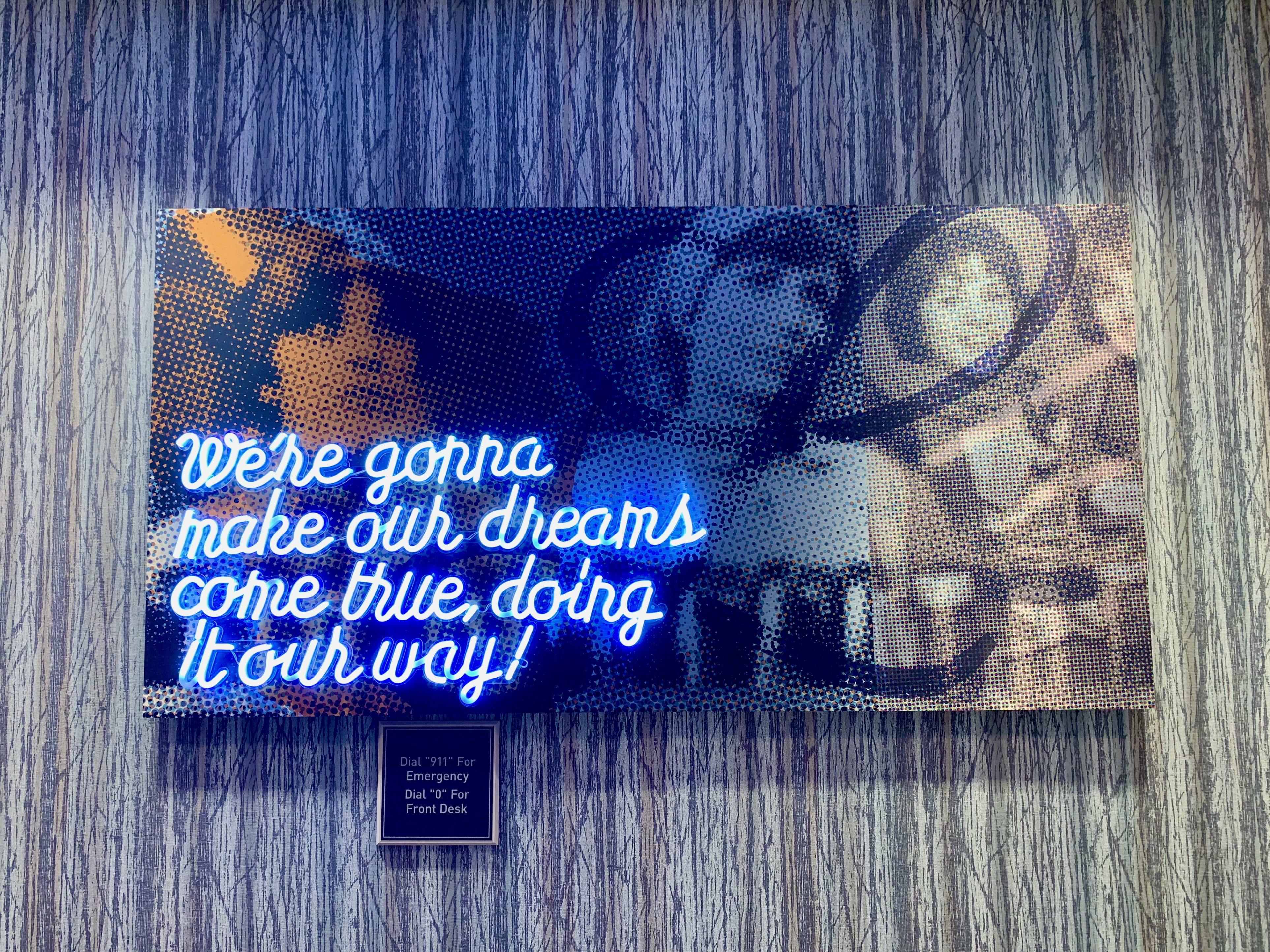
Earlier this month, I returned to Milwaukee (my hometown) for the first time in six years to meet up with my parents (who also now live in another part of the country) and a few old friends. Predictably, Laverne and Shirley (and The Bronze Fonz) remain the city’s most recognized cultural touchstones, as seen in this tableau across from the elevators in my hotel.
The weather was gorgeous for this time of year, so I skipped some of the more touristy indoor places I was considering visiting (including the soon-to-be-moved Milwaukee Public Museum). However, I couldn’t resist the Milwaukee Public Market.
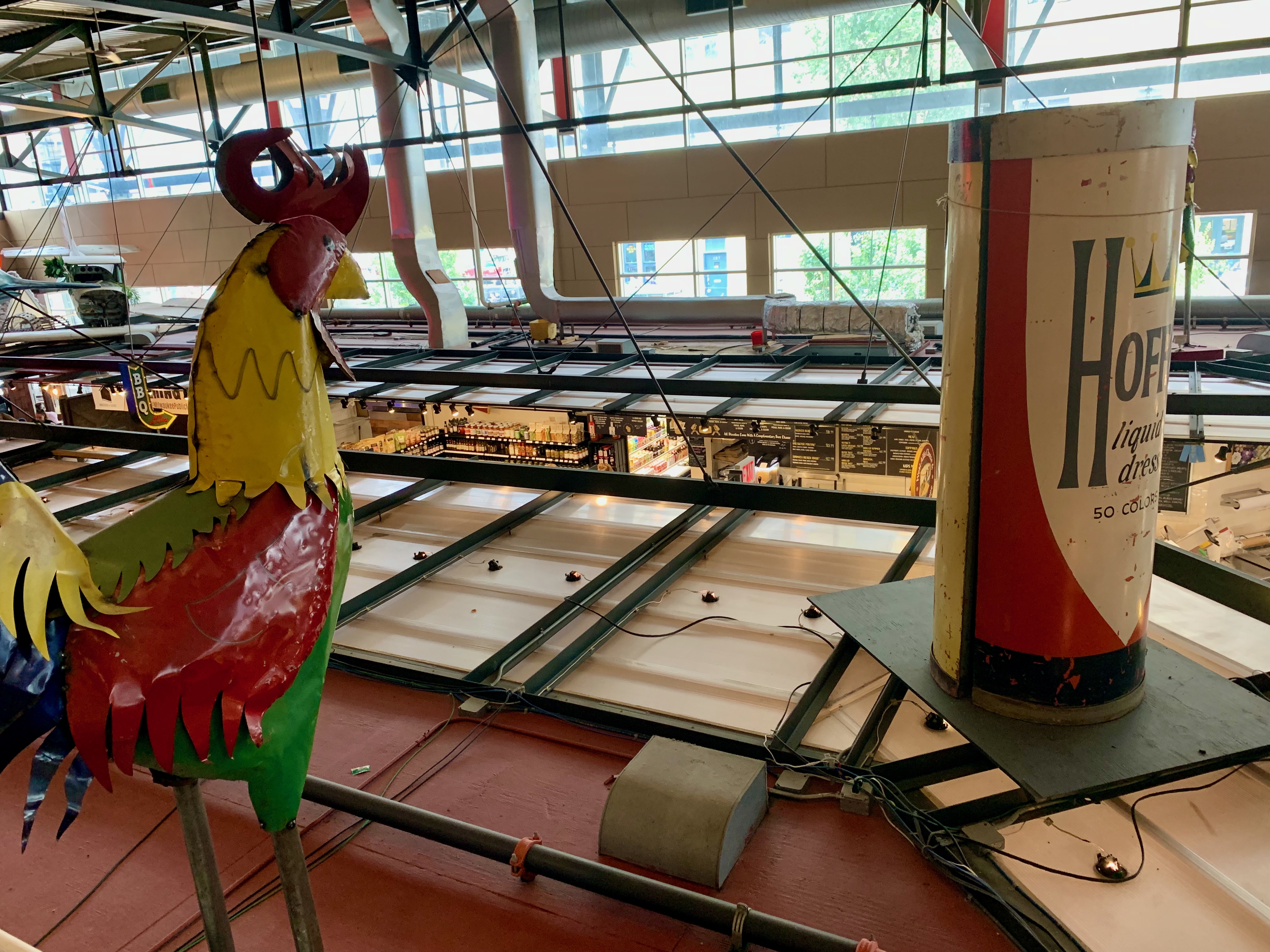
This Third Ward perennial actually didn’t open until about a decade after I left town. I’m afraid don’t know the story behind the giant rooster watching over all the stalls.
An anchor of the market, St. Paul Fish Company also has a location in suburban Mequon (which we had lunch at the following day, in search of decent seafood in the area.)
Seen on the staircase at the market. The big Allen-Bradley clock in Walker’s Point (often nicknamed “The Polish Moon”) is as much of a Milwaukee landmark as the Citgo sign is one for Boston.
After the market, we headed over to the East Side and Brady Street, picking up pasta and focaccia at Glorioso’s and Italian cookies from Sciortino’s. Decades on, Art Smart’s Dart Mart (and Juggling Emporium) endures (as does the city’s distinct, classic “harp” streetlights and those black bus shelters.)
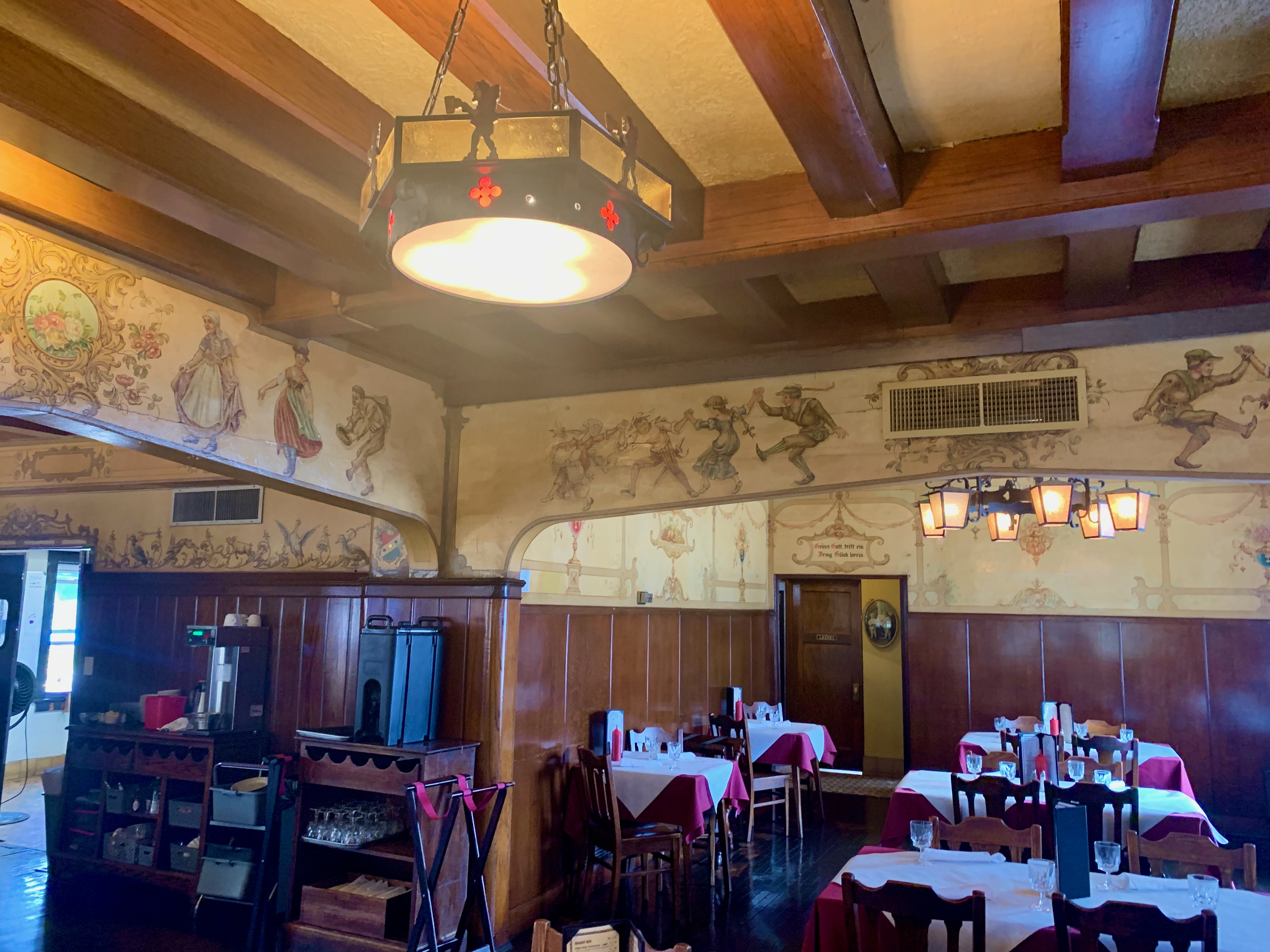
On to West Allis for a Friday Fish Fry at Kegel’s Inn, a meal no trip to Milwaukee is complete without. I can’t find great German cuisine in Boston, so it’s always a treat to get my fill of potato pancakes and Hacker-Pschorr here.
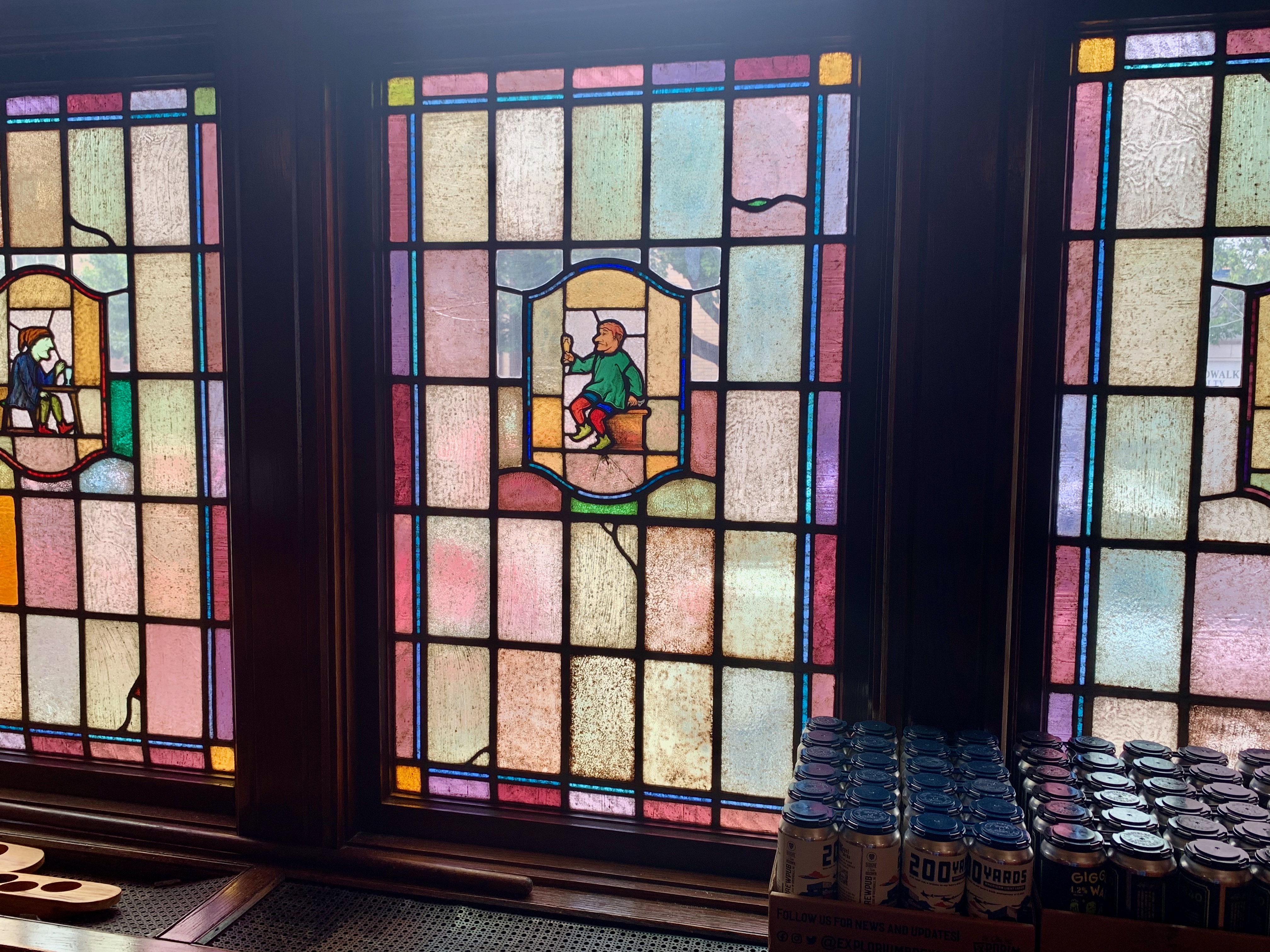
Each time I go to Kegel’s, I notice something I haven’t before, such as the detail in these stained-glass windows.
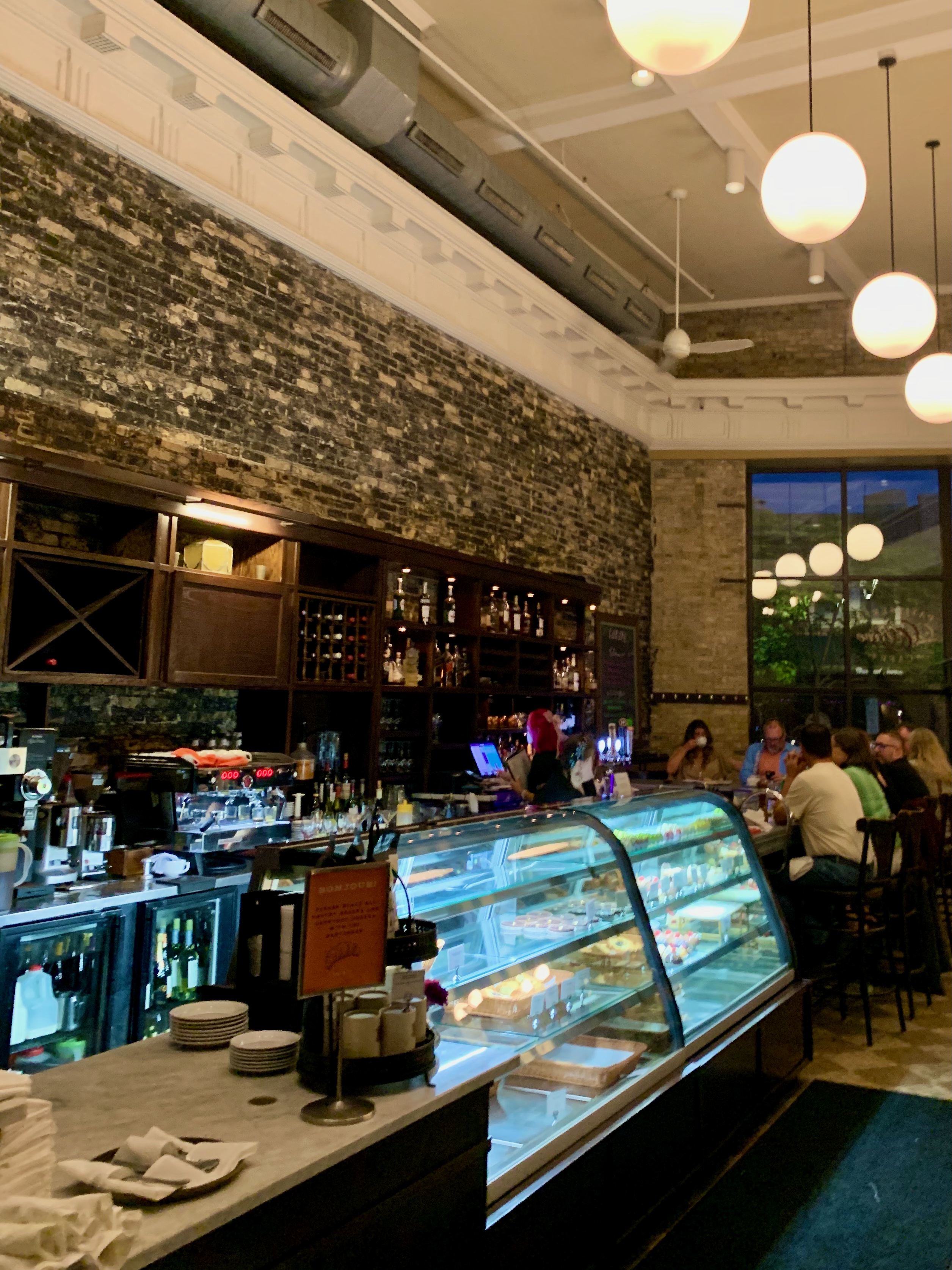
That evening, we met up with a dear friend at Le Reve in Wauwatosa Village, which had excellent cocktails, good mussels and a display case full of tasty French desserts.
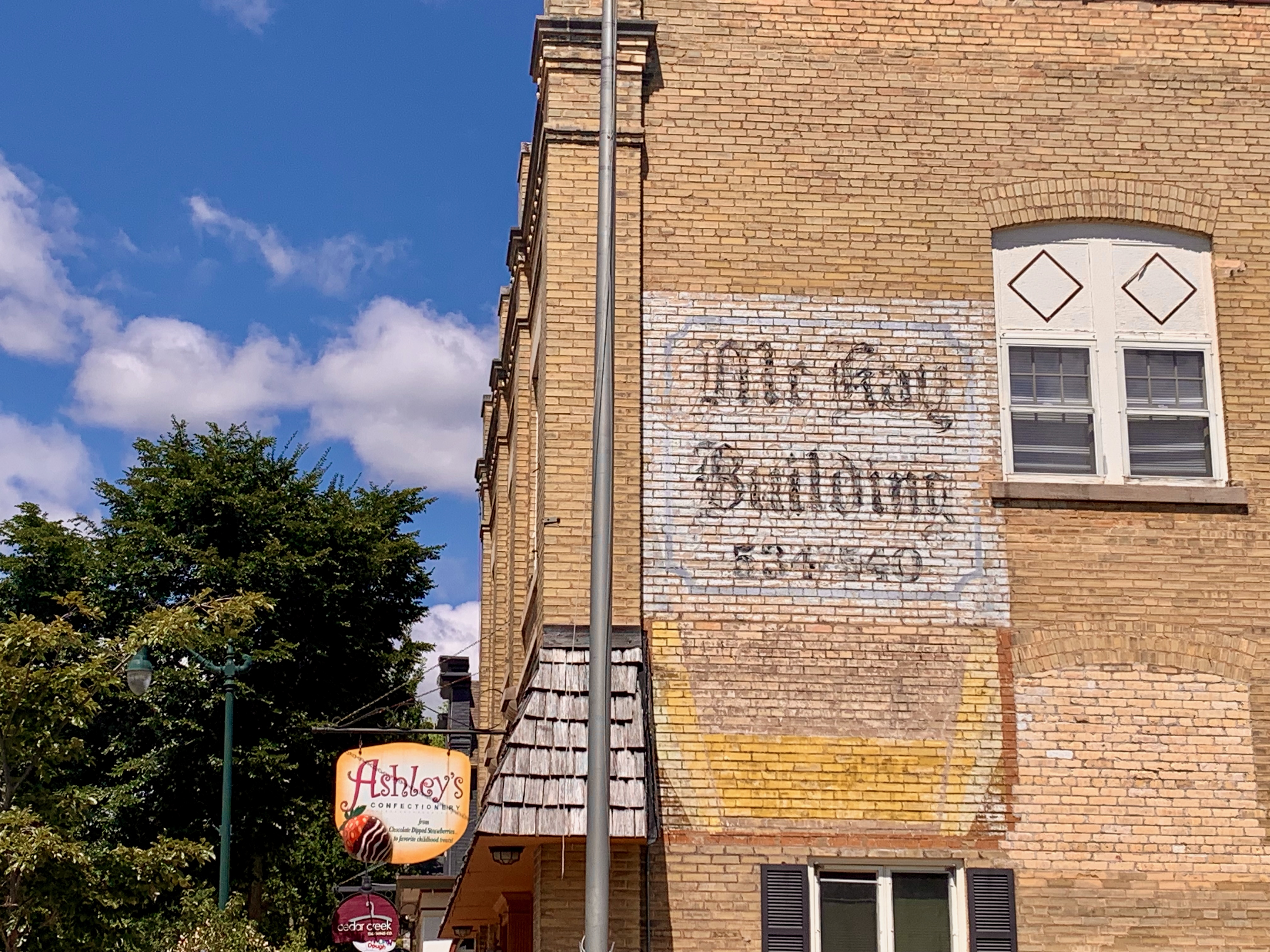
Following our lunch in Mequon the next day, we drove north to Cedarburg where I had not been in over a decade. We took a walk down the Washington Avenue Historic District and all the cream-colored brick buildings stood out to me in ways they hadn’t previously.
The vivid blue skies provided a striking contrast to these 100+ year old structures.
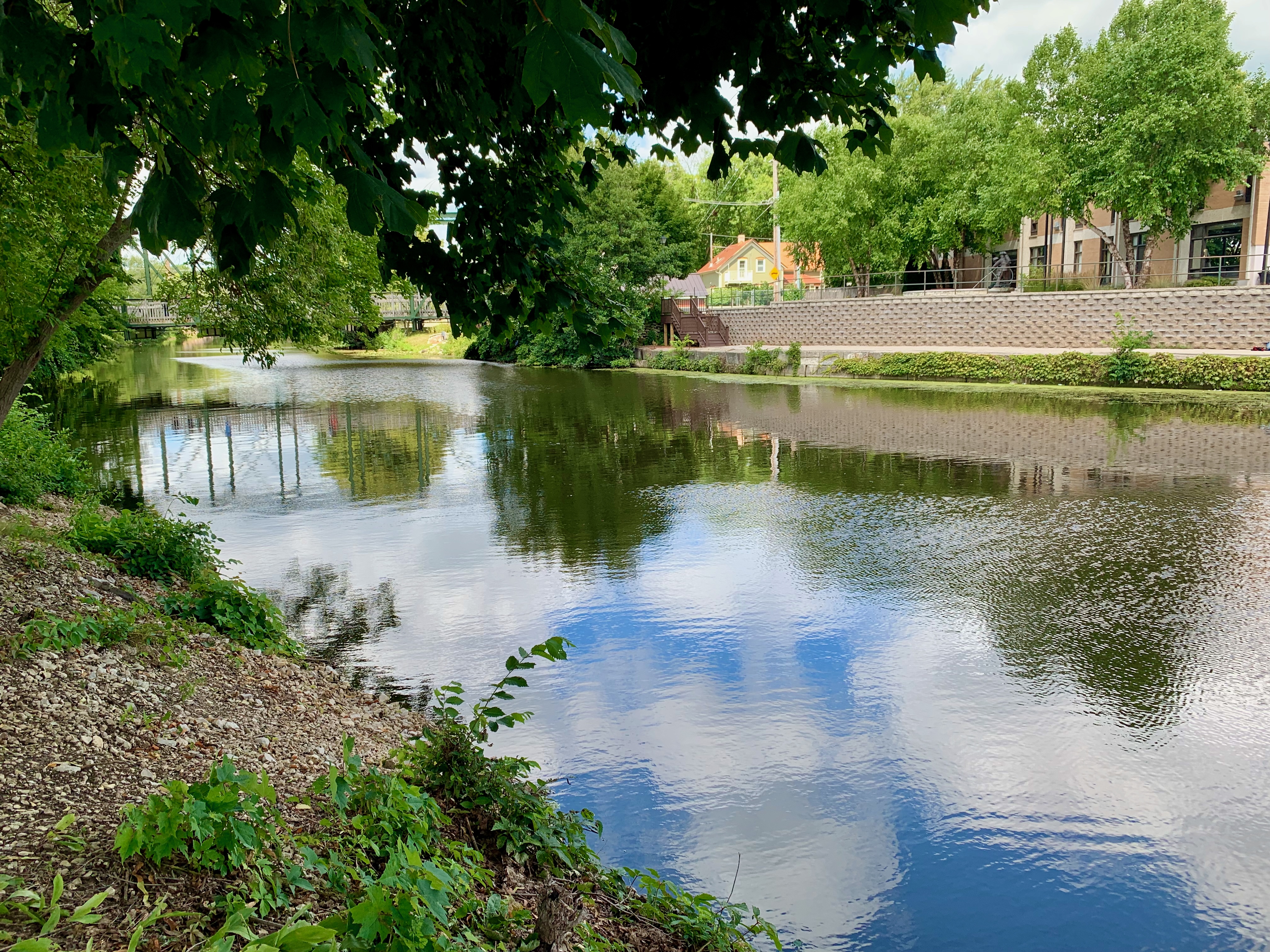
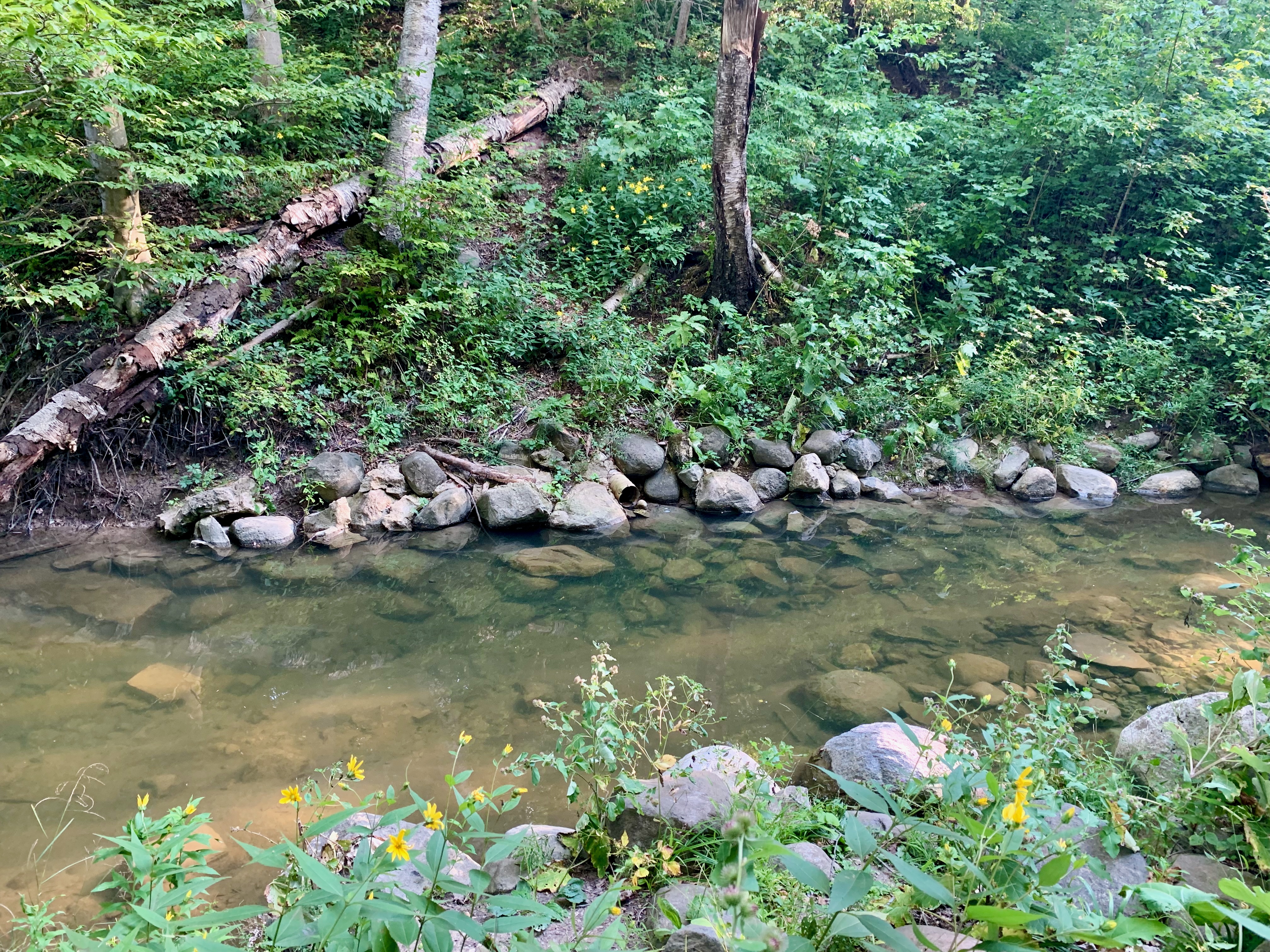
Naturally, we ended up at the Cedar Creek Settlement Shops, which I did not take any pix of this time. Here’s the Milwaukee River, which runs behind it, although this was taken a few blocks further south.
For dinner on Saturday night, we tried Jack Pandl’s Whitefish Bay Inn, a historic restaurant that my parents and I somehow had never previously visited (I do remember going to the now-defunct George Pandl’s in Bayside.)
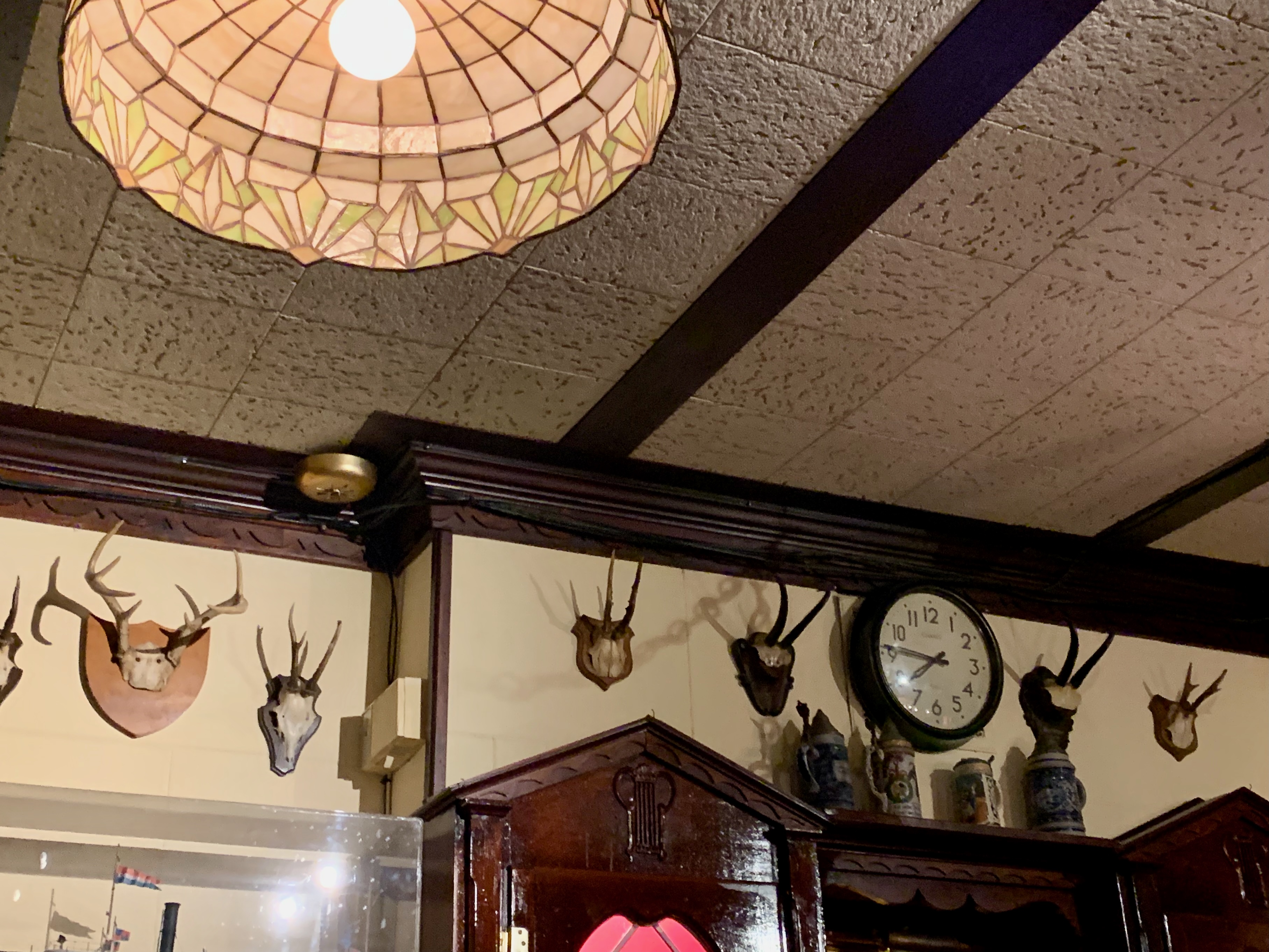
Our party of five was seated at a large round table near the bar, decked out in knickknacks one would likely only expect to find in Wisconsin.
Whitefish Bay is a rather affluent suburb, so it’s a hoot to see one of its most venerable establishments decked out in dinky taxidermy plaques.
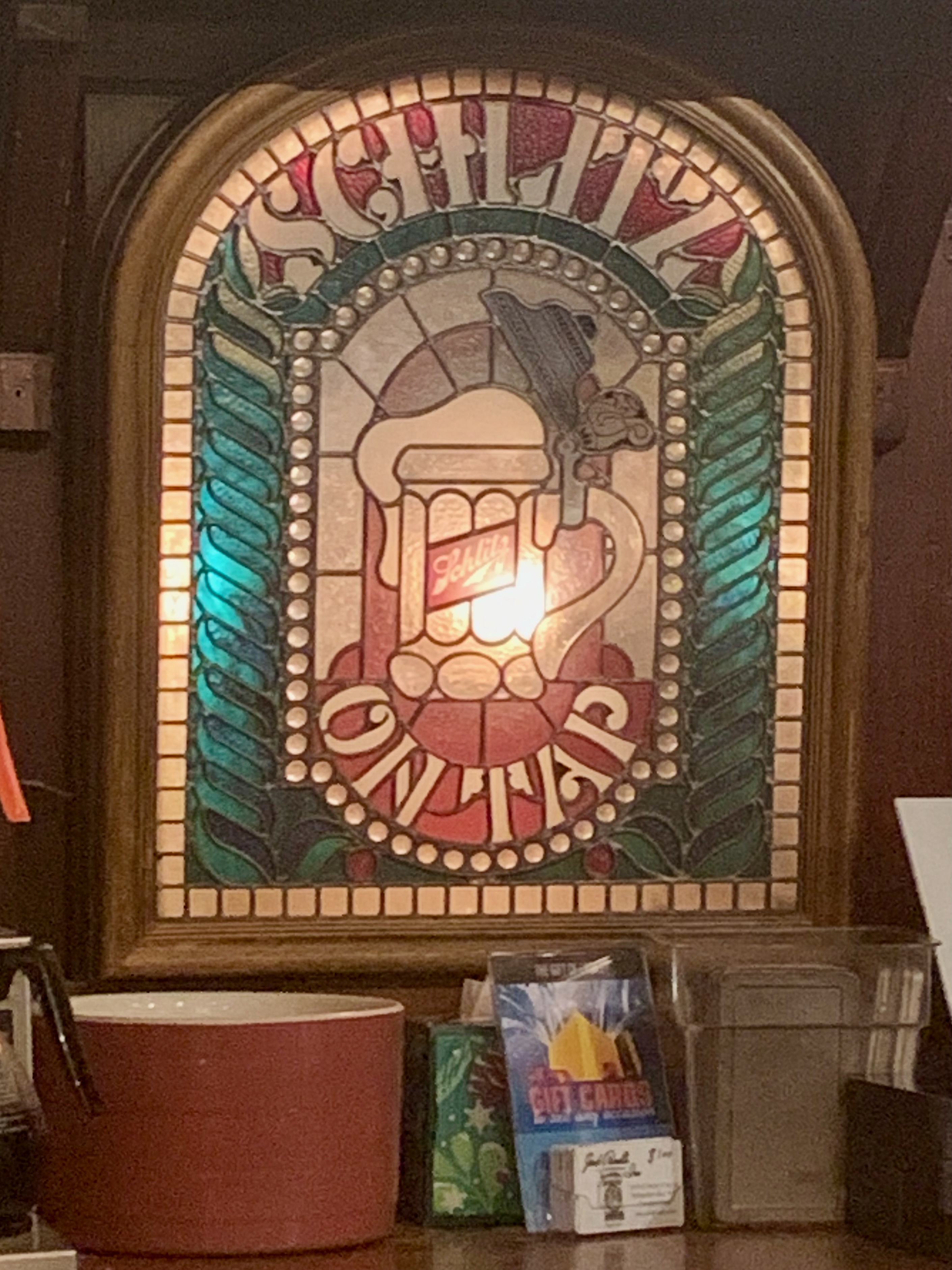
If any classic beer brand screams Wisconsin, it’s not Miller or Pabst, it’s Schlitz!
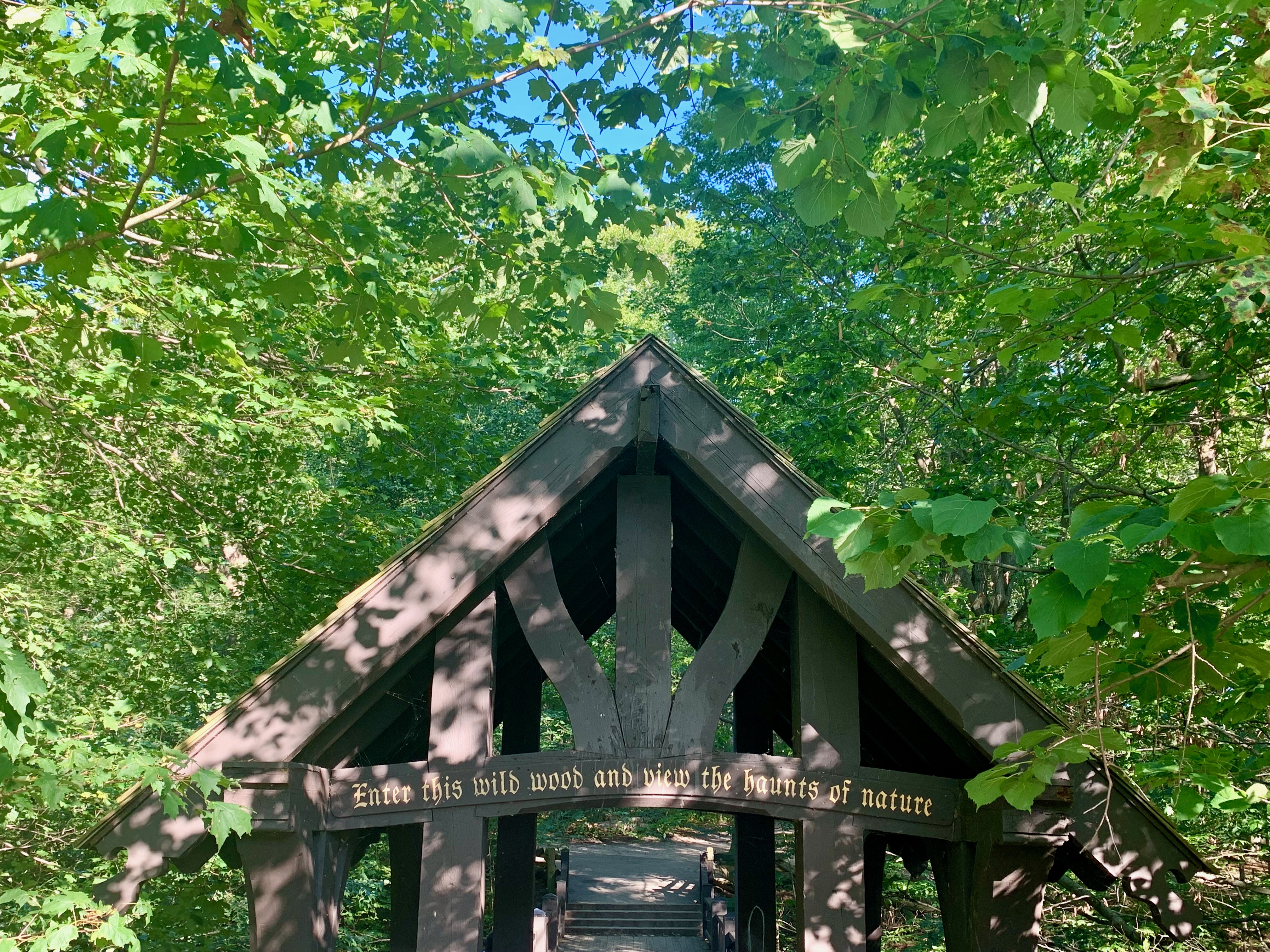
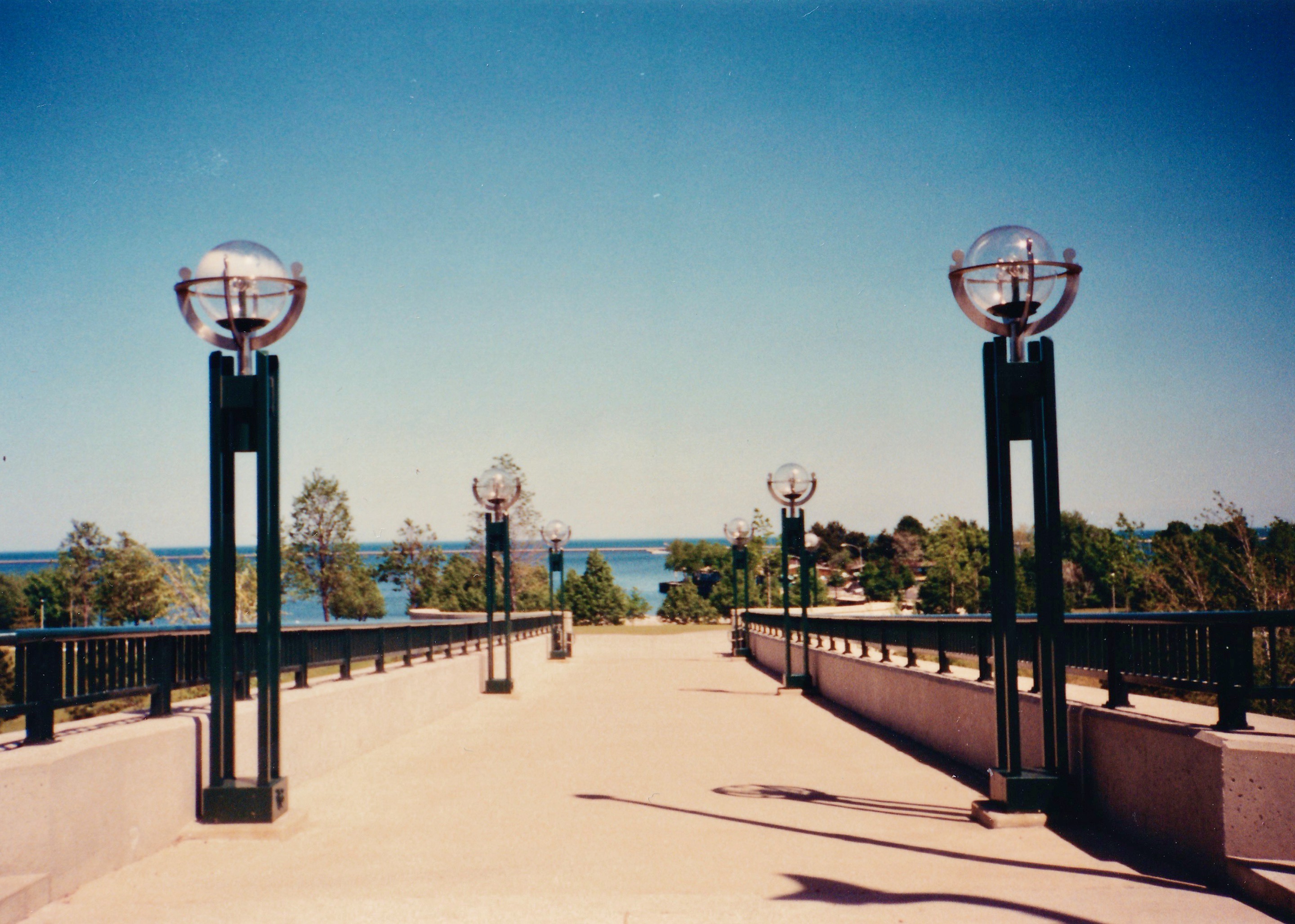
Recovering from our brandy old-fashioned soaked evening at Jack Pandl’s, we took it easy on Sunday: a stop at Kopp’s Frozen Custard, then an early evening walk at Grant Park on Lake Michigan in South Milwaukee. I hadn’t been there in nearly two decades. This gingerbread house-like bridge has always been one of my favorite places in the area (even if someone drew a dick on it, as partially shown above.)
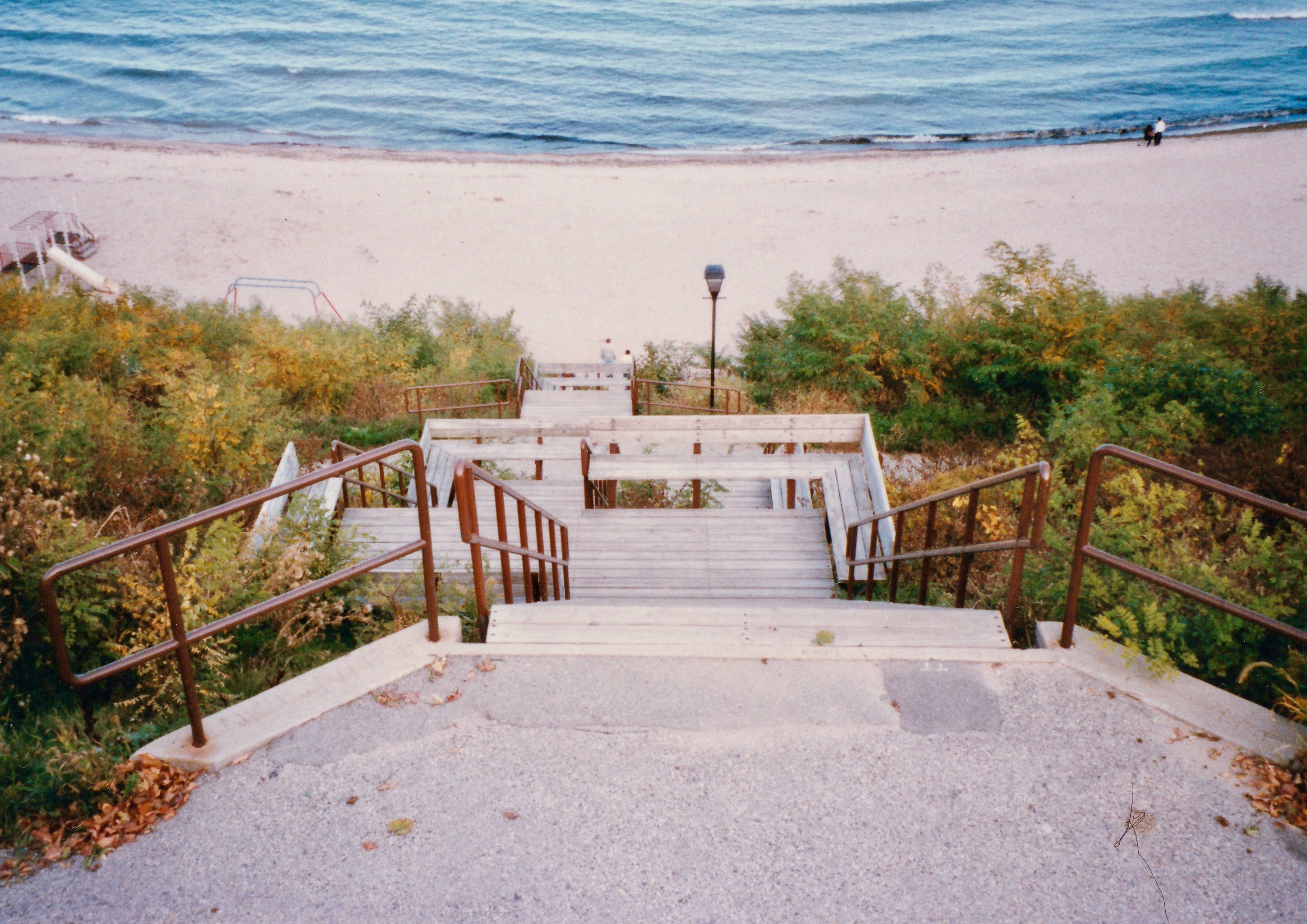
After crossing the bridge, one is led through a series of paths, stairways and other bridges along a ravine.
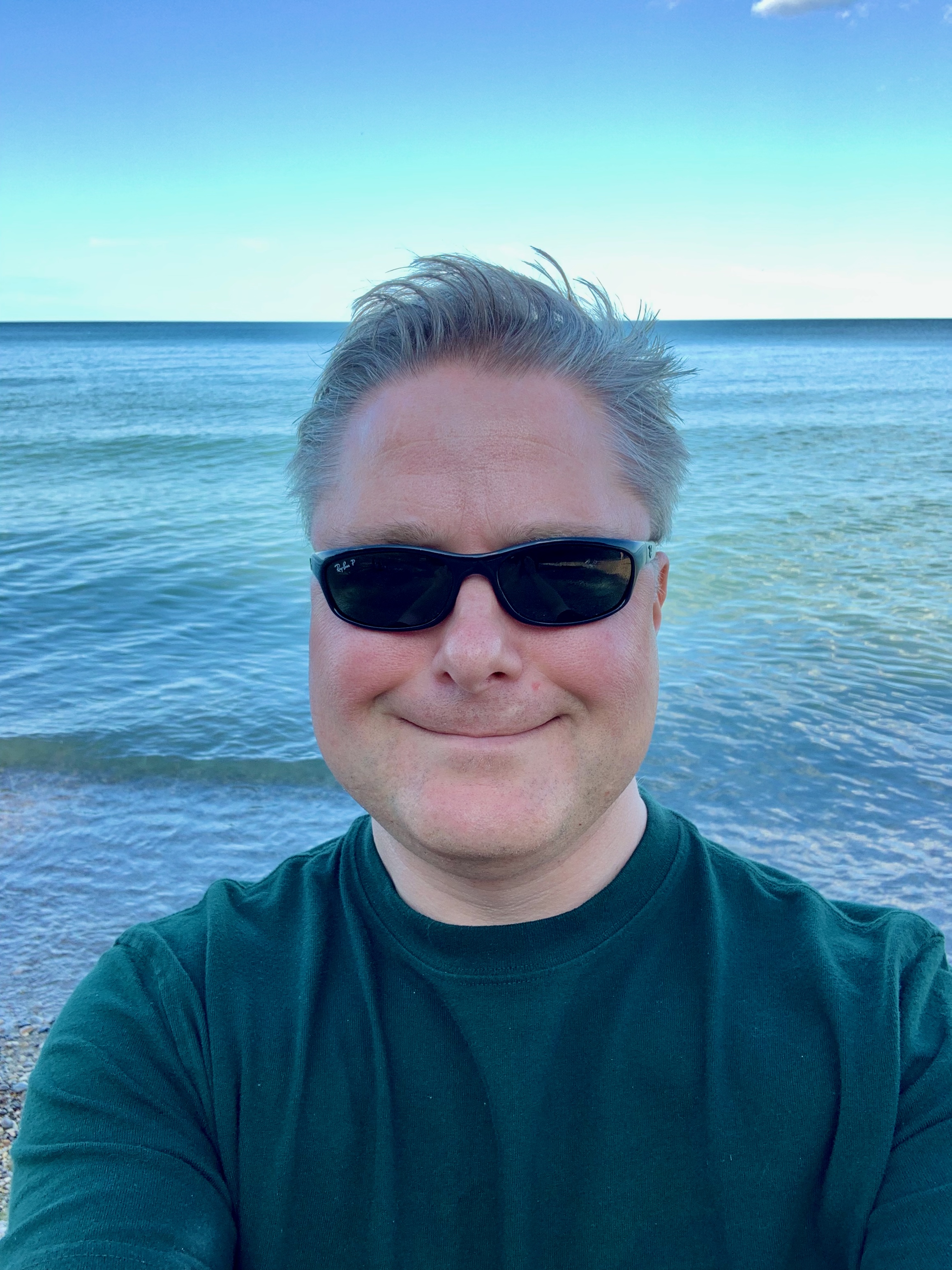
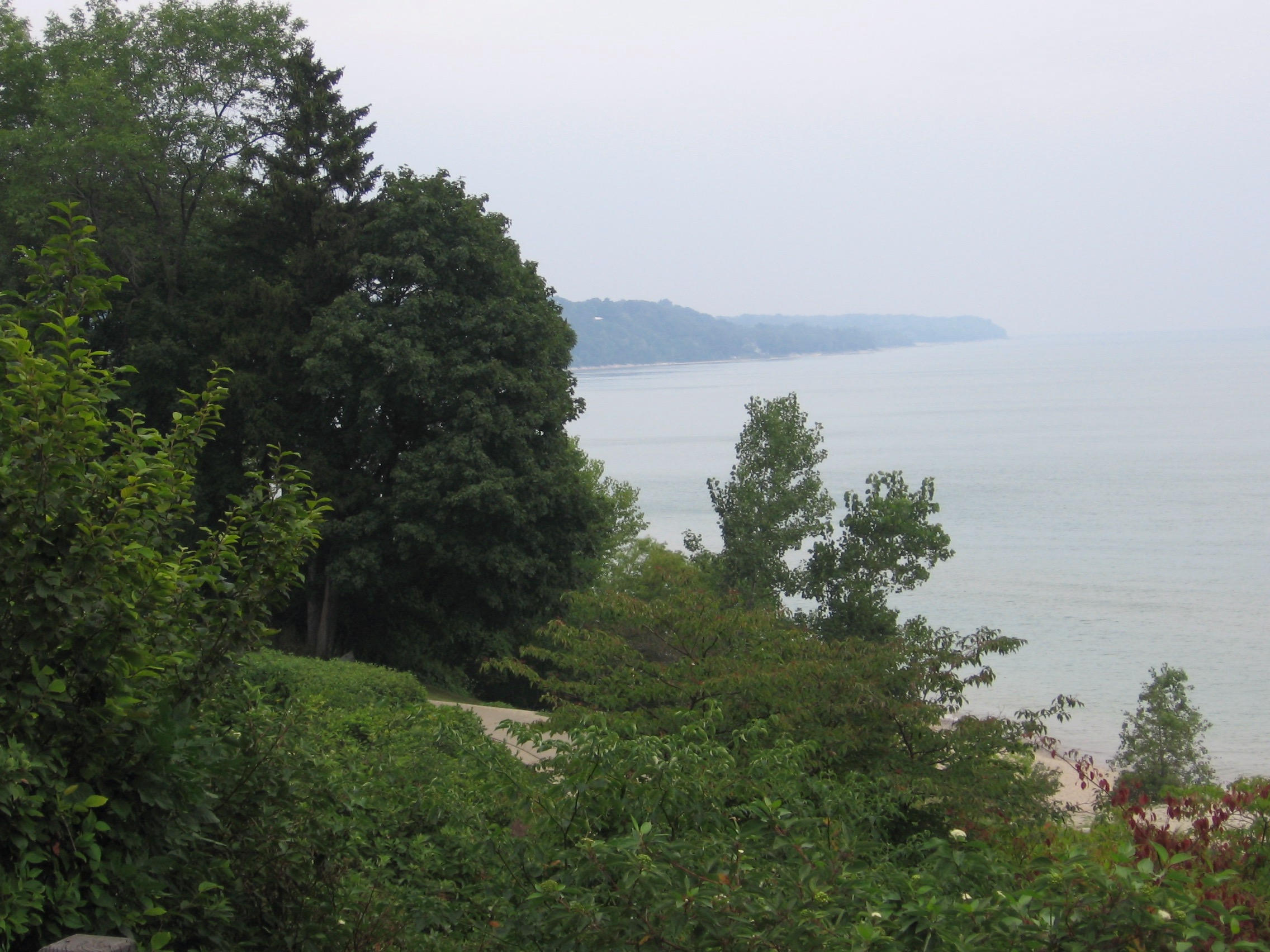
The end point is a small beach on the Lake. This was my “ocean” growing up and it was a thrill to return.
On our last day, I made a run to Irving Place Records and then down to Colectivo on Lincoln Memorial Drive for a smoothie and rest and relaxation on their massive patio. Although I’ve now lived in Boston for most of my life, Milwaukee will always remain a part of me. It’s nice to know that I can always go back for a few days, even if my heart’s now fully in another city.
Twenty summers ago, I made my last ever mixtape—that is, a music mix on a C-90 cassette as opposed to a blank compact disc. A few months earlier, I had acquired my very first laptop computer (dude, I got a Dell) which allowed me to make the move from analog to digital.
By late July 2003, I had a few mix CDs under my belt but circumstance gave me an excuse to make one more mixtape. In my hometown of Milwaukee, I met up with my parents (who then lived in Iowa) for three nights; then, I spent another six nights with my friend Laura, a Chicago native whom I met as a student at Marquette University some years before. I’d moved to Boston shortly after graduation but she stayed on. Between her job at a nursery and other family commitments, I was left alone roughly half of that time to apartment-sit, see other old friends and explore the city I’d left behind. Laura lived on the East Side just off Oakland Ave and I had a blast visiting all the old haunts, from the Oriental and Downer Theatres to Bradford Beach, Atomic Records and even Klode Park out in Whitefish Bay.
With ample time on my hands, I curated a mixtape for Laura as a thankful gesture for putting me up. I had brought an entire Case Logic 128-capacity CD wallet with me stuffed with all-time faves, recent purchases and a few discs I had to review for Splendid!, a music website I wrote for at the time; I may have also schlepped a blank tape with me purposely for this task. Laura was (and continues to be) a friend I make mixes for on an annual basis, going all the way back to our senior year at MU when we first bonded as friends and I crafted her a tape she dubbed the “Kriofske Mix” (a moniker I lent to two of my (now former) blogs.)
Revisiting this mix two decades on, I feel transported back to my late 20’s, an primordial era where I apparently thought nothing of including two songs by Ani DiFranco, two tracks from the Punch-Drunk Love soundtrack, an album cut from The White Stripes’ then-new Elephant (my #2 album of that year, I haven’t listened to it in at least 15) and the gauzy opener from Blur’s then-new Think Thank (also not heard in full in a long, long time.) I had also recently gotten into The Go-Betweens, The New Pornographers and Mary Lou Lord—hearing what I selected from each again reminds me what it was like to discover an artist one connected with so instantly you’d rush out and devour their back catalog piece by piece depending on what you could find in (for me, mostly used) record stores.
Among these twenty tracks, six are from albums I reviewed for Splendid! Required to write about everything from obnoxious prog-rock to near-ambient mood music, they’re scattered across that range: Paul Brill’s genre-expanding take on Americana, Natacha Atlas doing the same for world music (and sounding entirely different), Northern State (a clever and disarmingly low-fi distaff Beastie Boys), two cuts from a compilation for a record label helmed by a member of the Cocteau Twins (including the title track above) and an a capella cover of a Pixies song on TV On The Radio’s debut EP, so new-sounding and exceptional I wasn’t surprised by the mass-acclaim their second LP Return To Cookie Mountain received three years later.
True to titular form, there’s a loose and fairly obvious summer theme going on here. My favorite section is the last five songs—“You Had Time” sets the pensive, reflective mood (much better than the other DiFranco selection, anyway) and Jeff Buckley’s dreamy, ethereal cover of Leonard Cohen’s “Hallelujah” (which I listened to about 100 times that summer) runs with it, sustained by another old-school Stuart Murdoch reverie. Somehow, the contrasting tones of Shelley Duvall and Tunde Adebimpe just fit right in. I often cringe at mixes I made decades ago, but at least the last quarter of this one hit nicely when I revisited it a few weeks back, walking under the overgrow trees of the Commonwealth Mall on an idyllic mid-summer late afternoon.
The Milwaukee neighborhood I’m originally from is roughly three miles from Lake Michigan.
Growing up, it was easy to take the Lake for granted–it was just always there, providing the city’s Easternmost boundary. Like any ocean, it was impenetrable, for you couldn’t possibly see across it to the other side.
Alternately a backdrop for picnics, walks, beach days, fireworks displays, arts festivals, afternoon cruises, fishing and swimming, the Lake stretched on for miles–even within Milwaukee County, there were parts I never visited until my early 20s in the mid-90s, like Atwater Park in Shorewood.
As a Marquette University undergrad, I often walked down from campus to the Lake, usually reaching it via this long-gone pedestrian bridge that crossed over Lincoln Memorial Drive pre-Calatrava addition to the Milwaukee Art Museum.
Once at the Lake, I’d walk North along the footpath, occasionally stopping to sit on a bench and take in the birdsong, the often cool breeze and the not-unpleasant smells of the shore.
The footpath stretched on to Veterans Park, a large swath of green space that was usually empty except for special occasions and festivals like Maritime Days every Labor Day weekend.
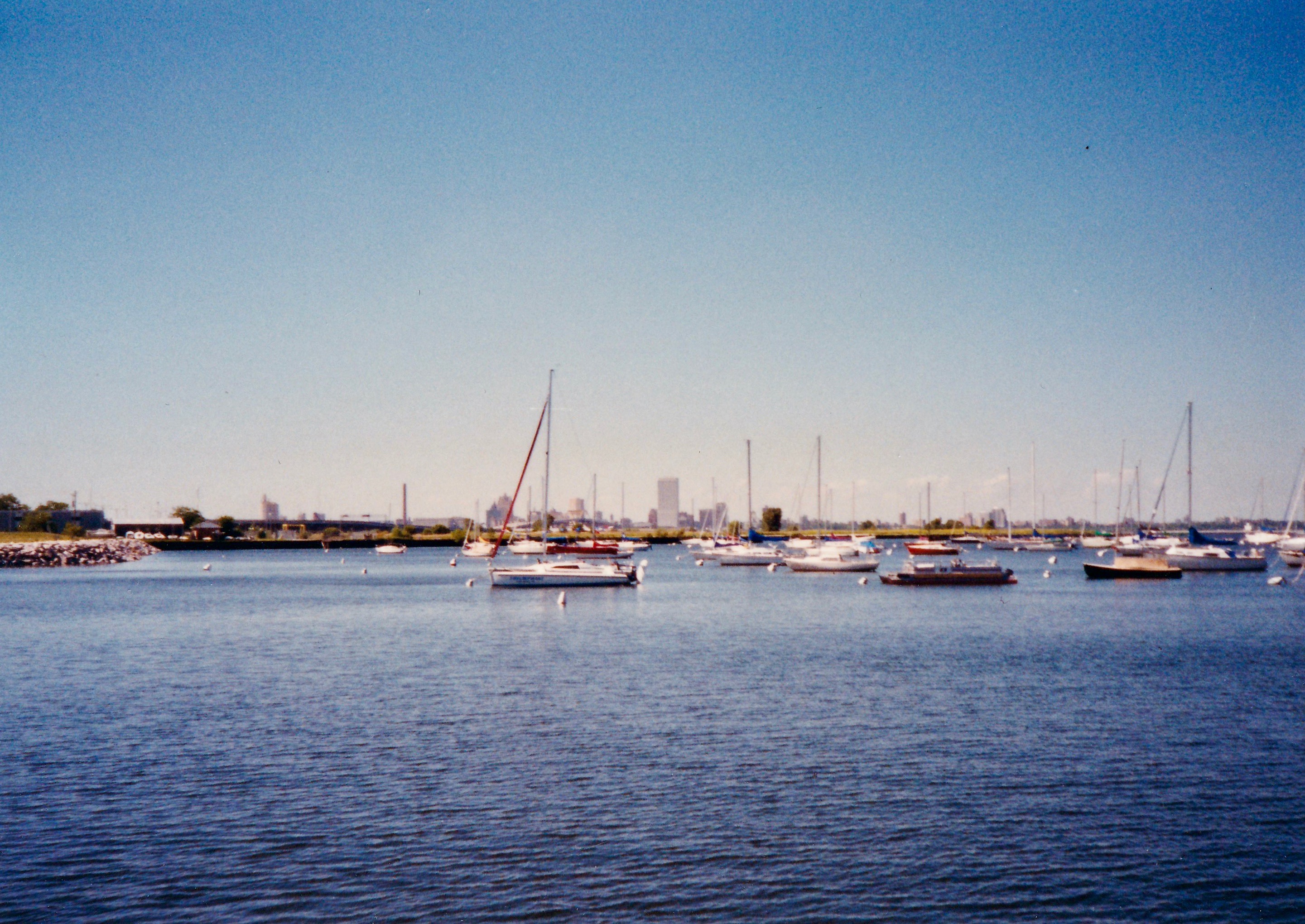
My last night in town before moving to Boston in 1997, a friend and I went for an evening stroll through South Shore Park in Bay View, providing one more time to take in the Downtown skyline as seen across the Lake and industrial Jones Island.
Although my parents moved to Iowa the following year, we’d all meet up in our hometown from time to time. Here’s a snapshot taken from roughly the same vantage point at South Shore Park nearly six years later.
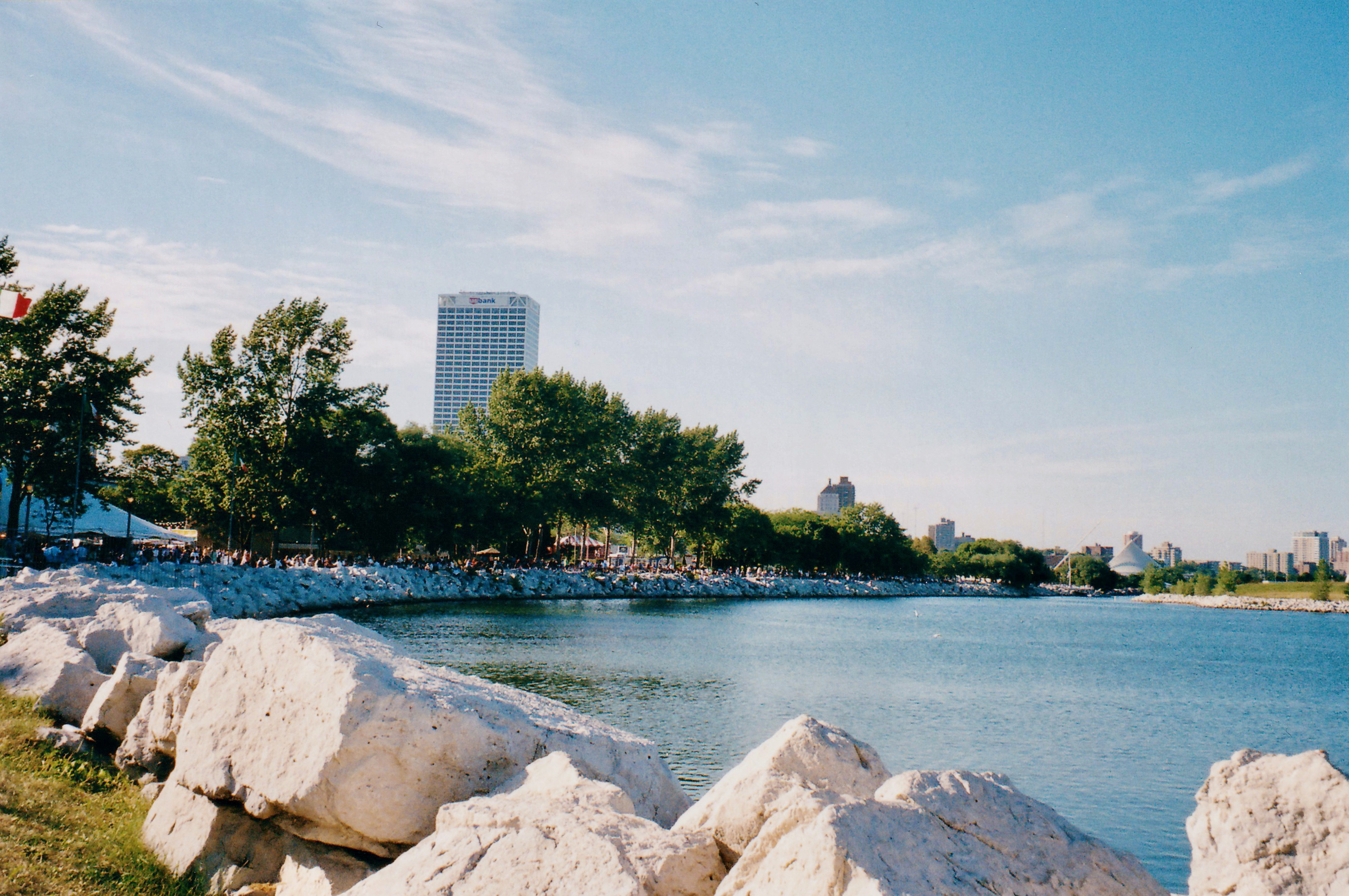
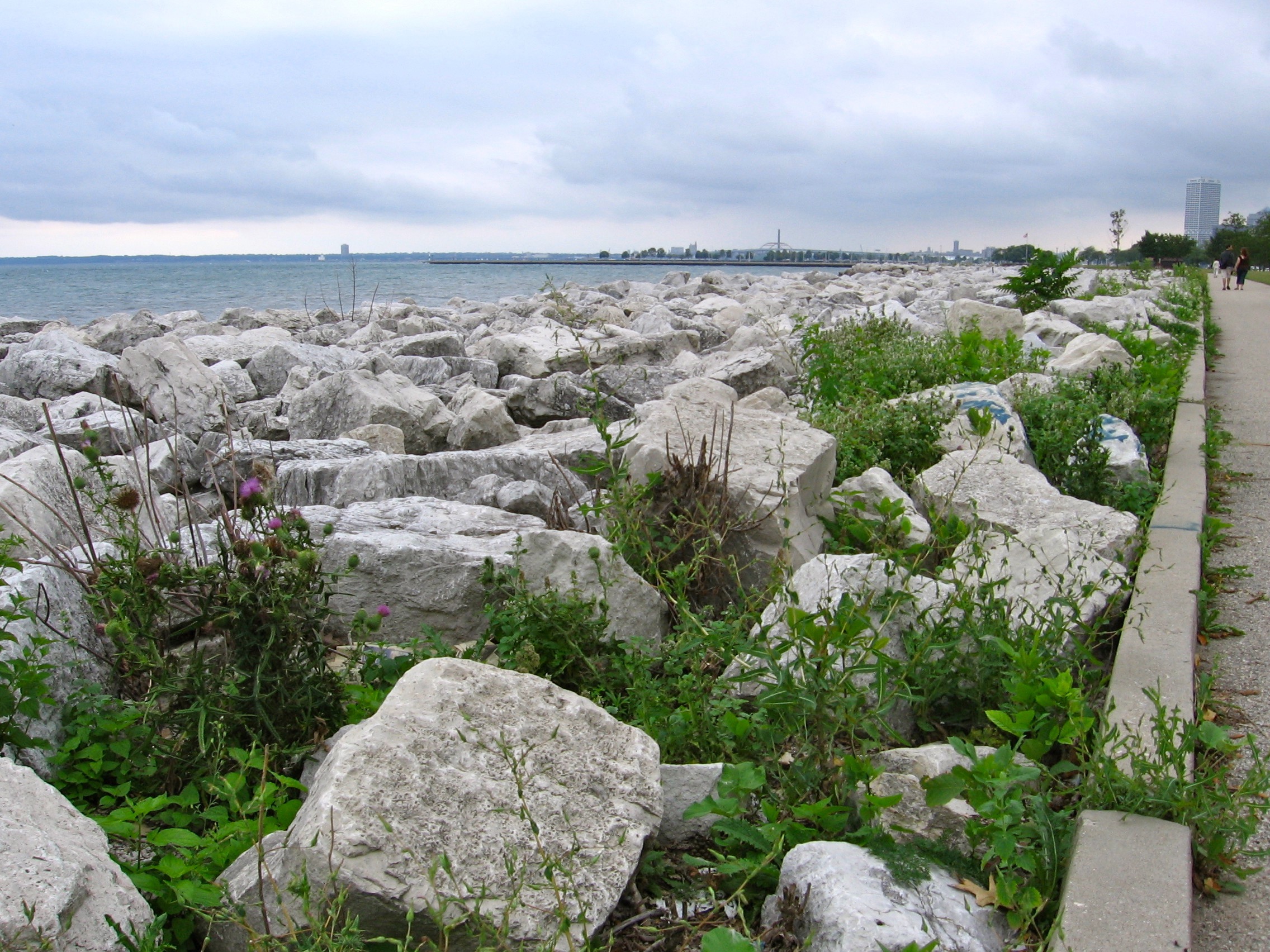
On this particular visit (July 2003), we attended Festa Italiana at Maier Festival Park; above are the white jagged rocks along Lakeshore State Park Inlet.
For more unadorned views of the Lake, travel North past Downtown over to Bradford Beach, which above appears suspiciously empty for a mid-Summer afternoon (perhaps it was unseasonably chilly, or “cooler by the Lake” as the expression goes.)
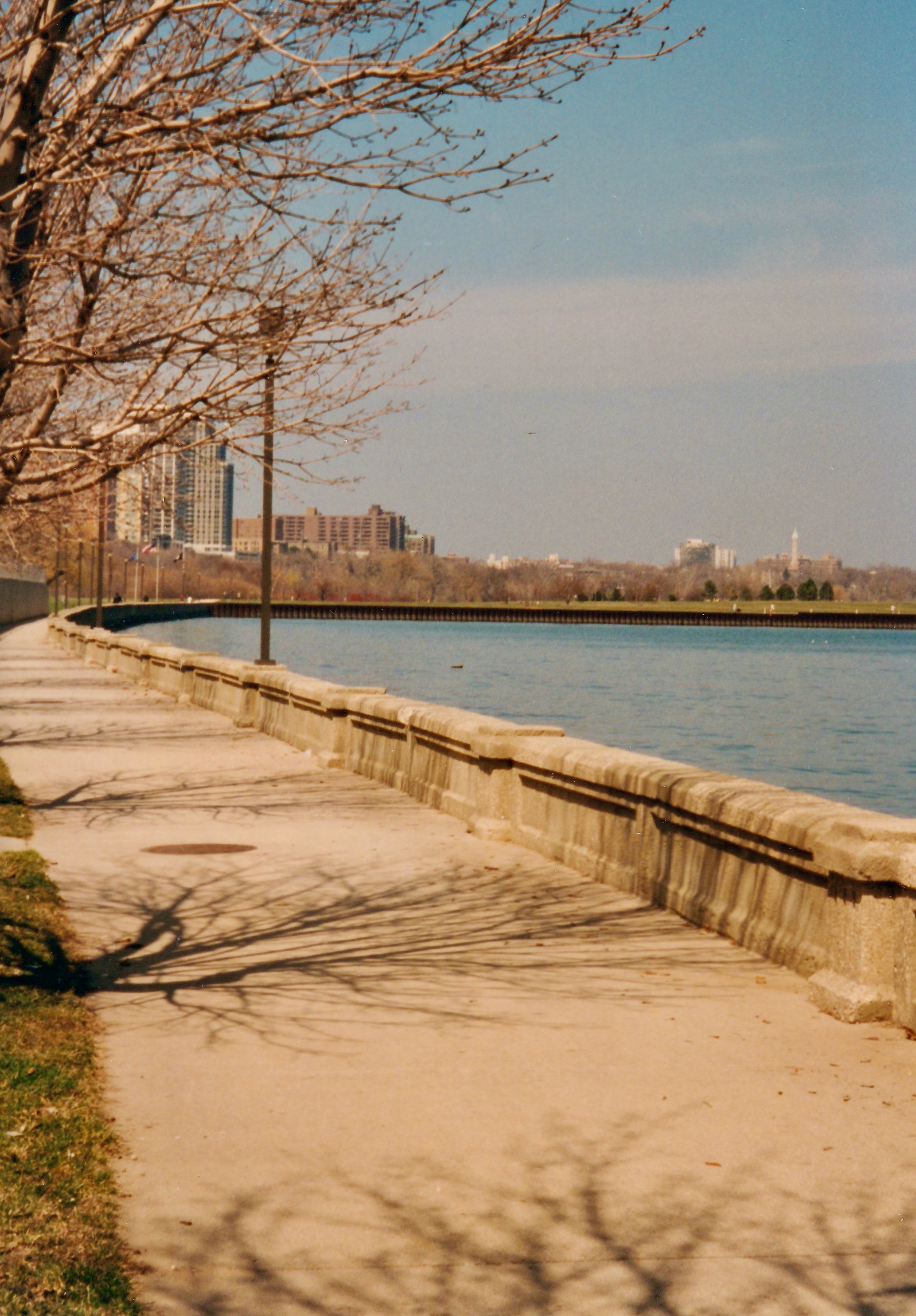
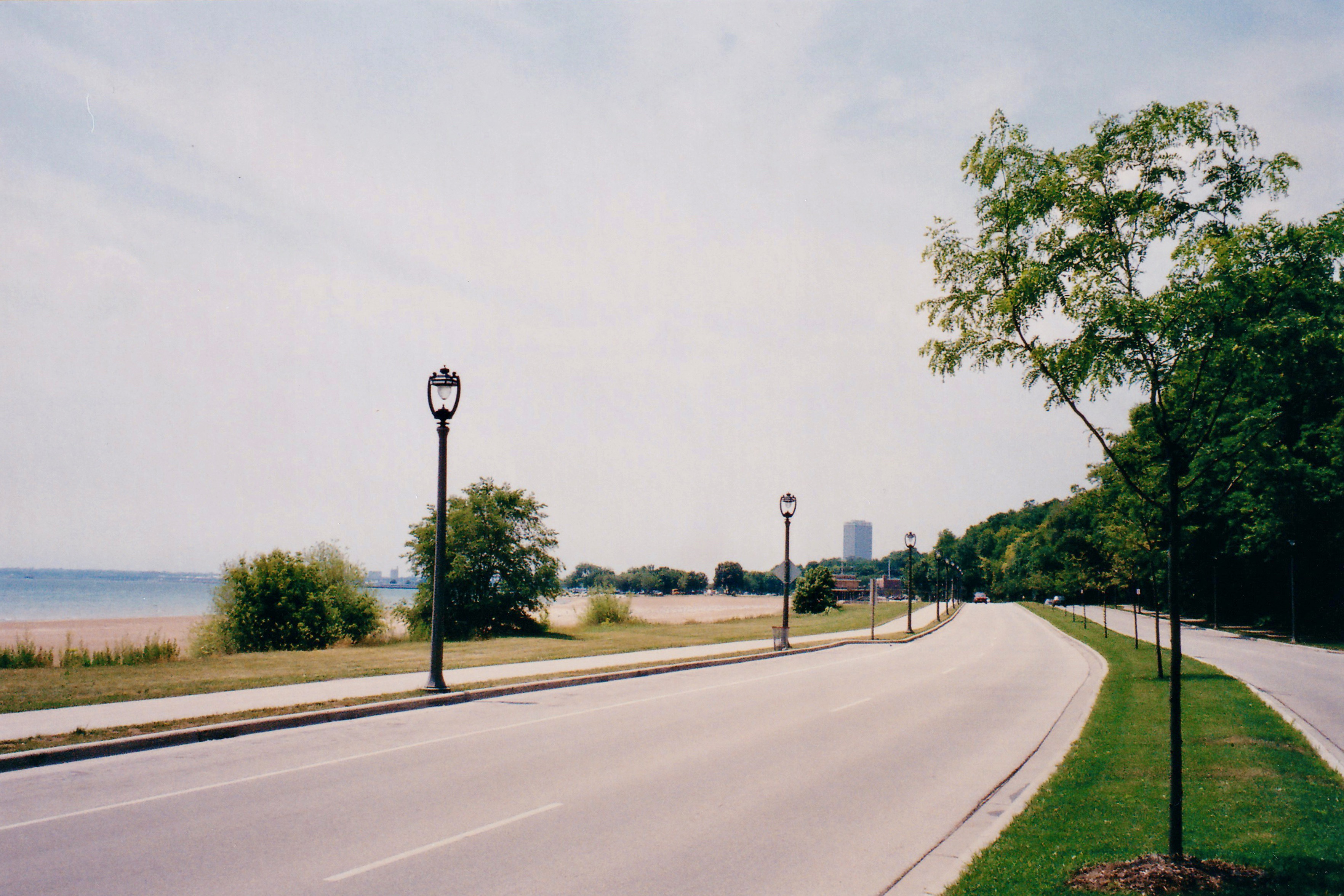
The most convenient way to experience the Lake (if only by sight and maybe smell) is to cruise along Lincoln Memorial Drive–my favorite Milwaukee road (and probably most others as well.)
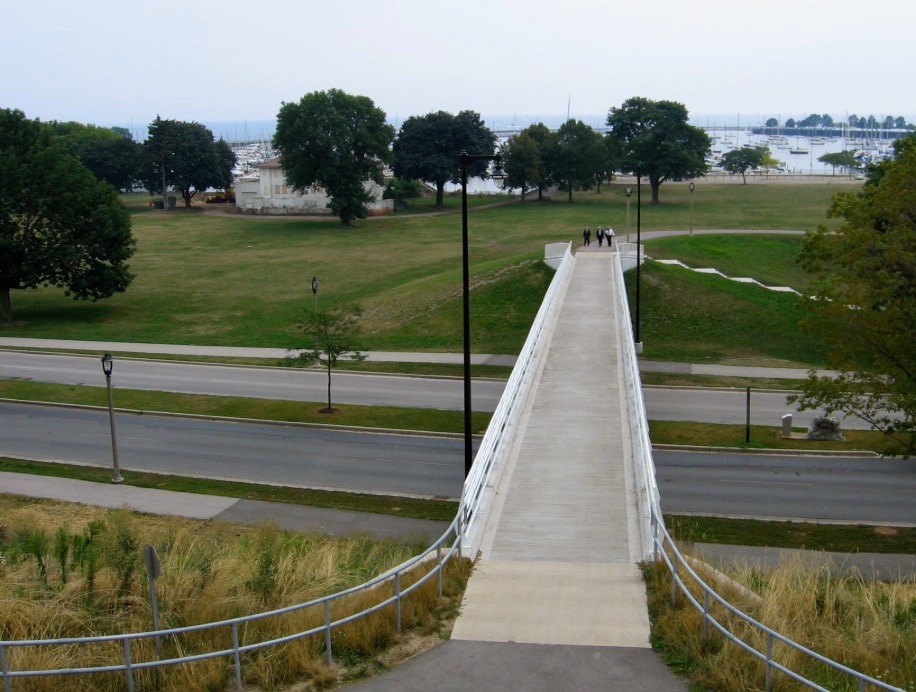
Returning for a visit in August 2006, I was excited to see a new and improved Oak Leaf Trail Footbridge connecting the end of Brady Street to McKinley Park over Lincoln Memorial Drive.
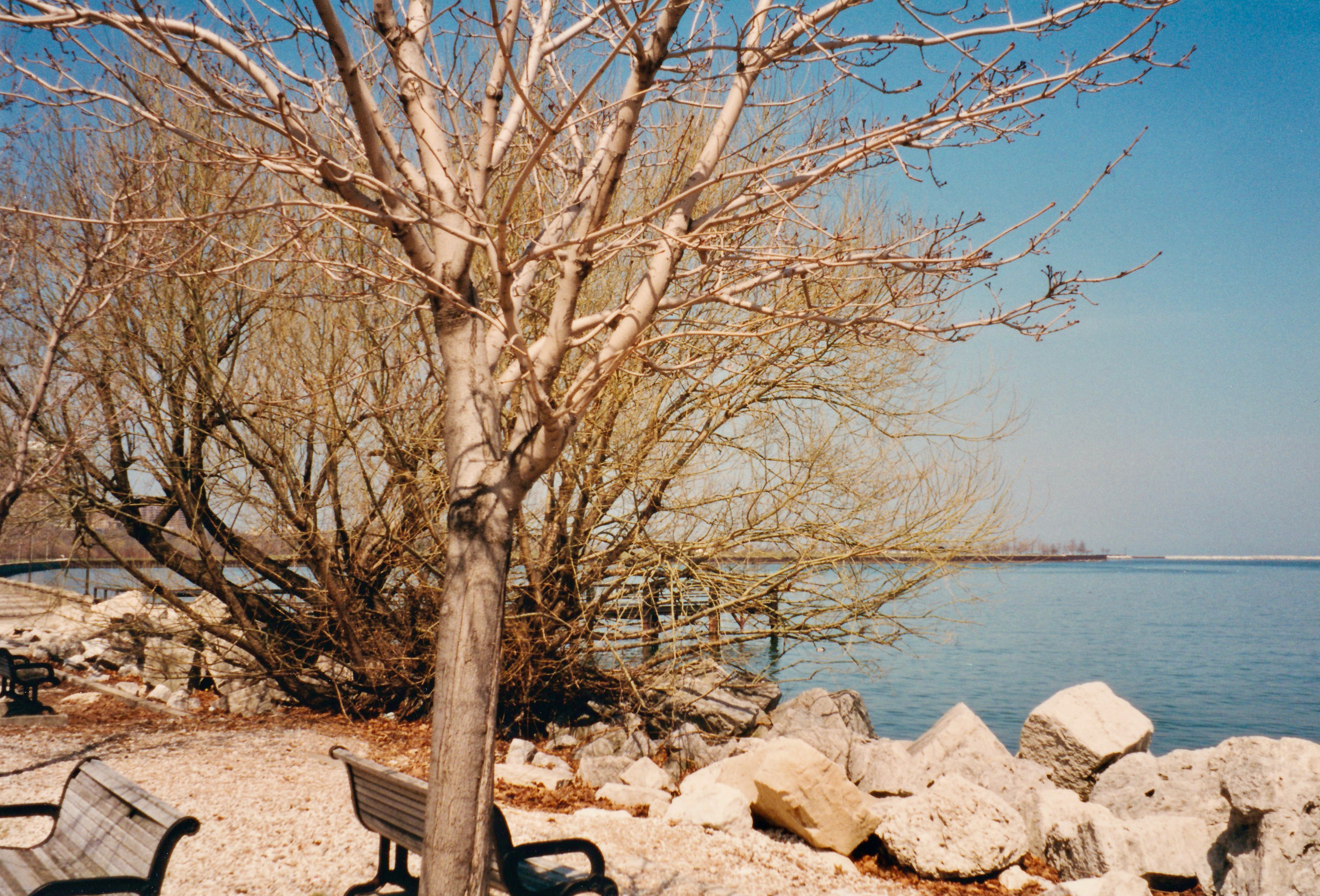
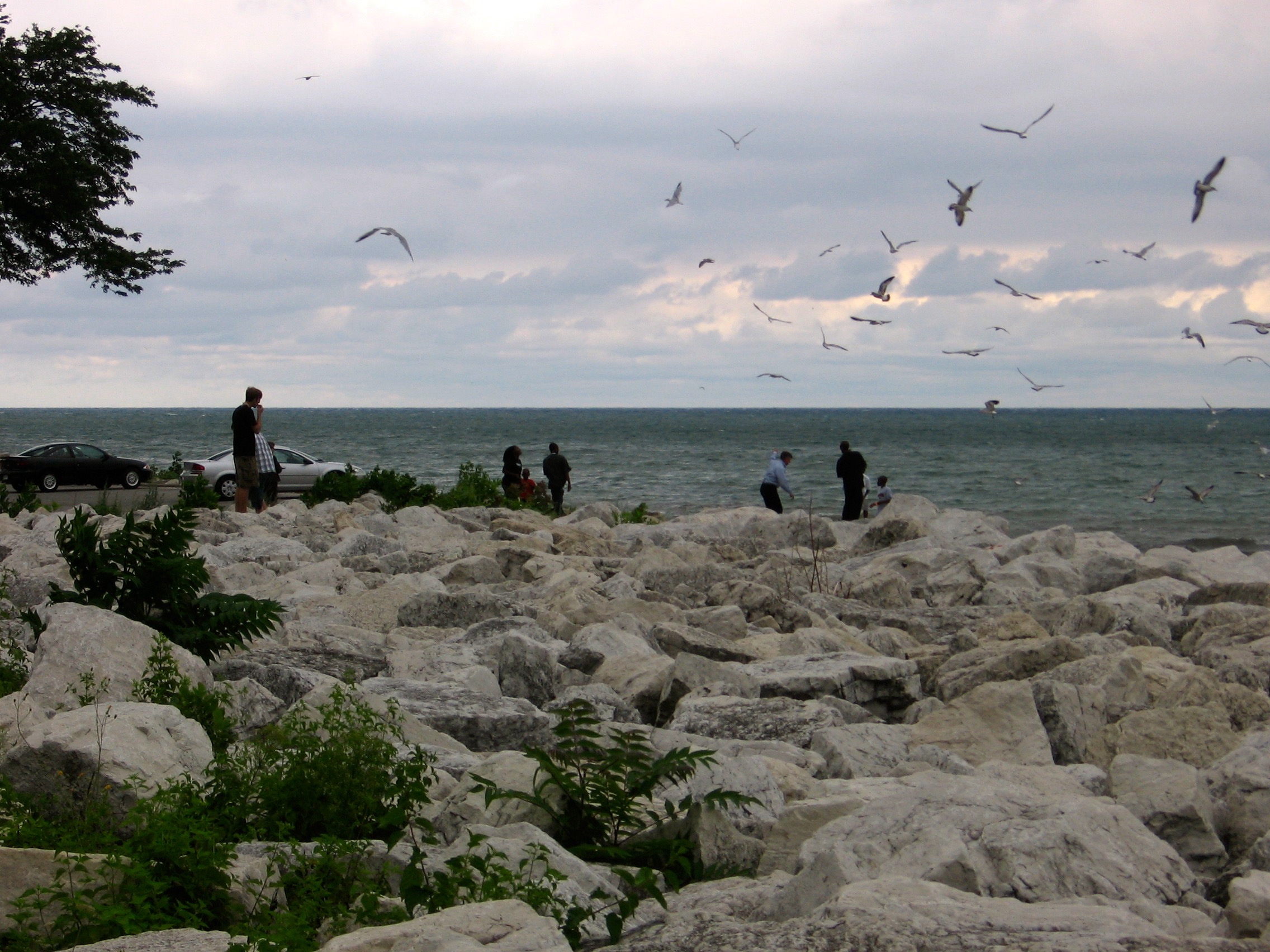
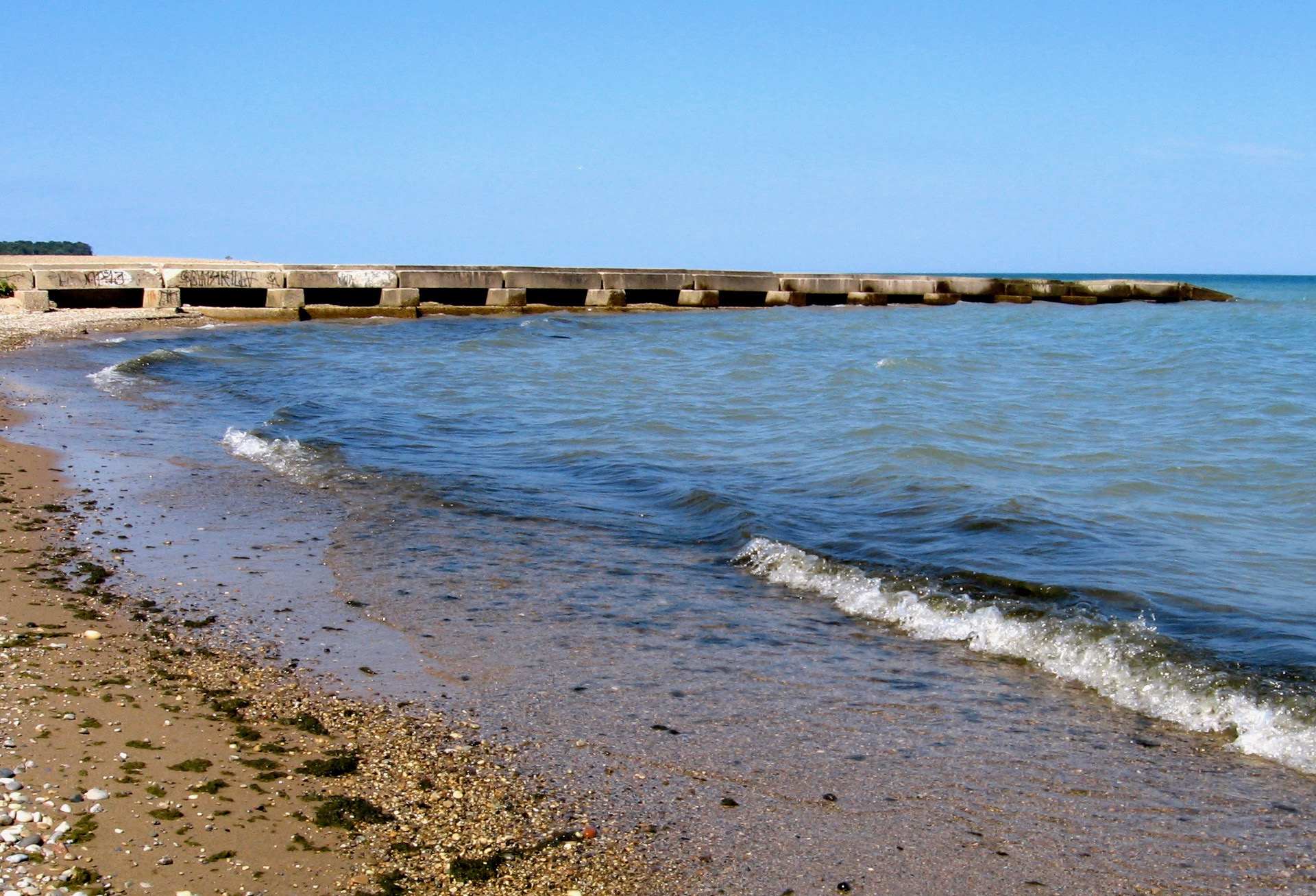
The rocks along this part of the shore brought back so many memories, including that time a decade before I had snuck down there with a few friends one late Summer night.
The rocky shore seems less mysterious in daylight, although one can still feel like they’re standing at an edge of the world as they feed or just watch the mass of gulls circling around.
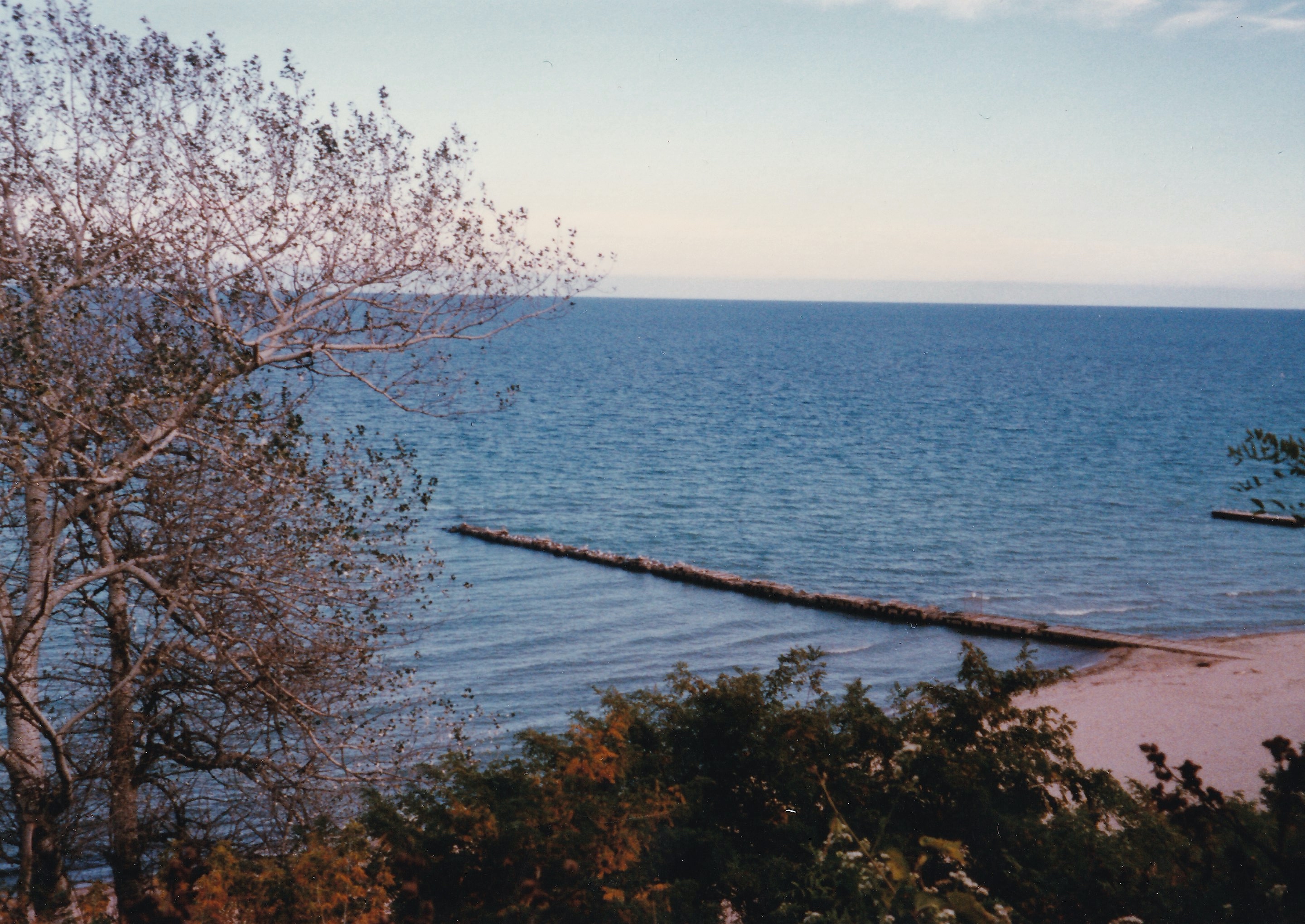
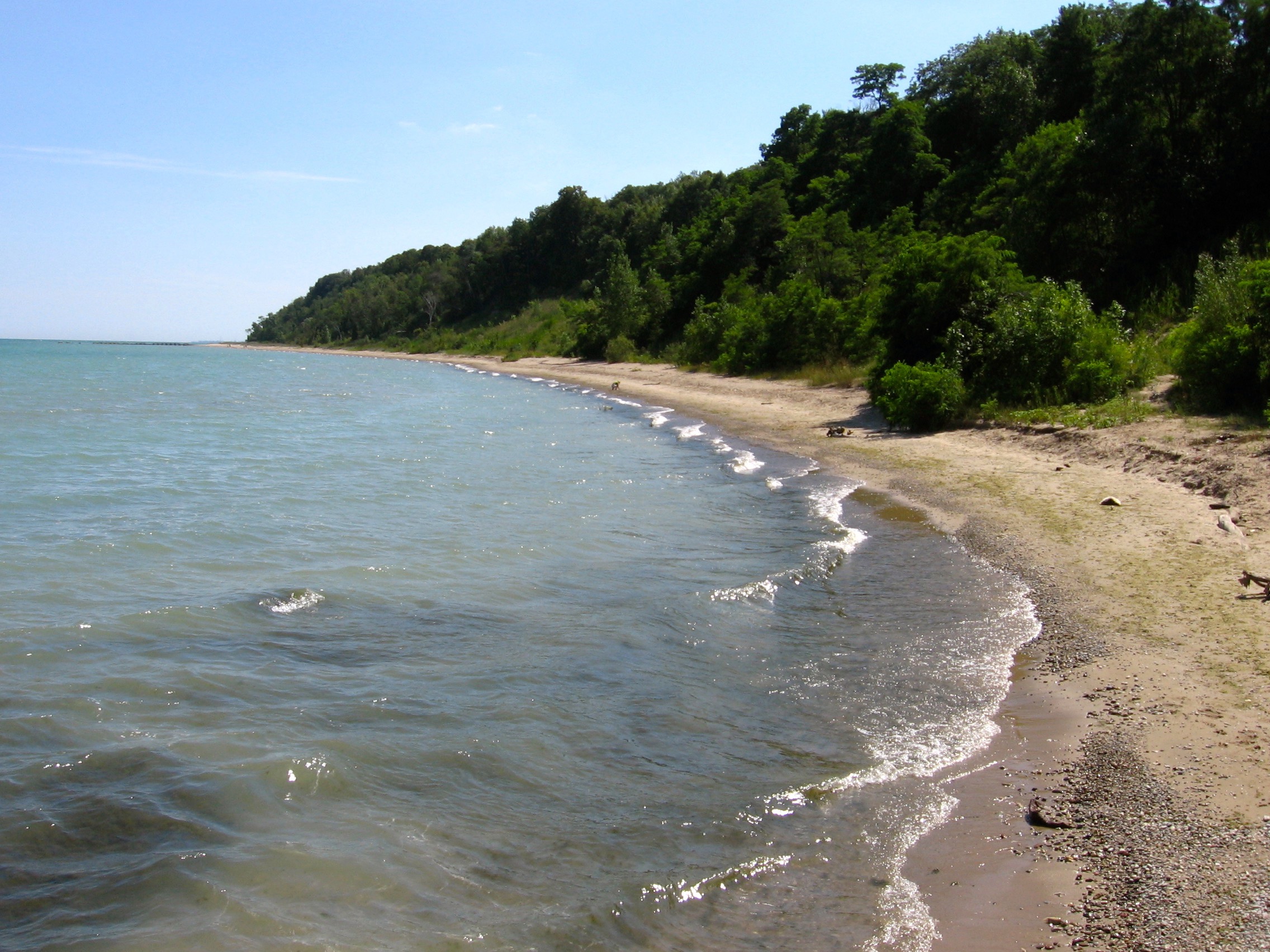
I concluded that same trip with a walk along the shore of Grant Park in South Milwaukee.
Because it’s further away from Downtown, the Lake along Grant Park tends to be less patronized than other coastal parks and beaches–it’s often an ideal spot for serenity, meditation and quiet.
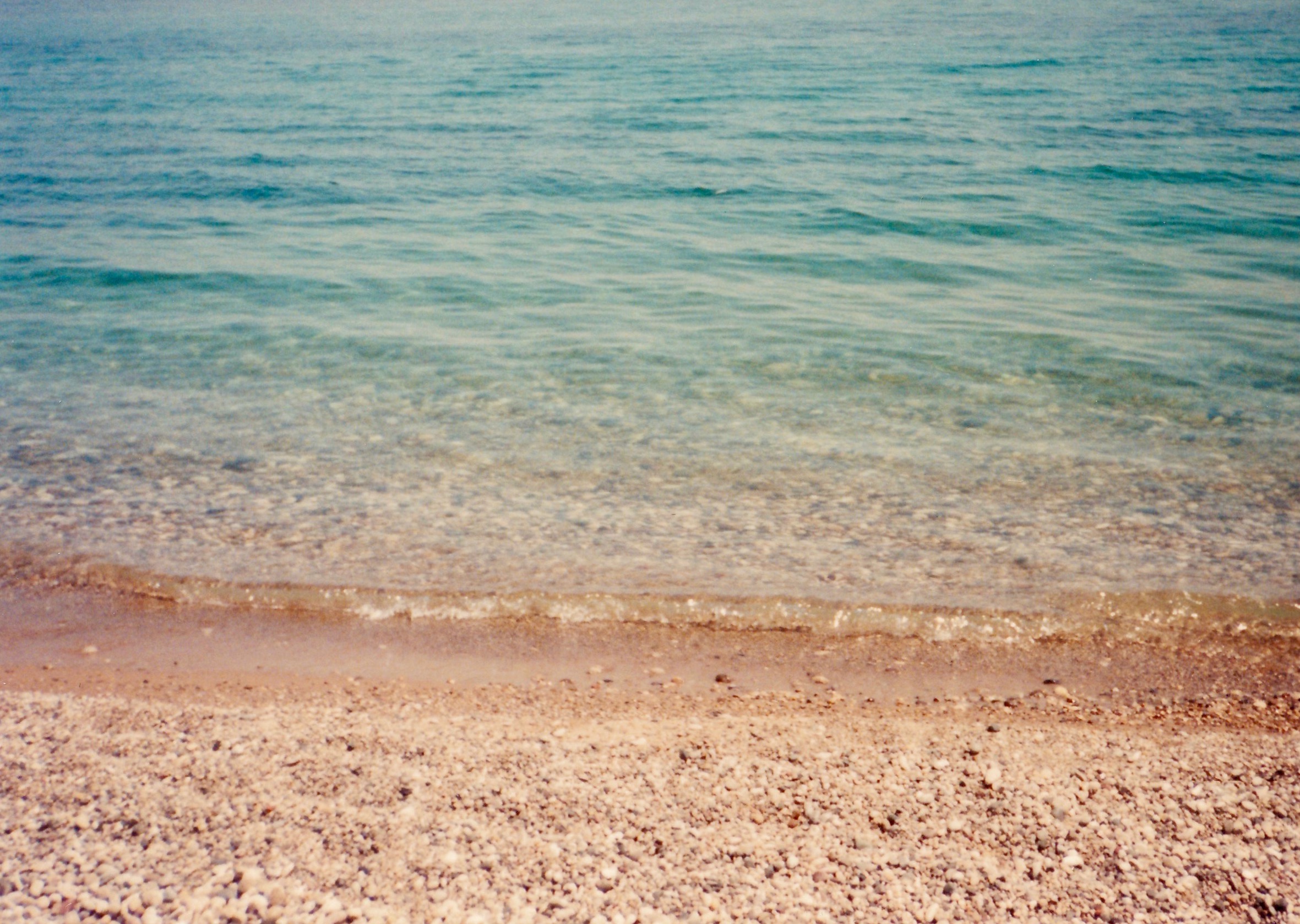
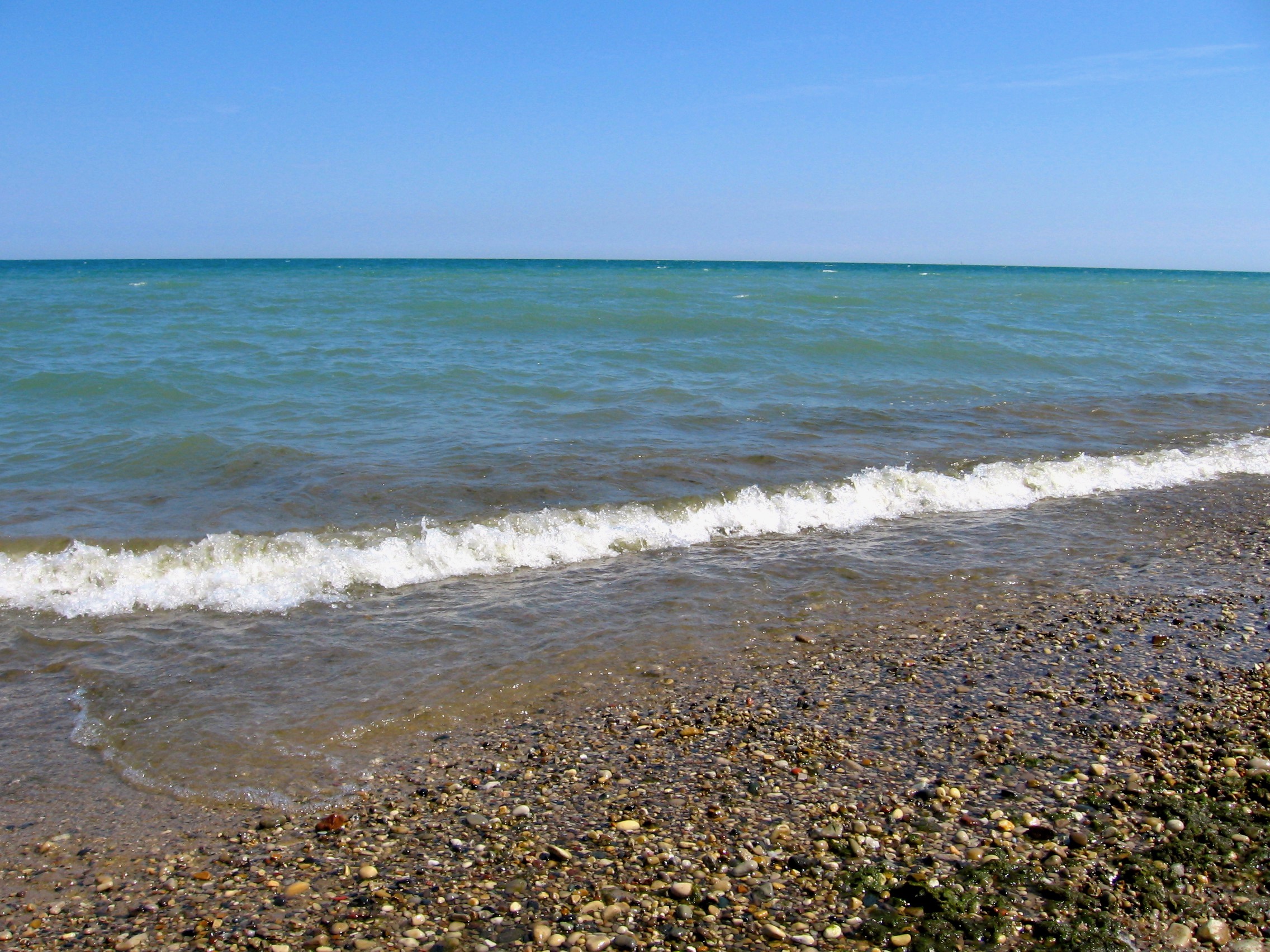
Again, the Lake just seems to go on forever. No tides coming in or out like you’d see at an ocean, just waves lapping against the shore, usually gently depending on which way the wind blows.
For over two decades, I’ve lived close enough to the Atlantic Ocean to be able to visit it whenever I wish; I’d like to think growing up so close to Lake Michigan conditioned me for that–the need for proximity to a large, seemingly endless body of water. I only make it back to Milwaukee every few years or so; no visit is complete without spending some time close to the Lake.
An April Friday, my Sophomore year at Marquette: I had no classes that day and I’d opted to spend a long weekend at home twenty minutes away instead of on campus in my dorm room. My mom had evening plans to attend a going-away party for a co-worker. She was even getting a ride from someone, so I had her car all to myself. She was a bit fanatical over that white four-door Pontiac Grand Am. I never had much of a curfew as a teen unless I borrowed her car.
Coincidentally, I also had a party to attend that evening; it was being thrown by my English Lit professor, a thirtysomething redhead who once began a lecture by saying to us, somewhat sheepishly, “Would you guys feel at all cheated out of your tuition if we didn’t have class today?” She lived across town in the tony suburb of Shorewood, and my original intent was to stop by. I’d know some people there, including a girl I’d recently, rather unsuccessfully tried to date (I was still a few years away from coming out)—not an emboldening reason for me to attend.
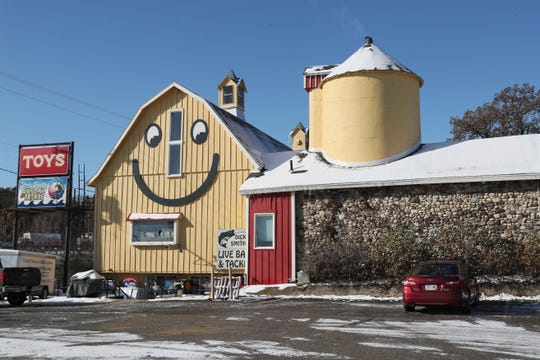
An evening before me with a car in my possession and absolutely nothing better to do, I left our South Side bungalow a little after 6:00 and got on the freeway in the direction of Shorewood. When I reached Downtown, however, I impulsively turned onto the West exit ramp. As I left Milwaukee County, I felt a little rush. When I passed the yellow barn with the giant smiley face painted on it at the Highway 83 exit, it suddenly was possible that I could keep going and going, another sixty or so miles all the way to Madison. I could make it there and back without Mom ever finding out. I often spent afternoons and evenings driving all over Milwaukee, putting mileage on the Grand Am but usually remembering to fill up the tank. I had more than enough cash on me for gas and food.
Crossing over from Waukesha to Jefferson County, I started picking up Madison radio stations (much to my chagrin, Mom would never splurge to install a tape deck or a CD player in her car.) I found a channel that only played hits of the 1970s, something of a novelty in the mid-90s. Passing through the flat terrain typical of Southeastern Wisconsin, all cornfields and the very occasional leafy tree, the sweet disco groove of Tavares’ “Heaven Must Be Missing An Angel (Part 1)” filled the vehicle and I was positively giddy—I was drivin’ all the way to Madison by myself!
I arrived in in less than an hour and a half. After passing through a succession of strip malls, chain restaurants and freeway exits with unfamiliar names (“Fish Hatchery Road” always stood out—did it, in fact, lead to the titular destination?), I left the interstate and headed directly towards the sprawling UW-Madison Campus. I found a parking spot a few blocks away from Sellery Hall, a typical 1960s-built ten story cinder-block accented dorm; this was where two of my high school friends now lived.
I walked up to Sellery’s lobby and rang Ewa’s buzzer, but she wasn’t in. I left a message and tried ringing Sam; he wasn’t in either. Where were my friends? Didn’t they appreciate me driving all the way up there, unannounced, just to see them?
I thought of another high school classmate I knew, Aimee (who happened to be Sam’s ex-girlfriend); she lived in the all-girls dorm Chadbourne (which Sam crudely dubbed “Chastity Chad”.) Luckily, she answered her phone. A petite, blonde Biology major, Aimee was ecstatic to see me although I’m sure she sensed she wasn’t the first person I tried contacting, given how close I was with her ex. We sat and chatted in her cramped room, complete with loft beds and plastic milk crates full of boxes of Cheerios and store-brand pasta. Using Aimee’s land line, I left additional voicemail messages for Ewa and Sam.
After 15 minutes, we had to get outside. It was unseasonably warm for April and not yet dark. With a comfortable breeze in the air, we walked a few blocks to State Street, a mile-long stretch of restaurants, bars, used record and clothing stores, and the occasional apartment complex. It was closed off to vehicular traffic apart from city buses and led towards Madison’s epicenter, the mighty, imposing State Capitol building.
We stopped at Steep and Brew for some herbal tea and caught up on how we were each doing in school. At the time, unhappy at Marquette, I was considering transferring to Madison, but did not disclose this information to Aimee. In retrospect, I probably should have uprooted the comfortable life I was used to in my hometown, though if I did, I might not have had the gumption to move out to Boston for grad school two years later, which was the best choice I ended up making—to leave Wisconsin and escape my comfort zone for something entirely new, to truly be on my own.
As things stood at the time, I was afraid of change, of even moving less than one hundred miles away. An hour-and-a-half joyride was all I could handle.
Aimee and I finished our tea and we walked toward the student union, where the setting sun rippled over Lake Mendota. We stood for a minute on the vast patio dotted by ‘70s-vintage yellow and orange canvased umbrellas and lights. I found a pay phone and tried Ewa again; this time, success! She was purposely waiting for me to call back. “Chris – WHERE ARE YOU???,” she yelled.
Within ten minutes, Ewa joined Aimee and I on the student union patio. As we hugged hello, I noticed her brown hair had grown out a bit since the last time I saw her (at a They Might Be Giants concert in Madison five weeks before), but she still wore her standard outfit of jeans, flannel shirt and dark green Chuck Taylor hi-tops. I’d known her for nearly five years; we’d met in a theology class Sophomore year at our Catholic high school. On the first day, we were required to introduce ourselves by listing some of our hobbies. Before the beginning of the next class, she came up to me and said, “So, you play guitar? That’s cool, I’ve been wanting to learn.” We were pals from then on; our friendship just developed naturally, never requiring any effort—we just had an instant rapport, one that felt like it had always been there.
The three of us strolled down State Street as the sky gradually changed from orange pink to dark blue. We browsed in a used CD store, briefly looked over the previously worn wares at Ragstock, and picked up some takeout at one of the numerous cheap Chinese joints littered up and down the thoroughfare. Aimee, having eaten at the dining hall earlier, said she had to go back to her dorm to study; we hugged goodbye and Ewa and I continued walking towards Sellery carrying bags of takeout cartons brimming with Sweet and Sour Pork, Chicken Lo Mein, Spring Rolls and White Rice. Ewa’s roommate had gone home for the weekend, so we had plenty of room to spread out our cheap, mostly fried bounty.
I tried calling Sam again and got his voicemail. It was a recording of Barry Williams as Greg Brady, excitedly talking about The Brady Kids, the band he and his siblings were part of and how excited they were to record their brand-new album. Sam’s own voice was nowhere to be heard on the message, which is how he preferred it. Even today, he eschews social media—my only contact with him in the past two decades has been through our Spotify accounts, which should tell you how much we’ve actually kept in touch since I moved to Boston.
As was our tradition, Ewa brought out a package of clove cigarettes, and we smoked a few. I then called home and left a voicemail for Mom, notifying her that I was “staying at the party late.” We listened to Rubber Soul three times in a row and chatted about our classes, our jobs, what new music each of us was listening to. She mentioned her upcoming summer trip to Poland (where she and her family emigrated from to the States when she was a young child), while I told her my plan to get a summer job on campus as a residence hall desk receptionist.
I felt more at ease sitting and chatting with Ewa in her room at Sellery than at home or even in my Marquette dorm, where I spent very little time. I had a packed schedule that semester, with most of my days and nights hunkered down in the library or the photography lab, and I went home most weekends to work a part-time retail job in the suburbs. I didn’t have a roommate, and I didn’t make much of an effort to hang out with the other guys on my floor. I’d moved on campus that year because I hated commuting from home, which during my Freshman year had the effect of college feeling like a supersized version of high school.
Living on campus didn’t magically solve all of my problems like I hoped it would. I’d later realize that the problem was me and my unwillingness to reveal much of myself to other people. I was deep in the closet and not yet ready to deal with or admit to myself whom I actually, honestly was. Hanging out with an old friend in Madison didn’t exactly bring me any closer to working through this issue, but it made me feel temporarily good, uplifted by spending time with someone I knew well.
11:00 PM turned into Midnight, and the next time I looked at my dark tan leather-banded Fossil watch, it was almost 1:00 AM. I’d given up on the possibility of Sam calling me back; later, I’d find out he was at his girlfriend Beth’s dorm room the entire evening. When I next glanced at my watch, it was nearly 2:00 AM. I knew what I had to do—get the car back home before sunrise and get some sleep before I had to go to work. Dragging my feet from the floor, I said my goodbyes to Ewa and headed out of Sellery over to where I parked the car. Thankfully, it was still there—no tickets or attempted break-ins. I pulled out of the UW-Madison campus and headed for the highway.
Driving on I-94 in the middle of the night, there were few other cars. Everything seemed much darker than usual, although it was probably no different than if I’d been driving at Midnight like I should have. I was completely sober (I was not a drinker yet) but miserably tired. I had the volume on the radio turned up loud to keep me awake.
Halfway home, I stopped at a Mobil to fill up the tank. Back on the expressway, I could sense my eyelids getting heavier by the minute. I switched from New Rock 102.1 to Classic Rock Station WKLH and cranked up the volume further. “It’s Still Rock and Roll To Me” came on and I began singing along. I wasn’t the world’s biggest Billy Joel fan; at my auto parts store job (yes, really), someone put a copy of the entire Piano Man album into one of the display auto cassette players and we listened to it on an endless loop—it was a perpetual hell of people putting bread in jars and microphones that smelled like beers, but still preferable to the country/western station one manager liked.
I still believe Billy Joel saved my life that night—singing along to his punchy, sarcastic, faux-rockabilly/faux new-wave number one hit from the Glass Houses album kept me awake and sharpened my focus. “HOT FUNK, COOL PUNK, EEE-VEN IF IT’S OLD JUNK!,” I shouted along, keeping my eyes as wide open as I could, never daring to take them off the road. The song ended with its jazzy final chord, and orange sodium lamps began dotting the expressway again. I was nearly in Milwaukee County and almost home.
I pulled into our alley around 3:45 AM, drove up to our garage, put the car in park, got out and turned my key in the garage door, slowly lifting it up and trying not to make too much noise (we didn’t have an automatic opener.) I eased the car inside, got out and pulled down the garage door as gently as I could. I opened the back door to my parent’s house in a similar manner, nearly walking on my tiptoes as I stumbled into my bedroom, took off my shoes and jeans and plopped into my childhood bed. As usual, I could faintly make out my dad’s snoring from the other bedroom. As far as I knew, I’d managed not to awaken either him or Mom.
I never told my parents about my joyride, and they never asked. Given what a goody-two-shoes I was all through high school, I felt a slight thrill at having gotten away with something forbidden, unexpected, a little gutsy. In a way, I was a step closer to being an adult, to making my own decisions and facing the consequences (I sure was tired at work that next day.) I’m not saying a joyride never hurt anybody, but for me, it pointed the way towards a road I desperately needed to take.









 Haunted Jukebox