(My 100 favorite albums in chronological order: #34 – released October 5, 1992)
Track listing: Drive / Try Not To Breathe / The Sidewinder Sleeps Tonite / Everybody Hurts / New Orleans Instrumental No. 1 / Sweetness Follows / Monty Got A Raw Deal / Ignoreland / Star Me Kitten / Man On The Moon / Nightswimming / Find The River
A Dozen Tributaries:
1. Forget everything you know about R.E.M., or at least anything after Automatic for the People was released in autumn 1992. Forget the “return-to-rock” follow up album, Monster (1994) which led to a stadium tour besieged by illness, including an aneurysm suffered by drummer Bill Berry, who’d leave the band a few years later. Forget the multi-million dollar contract that ensured R.E.M. would continue as a trio after Berry’s departure, and how deeply felt his absence was through five additional albums, most of them interminable, all of them inferior to what came before.
I know, it’s near-impossible a task, especially if you were of a certain age in autumn ’92 and lived through everything that came after. I had just entered my senior year of high school and knew R.E.M. from their second phase as former college rockers who had fully crossed over to the mainstream with a string of hit singles and iconic music videos—all of them undeniably commercial but also undiluted of the regional idiosyncrasies that had turned on a slightly older generation to them in their first, early-mid ‘80s phase as indie trailblazers who combined tuneful melodicism with Michael Stipe’s often unintelligible vocals.
From the Chronic Town EP (1982) to Out of Time (1991), R.E.M. continually built their audience and enhanced their sound to the point where the latter (itself almost an 100 Albums entry) became their first number one album. It showcased a band at its peak, incorporating everything from hip-hop (“Radio Song”) to The B-52s’ Kate Pierson (“Shiny Happy People”) while scoring a massive hit with mandolin as its unlikely lead instrument (“Losing My Religion”). Less than eighteen months after this triumph, it’s no exaggeration to suggest we all fervently anticipated what could come next.
Following a barely audible count off, “Drive” begins R.E.M.’s eighth album with a repeated, almost classical-sounding acoustic guitar arpeggio and Stipe singing, “Hey, kid, rock and roll / nobody tells you where to go / baby.” He’s borrowed a phrase from David Essex’s spooky/cool 1973 hit “Rock On” but there’s no cool or even any hint of swagger in his voice. He’s impassioned but direct, addressing his (ever-growing) audience in big-picture terms, but also conversationally: “What if I drive / what if you walk / what if you try to get off” goes the chorus, with Stipe alternating pronouns to propose multiple scenarios. Meanwhile, the arrangement gradually builds, first with accordion coloring, then with Led Zeppelin bassist John Paul Jones’ spacious, articulate strings. Like XTC’s “Dear God”, it develops tension via dynamics: it goes soft-loud-soft-loud then really loud when Peter Buck’s electric guitar charges in after the second chorus, only to get soft again (and then loud again). It vacillates between extremes, but the changes in volume never feel forced or unearned.
“Drive” was Automatic for the People’s first single. Despite being only a casual fan of Out of Time at that point, when I heard it on the radio days before the album’s release, I was transfixed—it seemed tender, imposing and eerie all at once. I couldn’t get its acoustic guitar riff out of my head. I bought the album that first week of release. A month later, I’d hear Abbey Road for the first time; its opening song, “Come Together”, reminded me more than a little of “Drive”. Perhaps this was just a happy coincidence, for together, Abbey Road and Automatic For The People forever changed how I listen to music.
2. From its sweet tick-tick-ticking percussive intro, you’d expect “Try Not to Breathe” to be a lighter confection than “Drive”, and you’d be correct regarding its sound. Nearly lilting, mid-tempo, in 12/8 time and suffused with organ and an electric guitar that gently oozes a little distortion for added texture, the song could’ve easily fit on Out Of Time. Though perhaps a likelier lead single than “Drive”, I think they picked the right song to introduce Automatic to the world. This is less profound, less enigmatic, less likely to catch you unawares like “Drive” does.
Lyrically, however, “Try Not to Breathe” introduces themes that will reverberate throughout Automatic: aging, mortality, death and the general passage of time (despite its title, Out Of Time is less heavily concerned with these things.) It appears to be sung from the perspective of someone nearing the end of his life. In the first person, he addresses a friend or perhaps a family member (“I will try not to worry you”), imparting wisdom and assessment (“I have seen things that you will never see.”) Avoiding being fatalistic or maudlin, the song continues the conversational tone of “Drive”, but with more compassion and warmth. Always R.E.M.’s secret weapon, bassist Mike Mills’ occasional counterpoint backing vocal in the later choruses only further pushes this feeling, as does the soulfulness Stipe repeatedly adds to the word “remember”. One not need wallow in sorrow and misery, for death, like breathing, is a constant—essential to a life.
3. Automatic was touted by the press as generally a downbeat, quiet album. A notable departure from the likes of “Stand” and “Shiny Happy People”, it had only two up-tempo songs on it (possibly three, depending on how far you stretch what “up-tempo” entails). The first of them, “The Sidewinder Sleeps Tonite” is Automatic’s most joyous, lighthearted track by a wide margin. With its title a take-off on doo-wop oldie “The Lion Sleeps Tonight” (months before Disney would re-popularize the tune for a new generation via The Lion King), it’s also one of R.E.M.’s most playful songs ever, thanks primarily to Stipe’s fizzy performance. He kicks it off with a few dee-dee-dee-dee’s straight from the older song, then launches into an excitable narrative steeped in Southern regionalism (“A can of beans or black-eyed peas / some Nescafe and ice”) and irreverent humor (“Tell her she can kiss my ass / then laugh and say that you were only kidding”). Throughout, Stipe employs a number of vocal tricks, deliberately stuttering for effect (“Today I need something more sub-sub-sub-substantial”), speeding up his cadence (the breathless chorus repeating the phrase, “Call me when you try to wake her up”), instinctually substituting nonsense words (final line, “We’ve got to moogie, moogie, move on this one”) and even occasionally shifting into a daringly higher register, reaching it with ease.
Though it may not represent Automatic as a whole, “The Sidewinder Sleeps Tonite” fits in well enough, thanks to Jones’ stirring orchestral arrangement. Although he only worked on four Automatic songs, his strings not only lent a new wrinkle to the band’s sound, they also beautifully, eloquently complimented the album’s overall tone. In “Drive”, they accent the drama that might’ve come off as too subdued by Stipe’s lyrics and vocals; here, they cast an ever-so-slight melancholic afterglow to the song’s good cheer and celebratory air. Issued as the album’s third single, it certainly sounded like a hit, but it never connected like “Drive” (or two other songs to come) did, receiving scant radio and MTV play in the US. Perhaps, it flopped because many of us were waiting for the song directly following it on Automatic to get a single release and win over the masses.
4. In his Entertainment Weekly review, Greg Sandow deemed “Everybody Hurts” the album’s “one surefire pop hit”, even likening it to Simon and Garfunkel’s “Bridge Over Troubled Water”; it’s a spot-on assessment, one I also thought of when hearing it for the first time. It’s almost absurd that the band waited until the following summer to release it as the album’s fourth single—that is, until you consider its uncomfortable place within R.E.M.’s folk/rock-heavy catalog, the backlash it provoked among many longtime fans and, despite only reaching #29 on the Billboard Hot 100, the feeling of overfamiliarity that eventually engulfed it.
Some years after the song reached a certain level of ubiquity, I had trouble listening to “Everybody Hurts” and only partially because I had grown sick of it. In the six months or so before everyone knew the song, it was my most beloved and played track off of Automatic. The clear, highly vulnerable, almost naked tone of Stipe’s vocal and the lyrics’ explict directness (the song is an emphatic plea to a friend against committing suicide) right away resonated with my 17-year-old self. I immediately took to the song’s gentleness, the timeless ‘50s rock ballad feel, the lullabye-ready guitar triplets and the tick-tock beat, the effective counterpart “hold on” vocals in the second verse. Most of all, I swooned at the chord change leading the second chorus into the middle-eight, were the orchestra and the band come in, full blast, the entire song blossoming after a slow build, hitting its most crucial emotional high with Stipe singing, “No, no, no, you’re not alone.”
Even though I’ve never seriously considered suicide (nor have ever been close to anyone who has), I identified with the song’s idealistic notion that, no matter how bad things seem, no one is really alone. As we age, we tend to encounter periods where we dismiss things that were significant to us as teenagers; in my 20s and early 30s, I lived through turbulence and disappointments I could not even imagine experiencing at 17. Thus, by that time, “Everybody Hurts”, with its simplistic optimism, seemed much further away than it once did—a view of the world that I felt no longer matched up with my own decidedly more nuanced and complicated experience. I can imagine this is how a lot of people older than me perceived the song when its famous, speculatively subtitled, freeway traffic jam-set music video was all over MTV in summer ’93—it aspired to be for everybody (well, it is right there in the title), downplaying any of the band’s past quirks for a big pop move, one practically calculated for universal appeal.
Then again, R.E.M. arguably already made that big pop move back with “Stand” or “The One I Love”; “Everybody Hurts” is more an effort to lend an olive branch to its audience, saying that it’s okay to will yourself to go out on a limb and open yourself up to the world. Phrases that sound banal on paper (“It’s time to sing along”, “Take comfort in your friends”) resonate beautifully within this context and also in the plainspoken but passionate way Stipe sings them. In preparation for this essay, when I first listened to “Everybody Hurts” after years of not listening to it so closely, I was nearly moved to tears—the same reaction I had at 17 and a sign, perhaps, that at 40, I’m now in a stable place or at least one where I’m more open and receptive to what “Everybody Hurts” proposes.
5. I never appreciated instrumentals (or at least those outside of jazz) until I began listening to Brian Eno about a decade ago. I used to think of them as filler, mostly skippable tracks that somehow carried less value because they had no words, no singing. It took Eno’s generally instinctual approach to creating sounds with “the studio as an instrument” for me to really get how these wordless compositions could provide texture, atmosphere and insight. They held the potential to add to or alter the flow of an album, to act as a link between other songs or occasionally, as a palette cleanser.
“New Orleans Instrumental No. 1” was the second time in a row R.E.M. sequenced a wordless song as an album’s fifth track (following Out of Time’s “Endgame”). Just over two minutes long, it’s Automatic’s least essential song almost by default. For years, I wondered why they didn’t include the terrific “It’s A Free World Baby” (B-side of the “Drive” single, later appearing on the Coneheads soundtrack, of all things) in its place. Built around an electric piano, e-bow guitar and possibly stand-up bass, it relays a ridiculously simple, two-chord melody; even its title is blatantly generic (was there ever a “New Orleans Instrumental No. 2”?). However, coming after the grand, emotional drama of “Everybody Hurts”, it allows one to catch one’s breath, to reset and reflect; it also lovingly evokes the calm, delicate stillness of sitting in a darkened room at three in the morning. Automatic doesn’t need the song in the way it absolutely requires “Drive” or “Everybody Hurts”, but its presence reassures that R.E.M. are still weirdos who will place their least commerical song right next to their most accessible one on an album if they want to.
6. My grandmother passed away nine months before Automatic came out; no one close to me had ever died before. Strangely enough, looking back on 1992 as a whole, I remember being uncommonly happy, notwithstanding the obvious grief I experienced right after my grandmother’s death. For as I turned 17, I began to come out of my shell and open myself up to world, if just a little. Entering my senior year of high school, I felt triumphant getting my driver’s license and reveling in the newfound independence that entailed. Despite my loss (or perhaps because of it), I was learning more about how to live.
Although it proceeds at an almost dirgelike tempo, “Sweetness Follows” somewhat mirrors such sentiments. As the cellos chug along and an organ drones behind him, Stipe, once again in that clean, clear tone he uses on much of Automatic, relays the album’s most explicitly death-centered lyrics. The opening couplet, “Readying to bury your mother and your father / what did you think if you lost another,” immediately presents the subject as universal. From there, he confronts the messiness in coming to terms with death, the resolve sitting aside undiminished pain, its presence constant as we remain “lost in our little lives”.
And yet, following a dramatic chord change and two lovingly drawn out “oh’s”, he sings the song’s title, which makes up the entire chorus and it’s all he needs to make his point. Grief after the death of a loved one never entirely vanishes, but we learn how to process and live with it. “Sweetness Follows” is ultimately about finding solace in our acceptance of death. We grieve, but we console, we remember, we heal. The song, which ends with a mewling of guitar feedback (a slight preview of Monster) brings Automatic’s first half to a resolute, somber close.
7. “Monty Got a Raw Deal” is, of course, about Montgomery Clift. A handsome leading man and respected method actor in the decade following World War II, he survived but was left shaken by a serious car crash in 1956; ten years later, he was dead at age 45 from a heart attack brought on by drug addiction. The “raw deal” in the title obliquely refers to his bisexuality, most likely a primary reason for his career’s gradual derailment. I didn’t know any of this in 1992, although I’d fully comprehend Clift’s otherness five years later when I first watched his breakthrough film, 1948’s Red River. In direct contrast to co-star John Wayne’s heroic, masculine persona, Clift came off as far more tender and vulnerable but not soft, which was the key to his singular appeal.
In its lyrical, solo acoustic guitar extended intro, R.E.M.’s tribute to Clift seems full of sorrow, until after Stipe finishes singing the first verse. Then, the rest of the band comes in, powered by Berry’s forceful drums, and it transforms into an inquiry rather than a lament. Although not overtly angry, “Monty Got a Raw Deal” practically seethes at times—with defiance, regret, maybe even a little scorn both for how Clift was wronged by society and for the destructiveness with which he confronted his demons. However, by addressing Clift in the first-person, Stipe ends up making the song as much about himself, noting straightaway that “Mischief knocked me in the knees / (and) said ‘Just let go. Just let go.’” Stipe would acknowledge his own bisexuality in the years immediately following Automatic, but one could easily argue that his first notable attempt to come out was via this song. I didn’t pick up on any of this at the time, which is fitting since I was also in deep denial about my own sexuality; still, I could sense the significance buried deep within, even if I didn’t yet have the acuity to pinpoint exactly where it was or what it meant.
8. An emphatically angry screed against the Reagan/Bush years, “Ignoreland” may come off as a little quaint to some given Bush/Cheney, 9/11 and everything that followed; you could just as well argue that it lost none of its relevance in the early ‘00s and still retains much of it to this day. Automatic’s sole rocker, it seems to have been included only because of its release date, one month before the ’92 presidential election. Louder than anything else on the album, the kitchen-sink arrangement features ringing electric guitars, blasts of harmonica, an unlikely clavinet, backing cowbell and manly vocal punctuations of “HUAH!” in each bridge leading to the chorus. Meanwhile, Stipe sounds as garbled as he did on any of R.E.M.’s first four albums, almost deliberately muffled to appear as if he’s shouting from a distance into the void. “Ignoreland” is Automatic’s true outlier, but also hooky enough to warrant inclusion, injecting a bit of life into an altogether moody and reserved album. Plus, it contains the classic Stipe statement, “But I feel better having screamed, don’t you?”
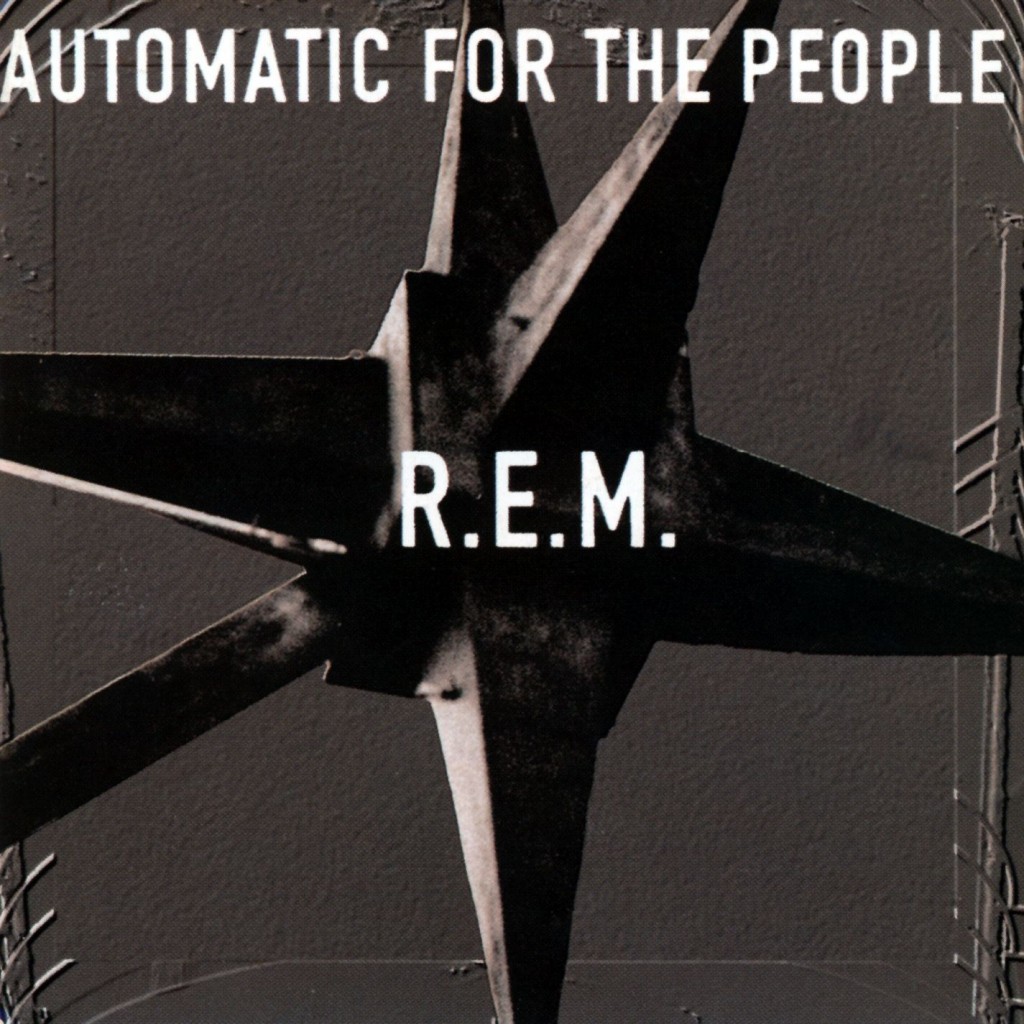
9. Let’s talk about the album title and cover. The former refers to Weaver D’s, a venerable soul food restaurant in the band’s home base of Athens, Georgia. “Automatic for the People” is literally the establishment’s slogan, a greeting bestowed upon customers by the titular proprietor. The cover, meanwhile, is an extreme-to-the-point-of-being-abstract close-up of a star-shaped Miami motel sign (and not of Weaver D’s sign, which I once thought was the case). It’s mysterious, something of a non-sequitur and not at all a stretch to call it weird.
When Automatic was first released, Mills described its songs as “weird”, and while they’re not necessarily strange compared to some of Murmur or Fables of the Reconstruction, you know what he’s getting at, especially on a track like “Star Me Kitten”. In great contrast to the in-your-face brashness of “Ignoreland”, it perpetually shimmers, practically just hanging there for over three minutes on a bed of unceasing “ahhh’s” and brushed percussion that’s still too rock ‘n’ roll to be mistaken for jazz. The guitar melody seems to lazily slip up and down the fretboard, an organ softly bleeds throughout and finger snaps are audible but threaten to disappear into the ether, not really enticing you to snap along with them.
Even the title’s weird, although explicable: the lyrics actually read “Fuck Me, Kitten”, the word “Star” substituting it on the album sleeve presumably to avoid Automatic from getting slapped with a then-omnipresent Parental Advisory sticker. Obviously one of R.E.M.’s lustier songs-to-date, though both the title change and Stipe’s vocal, submerged under that wall of sound again create a distancing effect. Yes, it’s a peculiar little experiment but rather disarming in how its graphic nature is contradicted by a certain bashfulness. If you’re curious, check out the somewhat less bashful version of the song the band later recorded with William Burroughs.
10. A few weeks after Automatic’s release, a Friday in late October, just after dinner: I’m sprawled out on my bed, listening to the album on headphones, likely on shuffle as I got my first CD player earlier that year and was still entranced by the novelty of hearing something in random order. I remember listening to Automatic often in this ill-advised way up until then (you can imagine how further disorienting “Star Me Kitten” appeared when played out of sequence). However, that particular evening, “Man on the Moon” came up and just like that, all of the album’s disparate pieces seemed to fall in place. I lay there in awe of the song’s cavernous yet cozy vibe as if I were gently cascading along an intimate yet sweeping vista, ever-expansive in its “yeah, yeah, yeah, yeah” call-and-responses, inviting harmonies and Buck’s magisterial-for-being-so-rare slide guitar solo.
An almost effortless wonder permeates “Man on the Moon”, Automatic’s second single and possibly its most-beloved standard. Like “Monty Got a Raw Deal”, it’s a tribute to a deceased, cultish performer, in this case Andy Kaufman—another person I knew little about at the time, apart from his role as Latka Gravas on the sitcom Taxi. At first, the lyrics seem purely stream-of-consciousness (“Mott the Hoople and the game of life”; “Let’s play Twister, let’s play Risk”), each phrase followed by those four yeahs. Kaufman is mentioned by name (along with his wrestling friend (Fred) Blassie), but the song does not turn conversational until the bridge, with Stipe shifting tone to address Kaufman in the afterlife, asking, “Andy did you hear about this one? Tell me are you locked in the punch?” The chorus finds Stipe readying a mixed metaphor about the chasm between what we’re told and what we actually choose to believe. I don’t seriously think the song vindicates all those naysayers who deem Apollo 11 to be a sham, but it does ponder how fantastically unreal such a thing as a man walking on the moon is in theory. If we can buy that, then why not believe in the absurd and the near-impossible, both critical components of Kaufman’s comedy and worldview?
Once again, an openness to the world reveals itself as one of Automatic’s ongoing themes. “Man on the Moon” may be concerned with one specific man and the unparalleled mark he left in his short lifetime. However, as I listen to it now, more than two decades after that October evening when it first affected me so deeply, I still feel greatly moved by the song’s spirit and also its sense of camaraderie, the idea previously proposed in “Everybody Hurts” that we’re all in this together, and isn’t that wild and absolutely profound? The song’s music video further supports this notion, with the final chorus straightforwardly lip-synched by a variety of people at a bar, male and female, young and old, all given their own brief moment on camera, powerful not for individual performances but for the communal whole—for the people, natch.
11. Although “Nightswimming” was the album’s fifth single in some countries, it retained a “deep cut” status in the US. I remember how thrilled I was to hear it played at my post-prom in May ’93—certainly not the most obvious choice for a slow dance (or a single, for that matter). The arrangement is among Automatic’s sparest, consisting only of piano (played by Mills), Stipe’s vocal and Jones’ orchestra. The cute opening snippet of the latter tuning up soon entirely gives way to Mills and Stipe, repeating a circular melody nearly as basic as the one in “New Orleans Instrumental No. 1”. Although minimalist, “Nightswimming” is rich with detail. The orchestral flourishes lithely accent the melody, occasionally dropping out and reappearing for dramatic effect. There’s also an oboe solo before the last verse that returns for the song’s final measures, its bittersweet tone a moment of grace.
Lyrically, “Nightswimming” highlights Automatic’s other major themes apart from death: memory and the passage of time. On the surface, it appears to be about after-hours, deep woods skinny dipping and presumably autobiographical, although Stipe later claimed that most of it was made up. Regardless, the yearning with which he sings these lyrics suggests a deep connection to them, even as he favors poetic abstraction over specificities. Brief, Zen-like phrases also take precedence over wordy, sentimental generalizations. When he sings, “The photograph reflects / Every street light a reminder / Nightswimming / Deserves a quiet night,” rather than paint a picture, he more conjures up a mental, almost dreamlike state where past memories coalesce with the present. The music’s elegance gives the listener something to grasp on to, while also enhancing Stipe’s wistful yet sincere, approachable tone.
12. Long ago, I read of review of Automatic (I couldn’t find it online) that began with a sentence along the likes of “A river has a beginning, many tributaries and an end.” Although a little pretentious, it neatly sums up the album’s effect as a whole, directly referencing its final track, “Find the River”. Like much of the rest of the album, it’s a pastoral ballad, acoustic guitars gently buoyed by piano, organ, melodica and backing vocals. As with “Nightswimming” it’s steeped in imagery regarding memory and the past, but also shows the narrator assessing his place in the world and pondering his future. The river of the title obviously represents life: always flowing, leading towards a goal (the ocean), hoping not to sink (or in this case, get swept away by the tides or the undertow) but keep swimming, keep moving.
Like a river, Automatic is a journey. It begins by mapping out different scenarios (“Drive”), celebrating good times (“The Sidewinder Sleeps Tonite”), dealing with the bad ones (“Everybody Hurts”), along the way making inquiries (“Monty Got a Raw Deal”), declarations of lust (“Star Me Kitten”) and wisdom (“Man On The Moon”), remembering (and perhaps visiting) past haunts (“Nightswimming”), eventually arriving at a crossroads in “Find The River” where Stipe shifts from singing “Nothing is going my way,” to “All of this is coming your way,” at the very end. The music then slowly fades out, its guitar riff practically undulating like a current in a stream stretching beyond the horizon.
I’ve called Automatic my all-time favorite album on numerous occasions. I no longer know if that’s true; I find it increasingly difficult to rank the music, books, films, etc.; that I love. A year at a time is somewhat manageable, but of everything I’ve ever heard, consumed, absorbed? Given how one can easily listen to a piece of music over and over again without devoting anywhere near the time a book or a film requires, a perception of how much it informs your life naturally varies over time. I’ve gone through years where I’m lucky if I listen to Automatic once in full; so many great albums I’ve heard since then have become just as central to my life, similarly informing the way I listen to music and perceive the world. If anything sets Automatic apart from these records (many of which will appear in this series), it’s simply because it was the first album to have such an impact on me, at an age when I was most vulnerable and willing to unequivocally accept it. Perhaps I wouldn’t even be writing about it (or at least at such length) if I had first heard it a few years earlier or later; more than any other album, Automatic was the soundtrack for my coming of age. As I return to it decades on and continue to find a lot to love in it, it feels serendipitous that it came out at the exact moment it did.
“Man On The Moon”:
“Everybody Hurts”:

