In the late 1990s, even as I learned how to view films more critically, I retained preconceived notions of which titles and directors I should pay attention to. In retrospect, I didn’t need to work on a graduate degree in the subject to understand that Welles, Bergman, Fellini, Kubrick, Hitchcock, Altman, Herzog, Lynch etc. were all important directors, along with contemporary and up-and-coming figures like Spike Lee, Mike Leigh, Jane Campion, Todd Haynes and (as if he would ever allow himself to be ignored) Quentin Tarantino.
Obviously, this is a miniscule selection of essential filmmakers—as if one could hope to comprehend the scope and breadth of 20th Century American literature only reading, say, Fitzgerald, Hemingway, Faulkner, Roth and Vonnegut. The thing about canons is that they should always leave some room (if not ample space) for more entries. Look at that preceding list of directors: apart from Spike and Jane, they’re all white American or European men. So, as a budding cineaste, you start looking beyond the usual suspects to the work of other women and African Americans, or films actually made in Africa, Asia and Eastern Europe. You could do worse than begin with universally adored legends such as Sembène, Kurosawa, or Tarkovsky, and then move on to lesser known but equally important figures from the same regions (Mambéty, Ozu, Parajanov), then onto other lands and cultures.
Not two weeks into grad school, I overheard two of my classmates gush in reverence over an upcoming Theo Angelopoulos retrospective at the Harvard Film Archive, to which I thought, “Who?” This same blank response came up again when, over a cheap dinner between classes, some other students casually discussed the works of Hal Hartley, an American indie filmmaker whom I had never heard of; did films of his like Simple Men and Trust ever make it to my hometown of Milwaukee? Naturally, most people didn’t know Hartley even at his mid-90s career peak. Regardless, I felt annoyed (and a little embarrassed) that I could still be grouped with “most people” concerning movies.
Once I realized/conceded that at 22, I still had a lot to learn about cinema (and that in itself was okay!), I set off trying to expose myself to everything I had access to. Whether browsing through the cult section at the neighborhood Videosmith or taking in Greek auteur Angelopoulos’ latest feature, the three-hour-long Ulysses’ Gaze (1995, starring then-ubiquitous Harvey Keitel!) at the Museum of Fine Arts on a Sunday afternoon, I spent most of my free time familiarizing myself with movies from practically hundreds of countries and subgenres. Officially over were the days when I’d go along with whatever a friend wanted to see in a theater or rent from a Blockbuster simply to socialize and fill up my time; I was now cultivating a discerning eye, training myself to separate the wheat from the chaff by seeing things critics, professors and classmates recommended and applying them to my own developing tastes and interests.
Around this time, Iranian cinema suddenly permeated American arthouses as films from Germany had in the 1970s and France and Italy before that. Seemingly overnight, it became common to see internationally distributed Iranian titles like Jafar Panahi’s The White Balloon, Majid Majidi’s The Color of Paradise and Mohsem Makhmalbaf’s Gabbeh alongside such big indie hits of the era as Run Lola Run, The Full Monty and Buena Vista Social Club. Coming from a country that had undergone a fundamentalist revolution just two decades before, it was remarkable that these films would have such a reach in the western world. Chalk it up to widespread acclaim within the global film community and how it tapped into a desire to see other ways of life depicted onscreen. To ignore films from Iran at this time (and ever since) would be like not trying to see anything other than a big studio picture, or only something in English.
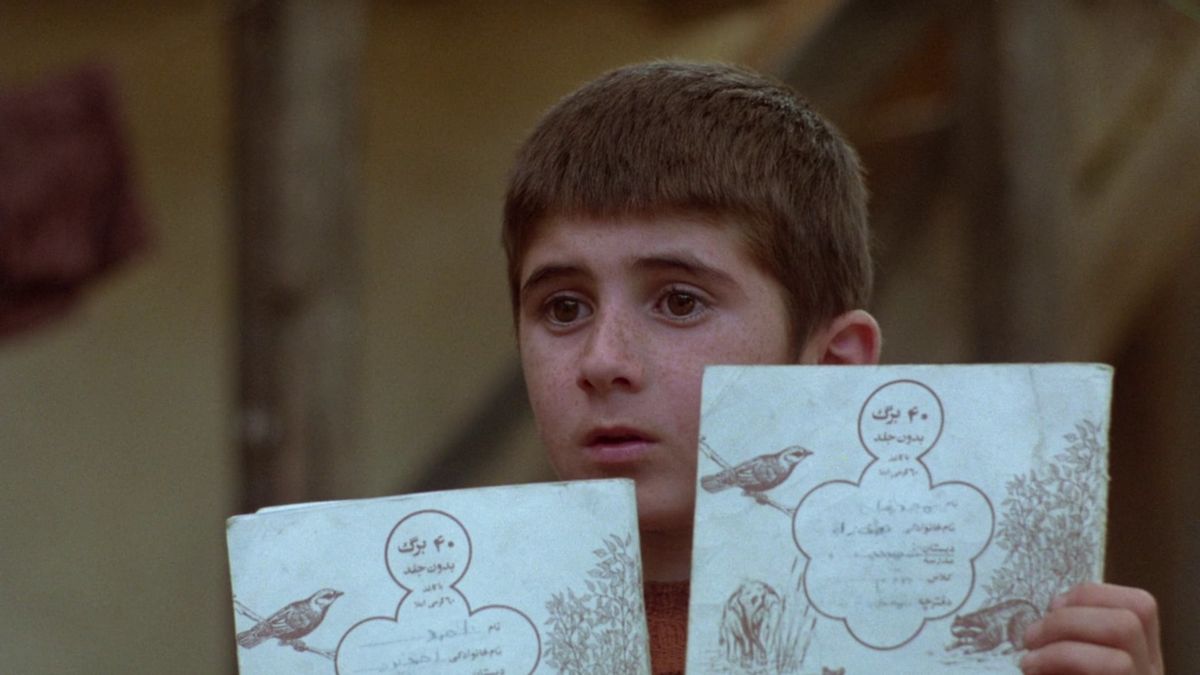
By no means a scholar of Iranian cinema or culture, my introduction to it was through a screening of Where Is The Friend’s House (1987) in a class on Neorealism film. If any single director could be said to personify post-revolution, pre-millennium cinema in Iran, it’s probably this feature’s director, Abbas Kiarostami. Having completed a number of shorts and documentaries since 1970, this was his first movie to receive any major recognition outside of Iran. It’s a relatively simple film about a boy going to great lengths to return a classmate’s notebook in a neighboring village. However, within this skeletal narrative, Kiarostami delves deep into ruminations on trying to do the right thing and both the physical and moral roadblocks that often prevent us from it. Ending in a moment of unexpected yet earned grace, it’s as miniaturist as a masterwork as Olmi’s Il Posto or Jarmusch’s Stranger Than Paradise.
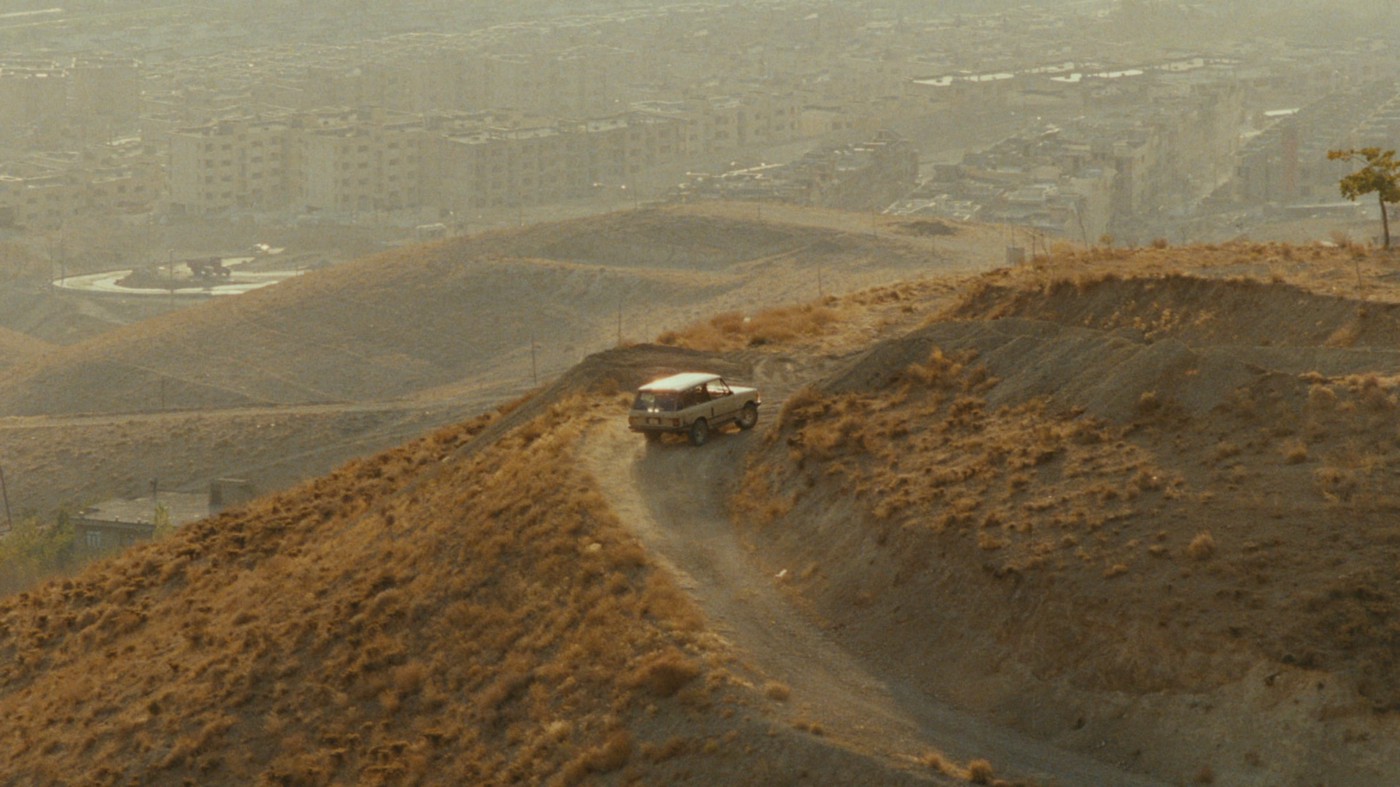
A few weeks later, Kiarostami’s latest feature, the Cannes Palme d’Or winner Taste of Cherry (1997) opened theatrically in Boston. In some ways, the film is an adult analogue to Where Is The Friend’s House as it involves Badii, a man attempting to complete a task and running into numerous barriers in his efforts to complete it—the big difference being that his goal is finding someone to help him commit suicide. Driving around, he picks up three different men, asking each if, after he spends a night in his own grave, they’d check on him the next morning and help him up if he has chosen life, or bury him if he has not. The third man agrees to the job (but not without trying to sway Badii away from ending his life.)
What’s baffling and/or brilliant about Taste of Cherry is that we never find out Badii’s decision. Instead, after a lengthy shot of him patiently sitting in his grave and a blackout, there’s a cut to video footage of Kiarostami and his crew filming the movie we’ve been watching, followed by the credits roll. I recall sitting in my theatre seat slack jawed, wondering what, exactly, I had missed. How could Kiarostami dangle this narrative carrot with potentially grave consequences only to end not on any conclusion except for the notion that this is only a movie you’re watching; therefore, it doesn’t matter whether Badii kills himself or not because he’s a fictional character. I needed time to process and be okay with such a notion, having been conditioned to look for and only accept concrete resolution where narrative was concerned—e.g., the family who had partially endured a half-century of radial cultural change in To Live or the shifty protagonist who gleefully got away with double-crossing his so-called mates at the conclusion of Trainspotting. But then, I think about how even a zany comedy like Monty Python and The Holy Grail simply ends on the pretense that it’s all just a film.
I don’t know if Kiarostami was at all a Python fan, but in much of his work, he plays with this near-invisible line separating reality from fiction. A few years after Where Is The Friend’s House, an earthquake devastated the remote village of Koker where it was filmed. Kiarostami returned there to look for the two boys who starred in it and then made a semi-fictional feature about it, shot documentary style (with an actor playing Kiarostami) called Life, and Nothing More…(1992). He followed that with Through the Olive Trees (1994), itself another semi-fictional feature: it recreates the filming of a scene in Life, and Nothing More… and the conflict between its two actors, one of whom struggles to differentiate between her acting role and her real-life relationship with her screen partner. Together, the three films are referred to as the Koker Trilogy, even if Kiarostami had not intentionally set out to make one.
Between the first and second Koker films, he completed another feature that had nothing to do with them yet was crucial in his growth as an artist that, much like Maya Deren or Derek Jarman, fuses fact and fiction until the two almost appear inseparable. Close-Up (1990) could be his most resonant film for how smoothly it attains this duality. Some might see it as a magic trick, a balancing act or an admittedly good stunt that is the genesis of his “It’s only a film” ethos. Either way, it’s essential viewing for anyone all at interested in the meta, self-referential aspect of filmmaking and how it can transcend pretensions of cleverness to reveal deep facets of human nature—particularly when one holds up a mirror to a screen but doesn’t necessarily see the exact same thing reflected back.
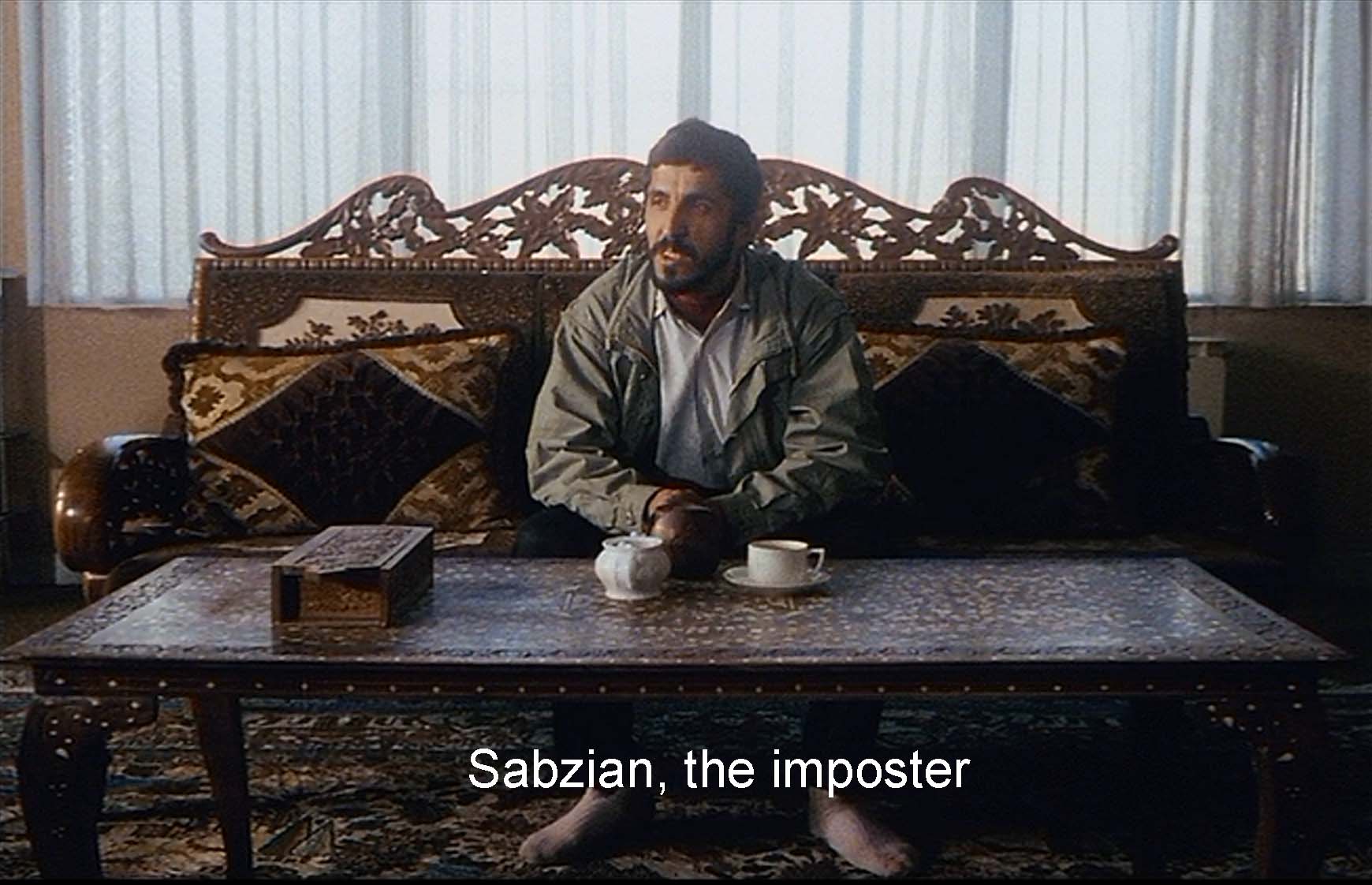
Prior to the film’s production, Kiarostami came across a news story in Tehran about a man, Hossain Sabzian who had been accused of impersonating fellow Iranian auteur Mohsem Makhmalbaf. Apparently, he led The Ahankhahs, an upper-middle-class family, to believe they’d be starring in his new film. Rather than serving as a straight documentary, Close-Up recreates not only this scenario but also the ensuing courtroom trial where Sabzian admits to being an imposter. Oh, and everyone plays themselves, from Sabzian and the Ahankhahs to the reporter of the news story (Hossain Farazmand), the judge, a taxi driver and even Kiarostami himself. The director shoots the film in a straightforward, cinema verité style, so both it looks and feels like a documentary. Heck, most unsuspecting viewers would likely believe it to be a nonfiction, even if it’s all a recreation and therefore technically a fiction.
Much of Close-Up focuses on Sabzian’s trial which is interspersed with preceding scenes of his arrest, Farazmand meeting with and interviewing him, and a few flashbacks depicting how Sabzian infiltrated himself into the family and those fateful moments when it finally dawned on them that something wasn’t right about the man who would be Makhmalbaf. One could’ve imagined a flashy, dramatic retelling of this story, playing up the hubris of the schmo posing as a famous artist, the mounting suspense of whether or not he can pull it off, the betrayal felt by the family when they learn he’s an imposter, his pleading in court for forgiveness and understanding. While each of these things are present to varying degrees in Close-Up, they play without any gloss or blatant embellishment. It feels more like Kiarostami just pointed his camera at the participants and captured what happened (even if “what happened” is, in fact, a simulation of such.)
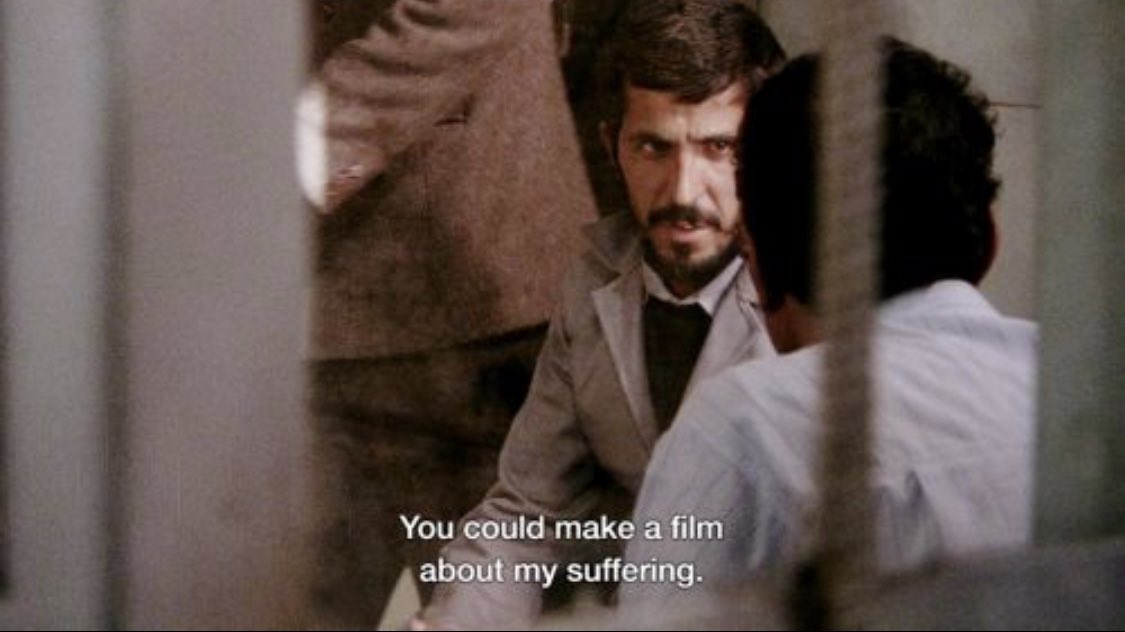
Adhering so closely to a realistic presentation, watching Close-Up is at times like stepping through the looking glass. We can’t know whether these things all actually happened; we can only rely on the filmmaker and choose to believe he’s telling the truth. Naturally, that didn’t work out so well for Sabzian, a liar who got caught. However, Kiarostami sees Sabzian, and not the Ahankhahs or even Farazmand as the film’s protagonist. When the two first meet, the imposter tells the director, “You could make a film about my suffering,” words that we’re led to believe were spoken because the legitimate director posits that this was the case by including them in the screenplay. As Close-Up continues, the more meta it seems, particularly in the trial scenes. Sabzian straight off confesses to the crime, admitting, “I really got into the part; it’s even as if I was a director.” Later, the judge asks him, “Have you ever worked in film?” to which he dutifully responds, “No, but I’ve read screenplays and books on the subject.” A member of the Ahankhahs isn’t having any of it; he dismisses any notion of Sabzian’s sincerity in court, arguing, “He’s still playing a role: ‘The sensitive soul.’”
It all comes to a head when the judge asks Sabzian, “Aren’t you acting for the camera right now?” Of course, Sabzian is acting to a degree as he’s playing a version of himself, no matter how identical to reality. But, for the pretense that this is a film, and perhaps a recreation of what he actually said at the real trial, he responds, “I’m not acting; I’m speaking from the heart.” It’s the one moment in Close-Up that almost seems a little too perfect, as if it were straight out of a movie and yet, as viewers, who are we to say whether he didn’t actually say this at the real trial? And does it matter, since this is, after all, just a film?
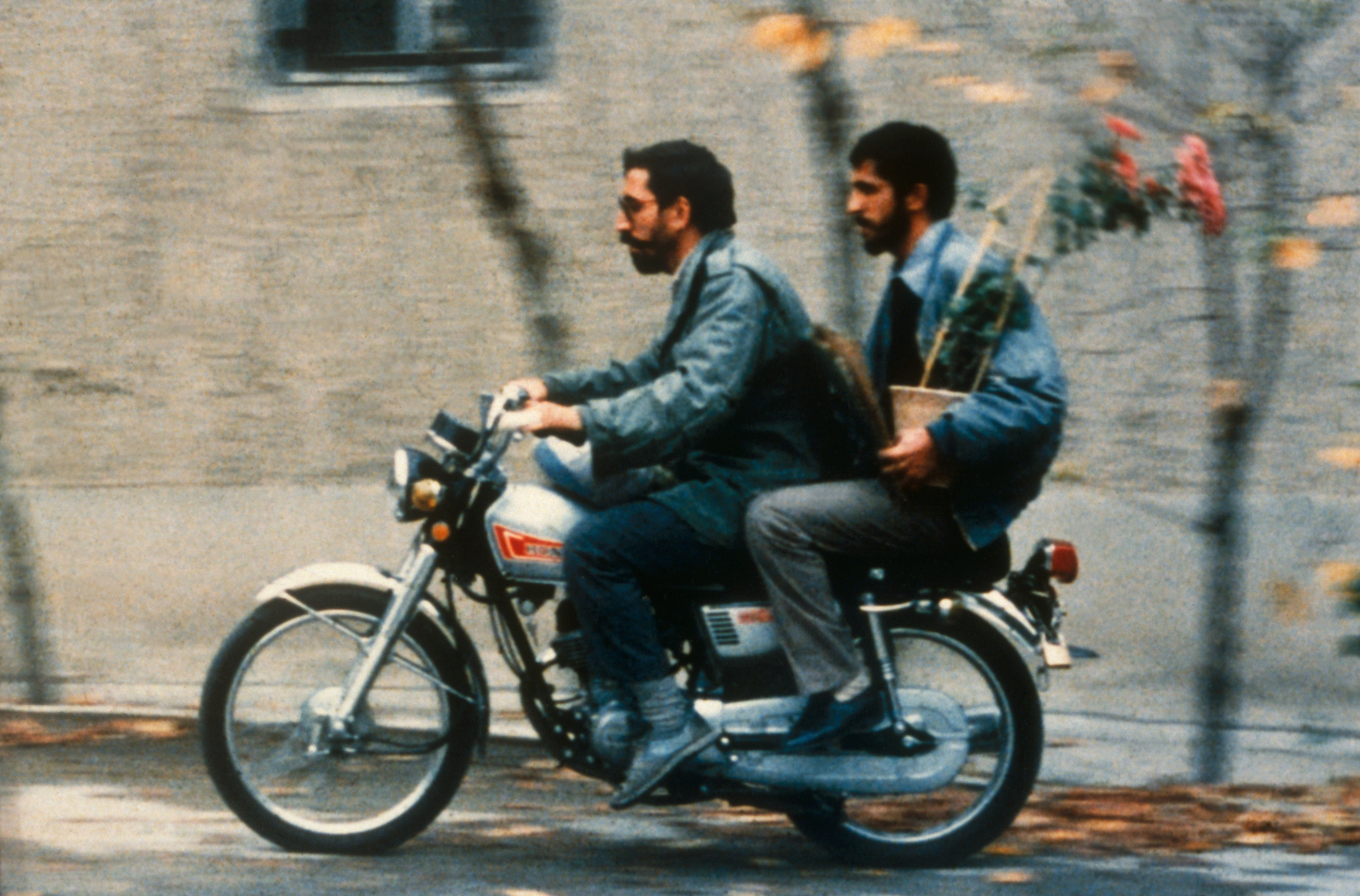
Naturally, films are more than just self-referential exercises. The medium wouldn’t have gotten very far if it was just about itself and not an endeavor to make art out of recognizable, relatable scenarios and emotions. Following the trial (where Sabzian is hand-slapped but not jailed), Kiarostami orchestrates an in-person meeting between Sabzian and Makhmalbaf himself. They ride together on the latter’s motorbike to visit the Ahankhahs as an olive branch of sorts for Sabzian to personally ask for forgiveness with the encouragement of the famous man he posed as by his side. One could not ask for a more bow-wrapped denouement where the imposter and his subject come together—just imagine the conversation they’d have in all of its awkwardness and grace.
They chat each other up all right, but there’s a catch—the sound keeps cutting out. Kiarostami’s crew can’t figure out the issue, but due to “technical difficulties”, very little of Sabzian’s and Makhmalbaf’s conversation is heard as they motor through the Tehran suburbs, picking up a flower bouquet on the way as a peace offering to the Ahankhahs. They arrive at the family’s front gate, the ex-imposter introducing himself over the speaker by saying, “It’s Sabzian,” a beat or two before he adds, “Makhmalbaf”, either indicating the director’s co-arrival or perhaps reverting to old habits, using the assumed name the family would’ve been most familiar with as his own (even if they now know it isn’t.)
Does the sound cut out at such a climactic moment on purpose or not? One might as well be inquiring whether Badii chose life or death in Taste of Cherry. Kiarostami leaves the question unanswered because it doesn’t matter. The version of events presented here is what matters: if the sound appears to have cut out, then we are called to accept that as the case. No matter how profound, the words exchanged between Sabzian and the man he once impersonated aren’t important. What matters is that they met, that Sabzian met the Ahankhahs, that Kiarostami met Sabzian and that in telling his story, he did so in a way that lets each viewer decide whether it’s all real or not or what in this case (or any case) constitutes “reality”. It’s a question most filmmakers provide as a given—yes, this is a documentary; no, this is purely fiction. What if, like real life with all of its nuances and contradictions, a work of art subsisted somewhere in between those poles? What about the filmmakers whose work tends to fall into such margins? Just a few of the many questions studying films at the graduate level persuaded me to ask about them.
Essay #10 of 24 Frames.
Go back to #9: McCabe & Mrs. Miller.
Go ahead to #11: Beau Travail.

