This 21-year-old British singer/songwriter’s debut LP is already the recipient of the kind of hype few young artists can claim, including this year’s Mercury Prize. Although far from the first to attempt an indie folk/R&B with poetry leanings (hello, Corinne Bailey Rae), her beautifully languid voice and reflective tone remain constants, complementing a dozen songs that resemble handcrafted, well-worn vignettes. Best opening couplet: “I’d lick the grief right off your lips / You do your eyes like Robert Smith.”
A dozen years after their last album and this Norwegian duo haven’t changed one iota—thankfully so, for the “if it ain’t broke, don’t fix it” approach serves them well. Whether continuing to put their singular harmonies and nylon-string guitars at the forefront or welcoming guest appearances from Feist as if it were still 2004, KON remains a timeless proposition. Not as essential as those earlier albums, mind you, but after six months of spins, almost as durable.
An LP written from the point-of-view of a volcano on the China/North Korea border does not seem nearly as outlandish coming from this enduring Welsh weirdo as opposed to anyone else. The real surprise is how hooky and accessible the music is, some of Rhys’ most accomplished since his band Super Furry Animals recorded their last LP over a decade ago. On that note, leadoff track “Mausoleum of My Former Self” is the year’s most hummable song with the least likely title.
When an artist puts out a self-titled album decades into their career, it’s usually a statement, and this might be LB’s most cohesive collection since Out of the Cradle (if not Tusk.) It kicks off with three instant classics (“I love it when you scream,” he sings on the opener), but it’s a near-perfect ten track album, folding in such unlikely flourishes as trap beats and synth-bass on some tracks and a return to his folk-rock roots on others.
Moving to Boston for graduate school coincided with my coming out as gay. I didn’t plan it that way, or perhaps I did so subconsciously, seizing on a physical move to make another big change. It wasn’t an easy or swift process. Until then, I’d been deep in the closet to the point where, just a year before, I seriously considered asking out a young woman who, like me, was also pursuing a Film minor at Marquette. I never worked up the courage, although I did fall into a misguided straight relationship with someone else for a few months before facing up to my true self, breaking it off weeks before I left my hometown behind.
I expected I’d easily attain a new identity as an out gay man freshly arrived in Boston, but it didn’t happen like that. Not necessarily wanting to be defined by my sexuality, I didn’t tell anyone about it. At least I no longer tried presenting as straight or thinking it a viable option. Those first few weeks in a new city, I’d often play a private game where I’d consider all the strangers I saw in a restaurant or on the T and ask myself of each one, “Honestly, do I find this person attractive?” Every single time I spotted someone I liked, it was a guy. I could no longer deny who I was.
My classes and work-study employment provided decent excuses for not actively pursuing much of an exterior social life. I was so preoccupied with film and writing about it that I simply did not have the time to go to gay bars and clubs or check out the campus’ LGBT organization (the primary letters then considered for that since-expanding acronym), or at least that’s what I told myself. Looking back, I admit I just wasn’t ready to pursue such activities, even though I wanted to partake in them. Being over 1,000 miles away from home was enough of a tremendous adjustment to navigate.
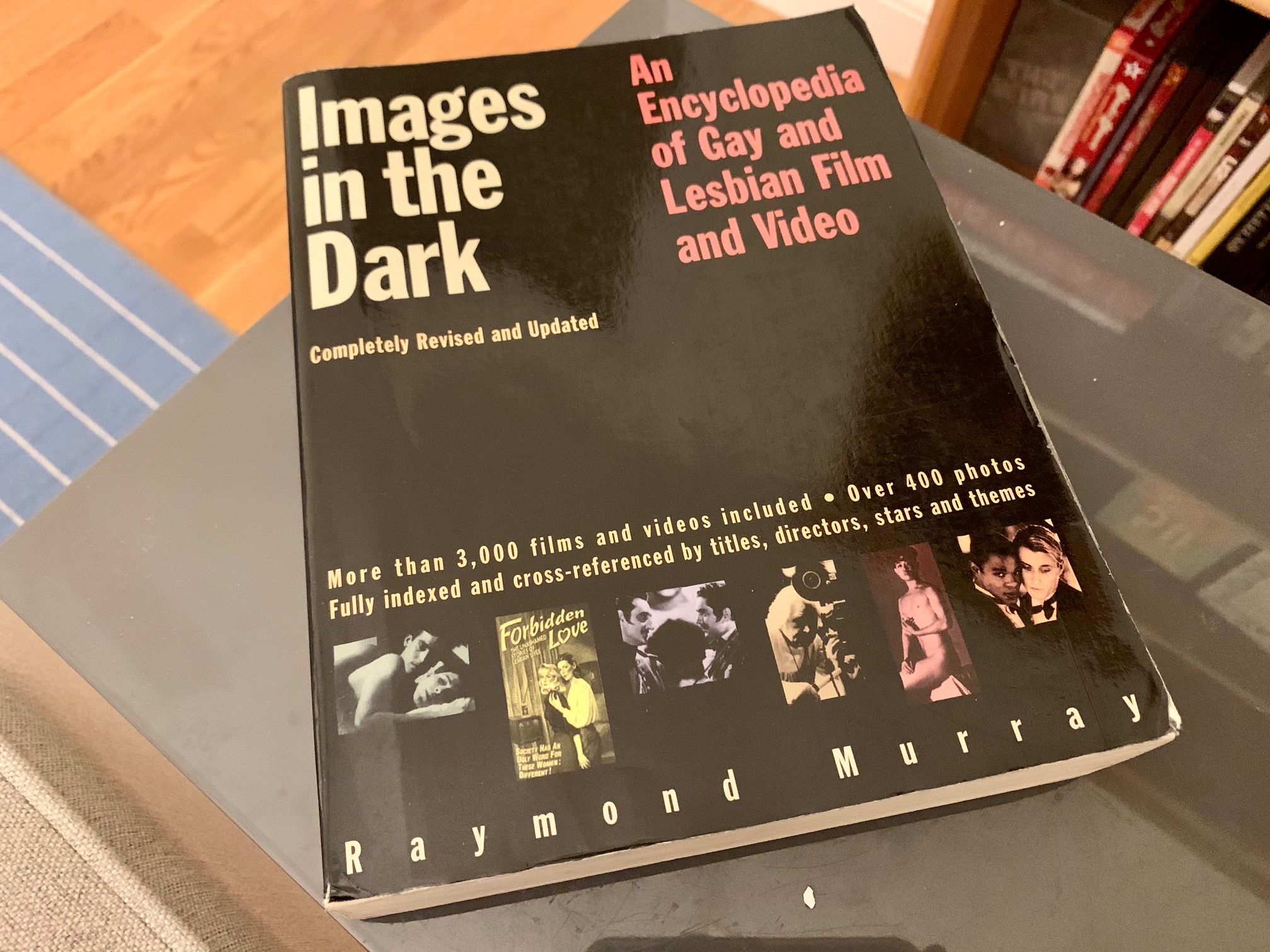
I eventually began dating and socializing with other gay men to the point where I couldn’t imagine it not being elemental to my identity. However, that would mostly happen after completing my degree. As a Film Studies student, I explored my freshly acknowledged sexuality through films. I cannot undervalue seeing other queer people depicted onscreen in an era where Ellen DeGeneres had just come out but with few other celebs quick to follow. Even though Boston University did not offer a course specifically on queer cinema, I was exposed to the work of such directors as Rainer Werner Fassbinder, Chantal Akerman, Andy Warhol and Todd Haynes. Even more significant was Raymond Murray’s Images In The Dark: An Encyclopedia of Gay and Lesbian Film On Video. Its second edition published the previous year, it proved a vital resource, cataloging the work of the filmmakers above in addition to many others. Accessing Murray’s tome was like entering another door, one leading me to artists as dissimilar as Pedro Almodovar and Terence Davies, Jean Cocteau and Piers Paolo Pasolini, Barbara Hammer and Ulrike Ottinger.
Given my age and the period, New Queer Cinema had the strongest impact on my worldview. A term coined by critic B. Ruby Rich in 1992, it encompassed recent work from gay and lesbian independent filmmakers, most of which dealt with transgressive themes and situations that offered alternatives to heterosexual culture. In other words, New Queer Cinema was proudly, unapologetically gay, fixated on such subjects as hustlers (My Own Private Idaho), AIDS (The Living End) and ballroom drag culture (Paris Is Burning). It could propose unconventional depictions of historical figures (Swoon, a take on the Leopold and Loeb murders) and serve as a medium for autobiography (essayists like Marlon Riggs and Su Friedrich.)
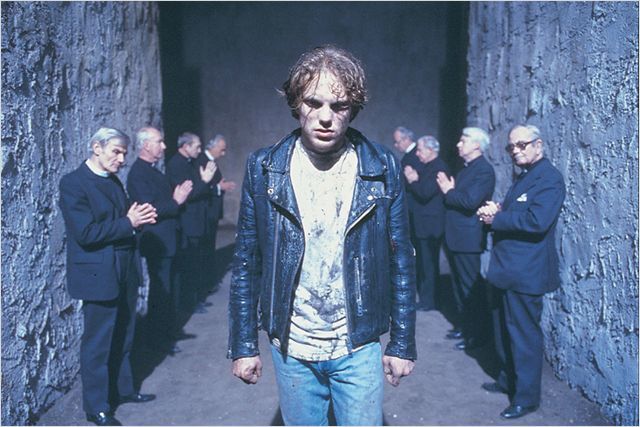
Murray’s book also introduced me to Derek Jarman, a British painter-turned-filmmaker whose cinema alternated between revisionist histories and experimental memoir. On a June Saturday afternoon, instead of checking out my first Pride Parade in the South End (which ended up postponed due to flooding rains), I watched Jarman’s 1987 feature The Last of England, rented from the Hollywood Express in Cambridge’s Central Square where one could get five films for five nights for ten bucks. After the closing credits rolled following a young Tilda Swinton cutting herself free from a wedding dress against the maelstrom of Diamanda Galas’ otherworldly siren song, I suspected I’d found a subject for my master’s thesis. I was just astonished by this perplexing, sensory-overload barrage of cross-cutting, dystopian landscapes, queer imagery (an early scene where a male hustler humps a Renaissance painting certainly imprinted itself on me) and the director’s own childhood home movies, all of it cohering into a savage indictment of Thatcherism, nationalism and a decaying empire.
Jarman had died from AIDS a few years before at the age of 52; The Last of England was the first film he completed after receiving his diagnosis and it’s a turning point in his oeuvre. Up until then, he oscillated between arty home movies and larger-scale features like Caravaggio and a gloss on Shakespeare’s The Tempest that ended with veteran chanteuse Elisabeth Welch serenading a chorus of sailors with the 1933 torch song “Stormy Weather”. The Last of England synthesized these motifs into something bolder, angrier, more political yet intensely personal. From there, knowing he was living on borrowed time, Jarman worked at a furious pace, completing five features in as many years comprising some of his most urgent and innovative work.
I thought of making The Last of England this essay’s focal point, but I already covered it in exhaustive detail for my master’s thesis, which considered it, along with The Garden (1990) and his final film Blue (1993) as an informal trilogy where fiction and memoir intersect, blurring the notions of one’s art and life until they appear inseparable. Rather than go back to that well, I’ll consider Edward II (1991), fittingly the second Jarman film I watched and one I have not previously written about in any great detail. If The Last of England was an introduction to an entire filmography I immediately wanted to devour, Edward II vindicated this desire with its unusual, inventive approach to literary adaptation.
One of 16th century English playwright Christopher Marlowe’s major and final works, Edward II focuses on the relationship between the titular King and his favorite nobleman, Piers Gaveston and how it led to both of their murders at the arrangement of military head Roger Mortimer. It had endured as a stage production up through the present, but Jarman was the first (and to date, only person) to attempt a feature film of it. While Marlowe’s prose subtly acknowledged the intimacy between Edward and Gaveston, Jarman’s adaptation places it at the forefront—gleefully, defiantly homoerotic, his Edward II is a story of a King (Steven Waddington) and his male lover, Gaveston (Andrew Tiernan), the threat it poses to the straight establishment headed by Mortimer (Nigel Terry) and Queen Isabella (Swinton) and the ensuing seizure of the throne by said establishment, whose murders of Edward and Gaveston are equated to hate crimes.
The notion of lending an explicitly queer slant to Marlowe’s prose is expected coming from an openly gay filmmaker/activist in 1991. From his casting of hunky actors to play his two queer leads to the inclusion of such imagery as two naked men engaged in sexual intercourse in the background of one scene for no reason germane to the plot, Jarman holds nothing back in this regard; in an era where the sight of two men lying in bed together on the TV series Thirtysomething provoked mass indignation, being so out, loud and proud felt more daring and radical than it might now.
Where Jarman goes beyond the shock of queerness is in his fearless deployment of anachronism. Present in his work all the way back to “Stormy Weather” and the contemporary dress in Caravaggio (to mirror that artist’s use of anachronism in depicting biblical figures), Jarman is not a slave to period or text. Purists and traditionists likely decried Edward II for sheathing its characters in white muscle T’s, pajamas, leather jackets and World War II-era fatigues. In one scene, Edward and Gaveston appear to be dressed for the set of Reservoir Dogs (sans sunglasses) one year early; in another, Edward and his brother Kent (Jerome Flynn) return from a game of tennis, rackets in hand, decked out in white polo shirts with matching towels around their necks.
Edward II’s production design (from longtime Jarman associate Christopher Hobbs) favors a minimalist approach: spare sets consisting of stone walls and dirt floors, its characters bathed in light and shadow. These spaces are strewn with such unexpected contemporaneous objects as a Christmas tree surrounded by presents, an electric hanging lamp, a board meeting table complete with water pitcher and drinking glasses and a battery-powered robot and portable Walkman for young Edward III (Jody Graber) to play with (not to mention a Coke can, its placement intentional unlike the Starbucks cup in Game of Thrones.) Isabella sits in bed with a cold cream mask over her face while Mortimer lies next to her, reading Unholy Babylon: The Secret History of Saddam’s War. The latter is telling, along with the proclamation Edward is coerced into signing to send Gaveston into exile: a quick shot reveals the date on it as 1991 rather than 1311.
Why would Jarman retain Marlowe’s prose and historical figures but essentially set it in the present? Granted, the uproar over Edward and Gaveston’s relationship is all too applicable for 1991. Despite some recently acquired cultural inroads, relatively little had changed since then in terms of public perception of homosexual attraction and companionship. When adapting a historical work, often the most illuminating route one can take is to explore and accentuate its relevance for modern audiences and what they can learn from it. In Edward II, Jarman spotted themes, situations and behaviors with a clear analogue to his own life and his treatment by the press as a homosexual and person with AIDS. Much of his later work is a rebuke to Thatcher and policies born out of that period like Section 28, a legislative designation prohibiting “the promotion of homosexuality by local authorities” that was in effect in the UK from 1988-2000.
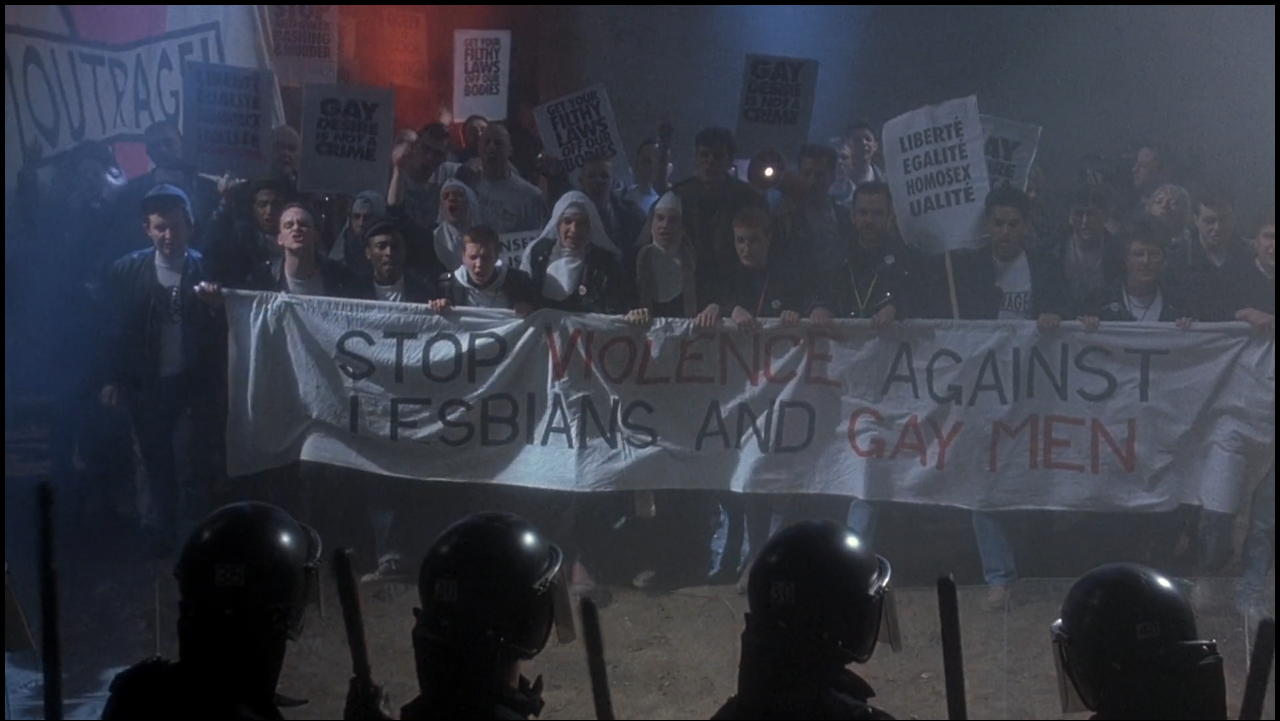
Jarman’s reaction to such oppression and censorship becomes Edward II’s most memorable anachronism. After Mortimer arranges Gaveston’s murder, Edward and his cohorts clash against the nobility in the guise of a gay rights demonstration. The protestors are portrayed by actual members of OutRage!, a UK gay rights group “committed to radical, non-violent direct action and civil disobedience”, fighting for “sexual freedom, choice and self-determination” for all queer people. They are depicted standing up to a riot-gear wearing police force, chanting in solidarity and carrying a big white banner reading “Stop Violence Against Lesbians and Gay Men.” It’s a relatively brief scene but a pivotal one: it bluntly but effectively drives home the close parallels drawn between the present and the past.
Such a big swing could come off as pretentious or dour. Fortunately, Jarman’s predilection towards camp leavens the film’s weightier stuff—see Gaveston and Edward celebrating their reunion by dancing a ramshackle tango or Edward III reclaiming the throne near the film’s end, tromping around to Tchaikovsky’s “Dance of the Sugar Plum Fairies” on top of a giant cage holding a decomposing Mortimer and Isabella. Even darker moments, such as Isabella murdering Kent by literally biting into his neck and sucking his blood, vampire-style (Swinton’s decades-early audition for Only Lovers Left Alive?), while shocking, retain a gallows humor in their absurdity.
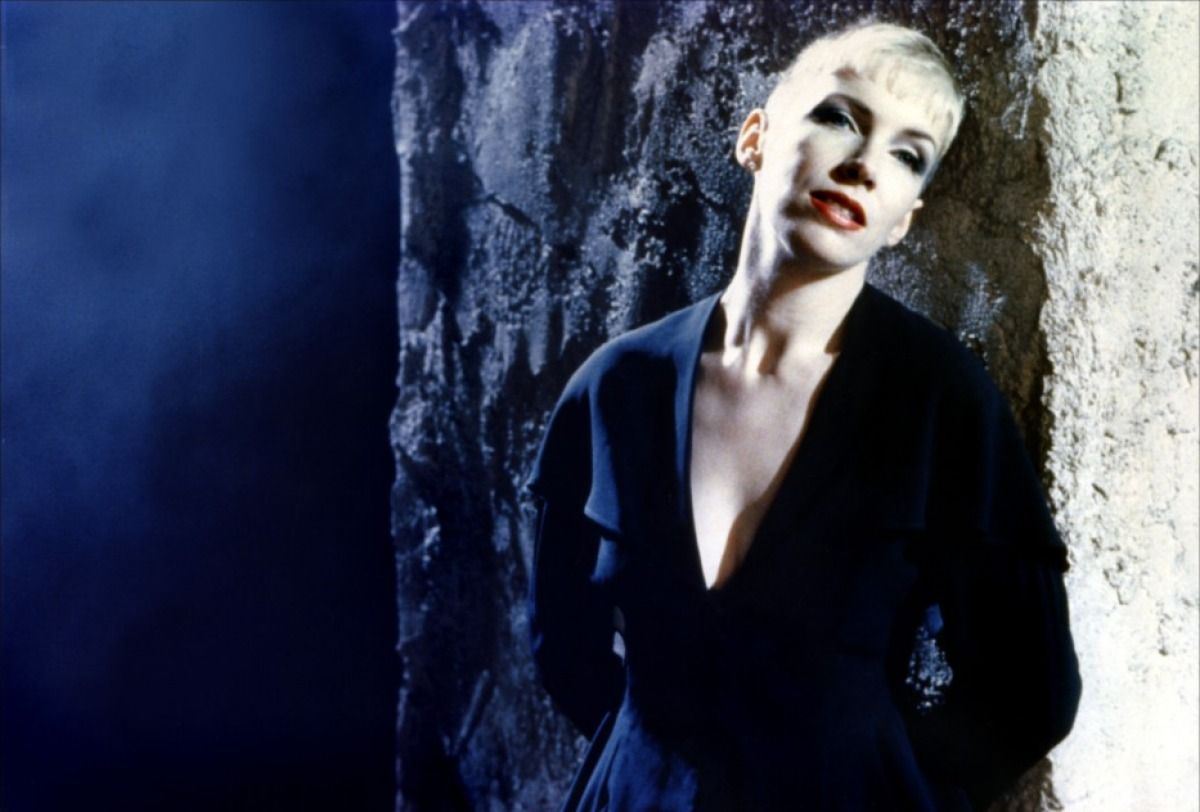
Occasionally, they also prove rather moving. Before Gaveston’s exile, he and Edward meet up. We hear the opening minor piano chords of Annie Lennox’s version of “Ev’ry Time We Say Goodbye”, recorded the year before for the great Cole Porter tribute/AIDS charity album Red Hot + Blue. In time, Lennox herself appears in person, off to the side, serenading the lovers. Hair close-cropped in a pixie cut almost as pale as her skin, she resembles a wraith as the couple embrace and bid each other bittersweet farewells. It’s a scene of pure fantasy but gender-bending icon Lennox’s plaintive appearance complements the song’s spare, piano-and-accordion arrangement, while the occasional tremor in her tone, along the melody and lyrics of Cole’s composition render the proceedings exceedingly poignant.
Jarman’s Edward II concludes by rewriting Marlowe’s ending: instead of death by hot poker from the executioner Lightborn (Keith Collins), whose time guarding Edward is a framing device throughout, he tosses the poker into a pool and gives Edward a tender kiss. We see both scenarios, in that order, with the second a revisionist history akin to Quentin Tarantino’s later work (albeit on a much smaller scale.) However, Edward II’s final shot is a pan across the OutRage! protestors, now silent, frozen in time as Edward’s voiceover reads Marlowe’s prose: “Come, death / and with thy fingers close my eyes / or if I live / let me forget myself.” During the film’s production, Jarman’s health was deteriorating to the point where it was uncertain whether this would be his last feature (he lived to complete two more.) As a potential goodbye to his art and his audience, it drives home the notion that Edward’s fight against homophobia and fear is as relevant and urgent as Jarman’s own and that of his friends and fellow queer people.
No matter who or what we are, we tend to look for representation in popular art, to see people onscreen who are recognizable, even similar to us, finding someone we can relate to and that the rest of the culture can also see. In this phase of my coming out (and coming of age in general), I looked to the work of queer filmmakers as a text and a guide, a way to feel less isolated or alone. Jarman, in particular, was fearless in putting and revealing himself onscreen; he also made a continual effort to show how queer people had been around for centuries, telling stories about their presence and importance, using his “cinema of small gestures” to bring these figures out of the shadows and into the light. While I took a film course the previous year called Ways of Seeing, watching Edward II (and the rest of Jarman’s filmography) for the first time felt to me like being seen.
I didn’t need to go to grad school for Film Studies; while I hoped such an undertaking would lead to a palpable career in the same way earning a degree in Nursing or Library Sciences could, I suspected all along this was not a practical, much less lucrative path to take. Even in the video store era, I could have avoided so much student loan debt by renting five or ten tapes a week and reading all the significant film theory tomes in my spare time; I might’ve emerged with a similar comprehension of, to reference the title of one of those books by Bruce Kawin, How Movies Work.
Still, I have no regrets putting in the time and money to earn what many would deem a most frivolous degree. It not only pushed me out of my hometown and forced me to learn how to live as an independent adult, it also significantly altered my worldview. The primary advantage to any arts/humanities graduate study is curation: when inspired, professors and instructors serve as guides to which art one should consume, how one should absorb it and what one can understand from it.
My second semester at Boston University played out similarly to the first. Excluding Introduction to Video Production, an elective required of anyone not in the Film Production tier of the program, the courses I took were genre-defined: one a broad survey on world cinema called International Masterworks (a loose sequel to last semester’s American Masterworks), another on Neorealism in Film (a concept that proved to be rather openly defined by its instructor) and finally, an overview of Avant-Garde Cinema. As with Neorealism, this was also broadly demarcated, though simpler to identify by default of often being short, experimental and what 99% of the public might categorize as weird.
It should come as no surprise that Avant-Garde Cinema ended up one of the more illuminating film courses I ever took. Unlike Ways of Seeing from the previous semester, this had barely anything to do with the instructor, regrettably. An experimental filmmaker herself originally from Quebec, I never questioned her knowledge of the subject; she just had no business teaching a class. Her lectures were erratic to the point of coming off as scatterbrained which proved a death knell in providing much sense of engagement (though the undergraduate male students who regularly sat in the front rows were certainly engaged by her busty figure. Not that I myself could’ve delivered a better lecture at that point, but still.)
Happily, the films she screened for us were enough. Given that experimental film in general and shorts in particular were difficult to find in that pre-streaming, pre-YouTube era (and to a lesser extent, remain so today), the cornucopia of cinema we consumed over the semester was in retrospect astonishing—a treasure trove of rarities, obscurities and stuff you couldn’t rent from local indie-friendly chains like Videosmith and Hollywood Express, much less Blockbuster. Most of it was even projected on 16mm (and occasionally 35mm) film. We’d usually watch an average of four titles per two-hour class, two times a week.
We saw so much stuff: for starters, abstract animation from Oskar Fischinger and Norman McLaren (the latter’s Begone Dull Care visualizing an Oscar Peterson Trio recording with colors and kinesis), the surrealism of Luis Buñuel’s and Salvador Dali’s Un Chien Andalou, the rapid montage cutting of Dziga Vertov’s Man With A Movie Camera and the queer pop art of Andy Warhol, Jack Smith and Kenneth Anger (the latter’s Scorpio Rising practically inventing the music video.) We took in both the challenging formalism of structuralist cinema (Stan Brakhage, Hollis Frampton, Michael Snow) and the more accessible, if still out-there pleasures of such one-of-a-kind auteurs as Chris Marker (best known for the short La Jetee, which inspired Terry Gilliam’s 12 Monkeys), Bruce Baillie, George Kuchar and Guy Maddin (who attended class in-person for a screening of his film Careful!)
Wavelength
For every work I found impenetrable (Snow’s Wavelength, which slooowly zooms in on a window for 45 minutes was particularly torturous), I watched another that enjoyably blew up my preconceived notions of what cinema could be. Baillie’s All My Life, for instance, was nothing but a three-minute single shot of a fence flanked by red flowers and eventually a clear blue sky, all of it accompanied by Ella Fitzgerald’s ebullient rendition of the title song. That’s it—no cuts, narration or dialogue, just a beautiful tableau presented for what it is. Like Wavelength, it roughly fell under the banner of structuralist film but in a more contained, condensed package.
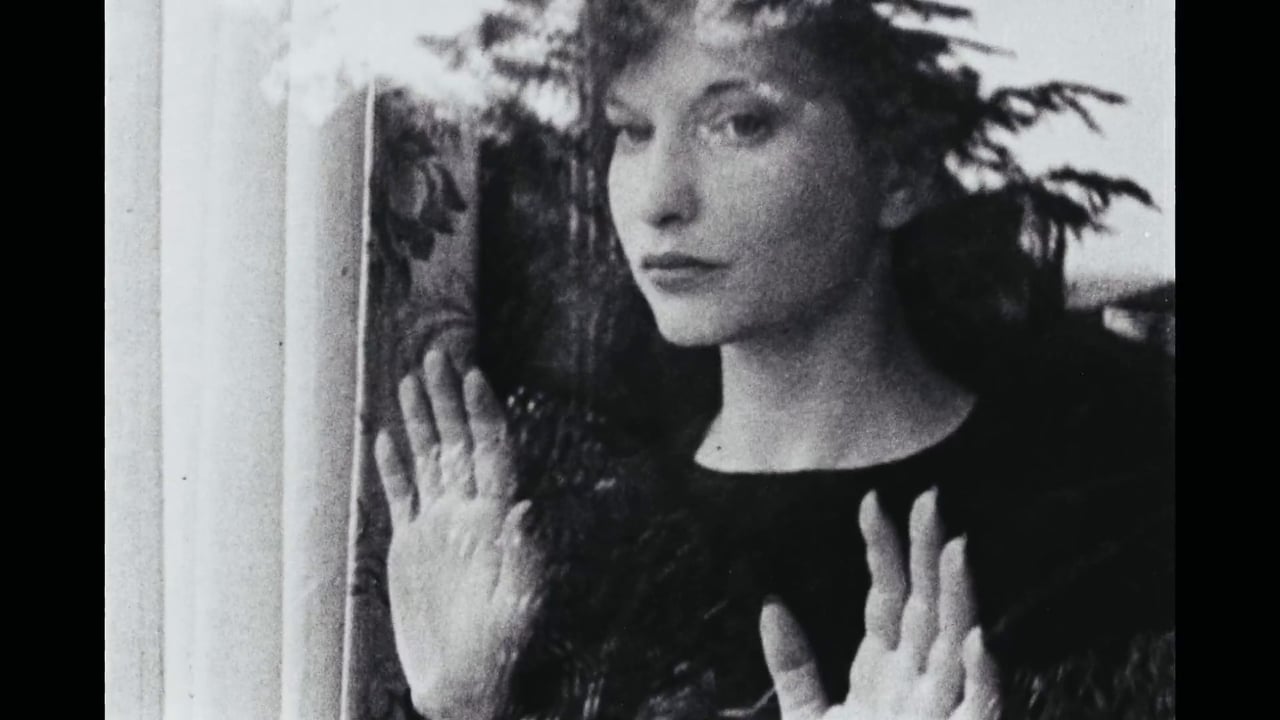
While McLaren, Anger, Marker and Maddin would become some of my favorite filmmakers, the one with the most direct impact on me at the time was Maya Deren. She only made a handful of short films between her 1943 debut, Meshes of the Afternoon and her death from a cerebral hemorrhage in 1961; she remains obscure outside academic and experimental cineaste circles, although Martina Kudlacek’s 2002 documentary feature In the Mirror of Maya Deren surely expanded her reach, providing an eloquent summation of her life and career. One can now see most of her work on YouTube, although Criterion and Kanopy offer legal options to view some of it as well.
Born as Eleonora Derenkowska in Russia, 1917, she and her family emigrated to the United States at age five. After studying literature at New York University and Smith College, she spent a few years amongst the bohemian elite in Greenwich Village before moving to California where she met Czech-born photographer Alexander Hammid. They married in 1942 and moved to Laurel Canyon where, the following year, they’d co-direct and star in a silent, 14-minute, black-and-white experimental film.
Meshes of the Afternoon wasn’t anything like the massive, big budget productions incessantly churned out at various studios in adjacent Hollywood. It had no stars or dialogue. The locations used were primarily inside and around the filmmakers’ own home along with some footage at a Pacific Ocean beach. The plot, such as it was, resembled not so much a straight line with a discernible beginning and end as it did a loose thread forever unraveling and occasionally turning back in on itself. In fact, the whole thing eschewed the kind of logic one would find in a traditional narrative; instead, it played out like a dream, a visualization of themes and ideas made all the more personal by the notion that the primary figure and closest thing to an audience surrogate was Deren herself.
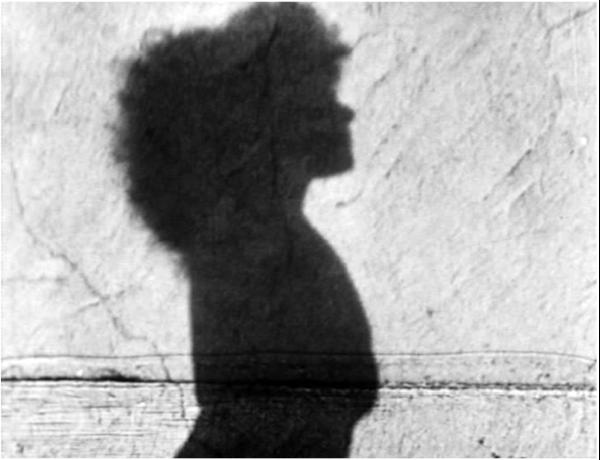
Although she appears in nearly every shot, for the first four minutes or so, she’s an elusive figure, offering only glimpses of parts of herself. It opens with her arm reaching down from the top center of the frame, gently laying a poppy-like flower on the ground. Subsequently, while alternating with point-of-view shots, she reveals a leg, her feet, her hand dropping a key. Her silhouette, betraying her short stature and wild mop of curly hair practically glides along other surfaces. It’s nearly as edifying as an extreme close-up of her eye but even that pales next to the moment we finally see her entire face, exposing her inquisitiveness and somewhat exotic, undeniable beauty—not a pin-up or a glamour girl one would see in a studio film but a figure that can’t help but exude charisma even though she’s not actively courting the camera’s attention. She’s the protagonist here, but this is her dream, her perception of the world, not yours.
As with multiple objects, the aforementioned key reappears throughout: Deren uses it to open a locked door, as one does with a key, but in another scene, she pulls it out of her mouth—how it ended up there is never explained. Later, the key returns but with the help of simple optical effects (the sort dating back to Georges Méliès’ groundbreaking silent cinema from four decades before), it turns into a knife before our very eyes—the same knife stuck in a loaf of bread that Deren discovered much earlier in the film.
Speaking of optical effects, there are multiple shots with multiple Derens, including one with her witnessing herself sitting in a chair and another where she steps into her home to find two more of her at a kitchen table; the clones regard her as if to say, “What are you doing here?” There’s also a sequence where Deren attempts walking up the home’s oft-seen staircase, but either she’s swerving back-and-forth like she’s drunk (or forcibly pulled against her will), the camera’s imitating someone doing the same, or both are happening simultaneously. Additionally, there’s a static shot where she quickly rematerializes in different positions along the staircase as if instantly teleporting among them.
Often in Meshes and experimental film in general, the emotion elicited by what images are placed next to each other is more important than whether they make any sense or result in some sort of resolution. The film’s most daring and perhaps startling sequence occurs about ten minutes in when Deren, suddenly wearing these funky globular goggles, knife in hand, takes a series of steps. After the first shot, we only see her foot, but in each of the following shots, it’s a jump cut to different terrain: a sandy beach, then soil, grass, pavement, and finally, a wooden floor inside the house. In five quick shots, is as if she’s traversing the world, or at least the one she has access to.
Meanwhile, another figure wearing a black cloak with a mirror-for-a-face surfaces throughout. At one point, Deren wakes up to see this figure standing over her, only for the latter to suddenly change into Hammid, her husband and co-director, who offers her the poppy from the opening shot. Eventually, Deren hits Hamid’s face with the knife, only for it to instantly turn into a mirror, now in shards scattered all over the previously seen beach. Is Hammid interchangeable with the cloaked figure, or is Deren in such an altered state that she is unable to discern between them? The ending further muddies this notion, as Hammid (face intact) comes across Deren sitting in the same chair as before, only she’s now dead, covered in shards of broken grass, seaweed (from the beach) and blood.
Meshes leaves the viewer with much to unpack and I could write a whole book about everything it contains and suggests. Instead, as with that first viewing in Avant-Garde Cinema, I’m more interested in what feelings it provokes: the mysteriousness of the house where persons and objects keep transforming or multiplying, the disquiet of having no soundtrack* to guide one’s perception, the lyricism achieved by near-constant movement (whether it’s Deren, the camera or even just the wind), the shock and terror of an act of violence.
Like Deren herself, Meshes now both seems ahead of its time (given her strong physical resemblance, it feels like a silent Kate Bush music video) and entirely out of it. There are few indicators of its era, whether purposely or not: it contains no city streets, no interiors apart from the filmmakers’ simple, mostly minimalist-designed home. It exists in a space that, while identifiable, is meant primarily to reflect the mind state of its creator. In this way, it helped to invent the psychodrama as a film genre where the creator’s psyche and/or collective unconsciousness is the key (so to speak) to understanding its themes and resolution (or lack thereof.)
It’s no wonder that the Criterion edition of Meshes begins with titles that, among other things, call Deren the “Mother of Underground Film”. One can spot Meshes’ influence on so much personal, handmade, experimental film that followed, from Anger’s focus on such obsessions as bike boys and the dark arts to Maddin’s later proclivity to name his primary characters after himself which hits a feverish peak with 2007’s “docu-fantasia” feature My Winnipeg. And while Meshes has its own antecedents such as Jean Cocteau’s Blood Of A Poet which similarly utilized its creator’s subjective point of view, it’s groundbreaking for placing the female gaze front and center—a lineage that arguably stretches through the decades to other filmmakers like Carole Schneemann and Su Friedrich or even those who took a more commercial path like Jane Campion, Lynne Ramsay or David Lynch (Laura Dern’s character in Inland Empire would likely relate to Meshes.)
All of Deren’s shorts have something to offer, even if only her second one, At Land, feels particularly close to its predecessor’s spirit. While Meshes established her as a film artist, the following years up to her early death were tumultuous. She’d soon split with Hammid, later marrying Teiji Itō (a Japanese musician 18 years her junior) and spend a fair amount of time filming Vodou rituals in Haiti for a project she never completed. Kudlacek’s documentary fleshes out such travails with great anecdotes (such as Brakhage recounting that one time she hurled a refrigerator across a room, possibly under a Vodou spell) and, in lieu of any surviving filmed footage of her with sound, plenty of archival audio recordings where her speaking voice resembles Lucille Ball’s, of all people.
Meshes and the Avant-Garde Cinema course were talismans I’d never think to seek out on my own at that age. For a while, whenever asked if I’d use my graduate degree to actually make my own films, I’d respond that if I were to do that, they’d be experimental shorts like the work of Anger or Deren. I never actually made my own films, feeling content enough just to watch and write about thousands of titles from every genre, era and country I’d encounter over the next few decades. In time, I even secured employment tangentially related to my field of study. Still, it was the thrill of discovery, of opening those new doors that encouraged me to pursue Film Studies in the first place. Meshes and other strange, obscure shorts like it vindicated that leap of faith I took in making film central in my life.
*That first screening of Meshes in class actually had a soundtrack composed by Itō more than 15 years after its initial release. Additionally, one can see (illegal) uploads of the film on YouTube with different soundtracks composed over the years. However, it is productive if not entirely decisive to see Meshes silent (as it is of this writing on The Criterion Channel) as Deren and Hammid originally intended it to be. In this case, the lack of accompaniment forces one to focus entirely on imagery and it’s enough to leave one feeling satiated.
Tsai Ming-liang’s a filmmaker who tends to make the same kind of picture over and over, like Yasujiro Ozu (to name one of his precursors) or Hong Sang-Soo (a contemporary.) This isn’t a deterrent, for nearly three decades after his feature debut (1992’s Rebels of the Neon God), he’s still unearthing inspiration in such long standing obsessions as loneliness, urban life, food, sex and, more so than perhaps any other auteur, water in all of its forms.
Since the anomalous erotic (!) musical The Wayward Cloud (2005), his work has seemingly turned more minimalist with each effort. His latest sports the disclaimer, “This film is intentionally un-subtitled”, which led me to expect even less action than his last narrative feature, Stray Dogs (2013), which had its share of endless long takes of people staring at a wall or eating a rotisserie chicken. Not that Days does a 180 on its predecessor, for it opens with another lengthy, static shot of Tsai’s long-running, now middle-aged protagonist Kang (Lee Kang-sheng) sitting and blankly staring into space over a steady rain.
Actually, quite a lot happens in the film; it just does so at a snail’s pace, occasionally approaching the repetitious style of classic structuralist cinema. When the film’s other character, the younger Non (Anong Houngheuangsy) spends ample time preparing his dinner, meticulously washing his lettuce and fish multiple times, it feels like a direct homage to the rituals incessantly enacted in real time throughout Chantal Akerman’s Jeanne Dielman… (1975).
Individual scenes with Kang or Non make up the film’s first half; a little more than midway through, the two men come together in a long sequence that most viewers will decidedly not find boring. Afterwards, we see them apart again until the final shot fades to white. Again, a deliberate structure, even if Tsai claims he pretty much made the film up as he went along, working without a screenplay (there’s so little dialogue that the subtitles aren’t missed.)
Viewers unfamiliar with or unreceptive to Tsai’s work may think, “Huh?” at all this; his devotees might also initially arrive at that conclusion, at least initially. While not as masterful as, say, What Time Is It There? (2001), given time to absorb and ponder Days, I grew to appreciate it far more. It’s a quiet and often gentle film, running through those same, ongoing obsessions I mentioned above; fortunately, they don’t yet feel stale or superfluous. Like any master of minimalism, Tsai’s still adept at taking the same puzzle pieces and rearranging them into (if ever so slightly) distinct configurations that at best inspire one to look at the familiar with fresh eyes.
When this blog reached its 250th post a little over a year ago, I put together a list of 250 films that I love. Likewise, for post #300, here’s a Spotify playlist of 300 songs I’ll rarely skip over whenever they appear on shuffle or the radio. Obviously, this has more than a few selections you’ll likely never hear on the radio, from the inspired lunacy of Adriano Celentano and Esquivel to relatively obscure artists like Tompaulin, Komeda and Os Mutantes. Conversely, many artists here are known and beloved by millions (Oasis, Fleetwood Mac, The Smiths, Ella Fitzgerald) while others retain devoted cult followings without ever having fully broken into the mainstream (Calexico, Jose Gonzalez, Morcheeba, Saint Etienne.)
As with 250 Films, this is by no means a definitive list of my favorite 300 songs, although tracks from nearly half of my 100 favorite albums are represented. Unlike most of my annual playlists, this one is meant to be listened to on shuffle. Pick a song you love or one that you haven’t heard but sounds intriguing to you and dive right in.
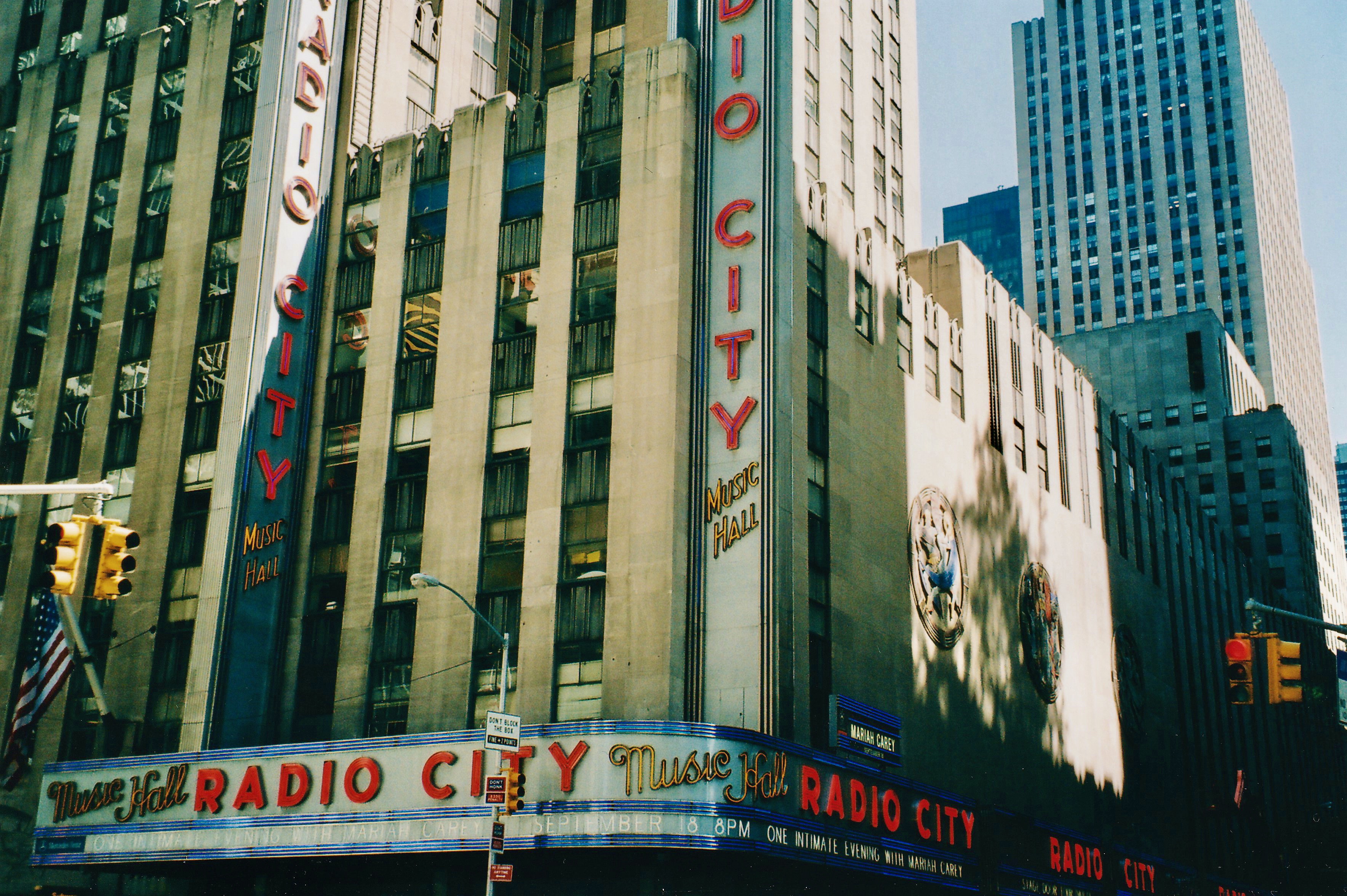
In September 2003, my roommate Frank and I decided to go spur-of-the-moment to New York City for a weekend—Greyhound bus tickets were pretty cheap, and he found a reasonably priced hotel room online. It was my first trip there.
I’d been yearning to visit the Big Apple ever since moving to Boston six years before, but never made it, not even when another former roommate relocated there in 2000 (she’d leave for San Diego shortly after 9/11.)
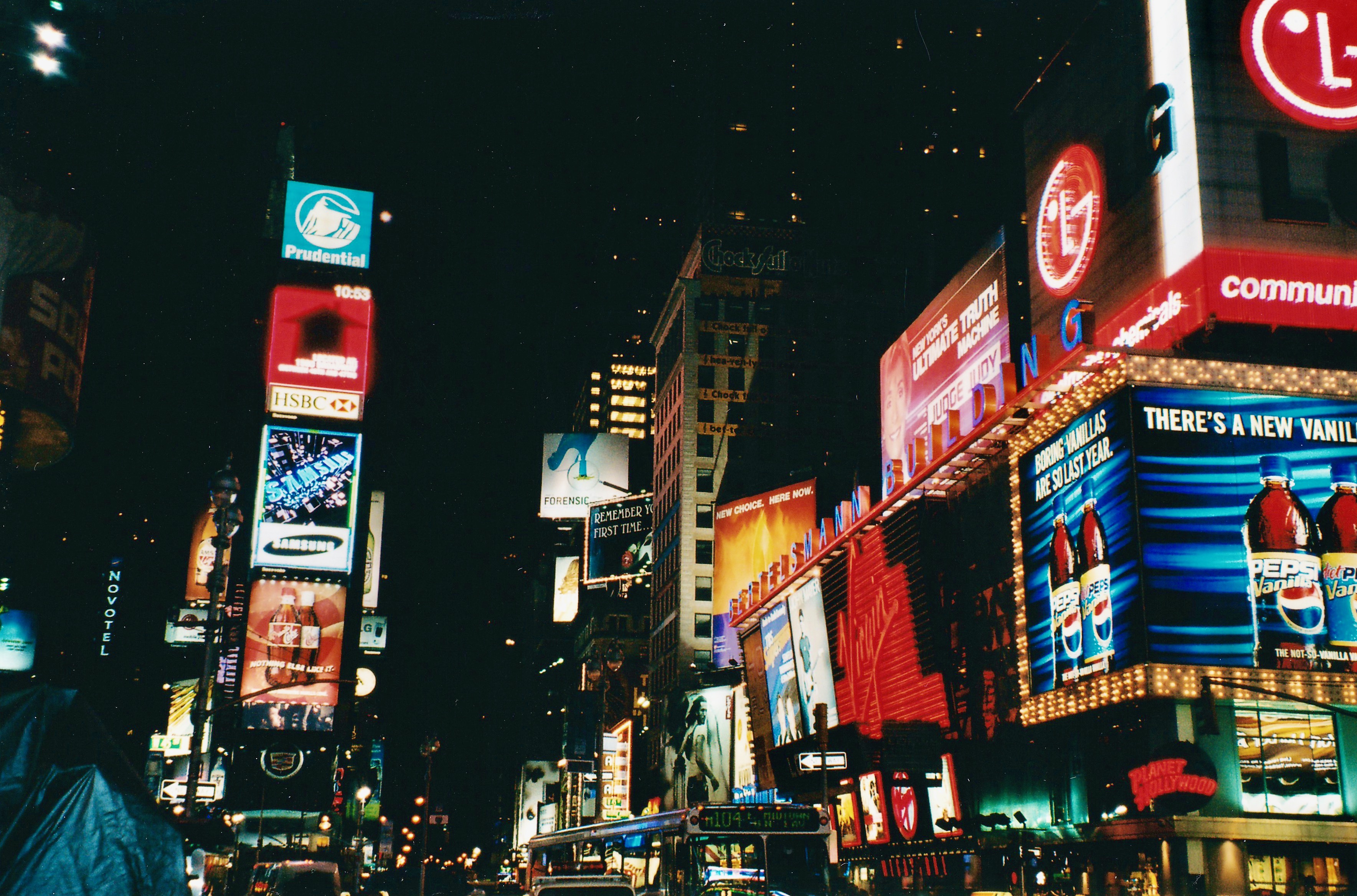
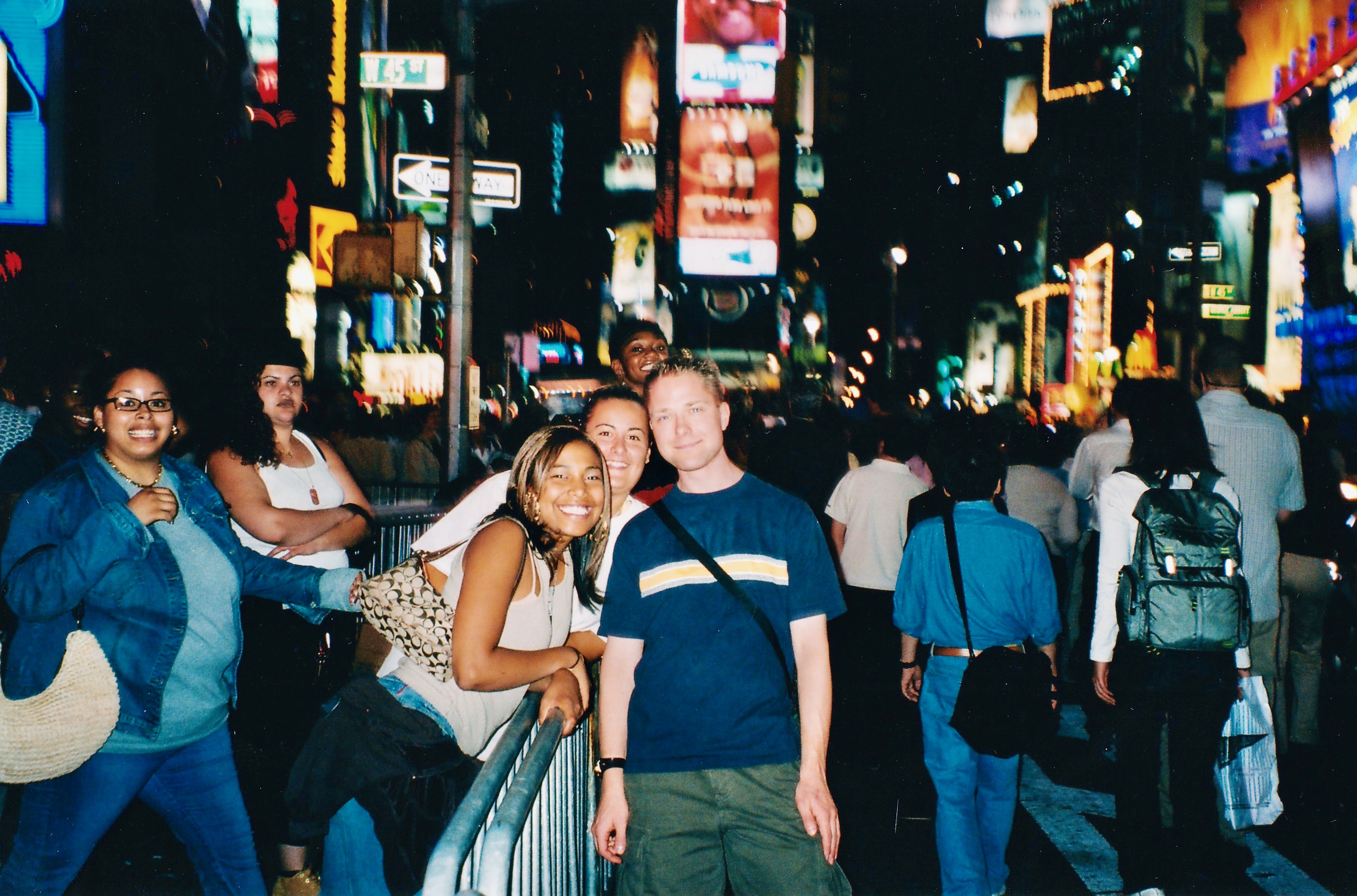
Upon arriving at Port Authority on Friday evening, we proceeded directly to Times Square, where Frank took this pic of me—I was only partially aware of the photobombing ladies on the left. Although I was too late to experience the seedy glory of pre-Giuliani era Times Square, at least the Howard Johnson’s was still in business, albeit looking most anachronistic amongst all this 21st Century neon.
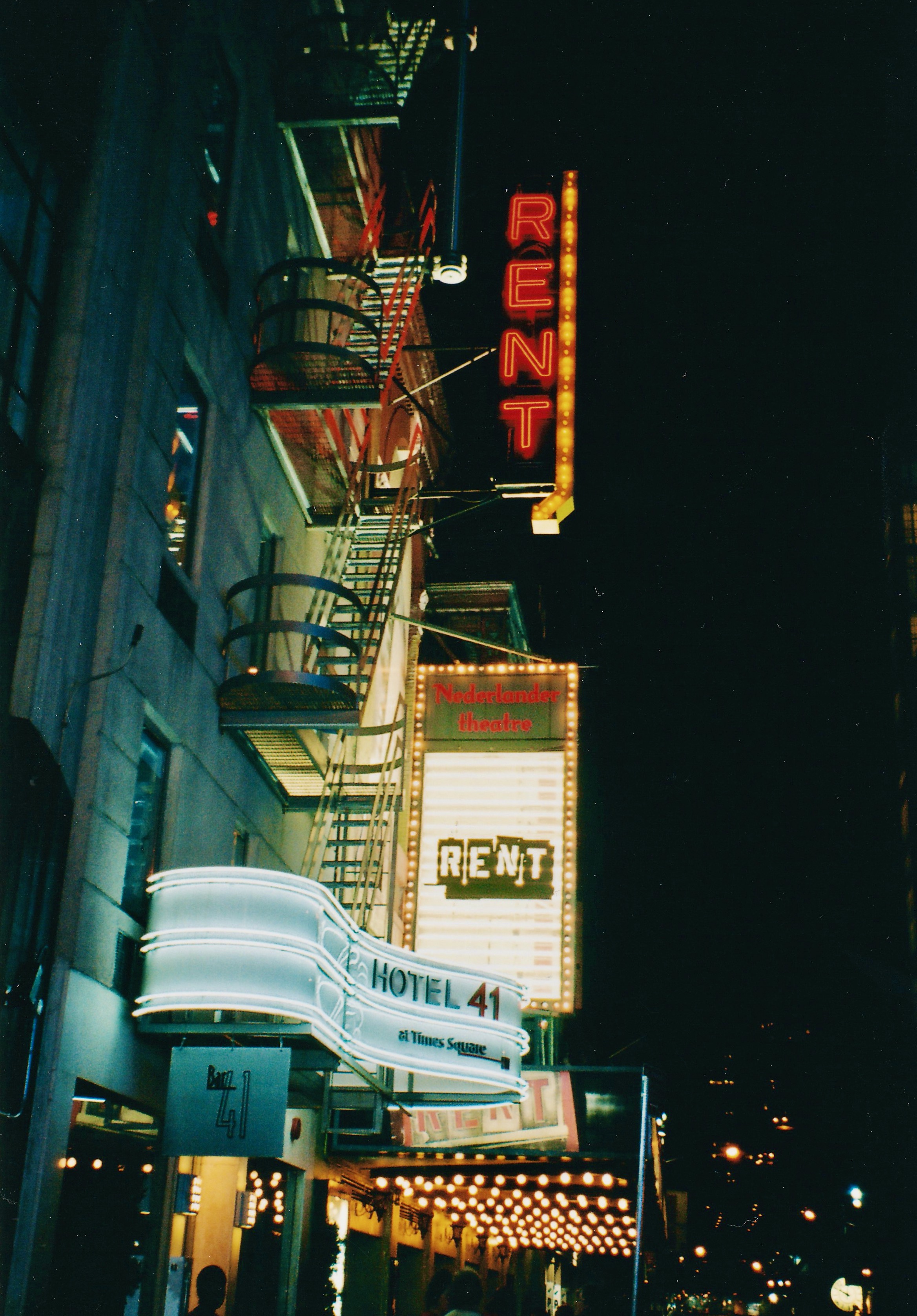
We stayed at a boutique hotel on 41st and 7th, next door to the Nederlander Theatre (then home to Rent)—yes, my very first night in NYC was right in the heart of the city’s tourism Valhalla most real New Yorkers would rather avoid. Our accommodations barely left enough room for a queen-sized bed, but they were modern and clean.
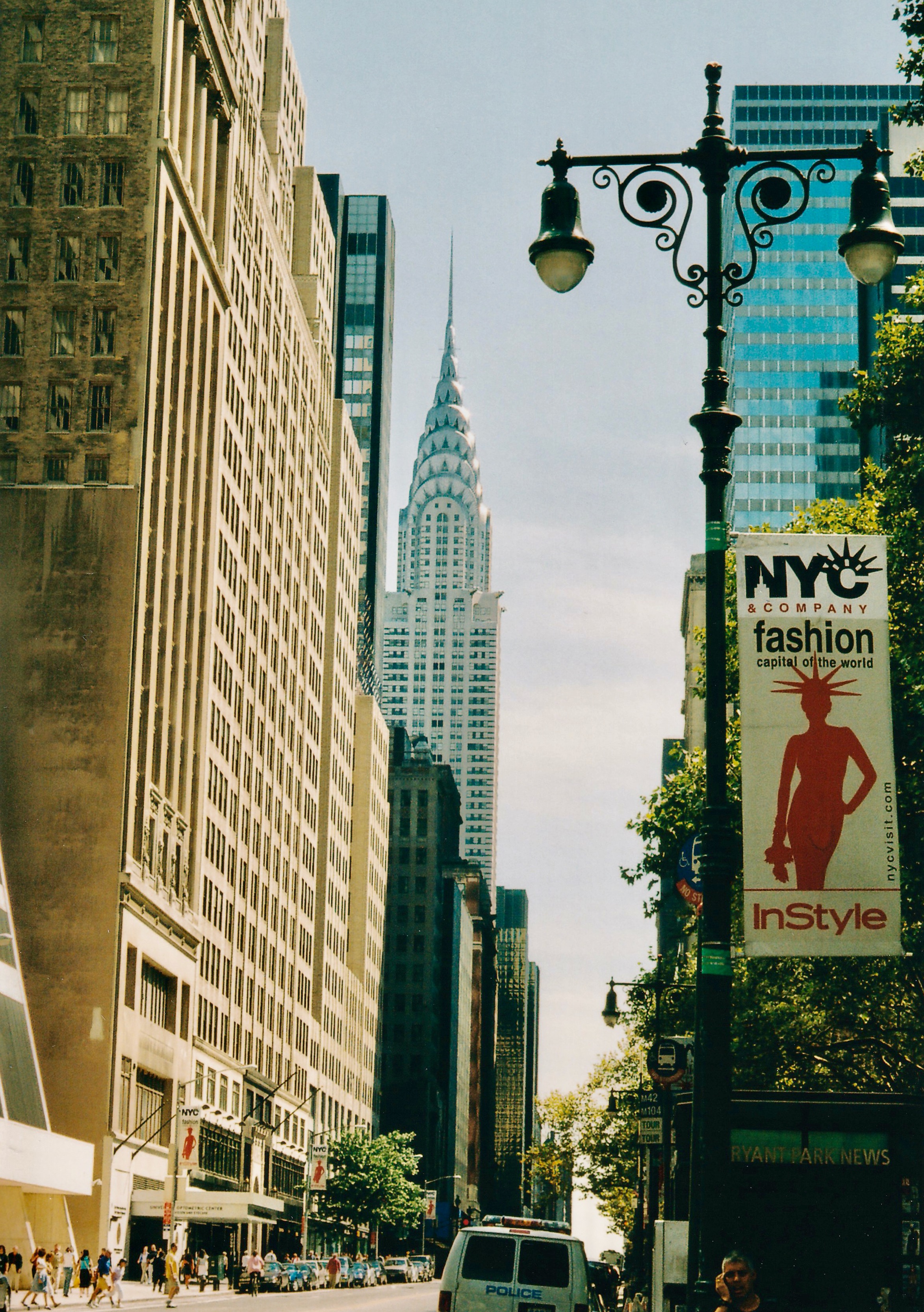
42nd Street near Bryant Park, looking East.
Anyway, we only needed the room for sleeping. That first night, we stayed out until 5:00 AM club-hopping around Chelsea and the West Village, ending up at a place called Hell in the Meatpacking District that played cool alternative ’80s and ‘90s rock (as opposed to the generic dance music most gay bars specialized in.) We slept past noon and went out exploring. Back then, one had a nifty view of the Chrysler Building from this vantage point; now, it’s blocked by the monstrosity that is One Vanderbilt.
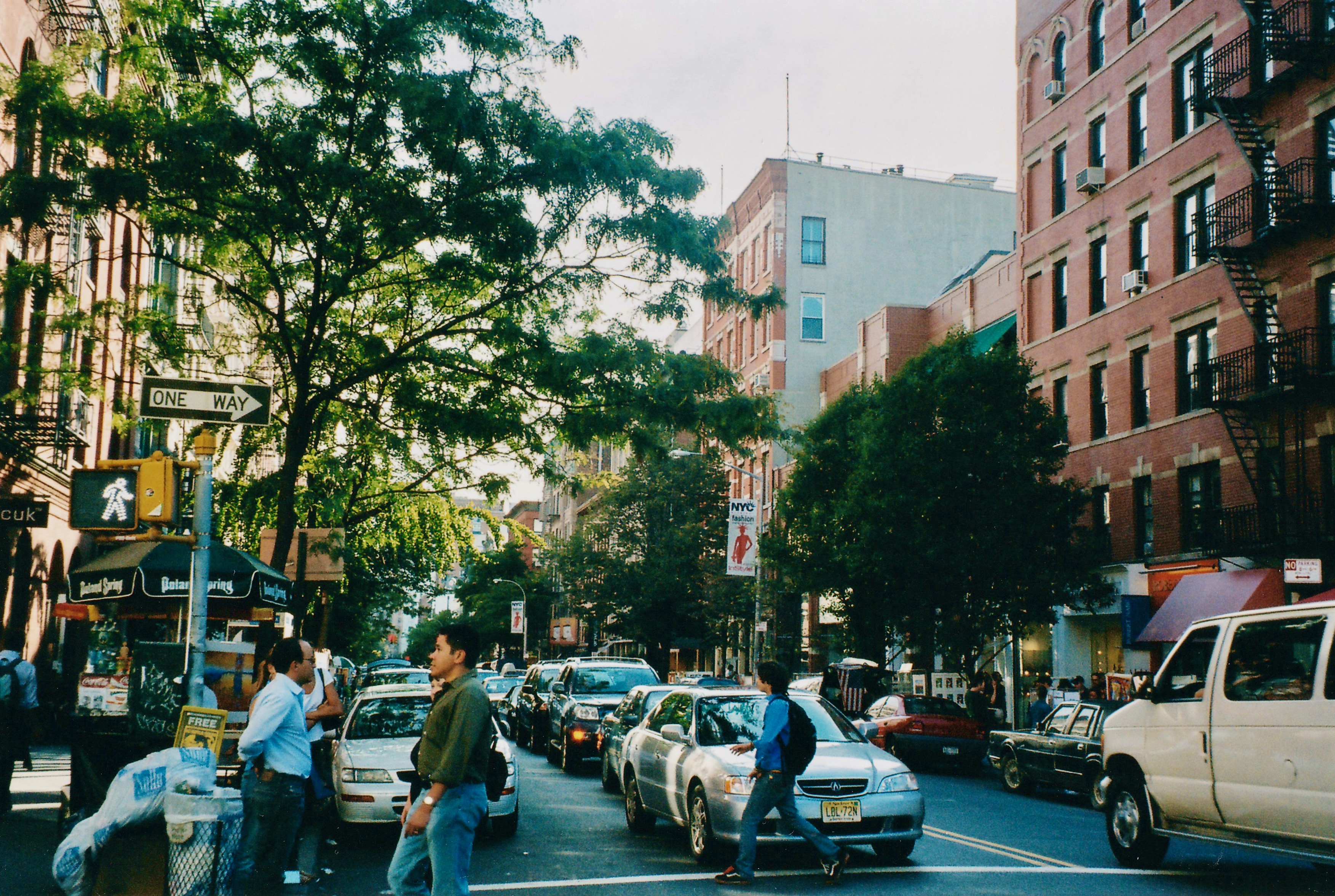
Facing South on West Broadway at Prince Street, Soho.
From there, we walked South towards the Village, and then through SoHo. I immediately felt more at home in leafier, funkier lower Manhattan than in touristy Times Square.
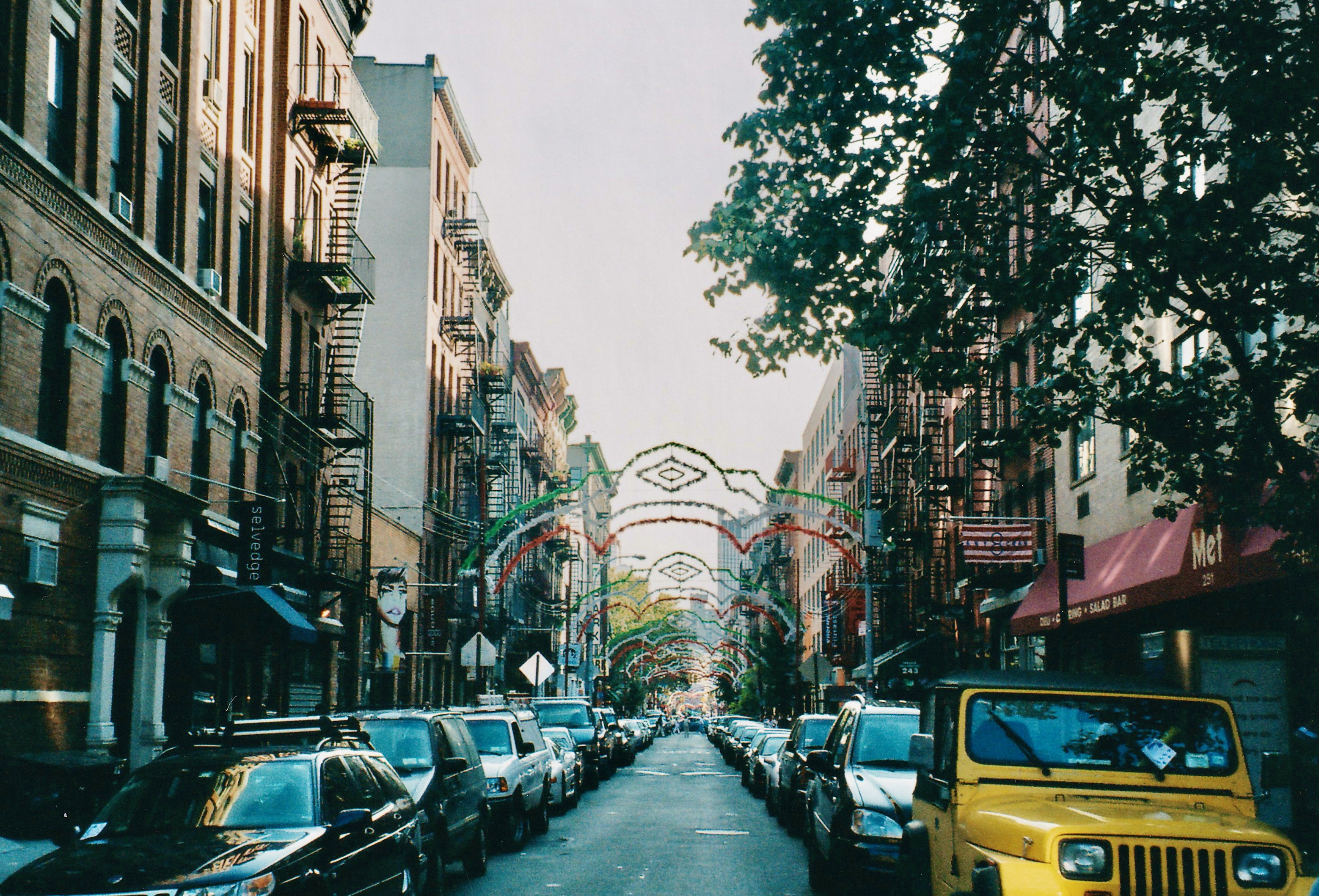
Facing South on Mulberry Street at Prince.
At this time, Little Italy still extended further North; today, the green-white-and-red banners seen here are long gone, the neighborhood technically called “Nolita” (but really just another part of SoHo.)
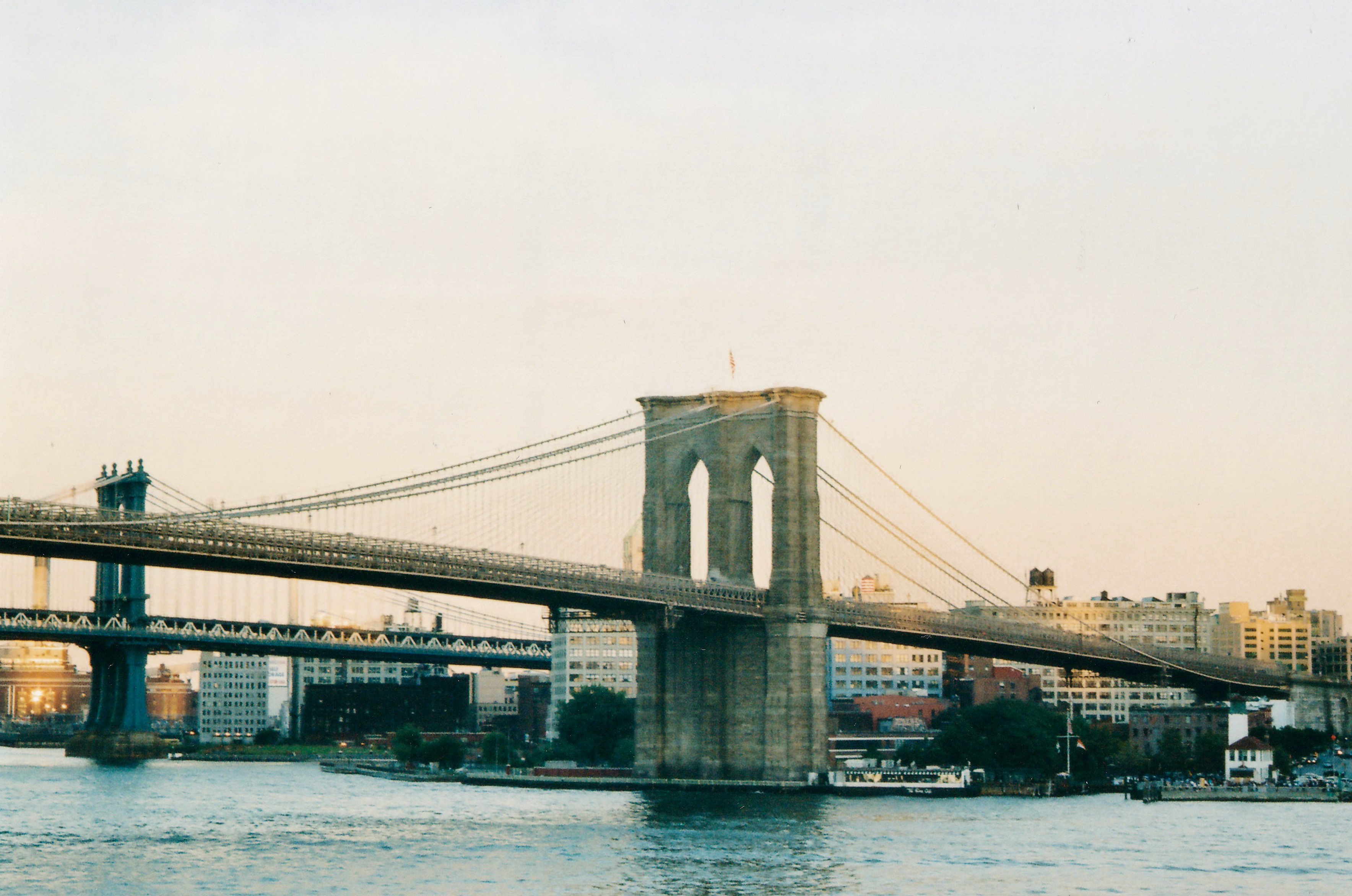
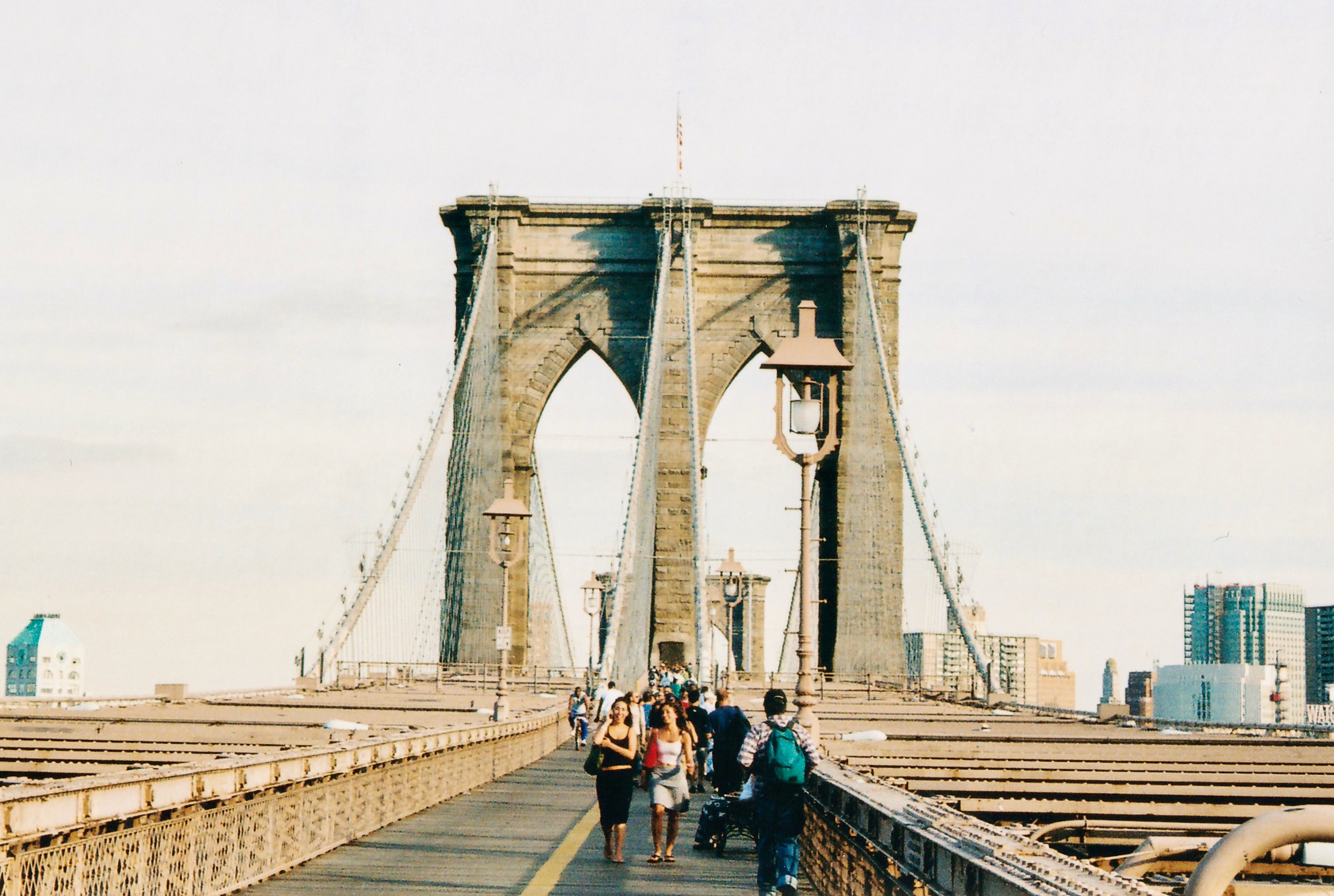
Heading further South through Chinatown (where I’m certain we stopped for dim sum at some point), we eventually reached the mighty Brooklyn Bridge.
A perfect, beautiful, late Summer Saturday to walk all the way across it.
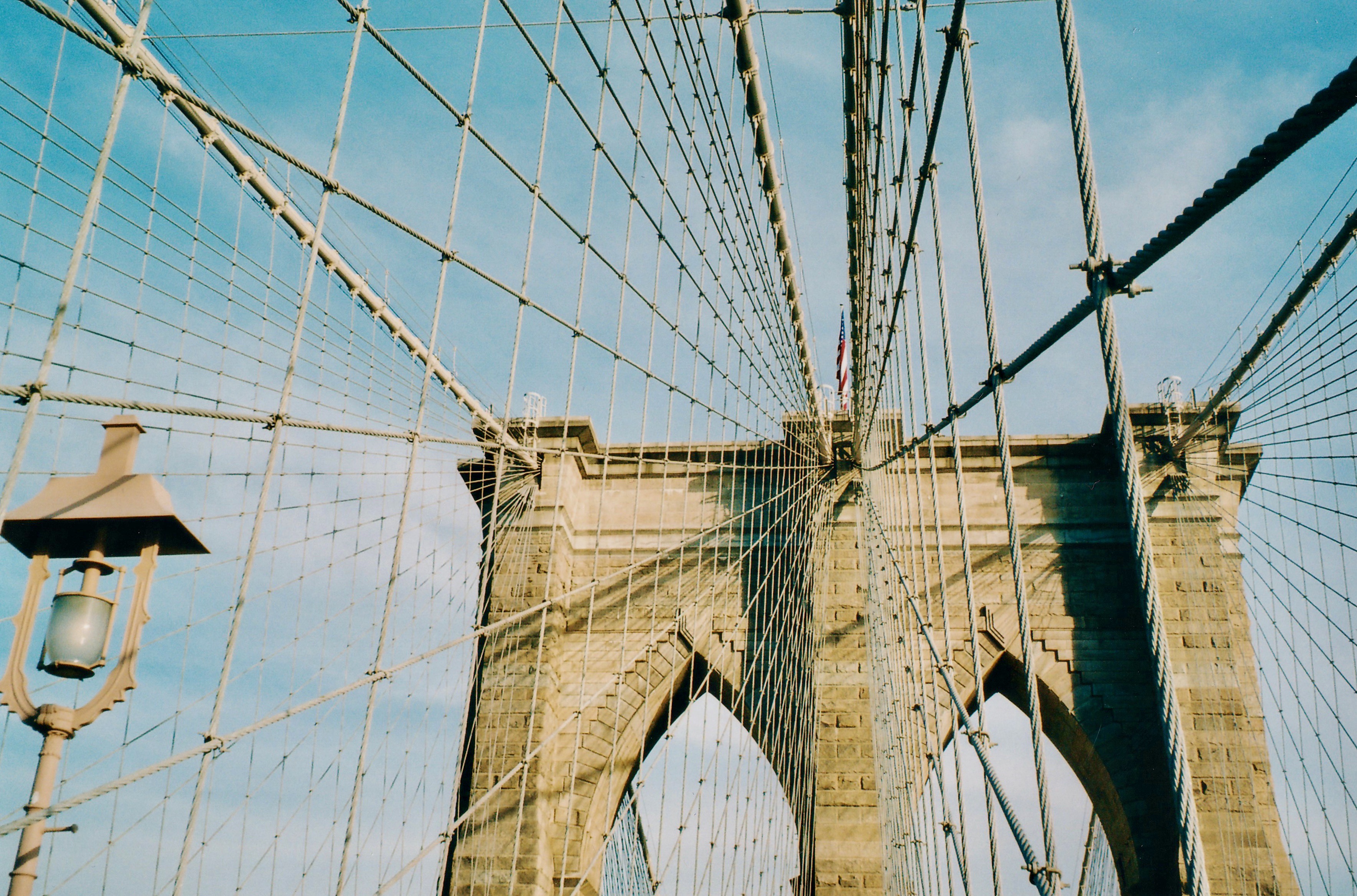
The world teems with many great urban bridges, but few match the classicism and elegance of this one.
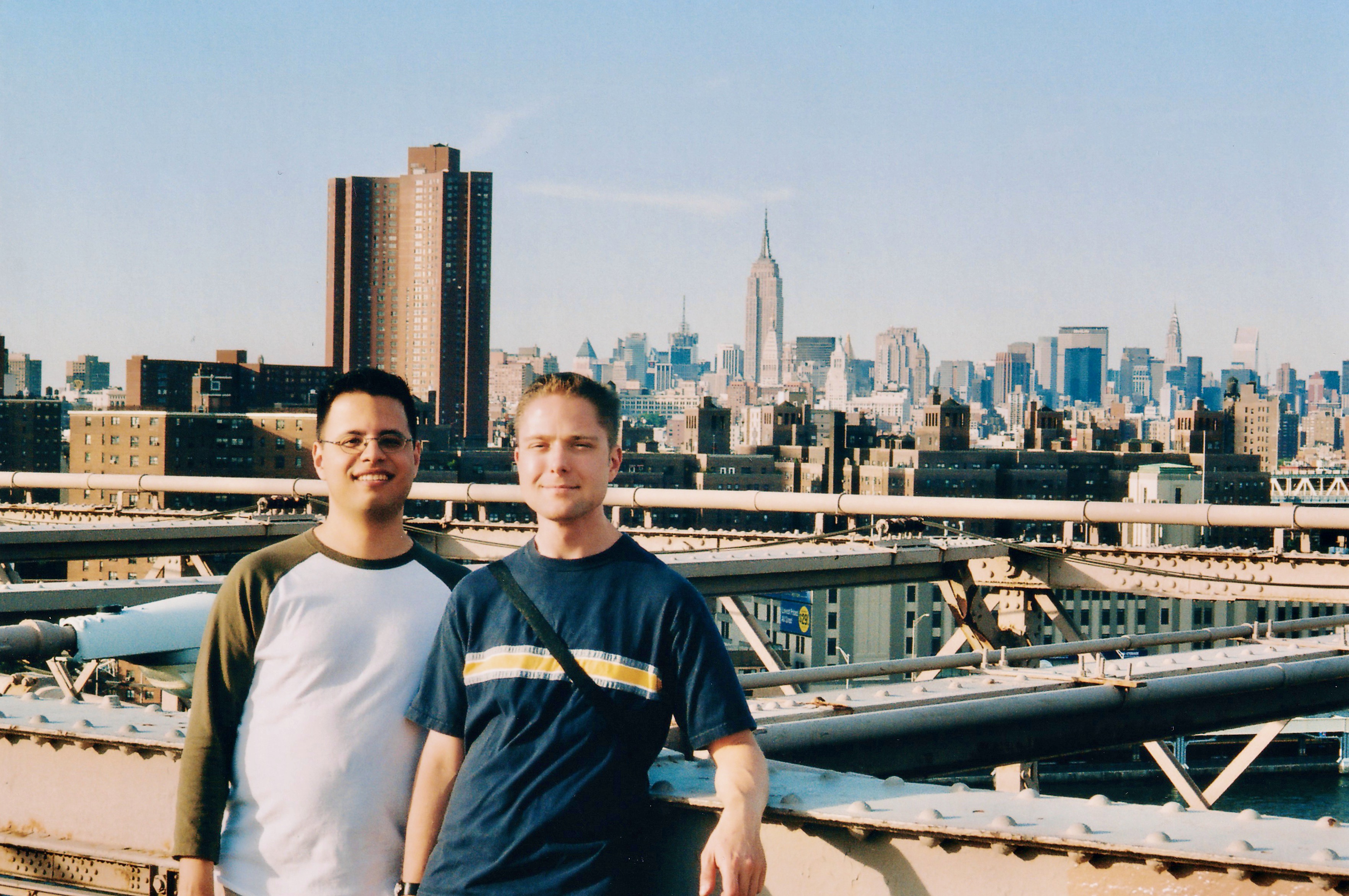
Frank and I and Manhattan, with the Empire State Building central in the background.
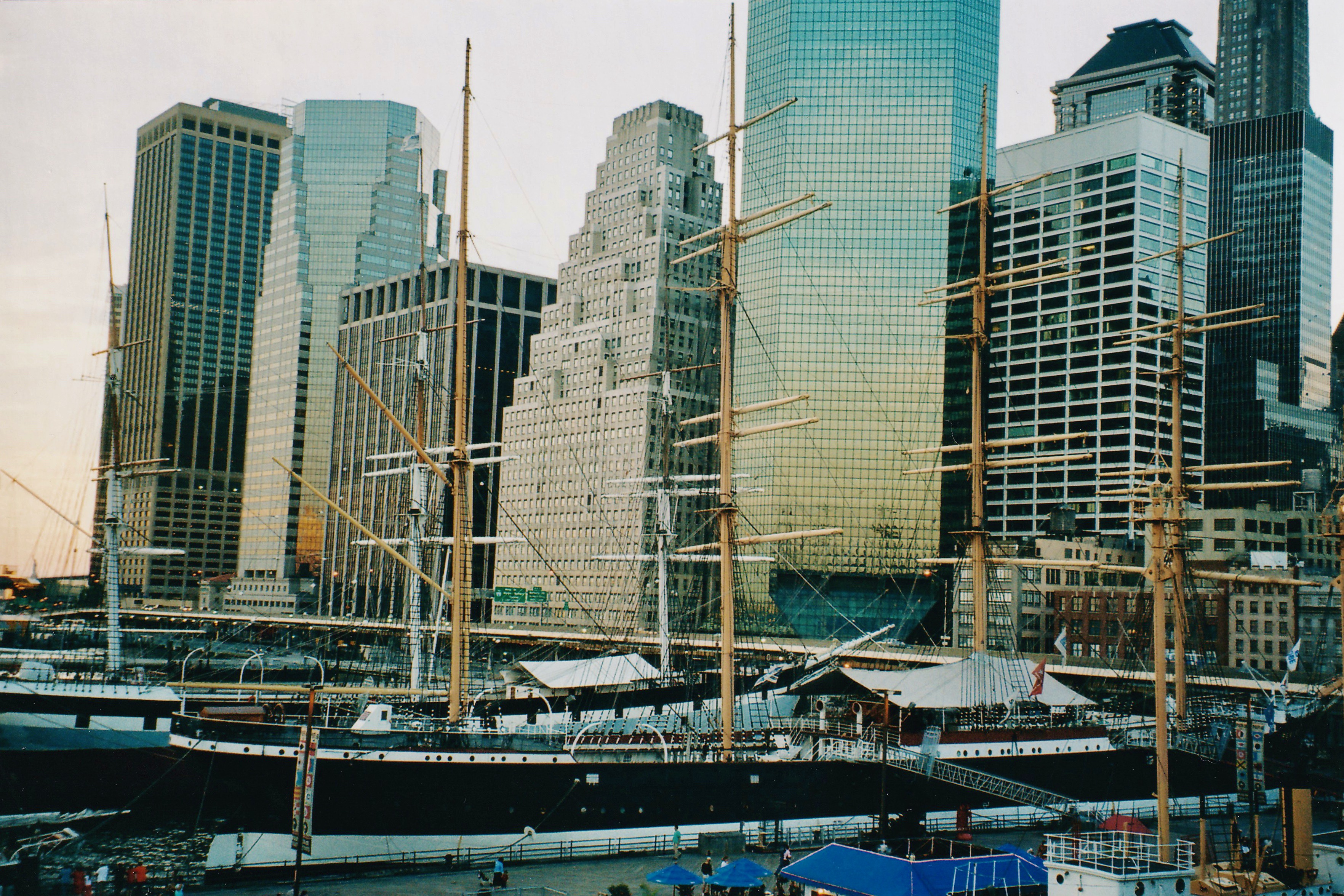
We later met up with a local friend of Frank’s and spent some time at South Street Seaport, which has undergone a massive re-haul in the past 18 years. This was our Financial District view from the deck we sat on. Although 9/11 was relatively fresh in everyone’s minds, the city felt like it was pushing forward, a celebratory air of the new New York, a Manhattan that had yet to become entirely a haven for wealthy foreign tax dodgers.
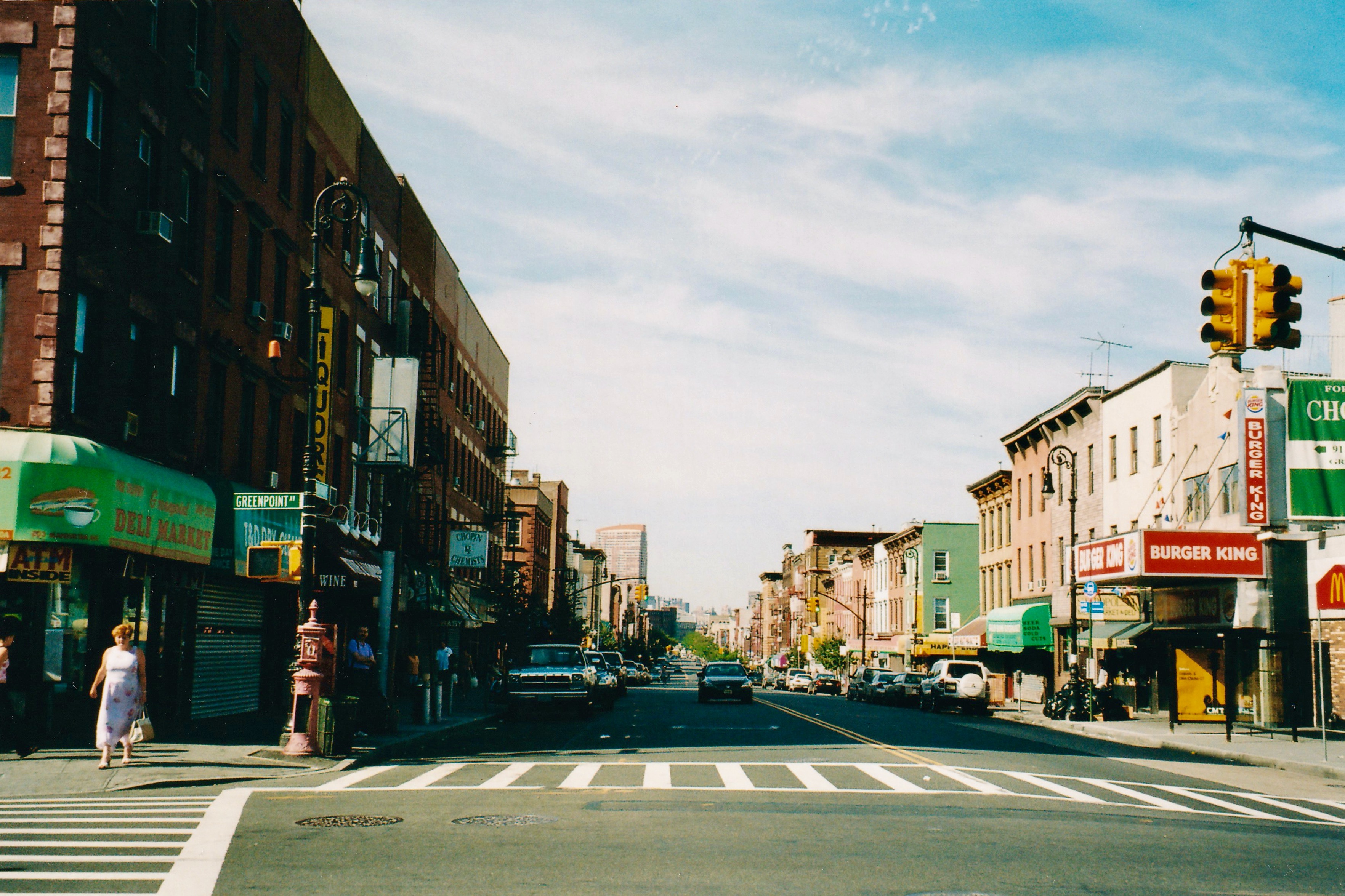
Greenpoint, Brooklyn: Facing North on Manhattan Ave. at Greenpoint Ave.
On Sunday, we ventured out to Brooklyn. Hipster Williamsburg was in its ascendancy; we walked through it over to a mostly pre-gentrified Greenpoint where we lunched at a place now known as Karczma but at the time was simply a bare-bones joint called “Polish Restaurant”. The massive combination platter, which included stuffed cabbage, pierogi, potato pancakes, kielbasa and Hunter’s Stew made me proud to be of Polish descent.
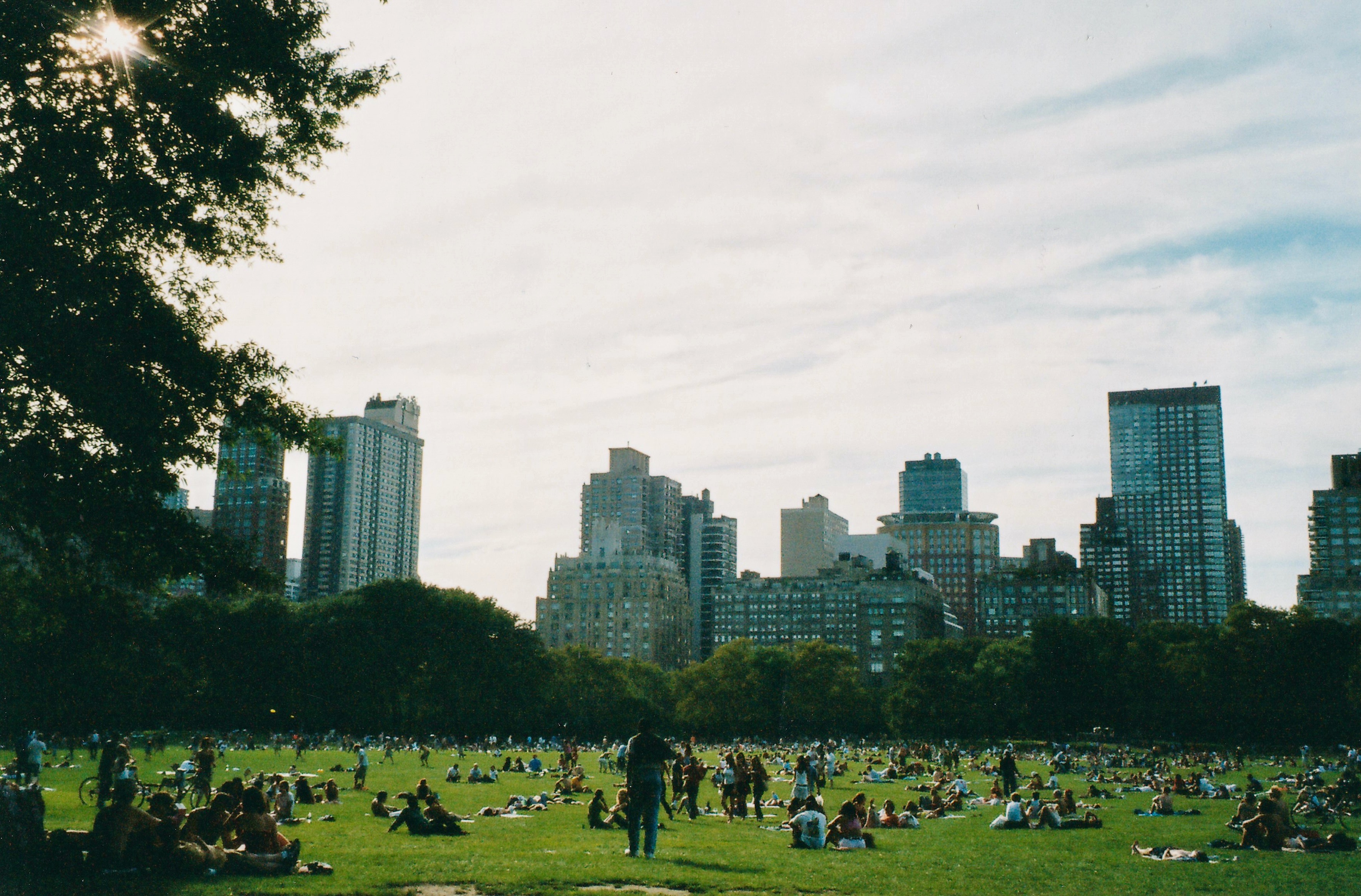
Before heading back on the Greyhound to Boston, we visited Central Park where an idyllic Sunday afternoon at the Great Lawn was in full swing. I recall walking past an affected young woman who seemed to think she was Holly Golightly in Breakfast At Tiffany’s, but I didn’t get a pic of her.
Also, I can’t leave out that before boarding the bus, Frank and I stopped at a midtown Krispy Kreme and picked up two dozen donuts (including a dozen freshly glazed and hot!) to bring back with us. As our bus made its way up through Harlem and the Bronx, we lounged in our seats, donut boxes on our laps, blissfully induced into Krispy Kreme Komas. Although I’d never seriously consider moving to NYC, I knew I’d be back to visit again—particularly after I made a good friend there who came to personify the city for me.
At 21, I knew I had to get out of Milwaukee. Mind you, I didn’t exactly hate my hometown. During Marquette University’s Freshman Orientation, I was practically a cheerleader for it, extolling the city’s many parks and local cuisines to any other student newly arrived from outside the metro area willing to listen. Three years later, however, I deeply regretted that I hadn’t gone away for school. Although I received an above-average education at the college of my choice, it gradually dawned on me that I was missing out on something. Nothing wrong or inferior about pursuing higher education as a commuter student, but I did so mostly out of fear. I had held back when I could’ve easily set my ambitions much higher. I realized I’d personally never become legitimately independent if I continued to stay put.
For me, the easiest way out was to attend graduate school in another city. Having discovered a passion for my minor (Film Studies) far more fervent than anything I had for my major (Journalism), I looked into master’s programs for the former. In those embryonic internet days, I had to consult a thick reference catalog at the campus library to determine which schools I could apply to. UW-Madison was the obvious choice—at 90 minutes away, it was a baby step of a move but far enough for me to adequately feel like I was on my own. Besides, over the past few years I’d visited friends there often enough to the point where it already felt familiar.
I was superciliously certain I could get into Madison but just to be safe, I also applied to two other schools. The first was Boston University—my roommate’s girlfriend had recently talked up the city, deeming it the ultimate college town and more “European” than other US metropolises. The other was New York University, as they had a program at the Tisch School For The Arts and I thought, “Eh, why not? I’m going to Madison anyway.”
Alas, Madison might’ve accepted me had I submitted my application on time. In the rush of taking my GRE, drafting the required essays, procuring recommendation letters and getting all the forms out in the mail, I miscalculated that school’s relatively early cutoff date. I also never seriously expected to get into NYU (nor can I imagine green 22-year-old me flailing about New York City); fortunately, I received a welcome packet from BU in mid-March. I could stick around Milwaukee for another year, maybe reapply to Madison for the spring semester; instead, I chose to see this little exercise’s outcome as a sign. I was moving to Boston.
*
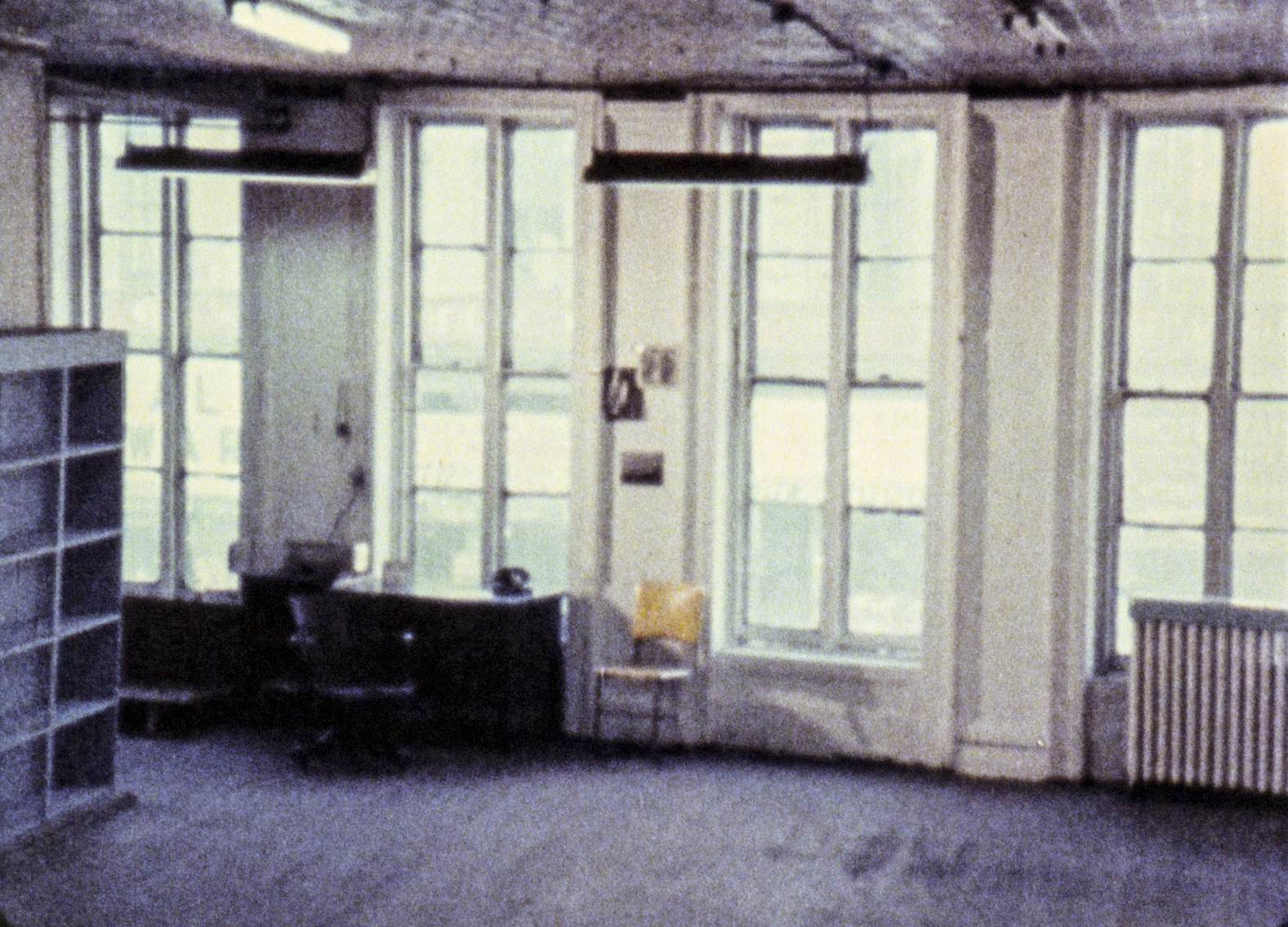
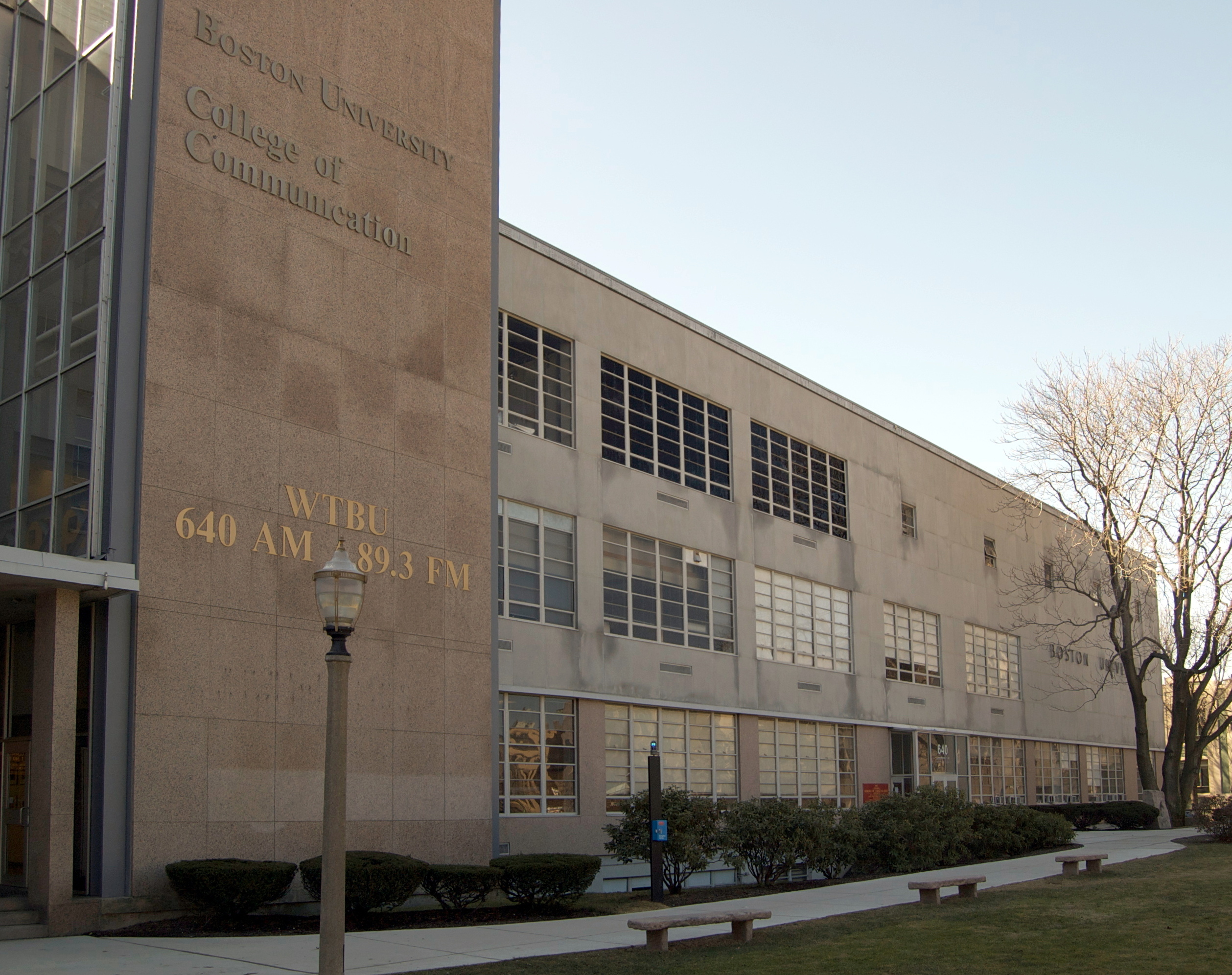
I’ve previously written about my first 48 hours in my new city. On the third day, having partially acclimated myself to my neighborhood of Allston and the BU campus, I showed up for orientation at the College of Communication building (hereafter shortened to COM), an unassuming, three story, mid-20th century structure that paled in the shadow of the gleaming, luxurious new School of Business Administration down the block. At the time, COM’s only distinguishing feature was a moderately short radio tower on its roof, which I soon learned no longer carried any broadcasting function whatsoever.
COM in all of its boxy, utilitarian glory.
I met my fellow classmates in the Film Studies program (seven of us in all) and received syllabi and reading lists for my courses. They included one on horror films, another on the work of British director Mike Leigh (who’d won the Cannes Palme d’Or for his film Secrets & Lies the year before) and a self-explanatory through-the-decades survey called “American Masterworks”. As with most of my BU courses, these were all open to both graduates and undergraduates, allowing the latter’s non-arts majors to fulfill their fine arts requirement. In subsequent semesters, I’d even serve as a teaching assistant for a few of these hybrid courses which basically meant I got to grade the undergraduates’ writing assignments and work the VCR and Laserdisc player whenever we watched movies in class.
That first semester, I also took a fourth course—one limited to graduate students included my fellow Film Studies majors along with all the new students in the Film Production and Screenwriting programs. Called “Ways of Seeing” (a simple but perceptive summation), we learned not only how to watch and assess a film but also how some films beg us to watch them differently from others. The semester kicked off with an intensive examination of Psycho. After one complete run-through the entire film, we returned to various scenes, watching and dissecting them again and again. So thoroughly did we pick it apart frame by frame that I haven’t watched it since—while our professor dutifully showed us why Hitchcock’s film was an example of major Hollywood studio cinema at its best, he also singled out in painstaking detail what he saw to be its many, many flaws, to the point where I simply couldn’t watch it again because all I could see were those imperfections.
From there, we studied films suggesting various “Ways of Seeing” that diverged from Psycho. Jean Renoir’s La Règle du Jeu presented a cinematic canvas composed less of shot-reaction shot editing than figures constantly, freely moving in and out and around the frame, engaging in moral complexities far more advanced than Psycho’s Freudian constructs. John Cassavetes’ A Woman Under The Influence further blurred such distinctions, its characters (and director) making unexpected, irrational, just plain messy choices with a raw impulsivity that felt less written than captured by a documentary film crew. Caveh Zahedi’s A Little Stiff was low-budget and contained to the point of seeming handmade, its filmmaker starring as a fictionalized version of himself and anticipating by a decade a genre critics would dub “mumblecore”. Andrei Tarkovsky’s Stalker, on the other hand, came off as immense and enigmatic, a personal sci-fi allegory that was the anti-Psycho for how it raised all sorts of questions and just left them there hanging and unanswered.
*
Late in the semester, we watched Todd Haynes’ Safe, a study of a woman suffering from environmental illness who seeks solace at a new age rehabilitation facility. I’d heard of the film when it came out two years before and recalled it briefly playing at Milwaukee’s Downer Theater. From what little I read regarding it, I imagined it to be a satire about suburban living, allergies caused by household products and the lengths people will go to find alternative solutions to combating such ailments. I pictured something not far off from, say, Alexander Payne’s screwball abortion rights fable Citizen Ruth (released the year after Safe.)
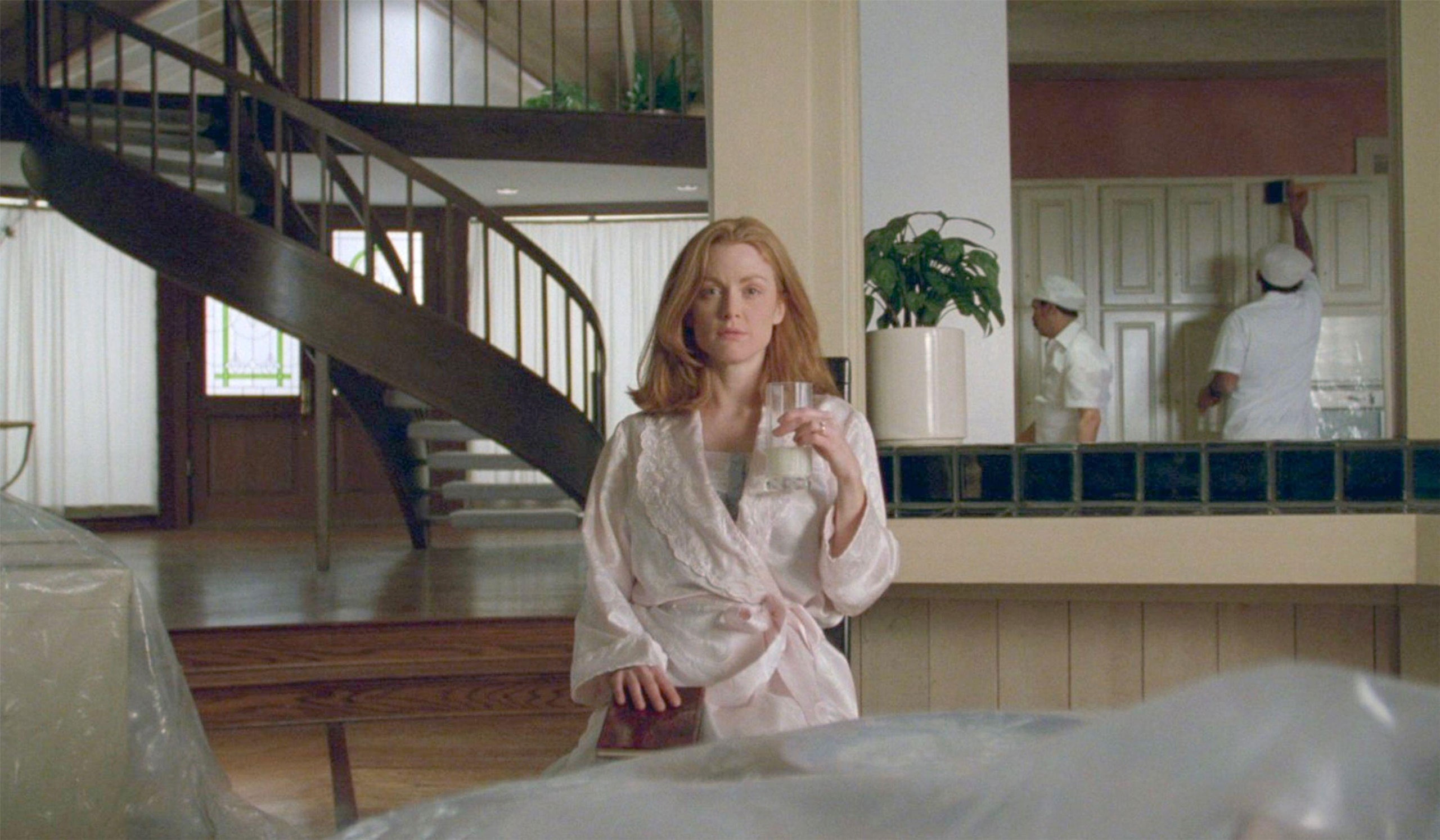
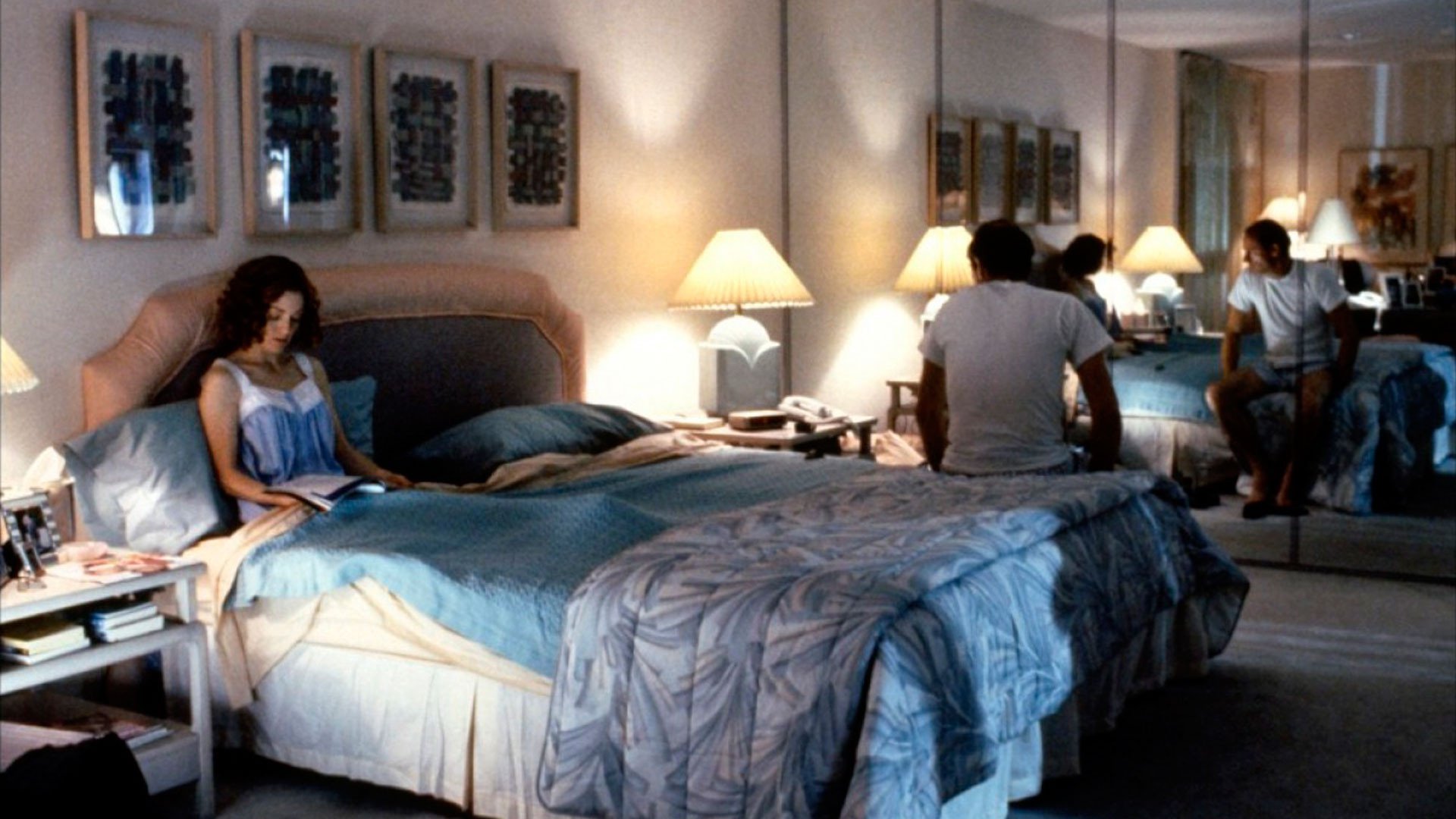
From the ominous, mournful, droning synths accompanying its opening credits, which appeared over a point-of-view shot of a car slowly driving at night through an upscale Los Angeles subdivision, I promptly understood that Safe would be absolutely nothing like Citizen Ruth. The next scene confirmed this: an uncomfortably drawn-out shot of the film’s heroine, Carol White (Julianne Moore), lying in bed, her face to the camera as she’s engaging in man-on-top sex with her husband. Her expression’s not completely indifferent but she doesn’t appear to be gleaning much pleasure from it.
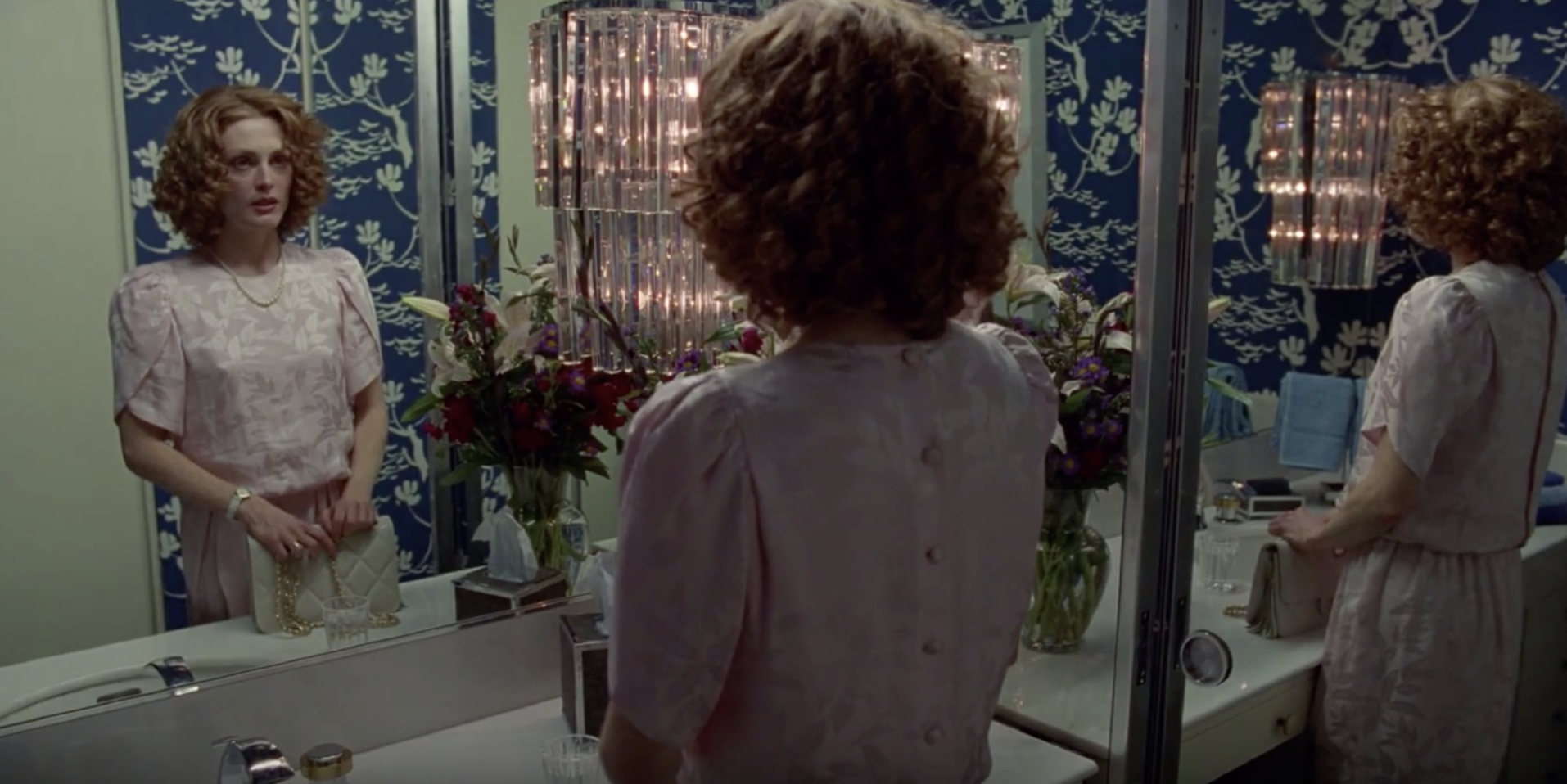
Does anything give Carol pleasure or even joy? She’s a Sherman Oaks housewife living in a gigantic McMansion in 1987 (set eight years before the film’s release.) She spends her days running errands, attending aerobics class, gardening, and going out to lunch. With a maid at her disposal and no job or profession to speak of, she seems to have a charmed life; she also seems barely there, often physically engulfed by her environment, sometimes appearing as small as a speck within the symmetrical, immaculately arranged wide shots inside her home.
About fifteen minutes into the film, she drives on a congested expressway behind a truck belching out exhaust fumes and suffers a coughing fit that’s alarmingly more severe by the second. She pulls off the road and into an underground parking garage where she stops, gets out of the car and continues to violently hack away, worryingly short of breath; as with the interior home shots, she appears tiny in the garage’s expanse, its darkness nearly encompassing her.
Similar attacks occur at a friend’s baby shower, the dry cleaners and the hair salon when she’s getting a perm. During these moments, Haynes often utilizes horror film tropes like dramatic bursts of sinister music or sudden jump cuts or close-ups—when the other ladies at the shower attempt to comfort Carol, it’s a sideways nod to the shower scene in Rosemary’s Baby (however, not Psycho.) Meanwhile, her doctor casually dismisses Carol’s claims, concluding that, despite the incessant coughing, headaches and general fatigue, there’s nothing physically wrong with her. He recommends she consult a therapist.
Perhaps the problem is psychological: after she attends a seminar on environmental illnesses (the first shot of an audience member donning a surgical mask is enough to elicit a visceral reaction in 2021), her husband, stumbling upon a pamphlet she’s brought home from it asks her, “Who told you to go to this?” His exact words and accusatory tone say more about how he and the other people perceive Carol than anything she says herself. Haynes further corroborates this by deliberately withholding what another film would regard as key information about her, like the fact she has a ten-year-old child (revealed 25 minutes in) and that it’s actually her husband’s son from a previous marriage (38 minutes in.) And Moore completes the picture of Carol as a blank by nearly disappearing into the role—a perfectly nice individual with barely a trace of discernible personality.
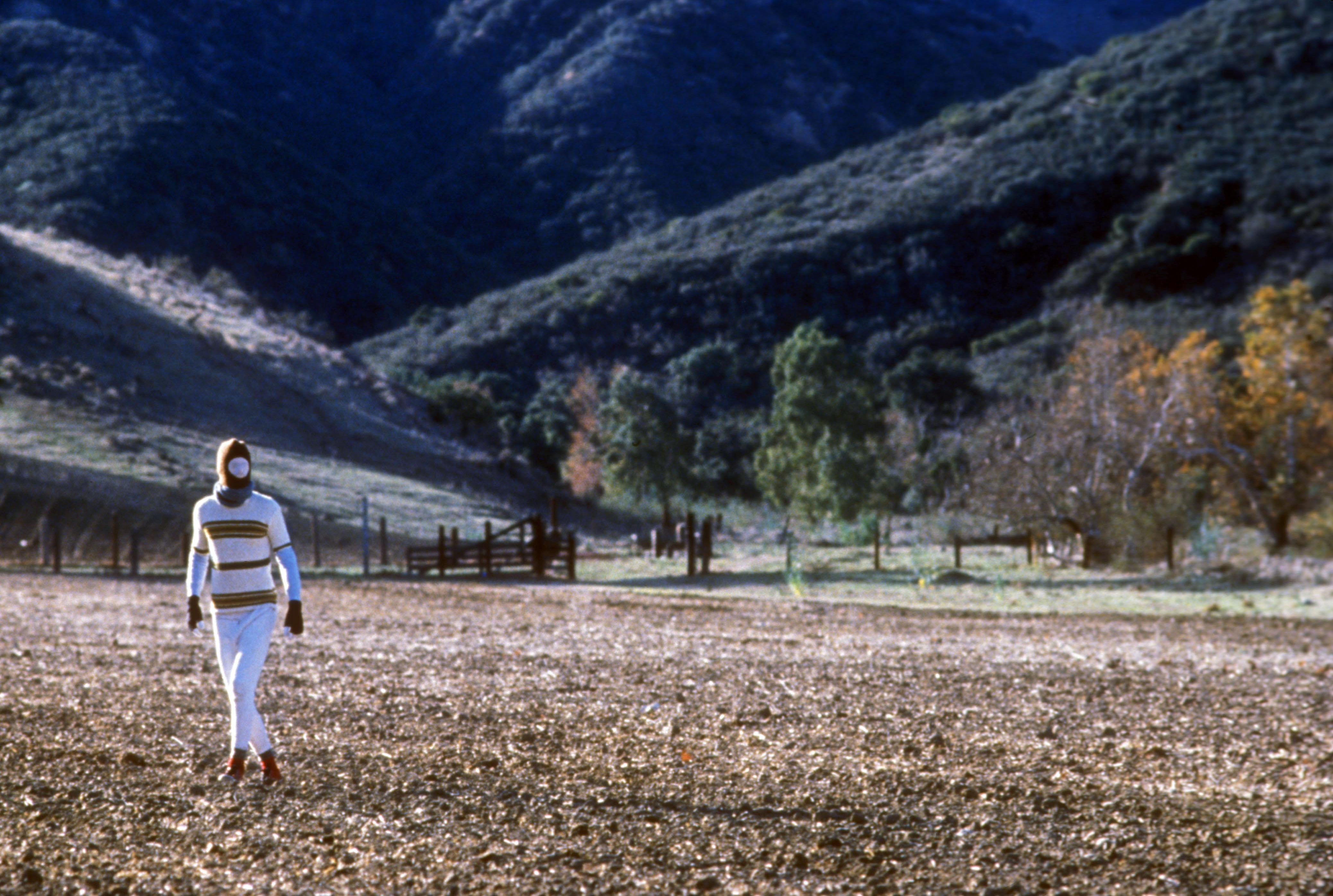
She winds up in the hospital following her attack at the dry cleaners. From her bed, she sees a TV commercial for Wrenwood, a new age-y rehab clinic in New Mexico specializing in treatment of people like her. In the very next scene, she’s in a cab, sans husband or stepson, riding through the desert on her way there. However, something seems off about the place when Carol’s cab first pulls in and she’s accosted by Nell, an older masked woman furiously screaming at her to turn back (the car fumes upset her because her husband is immune compromised), then creepily taunting her from a distance, “I see you,” after she exits the vehicle.
Wrenwood would seem a target overripe for satire given its remote location and inclination towards spoken and sung affirmations (a woman sings a Judy Collins-esque anthem to the assembled patients with such pithy lyrics as, “Give yourself to love / if love is what you’re after.”) Then, there’s Peter (Peter Friedman), the facility’s middle-aged owner who presides over the organization with an aw-shucks folksiness crossed with the understated but palpable fervor of your average cult leader. He concludes his talks by leading the group in the following inspirational credo: “We are one with the power that created us, we are safe, and all is well in the world.”
Despite all that, Wrenwood doesn’t particularly seem like a heightened or ridiculous proposition, at least not on the surface. The group therapy sessions feel straightforward and potentially constructive, especially when Peter advises Nell, “The only person who can make you sick is you, right?” Conversely, he doesn’t acknowledge Nell’s husband’s then-recent death, which for all we know might’ve been suicidal. He also never mentions to the congregation his own status a person living with AIDS (one of the other patients reveals this to Carol.) In 1987 (and, to a lesser extent, 1995), this was almost a certain death sentence; its revelation amplifies the notion that Peter is attempting to heal himself and his patients with the power of positive thinking in lieu of a (nonexistent) medical cure or treatment.
Carol doesn’t seem to be getting any better at Wrenwood; the film’s tone does not brighten once it shifts to New Mexico. She soon requests to change cabins because of “the fumes” she perceives (perhaps by way of Nell?) coming from outside the compound. Mask and oxygen tank in tow, she makes her way around the facilities in stilted movements, increasingly resembling Lester, a fellow patient only shown from a distance. When she first spots him, Peter remarks to Carol, “Poor Lester… he’s just very, very afraid.” Rather than improving in health or even disposition, Carol further withdraws into herself.
Poor Lester…
She does take tentative steps towards making a new friend in Chris (James LeGros), a fellow resident with whom she signs up to cook something for a communal potluck. The event itself seems a joyous one, with the dinner followed by its participants dancing to Kenny Loggins’ “Whenever I Call You ‘Friend’”. Then, Chris and the group surprise her with a cake (her birthday’s the next day), a genuinely sweet and selfless gesture. They ask her to give a speech, and she does, confessing to the group, “It’s just that, I really hated myself before I came here,” rambling on about such things as “education” and “AIDS” before gradually trailing off. She’s smiling but is also seriously emaciated, her face and skin disconcertingly blotchy.
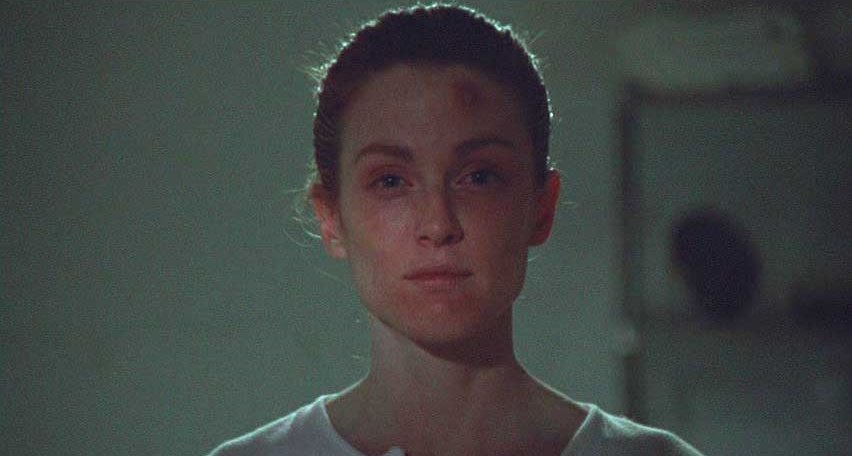
Chris walks Carol back to her cabin, which is now the “safe house”, a metal igloo-like structure once inhabited by Nell’s husband. Alone inside, Carol’s white, colorless clothing and skin blend into her stark, sterile, prison cell-like surroundings. She breathes from her oxygen tank and looks directly into a little mirror on the wall: the film’s final shot is of her staring into it, at us, her face partially in shadow. Blankly, she says to her reflection, “I love – I love you. I really love you. I love you.” Fade to black and credits roll.
*
I recall sitting in the classroom at that moment, figuratively chilled to the bone. Thoughts escaped me as how to process this deeply unnerving ending to an altogether unsettling film. Normally, a story about illness and rehabilitation would conclude triumphantly, the subject overcoming an affliction and having learned more about themselves in the process—perhaps even learning how to love themselves. Carol’s final words to us are as such, but they don’t at all reassure or convince. She struggles to get them out and indeed, they’re something a facility therapist instructed her earlier to say. As much as we’d (and, for that matter, she’d) like to believe they’re true, they come off as just words—a recitation.
It’s easy to view Safe through a cynical lens: most likely, Carol’s illness is psychosomatic, a physical manifestation of her psychological damage, self-punishment for the fact that she doesn’t love herself. A few critics at the time, most notably Jay Carr in The Boston Globe dismissed it as just that. However, I didn’t see it that way, not entirely. Safe’s austere conclusion genuinely shocked me—I was willing to believe something was physically wrong with her, that there must be an exterior reason for her symptoms, that she’d learn how to live with if not entirely combat them during her time at Wrenwood.
Then again, that’s only one of two parallel readings that Haynes thoroughly maps out in Carol’s trajectory; the other, where it is all in her head is just as present in the film’s overall design. For a character who appears in every single scene, she’s often deliberately spectral and insignificant, a non-entity. Moore’s subdued but internally complex performance only further serves this notion, that we’re looking both at and through the eyes of someone with so little self-esteem and sense of purpose that, instead of “getting better”, all she can do is further recoil into herself where she thinks she feels “safe” but in truth can’t feel anything at all.
Before Safe, I hadn’t seen a film attempt such a bait-and-switch (or at least wasn’t aware of one attempting it) and do it so seamlessly and effectively. And yet, I don’t believe what it does is a cheat or a clever way of saying, “Okay, here’s what this film’s really about.” Instead, Safe is about exterior and interior lives and how one’s physical and the psychological selves can be out of balance or even at opposition to each other. As for that title, it throws into relief its definition as an ability, an affirmation, a state of mind. Does the concept of safety ultimately imply a sense of feeling protected or does it come entirely from self-worth? Upending my life and moving to Boston at 22, I took a risk and deliberately tried to be unsafe, although one might argue that by opting for grad school instead of a job in the real world, I had deployed a safety net of sorts for myself. I’m willing to bet this conundrum lingered somewhere in my subconscious as I watched Safe, a film that asks its viewers to consider whether the desire to be “safe” is to simply crave comfort or inevitably give oneself over to fear.
I don’t know why it took me so long to get around to watching 12 Angry Men. Perhaps I’d seen it used so much as a cultural reference point that I felt like I didn’t need to see it—after all, one could easily summarize the plot in a sentence or two, tops. Sidney Lumet’s a filmmaker whose workmanlike agility I’ve always felt more admiration than passion for, but his first feature film conveys a mastery of pacing, blocking and framing to transform what is essentially a single set play into cinema, albeit one best viewed as a period piece that intrigues most when it offers occasional glimpses of self-recognition. Either way, as essential as you’ve heard it to be.
With all his shorts expiring on Criterion at the end of the month, I took a semi-deep dive into Georges Méliès, the first filmmaker to utilize optical effects and thus take serious advantage of what one could do with the new medium. Every cineaste knows A Trip To The Moon (especially the two that made this music video 25 years ago), but follow-ups like The Impossible Voyage and The Merry Frolics of Satan are even better, experimenting with textures and a fine-tuned whimsy. They are records of Méliès exploring film in real time, trying out new techniques and occasionally finding magic in them.
Not much new stuff to write home about (apart from Annette, reviewed here), with re-watches mostly confirming first impressions: Elliot Gould still iconic as a 1970’s Philip Marlowe in The Long Goodbye, Point Blank still pretentious but oddly fascinating, etc. On the other hand, Limbo feels more like a future classic the second time around and Pink Flamingos proves far more watchable with John Waters’ predictably entertaining, motor-mouthed commentary track.
On that note, I’m taking a break from these watchlist essays after 18 straight months of doing them in order to focus on other writing (including this series) and some new endeavors. However, I’ll still be posting (mostly short) reviews of everything I see on Letterboxd.
Films viewed in August in chronological order, with director, year of release and my rating (out of 10); starred titles are re-watches:
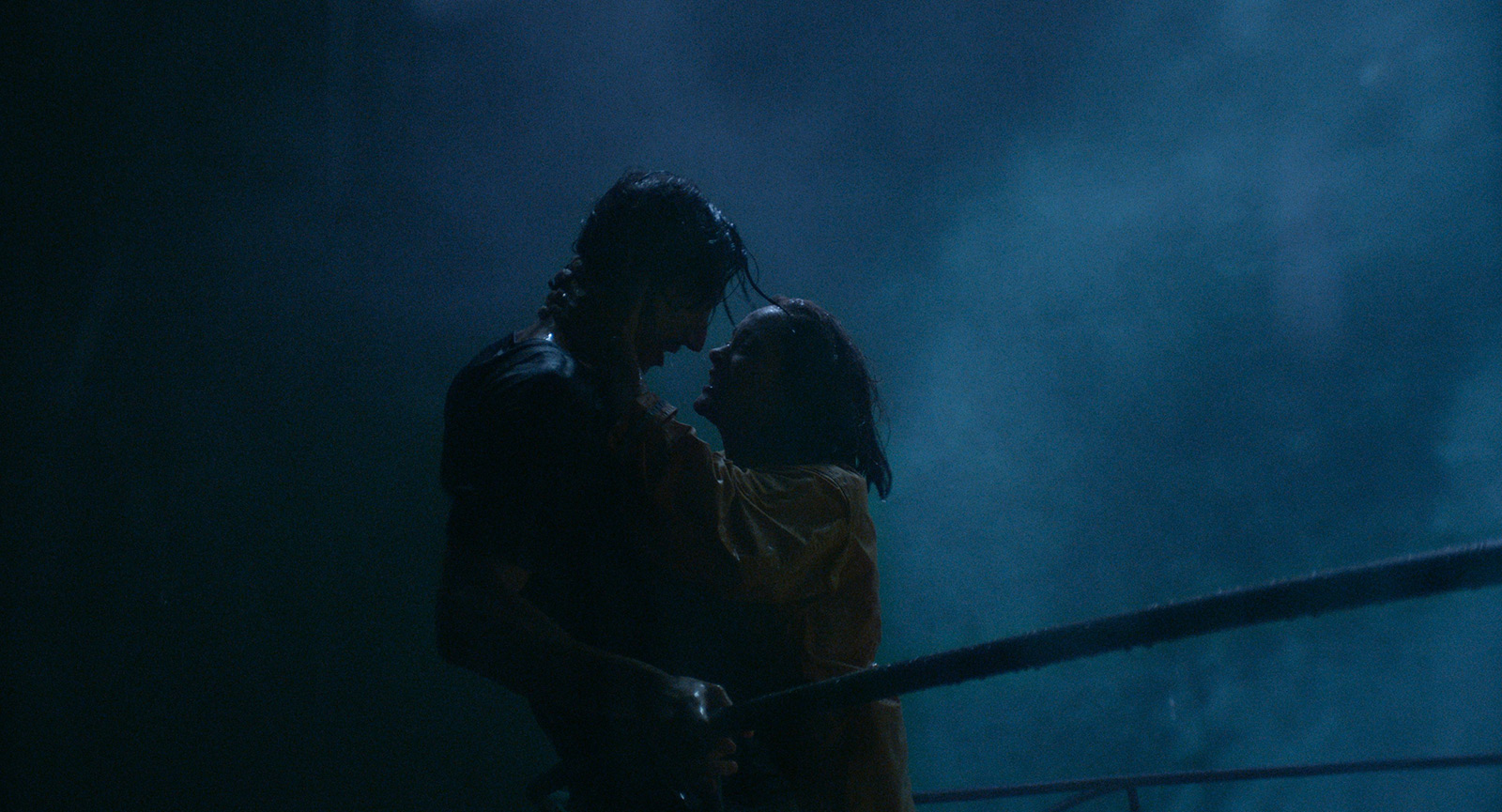
Annette is a tough film to wrap one’s head around and you wouldn’t expect anything less from an epic, operatic musical directed by Leos Carax (whose last film was the bonkers Holy Motors) and written/composed by brothers Ron and Russell Mael, better known as the long running cult duo Sparks. It’s a work that revels in its extreme artifice from the opening scene where Carax, the Maels and the cast march from the film set/recording studio through the streets of Hollywood at night, singing the self-referential anthem “So May We Start”.
The story that unfolds is similarly insane, charting the tempestuous romance between Henry (Adam Driver, possibly never better), a popular shock comedian and Ann (Marion Cotillard), an opera diva. Diametrically opposed in approach to their respective arts (Henry aims for laughter, Ann for tears as her character dies on stage every night), they have a child together, Annette; she is portrayed by a puppet.
From there, things gradually spiral, occasionally alluding to such iconic Hollywood tales as A Star Is Born and Mulholland Drive. There’s murder and manipulation, emotional and philosophical crises, and a heightened sense of fantasy and self-awareness that lends itself completely to the predominantly sung dialogue–if there is an analogue in the music here to Spark’s wildly diverse back catalog, it’s their great 2002 album Lil’ Beethoven, a quasi-classical work of melodic repetition and lyrical recitation.
The film sustains a teetering-on-the-edge-of-sanity feel that rarely lets up during its 140 minute running time and it’s not difficult to see why that makes for such a polarizing watch. Often reminiscent of similar musical/film balancing acts like Phantom of the Paradise and, to a lesser extent, Moulin Rouge!, Annette’s weird hybrid of emotion and artifice manages to feel more personal than either. After one viewing, I don’t yet know if it’s a great film or just a great effort at one, but it lingers on like a dream (maybe a nightmare?) that I’m still attempting to fully assess.