A quarter-century ago this month, I returned to my hometown for a friend’s wedding and, for the first time, felt like a stranger there. Since relocating to Boston three years earlier, my parents and a few good friends had moved to other states, so I no choice but to rent a car and a hotel room for a weekend.
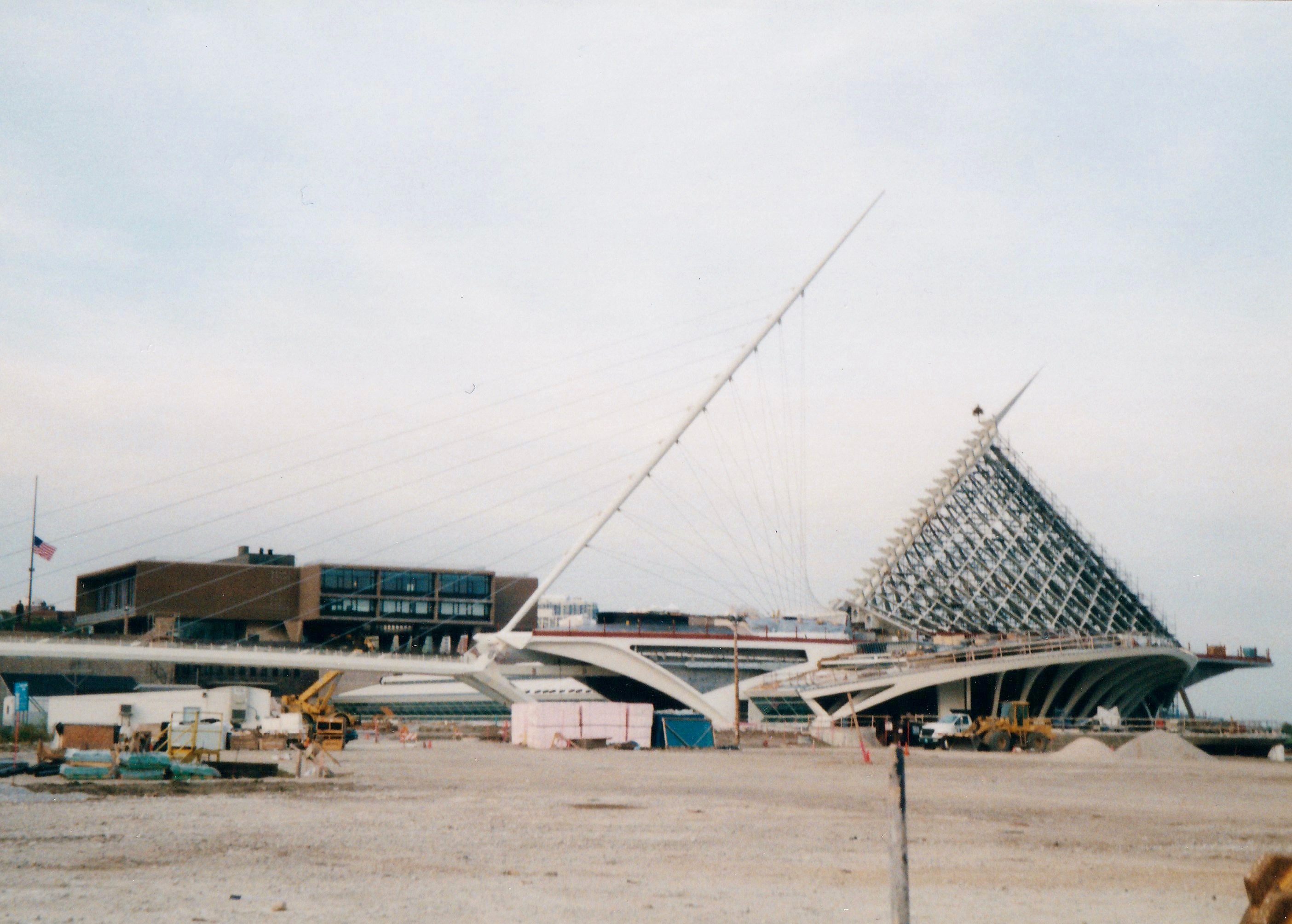
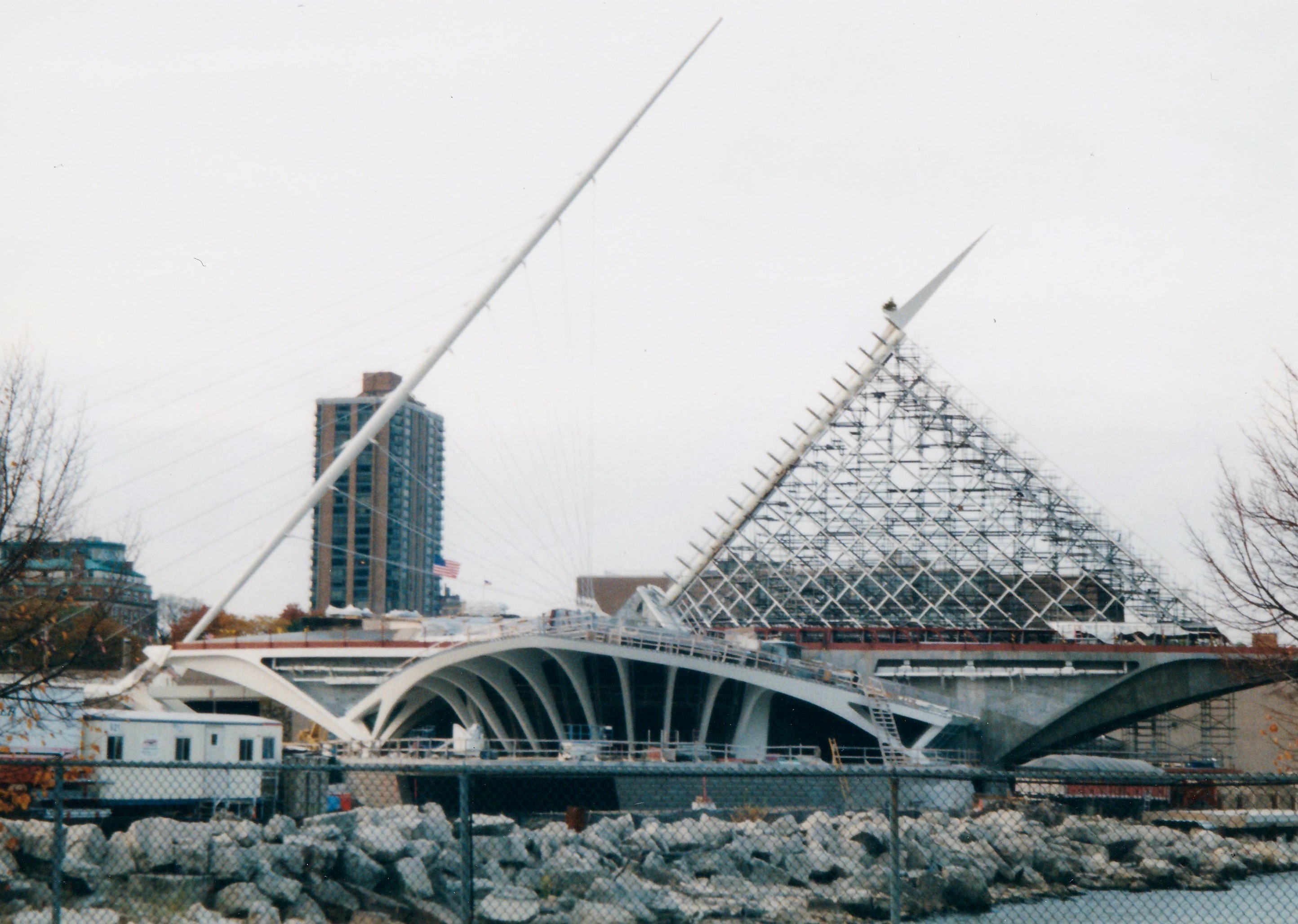
I feel there’s a long essay here but I’m still piecing it together. In the meantime, I came across some photos I took during this trip of the Milwaukee Art Museum as its Santiago Calatrava-designed addition was under construction. It was a big deal for the city, having been announced back when I was still living there. It was originally expected to be completed the year before my visit but this had been pushed back to 2001.
Upon my arrival downtown, I stopped by the construction site to see what progress there was. Behind a chain-link fence, the new Quadracci Pavilion with its retractable wing-shaped roof was far from finished. One can just make out the Eero Saarinen-designed War Memorial Center in the background (which sits atop the bulk of the original museum) beyond the rubble and the new architectural touchstone rising from its ashes.
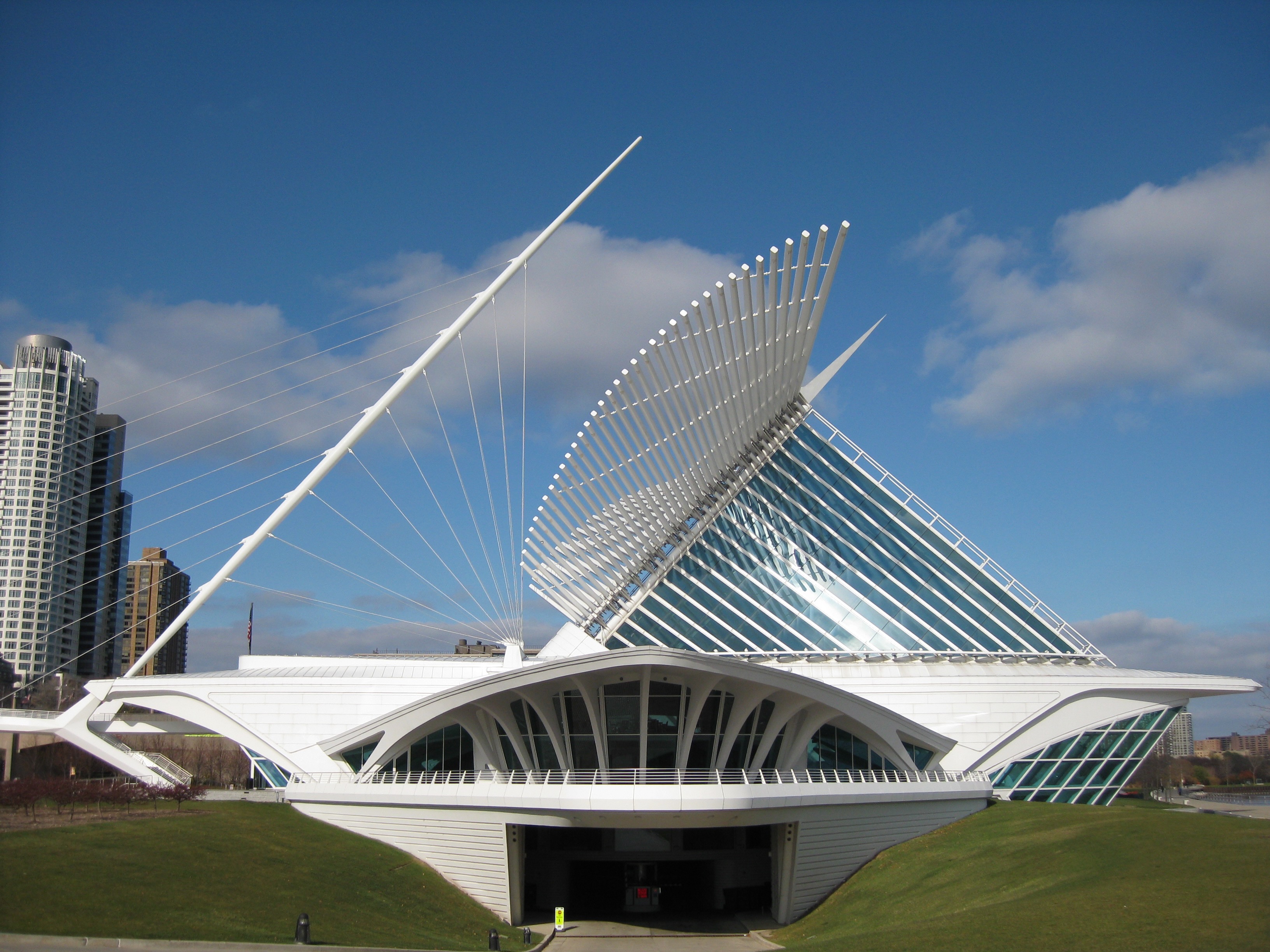
My next trip back was two years later. I visited the museum and its completed addition with an old friend who herself had moved back to town. Whenever someone asks me, ‘What is there to do in Milwaukee?”, I tell them to get a Friday fish fry at Kegel’s Inn, some frozen custard from Kopp’s and to spend an afternoon at the Milwaukee Art Museum.
Quadracci Pavilion under construction, October 2000Quadracci Pavilion, November 2008
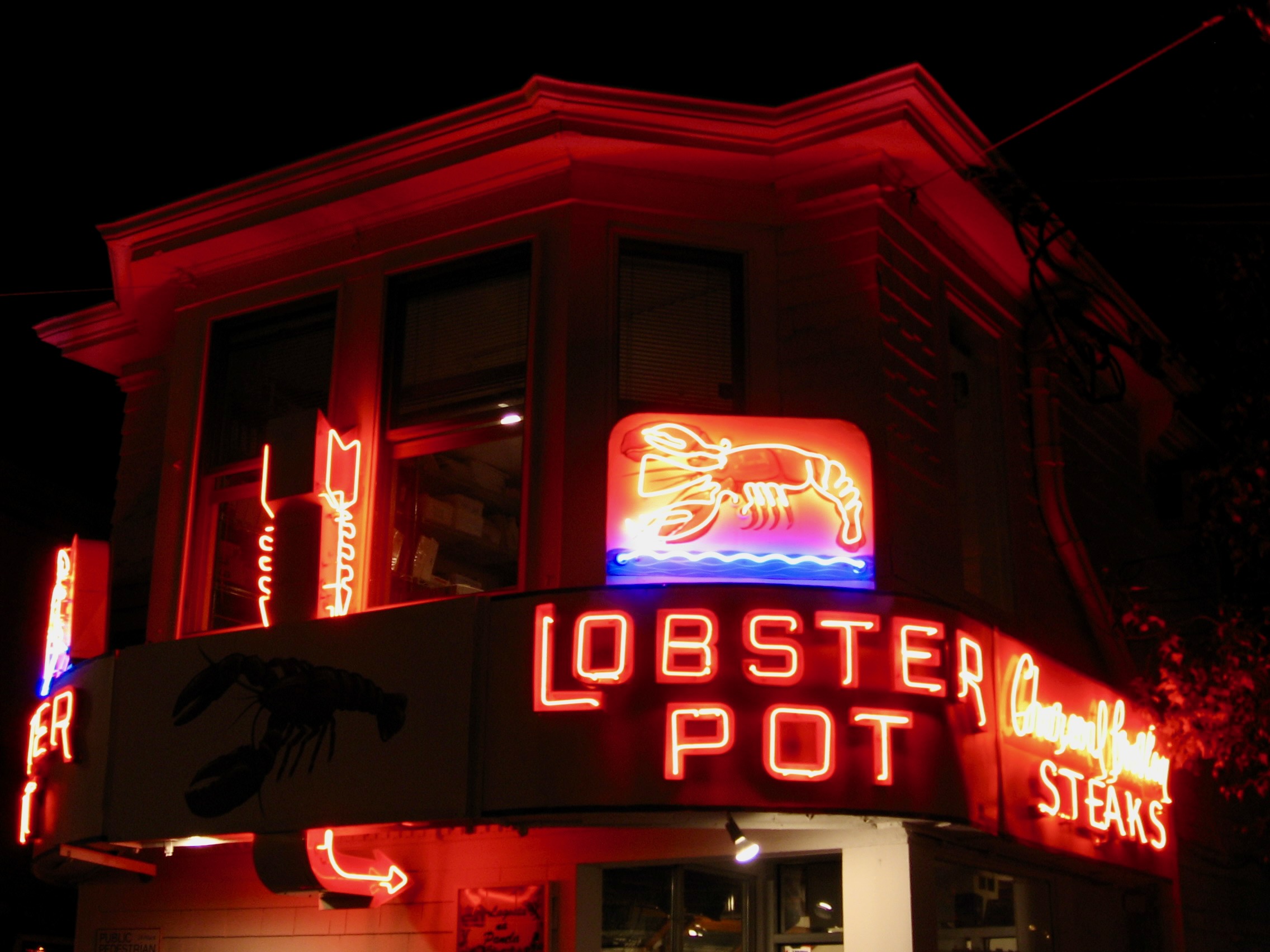
1. The Lobster Pot in Provincetown, Mass. Commercial Street is unimaginable without its piercing red glow.
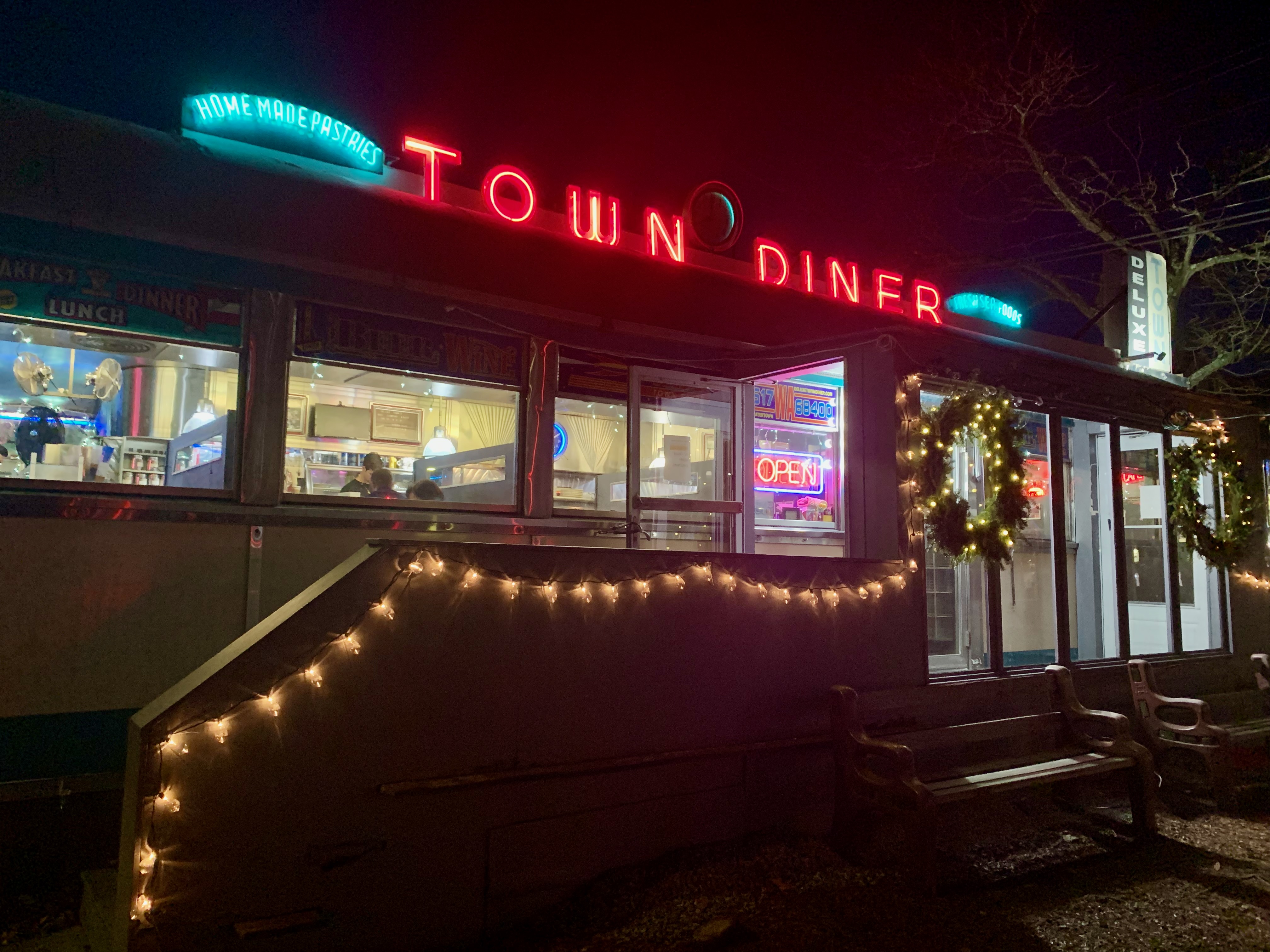
2. Deluxe Town Diner, Watertown, Mass. I lived a ten minute walk away in the early 2000’s and can still sense the delicate taste of their sweet potato pancakes.
3. Rosebud Bar & Kitchen, Davis Square, Somerville, Mass. Now the fancy front of a restaurant attached in the back, I ate this a few times back in the day when it was merely a diner (and the food was never as good as the Deluxe Town Diner’s.)
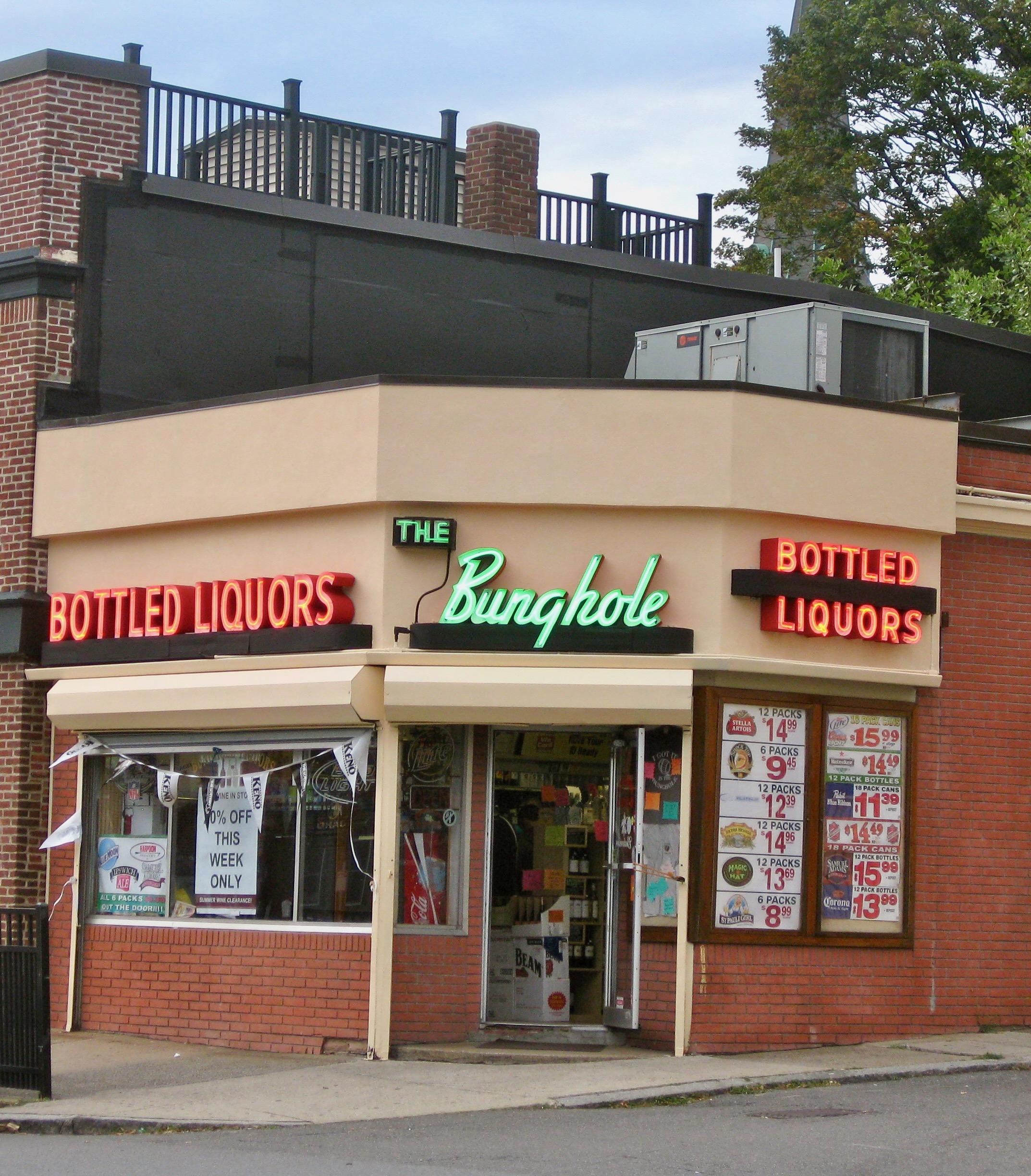
4. Bunghole Liquors, Salem, Mass. A favorite of weird-and-naughty-signs-aficionados far and wide.
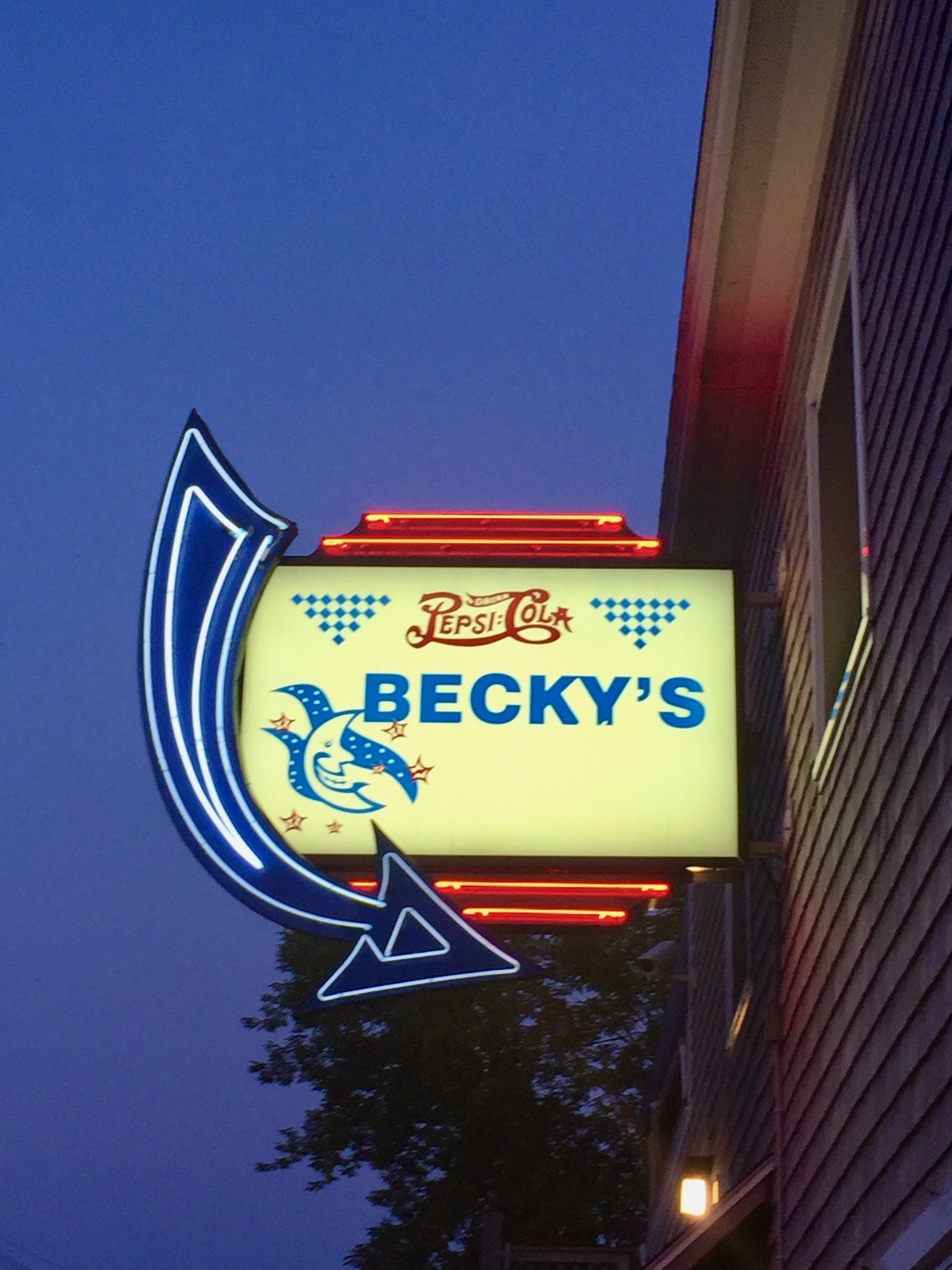
5. Becky’s Diner, Portland, Maine. Not sure how vintage the arrow is, but it is undeniably beautiful.
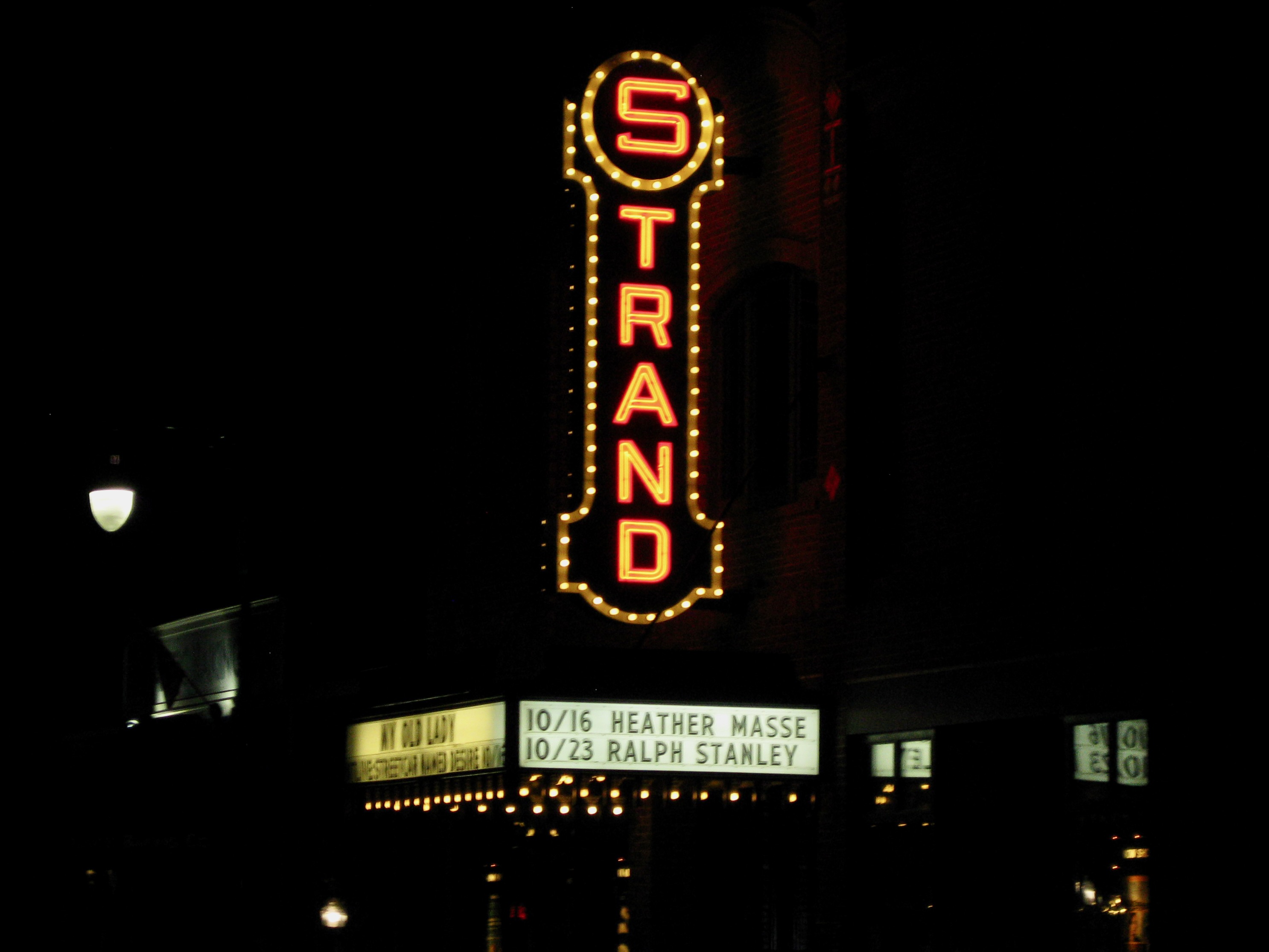
6. Strand Theater, Rockland, Maine. I’ve never been inside but this sign is an exclamation point on this coastal city’s downtown strip.
7. Leon’s Frozen Custard, Milwaukee. I could write a whole essay on the frozen custard stands of my hometown. It’s probably the third-best in terms of taste but certainly number one in design.
8. Miller High Life, some random bar on Kinnickinnic Avenue in Bay View, Milwaukee. Of course it’s Milwaukee!
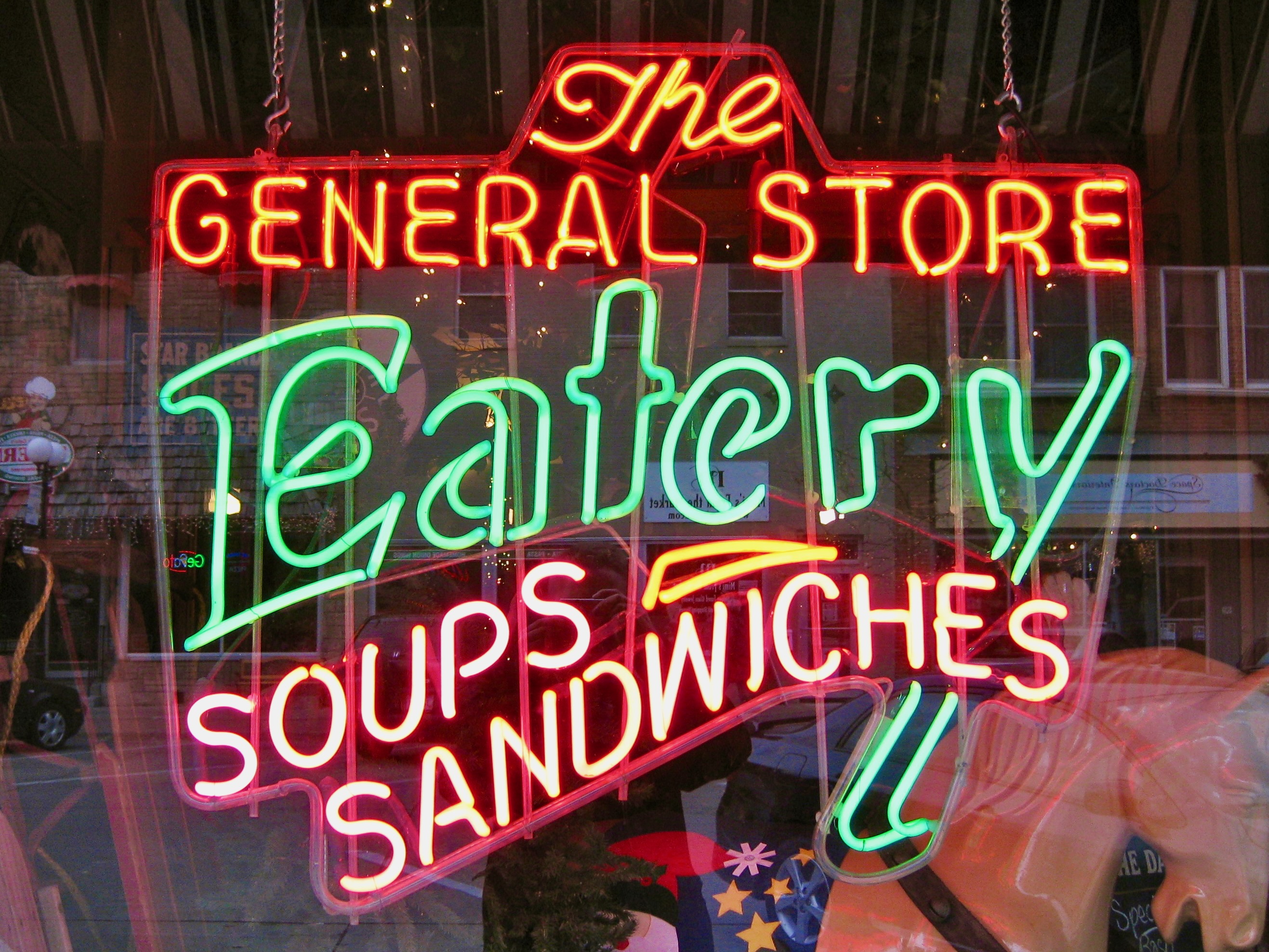
9. The General Store, Valley Junction, West Des Moines, Iowa. Spotted on one of my last visits when my parents lived there.
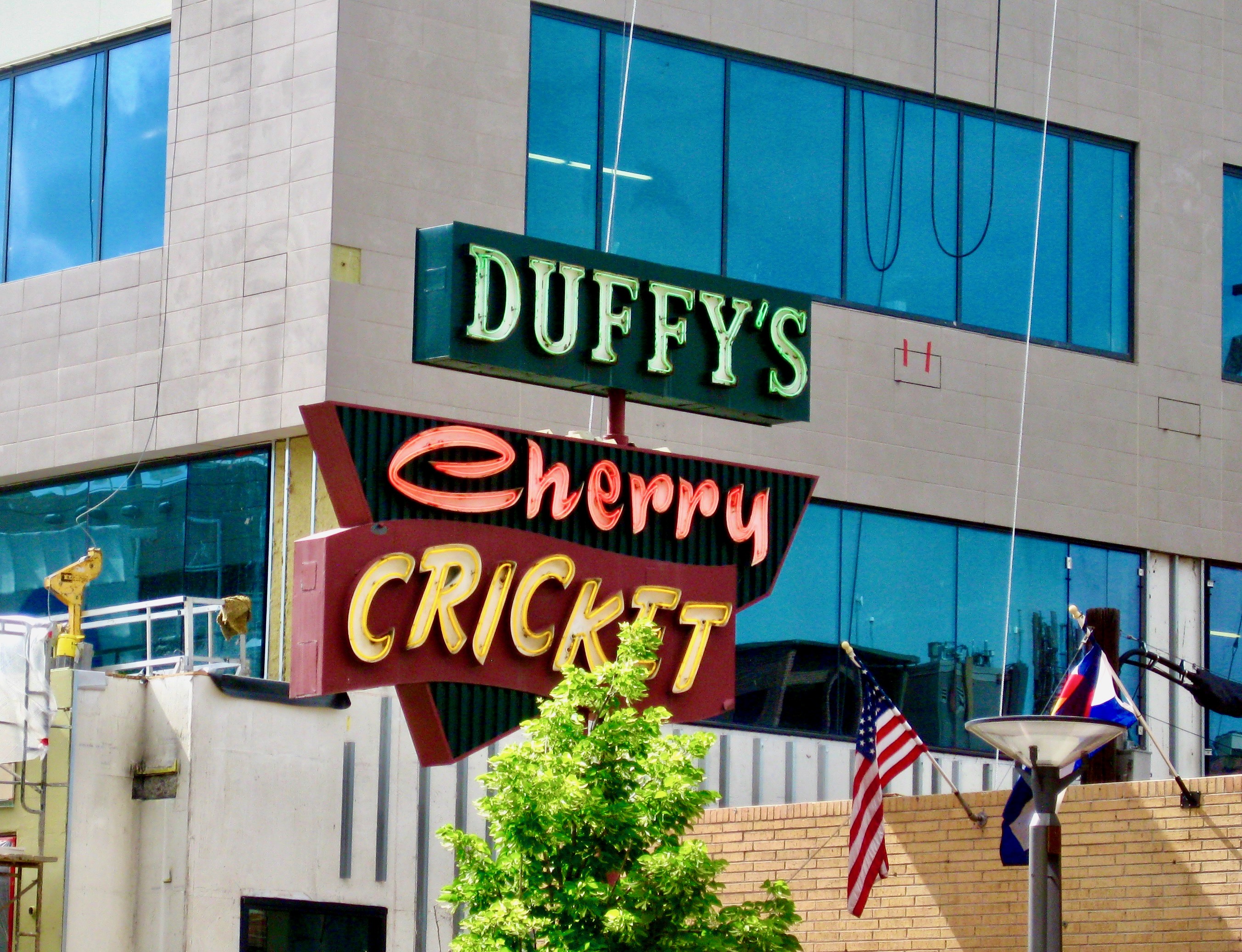
10. Duffy’s Cherry Cricket, Denver. Ate at a restaurant nearby on a visit a decade ago. Maybe I’ll check it out when I’m back there a few weeks from now.
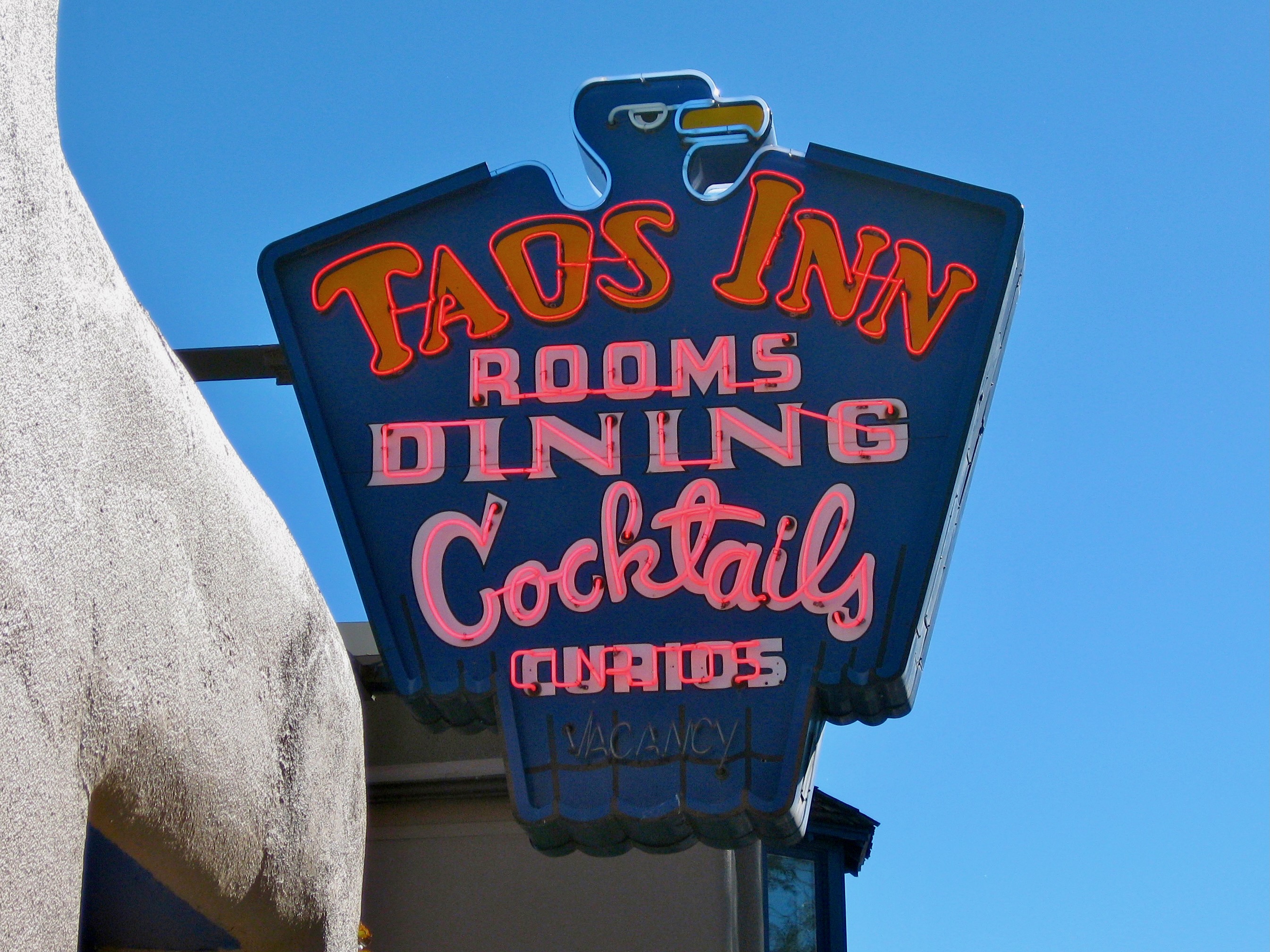
11. Taos Inn, Taos, New Mexico. Probably my favorite neon sign of this group. Respect the eagle!
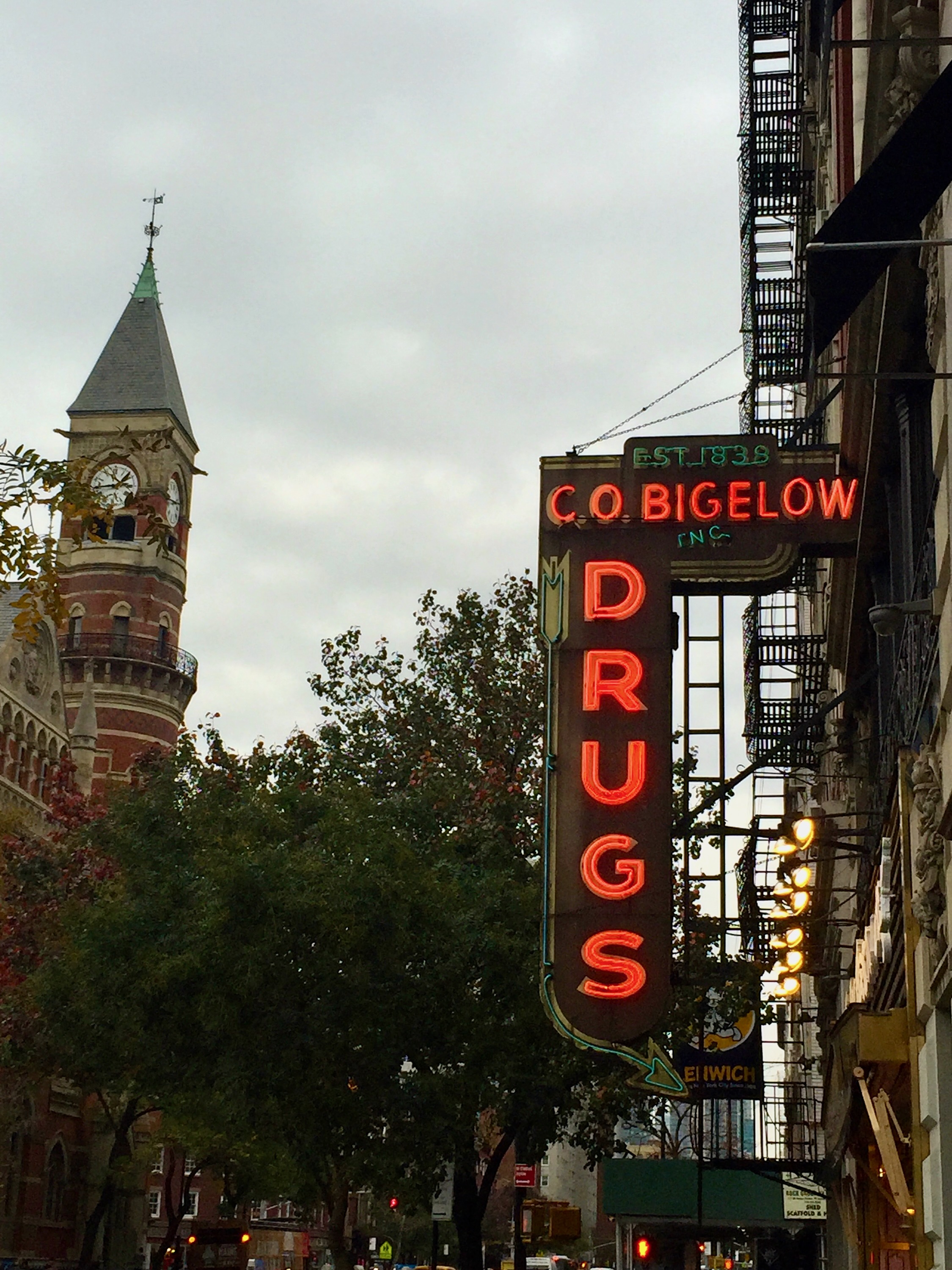
12. C.O. Bigelow Drugs, Manhattan. No trip to NYC for me is complete without a stop here.
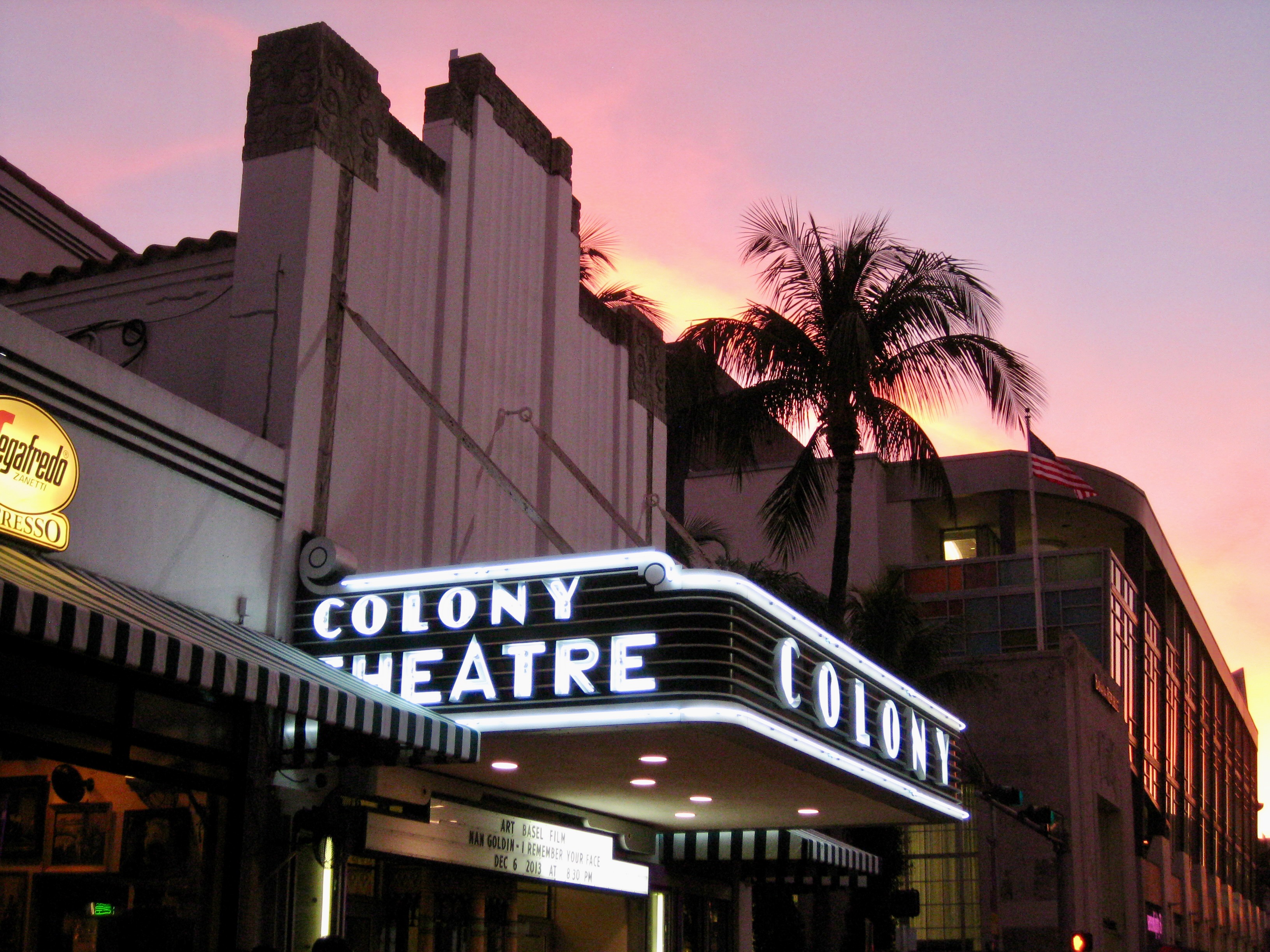
13. Colony Theatre, Miami Beach. Have not seen inside and I fear it would not fully live up to this exterior, taken on a December Thursday evening.
14. Southern Cross Hotel, Key West. One doesn’t see so much yellow-greenish neon; it’s stunning.
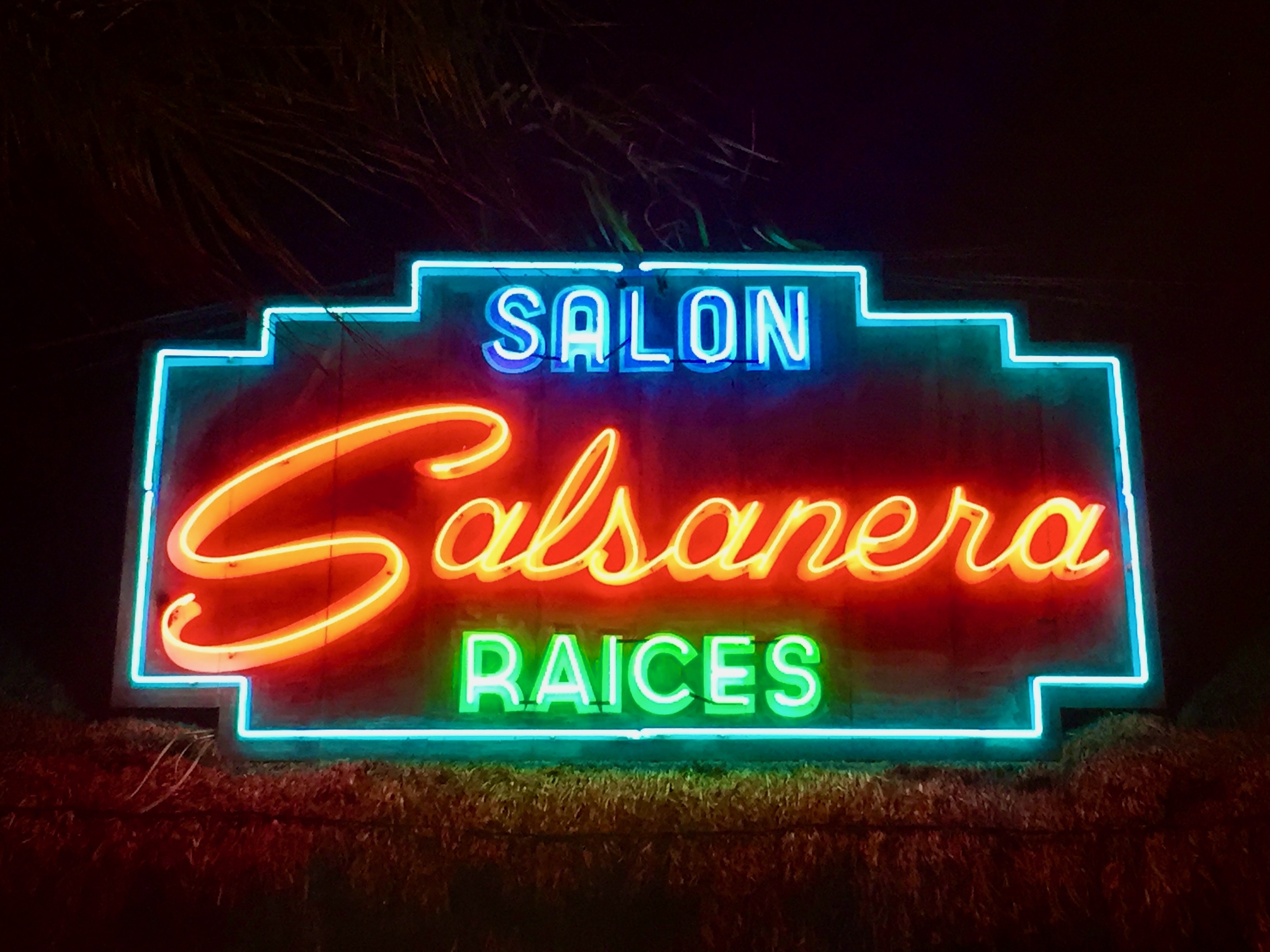
15. Salsanera, Playa Del Carmen, Mexico. This stopped me in my tracks on a visit nearly ten years ago; no way was I going to walk by without a snapshot of it.
Will be posting some old essays from former blogs of mine over the next few weeks as I take a hiatus from new writing; this piece was fun to revisit two decades on.
On January 1, 2005, another used-record store bit the dust: Disc Diggers in Davis Square, Somerville, Mass. While never my favorite recycled music shop, I’d pop in once every couple of months (grudgingly handing over my backpack to someone behind the counter) and occasionally find just what I was looking for.
I made my last Disc Diggers purchase on the last Saturday of the previous September. I had taken my bike across town on the T to ride the Minuteman Trail from Alewife Station to Bedford Depot and back. Exhausted and sweaty, I entered the store thinking, “OK, I’ll only buy something if they have Sally Timms’ In the World of Him or Tegan and Sara’s So Jealous.” When I spotted the former after running my fingers through racks and racks of new releases, dust-covered castaways and pitiable also-rans, I felt a rush of adrenalin–maybe not enough to take another ride on the Minuteman, but a sufficient reminder as to why I obsessively rummaged through one used-record store after another. It’s not just the goal of finding that particular CD I didn’t want to pay full price for or potentially unearth a buried treasure that could change my life. The challenge, the chase, the pursuit was just as essential.
The prototypical used-record store straight out of Nick Hornby’s novel High Fidelity endured for decades. I wasn’t aware of them until I turned eighteen. That year, CD Exchange, a three-store chain opened in the Milwaukee suburbs. As the name suggested, they didn’t traffic in vinyl or cassettes. The whole concept was foreign and questionable to me–selling CDs you no longer wanted… and buying other CDs someone no longer wanted… and hearing them right there in the store, at one of eight personal listening stations! It seemed too good to be true, and I approached the establishment with timid adolescent caution. However, the burgeoning bargain hunter in me (spurred on by working at a detestable, low-wage food service job) soon conceded, and I eventually made the rounds at the CD Exchange near Southridge Mall more often than Best Buy or local indie chain The Exclusive Company.
Alas, CD Exchange was an anomaly, a young upstart, a business perfectly suited for a mini-mall; nothing at all like Second Hand Tunes, my first real used-record store. Nestled on the corner of Murray and Thomas in Milwaukee’s East Side (and technically part of a chain that included a few Chicago locations), it was exactly like the store in High Fidelity only smaller, more condensed. At both windows sat wooden bins jammed with rows of plastic slipcases holding hundreds (thousands?) of CD booklets–all discs were kept behind the counter to discourage/prevent shoplifting. Tall, vertical see-through cases of cassette tapes made up the elevated employee counter at the other two ends of the square-shaped room, and in the store’s center, a giant, double-decker, C-shaped bin held most of the vinyl. Naturally, the windows and walls were plastered with cultish film and music posters of the Jimi Hendrix/A Clockwork Orange variety.
I spent many a Saturday afternoon in the mid-90s at that place, often flipping through every last slipcase, picking up used copies of stuff like They Might Be Giants’ Apollo 18, The Clash’s London Calling, and the Dukes of Stratosphear’s Chips From the Chocolate Fireball. Given their immense selection and my tenacity and dedication, I always found at least one thing to buy, if not two or five. I regularly saw guys (customers at these places were predominantly male) with teetering stacks of fifteen or twenty discs in their hands, and I couldn’t imagine getting together the funds to make such a weighty purchase.
Before long, I began thumbing through the neglected dollar vinyl that sat in a wooden crate on the floor beneath the CDs. At that point, it had been four or five years since you could find any vinyl in most new record stores. At the height of my wannabe urban hipster phase, vinyl was uncool in most mainstream circles, thus cool to me. I loved the comparatively life-sized cover art and the cheap thrill of picking up something I’d been secretly itching to hear (like Missing Persons’ Spring Session M) for only a buck.
I acquired a cheap-ass table-top stereo with turntable and amassed a collection of about 50 or so vinyl records with a year. I drove all over the city and the outlying ‘burbs, habitually visiting likeminded businesses such as Rush-Mor, Prospect Music and national chain Half-Price Books (they sold music, too.) Between that and continuing to buy new CDs at the big stores and through at least three of those “Buy 12 CDs for the price of one!” deals you used to always find inserted in Rolling Stone, for the first time in my life, I had more stuff to listen to than I knew what to do with.
Whenever people ask me (sometimes contemptuously) how in the world I’ve ever heard of band X or know of singer Y, I guess this partially explains how I became such a music geek. Kinda like a chain reaction, really: you discover something you like, and then it encourages you to check out something else (or, if you’re as fervent as I am, five or ten other things) and so on.
I had nearly as much difficulty leaving Second Hand Tunes behind as I did my family and friends when I moved to Boston in 1997. You’d expect to find an adequate replacement in every other neighborhood in the most college-friendly metropolis on the East Coast, but I’m not sure I fully did. The closest I came was Record Hog, a triangular corner shop steps away from the Cambridge/Somerville town line near Porter Square. They didn’t carry cassette tapes (by 1999, precious few places did) but everything else was perfectly, warmly familiar. More often than not, two cats sprawled their lazy selves across the centerpiece CD case and you’d have to gently lift them off the row of the discs you wanted to look through. This was where I made my greatest on-a-whim purchase ever (Ivy’s Apartment Life), in addition to fabulous buys like a promo copy of Stew’s The Naked Dutch Painter… and Other Songs (stumbled upon a week before you could buy it at Newbury Comics!), Gordon Gano’s Hitting the Ground and Bellavista Terrace: The Best of the Go-Betweens, among many others.
Alas, Record Hog closed in early 2003 and supposedly moved to a small town in Western Mass (I can’t remember which town and a Google search for “Record Hog” brings up little but costly pork prices). I continued acquiring a lot of used CDs every year, most of them from the local chain CD Spins, a true successor to CD Exchange. In each location, discs literally lined the walls from ceiling to floor. A CD Spins visit more or less satisfied my used-music jones, but it was like trying to get high off a pack of Marlboro Lights. I couldn’t possibly ever take in each store’s massive stock at once (at least half of it obscure $1.99 crap), so I skimmed through a mental list of stuff I’d like to get, which made it shopping with a goal in mind instead of a free-form stress-relieving act of discovery. A few used-music establishments with potential still lurked within various corners of Boston and Cambridge (and a handful even carried vinyl), but most of them were either too expensive or limited in their selection.
My last visit to Second Hand Tunes was in October 2000. In town briefly for a friend’s wedding, I had an extra day to visit a few hangouts that were once so dear to me: Kopp’s Frozen Custard, Klode Park in Whitefish Bay, and Second Hand Tunes. I hadn’t set foot in the store in more than two years and was surprised to find it haphazardly rearranged. The discs sat where the vinyl used to be, and they now even carried DVDs. Two employees I didn’t know talked loudly to each other behind the counter, watching clips of a training video for the Bronx police department. I made a customary run through the slipcases, briefly considered purchasing Bebel Gilberto’s Tanto Tempo, and then left without doing so. On my next trip two years later, the windows were papered up and a pitiful “Office Space for Lease” sign sat in one of them. Around the time I moved out East, one of the store’s old managers opened up his own used-vinyl/CD haven two blocks away. I made an effort to visit it every time I was back in town.
I missed Second Hand Tunes, Record Hog and all the rest. I no longer bought vinyl but still had enough disposable income to justify the hours I spent feeding my used CD fix. I wasn’t against buying music on Amazon or iTunes, although I knew that to an extent, both were doing their part to put the oldfangled High Fidelity stores out of business. I’d just about given up on finding a replacement that captured the personable, homey feel of those places. Thankfully, none of that distracted from the pleasure I still received from a newly acquired album, particularly one that resonated on the first spin.
2025 POSTSCRIPT:
Most remaining used CD stores went kaputt in the five-to-ten years after I wrote the above essay. I’ll never forget a depressing visit to an on-its-last-legs CD Spins which seemed packed to the gills with dozens of copies of the same, unloved used product, a far cry from when I spotted a rare copy of the import-only The Misadventures of Saint Etienne for thirteen bucks there a few months after posting this piece. Overall, I dealt with the demise of used CDs miserably, reduced to downloading entire albums from iTunes, patiently awaiting the convenience (if not the same sort of thrill) that streaming music would provide.
I certainly did not see the vinyl revival coming. By late 2016, I said fuck it and purchased an affordable but not cheap-sounding Audio-Technica turntable, hooked it up to my Bose stereo (with CD player!) and learned to love vinyl again—not always an affordable pastime in its own right (especially given the hike in pricing since Covid). Fortunately, it does scratch that music-purchasing itch, especially at such fine stores as Sonic Boom in Toronto, Irving Place Records in Milwaukee (owned by a former associate of the guy who managed Second Hand Tunes) and Lost Padre Records in Santa Fe, where on a visit in 2023 I picked up used, reasonably-priced vinyl copies of both the Starstruck soundtrack and Stevie Wonder’s Journey Through The Secret Life of Plants.
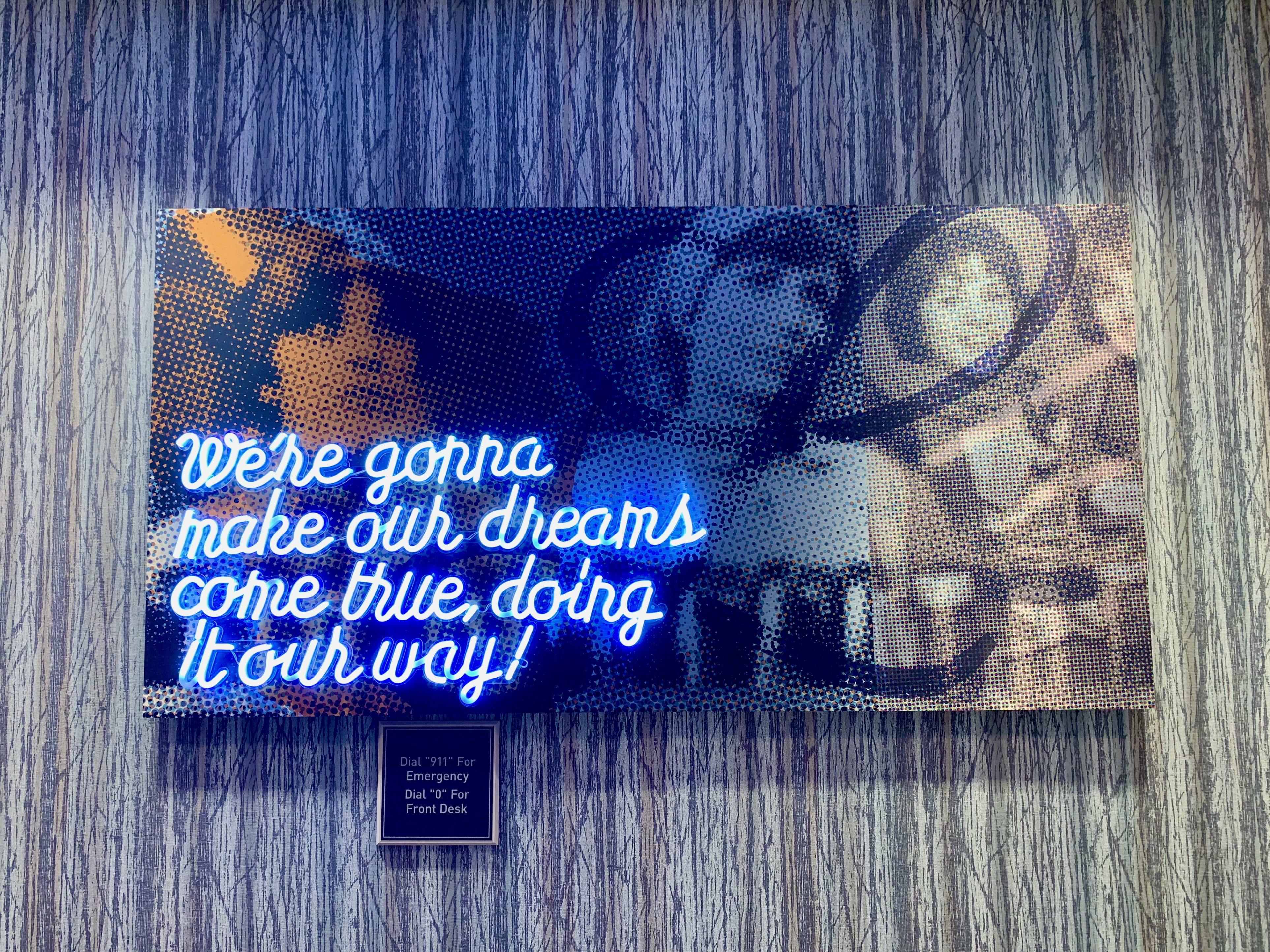
Earlier this month, I returned to Milwaukee (my hometown) for the first time in six years to meet up with my parents (who also now live in another part of the country) and a few old friends. Predictably, Laverne and Shirley (and The Bronze Fonz) remain the city’s most recognized cultural touchstones, as seen in this tableau across from the elevators in my hotel.
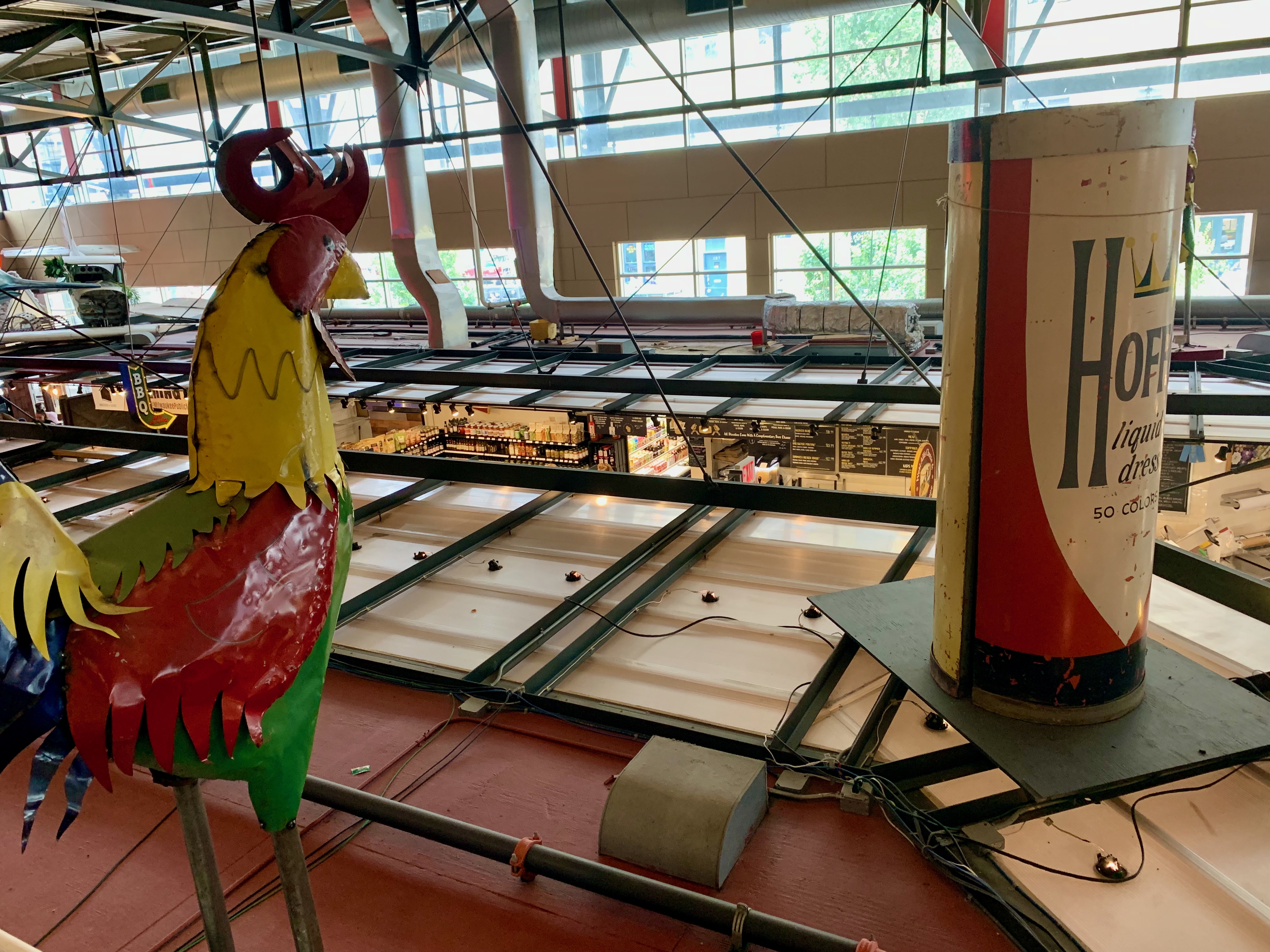
The weather was gorgeous for this time of year, so I skipped some of the more touristy indoor places I was considering visiting (including the soon-to-be-moved Milwaukee Public Museum). However, I couldn’t resist the Milwaukee Public Market.
This Third Ward perennial actually didn’t open until about a decade after I left town. I’m afraid don’t know the story behind the giant rooster watching over all the stalls.
An anchor of the market, St. Paul Fish Company also has a location in suburban Mequon (which we had lunch at the following day, in search of decent seafood in the area.)
Seen on the staircase at the market. The big Allen-Bradley clock in Walker’s Point (often nicknamed “The Polish Moon”) is as much of a Milwaukee landmark as the Citgo sign is one for Boston.
After the market, we headed over to the East Side and Brady Street, picking up pasta and focaccia at Glorioso’s and Italian cookies from Sciortino’s. Decades on, Art Smart’s Dart Mart (and Juggling Emporium) endures (as does the city’s distinct, classic “harp” streetlights and those black bus shelters.)
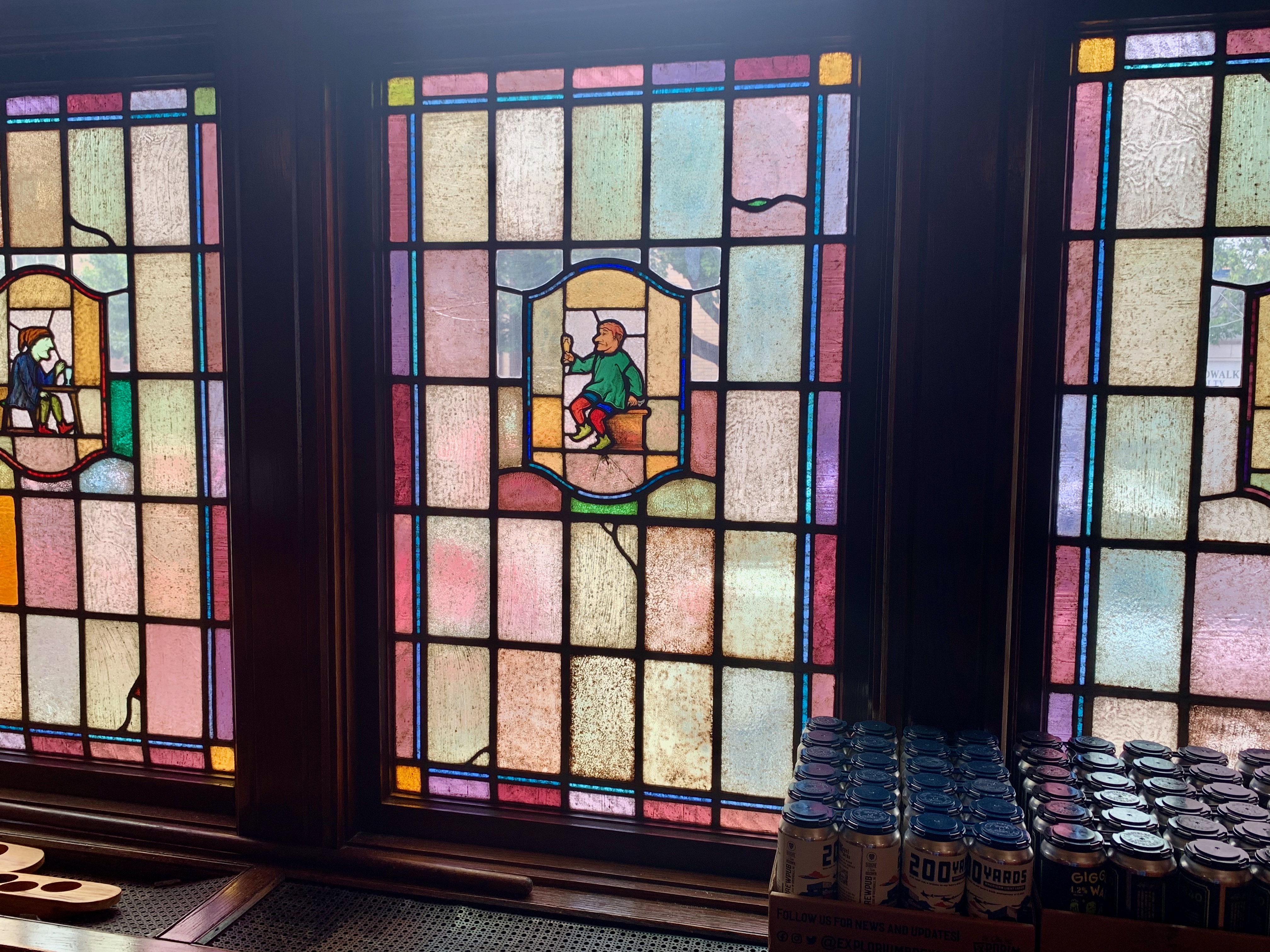
On to West Allis for a Friday Fish Fry at Kegel’s Inn, a meal no trip to Milwaukee is complete without. I can’t find great German cuisine in Boston, so it’s always a treat to get my fill of potato pancakes and Hacker-Pschorr here.
Each time I go to Kegel’s, I notice something I haven’t before, such as the detail in these stained-glass windows.
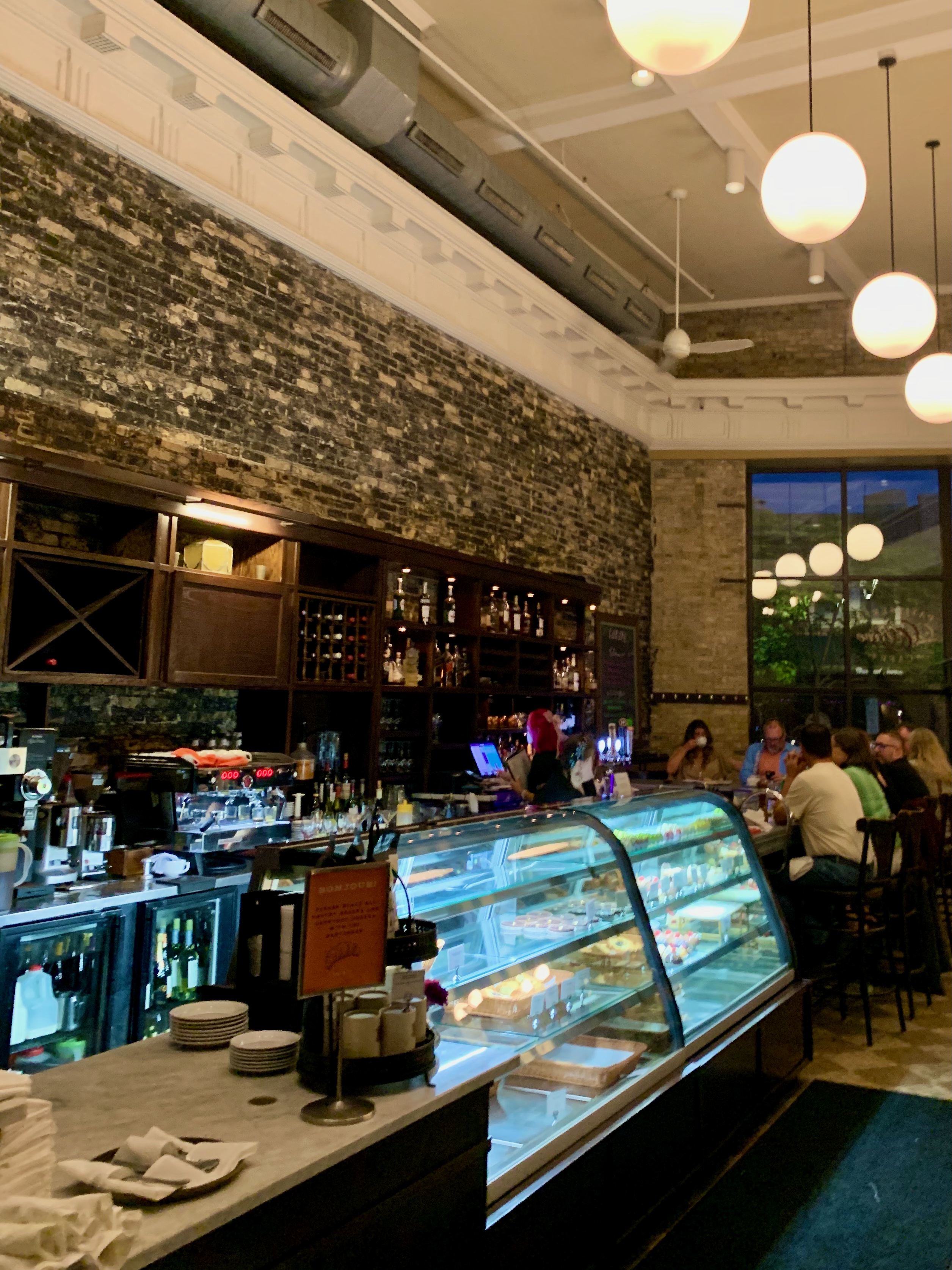
That evening, we met up with a dear friend at Le Reve in Wauwatosa Village, which had excellent cocktails, good mussels and a display case full of tasty French desserts.
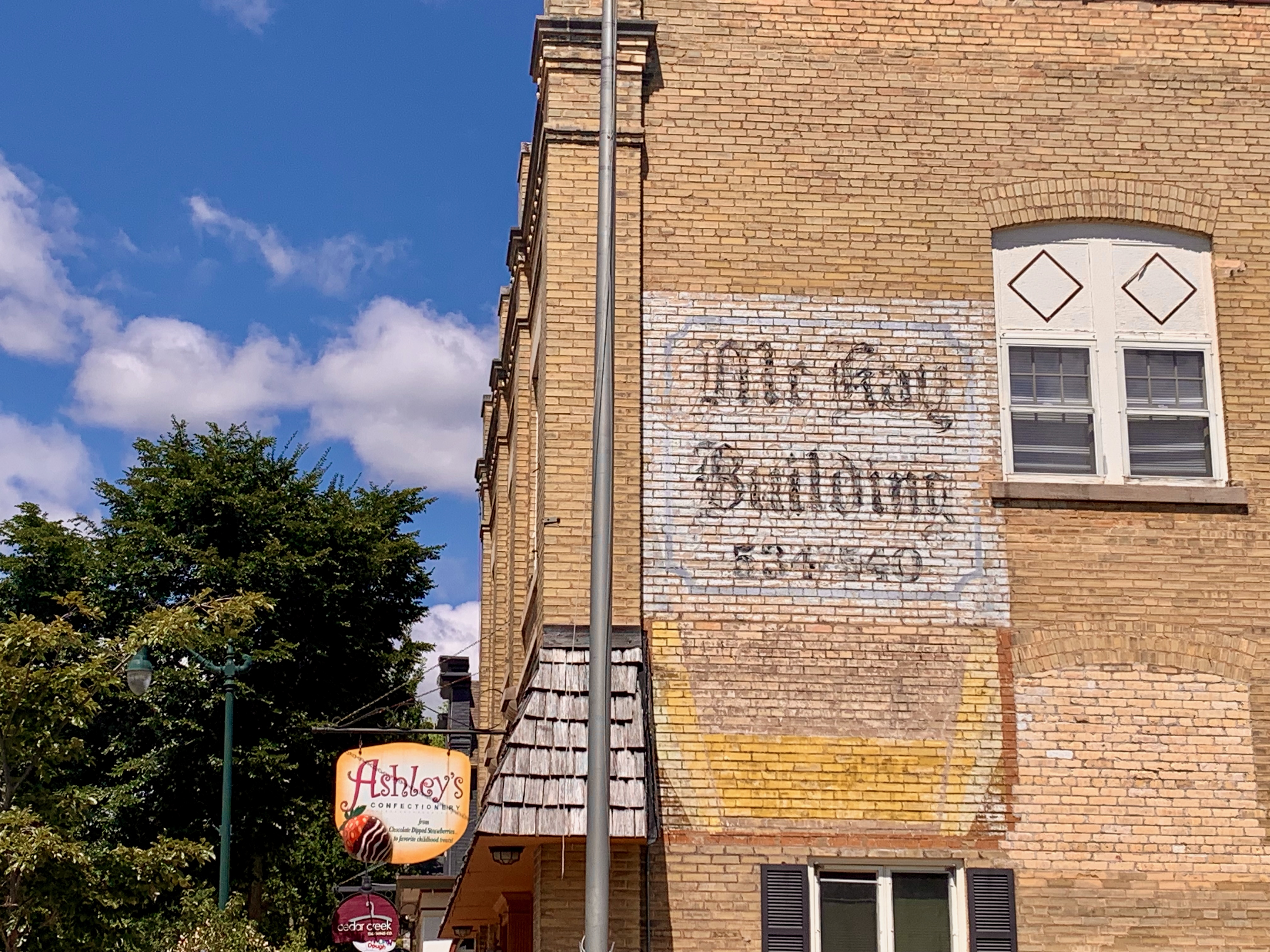
Following our lunch in Mequon the next day, we drove north to Cedarburg where I had not been in over a decade. We took a walk down the Washington Avenue Historic District and all the cream-colored brick buildings stood out to me in ways they hadn’t previously.
The vivid blue skies provided a striking contrast to these 100+ year old structures.
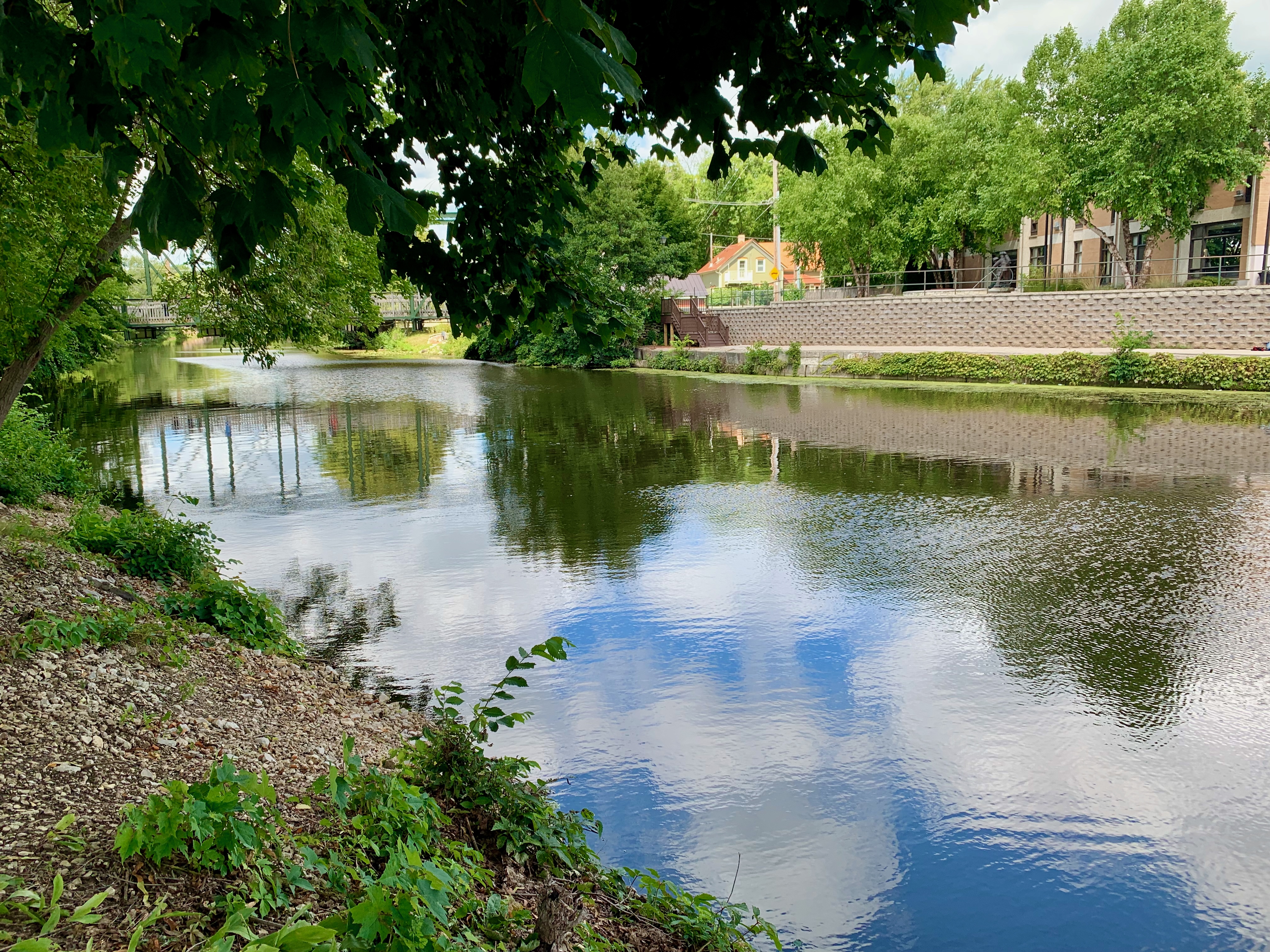
Naturally, we ended up at the Cedar Creek Settlement Shops, which I did not take any pix of this time. Here’s the Milwaukee River, which runs behind it, although this was taken a few blocks further south.
For dinner on Saturday night, we tried Jack Pandl’s Whitefish Bay Inn, a historic restaurant that my parents and I somehow had never previously visited (I do remember going to the now-defunct George Pandl’s in Bayside.)
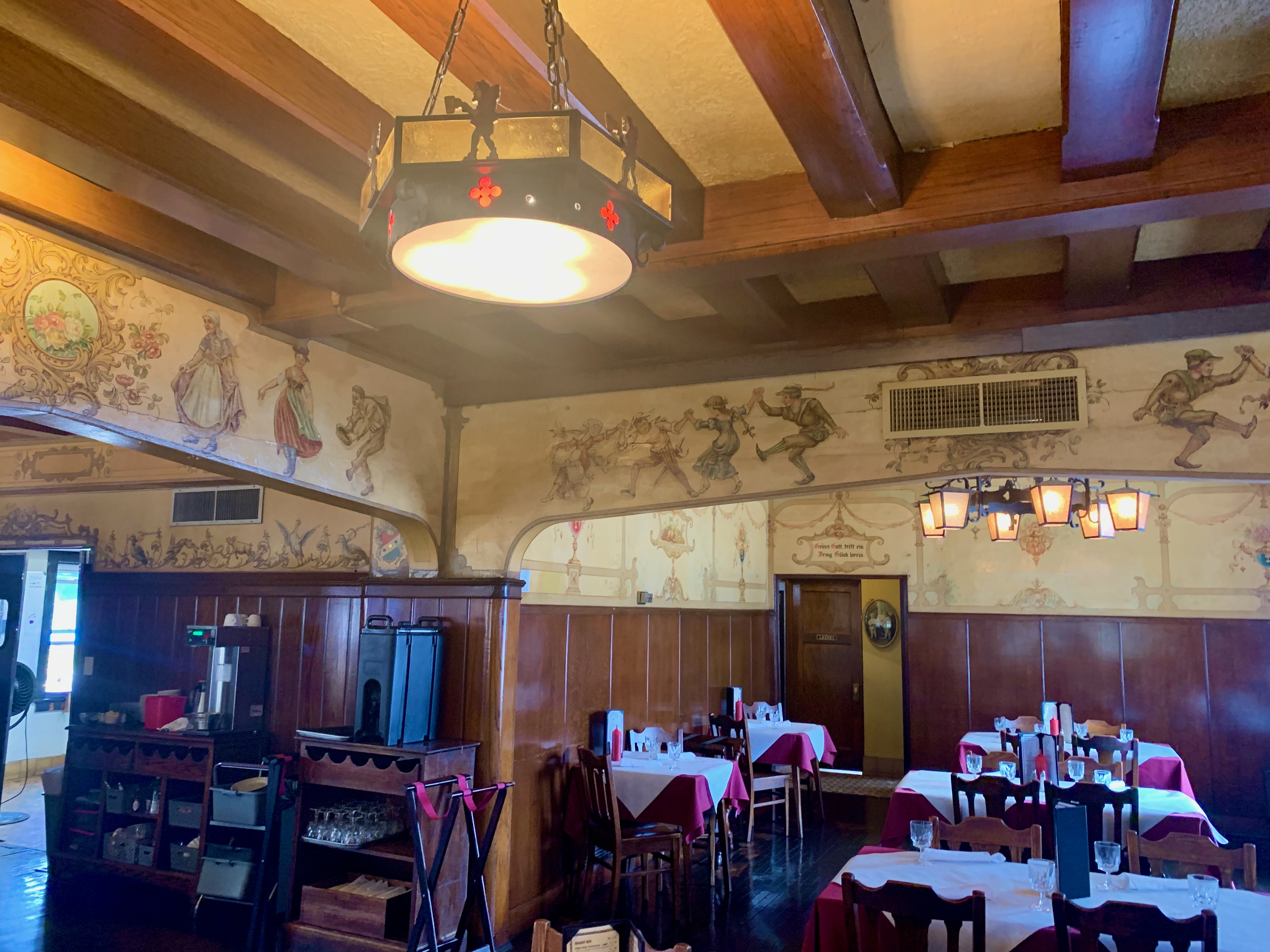
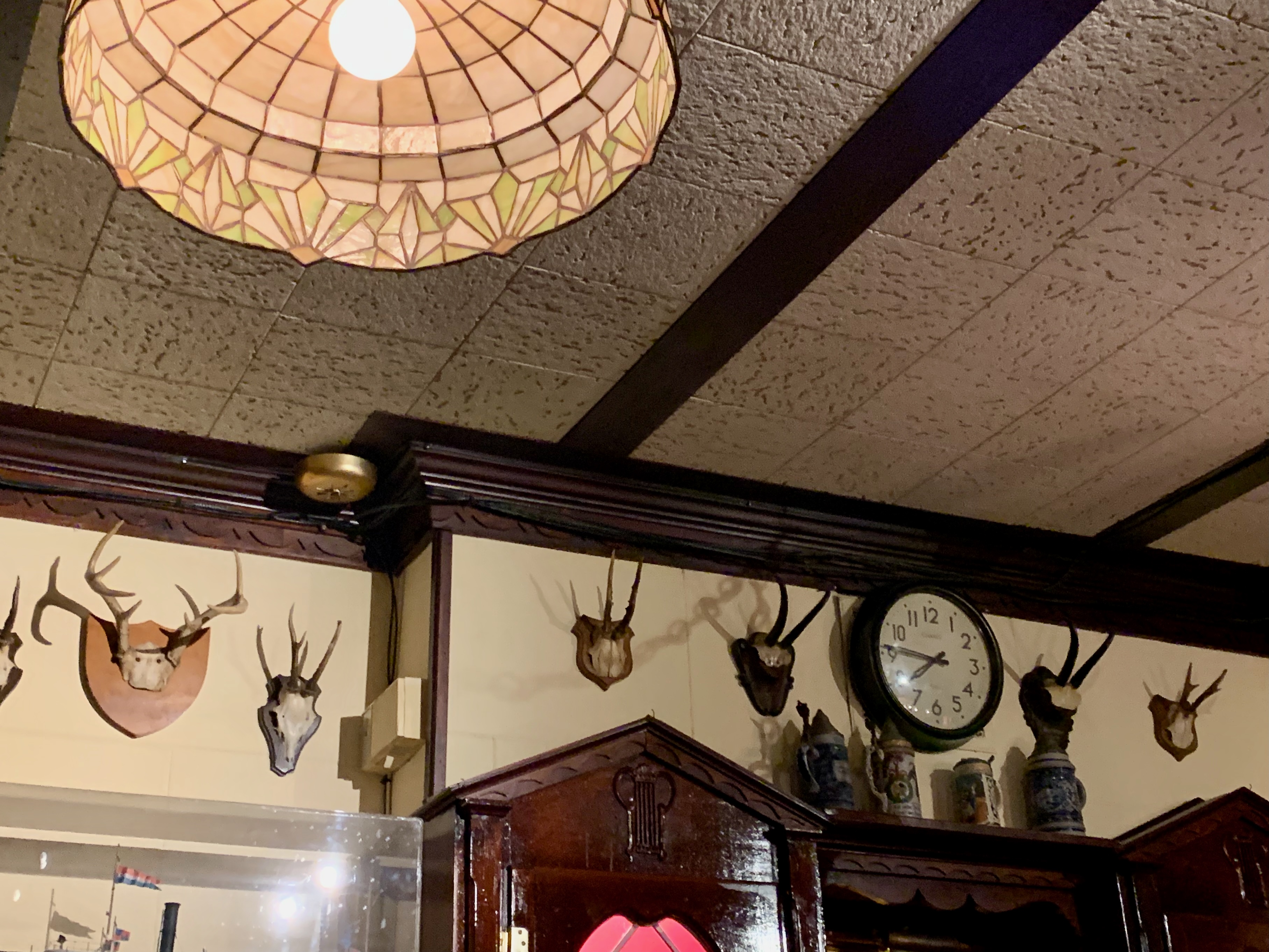
Our party of five was seated at a large round table near the bar, decked out in knickknacks one would likely only expect to find in Wisconsin.
Whitefish Bay is a rather affluent suburb, so it’s a hoot to see one of its most venerable establishments decked out in dinky taxidermy plaques.
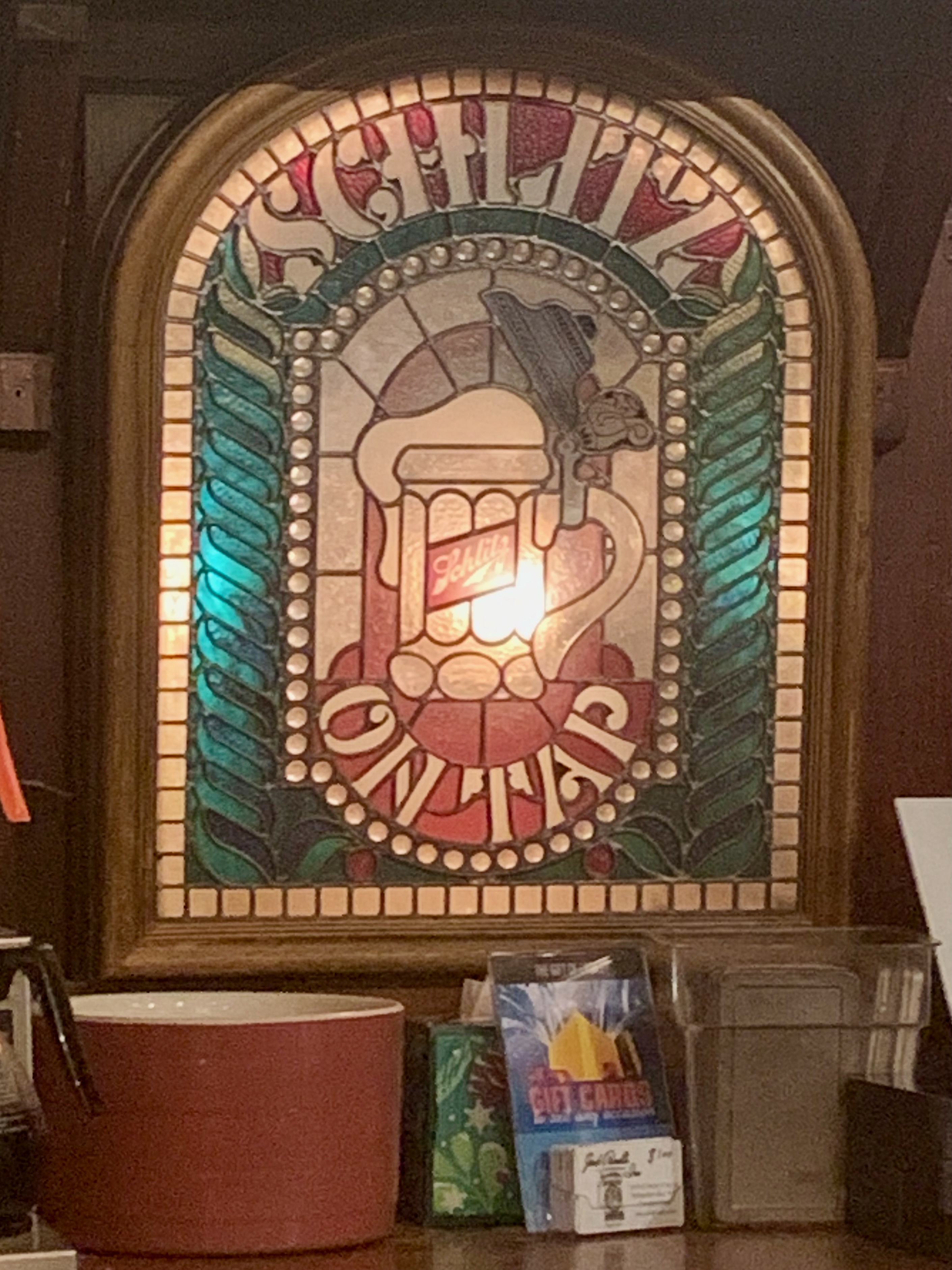
If any classic beer brand screams Wisconsin, it’s not Miller or Pabst, it’s Schlitz!
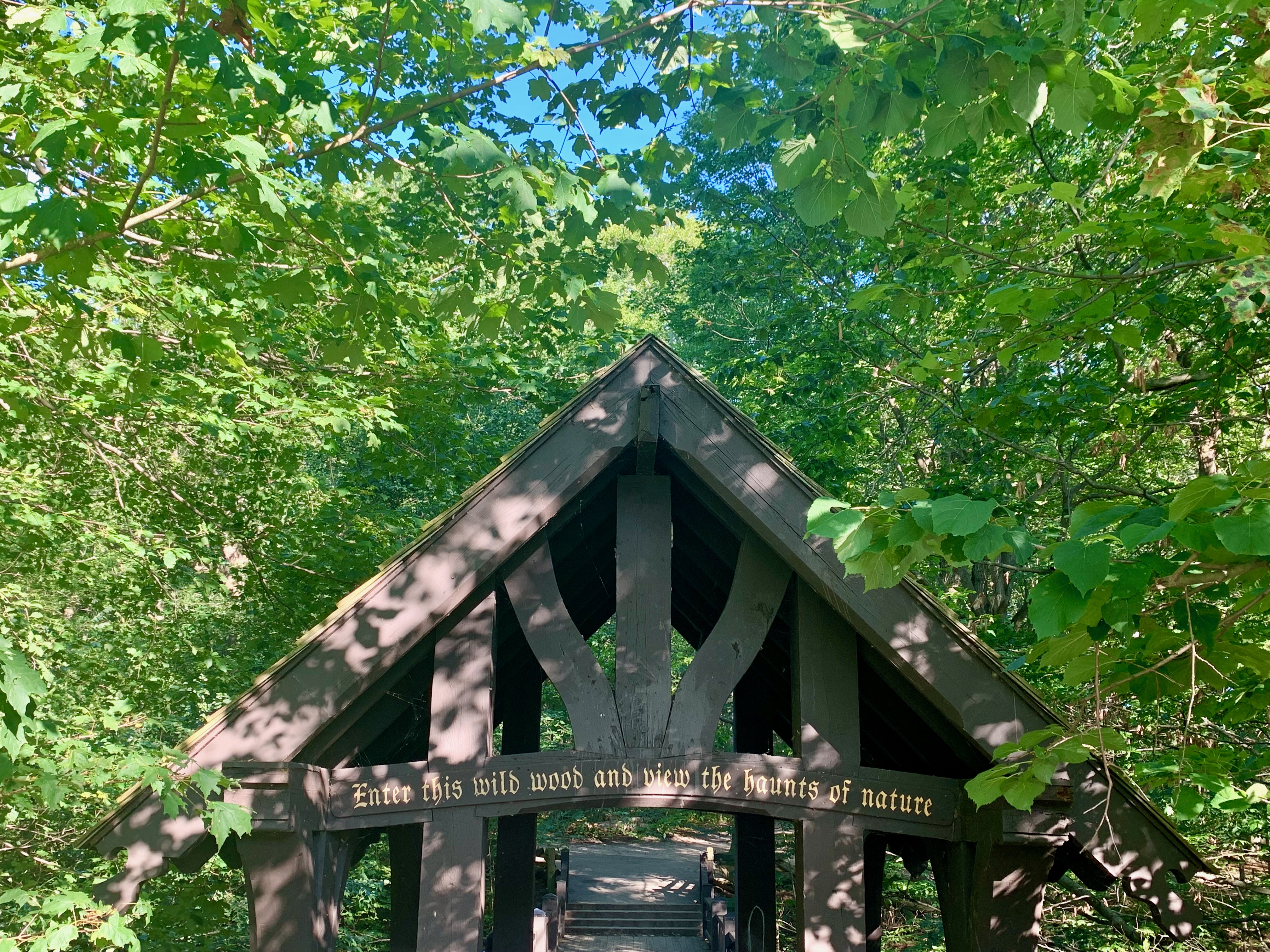
Recovering from our brandy old-fashioned soaked evening at Jack Pandl’s, we took it easy on Sunday: a stop at Kopp’s Frozen Custard, then an early evening walk at Grant Park on Lake Michigan in South Milwaukee. I hadn’t been there in nearly two decades. This gingerbread house-like bridge has always been one of my favorite places in the area (even if someone drew a dick on it, as partially shown above.)
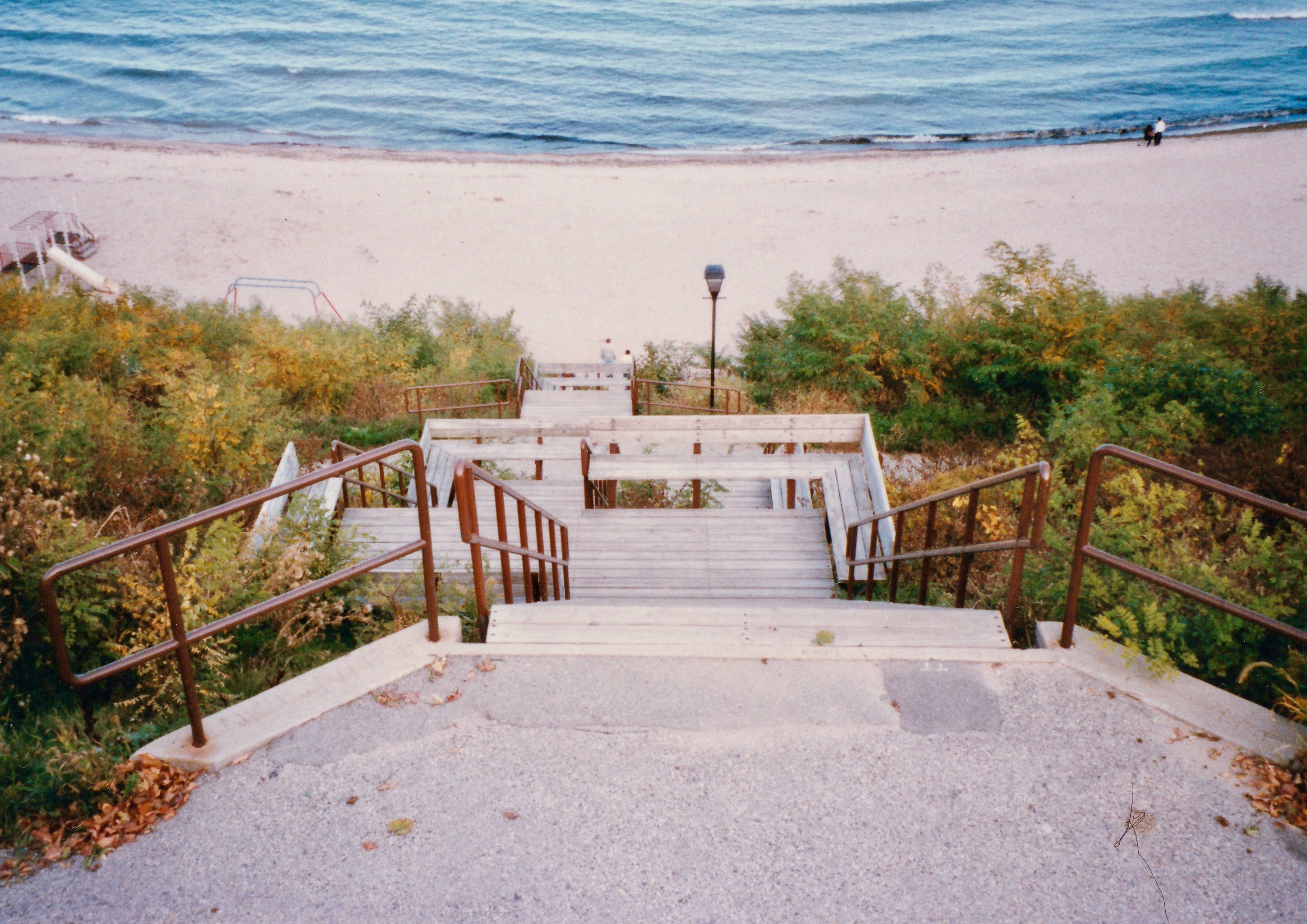
After crossing the bridge, one is led through a series of paths, stairways and other bridges along a ravine.
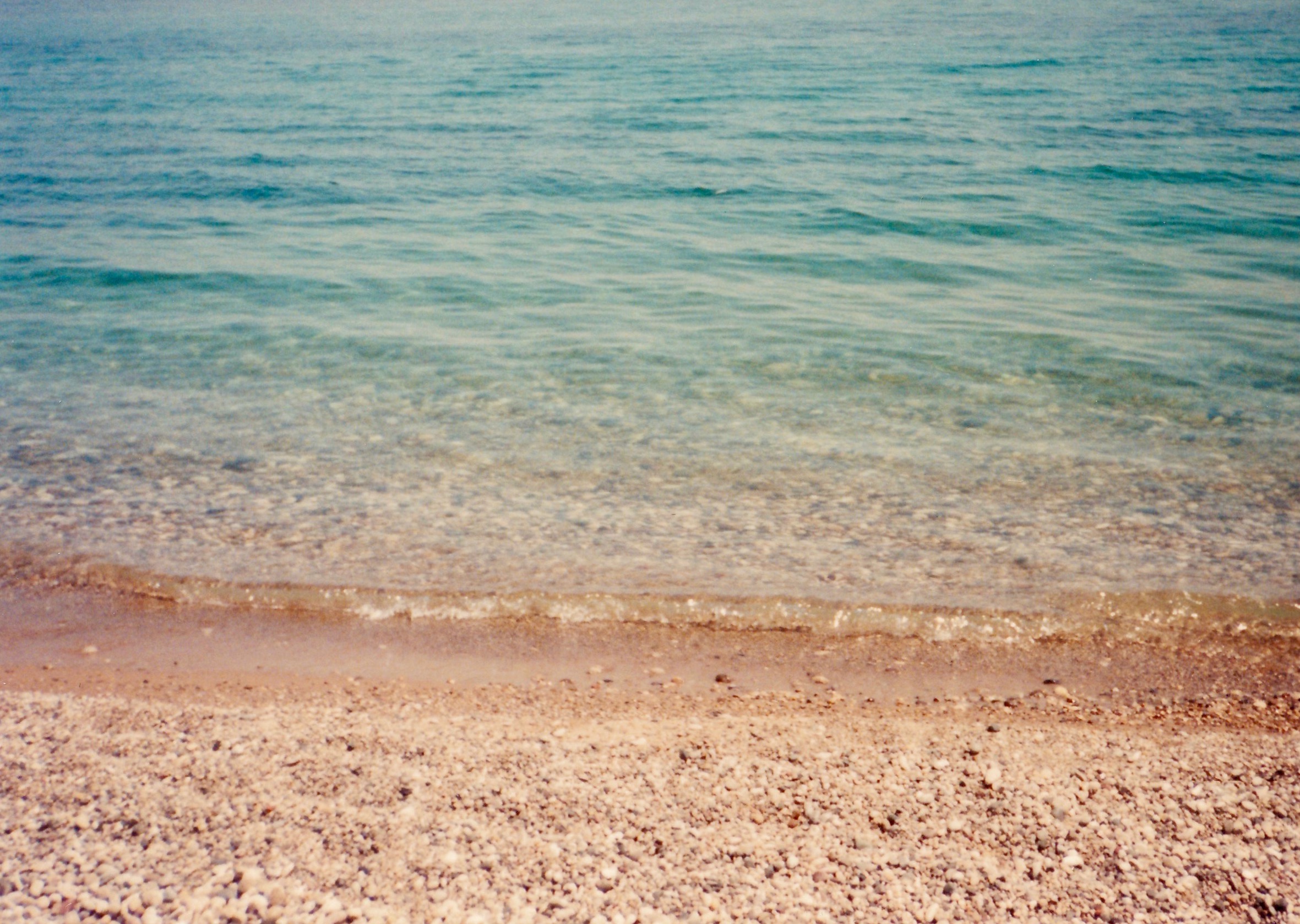
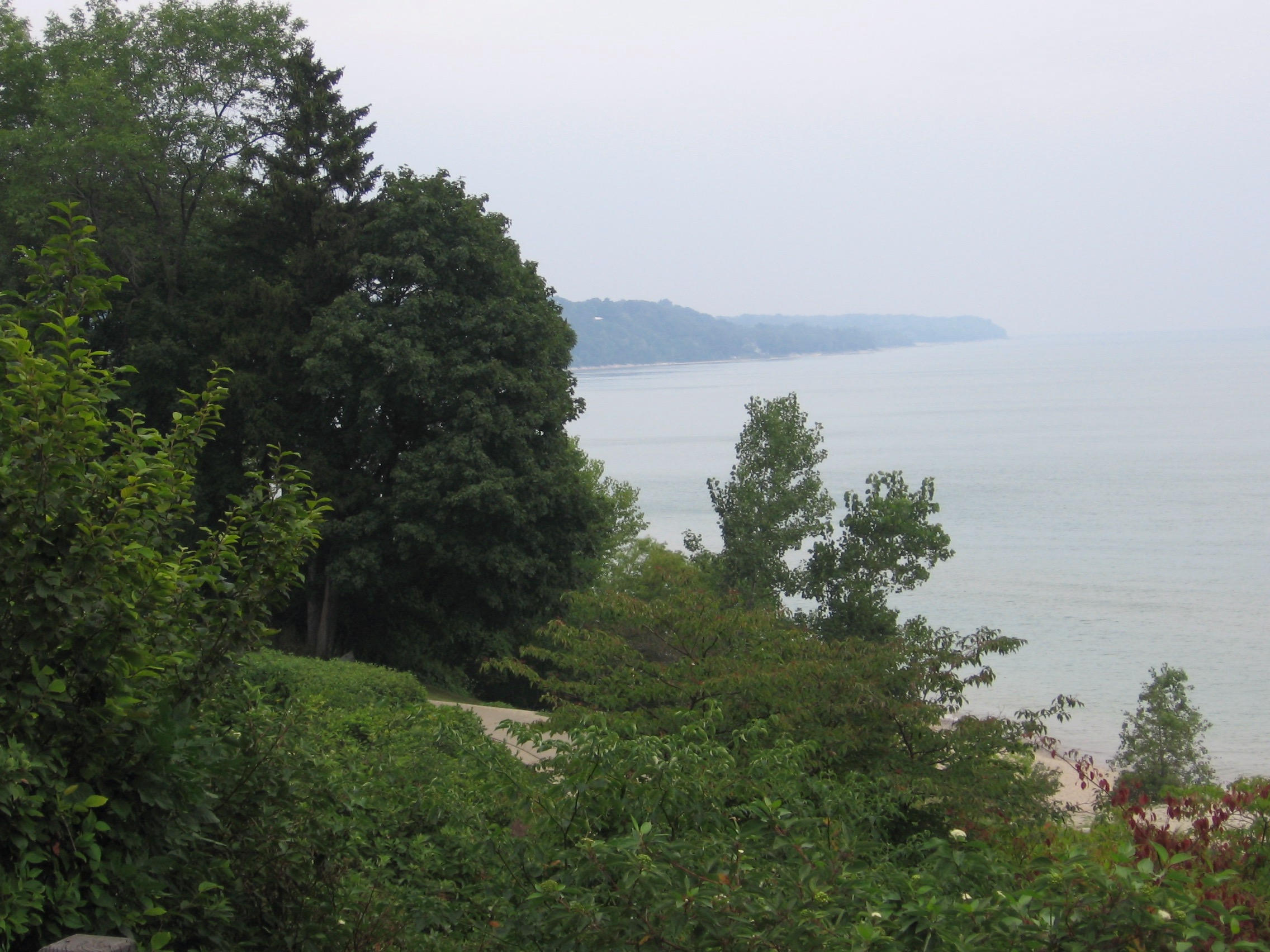
The end point is a small beach on the Lake. This was my “ocean” growing up and it was a thrill to return.
On our last day, I made a run to Irving Place Records and then down to Colectivo on Lincoln Memorial Drive for a smoothie and rest and relaxation on their massive patio. Although I’ve now lived in Boston for most of my life, Milwaukee will always remain a part of me. It’s nice to know that I can always go back for a few days, even if my heart’s now fully in another city.
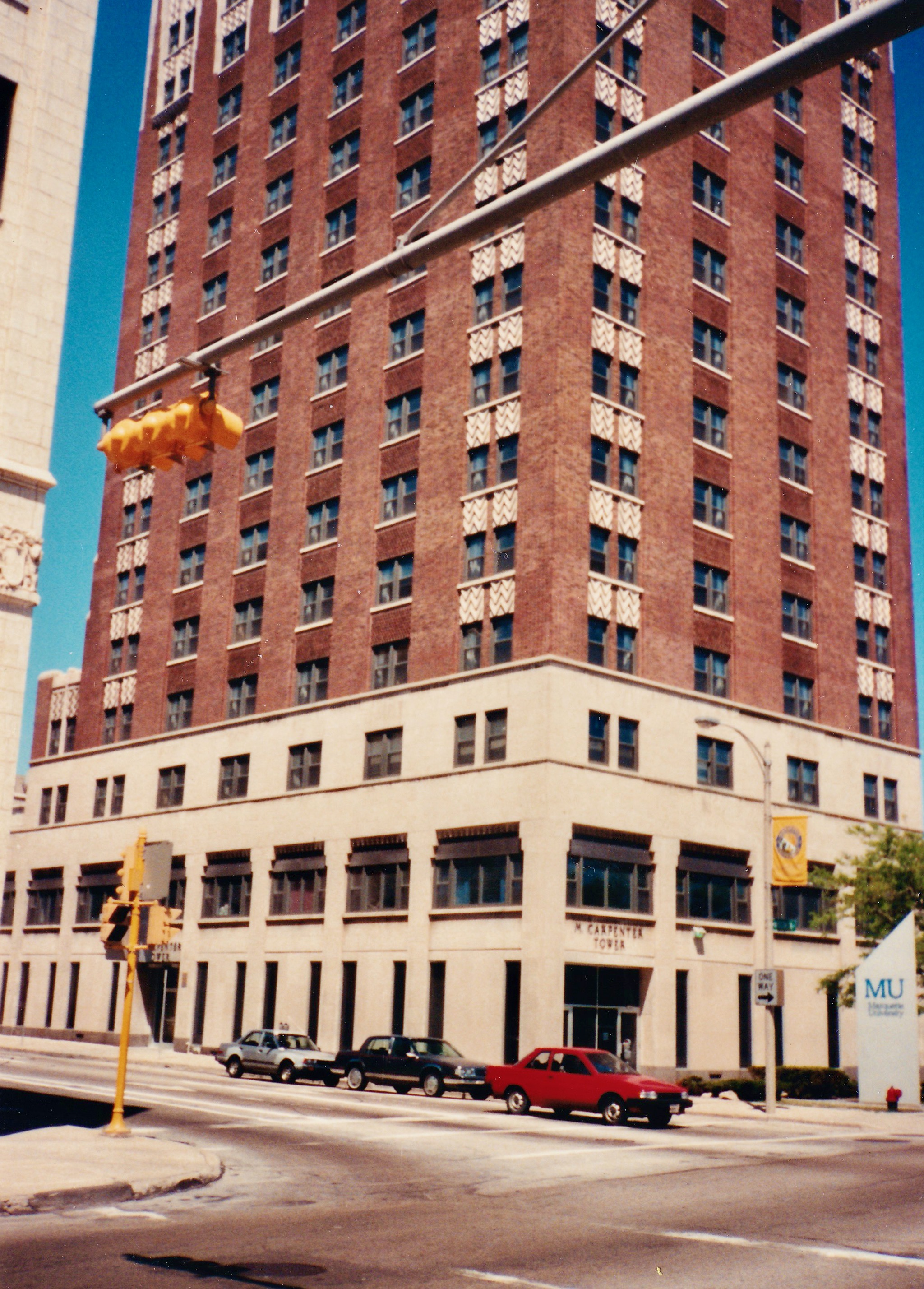
During a marathon digitization of my old photos, I came across a set taken in the Spring of 1995 when I was a Sophomore at Marquette University and living on the top floor at Tower Hall, a building so tall you can’t even see the top of it here.
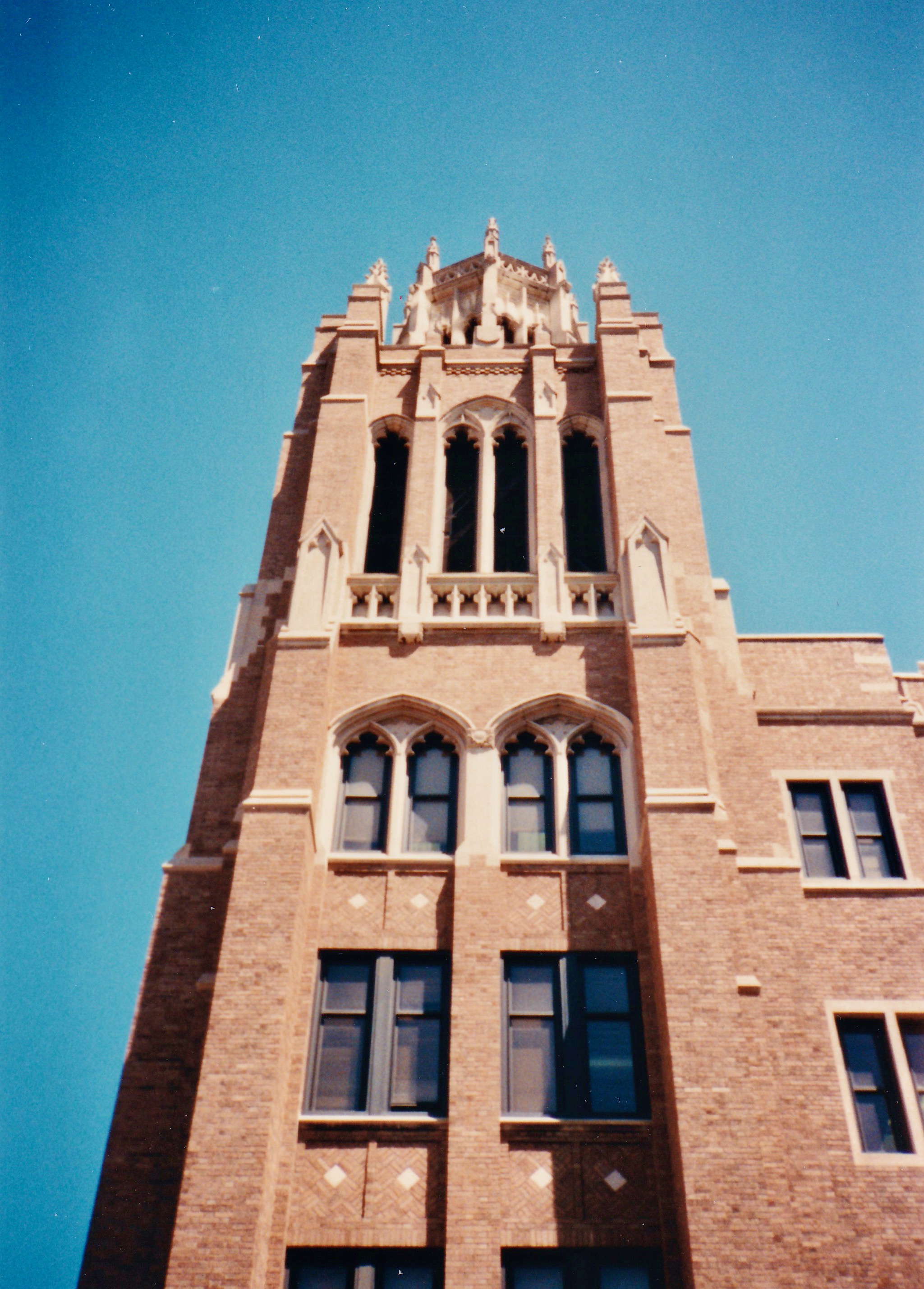
These were likely shot with a Nikon camera on loan for the Photography course I took that semester, though not for the course per se (we shot only in black-and-white); I thought I’d take advantage of using something other than my own cheapo Kodak while I had the chance. Above is Marquette Hall, noteworthy for its Gothic bell tower.
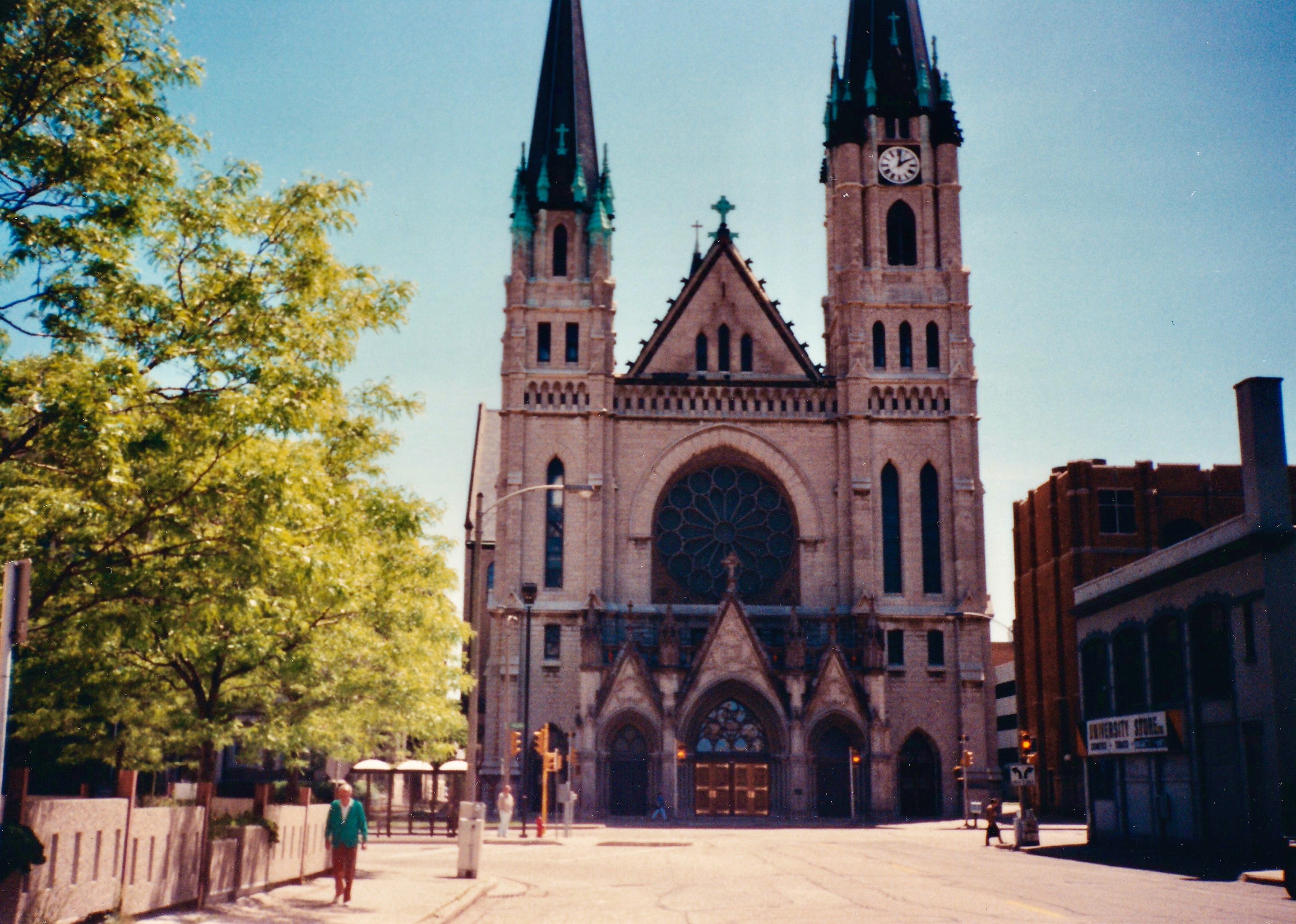
Next to it is Gesu Church, perhaps the campus’ most striking classic landmark. More notable to me now, however, is the dank-colored building in the right foreground which housed the University Store (where I often got a Snapple or a Cleary Canadian between classes) and, around the corner, Grebe’s Bakery, fine purveyors of danishes, crullers and other sweet doughy treats. Within a year of this photo, the entire building would be razed for “green space”; Zilber Hall (built in 2009) currently sits there.
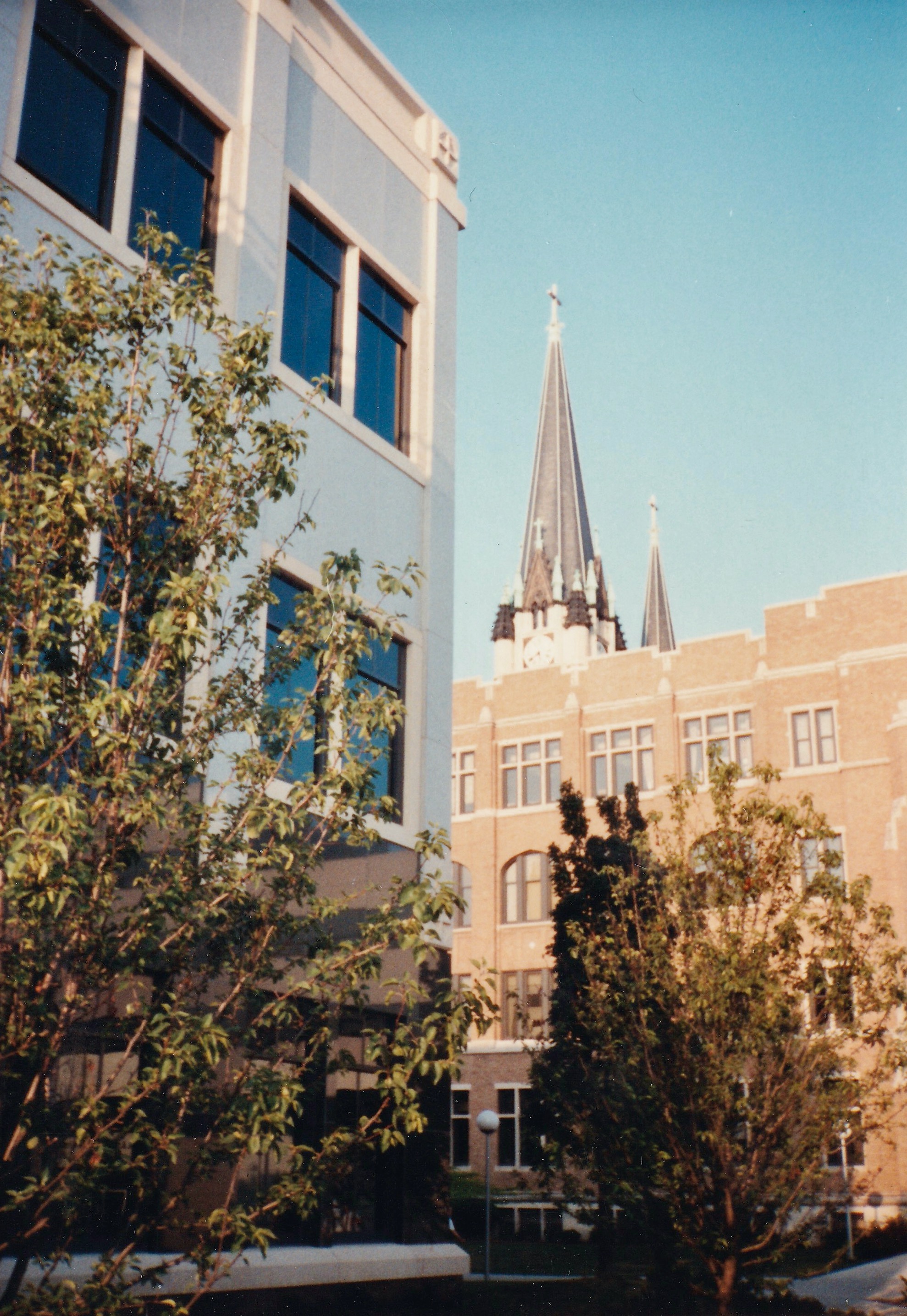
Here, the old-school architecture of Gesu and Marquette Hall are flanked by what was then a shiny, brand new complex.
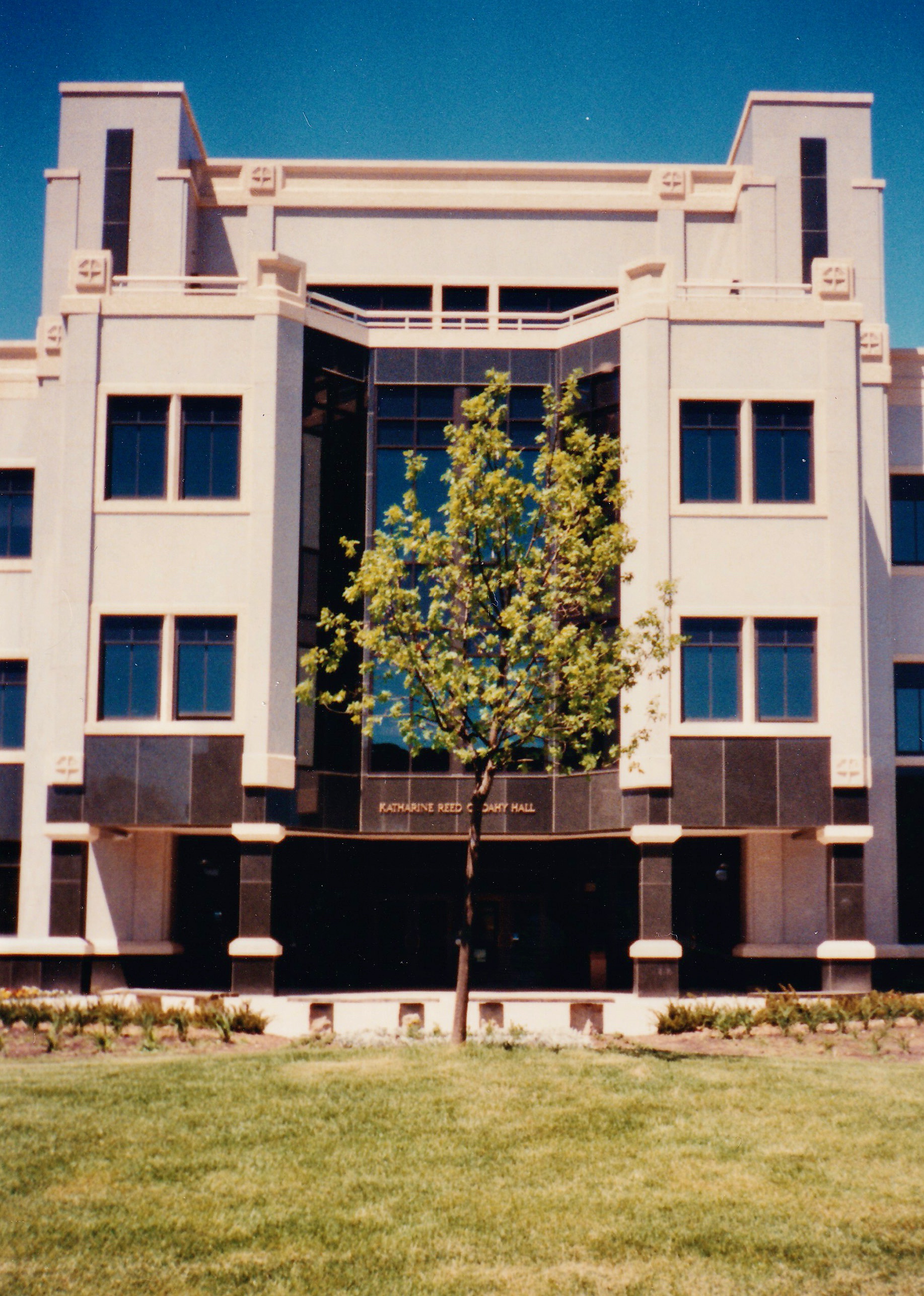
Cudahy Hall, completed in 1994, was most notable for housing MU’s computer labs. It was the first place I ever sent an email or surfed the internet; I will never forget the countless hours I spent there sitting at a monitor, scrolling through green type on a relatively tiny black screen.
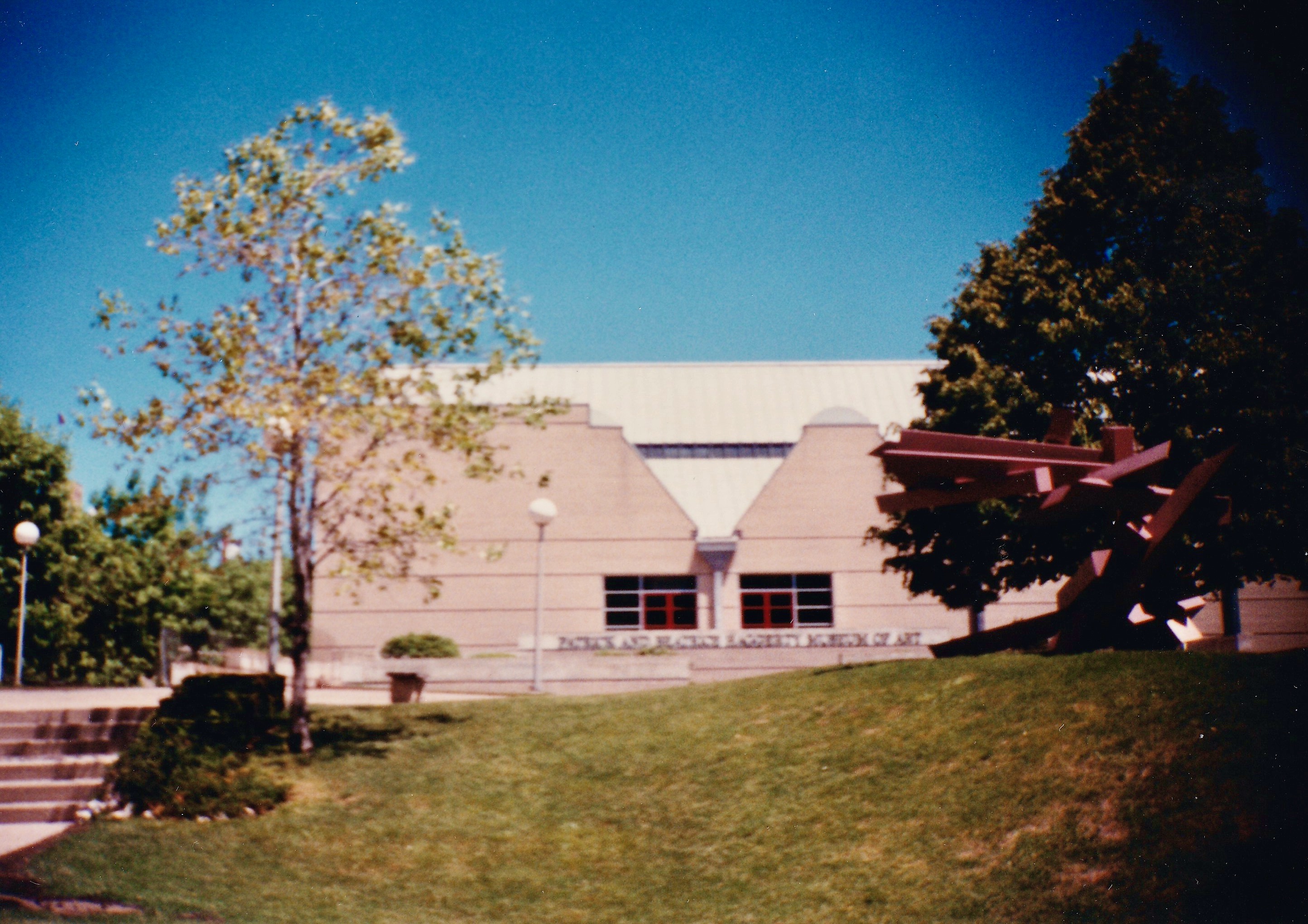
When exploring the information superhighway got to be a bit much, I’d take refuge at the Haggerty Museum of Art.
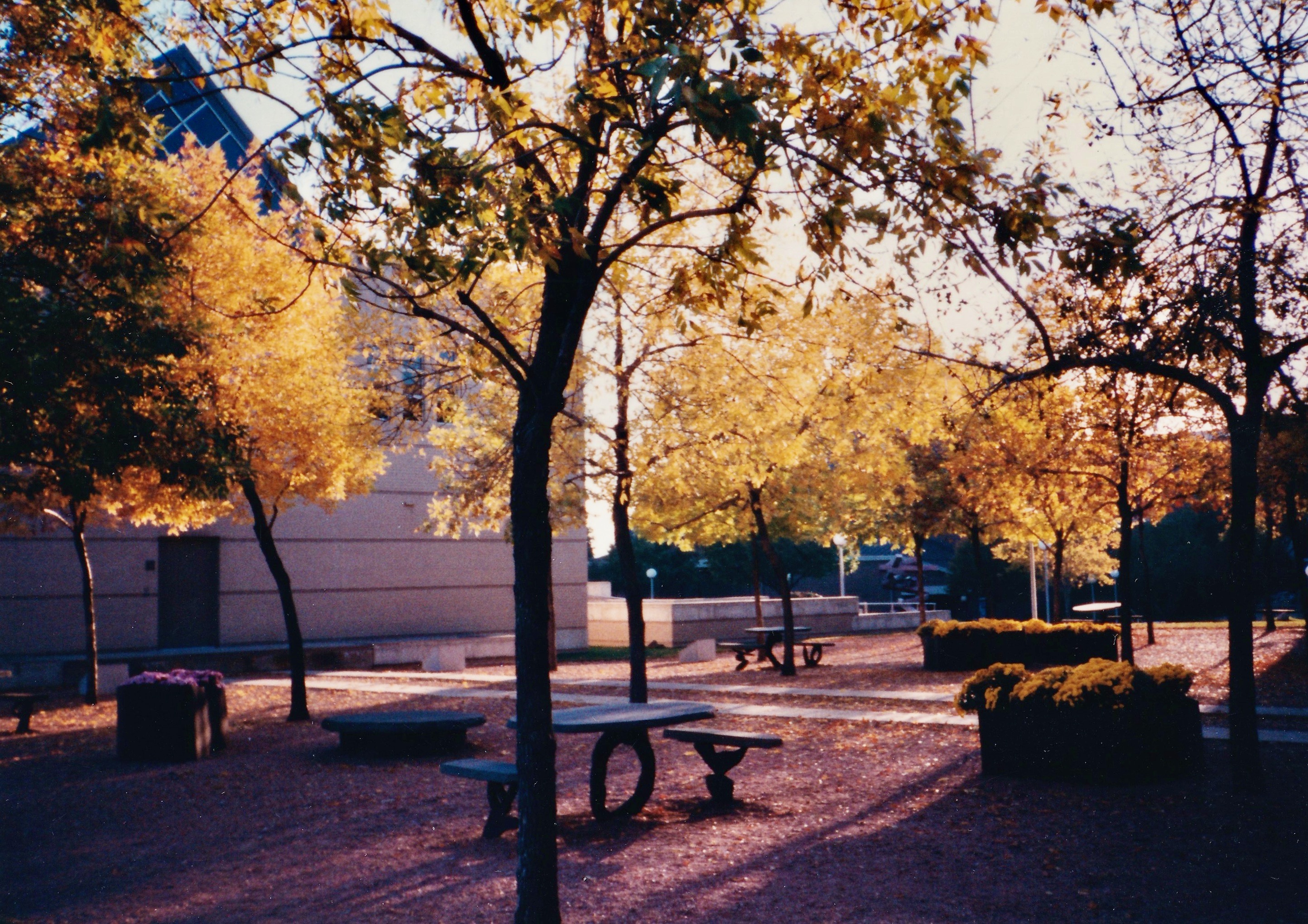
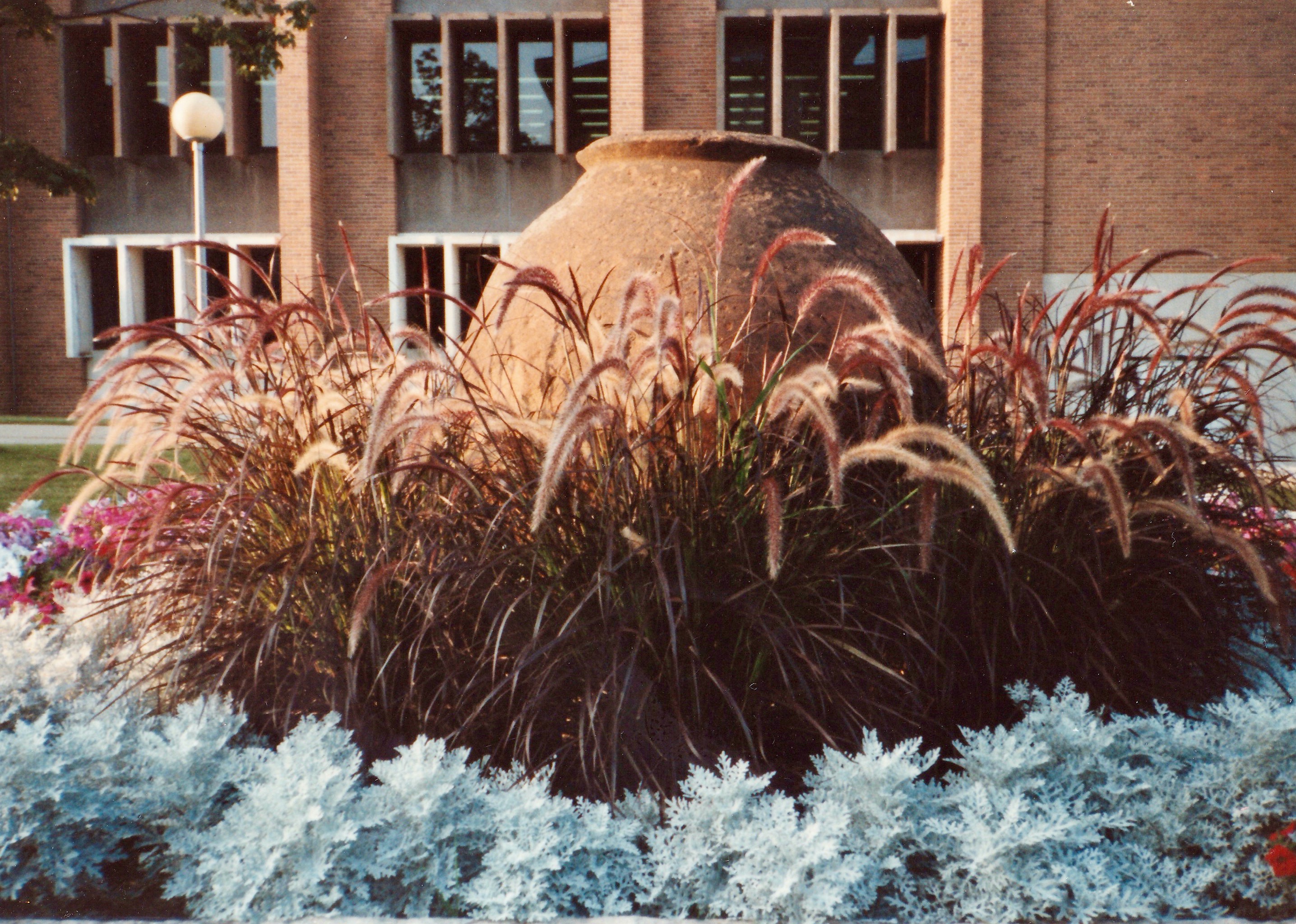
I frequented the Haggerty often; my Freshman year, I couldn’t believe how cool it was that there was an art museum right on campus! I’d also often have lunch or study at one of the picnic tables next to the building.
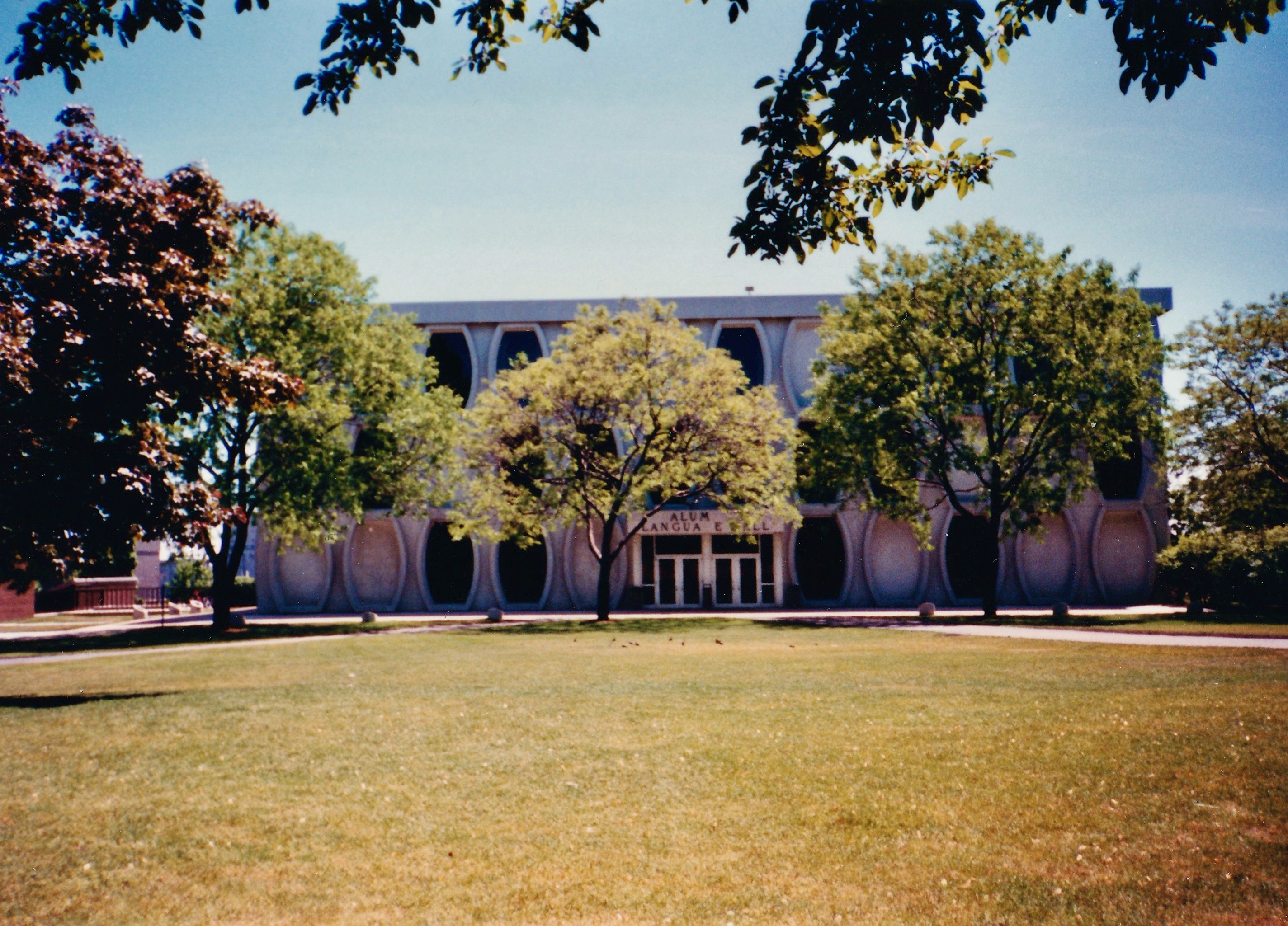
Not far from the Haggerty, Lalumiere Language Hall is easily MU’s most unique-looking structure, one whose modern, brutalist design (those windows!) I’d spot all the way from I-94 as a child. Opened in 1970, it seemed a little rundown by its 25th anniversary (note the missing letters), but it still stands today.
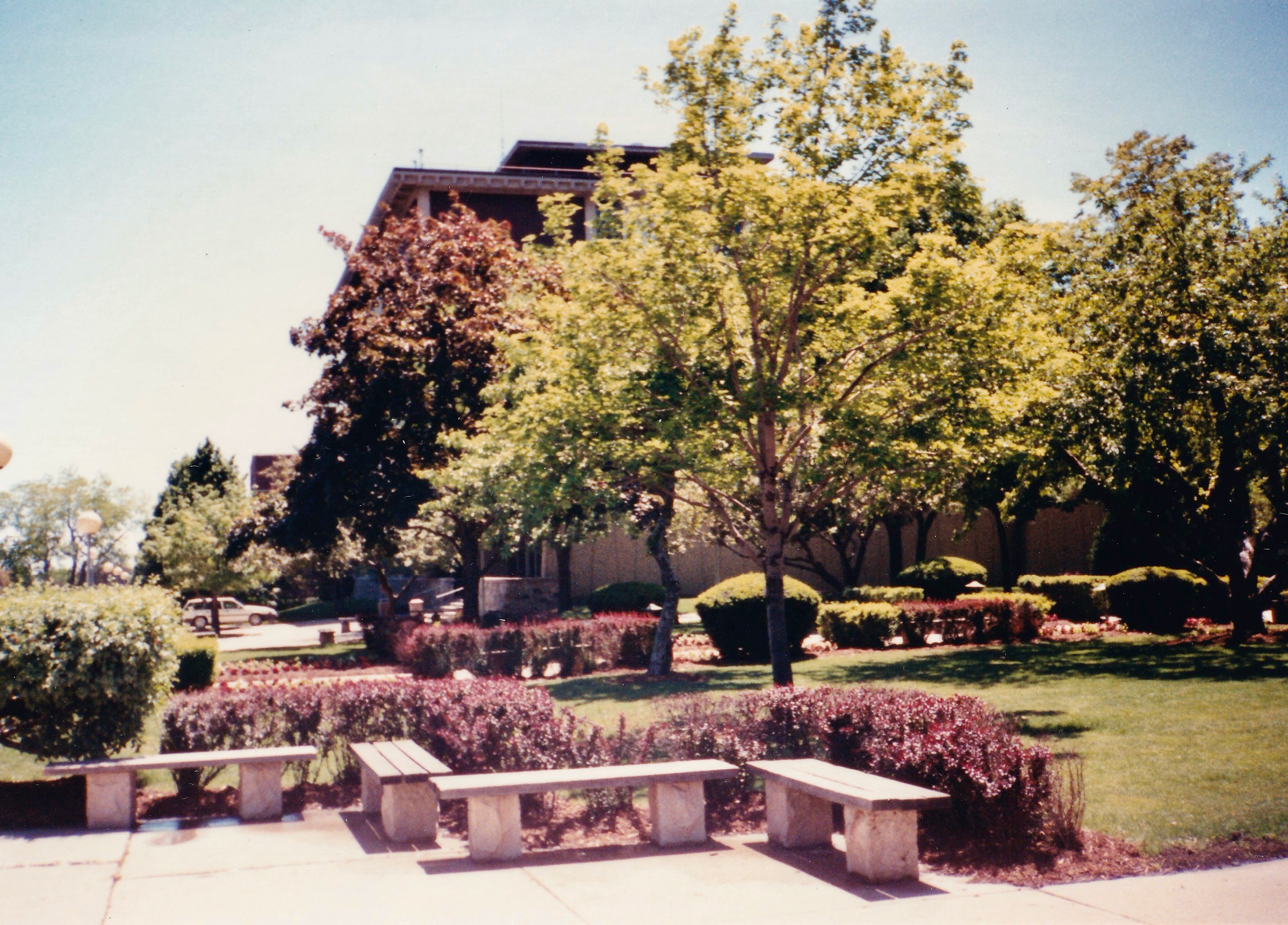
The most beautiful part of the campus might’ve been the West Mall: green space with benches and paths that were particularly inviting in the spring and summer months.
The West Mall was also adjacent to Memorial Library, where I’d spend hours studying, reading, browsing and relaxing—probably more time there than any other place on campus, apart from my dorm and Johnson Hall, where I had all my Journalism classes.
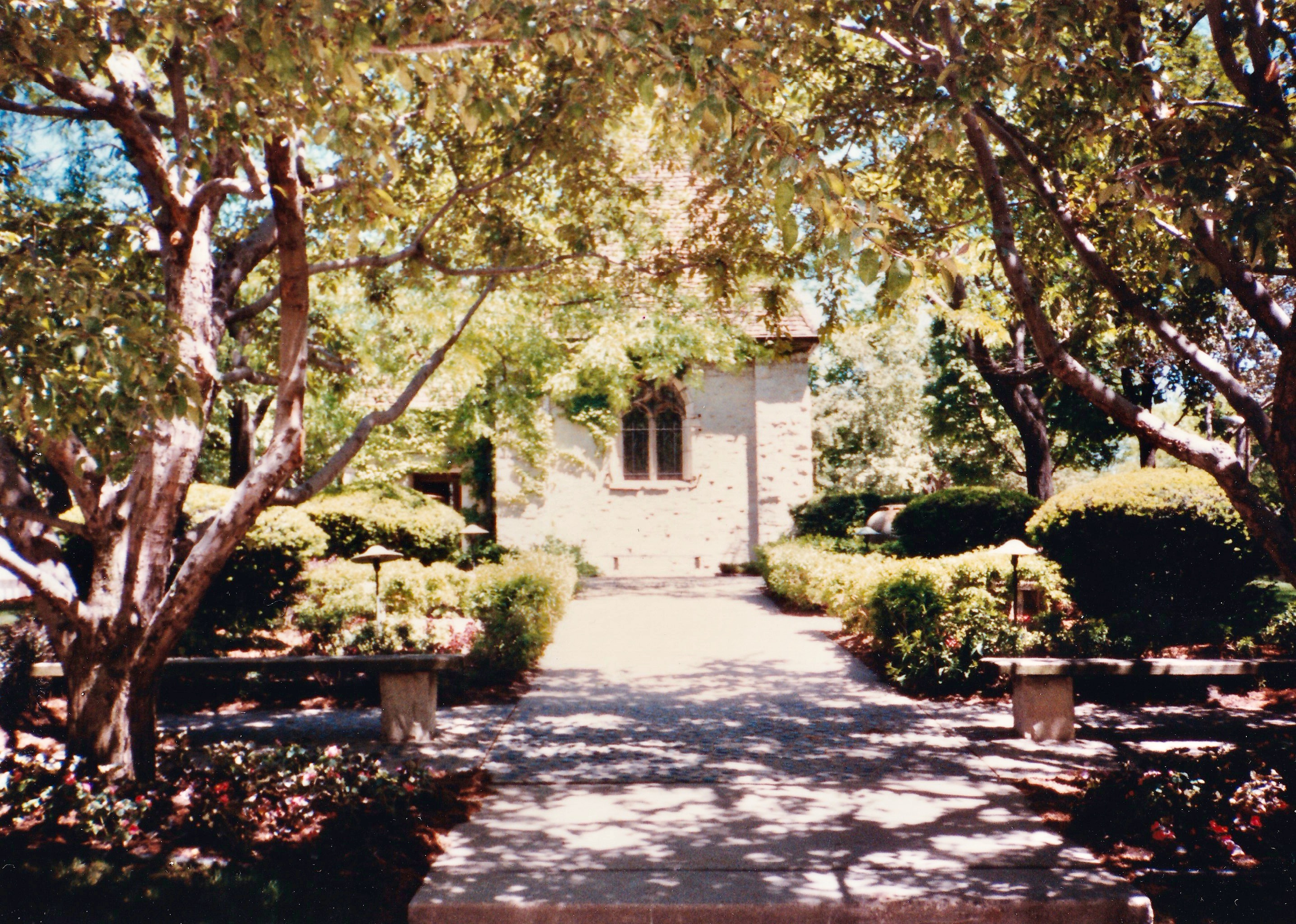
However, my favorite spot in the West Mall was the St. Joan of Arc Chapel. Built in 1420 France, it passed through a few hands before it was gifted to Marquette in the 1960s. Shipped to Milwaukee and re-assembled stone by stone, it’s a lovely, intimate structure. Pictured here is the back of it; a view from the front and a more detailed history can be found here.
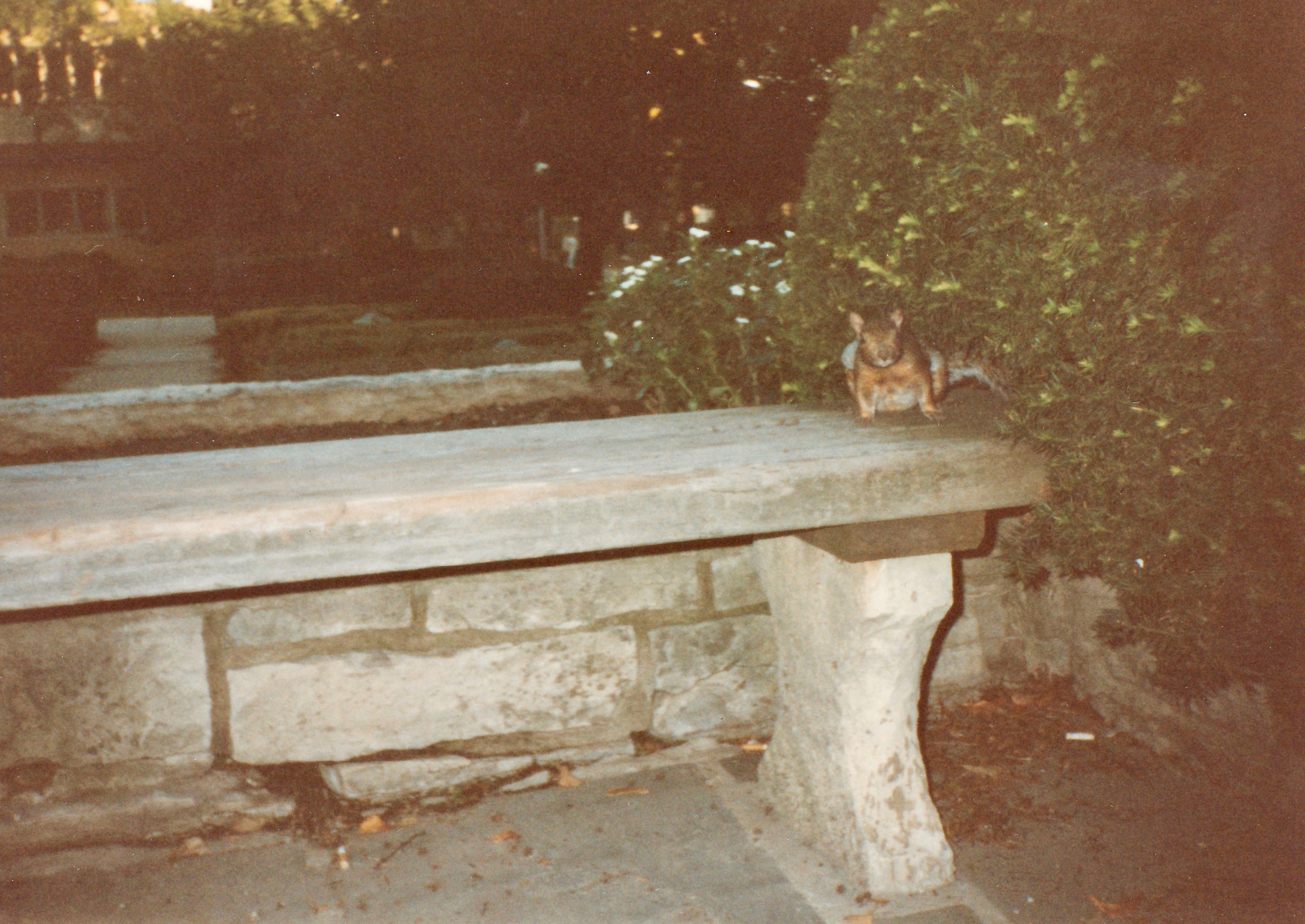
While spending many hours near the Chapel, I saw my share of squirrels—at the time, I noticed they were among the fattest I’d ever witnessed due to all the scraps they received from students and faculty. When I think back to this time and place, these little critters are as essential a part of it as getting a between-class donut at Grebe’s or free Friday night films at the Varsity Theatre or the time we all silently watched Madonna’s banned “Justify My Love” video in my Media Law class. Renovations abound, new buildings sprout up and technology moves forward, but I bet those fat squirrels are still there in abundance.
The Milwaukee neighborhood I’m originally from is roughly three miles from Lake Michigan.
Growing up, it was easy to take the Lake for granted–it was just always there, providing the city’s Easternmost boundary. Like any ocean, it was impenetrable, for you couldn’t possibly see across it to the other side.
Alternately a backdrop for picnics, walks, beach days, fireworks displays, arts festivals, afternoon cruises, fishing and swimming, the Lake stretched on for miles–even within Milwaukee County, there were parts I never visited until my early 20s in the mid-90s, like Atwater Park in Shorewood.
As a Marquette University undergrad, I often walked down from campus to the Lake, usually reaching it via this long-gone pedestrian bridge that crossed over Lincoln Memorial Drive pre-Calatrava addition to the Milwaukee Art Museum.
Once at the Lake, I’d walk North along the footpath, occasionally stopping to sit on a bench and take in the birdsong, the often cool breeze and the not-unpleasant smells of the shore.
The footpath stretched on to Veterans Park, a large swath of green space that was usually empty except for special occasions and festivals like Maritime Days every Labor Day weekend.
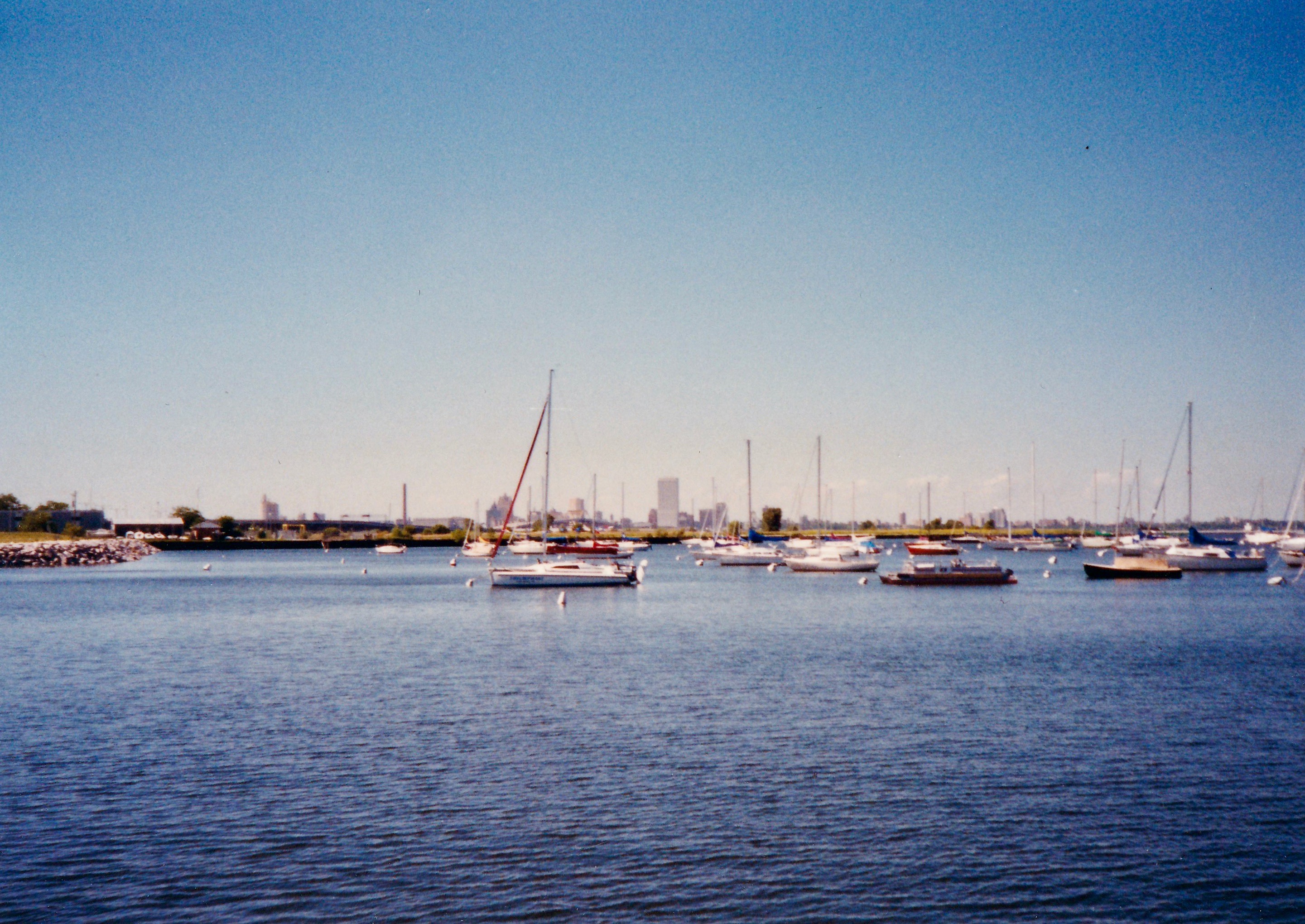
My last night in town before moving to Boston in 1997, a friend and I went for an evening stroll through South Shore Park in Bay View, providing one more time to take in the Downtown skyline as seen across the Lake and industrial Jones Island.
Although my parents moved to Iowa the following year, we’d all meet up in our hometown from time to time. Here’s a snapshot taken from roughly the same vantage point at South Shore Park nearly six years later.
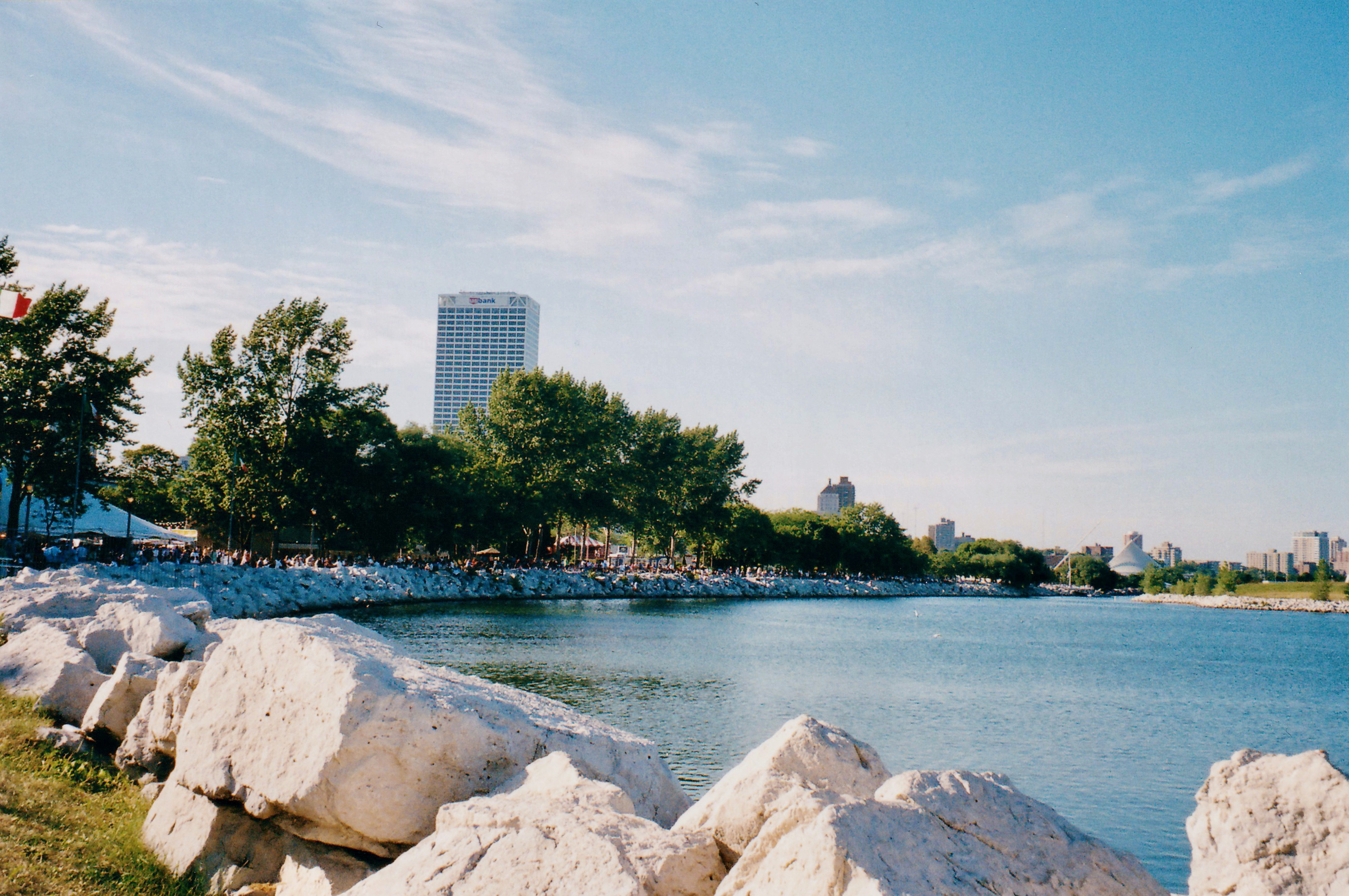
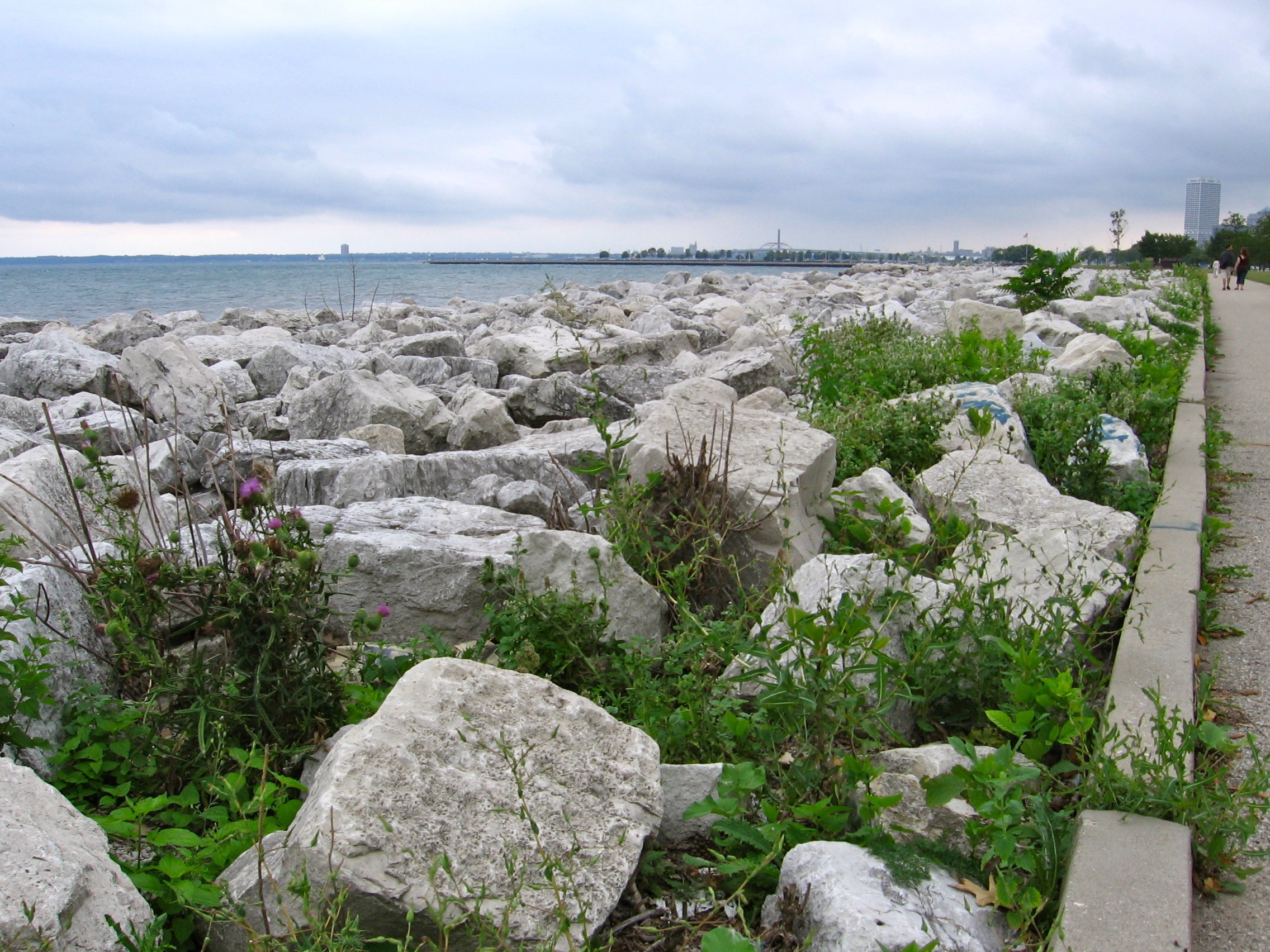
On this particular visit (July 2003), we attended Festa Italiana at Maier Festival Park; above are the white jagged rocks along Lakeshore State Park Inlet.
For more unadorned views of the Lake, travel North past Downtown over to Bradford Beach, which above appears suspiciously empty for a mid-Summer afternoon (perhaps it was unseasonably chilly, or “cooler by the Lake” as the expression goes.)
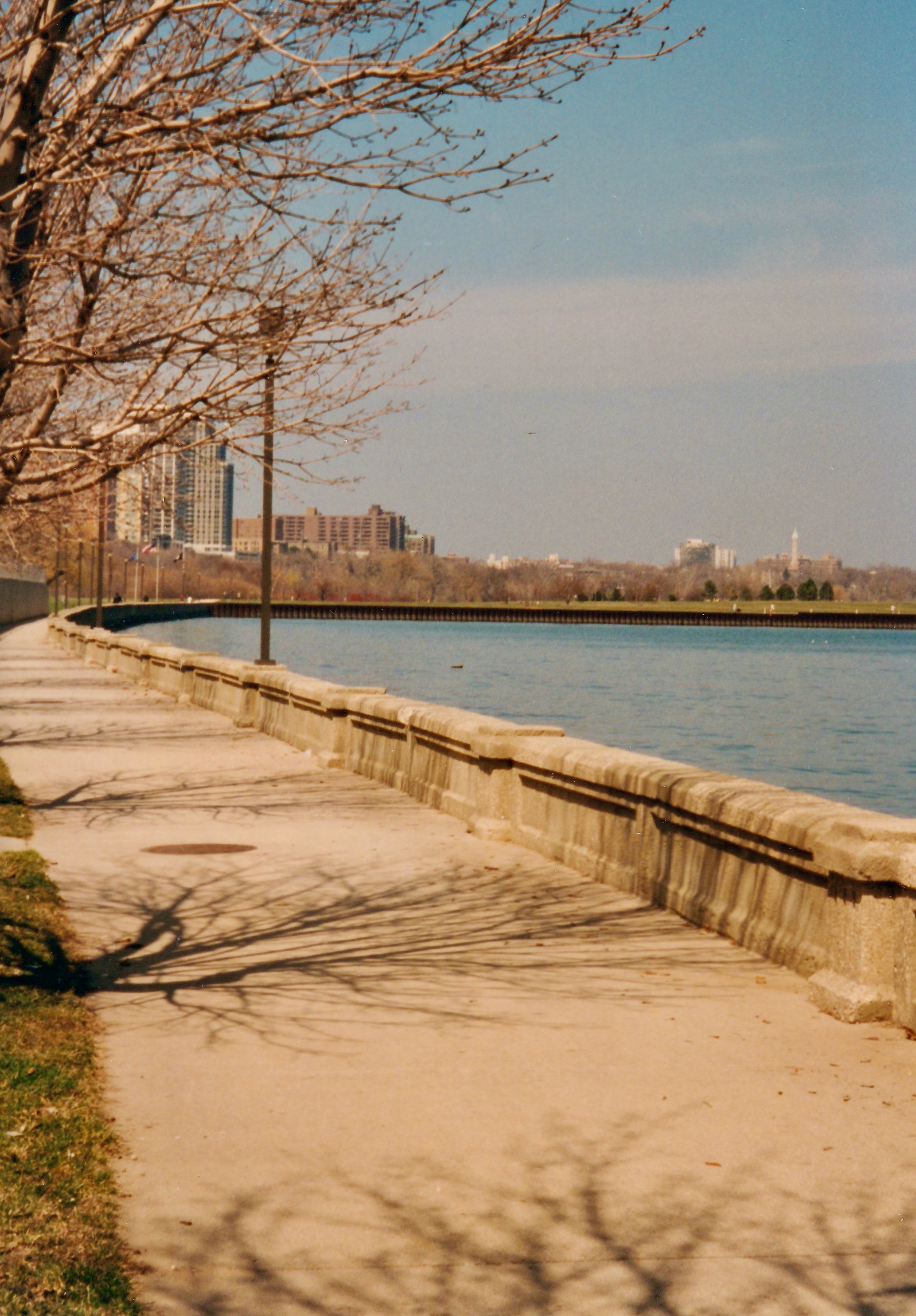
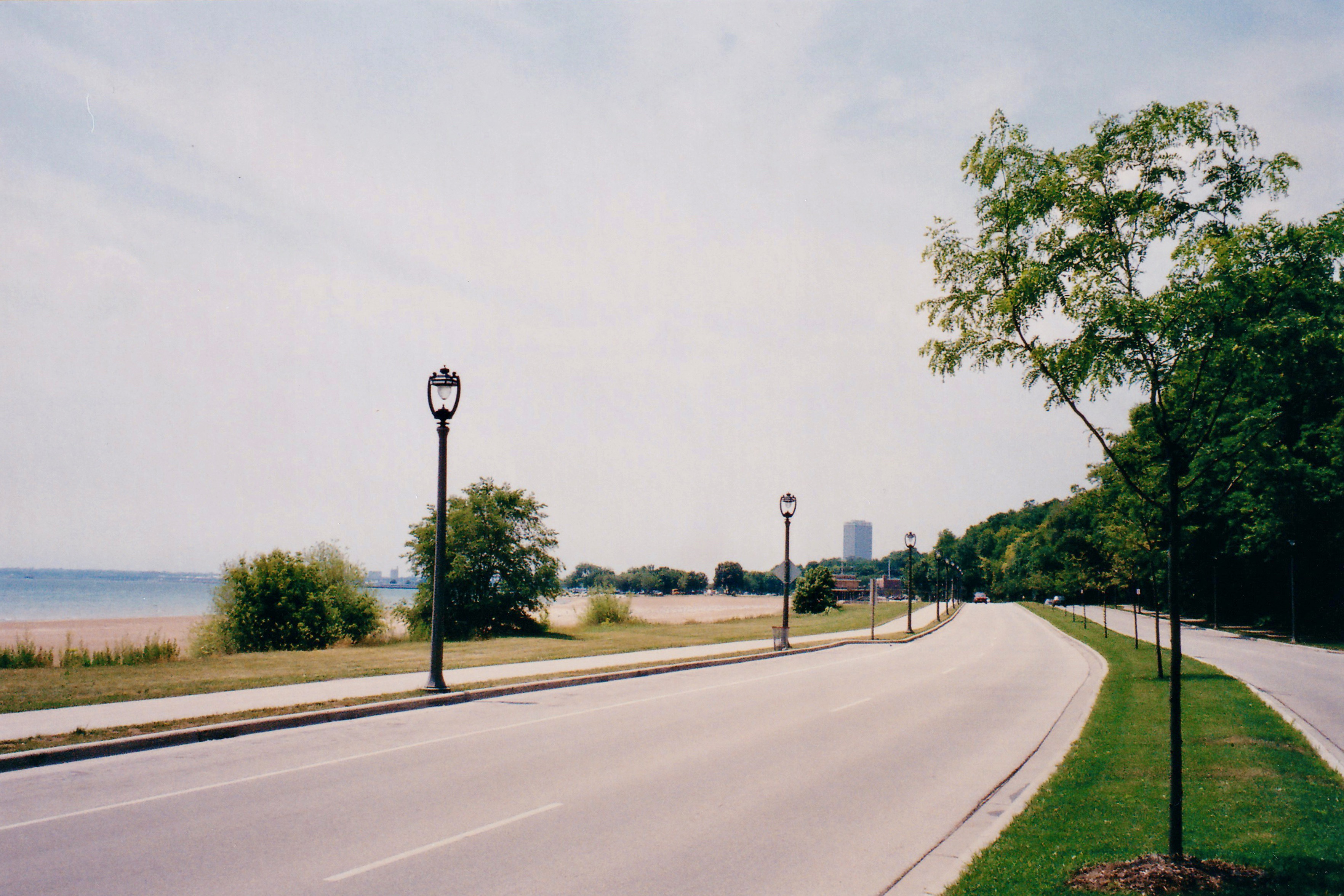
The most convenient way to experience the Lake (if only by sight and maybe smell) is to cruise along Lincoln Memorial Drive–my favorite Milwaukee road (and probably most others as well.)
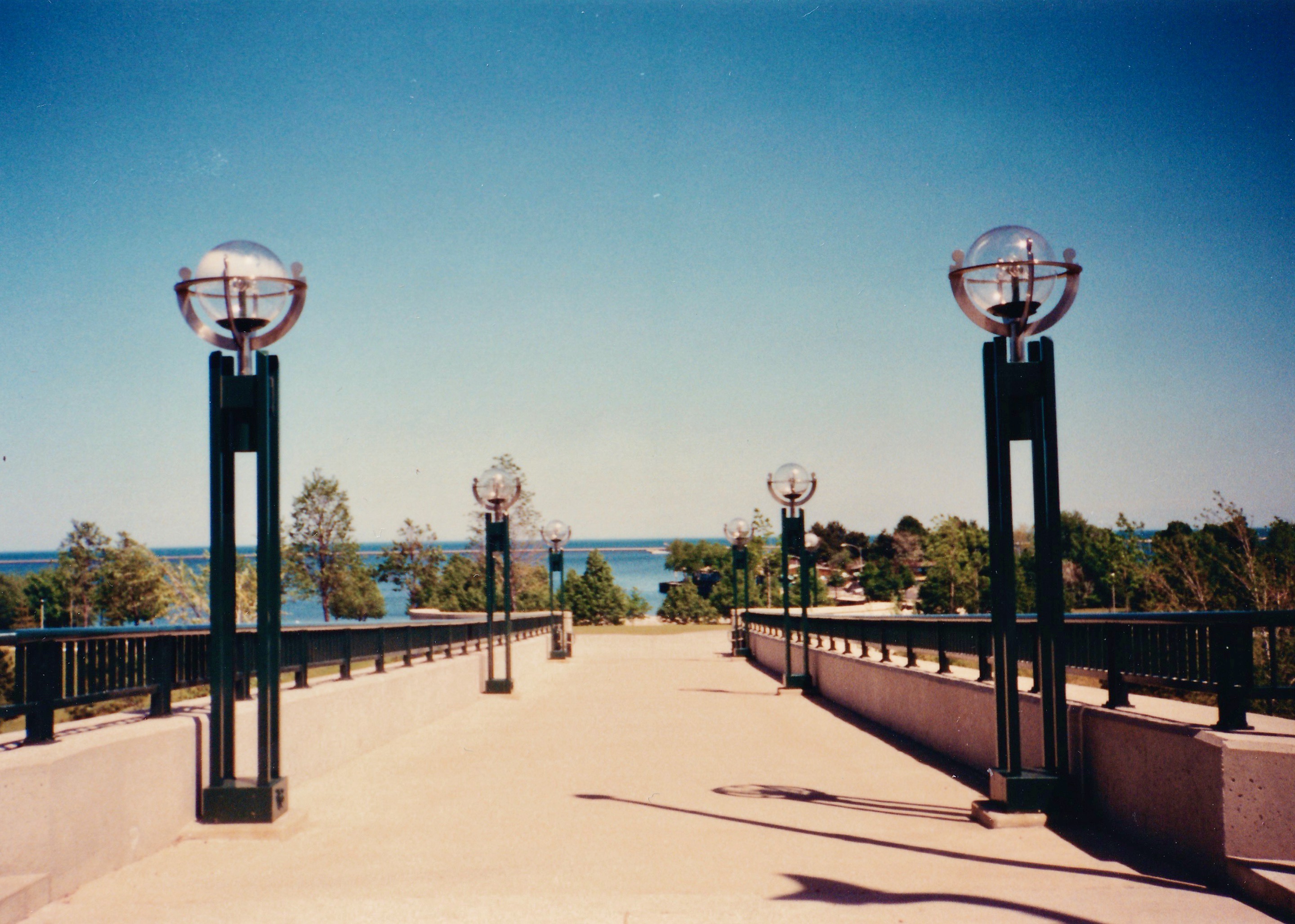
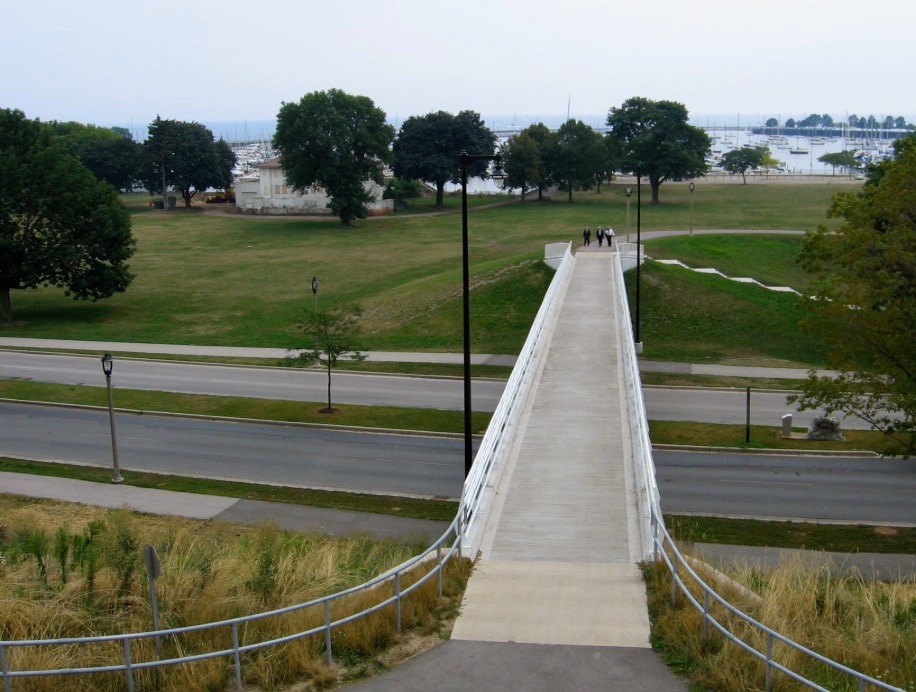
Returning for a visit in August 2006, I was excited to see a new and improved Oak Leaf Trail Footbridge connecting the end of Brady Street to McKinley Park over Lincoln Memorial Drive.
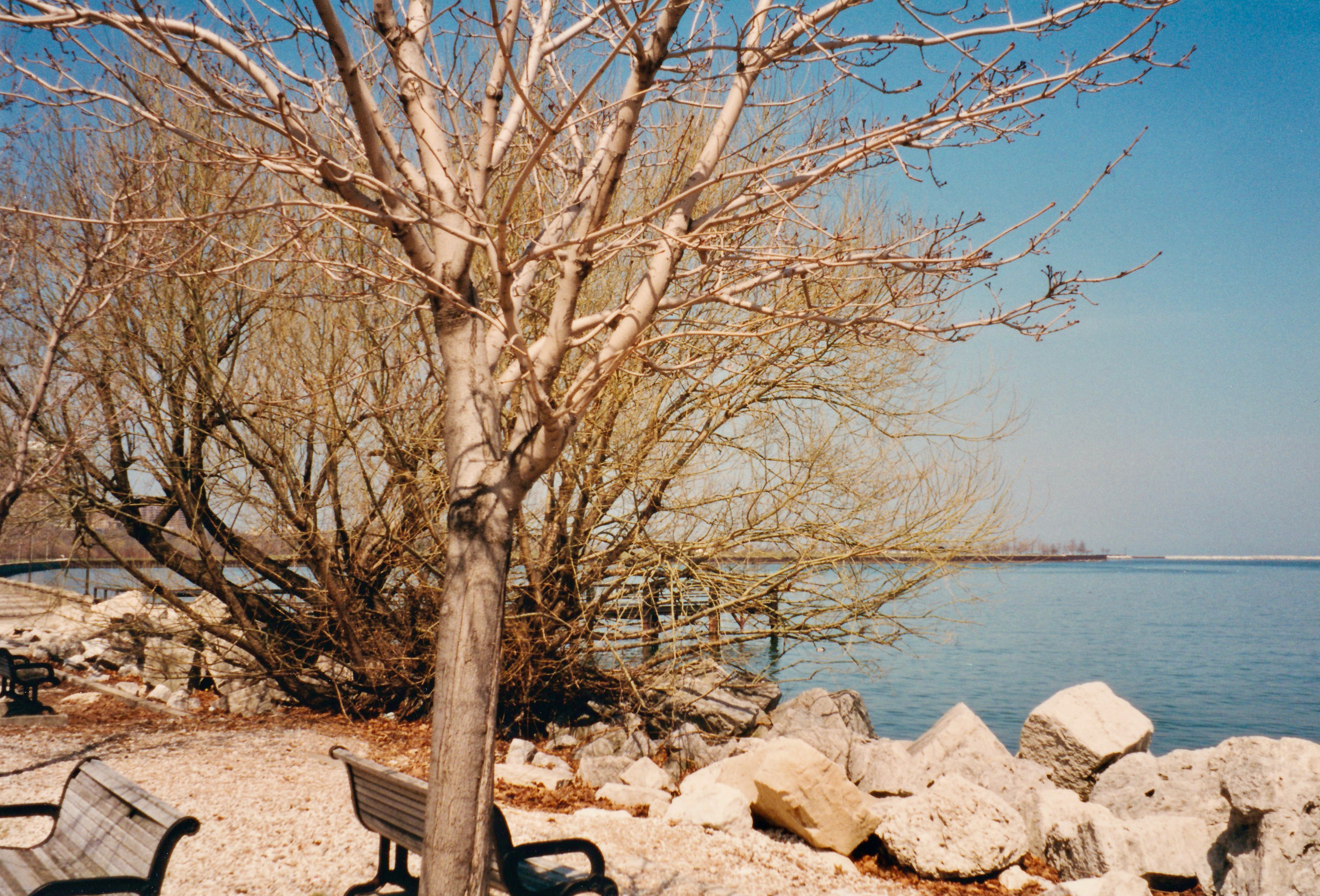
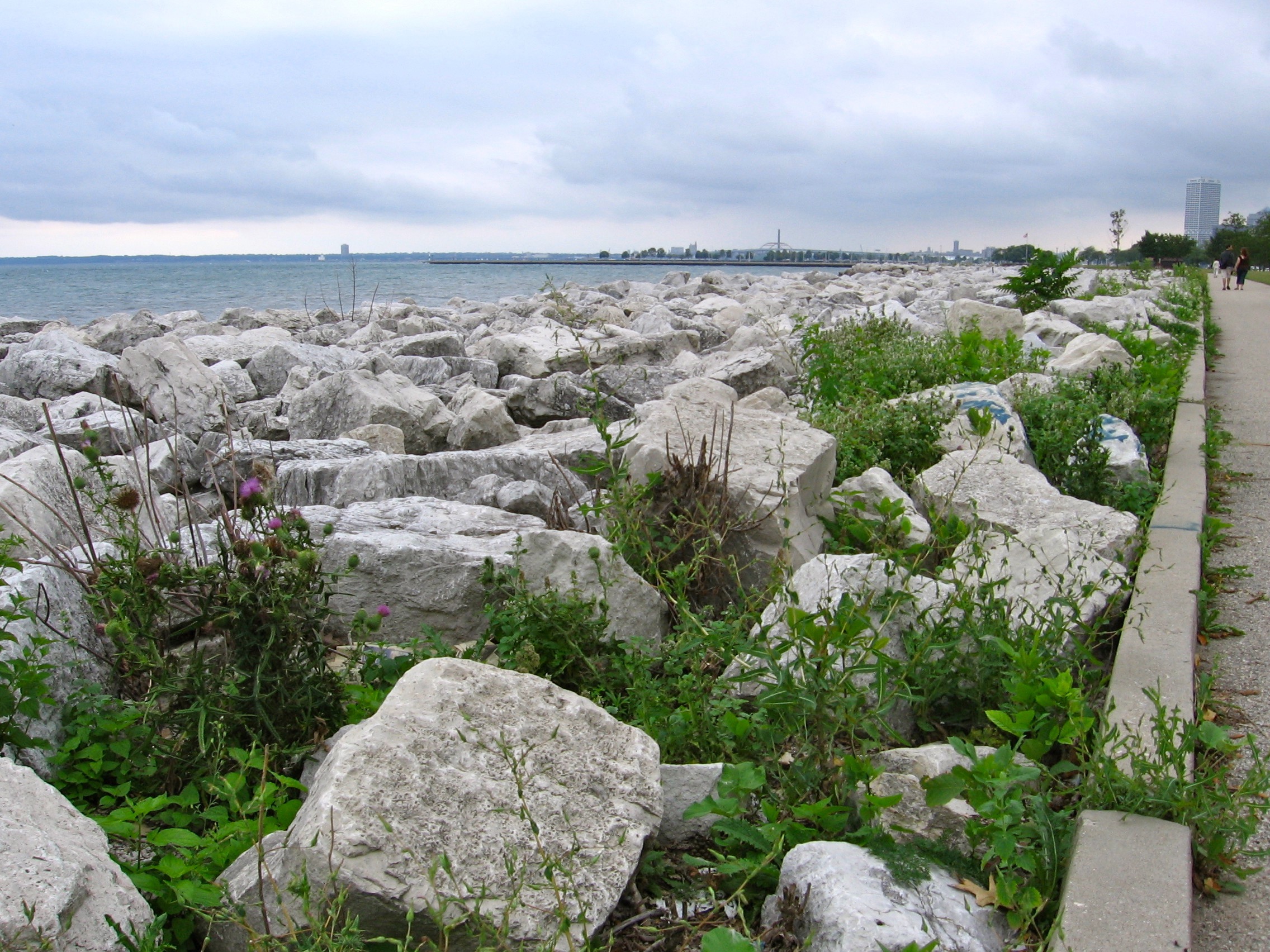
The rocks along this part of the shore brought back so many memories, including that time a decade before I had snuck down there with a few friends one late Summer night.
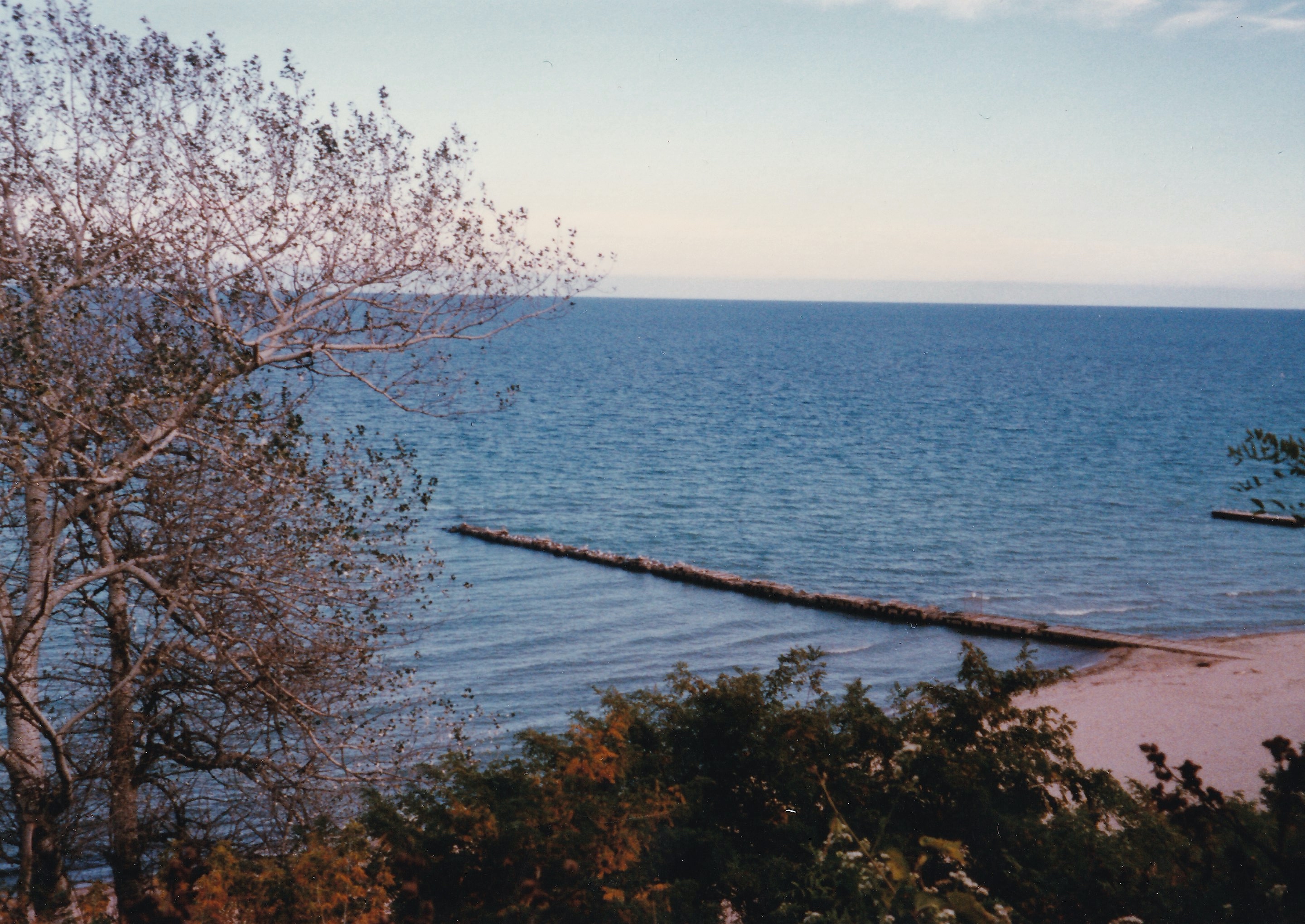
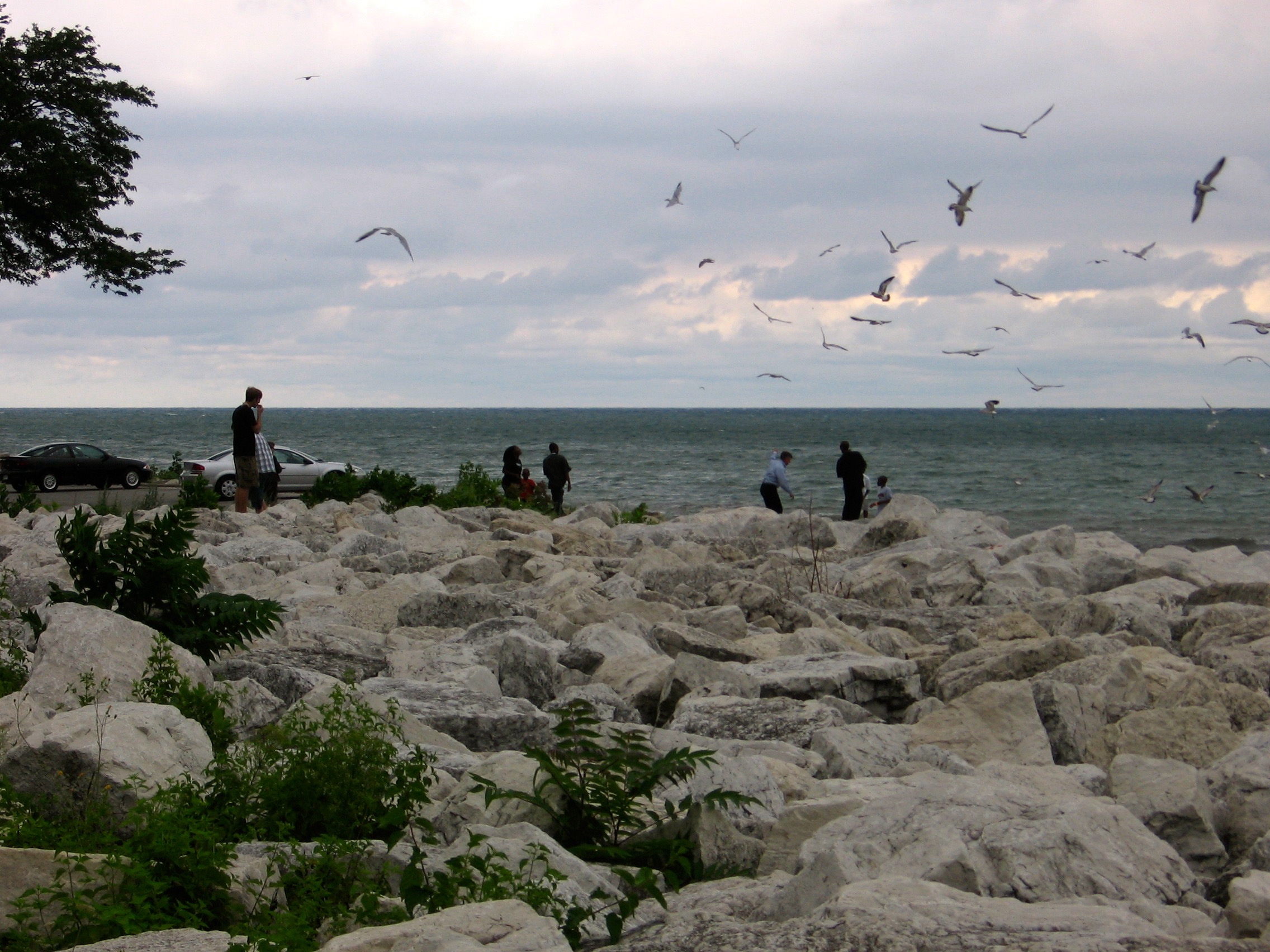
The rocky shore seems less mysterious in daylight, although one can still feel like they’re standing at an edge of the world as they feed or just watch the mass of gulls circling around.
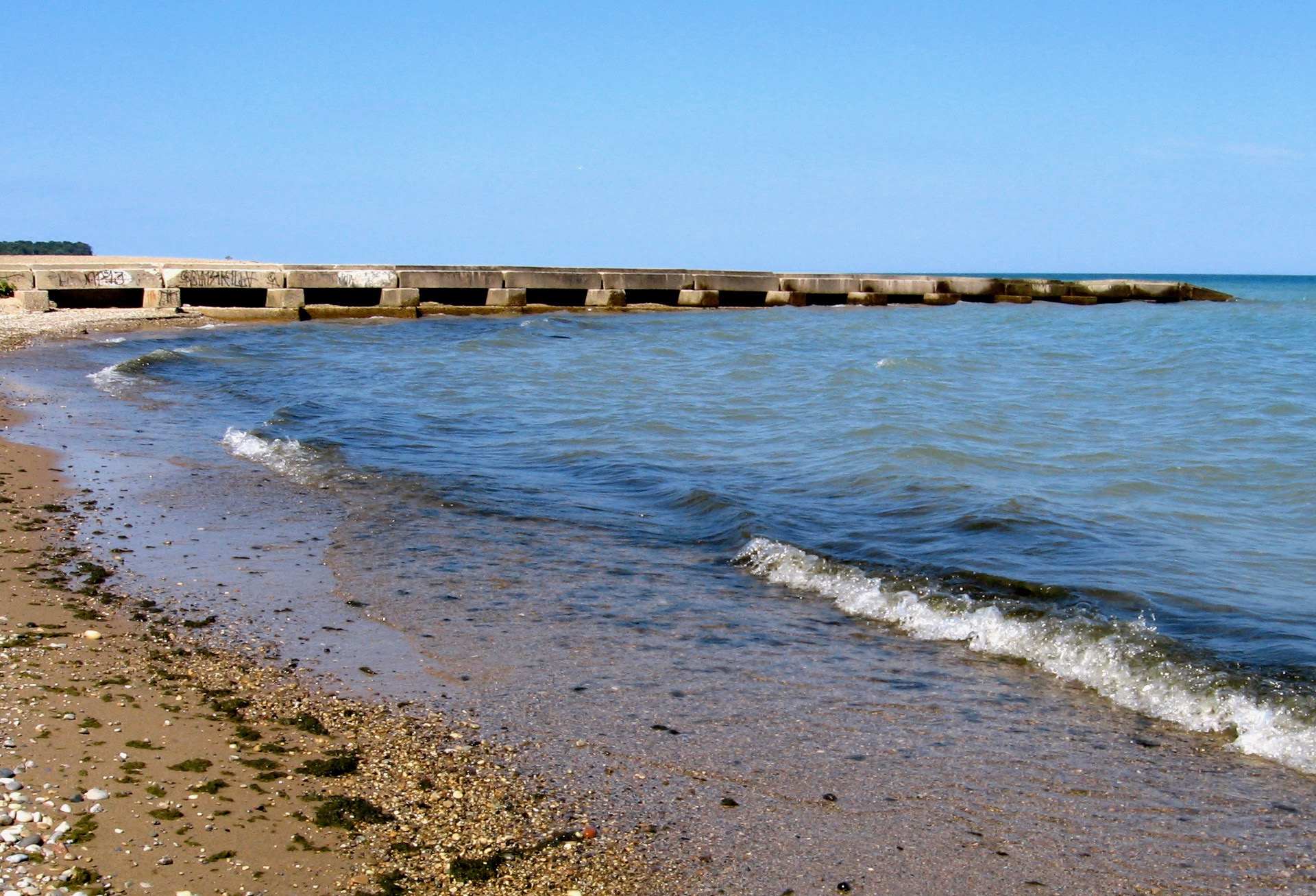
I concluded that same trip with a walk along the shore of Grant Park in South Milwaukee.
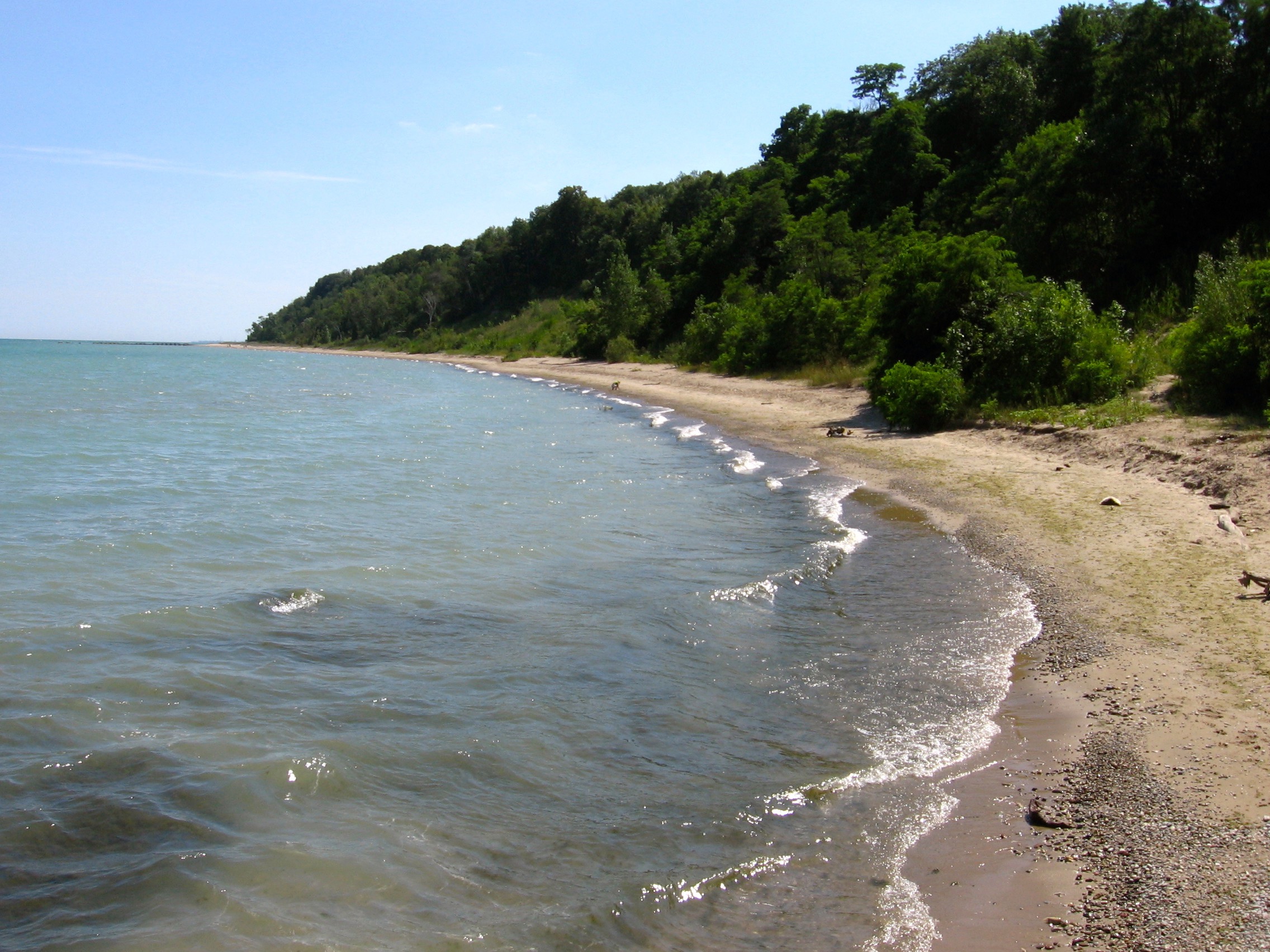
Because it’s further away from Downtown, the Lake along Grant Park tends to be less patronized than other coastal parks and beaches–it’s often an ideal spot for serenity, meditation and quiet.
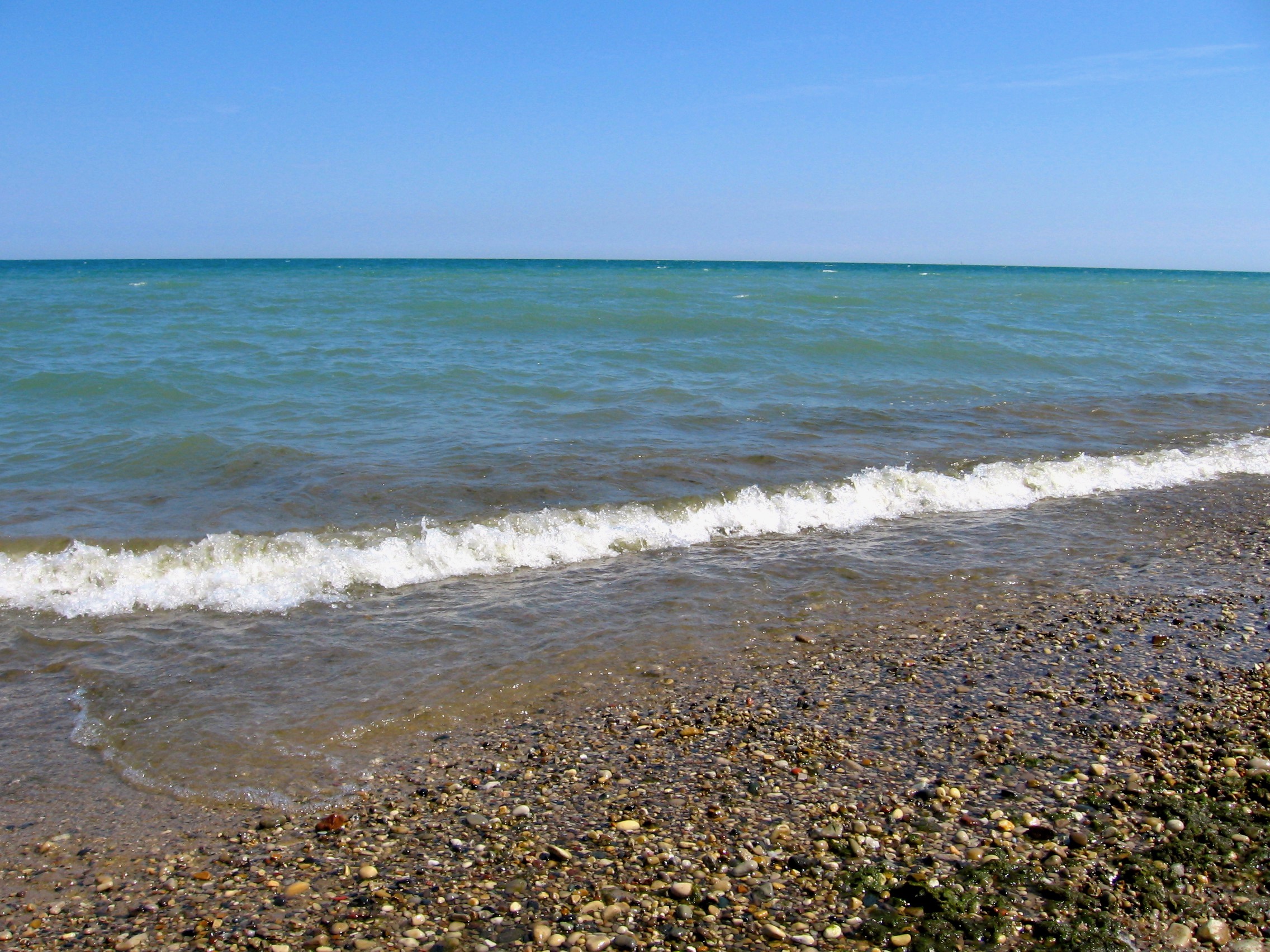
Again, the Lake just seems to go on forever. No tides coming in or out like you’d see at an ocean, just waves lapping against the shore, usually gently depending on which way the wind blows.
For over two decades, I’ve lived close enough to the Atlantic Ocean to be able to visit it whenever I wish; I’d like to think growing up so close to Lake Michigan conditioned me for that–the need for proximity to a large, seemingly endless body of water. I only make it back to Milwaukee every few years or so; no visit is complete without spending some time close to the Lake.
One of my favorite childhood Christmas activities was the annual ride Bob and Barb (my parents) and I took to view lights and other outdoor decorations on Milwaukee’s tony East Side. After Christmas Day dinner, we’d get in the car and head across town to Lake Drive to see all of its coastal mansions done up in displays spanning from the chaste and tasteful (a single spotlight, a mighty fir dressed in a single red bow) to those so gloriously ostentatious that the electricity bill for one night would’ve likely exceeded what my parents paid to keep our entire house illuminated the entire year. All the while, EZ 104 (actually WEZW-FM 103.7) would soundtrack our sojourn, piping nonstop holiday songs from “The Little Drummer Boy” to “It’s The Most Wonderful Time Of The Year” into our Mercury Monarch.
The ride enabled us to get out of our South Side bungalow and escape into a prettier and certainly more upscale world, if only for an hour. Truthfully, however, we didn’t have to travel all that far to partake in the electric beauty of the season. Heck, we could even experience it from our very own living room via the gorgeous, gigantic white metallic star lit with fat multicolored bulbs our neighbor across the street exhibited every year. Whereas most homes up and down the block strung up their holiday light displays the day after Thanksgiving, this elderly woman who lived alone would wait to decorate until about a week before December 25. One night, the star would suddenly, magically appear; I looked forward to its materialization every year.
Naturally, we did our part to make our own home look festive. Our tree, usually covered in simple white lights would sit in the living room, smack dab in the center of the four windows that faced our street. The windows themselves were decked out in crisscrossing strings of multi-colored lights. Scores of blue lights would dot the three roomy bushes below the front porch, while a wreath sporting older, fatter colored bulbs was always hung on the front door. Next to it, we often replaced the porch light’s white fluorescent bulb with a red or green one, just to be extra festive.
Our display was relatively average, anodyne, even, compared to other homes in the neighborhood. Here and there, one would spot the usual assortment of illuminated, life-sized angels, reindeer, snowmen, Nativity sets and Santa Clauses, both in sturdy concrete and inflated, plastic and more malleable forms. People lucky enough to sport giant conifers in their front yards would cover them with endless strings of lights. Occasionally, a homeowner would go above and beyond to present something unique, like the square, squat one-story home a few blocks away that, without fail, always put up a rather impressive giant neon martini glass (complete with green olive!) on top of their roof—it really stood out among all the other two-story structures surrounding it.
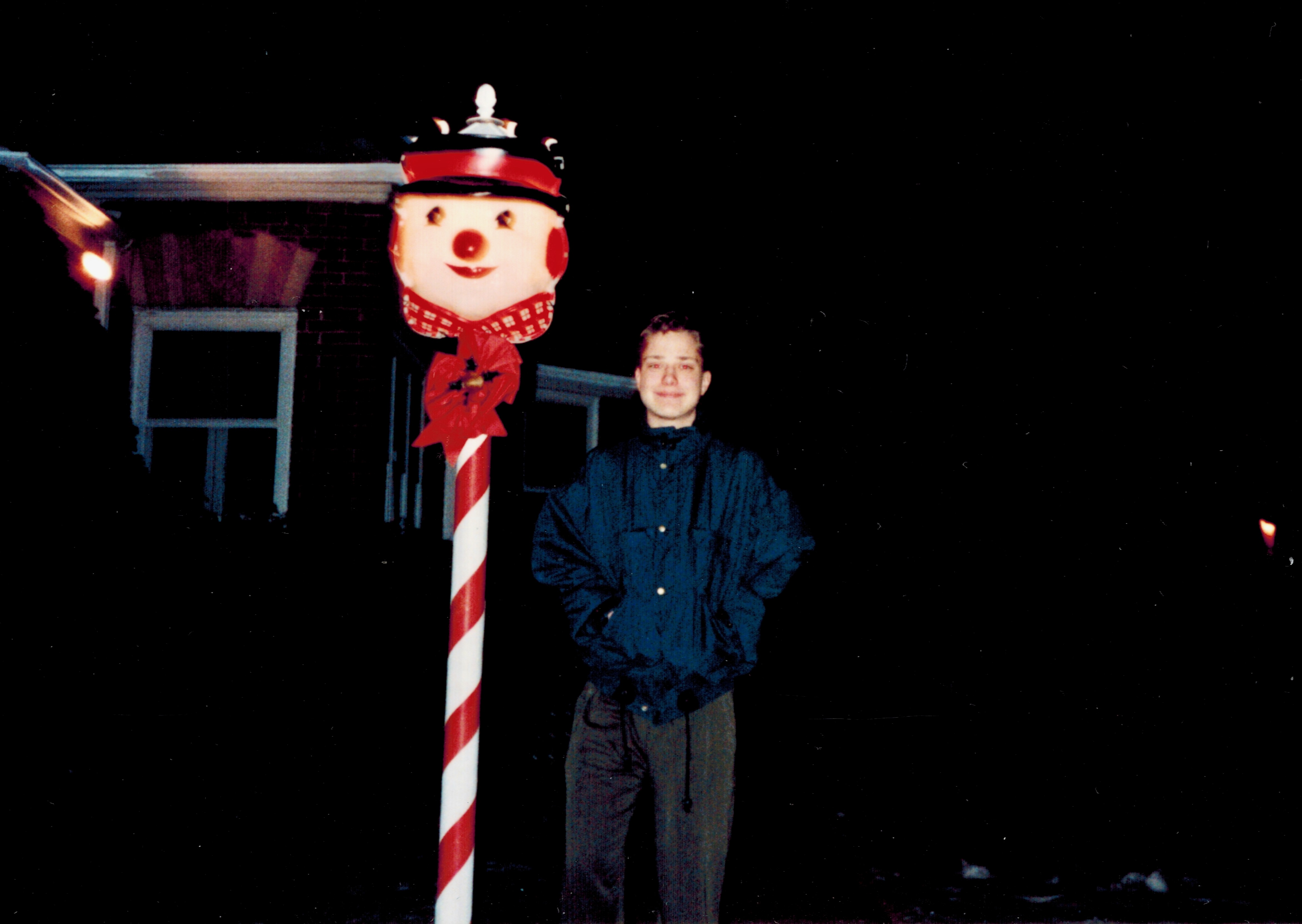
The neighborhood holiday decoration I most fondly recall, however, sat two-and-a-half blocks up our street. In front of a brick house with a terraced roof was a plastic snowman head placed over a lamppost. Painted to include a brimmed hat, red earmuffs, a big red nose and matching patterned scarf, it completely covered the lamp, while the white post was wrapped diagonally with a red ribbon and topped off with a shiny red bow. Simple, cheap and utterly basic, it nonetheless achieved legendary status in my family when I was ten or twelve and Bob first said, “Hey look, it’s Chris-on-a-Stick” once as we passed it.
Every subsequent December, whenever we’d drive by the house, the presence of Chris-on-a-Stick was something he rarely failed to acknowledge. For the first few years, this teasing made me furious which of course only encouraged him to do it more. As I entered High School and put the initial indignities of puberty behind me, I came to accept and embrace the nickname. I even grew to anticipate having a reason to drive past Chris-on-a-Stick, to revel in the joke, comprehending how silly and yet sublime it was to see what had become my namesake—a ridiculous Frosty-the-Snowman-head-on-a-post that would only appear one month out of the year.
When I was 17, I detected a subtle change in Chris-on-a-Stick—he looked a little less faded and possibly a tad jollier. After driving by a few times, I began to think something was awry; upon closer inspection, I discovered I was right—there was a new snowman head on the lamp this year. To the layperson or casual onlooker, it was almost indiscernibly similar, but those aforementioned changes, along with the fact that the plastic head was now two-faced, with an identical visage on its opposite side pitched at the house, confirmed that it was indeed a replacement. “That’s not the real Chris-on-a-Stick”, I’d scoff, adding yet another layer to this seasonal plastic mythology.
That year, Bob and Barb somehow convinced me to pose for a picture standing next to Chris-on-a-Stick (I can imagine its owners’ bewilderment if they were home), even if it wasn’t the real one. Decades on, I’m so thankful they did, if only because I have photographic evidence that it really existed. As for my dad, I got my revenge the following year when, one block over, I noticed a fat plastic snowman placed in someone’s front yard on the ground right in front of a towering flagpole.
“Hey look, it’s Bob-on-a-Pole”, I casually announced as we drove past it one night. Barb burst out laughing and Bob enjoyed the joke as well, knowing that it’s good to both give and receive, not only during the holiday season but throughout the year.
Less than an hour on the United Limo bus from O’Hare, we cross the state line. A rustic wooden sign, WISCONSIN WELCOMES YOU in the shape of said state only hints at an array of tidbits on the other side: Mars Cheese Castle (with its ginormous concrete mouse), restaurants promising “Bohemian Specialties” and a couple of adult video stores. Escape To Wisconsin for Dairy and Porn!
I arrive at Mitchell Airport just after 3:00. Ewa shows up in a red Grand Am and a white T-shirt. Her hair, like Dana’s, is the longest it has been since high school, rendering her slightly less tomboyish than usual. We hug and have so much to say to each other we barely know where to begin. Within seconds, however, she excitedly asks, “So, no pressure, but do you wanna drive out to Ann Arbor to see Teresa on Thursday?” Teresa is a mutual friend from high school that was also Ewa’s college roommate for two years. I wasn’t expecting to go to Michigan, but she really wants to see Teresa one more time before she moves to Poland to begin medical school next month. Ewa’s originally from there, having immigrated to the states with her family when she was seven.
Midway to her parents’ townhouse in the suburbs, I disclose that I have a fresh pack of clove cigarettes in my bag. “Well, Chris, why didn’t you say so in the first place?!” she blurts out. We immediately tear into them and take the long way home so that her father won’t smell anything on her. We drive down Old Route 41, itself shadowed by the adjacent expressway, past ancient motels sparsely dotting the strip with names like “El Rancho” (which Ewa dubs “El Roadshow” because it’s never busy except at lunchtime when customers apparently congregate for a downlow quickie) and the “Knotty Pine” (which I’ve always called the “Naughty Pine” for the same reason.)
After we drop my stuff off at the house, we take a walk along the new bike trail across Drexel Avenue. The late-afternoon August sun dominates the sky. We break out the cloves and I ask about her recent breakup with a longtime boyfriend; I get an expurgated version as she’s already sent me an epic letter with all the details (I’ll see it when I return to Boston.) In turn, she asks me about my sexuality. I’d come out to her the previous year via another epic letter. I am her first openly gay close friend, so she has a lot of questions. She’s curious at how I know what I like, since at that point I’m still a virgin. “What do you think of Harrison Ford?!,” she asks, herself a big fan of Tommy Lee Jones; she’s watched The Fugitive at least a dozen times. It’s hard to explain (I’ve never really thought about Ford, to be honest), but I don’t feel insulted, more relieved to be able to talk so freely with someone about this.
We head back towards civilization and reach Ewa’s house just in time for her father’s arrival. A physician, his thick accent and considerable girth always intimidated me in the past; now, it’s time to have dinner with him and Ewa’s comparably petite mother. We eat in the dining room, amidst upright cabinets displaying Polish plates, butter dishes and assorted knickknacks. On the menu: individual meatloaves, plain boiled potatoes sans any hint of seasoning and green beans one can accompany with a pour of bacon grease. Roughly similar to the kinds of meals I was served growing up, and yet not (potatoes of every variety were always doused in butter and bacon grease was usually poured directly from the pan into an empty can to congeal before its disposal.) I load up on beans (and just a few drops of the grease.) Her dad questions my post-grad school plans and offers some wine. I do as best I can to convince him I know what I’m doing with my life; I decline the wine—before dinner, Ewa warns me never to accept alcohol from her father or encourage him to drink because he tends to gets drunk, and besides, he’s on call tonight!
After dinner, I crave that hometown delicacy, Frozen Custard, so we swing by Kopp’s on 76th Street for a scoop. Then, we take a rather impromptu trip to my old neighborhood on the South Side. I haven’t been back home in over a year, but my anticipation diffuses as we drive down my street—it feels overly familiar, but tired rather than inviting since my parents no longer live there. We swing through the alley in back; our neighbors have replaced their junky old swing with a slightly newer, but still second-hand (and fairly junky) one; everything else is pretty much the same.
I awaken the next day around 11:00, racing up two flights of carpeted stairs from the basement and poking my head into Ewa’s bedroom. She’s still asleep under her cow-print blanket, arms at her sides like a mummy, her little grey cat, Taro, curled up on her pillow. Her father sits in a front of a computer screen in the next room, looking for a good deal on a used computer Ewa could take with her to Poland. His back to the door, he doesn’t notice me. I return to the basement, sprawl across the sofa bed and stare at a wood-and-brick paneled wall, pictures of Ewa’s older brother (now living in California) and his many framed accomplishments staring back at me.
In time, I walk back upstairs to find Ewa sitting in the living room, a bowl of Sugar Smacks in her lap, a mug of Turkish-style coffee at her side. We go downtown in order for Ewa to visit the Citizenship Office to get her status straightened out before going back to Poland. Once there, we empty our pockets before passing a security check—a novelty in the days before 9/11 made this mandatory for air travel. At the other end of a spacious marbled hallway, the Citizenship Office is so packed, Ewa has to take a number. She picks 10; they’re on 69, somehow. As we sit on an oak bench, I pour through copies of local alternative weekly paper The Shepherd Express and The Onion, which one can only read online in Boston.
Thirty-odd minutes later, I need some air, so I go for a walk. Compared to Boston at 2:00 on a weekday afternoon, Milwaukee’s almost a ghost town. I head west on Wisconsin Avenue towards the Milwaukee River, past Wok N Roll (a Chinese takeout place, obviously) and Grebe’s Bakery. I wonder into Walgreen’s, craving chocolate. A bum stands outside the store, selling something indiscriminate—candy, perhaps, or crack. Upon exiting Walgreen’s, I slip my Butterfinger into my jeans pocket and avoid eye contact with the street-salesperson (who is now talking to an immense, bearded man.)
I take the Riverwalk, passing under multiple skywalks until reaching Wells Street. From there, I revisit all the institutions I grew up with: The Pabst Theatre, City Hall (forever immortalized in the opening credits of Laverne and Shirley), Marcus Center For The Arts, Cathedral Square. As with my old neighborhood, everything feels overly familiar, not thrilling like I’d expected or hoped. I think back to a few years before, when I’d walk all the way from Marquette University to the Lower East Side, rummaging in one used record or bookstore after the next, blissfully bored but satiated. In Boston, I can more or less do the same thing there, so the idea of tracing this route again no longer has the same appeal.
When I return to the Citizenship Office, the front door’s locked. It had closed at 2:30, but Ewa was presumably still inside. She emerges fifteen minutes later, her status closer to being sorted out but not entirely (to her chagrin.) Ready for lunch, we drive over to The Gyros Stand in Bay View, which still has the best gyros I’ve ever consumed. I order the titular treat, along with super-thick-cut seasoned home fries and a bright green lemon-lime slushy that comes, as always, in a short, fat plastic cup.
We take our food over to South Shore Park, eating at a picnic bench overlooking Lake Michigan and the beach. Ewa only finishes half of her gigantic gyro, so she throws a piece of meat towards a seagull nearby. Seconds after this gesture, a swarm of twenty or so additional gulls materialize; they all caw and screech whenever Ewa throws them another piece of gyro meat. We take delight in this display of hunger and greed amongst the gulls, although I question whether they might start attacking us, having now developed a taste for flesh. Fortunately, as soon as Ewa runs out of meat and pita bread, the gulls quickly disperse.
By the following evening, we’re both chronically bored—contrary to what some Milwaukeeans might claim, you can only consume so much frozen custard or smoke so many cloves while driving through the outer suburbs or spend so many hours slugging down cheap coffee and frozen French fries at a George Webb’s (a local greasy spoon chain frequented by slacker college students and the elderly.) This is how I generally felt two years ago when I decided to move to Boston, hungry for disruption and change. Fortunately, Ewa and I were heading to Ann Arbor the next day.
Freshman year at Marquette University, I commuted from home (having grown up less than a twenty-minute drive away.) Quickly becoming fed up with that, Sophomore year, I lived in a dorm; Junior year was spent in a residence hall (more like a glorified dorm for four with two bedrooms and a common space.) As for Senior year, I made the coveted but not at all uncommon transition from on-campus to off, having secured (along with three friends from the residence hall) a unit in Renee Row, a modern apartment complex where I’d have my own bedroom, an outdoor deck, and plenty of space for all the curious belongings of four male undergrads (in our case, a neon Zima sign which hung on the wall above the TV; you can’t make this shit up, it was the mid-90s.)
Since our lease at Renee Row began in June, I would also be spending the summer before Senior year in my first apartment—a welcome change from the previous summer, when I had to move back home after nine months of dorm livin’. However, I couldn’t afford to take any additional credits outside the fall and spring semesters, so I had to work. I was already a desk receptionist at another residence hall (this one exclusively housing graduate and non-traditional students), but that was only 10-15 hours a week. Too lazy to have found an internship of any kind, much less one remotely related to my Journalism major (a field I was losing more interest in with each semester), I needed a second job to fill the time, and more crucially, make my rent. I figured another University job was the way to go and hoped to secure a position with the Grounds Crew. During the warmer months of the year, I’d spotted them out in the sun, mowing grass or planting flowers. Planting flowers! I could do that! It’d be an improvement over the crappy, entry-level retail and food service jobs that comprised my work experience to date.
Like the Jewish Theory and Practice course that always filled up instantaneously because it met a required Theology elective (and was also rumored to be a fun, blow-off class at a Jesuit school, of all places), that summer’s Grounds Crew was complete by the time I thought to inquire about it. Fortunately, the General Maintenance department was still looking for seasonal help. With five other students and ten adults, I spent the next three months walking from dorm to dorm, and within each dorm, from room to room fixing desks, bureaus, bunk beds and other cheap, Formica-heavy furnishings. It was almost like an informal assembly line—checking every screw in every handle of every desk to ensure it was sufficiently tightened, doing the same for each bed frame, testing all curtain rods so that they opened and closed properly, etc.
Compared to another summer of dealing with customers and stocking shelves, this appeared to be a pretty sweet gig. My uniform consisted of worn jeans, scuffed tennis shoes and a mint green t-shirt with the words “Marquette University Summer Crew” in purple print on it. This was boring, mundane work for sure. We often got everything done ahead of time, then ambled around the building pretending to look busy but not really doing much of anything. Occasionally, a few of us found a room, closed the door and played card games for an hour or two. I could handle Go Fish or Crazy Eights but could never master the adults’ favorite game, Sheepshead—once becoming so frustrated with it that I simply threw my cards up in the air and walked out of the room.
Such petty emotional injuries paled in comparison to the physical ones. I suffered two accidents that summer. The first involved a long, narrow window spring getting stuck in my near shoulder-length hair as I attempted to tighten it; luckily, it just took out a follicular clump and I had enough extra hair at the time to mostly cover it up. The second injury was more serious: a mere ten days after the window spring incident, the metal bottom of a window screen crashed into my chin as I fumbled to extract it from its frame (a laborious process that required squeezing little doodads in opposite directions to both extract and secure the screen in place.) After I was led over to both the campus infirmary and the HR department (to secure a Worker’s Comp form), I was driven to a nearby hospital (coincidentally, the one I was born in!) and received a few stitches, which I had taken out two weeks later. It was more bloody than painful, and they weren’t even the most stitches I’d ever received (that would’ve been after my forehead collided with a folding table a teacher’s aide carried on a stairwell the first day of Fifth Grade.)
Mishaps aside, as with most jobs, the sheer monotony festered into something toxic in no time at all. One day blurred into the next as my co-workers and I wandered through those immense, uniform buildings, massive living spaces entirely devoid of life for one-quarter of the year. This surrealness carried over to my leisure time: here I was, trudging through all ends of campus every day, (temporarily) no longer a student. Unlike two of my roommates, both enrolled in summer classes (the third was all the way back home in Oregon and would join us in the fall), I was at school exclusively to work, and it felt off.
One day, about six weeks into this routine, I was walking back to Renee Row in the early evening, the sun still blazing, the air deeply humid (I wasn’t regretting not getting an outdoor job at that point.) With the old Jesuit Residence coming up to the sidewalk at my right, I spotted a throng of people to my left, filing out of the library across Wisconsin Avenue. Like a thundering mob or perhaps a heard of cattle, they ran in my direction, twenty or thirty of them, all my age or younger, possibly teens present for some sort of conference or summer program.
Not only did they come directly at me, they didn’t seem to register that I was an object in their path. They smiled and laughed while also seeming vacant and oblivious. Approaching from both my left and straight ahead, I couldn’t avoid the onslaught. I slid up against the brick wall of the Jesuit Residence, my hands grasping it as one tall boy of about seventeen or eighteen crashed right into me, his eyes lifeless and glazed as if I didn’t exist. My two left knuckles bled a bit from the force of this collision as they scraped against the brick. And just like that, it was over—the boy and his mob moved on, as if an uncommonly violent breeze just passed through.
I wasn’t physically hurt (as with the stitches, I had suffered worse scrapes), but the incident left me utterly bewildered. How to explain this out-of-nowhere teen mob in such a euphoric state, decimating anything (namely, me) in its path? Had I just turned invisible, all of a sudden? Slightly dizzy and also exhausted by the heat, I made my way past the Alumni Memorial Union, over to Wells Street, around the Campus Town Apartments and up another block before arriving safe and sound at Renee Row. I heated up a frozen dinner, popped open a wine cooler and gradually put the surreal incident behind me as another day of tightening screws and card games awaited.
***
I call in sick the next day; I often do with this job. It’s never a big deal, it just means I won’t get paid for the day. At $5.50/hour, my funds won’t deplete that much, and I still have a few shifts of desk receptionist work to fall back on every week. I feel a bit guilty about forgoing employment for idleness every once in a while; looking back, I’m thankful I exercised that rare freedom a 21-year-old with a low stakes job retains.
One Friday, the day after the Fourth of July, I blow off work and spend the afternoon hanging out with my mom (whom often has Fridays off from her retail job.) We drive out to Southridge Mall, eat lunch at the food court and then go over to Half Price Books where I pick up a handful of used vinyl records from the dollar bin. By that summer, I’ve amassed a minor collection of the stuff, ranging from such staples as the Jesus Christ Superstar soundtrack and peak early ’70s Elton John to somewhat forgotten ‘80s works from the likes of Yaz, Missing Persons and New Order. That day, I purchase Everything But The Girl’s 1986 LP Baby, The Stars Shine Bright, a title that would soon prove prophetic.
That evening, my friend Jen calls, wanting to go out. I’ve just spent the previous day with her—the entirety of it, in fact, attending Summerfest and the Violent Femmes concert. After all that, I’m kind of tired of hanging out with her, dealing with her mood swings and her intensity, but she’s still my friend. Besides, I have nothing better to do than sit around with my roommates and watch a cable-TV documentary about the History of the Bikini. I’m still some distance from coming out, but confident that I have no interest in this particular subject.
Within an hour, Jen picks me up. We are to meet Diana, another friend from high school at Sunset Blvd., a newly opened coffeehouse on the East Side. We ramble along the misty streets, windows rolled down all the way because the A/C’s broken. We listen to Jen’s Stabbing Westward CD. Like a lesser Nine Inch Nails, the music’s all minor key arpeggios and industrial dead-beats. Track three, their big alternative radio hit, keeps skipping. Jen pounds the steering wheel with her right fist in time to its insistent stomp. She’s mostly lost in the music, at one point even flooring her burgundy Toyota Camry and running a red light at a deserted intersection. The mist is so light Jen rarely has to use the wipers, though still concrete enough to feel as my right hand dangles outside the passenger seat window.
I could go for a hot fudge sundae with double the fudge and triple the whipped topping, but The Chocolate Factory closed at 10, it’s now almost 11, and we have to pick up Diana. Jen wears a pink XXXL Budweiser shirt and a denim blouse, while I’m in my black Snoopy World War I Flying Ace tee and olive cargo shorts. The mist prevails but the temps have dropped a few degrees since we left my place. Jen goes on about her three-month-old pet rabbit which she acquired at a rural roadside stand that was giving the damn things away for free.
We walk into Sunset Blvd. It looks thrown together with kitschy 1950s-style tables, walls done up in bright green paint and exposed brick and amateur artwork. PJ Harvey’s To Bring You My Love echoes through the brightly lit café. I order a Lime Italian Soda, Jen gets a Chocolate Malt. Diana sits in the right corner with ten other girls and guys on chairs and a couch arranged in a sloppy circle surrounding a table littered with Friends-style oversized coffee mugs and cobalt blue highball glasses. A cloud of sweet clove cigarette smoke wafts above them; within a few years, the place will close, unable to survive a citywide indoor café smoking ban.
Diana’s group is deep into Vampires, a D-and-D style role-playing game, with cards spread out everywhere. Most of them consult strategy-filled notebooks and scan as “Goth”, decked out primarily in black and dark red clothing, Manic Panic’d hair and a panoply of Doc Martens, chain mail jewelry and unusual piercings. So intense is their discussion that Diana doesn’t even register our arrival at first. Waiting for our drinks, we walk over to them. Upon our presence, Diana, tiny with her long brown hair put into a ponytail, suddenly jumps up, hugs us and yells, “Hey guys! I missed you so much!!!,” interrupting the pudgy bespectacled guy with the jet black hair going on and on about how Lollapalooza in its sixth year had lost its sting.
Allowing our friend to finish the game, Jen and I grab the only vacant table and proceed to play five games of Connect Four. By the third one, I’m getting tired of dropping red checkers into plastic slots, but Jen remains oblivious to this. I think her meds are taking hold; she seems preoccupied, her face lost in some faraway state of “Jen-dom”. As we finish our fifth game, the gathering of Vampires begins to disintegrate. When closing time arrives at Midnight, Jen and I head out with Diana and fellow Vampire player Alice, whom she knows from Dance Camp. Alice has the requisite blood-red lipstick with matching hair, but also a breezy, floral-print blouse, cutoff jeans and a giddy, almost wide-eyed demeanor. Up and down Murray Avenue, the streetlamps glisten with moisture from the mist and everyone wonders what to do next. No one’s ready to go home or walk two blocks over to Ma Fischer’s, a diner that’s the only place guaranteed to be open this late apart from bars that all card (I’m the only one of legal drinking age in our quartet.)
We leave the café and drive a few blocks to Lake Park, where we park illegally on the street. The park and the adjacent golf course closed hours ago, but everyone goes there after dark anyway. I take in a clearing sky peeking out through the cityscape and the suddenly sweet summer air. We stroll past Bartolotta’s Bistro, down the ravine, across Lincoln Memorial Drive and over to Lake Michigan. We arrive at the beach’s northern end where the sand’s overtaken by rocks.
Jen and I are a bit paranoid—no one’s allowed here this late at night and we keep looking over our shoulders for cops; however, Diana and Alice do not seem to share our concern. The four of us wander onto the rocks, which extend North along the shore for what seems like miles. We aren’t entirely alone, hearing other voices in the dark and the occasional car zipping along Lincoln Memorial Drive. The vastness and stillness of the Great Lake ahead of us and the increasingly starry sky holds our attention.
We sit on those rocks for at least an hour. In time, we impulsively begin singing Tori Amos songs, mostly from Little Earthquakes: “Silent All These Years”, “Winter” and “China”; Diana admits she once thought the latter was corny, but now, she likes it. Actually, what we were doing was pretty corny in itself, the four of us warbling, “Why do we / cru-ci-fy ourselves /ev-er-ry day” under the stars, waves gently crashing against the rocks, Lake Michigan before us devoid of any perceptible boats or ships. Still, for one hour, my frustration with my job, with Jen, with feeling like I was in a continual state of limbo just dissipates. Such things suddenly feel petty and unimportant. Although I have another six weeks of working in the dorms ahead of me (including the two injuries I mentioned above), this night somewhat cleanses my soul. It reminds me what magic (or perhaps a better word would be beauty) one can discover when one’s not even seeking it.
Our family had no cabinets in our kitchen. The room where we ate breakfast and lunch (but usually not dinner; we had a dining room for that) did have a perfectly round wooden table with four chairs, a white upright refrigerator with the freezer on top, a 1970s harvest gold four-burner gas stove (it stuck around well into the ‘90s) and an old-fashioned exposed white sink with a short, rectangular radiator underneath. Eventually, we’d also acquire a wooden cart with wheels upon which our first, relatively massive microwave sat.
Mom decorated the cabinet-less walls with various copper and metal molds; apart from those for making curiously bland Bundt cakes, we rarely if ever used them (one was in the shape of a fat fish.) A row of painted ducks later joined the molds during a stenciling phase Mom went through in the late ‘80s which nearly extended to my bedroom: “Chris, I could draw something more masculine like bicycles on your walls,” she offered before I put my foot down and respectfully declined her services.
We didn’t need cabinets in our kitchen for we had them in our narrow, walk-in pantry off to the right of the sink. They sat along one of the longer walls, down to the floor beneath deep built-in shelves. The opposite wall was bare; between them at the end of the room, a skinny window overlooked the backyard, our garage and the alley. When visiting the homes of friends or relatives or watching TV sitcoms such as Who’s The Boss? or The Golden Girls, I couldn’t help but notice how seemingly everyone else had kitchen cabinets instead of a walk-in pantry.
These days, I often think about that pantry fondly. Despite its window facing east, I remember it as a predominantly dark space chockablock with hidden treasures. Upon entering it was a long, vertical cabinet spanning from the lowest shelf to the ceiling: it housed spices and baking supplies, but also decorations such as a rainbow assortment of sprinkles and sugars used exclusively for Christmas Cookies. On another shelf sat a variety of condiments, some of them ubiquitous like the Open Pit BBQ sauce that accompanied nearly every meat and vegetable my dad cooked on our red circular Weber charcoal grill; others were more obscure like the A-1 Steak Sauce whose ingredients listed in miniscule print forever intrigued me (it had raisins in it!) A higher, barely reachable shelf held items I don’t remember my parents ever touching, like the dusty bottle of Blackberry Brandy that was apparently purchased for (or given to us as a gift from) an elderly relative.
Our pantry, however, was more than a repository for dry goods, flatware, pots and pans and daisy-patterned china; it was a singular space, as much of an individual room to us as any other in the house. As a toddler, it was an ideal place to play Hide and Seek; as a pre-teen, when both my parents were at work and I had the house to myself, I reclaimed the room as one of exploration, browsing deep into the less-used cabinets to see just what I could find (often boring items such as a rusting muffin pan or a forgotten box of Saltines.) The pantry even had its own myths and legends, such as the time (often recounted by my mother) that a portly adult friend of my folks supposedly wedged his bulbous frame on the shelf above the bottom cabinets, scarfing down Hostess Ding Dongs during a party I’d been far too young to remember myself.
When I was ten, I stood in that pantry one September evening, searching for a metal ice cream scooper in the utensil drawer beneath the window. My fingers brushed over an apple corer, assorted teaspoons, a steak knife with a dulled blade. The distracted clinking of flatware filled the air. Glancing up at the window, adorned with a bejeweled hanging ornament (framed by popsicle sticks!) I’d made in Second Grade, I spotted an unusual, almost inviting glow beyond our garage in the dark of night flanked only by a fluorescent white alley light. Within seconds, I could make out flames. Was that our garage… on FIRE??!!
Before I could even think to call out to my parents, a figure whizzed by so rapidly across the alley, I initially couldn’t discern whether it was human, animal or even of this earth. I then caught a flash of nylon jacket, a skinny frame and thinning hair. It screamed “FIRE! FIRE!” as it ran left to right, not doing anything constructive except making the entire block aware of the developing inferno yards ahead of me. Somewhere between confused and delusional, I plainly thought, “This isn’t real; our garage is NOT on fire.”
I was half-right, for it was the garage directly across from ours in the alley that was ablaze. By that time, my mother noticed it too: “OHMYGOD!,” she shouted, running up to me in the back of the pantry. Putting her hand on my shoulder and gazing out the window, she saw what was actually going on. We were then silent, almost awestruck—we could feel the force of the blaze from there, if not the warmth.
A crowd began to form, mostly in ours and the neighbors’ backyards. Mom walked away from the pantry, calm as I’ve ever seen her, not worried about our proximity to the fire. She returned with my denim jacket and her pink windbreaker, leaving Dad in the living room on his tan corduroy La-Z-Boy recliner, obliviously snoring away as St. Elsewhere blared from our 19-inch Zenith.
We stepped out onto our back porch; not one of the twenty or so assembled onlookers noticed us at first. Not everyone was as intently focused on the blaze as we were in the pantry: an trio of old men held longneck bottles of Miller’s Best in their calloused hands, while a quartet of kids ran through ours and the adjoining yards, deep into a game of tag, their mothers barking at them not to get too close to the fire. The blaze didn’t frighten me, exactly, but its sheer force reminded me of what destruction was possible. Still, its cackling insistence almost had a soothing effect.
There’s nothing like a fire to bring a neighborhood and its inhabitants together (no block parties for us, thank you.) A year or two before, there was a small one at the house on the corner of the next block; my parents and I heard the sirens and walked over, becoming part the considerable mob lined up and down our street. Now, it was our turn to partially “host” the Gathering. People eventually came up to us and said hello. Millie, an older woman who lived two doors down, engaged in a bit of neighborhood gossip with Mom of the kind that didn’t require any special occasion—the fire raged on across the alley almost as if it was an everyday occurrence, although it most definitely was not.
It felt like hours standing there on the back porch, although the fire truck arrived and completely doused the blaze within minutes. The neighbor’s garage was a lost cause, a smoldering hunk of concrete and debris. It belonged to an elderly woman living alone, which seemed to account for at least one-third of the residents on our block. I can’t remember the exact cause of the fire—something to do with leakage of gas or some other chemical, perhaps. Anyway, the only damage to our own garage were black marks across its wooden door, which would be replaced with an off-white and rather ugly (but more durable) aluminum one. Our neighbor across the alley, meanwhile, would have an entirely new garage built within weeks.
I’d often think of that fire whenever I stood in our pantry, looking out that window. Nothing so exciting ever happened in that alley again, apart from the pig roast (!) our upstairs neighbors had next to the garage over a decade later as part of their backyard wedding reception that I refused to have anything to do with. In all the apartments I shared with roommates in my twenties and thirties, two actually had walk-in pantries, but they just weren’t the same—they held no intrigue, no crevices where hidden treasures lurked perhaps because I was an adult and therefore directly responsible for all the items I kept in them. The closest thing to a discovery I ever made in these later pantries was a forgotten banana placed on a high shelf. When I next spotted it after a couple of months, it had not only turned entirely black, but had somehow shrunken to the size of a large jalapeno pepper—a far less profound pantry experience for sure.
















 Haunted Jukebox