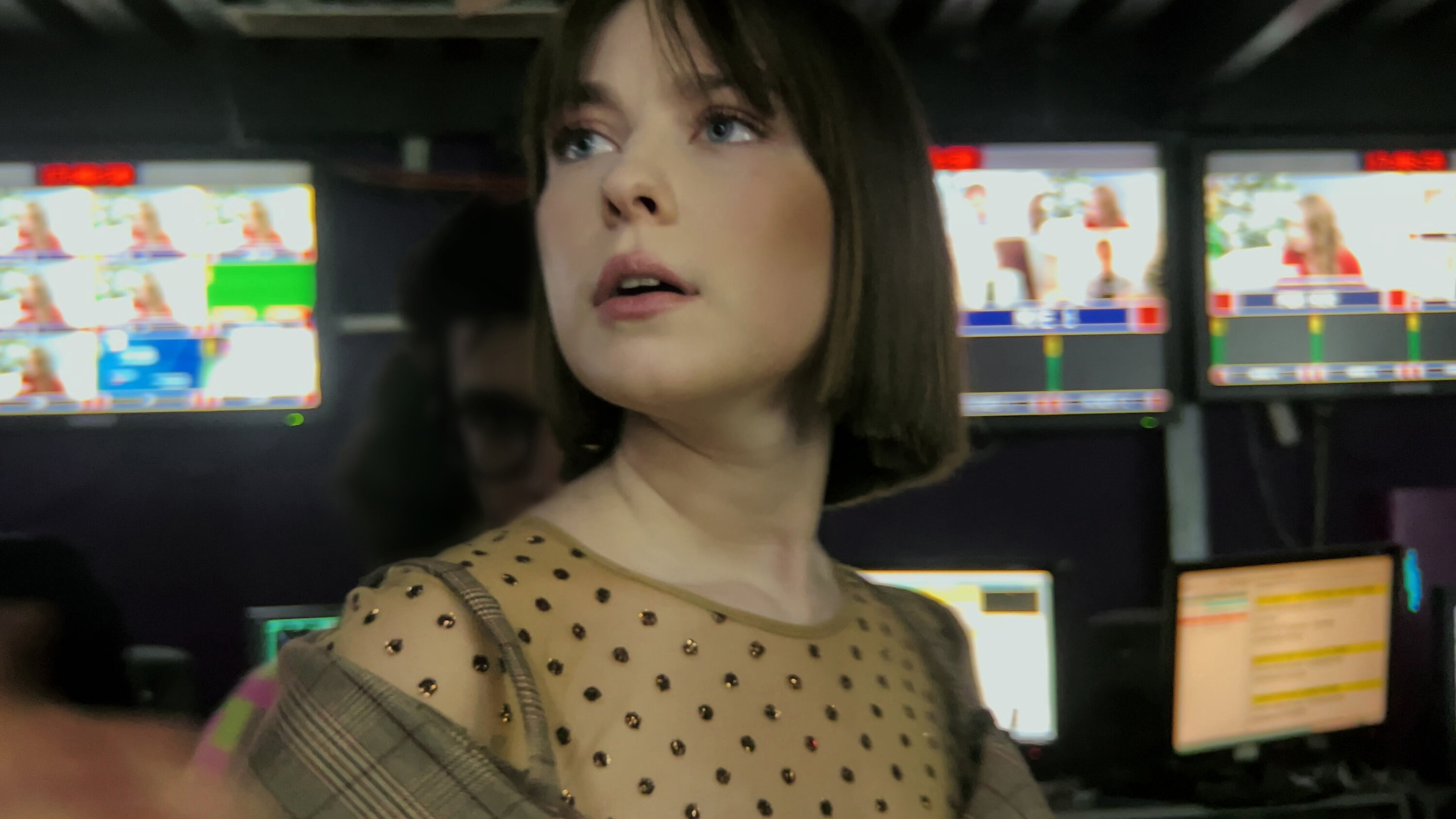
Someone, someday may produce a definitive film about Russia’s war on Ukraine, perhaps a historical drama or a painstakingly researched expose of the country’s corrupt government. It likely won’t be as visceral or affecting as this five-and-a-half hour documentary from director Julia Loktev (her first feature since 2011’s The Loneliest Planet). As seen from the perspective of a collective of young Russian journalists (most of them women), it spans the six or so months leading up to the invasion and the first ten days of the conflict.
The women profiled here mostly work for TV Rain, an independent Russian television news program. Led by Loktev’s friend, Editor-in-Chief Anna Nemzer, both the program and its journalists get labeled “foreign agents” by the government which also slaps a lengthy disclaimer stating such at the start of each broadcast. Civilians with this designation are subject to mandatory audits of their personal expenses and fines and criminal prosecution for non-compliance; they’re often also referred to as “undesirables”.
Divided into five digestible chapters, the first one provides a sampler of TV Rain’s programming and a behind-the-scenes overview into what goes into making it while facing limitations from the “foreign agent” label. The next two chapters focus more closely on the women themselves, among them Ksyusha, whose fiancé is imprisoned for his political beliefs; Ira, who is often seen with her adopted one-eye French bulldog mix; and Alesya, who has a female partner but is not out to her family. Loktev dutifully captures their skills as journalists in an environment that’s unfriendly to the profession but really excels at depicting them as persons dealing with and concerned by what is happening to their country.
The final two chapters unfold over the days leading up to and following Russia’s invasion of Ukraine. The trust Loktev has already established with her subjects pays off here as we see in near-real time how a country closes itself off from the rest of the world and what effect that has on its civilians. The framing of Loktev’s shots becomes tighter, more painfully intimate, emphasizing the confusion and fear her subjects are experiencing. Although the circumstances are extraordinary, they all remain fully relatable as their counterparts would in any country, making references to Harry Potter (Voldemort ends up a prescient stand-in for Vladimir Putin), gathering together for communal dinners and pondering over their unknowable futures.
The long running time is intimidating but it develops into an asset given how much it encompasses and how quickly the action accumulates near the end. The project ultimately works because Loktev uses what is essentially a humane character-study of a documentary to also detail how an ostensible “democracy” gradually, chillingly devolves into what is unquestionably a totalitarian regime. As the title indicates, although war has driven all of Loktev’s subjects to flee the country for their safety, the story’s not over—a second part subtitled “Exiles” is currently in post-production.
 Haunted Jukebox