
Day 6 began with a favorite that was expected, another that wasn’t and a third film that wasn’t in the same league but still deserves to find an audience. I squeezed in one more title on Day 7 before leaving Film Fest Land once again, returning to normal life.
THE HOLDOVERS
If Alexander Payne’s last film, 2017’s sci-fi allegory DOWNSIZING was a big swing and a miss, his latest plays it much safer for the benefit of everyone involved. A return to smart, dyspeptic comedy, THE HOLDOVERS also reunites Payne with another master of the form, Paul Giamatti, the star of his 2004 hit SIDEWAYS. Together, they’re a director/actor pair in sync with one another as much as Scorsese and De Niro or Holofcener and Keener.
The setting is an elite all-boys boarding school in Massachusetts 1970 (it was shot throughout the state, including a side trip to Boston.) Giamatti plays Paul Hunham, an ornery, pompous teacher who, like his Miles in SIDEWAYS is really just another masochistic, insecure underachiever. He gets stuck staying on campus for Christmas break to supervise the few students unable to go home. One of them, Angus (Dominic Sessa) is as intelligent as he is belligerent with a history of antagonizing Paul (and vice-versa.) Also staying on campus for the break is Mary (Da’Vine Joy Randolph), a cafeteria manager whose own son was recently killed in Vietnam. Angus and Paul evolve from being enemies to gradually understanding one another but David Hemingson’s screenplay presents this organically, further made convincing by the three central performances. In addition to Giamatti just doing what he does best, Sessa in his film debut is a great find on the order of, say, Lucas Hedges in MANCHESTER BY THE SEA while Randolph (MY NAME IS DOLEMITE) beautifully inhabits a complex character working through her grief.
Not only set in 1970, THE HOLDOVERS also looks and feels like a film from that period with its painstakingly correct stylistic touches such as its opening credits font, slow dissolves and winsome, period folk-rock soundtrack. At the TIFF Q&A, Payne mentioned that he always thought of himself as a 1970s New Hollywood-influenced director, so why not make a movie set in that decade. The highest praise I can give him is that he fully captures the feeling and substance of a good Hal Ashby film or one of Robert Altman’s smaller ensemble pictures. Though not exactly groundbreaking, it’s a solid, satisfying throwback and also a comeback for Payne as I haven’t liked anything from him this much since, well, SIDEWAYS. (Score: 9/10)
THE TEACHERS’ LOUNGE
A junior high school is as ideal a setting as any for a taut thriller and this German film gets all the little details right as to why—in particular, a mounting, no-going-back pressure of the sort easily egged on by early adolescents, although it comes just as swiftly from their parents and teachers. One of the latter, Carol (Leonie Benesch) has just taken her first job out of teaching school. She’s initially a natural—her control of and engagement with her students is readily apparent and impressive for such a novice. The trouble begins when a thief starts stealing money from various faculty. Carol is vehemently against the interrogation techniques the principal and her colleagues use on suspected (targeted, really) students. As more money goes missing, she decides to take matters into her own hands, making a shocking discovery in the school’s titular space. She’s also left immediately blindsided (and also targeted in a different way) by her action’s consequences.
I didn’t know what to expect coming into THE TEACHER’S LOUNGE, only mildly intrigued by its title and premise. I left it nearly buzzing with excitement from its cunning trajectory: in solving a mystery, good intentions end up backfiring magnificently for all parties involved. Meanwhile, due to opposing, unwavering stances exacerbated by public shaming conducted both in person and over social media, the tension ramps up until it reaches a near-breaking point. Suspicion, paranoia, desperation and hysteria all factor into how a seemingly straightforward conflict gets blown way out of proportion and the film rarely wavers in holding one’s attention. It may even go a little too far for some in the last act, though the final scene satisfyingly offers a modicum of closure for a seemingly unresolvable situation. (8/10)
WE GROWN NOW
Set in a re-creation of the now-demolished high rise towers of the notorious Chicago housing project Cabrini-Green in 1992, Minhal Baig’s film focuses on two 12-year-old boys living there: Malik (Blake Cameron James) and Eric (Gian Knight Ramirez). When not partaking in such activities as pushing a mattress down a dozen flights of stairs to use as a playground implement or playing hooky from school to explore the Loop, they’re faced with the harsher realities of this world: drug-ridden crime, drive-by shootings, reactionary police raids. As Malik’s mother Delores (Jurnee Smollet) looks for a safer environment for her family, what was once an inseparable friendship between the two boys begins to fray. While it doesn’t come close to achieving the rare poetry of obvious influences such as KILLER OF SHEEP or the fourth season of THE WIRE, this evokes a time and place in vivid enough detail (especially in the dimly lit, sparsely furnished apartments); James and Ramirez, both in their film debuts are also well cast. Still, it’s a type of story that’s been told many times before and far less predictably. (6/10)
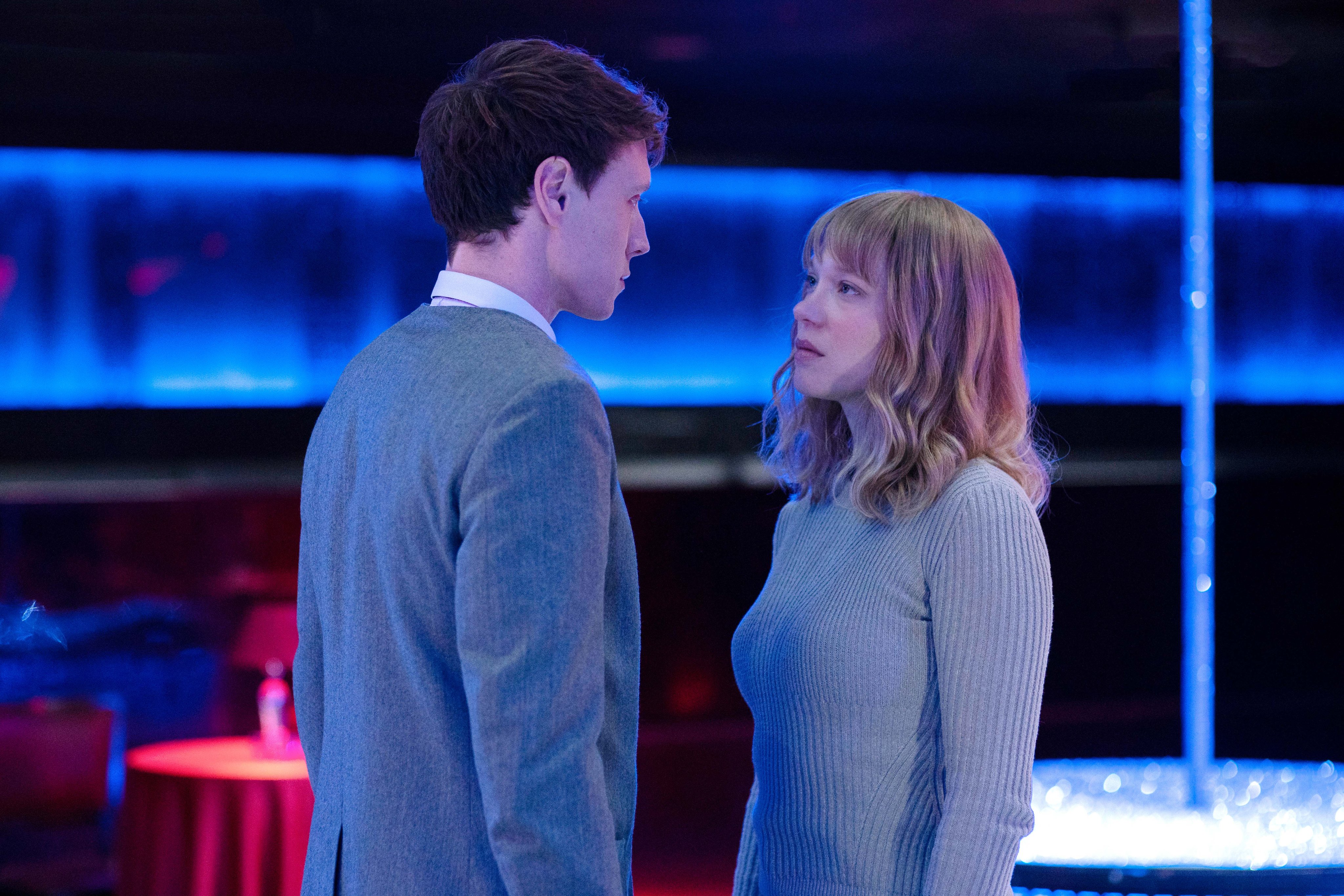
THE BEAST
In past films like SAINT LAURENT and NOCTURAMA, I’ve admired director Bertrand Bonello’s approach and elements of his heightened style without finding them complete or entirely convincing. His latest gets closer than ever to feeling whole but that’s primarily due to star Lea Seydoux appearing in nearly every scene. Her Gabrielle is paired with Louis (George MacKay) principally across three time periods: 1904 France, 2014 Los Angeles and a near-future heavily shaped by artificial intelligence. Bonello will also occasionally and briefly shift to 1980 or the mid-1960s for scenes that seem present mostly to indulge in era-appropriate music or fashion. The constant throughout this is how Gabrielle and Louis spin in orbit but can never fully connect with each other for reasons not fully apparent until late in the film.
Very loosely adapted from the Henry James novella THE BEAST IN THE JUNGLE, the film is perhaps overlong but rarely boring. It’s mostly a showcase for Seydoux and MacKay as they inhabit different personas in alternate time periods (the latter especially effective when shifting from a European aristocrat to a 21st Century incel) and, as usual, also one for Bonello’s depiction of worlds only possible through a camera lens. I’m not sure what it all adds up to although its fixation on AI seems especially timely and considered; let’s just hope it doesn’t start an accidental trend by way of its high-concept end credits “roll”. (7/10)
 Haunted Jukebox