“Write what you know” is the most basic and profound advice I’ve received as a would-be author. For some, it’s essentially a jumping-off point, an ability to create entirely fictional worlds still informed and inspired by one’s own sensibility and lived experience. For others, the implication is less abstract—an invitation to write directly about yourself and what you’ve experienced without the pretense of hiding behind a pseudonym or a composite. As evidenced by this project and my blog’s pull towards critical writing and memoir, I tend to fall into the latter camp. Nonfiction has just come easier to me even as I’m often influenced by novels as much as autobiographies and books about film and music (among other arts.)
A preference for fiction or nonfiction can also apply to filmmaking. A director may choose to create new worlds aided by an original (or sometimes adapted) screenplay or relay a true story via a documentary or essay film. Some possess the talent or at least the interest and appetite to do both: Jonathan Demme following his iconic Talking Heads concert film Stop Making Sense with the near live-action cartoon fantasy of Something Wild, or Werner Herzog mostly pivoting to documentary in his later career while still making time for the occasional fiction feature such as Bad Lieutenant: Port of Call New Orleans or Rescue Dawn (the latter a fiction remake of his own doc, Little Dieter Needs To Fly.) As regarding anything offering a binary as recognizable as fiction vs nonfiction, one doesn’t necessarily have to choose sides.
Where this becomes tricky and often more fascinating occurs when one blurs the line between these two approaches. Abbas Kiarostami’s Close-Up, for instance, recounts a true-life story by enabling its participants to reenact the events. The end result was by no means a documentary—technically, it was a work of fiction, for a viewer simply couldn’t know if the film’s events all actually happened, whether Kiarostami says they did or not. Some actual documentaries such as Man On Wire and The Act of Killing take a near-opposite approach by including explicit reenactments that are not fully meant to stand in for the real thing; the latter’s assemblage of former members of Indonesian death squads are asked to recreate their genocidal 1960s murders of the country’s communist citizens as if they were scenes in a movie. Also consider mockumentaries like This Is Spinal Tap, which clearly read as fiction… except to those who don’t know that they are and get swept up in their convincing, deadpan approach.
Guy Maddin is not what one would deem a documentarian in the traditional sense. Nearly all of his output is explicitly fantasy—even his works one could describe most as “realistic” and traditionally narrative-driven such as Keyhole (2011) or The Saddest Music In The World (2004) are not too far off from fever dreams (the latter features Isabella Rossellini as a beer baroness whose prosthetic leg is literally a glass boot full of her product!) Emerging from the ultra-indie Winnipeg film scene with his 1988 debut feature Tales From the Gimli Hospital, he had his peculiar, specific style already in place. Heavily influenced by silent film aesthetics (black-and-white cinematography, intertitles, archaic techniques such as iris-in, iris-out transitions between scenes), Gimli would appear to be a silent cinema pastiche except that there is sound (some occasional dialogue, even!) and an overarching surrealist sensibility that, while not at all modern, is something one would rarely mistake for being just from the silent era—contrarily, it’s more out of time and very much its own thing.
Maddin made three more features and a smattering of shorts over the next decade, but I did not even hear of him until 1998. He was in Boston for a career-to-date retrospective at the Museum of Fine Arts and visited my Avant-Garde Cinema class at Boston University for a Q&A after a screening of Careful (1992), his first color feature and most dialogue-heavy effort to date. Naturally, it was shot in two-strip technicolor (limiting the palette to two hues (and an occasional smidge of yellow) at all times) and the stilted dialogue had been translated from English to Icelandic and back to English again. In the classroom, Maddin came off as an affable (if somewhat bewildered) Canadian, just as my classmates and I festooned him with questions about his bewildering film. The premise? An isolated town that’s continually threatened by avalanches triggered by either loud noises or outwardly expressed emotions!
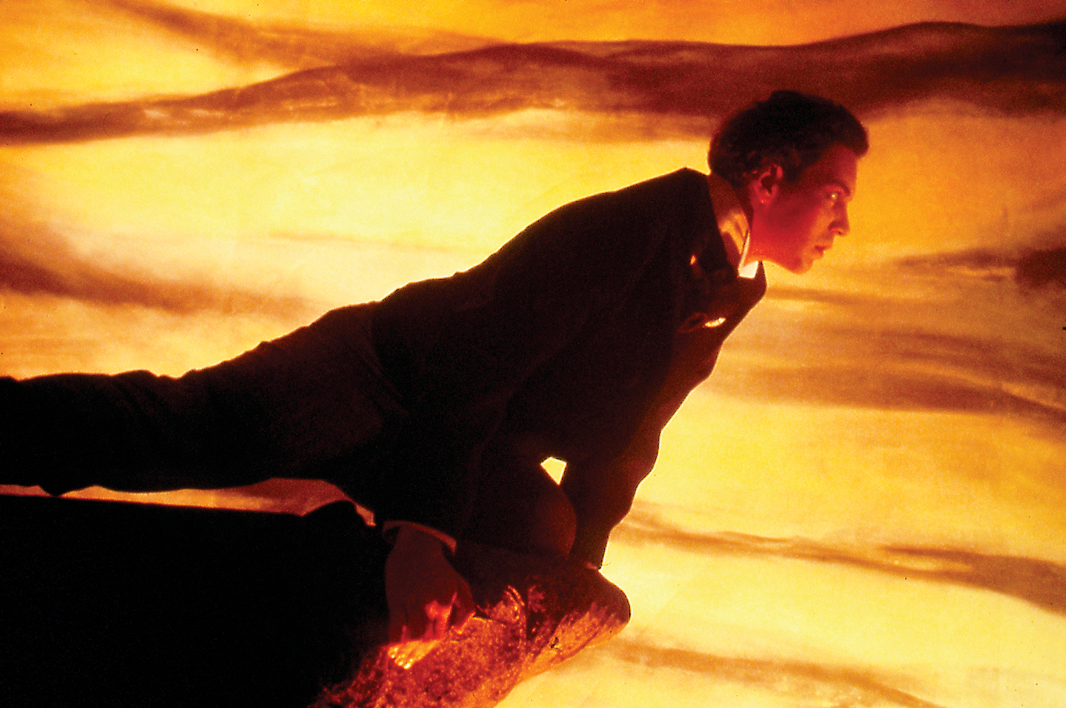
Like much of what I saw in that class, I didn’t fully know what to make of Careful, though it was unique without being obscure or off-putting; I duly rented the rest of Maddin’s features from my local VideoSmith. Two years later, his produced-for-TIFF short The Heart of The World won ample acclaim including the Genie Award (Canadian Oscars-equivalent) for Best Live Action Short Film plus accolades at film festivals from San Francisco to Brussels. Relaying a love triangle/end times/cinema-as-savior chronicle in the style of early 20th Century art movement Russian Constructivism (a precursor to Dziga Vertov’s Man With A Movie Camera and the films of Sergei Eisenstein), the short’s exhilarating, rapid-fire editing encompasses a dizzying amount of plot in just six minutes.
From there, Maddin was on a roll. With Dracula: Pages From A Virgin’s Diary (2002) he transformed a filmed ballet adaptation of Bram Stoker’s iconic novel into an experimental tone poem in his phantasmagorical style, while the aforementioned The Saddest Music In The World, featuring such marquee names as Rossellini and Mark McKinney not only received widespread acclaim but became something of an indie “hit”. These features were interspersed with a slew of shorts ranging from My Dad Is 100 Years Old (made with Rossellini about her famous filmmaker father Roberto) to Sissy Boy Slap Party (everything the title says it is and somehow more.) Cowards Bend The Knee (2005) and Brand Upon The Brain! (2006) kept the momentum going while also finding Maddin, perhaps influenced by his short with Rossellini turning inward and ostensibly autobiographical: both films had characters named after himself and took inspiration from his own memories (no matter how distorted.)
My Winnipeg felt like a natural progression from those self-referential works. Commissioned by the Documentary Channel (a now-defunct cable network), Maddin was given one directive for the project from his producer: “Don’t give me the frozen hellhole everyone knows that Winnipeg is.” Maddin gleefully obliged, crafting an unusual hybrid of an essay film that he described as a “docu-fantasia”. Filmed almost entirely in black-and-white, the final product is a mélange of archival footage, re-creations and new material shot to appear like it’s from the past (or some unspecified limbo) continually shepherded by Maddin’s voiceover narration. In other words, he made a Maddin film—a bittersweet love letter to his hometown like past cine-essayists such as Chris Marker or Agnes Varda might’ve conceived but full of potential tall tales and a liberal dose of magical realism. Did “Man Pageants” actually occur at the Paddlewheel Room in The Bay department store? Did “If Day”—a World War II-era demonstration involving a simulated Nazi invasion of the city (covertly serving as a cover to buy Canadian war bonds) really happen? “What if, what if…” ponders Maddin’s narration as a reoccurring refrain throughout; like Kiarostami in Close-Up, he leaves it to the viewer to decide what to believe and/or dismiss.
Brand Upon The Brain! implemented voiceover narration from Rossellini in its theatrical release, though alternate audio tracks featured other narrators, among them oddballs like Crispin Glover, Laurie Anderson, Eli Wallach, Louis Negin (a member of Maddin’s stock players who appears in My Winnipeg as Mayor Cornish) and Maddin himself. For this immediate follow-up, however, Maddin was pretty much the only narrator (even if some screenings purportedly substituted him with live readings from British “Scream Queen” Barbara Steele and the inimitable cult legend Udo Kier(!)) I was lucky to first see the film at one of its premiere screenings at TIFF in 2007 with Maddin himself narrating live on stage at the Winter Garden Theatre. While not as distinct a vocal performer as Rossellini or Glover, it only seemed right to hear these intensely personal words spoken by the man who wrote them, no matter how much “truth” they contained.
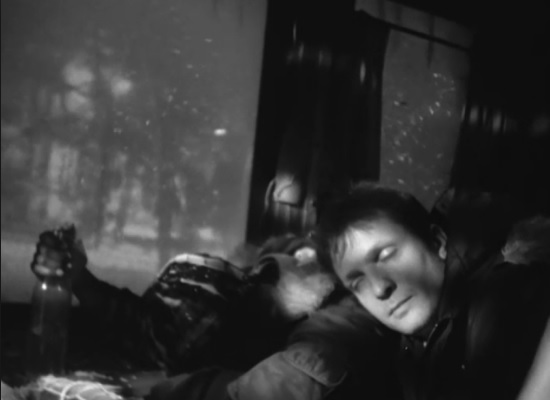
“Guy Maddin” also appears onscreen in the guise of actor Darcy Fehr (who played another version of the director in Cowards Bend The Knee.) In the world of My Winnipeg, as a throughline narrative, a drowsy Guy/Darcy, slumped in this seat on a moving train looks to escape his hometown (“What if I film my way out of here?,” asks Maddin’s narrator at one point.) The city as blurred imagery through the train windows emerges as a dreamscape of memories that do not fully coalesce; the whole thing is made further bizarre by a few sausages inexplicably hanging from the train car’s ceiling on strings, gently bobbing back and forth over Guy’s/Darcy’s head. Maddin’s fragmented phrasing provides unsentimental but near-lyrical reverie acknowledging “The Forks (of intersecting rivers)… The Lap (of the land)… The Heart of the Heart of the Continent” that establish geographically-centrally-located-but-still-isolated Manitoba capital Winnipeg, a place where it’s “Always winter, always sleepy.”
Whereas some other filmmakers might confine themselves to Winnipeg lore and landmarks constituting a shared experience (The 1919 General Strike, Happyland amusement park, the saga of the doomed effort to save the Wolseley Elm), for Maddin, his own personal experience is inextricable from the whole (hence the declarative “My” in the film’s title.) Not only does he delve deep into places and events that had a formative effect on his psyche (such as the three-story Sherbrook Pool, one public pool stacked upon another and another with the bottom, subterranean level restricted to boys), he goes so far as to sublet his childhood home, a “white block house” connected to what was once his Aunt Lil’s beauty parlor. As part of a drive to “properly recreate the archetypal episodes” of his family history, he casts actors to portray his three older siblings, circa-1963 (when he would’ve been seven years old); his father is excluded, but not Mother.
For her, Maddin travels further down the rabbit hole in clouding the real with the imagined. The Mother we see on screen is to all intents and purposes for Maddin his mother. However, she’s actually octogenarian Ann Savage, an actress best known for portraying arguably the most frightening film femme fatale of all time in Edgar G. Ulmer’s 1945 poverty row classic Detour. Maddin actually gives the game away at the onset: My Winnipeg opens with footage of an off-camera Maddin directing Savage as she rehearses some dialogue. That he drops the pretense of filming his actual mother vs. casting a professional actress to play her sets an expectation that what follows is a fusion of facts and legends. It’s in line with Maddin’s long-running tendency to present modern day films as if they were remnants from the past or for that matter, casting other people to play versions of himself and his siblings (though he notes of the latter, they do “bear uncanny resemblances to the originals.”)
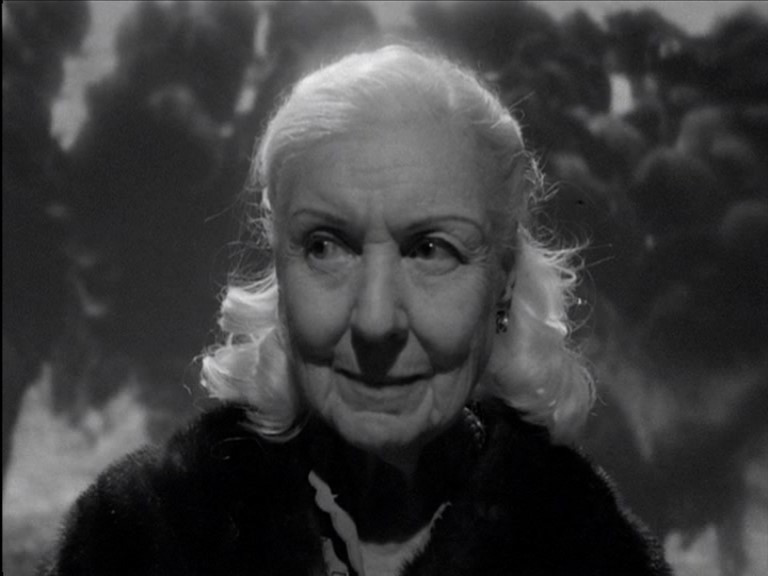
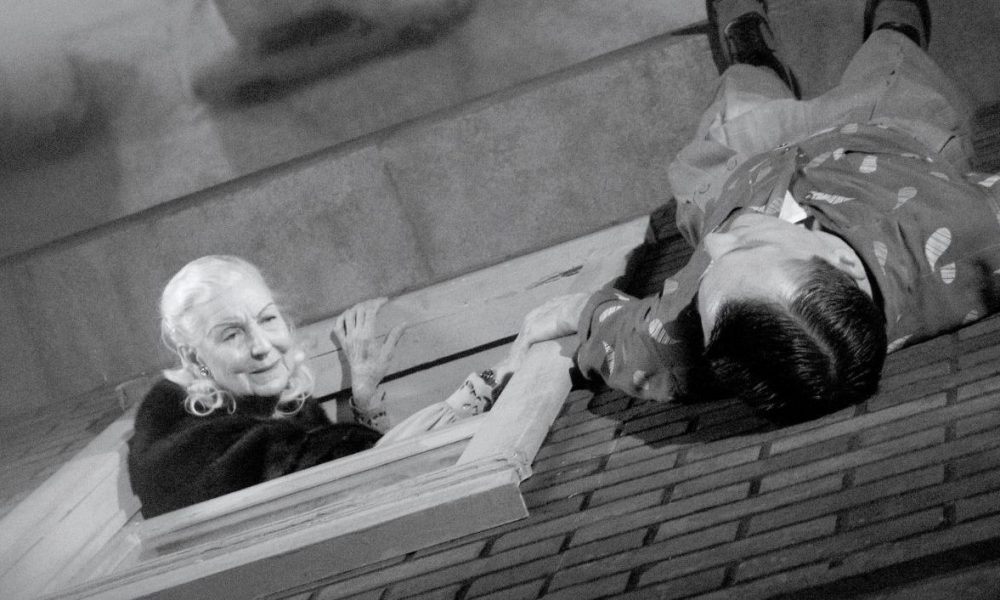
In Maddin’s accompanying book of the film, he says of Savage, “I knew there was only one person alive, who had ever lived, who could play the role of my mother.” He was fortunate to get her, as she’d retired from acting in the 1950s. The idea of casting the terrifying succubus from Detour as your mom is a twisted, brilliant joke viewers familiar with that film will immediately get, but Maddin doesn’t relegate her to a punchline. In one of the film’s more outrageous and entertaining fabrications, we do see how Mother made a living starring in Ledgeman, “the only TV drama ever produced in Winnipeg,” on the air since 1956 (Maddin’s birth year.) Every day at noon, viewers could watch Mother talking her son out of threatening to jump off a window ledge he had just climbed out on, driven by some sensitive fear or malady (usually instigated by Mother, naturally.) It neatly sums up a perceived dynamic between Maddin and his mother as depicted by an actress playing a mother who is also an actress.
However, the set piece that places Savage’s performance in nearly the same league as her Detour work arrives later with the scene she rehearsed at the beginning—a re-creation of the time after Maddin’s older sister Janet hit a deer on the highway coming back from a trip. As Janet confesses her accident to Mother, the old woman is not buying any of it. She suspects her daughter’s tardiness was due to something more sinister, more sexual. To watch Savage-as-Mother snarl accusations at Janet (“Where did it happen? In the back seat?… Did he pin you down, or did you just lie back and let nature take its course?”) is to see her young, dangerous Detour spirit flicker back to life. No matter how outrageous the exchange may seem, one immediately detects why Maddin cast Savage for the part and how her spitfire and dominance vividly embody his own idea of his mother (if not how the actual person might’ve appeared to us strangers.)

As with many essay films about one’s own past, My Winnipeg is a pining for the way things used to be and what’s been lost. Nostalgia is perhaps unavoidable in such explorations, even if the ambiguity with which Maddin presents what’s real and what’s fabricated is a tonic revealing how layered and complex such thoughts can be. He spends the whole of the film thinking about release and moving on, but he has good reasons as to why he continues to live and work in Winnipeg to this day. One is a modicum of hopefulness, even if it means conjuring up a figure called “Citizen Girl”, a bold, beautiful warrior who with the touch of her wand could triumphantly restore the city to its former glory (including turning on the neon sign at Clifford’s, a defunct ladies’ apparel store that is a well-beloved piece of iconicity for certain generations of Winnipeggers.)
Still, one senses Maddin knows such conceits are just wishful thinking. Some things can never come back, like his teenaged brother Cameron whom we’re told died of some undisclosed cause not long after the period re-created with Savage. My Winnipeg ends rather wistfully with Savage and the actor playing Cameron in a surprisingly intimate, tender mother/son embrace. “What is a city without its ghosts?” Maddin’s narration asks and it’s the film’s central thesis. It lends weight to what simply could have been a kooky look at a quirky childhood. Indeed, the fluidity of ghosts and shifting, occasionally unreliable memories in this “docu-fantasia” hybrid seem to contain (as Maddin notes Sherlock Holmes creator Sir Arthur Conan Doyle once said of Winnipeg) the “greatest psychic possibilities.”
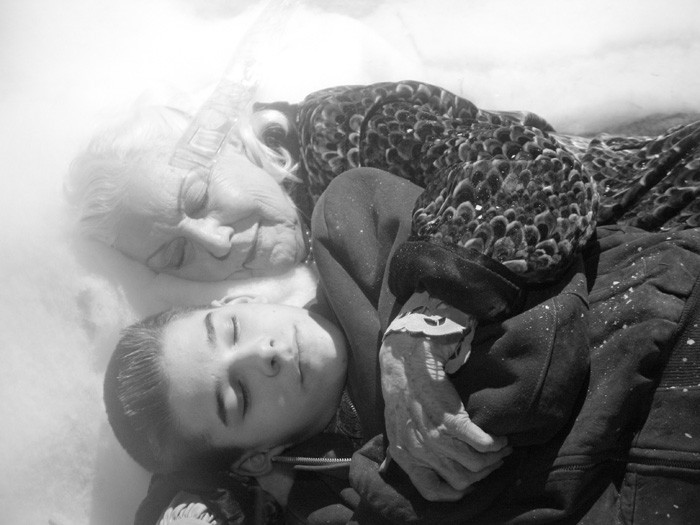
Essay #18 of 24 Frames
Go back to #17: C.R.A.Z.Y.
Go ahead to #19: A Matter of Life and Death
 Haunted Jukebox