If it seems conspicuous that the only 1991 entry in my 100 Albums series was a singles comp (represented below via a mind-melting medley covering U2 and Frankie Valli), note that at times I seriously considered including the following: R.E.M.’s first number one album (which also had their highest-charting single), Seal’s first eponymous release (believe it or not, he was actually interesting pre-Grammys/Steve Miller cover/Heidi Klum), Sam Phillips’ second secular album (I’d write plenty about her third), even PM Dawn’s dreamy, near-unclassifiable debut. In the end, none compelled me enough to want to write about at length, but I’ve made sure to represent tracks from each of them here.
Historically, people love to sum up 1991 as The Year of Nirvana and Nevermind; I respected Cobain and co. but was never much of a fan, preferring my rock and roll to be Anglophilic and danceable. Looking over this curious selection, one might almost get an impression of ’91 as a last breath of optimism/utopianism before grunge and alt-rock’s irony/cynicism took over. Saint Etienne’s landmark early single (still easily one of the five best songs they ever did) sets the tone, and fellow Brits The Orb, The Shamen, Jesus Jones, James, Primal Scream and even Seal all sustain it, although only “Right Here Right Now” really broke through over here. Kirsty MacColl’s vivacious Latin bauble carries the same spirit although musically it has precious little in common with the others.
As with last year’s playlist, this combines top 40 (Roxette, Prince, Londonbeat) with modern rock (Billy Bragg, Electronic, Violent Femmes, Matthew Sweet) and the occasional crossover from the latter to the former (Divinyls, Siouxsie and the Banshees.) The mighty “Unfinished Sympathy” sounds absolutely undiminished, “Love… Thy Will Be Done” is a terrific, long forgotten top ten hit ripe for reappraisal and “Funeral” and “It Won’t Be Long” are obscurities everyone should know. I was giddy with joy when many songs by the KLF resurfaced on streaming in the past few years. A techno-pop hymn about the band’s own “mythology” and their ice-cream van, sung by none other than country-western legend Tammy Wynette(!), “Justified & Ancient” is the most bonkers hit of its time (and perhaps the entire decade.) Thirty-plus years on, I still can’t believe how big it was. Watch the video above and ask yourself, “Did this really happen, and could something so delightfully weird and far out of left field ever become a hit again?”
1991: All Bound For Mu Mu Land
Saint Etienne, “Nothing Can Stop Us”
The KLF feat. Tammy Wynette, “Justified & Ancient”
PM Dawn, “Paper Doll”
Siouxsie and the Banshees, “Kiss Them For Me”
Crowded House, “Fall At Your Feet”
Sam Phillips, “Cruel Inventions”
Alison Moyet, “It Won’t Be Long”
Roxette, “Fading Like a Flower”
R.E.M., “Near Wild Heaven”
Divinyls, “I Touch Myself”
Mekons, “Funeral”
The Orb, “Little Fluffy Clouds”
The Shamen, “Move Any Mountain”
Massive Attack, “Unfinished Sympathy”
Billy Bragg, “You Woke Up My Neighbourhood”
Seal, “Future Love Paradise”
Dream Warriors, “My Definition of a Boombastic Jazz Style”
Londonbeat, “I’ve Been Thinking About You”
Matthew Sweet, “I’ve Been Waiting”
Electronic, “Get the Message”
Morrissey, “My Love Life”
James, “Sit Down”
Prince & the New Power Generation, “Diamonds and Pearls”
Joni Mitchell, “Come In From the Cold”
Erasure, “Breath of Life”
Kirsty MacColl, “My Affair”
Kylie Minogue, “Shocked”
Martika, “Love… Thy Will Be Done”
Simply Red, “Something Got Me Started”
Lisa Stansfield, “It’s Got To Be Real”
Queen, “I’m Going Slightly Mad”
U2, “Until The End of The World”
Jesus Jones, “Right Here Right Now”
Pet Shop Boys, “Where The Streets Have No Name/Can’t Take My Eyes Off You”
Like songs, poems, books and the live stage, films are another medium for storytelling. Even the most simplistic (Arrival of a Train at La Ciotat, The Lumiere Brothers, 1896) or experimental (Wavelength, Michael Snow, 1967) cinema communicates something to its audience, no matter how straightforward (the former a 50-second shot of exactly what its title promises) or abstract (the latter a 45-minute zoom shot directed towards a window in a room.) Arguably the best films either relay a story like none other or do so in ways few (if any) other films have tried. One might regard this as a challenge given the sheer amount of work this relatively young medium has already produced; even accounting for the small fraction of it that’s truly great (on Letterboxd, for example, I’ve given only about 250 out of 4500 movies (6%) a five-star rating), it’s easy to be critical/skeptical of finding new films that surpass or at least measure up to one’s favorites.
Still, I’d argue the notion that “it’s all been done” actually sustains an interest in filmgoing: one rarely knows when you will find something new to enter into your own canon of great movies. To develop a critical eye is to recognize when something is a rare gem, a work presenting a world clearly distinguishing itself from others while also meaningful in how it accomplishes this. Consider the titles I’ve included in this project so far: An irreverent, satirical take on the Arthurian legend that resolves itself via anarchy? A transgressive, phantasmagorical autobiographical sketch that contains as much razzle-dazzle as it does sober self-actualization? A revisionist Western, an idiosyncratic, kinetic extrapolation of a Herman Melville novel, a near tone-poem sculpted from the textures of an urban environment, even a war-tinged romance turned fantasy pondering the afterlife—all of these have singular narratives presented in equally original ways, even if they occasionally allow one to spot allusions to other works. All That Jazz, for instance, might not have existed without the influence of Fellini’s 8 ½, though most viewers would likely find more differences than similarities between the two; casual ones might not even pick up on them at all.
Through the years, I’ve shifted stances between whether form or content carries more weight in determining a film’s greatness. In film school, after taking a class on Avant Garde cinema and another called “Ways of Seeing”, I edged towards valuing the shape of a film rather than its story (no matter how conventional or nonlinear.) I’d chalk that up to my exposure to many different ways of making a film over a short period of time. When asked by family or friends if I ever thought I’d direct any films of my own, my stock response was usually, “If I do, they’ll be experimental ones”; obviously, I perceived myself as somehow beneath becoming a more conventional filmmaker, not realizing how difficult it is to craft anything on either side of the commercial spectrum (at least in this time before anyone could make a movie with their smartphone.)
Of course, while studying film, I was exposed to just as wide a variety of narratives as I were stylistic approaches. It’s easy to focus on the plot but also let it dictate how you feel about the imagery, sound, editing, production design, etc. For instance, I was so sickened by some of the content in Darren Aronofsky’s bold, numbing Hubert Selby Jr. adaptation Requiem For A Dream that I couldn’t appreciate its style one whit. In turn, the deliberately unpleasant way it often presented said content (my god, the unflattering lighting!) altered my perception of the material and may have influenced why I had such a negative reaction to it. For better and worse, form and content are equally crucial for a film to register and connect with me—as one should expect of all great art, it constitutes a delicate balance, a confluence of all of its parts coming together to somehow form a satisfying whole.
At one point in this project, I was going to include an entry on The Sweet Hereafter, Atom Egoyan’s 1997 adaptation of a Russell Banks novel about a remote community ravaged by the aftermath of a fatal school bus accident. Seen when it was first released during the holiday break between my first two semesters of film school, it had a substantial impact in how it played with time and perspective, its narrative generally nonlinear, certain information intentionally missing until strategically revealed as if sifting through puzzle pieces and attempting to piece them all together. It was the Toronto-based Egoyan’s seventh feature; I’d end up renting the previous six from various video stores over the next six months.
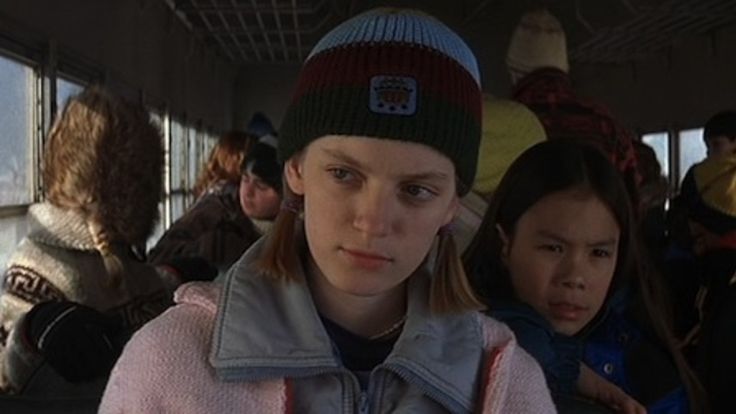
Sarah Polley in The Sweet Hereafter
Perhaps I’ll will write more about The Sweet Hereafter one day (it’s far from the only title I considered for this project but ultimately passed over); I mention it here because of its central performance from then 18-year-old Sarah Polley, a Canadian child actress who had appeared in such projects as The Adventures of Baron Munchausen, TV series Ramona (based on Beverly Cleary’s beloved children’s novels) and Road to Avonlea and Egoyan’s sixth feature Exotica. Nicole, her character in The Sweet Hereafter, however, was a turning point. With a naturalness and steel-eyed reserve, Polley had undeniable presence—magnetic without coming off as showy, thoughtful but not opaque. As the lone survivor of the crash, she’s thrust into a situation where she holds a rare power. As her backstory comes to light, she mesmerizes in how she wields such power while not letting us forget, heroine or anti-heroine, she’s still just a teenager, flaws and all.
The film raised Polley’s profile considerably outside her home country. Over the next few years she starred in a number of pictures from big Hollywood productions (Go, The Weight of Water, Zack Snyder’s Dawn of The Dead remake) to indieplex staples (Guinevere, David Cronenberg’s eXistenZ) and smaller, more intimate pictures like My Life Without Me and Hal Hartley’s No Such Thing. During this period, Polley began writing and directing her own short films, which led to an impressive feature debut with 2006’s Away From Her, an Alice Munro adaptation that earned its star, Julie Christie an Academy Award nomination. Along with its follow-up Take This Waltz (2011), Polley suggested that her skills as a filmmaker were up there with her acting, approaching material with a tangible point of view and a nuanced understanding of human behavior.
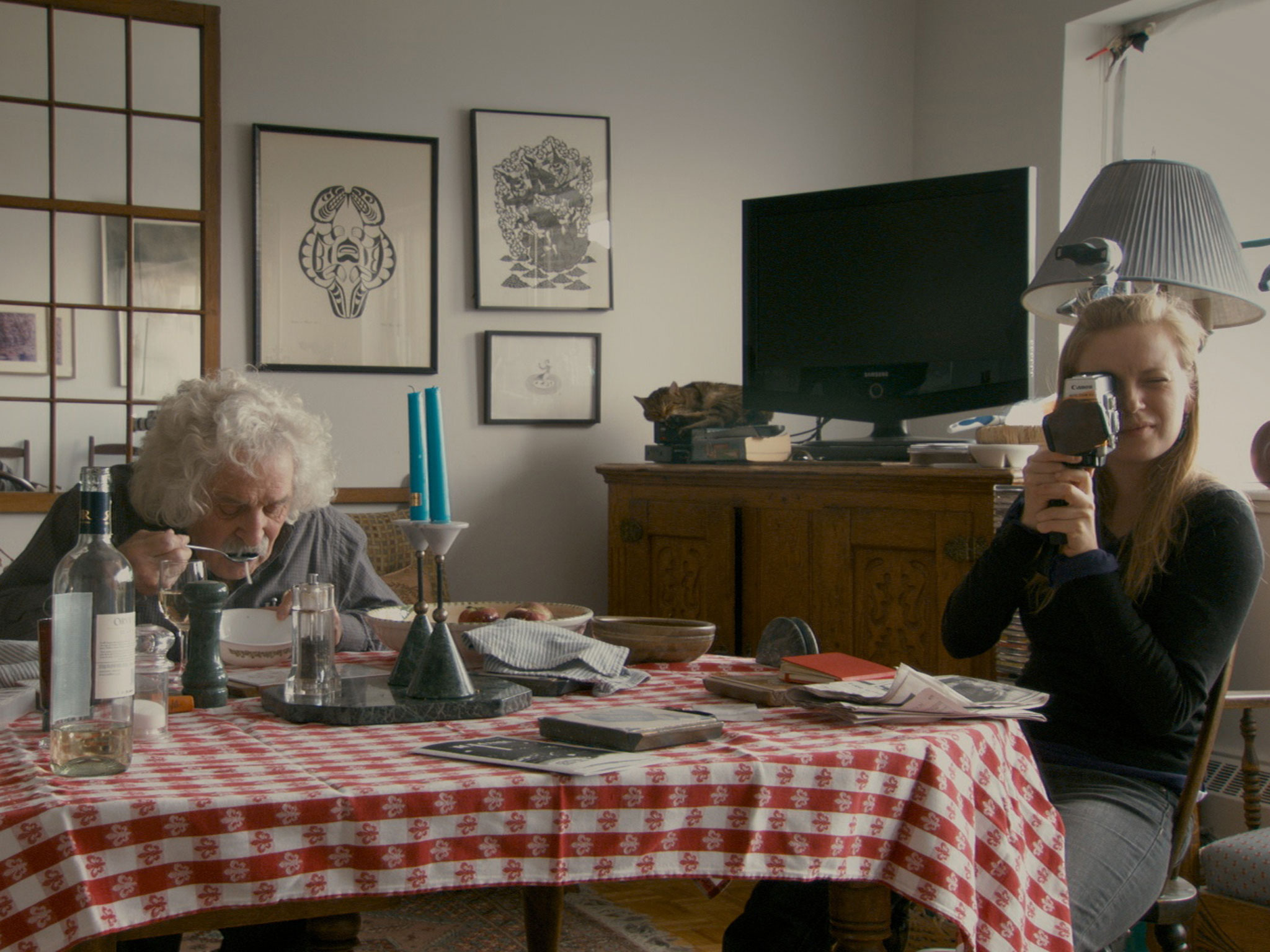
One can apply the same attributes to her third feature and first documentary, 2012’s Stories We Tell. It’s a personal essay film about her family and although accurate, such a simplistic description doesn’t do it justice. At least on the surface, it’s a template for Polley to interview her father, Michael, her older siblings and stepsiblings and an extended network of people who all knew her mother, Diane, who died of cancer in 1990 when Sarah was eleven. She accompanies these interviews with silent home movie footage and Michael (himself an actor) reading his account of the family’s story; in doing so, she explores in-depth the various ways of telling a story, considering multiple points of view, the abundance or absence of found documentation, and how all that information is shaped into a narrative, bearing in mind what’s emphasized and also what’s left out.
Polley commences by asking her subjects variations of the following directive: “Tell me the whole story (of our family) as if I don’t know the whole story.” To pose this instruction is a neutral way of building a story drawing from various perspectives, to see what details reoccur in each person’s version of the story and, more significantly, which ones conflict and contrast with each other. From there, the viewer can piece together a throughline narrative: Diane (also a Toronto-based actor) met Michael in 1965. They married, had kids and both mostly left their chosen professions behind to raise their family. In 1978, craving a return to acting, Diane relocated to Montreal for a few weeks to be in a stage play (called Toronto (!)); not long after her return, she found out she was pregnant with Sarah. After Diane’s early death, child actress Sarah, significantly younger than her siblings would become even closer to her father.
It seems a fairly straightforward trajectory until one hears numerous people talk about how, leading up to her time in Montreal, Diane and Michael had grown apart—she was frustrated with having given up her career to become a housewife and not fully getting the love and attention she needed from him. However, it’s not the whole story. 45 minutes in, the viewer learns that before meeting Michael, Diane was previously married to another man. Two of Sarah’s four siblings are actually step-siblings from that marriage; one of them describes their birth father as “controlling”. Deeply unhappy, Diane leaves him for Michael and as a result, loses custody of her two children.
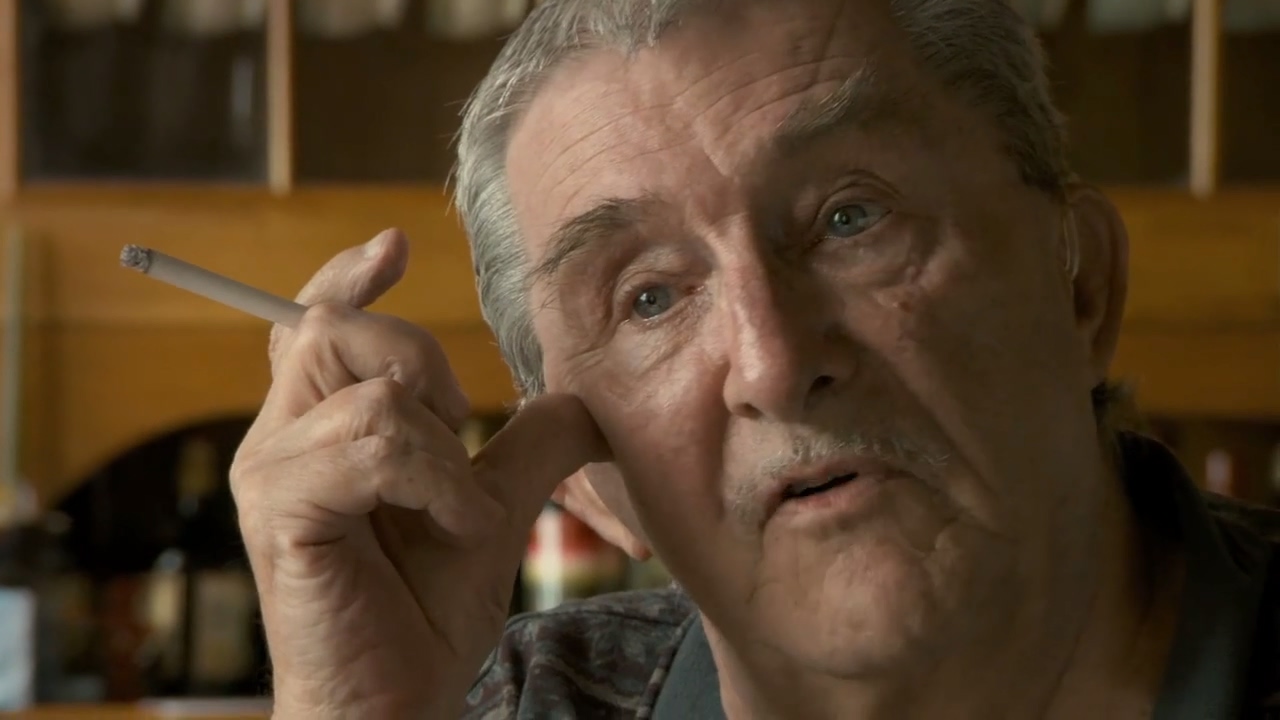
Michael Polley
In the course of their interviews, multiple siblings and friends of the family remind Sarah that they used to tease her as a child because she didn’t much resemble her father, physically, stoking speculation that Diane might have slept with another man during her time in Montreal. After some detective work as an adult, Sarah discovers her biological father is actually Harry, a filmmaker Diane met while acting in Montreal. A DNA test proves it, enabling Sarah to forge a relationship with Harry while also figuring out how to break the news to the rest of the family, and in particular, Michael. Us knowing that Diane lost custody of her two eldest children also illuminates why she didn’t leave Michael and her two kids with him after meeting, falling for and becoming pregnant by Harry.
In unspooling this ever-more complex trajectory and keeping it afloat, Stories We Tell is a marvel of editing. Often, the film stitches together phrases from numerous interviewees with a swift fluidity where one could almost believe they came about as a mass conversation, like all the subjects were sitting together in the same room. Even if this were the case, however, it would sound more disjointed, like a Robert Altman film where words overlap due to the natural messiness of most conversations. Again, deciding what to include and where to put it is a conscious decision made by Sarah and her editor, Mike Munn. That it doesn’t come off as stilted but remains engrossing is the key to effective storytelling.
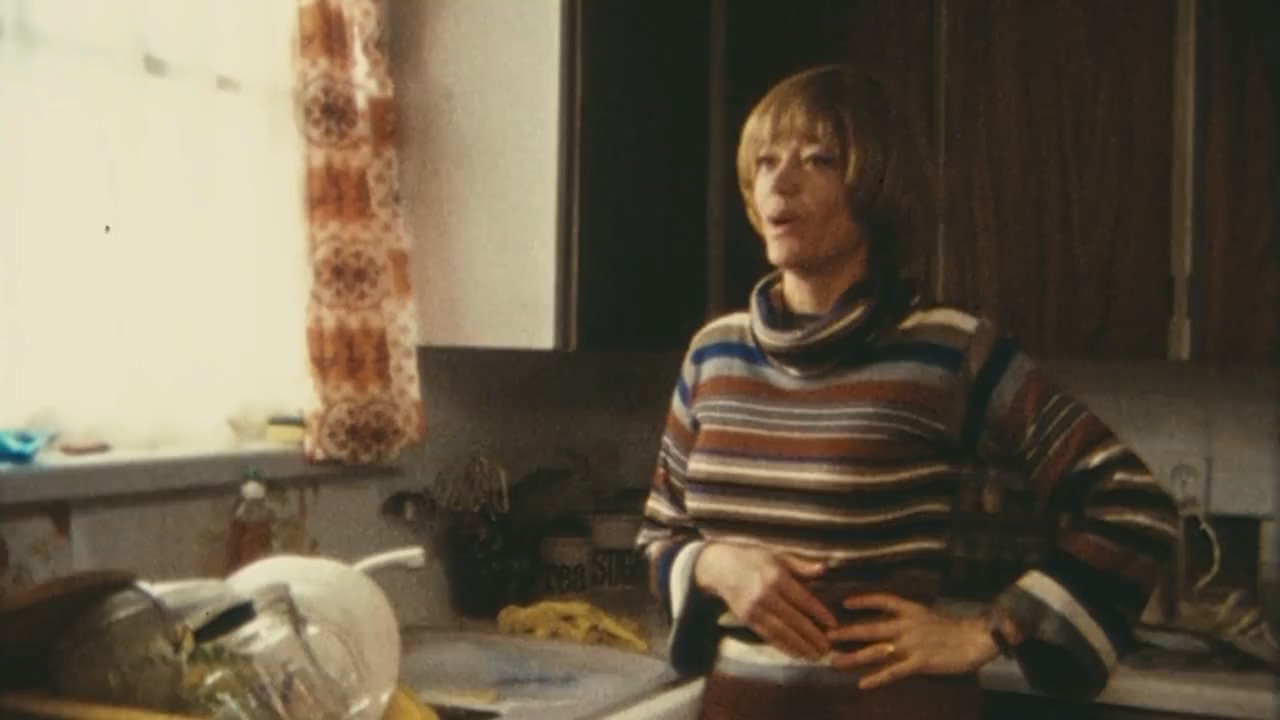
Regarding home movie footage of Diane and Michael, much of it is concentrated from their first few years together and the time immediately before and after Sarah’s birth; we also see scenes from Diane’s funeral and the years following it when young Sarah most closely bonded with Michael. They’re meant to accompany the story told by all the narrators and they often correspond neatly with what’s being said. It’s a seemingly excessive amount of footage and all reasonably convincing until, more than three-quarters of the way through, there’s some vintage footage of Diane and Michael where the camera tracks to the left to reveal a modern-day Sarah filming and directing them (as played by actors Rebecca Jenkins and Peter Evans.) At that moment, her voiceover notes, “I’m interested in the way we tell stories about our lives; the past is often ephemeral and hard to pin down.”
This late-in-the game reveal to exactly how Sarah’s been telling the story audaciously transforms the film. Suddenly, we’re encouraged to question whether any of the non-interview footage is real or a reenactment. Sarah’s initial correspondence and meetings with Harry, shot in the same fuzzy, silent, super-8 grain are surely the latter as are the Montreal rehearsal scenes of Toronto or the footage Diane’s funeral (who shoots home movies of those?), about which one sibling reminisces, “It was some kind of production; I felt like I was at a big play.” The stuff of Michael as a young child or time he spent with Sarah after Diane’s death, however, are more likely the genuine articles. Then again, we now no longer know for sure, and here’s the thing—it doesn’t entirely matter. Even beyond the “home movies”, Sarah infuses the film with deliberate artifice, whether it’s still shots and scenes of her acting (in caveperson garb!) in the film Mr. Nobody at the time of her first contact with Harry, or footage from the 1964 Sophia Loren film Marriage, Italian Style whose plot about questionable paternity provides an analogue to this film’s narrative or, most notably, all the scenes of Sarah directing her father in a studio as he records his own written narration/side of the story (multiple times we see her ask him, “Dad, could you go back over that one line?”, looking for the best “take” of his performance.) As Michael notes earlier in the film, “It’s all done with mirrors, mate,” a seemingly tossed-off comment suddenly more resonant after the reveal.
Rebecca Jenkins as “Diane” (or is it?)
Stories We Tell is the third film in this project that blurs fiction and non-fiction to a fine point. The other two, Close-Up and My Winnipeg arguably do so as narrative films exceedingly resembling documentaries to different ends: the former is a feature-length recreation of real-life events, while the latter is ostensibly a documentary suffused with fantastical elements to the point where the “My” in its title is crucial to understanding its idiosyncratic approach. Polley’s film is more explicitly a documentary in that it relays events that all purportedly happened, even if its subjects have varying accounts of such (for instance, Harry remembers attending Diane’s funeral, but Michael is nearly adamant that his wife’s lover was not there.) It’s no docu-fantasia such as My Winnipeg, but it does feature a slew of recreations that, like the events of Close-Up are presented as apparently factual (if in the end, unprovable.)
Films muddling this real/fake line fascinate me. After all, how can art connect if it doesn’t draw from some semblance of real-life experience? In my master’s thesis on Derek Jarman, I concluded that his art’s greatness depended on its inseparableness from his own life; such ambiguity has provided fodder for many films, from the deliberate, recontexualized performances in The Act of Killing and the more subtle, intentionally convincing ones of Bloody Nose, Empty Pockets to a prankster delving deep into the meta-ness of constructing what may (or may not) be one resounding prank in the guise of an entire documentary in Banksy’s Exit Through The Gift Shop. Reenactments often get a bad rap for their failure to convince or the level of artifice their mere presence suggests. Still, are they less pure than any other decisions Polley makes in telling this story? What’s left out or kept in or de-emphasized or brought to the fore can be just as calculating and indicative, documentary or not.
Midway through the film, Sarah recalls an argument with Harry where he wanted to write his own version of this story but she did not want him to publish it, hoping to give “equal weight to everyone’s version” (a lodestar for many documentarians.) Harry counters this by saying, “The crucial function of art is… to find out the truth of a situation.” Despite the facetiousness inherently unavoidable in any documentary (no matter how intentionally applied, like the “home movies”), to Sarah’s credit, Stories We Tell arrives at an unerring truth about the situation—one of its main participants, the long-deceased Diane, is unable to tell her version of this story. After Harry notes this, a montage follows of nearly all of the film’s interviewees one by one, each person silent, their faces consumed with grief, presumably thinking of Diane as a wistful, melancholic folk-pop song plays on the soundtrack. It’s deeply affecting for it reminds us not what the story is or necessarily how it was relayed, but why it was told.
Stories We Tell would end up Sarah’s last film for a decade as she struggled with a brain injury, eloquently outlined in her 2022 memoir Run Towards The Danger. She’d recuperate and make a triumphant return that year with Women Talking, an adaptation of a Miriam Toews novel that won her an Academy Award for Best Adapted Screenplay. It retains some of the thoughtfulness and innovation of her past work; hopefully, its success will enable Sarah to continuing making exactly the projects she wants to; preferably, they will look back to her third feature for a sense of inspiration and purpose.
A brand-new decade, even though many paint this as a liminal period, a bridge between 1980s flash and what we would come to know as 1990s bellwethers (grunge, alternative rock, gangsta rap, etc.) Roughly two-thirds of these songs were favorites at the time (mostly anything here that made the top 40); I became familiar with the rest over the ensuing decade, the tellingly named “Obscurity Knocks” being of the few exceptions (my husband introduced it to me not long after we first met.) You can already detect the budding Anglophile within, as more than half of these tracks are from UK-based artists; the Americans run the gamut from superstars (Madonna) to, at the time, super-obscure (Yo La Tengo long before MTV ever played ’em).
You wouldn’t expect Iggy Pop, of all people, to secure two slots on a 1990 playlist, but here he is with “Candy”, his sole top 40 hit/duet with The B-52’s Kate Pierson, and “Well Did You Evah!”, a gleefully irreverent Cole Porter cover with perfectly acidic support from Debbie Harry which appeared on the wonderful Red Hot + Blue tribute album (an early candidate for my 100 Albums list that missed the final cut). I could’ve ended and started the mix with Iggy but instead chose Deee-Lite’s immortal “Groove Is In The Heart” for an opener (it arguably sounds fresher today than anything else on this list) and The La’s deathless “There She Goes” to go out on—like Squeeze’s “Tempted” in ’81, can you believe it never made the American Top 40?
In addition to finding room for good artists who never made what I’d consider a great, timeless album (INXS, Sinead O’Connor (both of whom came close)) and quirky one-hit wonders such as Soho, who scored with a genius-dumb lament built upon a Smiths sample, this format gives me an excuse to spotlight weird one-offs that don’t fit anywhere else: Was (Not Was)’s hilariously cruel and cold character sketch (it’d be unimaginable post 9/11), Prefab Sprout’s beguiling bossa nova/samba/end-of-the-world party anthem, DNA’s infamous/genius surprise hit remix of a three-year-old a cappella Suzanne Vega album track, Urban Dance Squad’s leftfield Beck-anticipating earworm.
As with most of these mixes, I posted a putative version long ago that stopped at 25 songs; upon reappraisal, I had difficulty limiting it to 11 more. Among the most notable additions: George Michael’s career-torching but supremely catchy manifesto, Living Colour delving into Afrobeat as if making their own Graceland, Information Society’s inspired, sample-heavy nonsense, and proof that as late as 1990, Brian Eno and John Cale could join forces to produce perfect pop that should’ve topped the charts instead of all those drippy ballads that did from the likes of Michael Bolton, Taylor Dayne and Mariah Carey.
A crucial year, for it was when I began listening to American Top 40 on a weekly basis and looking for a posted copy of the Billboard Hot 100 whenever I visited Musicland or JR’s at Southridge mall—not coincidentally also where I bought my first post-“Weird Al” Yankovic albums (on cassette, naturally.) In 1989, I began thinking of pop music (and all its genre-specific iterations) as a cultural force, something to obsess over and actively engage with rather than relegate to background noise from the radio or MTV.
As with most of these mixes, I heard few of these songs in 1989 apart from the big fat hits (Madonna at her peak, Fine Young Cannibals at theirs, Donna Summer’s S/A/W-produced comeback, Elvis Costello’s fluke McCartney co-write crossover); perhaps the least likely smash of them all was Neneh Cherry’s homespun, hip-hop-adjacent “Buffalo Stance” which never fails to mentally transport me back to that summer. Other new sounds from Europe also infiltrated my consciousness: Soul II Soul’s uncommon elegance (and soon widely imitated shuffle beat), Black Box’s straight-up revivalist disco, even wacko-dance novelty “Bring Me Edelweiss”, which I became obsessed with after taping it off the radio (a wise move, since I believe I never heard it there ever again.)
Elsewhere, I’ve included obvious choices (Bob Mould going all jangle-pop, The Pixies going pop, period), a few obscure album tracks (“One Of The Millions”, possibly the best XTC song Colin Moulding ever wrote; the languorous, Sally Timms-fronted “Learning To Live On Your Own”) and a couple of mostly forgotten hits (I’d rather hear “Deadbeat Club” instead of “Love Shack” again, or listen to “Blue Spanish Sky” vs. another round of “Wicked Game”.)
As the decade drew to a close, a potential for something startlingly new was apparent, even if it ended up sounding forever of its time (Kon Kan’s cheeky Lynn Anderson extrapolation, Pet Shop Boys-produced Liza Minnelli (covering Sondheim!)) or drawing considerable influence from the past (Lisa Stansfield merging Philly Soul with Diva House, for instance.) Although “Daisy Age” rap would soon mostly give way to harder textures and crasser temperaments, De La Soul’s sole top 40 hit remains a wonder–ingenuously sampling the past until it becomes a tapestry not so much futuristic as it is timeless.
As always, these playlists are totally subjective and meant to collect my favorite songs of a single year rather than attempt a record of what 1988 was actually like for me or most listeners at the time. I heard a lot of Guns N’ Roses and Richard Marx on the radio in ’88, but they (mercifully) won’t appear here. Truth be told, this was the year I started to pay close attention to Top 40 radio (having received a dual cassette boombox for my 13th birthday) and MTV’s Top 20 Video Countdown, so I was newly aware of a world beyond “Weird Al” Yankovic and whatever my parents listened to in the car.
On that note, Top 40 doesn’t dominate as it did in previous years, though a few unlikely crossover hits do make the cut: Tracy Chapman’s unlike-anything-else-at-the-time breakthrough single, Erasure’s enduring danceable ballad, sublime one-hit-wonder When In Rome, the incomparable Information Society, also unlike anything else on the radio in 1988–I still marvel that this Latin freestyle techno-pop with sci-fi/Star Trek accents (from Minneapolis, no less!) reached number 3 on the Hot 100 that October. I wish Sade’s refreshing, proto-Trip Hop groove “Paradise” (far less overplayed than “Smooth Operator”, for sure) peaked higher than number 16 on said chart.
Still, other musical worlds existed beyond such mainstream confines: They Might Be Giants’ sui generis quirk-pop, Leonard Cohen’s ballsy reinvention as a sophisticated, smokey-voiced chanteur, Cowboy Junkies’ indie slowcore Velvets cover, Talk Talk’s own transformation from second-string new romantics into ambient-leaning experimenters. There was another world just beyond my reach–British pop fascinated in the late ’80s/early ’90s, from club songs that crossed over to the top of the UK charts (Yazz and the Plastic Population) to sparkling one-shots such as Fairground Attraction (also a UK #1) and The Primitives. The old guard continued to innovate (Siousxie and the Banshee’s craziest, fizziest hit), surprise (The Fall’s sardonic-yet-faithful Kinks cover) and expand its horizons (both newly solo Morrissey and Pet Shop Boys turning ever more orchestral.)
All this plus a guitar-pop triple-threat from Down Under (The Go-Betweens, Hunters & Collectors, Crowded House), early Sam Phillips (assisted by Van Dyke Parks’ super-lush orchestral arrangement), late ‘Til Tuesday and Icelandic weirdos The Sugarcubes, most notable for unleashing vocalist Bjork on the rest of the planet.
1988: What A Life
Information Society, “What’s on Your Mind (Pure Energy)”
Prefab Sprout, “Cars and Girls”
When In Rome, “The Promise”
The Primitives, “Crash”
The Church, “Under The Milky Way”
Sade, “Paradise”
The Go-Betweens, “Quiet Heart”
Tracy Chapman, “Fast Car”
Everything But The Girl, “These Early Days”
Hunters & Collectors, “Back On The Breadline”
Fairground Attraction, “Perfect”
Morrissey, “Everyday Is Like Sunday”
Leonard Cohen, “Everybody Knows”
Siouxsie and the Banshees, “Peek-A-Boo”
The Sugarcubes, “Motorcrash”
They Might Be Giants, “Ana Ng”
Yazz and the Plastic Population, “The Only Way Is Up”
Inner City, “Good Life”
Talking Heads, “(Nothing But) Flowers”
R.E.M., “You Are The Everything”
Cowboy Junkies, “Sweet Jane”
Talk Talk, “I Believe In You”
Sam Phillips, “What Do I Do”
Erasure, “A Little Respect”
Pet Shop Boys, “Left To My Own Devices”
Was (Not Was), “Somewhere In America There’s A Street Named After My Dad”
This year arguably epitomizes the sleek professionalism we now tend to associate with the entire decade. Everything had to sound this expensive and immaculate in order to be a hit, from songs that either topped the charts (“Heaven Is A Place On Earth”, “Father Figure”) or came very close to doing so (“What Have I Done To Deserve This”, “Little Lies”) to unlikely but thrilling Top 40 crossovers from the likes of The Cure and Midnight Oil. Even beyond that, you have The Smiths at their lushest, The Replacements at their poppiest and UK goths Sisters of Mercy getting the hell produced out of them by Jim “Total Eclipse of the Heart” Steinman.
Personally, it’s also a weird year. I was 12 and on the verge of discovering a world beyond “Weird Al” Yankovic. I remember incessant MTV airplay for one-hit wonders such as Danny Wilson (“Mary’s Prayer”, no longer on Spotify) and Breakfast Club (“Right On Track”, recently on regular rotation at my local supermarket and it still slaps) and occasional peek-through appearances like 10,000 Maniacs performing “Like The Weather” on SNL. And yet, I knew nothing of The Cure, R.E.M., Sinead O’Connor or Siouxsie and the Banshees just yet—still too young to stay up and watch 120 Minutes on Sunday nights, I guess.
Obviously, I came to know a majority of these songs after ’87, with some exceptions. George Michael was everywhere at the time and I knew the U2 hits among all the Whitney, Bon Jovi and Heart coming out the radio, which might be why I prefer an album track like the lovingly wounded “Running To Stand Still” or the no-nonsense pub rock of “Mystify” to INXS’ overplayed hits of the era. While nearly anything from Sign ‘O’ The Times would suffice below, the Sheena Easton duet is an instinctive choice (also, it doesn’t just slap, it slams.)
As for the few tracks that conceivably could’ve come from another year besides this one, we have the ever in-his-own-time Tom Waits, retro-pastiche artists The Dukes of Stratosphear (if you don’t know them, don’t look ‘em up before listening to “Vanishing Girl”), R.E.M.’s jangle-pop classicism (was happily surprised to hear them play “Welcome To The Occupation” on their Monster tour in ’95) and The Go-Betweens’ heart-on-sleeve guitar pop splendor, with a soaring chorus and an oboe (!) solo on its outro. As for New Order’s definitive, near-euphoric 1987 remix/rethink of their 1982 single “Temptation”, well, I did rate it rather highly once (and still do.)
1987: Please Don’t Let Me Hit The Ground
The Cure, “Just Like Heaven”
R.E.M., “Welcome To The Occupation”
George Michael, “Father Figure”
Midnight Oil, “Beds Are Burning”
Sinead O’Connor, “Mandinka”
The Smiths, “Stop Me If You Think You’ve Heard This One Before”
Sting, “Englishman In New York”
Eurythmics, “You Have Placed A Chill In My Heart”
10,000 Maniacs, “Like The Weather”
INXS, “Mystify”
U2, “Running To Stand Still”
The Replacements, “Can’t Hardly Wait”
Fleetwood Mac, “Little Lies”
Tom Waits, “Hang On St. Christopher”
The Go-Betweens, “Bye Bye Pride”
Alison Moyet, “Is This Love?”
Pet Shop Boys and Dusty Springfield, “What Have I Done To Deserve This?”
Belinda Carlisle, “Heaven Is A Place On Earth”
Prince, “U Got The Look”
Wendy & Lisa, “Waterfall”
The Dukes Of Stratosphear, “Vanishing Girl”
Swing Out Sister, “Breakout”
Breakfast Club, “Right On Track”
Vanessa Paradis, “Joe le Taxi”
Debbie Gibson, “Only In My Dreams”
Alexander O’Neal & Cherrelle, “Never Knew Love Like This”
Since finishing my Film Studies graduate degree, I’ve tried to keep up with current cinema, averaging about 100 brand new movies seen each year. I’ve cultivated spreadsheets of upcoming release dates, attended film festivals both local and international and in the past decade, habituated myself to what’s available for streaming on various platforms from The Criterion Channel to Kanopy. When I prepare annual lists of my favorite films of each year, I feel I’ve seen enough to do so with a particular authority and thorough knowledge (even if it’s impossible to see everything that comes out.)
Keeping current, however, does not mean I shy away from seeking out older titles I haven’t seen before. When I began studying film in my early 20s, what struck me most about the medium was that for being a relatively young one, the sheer volume of great, important movies to see was remarkably vast. Books, reviews, articles and recommendations from friends frequently revealed another title to add to my watchlist; when I discovered a new old film that I loved, I often wanted to see other work from its director or actors or even in some cases its screenwriter or cinematographer. Upon its 1996 release, Fargo made an immediate impact— over the next few years, I felt moved to consume everything else Joel and Ethan Coen made including past titles I’d missed (Blood Simple, Barton Fink) while keeping up with their subsequent work. I recall seeing the trailer for The Big Lebowski a few months ahead of that film’s release and thinking, a bit dumbfounded, “Well, it appears to be about bowling.”
Settling into a lengthy tenure working for a movie theater, I’d stay and watch the occasional repertory screening of something I hadn’t seen before. For instance, Billy Wilder’s The Apartment, the VHS of which I turned off after twenty minutes at home years earlier. Now, it either proved revelatory on a big screen, or perhaps I was just at a better age to grasp its unique blend of melodrama and dark humor. Likewise, I loved revisiting titles previously seen at home on the big screen, from A Thousand Clowns (with Click and Clack, the Car Talk guys introducing one of their favorite films in person!) to a front-row nosebleed seat to take in Persona at a much larger and more frightening scale than ever before (star Liv Ullman was present for that one, too.) With such an awesome resource (alongside a few other Boston-area cinemas with dazzling repertory offerings), I was watching less films at home (which would change radically during the pandemic, but that’s for a later entry.)
Reviewing a record of my movie viewing for 2009, my trusty spreadsheet reveals I watched 146 films that year including three titles seen twice (500 Days of Summer, Precious and Still Walking.) 84 were cinema screenings (all but seven of them brand new films); 32 of the remaining 62 watched at home were also relatively new titles (from XXY to Scott Walker: 30th Century Man) with twelve rewatches and eighteen older films seen for the first time. (Incidentally, I also saw Michael Clayton around this time but recently determined that I failed to record exactly when, so maybe these numbers aren’t entirely exact.) This list of older titles is unquestionably eclectic: Samuel Fuller’s art/exploitation hybrid White Dog; Chris Marker’s three-hour dissection of Marxism, A Grin Without a Cat; two unconventional comedies from the late 80s (Whitnail and I, Bagdad Café). There are efforts to fill in gaps by some of my favorite directors (Robert Altman’s Buffalo Bill and The Indians, Michelangelo Antonioni’s Zabriskie Point), a documentary about another beloved auteur (Waiting For Twilight: Guy Maddin), a pair of Douglas Sirk melodramas (Magnificent Obsession, Imitation of Life) and random stuff like, um, Troll 2 (more entertaining than The Room, also seen for the first time that year.)
Also on this list are another pair of films from the British team of Michael Powell and Emeric Pressburger. Powell generally directed while Pressburger mostly wrote the screenplays but they always insisted on a dual directorial credit (similar to Joel and Ethan Coen, come to think of it.) Also referred to as “The Archers” (their production company), Powell and Pressburger and their nineteen features together were generally forgotten by the public at large decades after their 1940s heyday. Not by Martin Scorsese, however, who cited them as a major influence and fervently worked to rehabilitate their reputations and restore their work once he himself became a renowned filmmaker in the 1970s. Thelma Schoonmaker, Scorsese’s longtime editor, even married Powell in 1984; they stayed together until his death in 1990 at age 84.
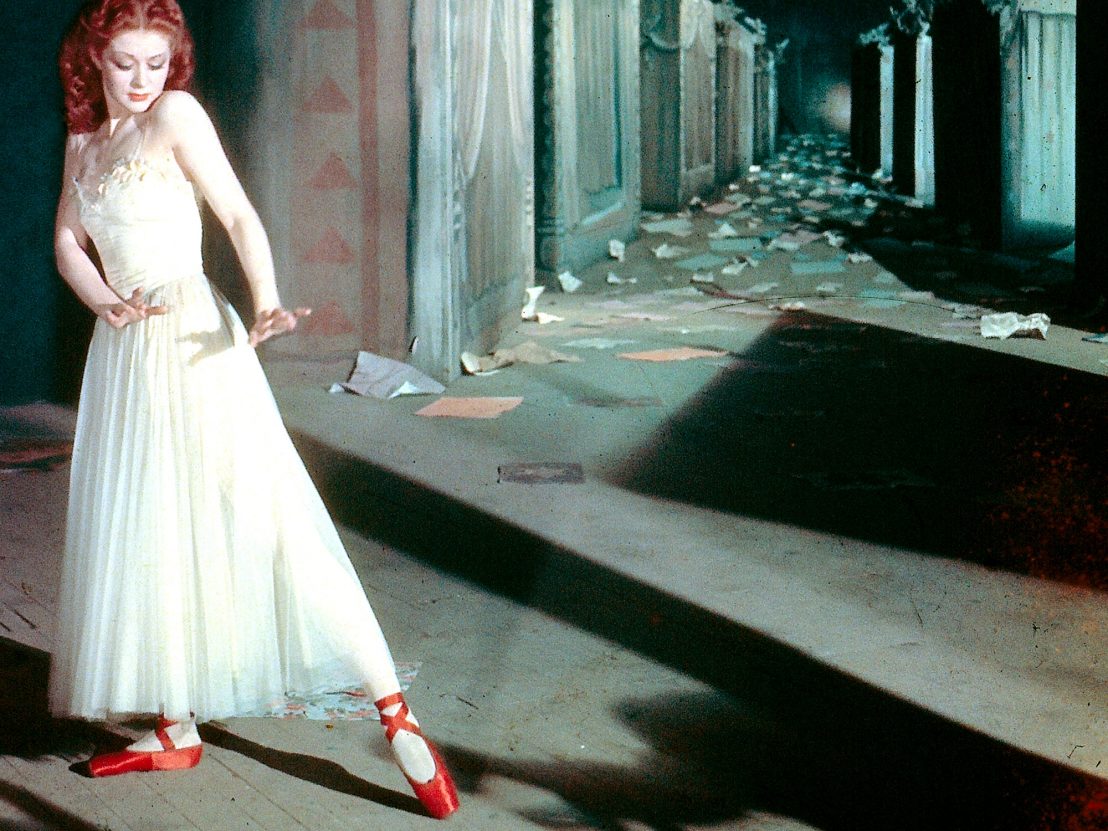
I don’t believe I saw anything by the Archers in film school; I was likely first aware of them when, gathering research for my master’s thesis on Derek Jarman, I saw that the writer Michael O’Pray cited Powell and Pressburger as primary influences on Jarman’s work (along with more obvious antecedents such as Kenneth Anger and Ken Russell.) I may have first watched The Red Shoes around this time, probably the most seen and discussed of their works among cineastes and classic film lovers. A Technicolor take on the Hans Christian Andersen fairy tale of the same name, it’s both the Archers’ biggest hit and innovative for how it incorporates a lengthy, impressionistic ballet sequence in the middle of its 134-minute running time, a clear influence on what Best Picture Academy Award Winner An American In Paris would attempt (albeit at that film’s end) three years later.
The Red Shoes
I appreciated The Red Shoes but did not rush out to consume the rest of the Archers’ oeuvre. A few years on, I caught Black Narcissus, a gloriously deranged picture about repressed nuns in the Himalayas that culminates in a shocking-for-its-era depiction of raw female desire when a troubled sister defrocks and removes her makeup. Later came I Know Where I’m Going!, set on a remote, otherworldly Scottish isle, its black-and-white cinematography and heavily-layered fog rather hallucinatory for what was essentially a screwball comedy rather than any sort of dreamlike fantasy. Thanks to Criterion Collection reissues, these films became much easier to see. In early 2009, I watched A Canterbury Tale, a work from the Archers’ peak period but also one of their odder efforts. Set in contemporary (i.e. World War II-era) Britain, it’s structured around an American soldier (played somewhat awkwardly by actual American solider, Sgt. John Sweet.) Less romantic and starker than the other Archers films I’d seen, it seemed an anomaly in their catalogue (albeit one I mean to revisit.)
Much later that same year, I saw A Matter of Life and Death. Arriving between I Know Where I’m Going! and Black Narcissus, it would initially seem to have more in common with A Canterbury Tale given its setting: on May 2, 1945, less than a week before Germany’s surrender of World War II (filming took place a mere six months later), Peter Carter (David Niven), a Royal Air Force pilot, is shot down over the English channel while on a bombing raid. He jumps from the burning aircraft, but his parachute malfunctions; he should be dead and when he wakes up near the shore, he assumes this is the afterlife. However, he is very much still alive, for Conductor 71 (Marius Goring), a guide in guise of an 18thCentury French dandy sent to escort him to what the film refers to as the “Other World”, misses him in the fog. In no time, Peter runs into June (Kim Hunter), a US Air Force radio operator whom he initially communicated with from his plane after it was hit. They immediately fall in love (this is the movies, after all), which creates a problem for Conductor 71 who is tasked to rectify his mistake and bring Peter to his rightful place for “it was his time”. Peter refuses to abide, matter-of-factly telling the guide, “I’ve fallen in love because of your mistake.”
David Niven as Peter
It’s not that simple, of course. Through the observation of June’s friend Dr. Frank Reeves (Roger Livesey, an Archers regular), we learn that Peter is likely experiencing hallucinations and that his fall may have caused some brain damage. Whenever Conductor 71 visits him, time and space seem to suddenly stop. For instance, while convalescing at Dr Reeves’ home, Peter calls out for help when this occurs, but June and Dr. Reeves, playing ping pong in an adjacent room, can’t hear him—they’re perfectly still, the ball in mid-bounce over the table between them. As the hallucinations become more frequent, is it determined only brain surgery can help Peter live fully in the Real World; for him, however, this plays out as a court trial in the Other World where he must make a sound case to a jury to go on living because he’s found true love. His defense lawyer ends up being good old Dr. Reeves, who is suddenly killed in the motorcycle accident and finds himself in the Other World (or at least Peter’s hallucination.)
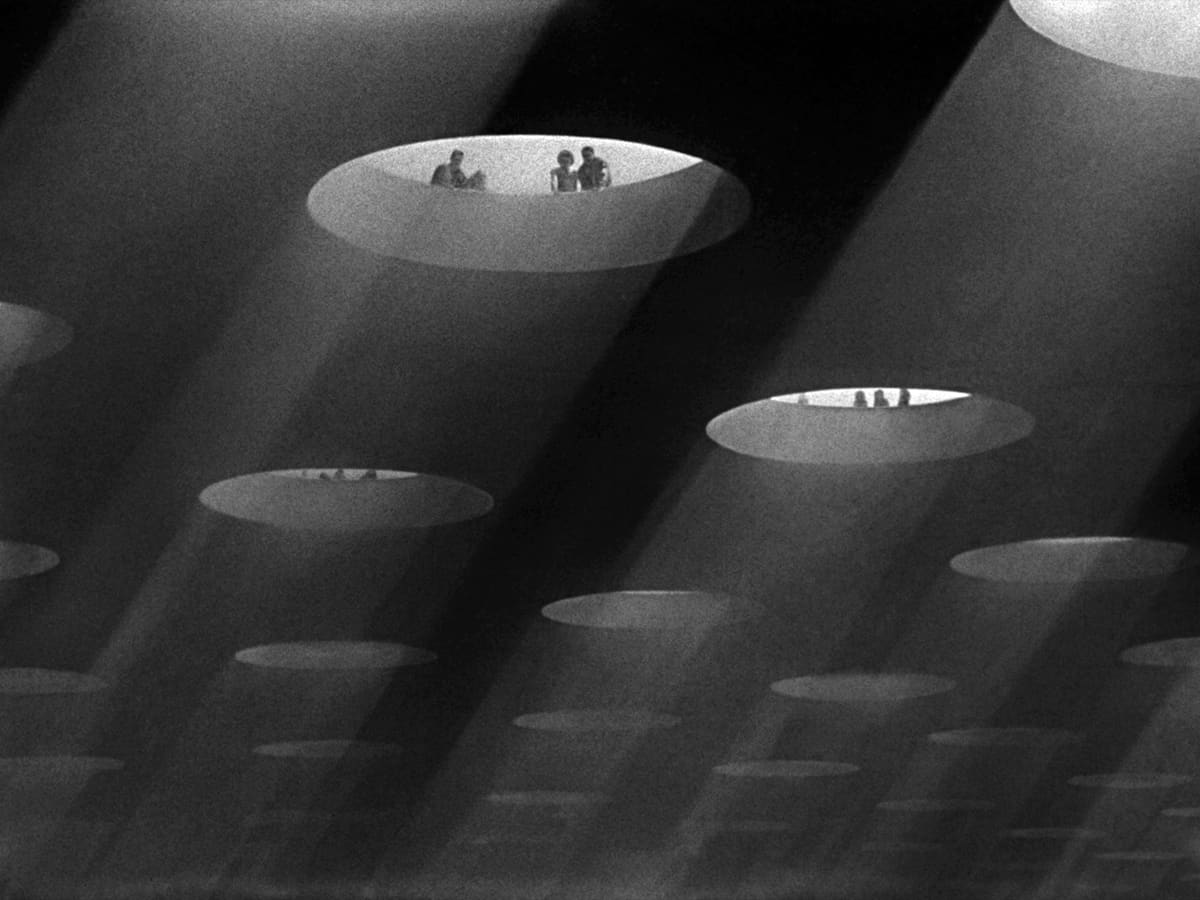
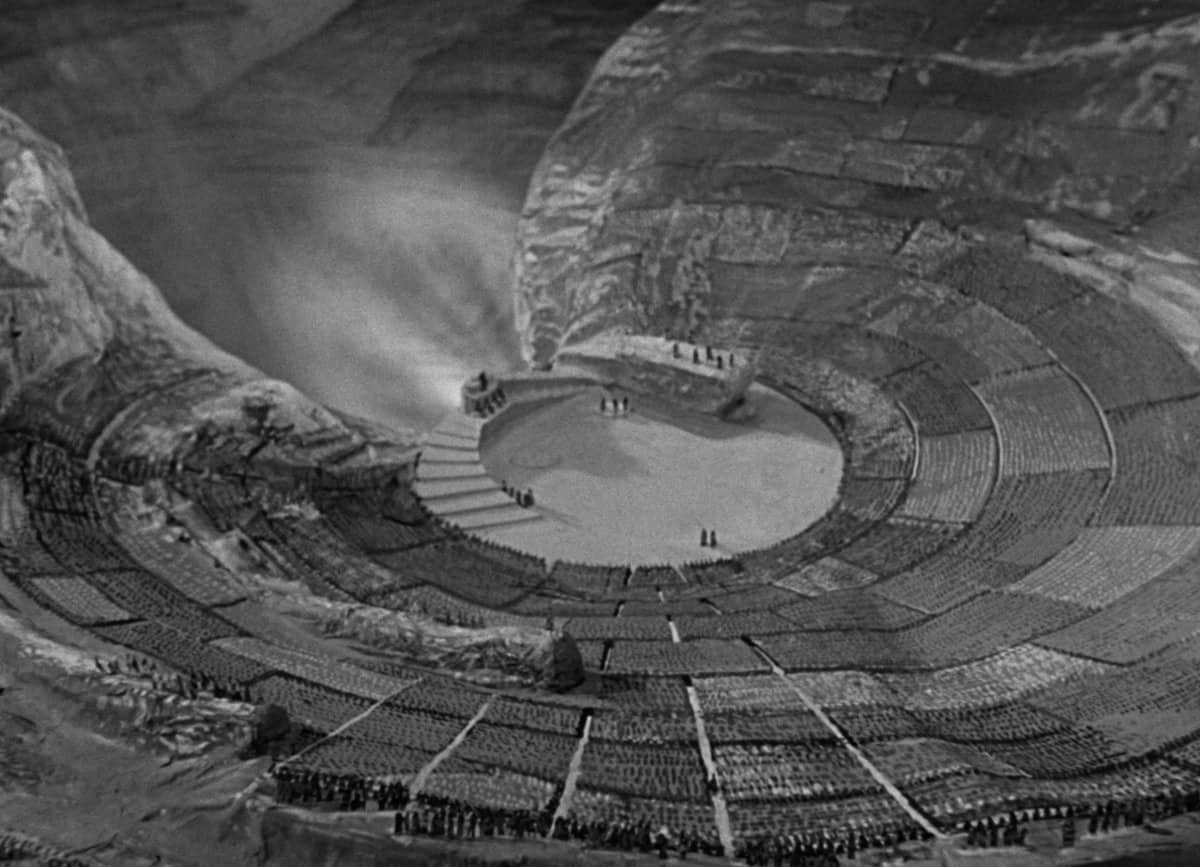
The contrast between the two worlds is the film’s most striking construct. Set up as sort of a reverse The Wizard of Oz, the Real World scenes are in eye-popping Technicolor while the Other World is shot in black-and-white. It was the first of three consecutive Archers films to be helmed by cinematographer Jack Cardiff; he’d win an Oscar for Black Narcissus the following year and go on to film The African Queen and The Barefoot Contessa, among others. The Real World is as scintillating and rich-hued as any film of the period, often highlighting fiery reds, feather-soft pinks and infinite blues along with dramatic close-up shots and ornately-detailed frames (Dr. Reeves’ home gives off a convincing illusion of an actual, lived-in space rather than a set.) The Other World draws more heavily on abstraction and German Expressionism: cathedral-sized sets (the court sort of resembles the Roman Coliseum), severely tilted angles and fantasy set pieces such as the ginormous escalator serving as a conduit between the two realms (in America, the film was originally released with the title Stairway to Heaven.) Although each world is clearly delineated from the other, they still give off the impression of existing simultaneously (hallucination or not)—one motif occurring in both realms is the appearance of oval-like shapes: giant, ceiling spheres peering into a seemingly endless Department of Records in the Other World are later recalled by Dr. Reeves’ unusual, mirrored telescope, its oval-shaped lens gifting him a view of his entire village in the Real World (along with the near-oval of the mirror above an operating table later in the film.)
The Real World
Although occasionally rendered via a simple cut, transitions between the two realms are often slow dissolves. They effectively personify the off-kilter, damaged mind state Peter experiences—at one point, while moving from the Other World back into the real one, the color literally returns to his face via a gradual dissolve. While succumbing to anesthesia for his surgery not long after, his eyes slowly close and the camera pans down (rather than up!) to the Other World. From there, the surrealness of his situation is made more explicit. During surgery, he has a literal out-of-body experience, his persona splitting in two as one version of him sits up awake in his own body, the other version of which lies still in freeze-frame courtesy of a visit from Conductor 71 and the now-deceased Dr. Reeves, rendered with a playfulness Bob Fosse would later reference inAll That Jazz.
For all of its technical spectacle and far-seeking invention, however, A Matter Of Life and Death is, like most of the Archers films, a fable full of substance and heart. As much a good old-fashioned romance as it is a fantasy, its ambitions never obscure the humanism continually evident at the picture’s core. Sure, Peter and June meet over a mayday call (one of the more dramatic of circumstances) but it still comes off as a meet-cute (“I’ll be a ghost and come and see you,” he drolly tells her amidst the flaming wreckage), further confirmed upon their unexpected, near-magical reunion on the ground. When Conductor 71 first materializes in the Real World, he notes, referring to where he has come from, “One is starved for Technicolor up there”; he also picks a pink rose which later becomes an item meant to prove Peter’s love for June (via his tears of joy for her collected on the flower) in his trial. Speaking of which, that whole sequence dominates the film’s third act. It may be a huge set piece with a cast of seemingly thousands of the deceased (from presumably every nation and culture in the Real World) and shot as if it were a heightened version of the political rally from Citizen Kane but it’s also laced with an approachable, knowing humor—when the prosecutor, Abraham Farlan (Raymond Massey), an American alive during the Revolutionary War biased against all Brits argues that his culture is more worth preserving and celebrating than Peter’s, Reeves plays a recording that approximates a then-contemporary American swing tune with mostly nonsense lyrics (to which Farlan scoffs, “I don’t understand a word!”)
The Other World – Peter’s trial
The film concludes with the two worlds finally, briefly converging (if only in Peter’s head.) Key members of the trial have literally descended into the Real World via the giant staircase, arriving at Peter on the operating table (who again wakes up as time and space stops.) The tears on the flower are not enough concrete proof for the judge and prosecution. They ask Peter if he would die for June. He says he would, though he’d rather live a life with her. They then call June to the witness stand, awakening her from a Conductor 71-assisted slumber. Dr Reeves asks June if she would take Peter’s place in the Other World to prove her love for him. She would, and as she steps onto the stairway as it begins to move away from the Real World, that clinches it—proof not only that Peter is in love but also loved in return. He’s allowed to live on in the Real World with June; the film ends with him awakening from surgery in his hospital bed to the sight of June’s smiling face. “We won,” he says; “I know, darling,” she responds. It’s a sentimental ending, for sure, but as usual for the Archers, it’s an earned one, with Peter’s words particularly affecting coming just one year after the end of a Real World War.
Although products of a time long past, the Archers’ work endures because their narratives, while often highly fantastical were always built on solid emotional foundations. Powell and Pressburger may have viewed the world a little differently than their homegrown colleagues or Hollywood counterparts, but they usually sought to say something concrete and resonant about the human condition. So much of today’s studio filmmaking values technical innovation over anything relatable from our own Real World. Whenever I watch a film for the first time, I keep in mind how it makes me feel, which can come from its cinematography, special effects, musical score, the brilliance of a performance, etc. In the best films, however, there’s also a deeper connection, one that not only changes our literal view of the world but also our perception of it. A Matter of Life and Death accomplishes this by recognizing the act of love as the driving force its title refers to; what better reason does one need to live?
When I posted my 1985 mix, I indicated the following year was more in line with what we think of as “Peak Eighties”, i.e. state-of-the-art, ultra-synthetic, BIG sounds that evoke bright neon colors, huge hair and millions spent. Roughly half the tracks below conform, often blatantly (Bananarama’s S/A/W-produced Shocking Blue cover, Siouxsie and the Banshees at last embracing the sparkly pop in their goth, Talk Talk bridging the gap between their new-pop past and near-ambient future) but occasionally accidentally as well. Given their timeless melodies, one can easily imagine what songs from The Bangles, Peter Gabriel (with crucial help from Kate Bush) and Eurythmics would’ve sounded like if recorded in another era.
Still, not everything in ’86 was spandex and synths (to quote another blog.) British-inspired jangle guitar pop was at a shimmering peak, whether crafted by Americans (The Feelies, R.E.M.), Australians (The Go-Betweens, Crowded House) or actual Brits (XTC, The Smiths, The Housemartins.) Meanwhile, ‘Til Tuesday’s “Coming Up Close”, an underrated, pastoral, anomaly-within-the-artist’s-catalog ballad not only transcends 1986, it anticipates Aimee Mann’s subsequent and unlikely (at the time) solo career.
As always, I love the year’s true oddities, from an ingeniously cheeky track off of They Might Be Giants’ debut album to the rise of innovative producers Jam/Lewis via Janet Jackson and The Human League to more sophisti-pop including The Blow Monkeys and Everything But The Girl’s brief but compelling departure into orchestrated Burt Bacharach splendor. Also, actual one hit wonders like Timbuk 3’s goofy/caustic rave-up and the immortal “I Can’t Wait” by the terribly-named Nu Shooz, which both reeks of 1986 and could’ve come out yesterday.
In addition to “Venus” and “Human”, we also had a treasure trove of all-timers topping the Billboard Hot 100. I couldn’t even make room for such undeniable bangers as Whitney Houston’s “How Will I Know”, Heart’s unexpectedly enduring “These Dreams” and Pet Shop Boys’ “West End Girls” (opting instead for their brilliant flop follow-up single.) However, I couldn’t leave off “Live To Tell” (daringly liminal and moody for the time), “Holding Back The Years” (a revelation when it appeared in the TV series Pose a few years back) and of course, “Kiss”—it took a talent as monumentally original as Prince to score a chart-topper so bizarre yet catchy, concise and deliriously out-of-time.
1986: I’m Gonna Show You What It’s All About
The Feelies, “Let’s Go”
Nu Shooz, “I Can’t Wait”
They Might Be Giants, “Number Three”
The B-52’s, “Ain’t It A Shame”
Stan Ridgway, “Drive, She Said”
The Go-Betweens, “Spring Rain”
The Housemartins, “Think For A Minute”
Erasure, “Oh L’Amour”
Bananarama, “Venus”
Pretenders, “Don’t Get Me Wrong”
R.E.M., “Fall On Me”
The Smiths, “Half A Person”
Siouxsie and the Banshees, “Cities In Dust”
The Blow Monkeys, “Digging Your Scene”
Crowded House, “Don’t Dream It’s Over”
The Human League, “Human”
Janet Jackson, “What Have You Done For Me Lately”
Husker Du, “Don’t Want To Know If You Are Lonely”
Pet Shop Boys, “Love Comes Quickly”
‘Til Tuesday, “Coming Up Close”
Talk Talk, “Life’s What You Make It”
Peter Gabriel, “Don’t Give Up”
Madonna, “Live To Tell”
Everything But The Girl, “Cross My Heart”
Simply Red, “Holding Back The Years”
New Order, “All Day Long”
Prince and the Revolution, “Kiss”
The Bangles, “Manic Monday”
Timbuk 3, “The Future’s So Bright, I Gotta Wear Shades”
Whether 1985 qualifies as Peak ‘80s is a matter of personal taste (personally, I’d lean towards ’86 or ’87), but mid-decade is by design an ideal place to assess how we think of its music as a whole. This playlist’s run from the greatest up-tempo Madonna single of her imperial phase to the least overplayed of three massive Tears For Fears hits (along with Aretha’s tailor-made driving anthem and Murray Head’s musical-project-written-by-Benny-and-Bjorn-from-Abba oddity (which I remember it sounding like nothing else on syndicated TV series Solid Gold at the time) exhibits the lofty heights mainstream radio could then ascend to.
Sade and Prince also scored pretty neat leftfield ’85 hits too as did (with considerable help from the latter) Sheila E., undoubtedly scanning as Top 40 while reinterpreting the very notion of such in ways that were beyond, say, Phil Collins, REO Speedwagon or Dire Straits. Not as much as Kate Bush, of course—her sole top 40 hit in the US still startles, not least because it doesn’t dilute one whit of her otherness. “Although built almost entirely on era-specific synthetics, it somehow sounds as out of time now as it ever did,” is something I wrote in 2021, a year before its surprise revival in Stranger Things proved me right and the song became the massive worldwide hit it was always meant to be (reaching a new peak of #3 on the Billboard Hot 100, even.)
In addition to Tears For Fears, punchy singles from New Order, Big Audio Dynamite, The Cure and OMD would suggest 1985 was the year of Brit postpunk bands making big pop moves; however, I detect a more novel trend in guise of a cool, crisp, slightly jazzy subgenre dubbed Sophisti-Pop: Sade for sure, but also Prefab Sprout, Everything But The Girl, Fine Young Cannibals (to a lesser extent) and even a few old(er) souls like Bryan Ferry and Leonard Cohen (transforming his sound from monochrome folk to Casio keyboard pastels.) I’ve also slotted in some Sci-Fi Sophisti-Pop: The Rah Band’s daffy but strange and charming “Clouds Across The Moon”, a UK top ten hit I’d never heard of until a few years ago.
If the sublime INXS album track doesn’t particularly sound like 1985 while the Oingo Boingo one couldn’t possibly come from any other time, the late, great Kirsty MacColl’s “He’s On The Beach” splits the difference—while steeped in era-specific production, its sun-kissed yet melancholic view of an ex-lover from afar is, like nearly everything else the British singer-songwriter recorded, the most perfect pop song you’ve likely never heard. It was released as a stand-alone single that year and it didn’t seem to chart anywhere; it deserves some “Running Up That Hill”-like rediscovery.
1985: So Far Out Of Reach
Prefab Sprout, “Bonny”
Sade, “The Sweetest Taboo”
Kirsty MacColl, “He’s On The Beach”
Suzanne Vega, “Marlene On The Wall”
Fine Young Cannibals, “Johnny Come Home”
Everything But The Girl, “When All’s Well”
Tom Waits, “Clap Hands”
Felt, “Primitive Painters”
Madonna, “Into The Groove”
Aretha Franklin, “Freeway of Love”
Murray Head, “One Night In Bangkok”
Tears For Fears, “Head Over Heels”
Oingo Boingo, “Dead Man’s Party”
Camper Van Beethoven, “Take The Skinheads Bowling”
Prince, “Raspberry Beret”
R.E.M., “Driver 8”
Kate Bush, “Running Up That Hill (A Deal With God)”
Big Audio Dynamite, “The Bottom Line”
Echo & The Bunnymen, “Bring On The Dancing Horses”
The Los Angeles Olympics, the Apple Mackintosh Super Bowl commercial, Reagan’s landslide reelection and Clara “Where’s The Beef?!” Peller–1984 only lived up to George Orwell’s dystopian novel of the same name depending on where one stood with such (no matter how dubious) cultural touchstones. As for the year in music, given Purple Rain, Born In The USA, Private Dancer, Make It Big, Let It Be (Replacements, not The Beatles, naturally) and This Is Spinal Tap (which I couldn’t resist including a track from here), I don’t need to further the argument for 1984 being a bit special. Even beyond those LPs, the year was flush with classic hit singles, from Chaka Khan’s transformative Prince cover to the beginning of Madonna’s world-conquering run to era-defining anthems by Thompson Twins and General Public to, well, “Weird Al” Yankovic capturing the zeitgeist with his so-obvious-it’s-almost-brilliant Michael Jackson parody.
As with any year, the stuff that missed the Billboard Top 40 but lingered on in the collective unconscious is just as noteworthy. Nine years old at the time, I didn’t even hear these selections from The Smiths, Echo & The Bunnymen, Bronski Beat, The Nails and Hoodoo Gurus until at least a decade later when I was a college student and the local Alternative Rock station aired their daily “Retro Flashback Lunch” hour dedicated to post-punk new wave gems.
However, it’s in the margins where ’84 truly fascinates. Billy Bragg’s electric but spare folk music sits next to Kirsty MacColl’s big pop cover of one of his songs. Rubber Rodeo reinterprets the Pretenders’ jumpy rock with a western twang. Cocteau Twins seem to beam out from their own planet with a sugary wall of sound and pleasantly indecipherable vocals. Everything But The Girl (and to a lesser extent, Sade) subsist on their own jazz-and-bossa-nova-suffused plane. XTC continues to craft perfect pop music while defying nearly everything about it the rest of the world describes as such.
“Sexcrime (1984)” by the Eurythmics obviously sums up the year (and when else but in ’84 would one soundtrack an adaptation of Orwell’s novel with this?); slightly less on-the-nose, however, is a sweet techno-pop movie theme (about a love triangle between a man, a woman and a computer voiced by Bud Cort from Harold and Maude!) from the lead singer of The Human League and the electronic music pioneer whom seven years before gave us Donna Summer’s “I Feel Love”.
1984: Love Never Ends
Chaka Khan, “I Feel For You”
Alison Moyet, “Love Resurrection”
Bananarama, “Robert De Niro’s Waiting”
Kirsty MacColl, “A New England”
Billy Bragg, “Between The Wars”
XTC, “Wake Up”
R.E.M., “Harborcoat”
The Go-Betweens, “Bachelor Kisses”
The Psychedelic Furs, “The Ghost In You”
The Replacements, “I Will Dare”
Bronski Beat, “Smalltown Boy”
Cocteau Twins, “Lorelei”
The Smiths, “What Difference Does It Make?”
Prince, “Take Me With U”
Spinal Tap, “Big Bottom”
Madonna, “Material Girl”
Phil Oakey and Giorgio Moroder, “Together In Electric Dreams”
Echo & The Bunnymen, “The Killing Moon”
Cristina, “Smile”
General Public, “Tenderness”
Rubber Rodeo, “Anywhere With You”
Everything But The Girl, “Fascination”
Sade, “Hang On To Your Love”
Tina Turner, “Better Be Good To Me”
INXS, “Original Sin”
Cyndi Lauper, “Time After Time”
The Nails, “88 Lines About 44 Women”
Eurythmics, “Sexcrime (Nineteen Eighty-Four)”
The Go-Go’s, “Head Over Heels”
“Weird Al” Yankovic, “Eat It”
Wham!, “Freedom”
The Style Council, “My Ever Changing Moods”
Thompson Twins, “Hold Me Now”
Hoodoo Gurus, “I Want You Back”
The Icicle Works, “Whisper to a Scream (Birds Fly)”